
Life, 1923-11-01 · page 26 of 41
Life — November 1, 1923 — page 26: what you’re looking at
What you’re looking at
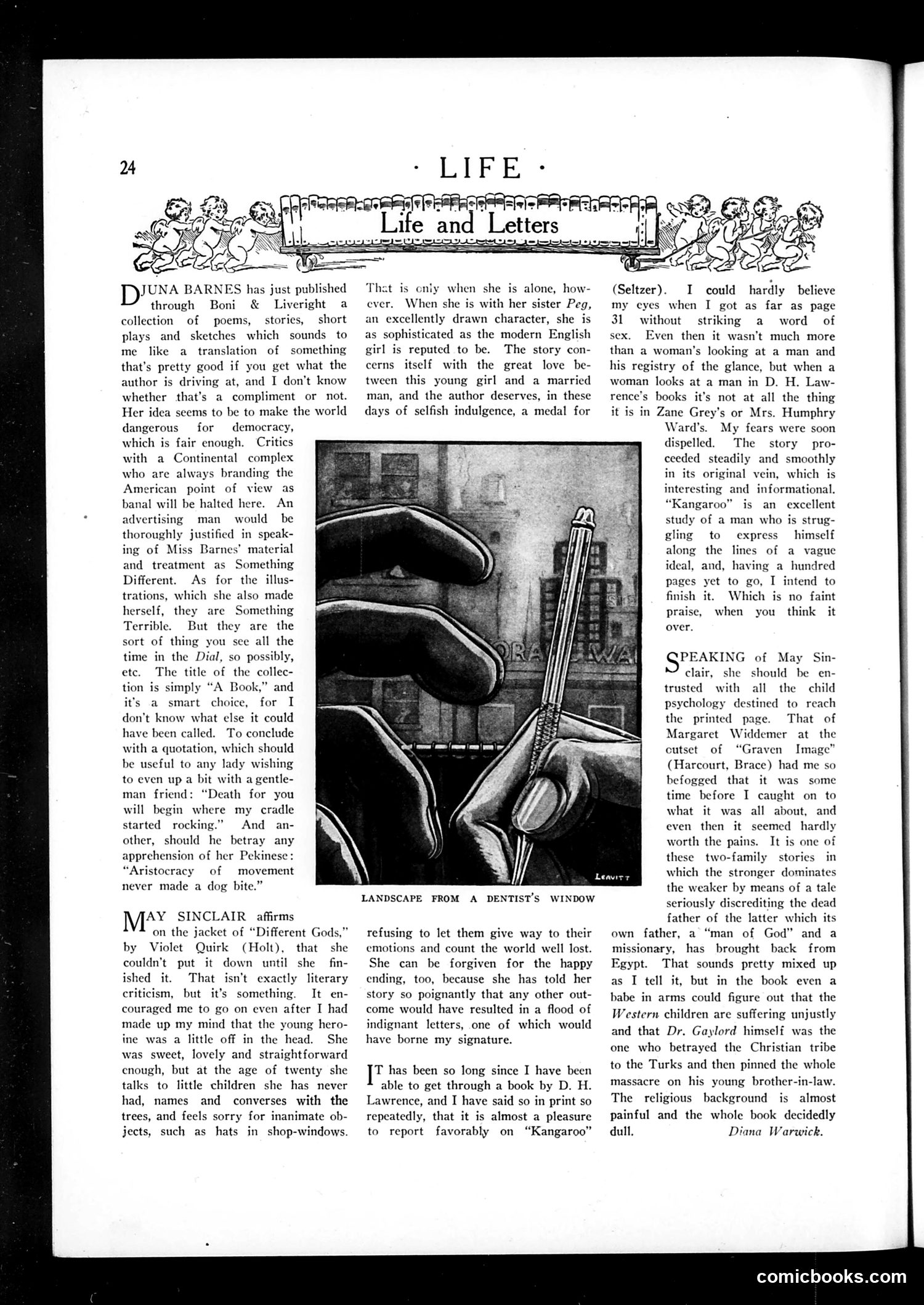
This is a literary review section titled "Life and Letters." The central image—labeled "Landscape from a Dentist's Window"—appears to be an illustration by Djuna Barnes (the author being reviewed), showing an abstract or modernist drawing of what looks like dental instruments or tools in a stylized manner. The reviews discuss several books: Barnes's own poetry/story collection "A Book," which the critic praises for being "different" and challenging American literary conventions, though the illustrations are called "Something Terrible." Other reviews cover "Different Gods" by Violet Quirk and D.H. Lawrence's "Kangaroo," which the reviewer surprisingly found readable because Lawrence restrains his typical sexual content until page 31. The tone is witty and somewhat dismissive of literary pretension while acknowledging experimental modernist work as valuable, even when difficult or unconventional.
📄 Transcribed text from this page (OCR, searchable)
Machine-transcribed from the original scan — historical spelling and the odd misread are preserved.
as just published Boni & Liveright a poems, stories, short and sketches which sounds to me like a translation of something that’s pretty good if you get what the author is driving at, and I don’t know whether that’s a compliment or not. Her idea seems to be to make the world dangerous democracy, which is fair enough. Critics with a Continental complex who are always branding the American point of view as banal will be halted here. An advertising man would be thoroughly justified in speak- ing of Miss Barnes’ material and treatment as Something Different. As for the illus- trations, which she also made herself, they are Something Terrible. But they are the sort of thing you see all the time in the Dial, so possibly, etc. The title of the collec- tion is simply “A Book,” and it's a smart for I don’t know what else it could have been called. To conclude with a quotation, which should hing to even up a bit with a gentle- man friend: “Death for you will begin where my cradle started rocking.” And other, should he betray through collection of for choice, be useful to any lady w an- any apprehension of her Pekinese: “Aristocracy of movement never made a dog bite.” AY SINCLAIR affirms on the jacket of “Different Gods,” by Violet Quirk (Holt), that she couldn't put it down until she fin- ished it. That isn't exactly literary criticism, but it’s something. It en- couraged me to go on even after I had made up my mind that the young hero- ine was a little off in the head. She was sweet, lovely and straightforward cnough, but at the age of twenty she talks to little children she has never had, names and converses with the trees, and feels sorry for inanimate ob- jects, such as hats in shop-windows. ess ‘Life and Letters That is only when she is alone, how- When she is with her sister Peg, an excellently drawn character, she is as sophisticated as the modern English girl is reputed to be. The story con- cerns itself with the great love be- tween this young girl and a married man, and the author deserves, in these days of selfish indulgence, a medal for ever. LANDSCAPE FROM A DENTIST'S WINDOW refusing to let them give way to their emotions and count the world well lost. She can be forgiven for the happy ending, too, because she has told her story so poignantly that any other out- come would have resulted in a flood of indignant letters, one of which would have borne my signature. a has been so long since I have been able to get through a book by D. H. Lawrence, and I have said so in print so repeatedly, that it is almost a pleasure to report favorably on “Kangaroo” (Seltzer). I could hardly believe my eyes when I got as far as page 31 without striking a word of sex. Even then it wasn’t much more than a woman's looking at a man and his registry of the glance, but when a woman looks at a man in D. H. Law- rence’s books it’s not at all the thing it is in Zane Grey’s or Mrs. Humphry Ward's. My fears were soon dispelled. The story pro- ceeded steadily and smoothly in its original vein, which is interesting and informational. “Kangaroo” is an excellent study of a man who is strug- gling to expre: himself along the lines of a vague ideal, and, having a hundred ages yet to go, I intend to finish it. Which is no faint praise, when you think it over. PEAKING clair, of May should be en- with all the child psychology destined to reach the printed page. That of Margaret Widdemer at the cutset of “Graven Image” (Harcourt, Brace) had me so befogged that it was time before I caught what it was all about, even then it seemed hardly worth the pains. It is one of these two-family stories in which the stronger dominates the weaker by means of a tale seriously discrediting the dead father of the latter which its father, a “man of God" and a missionary, has brought back from Egypt. That sounds pretty mixed up as I tell it, but in the book even a babe in arms could figure out that the Western children are suffering unjustly and that Dr. Gaylord himself was the one who betrayed the Christian tribe to the Turks and then pinned the whole massacre on his young brother-in-law. The religious background is almost painful and the whole book decidedly dull, Diana Warwick. Sin- she trusted some on to and own comicbooks.com