
Life, 1923-11-01 · page 18 of 41
Life — November 1, 1923 — page 18: what you’re looking at
What you’re looking at
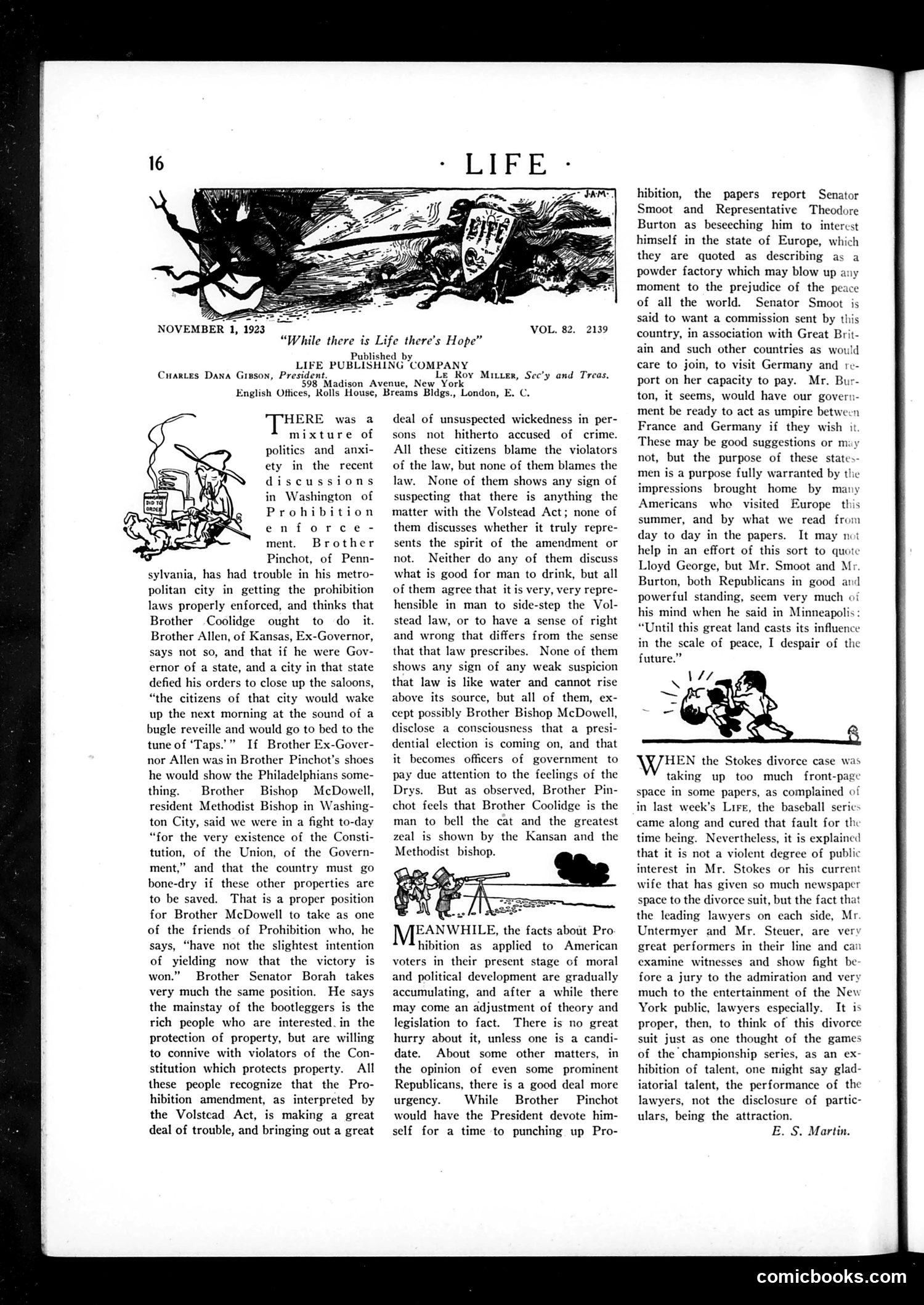
This page critiques Prohibition enforcement debates among prominent Republicans and religious figures. The article satirizes "Brother Pinchot" (Pennsylvania's Gifford Pinchot), "Brother Coolidge" (President Calvin Coolidge), "Brother Allen" (Kansas ex-governor), and Methodist Bishop McDowell for their competing positions on enforcing the Volstead Act. The author mocks their selective moral outrage: these leaders blame *violators* of Prohibition rather than questioning the law itself, while conveniently ignoring that "the mainstay of bootleggers is the rich people" seeking to protect property. The piece suggests their fervent Prohibition enforcement rhetoric masks opportunism—they're performing for voters ahead of the coming presidential election rather than genuinely addressing the "unsuspected wickedness" Prohibition has revealed. The satire implies these politicians lack intellectual honesty about Prohibition's actual failures and consequences.
📄 Transcribed text from this page (OCR, searchable)
Machine-transcribed from the original scan — historical spelling and the odd misread are preserved.
“While there is Life there's Hope” ublished b: LIF: Cuarces Dana Gipson, President. Pi d by PUBLISHING COMPANY Le Roy Miter, Sec’y and 998 Madison Avenue, New York English Offices, Rolls House, Breas Bldgs., London, E. C. HERE was a mixture of politics and anxi- ety in the recent discussions in Washington of Prohibition enforce- ment. Brother Pinchot, of Penn- sylvania, has had trouble in his metro- politan city in getting the prohibition laws properly enforced, and thinks that Brother Coolidge ought to do_ it. Brother Allen, of Kansas, Ex-Governor, says not so, and that if he were Gov- ernor of a state, and a city in that state defied his orders to close up the saloons, “the citizens of that city would wake up the next morning at the sound of a bugle reveille and would go to bed to the tune of ‘Taps.’” If Brother Ex-Gover- nor Allen was in Brother Pinchot’s shoes he would show the Philadelphians some- thing. Brother Bishop McDowell, resident Methodist Bishop in Washing- ton City, said we were in a fight to-day “for the very existence of the Consti- tution, of the Union, of the Govern- ment,” and that the country must go bone-dry if these other properties are to be saved. That is a proper position for Brother McDowell to take as one of the friends of Prohibition who, he says, “have not the slightest intention of yielding now that the victory is won.” Brother Senator Borah takes very much the same position. He says the mainstay of the bootleggers is the rich people who are interested. in the protection of property, but are willing to connive with violators of the Con- stitution which protects property. All these people recognize that the Pro- hibition amendment, as interpreted by the Volstead Act, is making a great deal of trouble, and bringing out a great deal of unsuspected wickedness in per- sons not hitherto accused of crime. All these citizens blame the violators of the law, but none of them blames the law. None of them shows any sign of suspecting that there is anything the matter with the Volstead Act; none of them discusses whether it truly repre- sents the spirit of the amendment or not. Neither do any of them discuss what is good for man to drink, but all of them agree that it is very, very repre- hensible in man to side-step the Vol- stead law, or to have a sense of right and wrong that differs from the sense that that law prescribes. None of them shows any sign of any weak suspicion that law is like water and cannot rise above its source, but all of them, ex- cept possibly Brother Bishop McDowell, disclose a consciousness that a presi- dential election is coming on, and that it becomes officers of government to pay due attention to the feelings of the Drys. But as observed, Brother Pin- chot feels that Brother Coolidge is the man to bell the cat and the greatest zeal is shown by the Kansan and the Methodist bishop. EANWHILE, the facts about Pro hibition as applied to American voters in their present stage of moral and political development are gradually accumulating, and after a while there may come an adjustment of theory and legislation to fact. There is no great hurry about it, unless one is a candi- date. About some other matters, in the opinion of even some prominent Republicans, there is a good deal more urgency. While Brother Pinchot would have the President devote him- self for a time to punching up Pro- hibition, the papers report Senator Smoot and Representative Theodore Burton as beseeching him to interest himself in the state of Europe, which they are quoted as describing as a powder factory which may blow up any moment to the prejudice of the peace of all the world. Senator Smoot is said to want a commission sent by this country, in association with Great Brit- ain and such other countries as would care to join, to visit Germany and re- port on her capacity to pay. Mr. Bur- ton, it seems, would have our govern. ment be ready to act as umpire between France and Germany if they wish it These may be good suggestions or muy not, but the purpose of these state men is a purpose fully warranted by t impressions brought home by many Americans whe visited Europe this summer, and by what we read fro day to day in the papers. It may not help in an effort of this sort to quot Lloyd George, but Mr. Smoot and M Burton, both Republicans in good powerful standing, seem very much of his mind when he said in Minneapolis: “Until this great land casts its influence in the scale of peace, I despair of the future.” \/7 \ ~ HEN the Stokes divorce case was taking up too much front-pag space in some papers, as complained « in last week's Lire, the baseball series came along and cured that fault for the time being. Nevertheless, it is explained that it is not a violent degree of public interest in Mr. Stokes or his current wife that has given so much newspaper space to the divorce suit, but the fact that the leading lawyers on each side, Mr Untermyer and Mr. Steuer, are very great performers in their line and cai examine witnesses and show fight be fore a jury to the admiration and very much to the entertainment of the New York public, lawyers especially. It is proper, then, to think of this divorce suit just as one thought of the games of the championship series, as an ex- hibition of talent, one might say glad- iatorial talent, the performance of the lawyers, not the disclosure of partic- ulars, being the attraction. E. S. Martin. comicbooks.com