
Life, 1923-11-01 · page 22 of 41
Life — November 1, 1923 — page 22: what you’re looking at
What you’re looking at
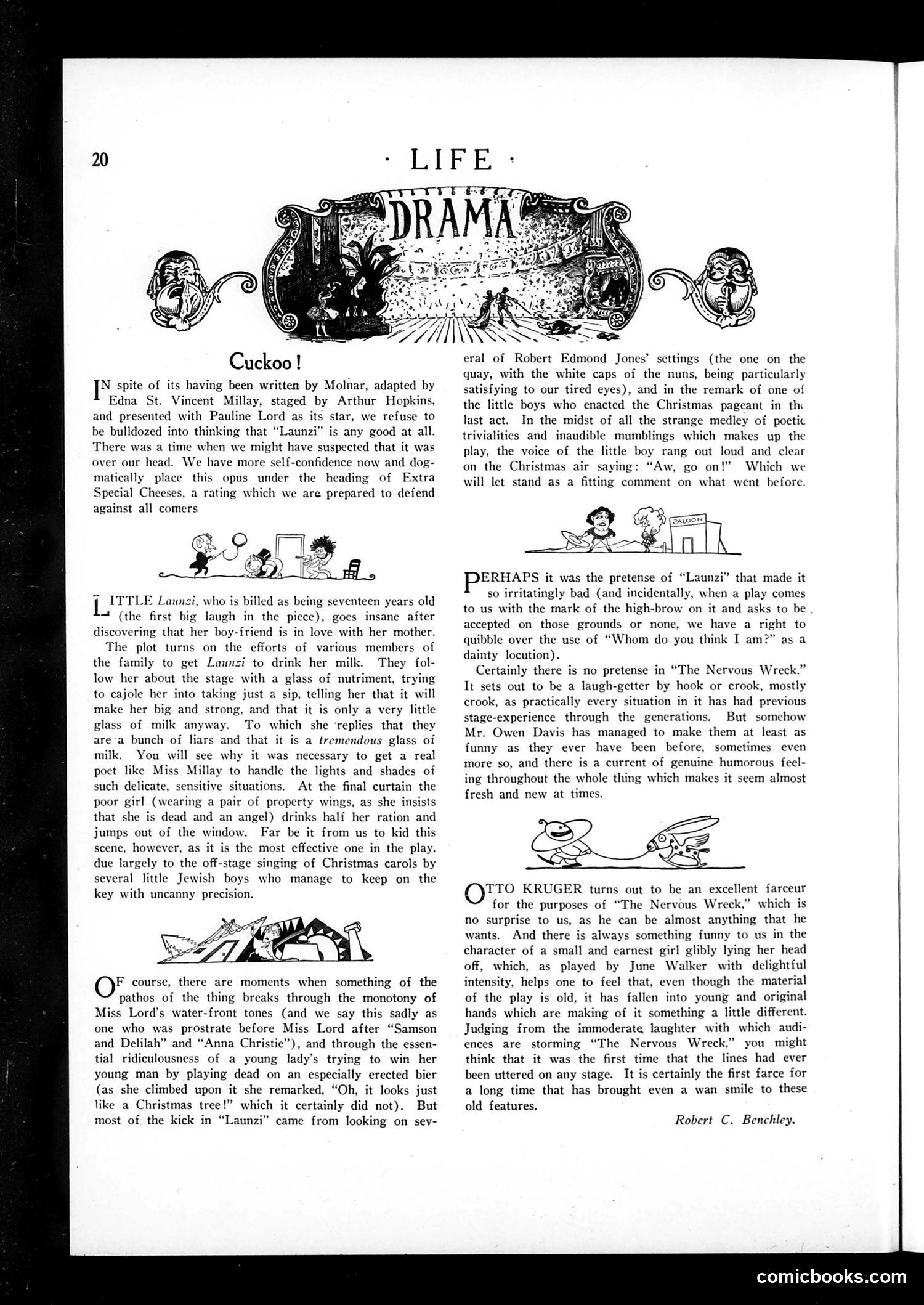
This is a theater review section mocking the play "Launzi"—a pretentious literary adaptation featuring acclaimed talent (playwright Molnar, poet Edna St. Vincent Millay, director Arthur Hopkins, and star Pauline Lord). The critic savagely dismisses it as overwrought nonsense despite its pedigree. The plot involves a seventeen-year-old girl who goes mad and ultimately commits suicide by jumping from a window—all supposedly centered around refusing to drink milk. Life's reviewer ridicules this as absurdly trivial, sarcastically praising Millay's adaption of such "delicate, sensitive situations." The only genuine laugh comes from an offhand remark by a child actor and Christmas caroling by Jewish boys. The review then pivots to favorably comparing "The Nervous Wreck" (a conventional farce with Otto Kruger), which succeeds through honest entertainment rather than pretentious artistry. The satire targets high-brow theater's self-importance and the gap between critical prestige and actual quality.
📄 Transcribed text from this page (OCR, searchable)
Machine-transcribed from the original scan — historical spelling and the odd misread are preserved.
N spite of its having been written by Molnar, adapted by Edna St. Vincent Millay, staged by Arthur Hopkins, and presented with Pauline Lord as its star, we refuse to be bulldozed into thinking that “Launzi” is any good at all. There was a time when we might have suspected that it was over our head. We have more self-confidence now and dog- matically place this opus under the heading of Extra Special Cheeses, a rating which we are prepared to defend against all comers i ITTLE Launzi, who is billed as being seventeen years old (the first big laugh in the piece), goes insane after discovering that her boy-friend is in love with her mother. The plot turns on the efforts of various members of the family to get Launzi to drink her milk. They fol- low her about the stage with a glass of nutriment, trying to cajole her into taking just a sip, telling her that it will make her big and strong, and that it is only a very little glass of milk anyway. To which she ‘replies that they are’a bunch of liars and that it is a tremendous glass of milk. You will see why it was necessary to get a real poet like Miss Millay to handle the lights and shades of such delicate, sensitive situations. At the final curtain the poor girl (wearing a pair of property wings, as she insists that she is dead and an angel) drinks half her ration and jumps out of the window. Far be it from us to kid this scene, however, as it is the most effective one in the play. due largely to the off-stage singing of Christmas carols by several little Jewish boys who manage to keep on the key with uncanny precision. F course, there are moments when something of the pathos of the thing breaks through the monotony of Miss Lord’s water-front tones (and we say this sadly as one who was prostrate before Miss Lord after “Samson and Delilah” and “Anna Chri. ”), and through the essen- tial ridiculousness of a young lady’s trying to win her young man by playing dead on an especially erected bier (as she climbed upon it she remarked, “Oh, it looks just like a Christmas tree!” which it certainly did not). But most of the kick in “Launzi” came from looking on sev- eral of Robert Edmond Jones’ settings (the one on the quay, with the white caps of the nuns, being particularly satisfying to our tired eyes), and in the remark of one of the little boys who enacted the Christmas pageant in th: last act. In the midst of all the strange medley of poetic trivialities and inaudible mumblings which makes up the play, the voice of the little boy rang out loud and clear on the Christmas air saying: “Aw, go on!” Which we will let stand as a fitting comment on what went before. ERHAPS it was the pretense of “Launzi” that made it so irritatingly bad (and incidentally, when a play comes to us with the mark of the high-brow on it and asks to be accepted on those grounds or none, we have a right to quibble over the use of “Whom do you think I am?” as a dainty locution). Certainly there is no pretense in “The Nervous Wreck.” It sets out to be a laugh-getter by hook or crook, mostly crook, as practically every situation in it has had previous stage-experience through the generations. But somehow Mr. Owen Davis has managed to make them at least as funny as they ever have been before, sometimes even more so, and there is a current of genuine humorous feel- ing throughout the whole thing which makes it seem almost fresh and new at times. TTO KRUGER turns out to be an excellent farceur for the purposes of “The Nervous Wreck,” which is no surprise to us, as he can be almost anything that he wants. And there is always something funny to us in the character of a small and earnest girl glibly lying her head off, which, as played by June Walker with delightful intensity, helps one to feel that, even though the material of the play is old, it has fallen into young and original hands which are making of it something a little different. Judging from the immoderate laughter with which audi- ences are storming “The Nervous Wreck,” you might think that it was the first time that the lines had ever been uttered on any stage. It is certainly the first farce for a long time that has brought even a wan smile to these old features. Robert C. Benchley. comicbooks.com