
Life, 1923-11-01 · page 16 of 41
Life — November 1, 1923 — page 16: what you’re looking at
What you’re looking at
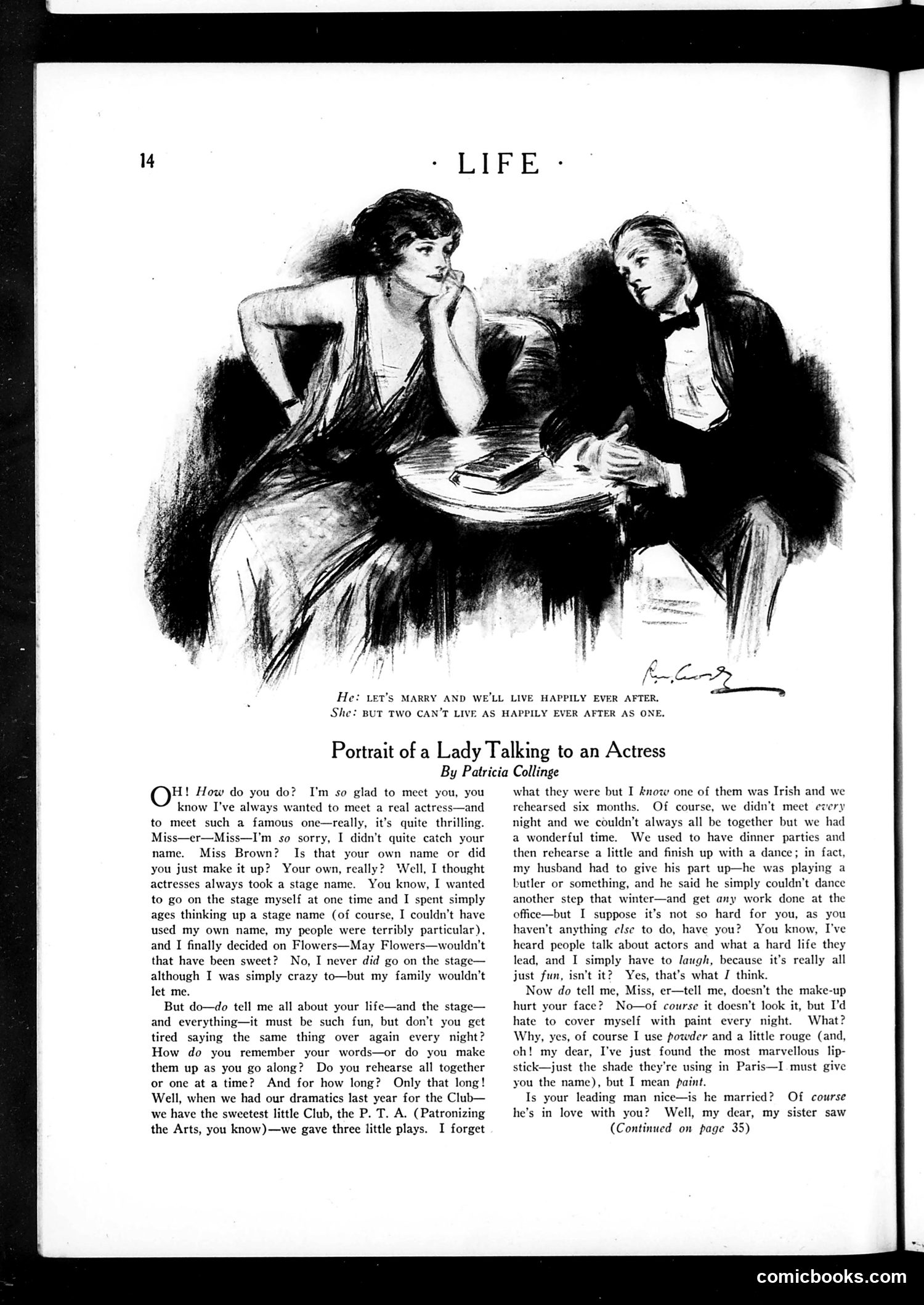
This illustration by Patricia Collinge depicts a social encounter between two women—apparently a society lady and a theatrical actress—seated at a small table. The accompanying dialogue presents their conversation with gentle satire about theatrical life and social pretension. The humor centers on contrasting perspectives: the society woman expresses fascination with stage life, asking about the actress's experiences, makeup, and romantic involvements. The actress responds with somewhat weary practicality, suggesting the glamorous theatrical world the society woman imagines differs from its reality—long rehearsals, modest pay, and exhausting work. The satire gently mocks both figures: the society woman's romanticized view of theater versus the actress's matter-of-fact professionalism. This reflects early 20th-century American attitudes toward theater as simultaneously glamorous and socially suspect.
📄 Transcribed text from this page (OCR, searchable)
Machine-transcribed from the original scan — historical spelling and the odd misread are preserved.
MARRY AND WE'LL LIVE HAPPILY EVER AFTER, She: BUT TWO CAN’T LIVE AS HAPPILY EVER AFTER AS ONE. Portrait of a Lady Talking to an Actress By Patricia Collinge I'm so glad to meet you, you know I’ve always wanted to meet a real actress—and to meet such a famous one—really, it’s quite thrilling. Miss—er—Miss—I'm so sorry, I didn’t quite catch your HH! How do you do? name. Miss Brown? Is that your own name or did you just make it up? Your own, really? Well, I thought actresses always took a stage name. You know, I wanted to go on the stage myself at one time and I spent simply ages thinking up a stage name (of course, I couldn't have used my own name, my people were terribly particular), and I finally decided on Flowers—May Flowers—wouldn't that have been sweet? No, I never did go on the stage— although I was simply crazy to—but my family wouldn't let me. But do—do tell me all about your life—and the stage— and everything—it must be such fun, but don’t you get tired saying the same thing over again every night? How do you remember your words—or do you make them up as you go along? Do you rehearse all together or one at a time? And for how long? Only that long! Well, when we had our dramatics last year for the Club— we have the sweetest little Club, the P. T. A. (Patronizing the Arts, you know)—we gave three little plays. I forget what they were but I know one of them was Irish and we rehearsed six months. Of course, we didn’t meet every night and we couldn’t always all be together but we had a wonderful time. We used to have dinner parties and then rehearse a little and finish up with a dance; in fact, my husband had to give his part up—he was playing a butler or something, and he said he simply couldn't dance another step that winter—and get any work done at the office—but I suppose it’s not so hard for you, as you haven't anything else to do, have you? You know, I've heard people talk about actors and what a hard life they lead, and I simply have to laugh, because it's really all just fun, isn’t it? Yes, that’s what J think. Now do tell me, Miss, er—tell me, doesn’t the make-up hurt your face? No—of course it doesn't look it, but I'd hate to cover myself with paint every night. What? Why, yes, of course I use powder and a little rouge (and, oh! my dear, I’ve just found the most marvellous lip- stick—just the shade they're using in Paris—I must give you the name), but I mean paint. Is your leading man nice—is he married? Of course he’s in love with you? Well, my dear, my sister saw (Continued on page 35) comicbooks.com