
Life, 1923-11-01 · page 28 of 41
Life — November 1, 1923 — page 28: what you’re looking at
What you’re looking at
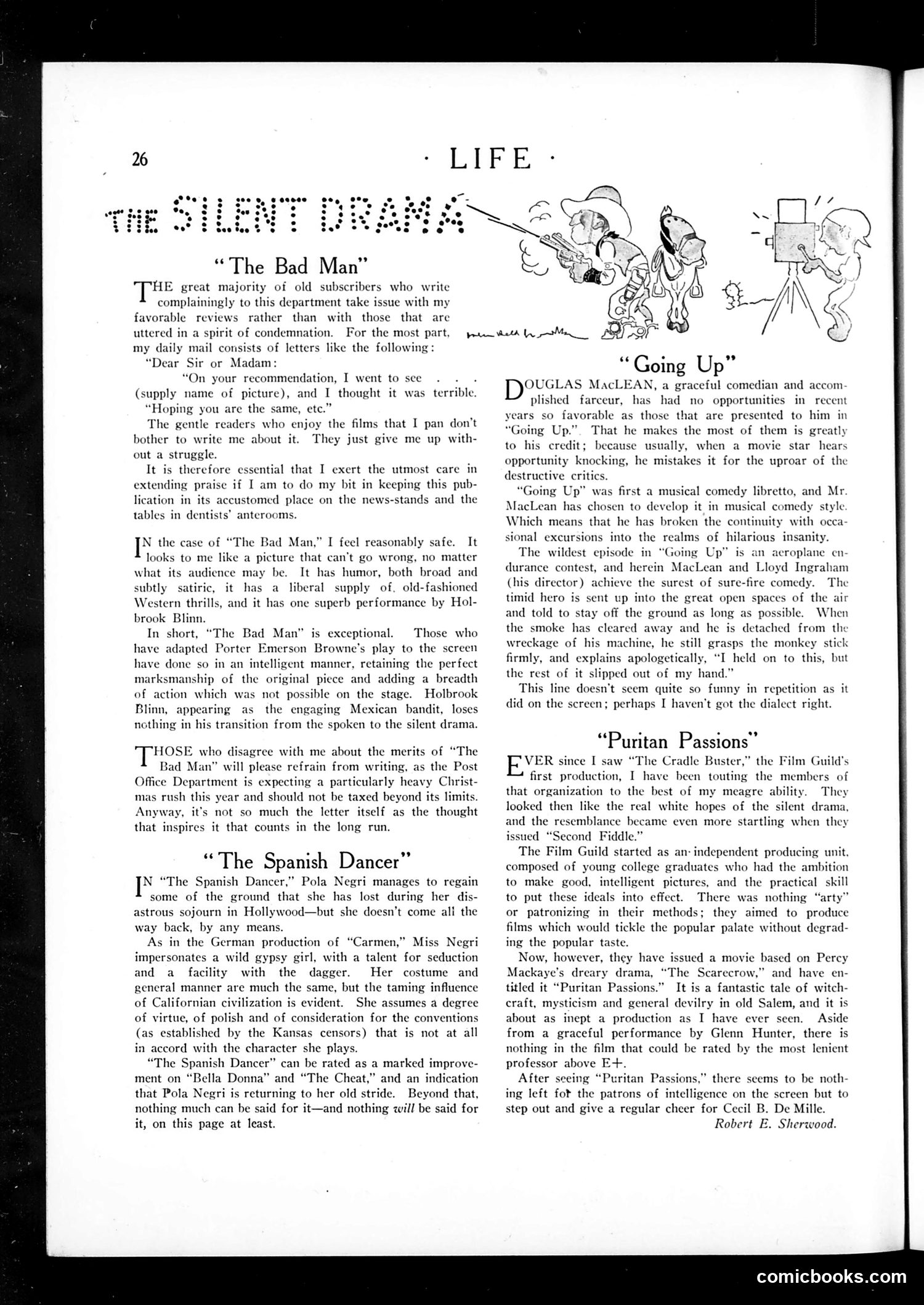
This page contains three separate film reviews from Life's drama criticism section, written in a humorous, caustic style typical of the magazine's satirical approach. **"The Bad Man"** reviews a Western adaptation of a Porter Emerson Browne play, praising actor Holbrook Blinn's performance and the film's humor. The critic humorously requests that readers who disagree *not* write complaints, claiming the Post Office is already overwhelmed during Christmas season—a joking reference to mail volume. **"The Spanish Dancer"** reviews Pola Negri's performance, noting she's recovering from previous Hollywood failures but remains somewhat tamed by "Californian civilization" and censorship ("Kansas censors") compared to her earlier roles. **"Going Up"** discusses Douglas MacLean in a musical-comedy adaptation, praising his comedic talents, particularly in an airplane-stunt sequence. The cartoon illustrations above depict typical silent-film action and slapstick scenarios. The reviews reflect 1920s cinema and industry attitudes toward European actresses and Hollywood censorship constraints.
📄 Transcribed text from this page (OCR, searchable)
Machine-transcribed from the original scan — historical spelling and the odd misread are preserved.
“The Bad Man” HE great majority of old subscribers who write complainingly to this department take issue with my favorable reviews rather than with those that are uttered in a spirit of condemnation. For the most part, my daily mail consists of letters like the following: “Dear Sir or Madam: “On your recommendation, I went to see. . (supply name of picture), and I thought it was terrible. “Hoping you are the same, etc.” The gentle readers who enjoy the films that I pan don't bother to write me about it. They just give me up with- out a struggle. It is therefore essential that I exert the utmost care in extending praise if I am to do my bit in keeping this pub- lication in its accustomed place on the news-stands and the tables in dentists’ anterooms. I J the case of “The Bad Man,” I feel reasonably safe. It looks to me like a picture that can’t go wrong, no matter what its audience may be. It has humor, both broad and subtly satiric, it has a liberal supply of. old-fashioned Western thrills, and it has one superb performance by Hol- brook Blinn. In short, “The Bad Man” is exceptional. Those who have adapted Porter Emerson Browne's play to the screen have done so in an intelligent manner, retaining the perfect marksmanship of the original piece and adding a breadth of action which was not possible on the stage. Holbrook Blinn, appearing as the engaging Mexican bandit, loses nothing in his transition from the spoken to the silent drama. HOSE who disagree with me about the merits of “The Bad Man” will please refrain from writing, as the Post Office Department is expecting a particularly heavy Chri: mas rush this year and should not be taxed beyond its limits. Anyw it's not so much the letter itself as the thought that inspires it that counts in the long run. “The Spanish Dancer” IS “The Spanish Dancer,” Pola Negri manages to regain some of the ground that she has lost during her dis- astrous sojourn in Hollywood—but she doesn’t come ali the way back, by any means. As in the German production of “Carmen, Miss Negri impersonates a wild gy; girl, with a talent for seduction and a facility with the dagger. Her costume and general manner are much the same, but the taming influence of Californian civilization is evident. She assumes a degree of virtue, of polish and of consideration for the conventions (as established by the Kansas censors) that is not at all i cord with the character she plays. “The Spanish Dancer” can be rated as a marked improve- ment on “Bella Donna” and “The Cheat,” and an indication that Pola Negri is returning to her old stride. Beyond that, nothing much can be said for it—and nothing will be said for it, on this page at least. . ” “Going Up OUGLAS MacLEAN, a graceful comedian and accom plished farceur, has had no opportunities in recent years so favorable as those that are presented to him in “Going Up.” That he makes the most of them is greatly to his credit; because usually, when a movie star hears opportunity knocking, he mistakes it for the uproar of the destructive critic “Going Up” was first a musical comedy libretto, and Mr MacLean has chosen to develop it in musical comedy style Which means that he has broken the continuity with occa- sional excursions into the realms of hilarious insanity. he wildest episode in “Going Up durance contest, and herein M is an aeroplane en- an and Lloyd Ingraham (his director) achieve the surest of sure-fire comedy. The timid hero is sent up into the great open spaces of the air and told to stay off the ground as long as possible. When the smoke has cleared away and he is detached from the wreckage of his machine, he still grasps the monkey stick firmly, and explains apologetically, “I held on to this, but the rest of it slipped out of my hand.” This line doesn’t seem quite so funny in repetition as it did on the screen; perhaps I haven't got the dialect right. “Puritan Passions” VER since I saw “The Cradle Buster,” the Film Guild's first production, I have been touting the members of that organization to the best of my meagre ability. They looked then like the real white hopes of the silent drama, and the resemblance became even more issued “Second Fiddle.” The Film Guild started as an- independent producing unit. composed of young college graduates who had the ambition to make good, intelligent pictures, and the practical skill to put these ideals into effect. There was nothing “arty” in their methods; they aimed to produce films which would tickle the popular palate without degrad- ing the popular taste. startling when they Now, however, they have issued a movie based on Percy Mackaye’s dreary drama, “The Scarecrow,” and have en- titled it “Puritan Passions.” It is a fantastic tale of witch- craft, mysticism and general devilry in old Salem, and it is about as inept a production as I have ever seen. Aside from a graceful performance by Glenn Hunter, there is nothing in the film that could be rated by the most lenient professor above E+. After seeing “Puritan Passions,” there seems to be noth- ing left fot the patrons of intelligence on the screen but to step out and give a regular cheer for Cecil B. De Mille. Robert E. Sherwood. comicbooks.com