
A complete issue · 40 pages · 1923
Life — August 2, 1923
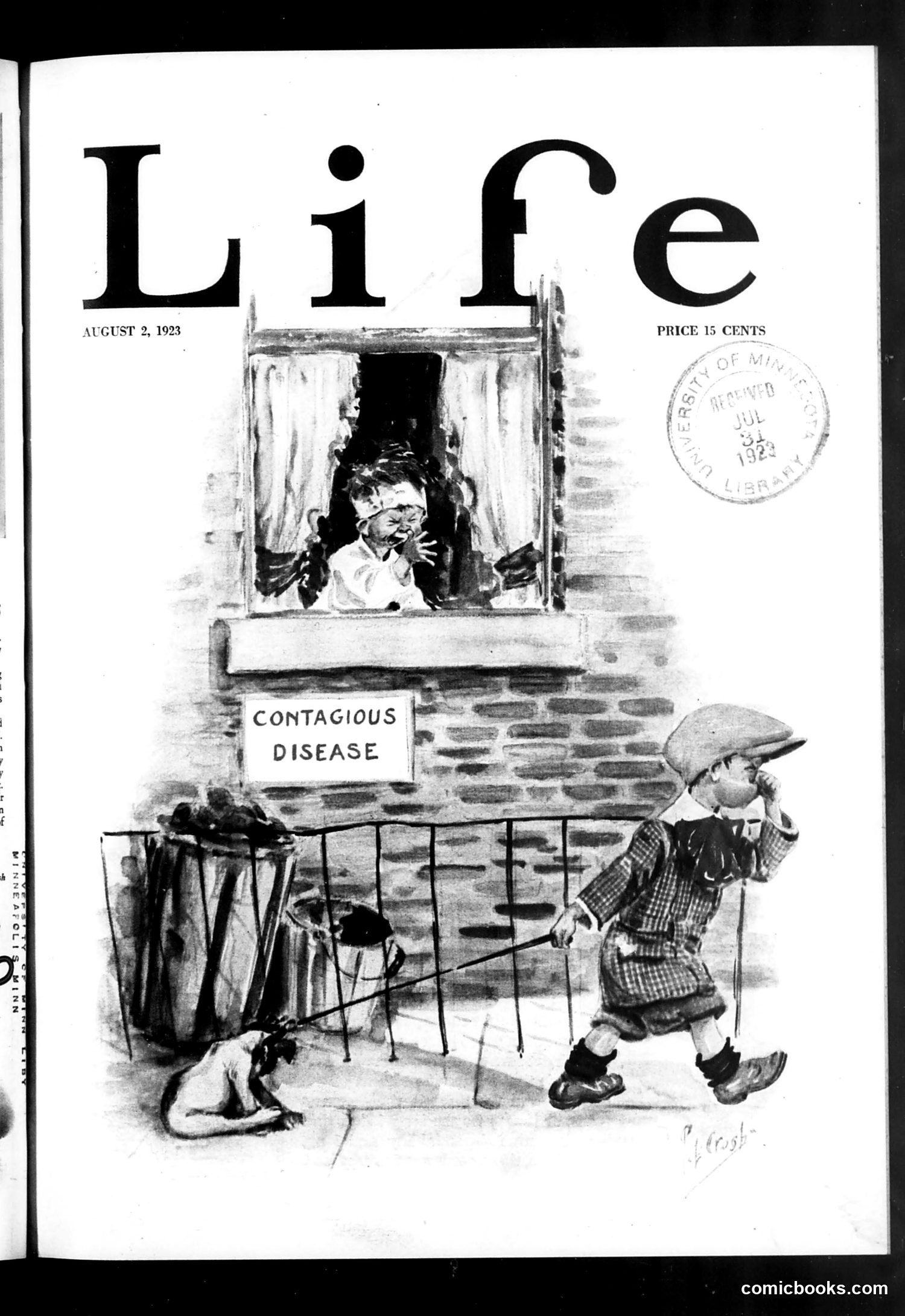
This satirical cover illustrates public health messaging about disease transmission. A child peers from a window labeled "Contagious Disease," while below, a man in working-class attire (flat cap, checked shirt) approaches with a small dog. A trash bin sits nearby. The cartoon warns against contact with disease sources—likely referencing typhoid, influenza, or similar illnesses prevalent in 1920s urban areas. The composition suggests danger: the infected person isolated above, the unsuspecting pedestrian and pet below, separated only by a fence. The satire critiques public carelessness or lack of awareness about hygiene and disease prevention. The everyday scene emphasizes how contagion threatens ordinary people, making public health education the magazine's apparent message rather than political commentary.
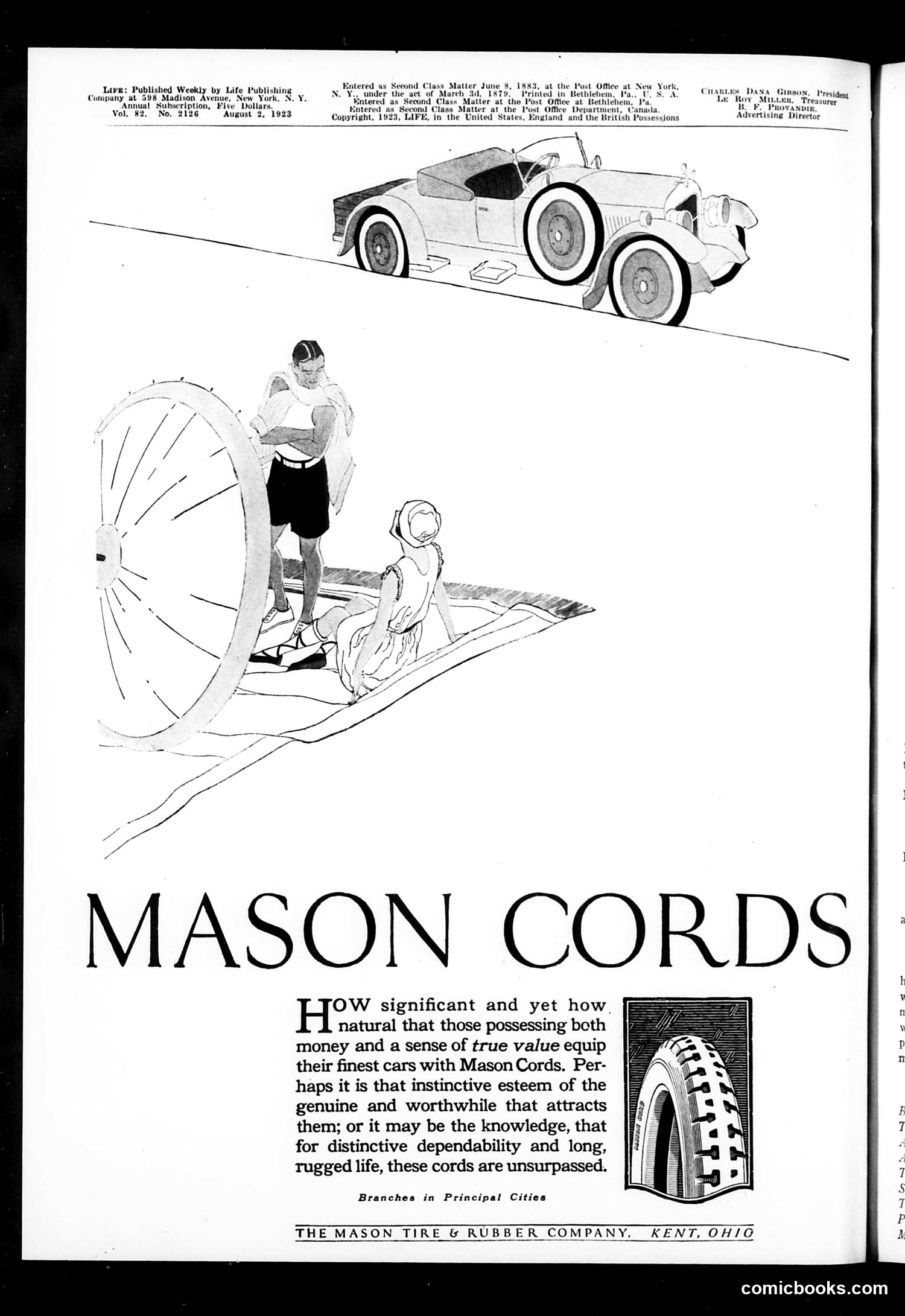
This is primarily an **advertisement for Mason Cords tires**, not political satire. The page depicts two contrasting scenes: **Upper illustration**: An expensive automobile on an incline, representing wealth and modern technology. **Lower illustration**: A man and child with a large wagon wheel, representing working-class transportation. The advertisement's argument appeals to affluent readers by suggesting that even wealthy car owners who can afford quality should choose Mason Cords tires because of their "distinctive dependability and long, rugged life"—implying the tires are so reliable they're suitable for both luxury vehicles and humble wagons. This reflects 1923 consumer marketing strategy: positioning a product as universally valuable across social classes to broaden appeal to the magazine's middle and upper-class readership.
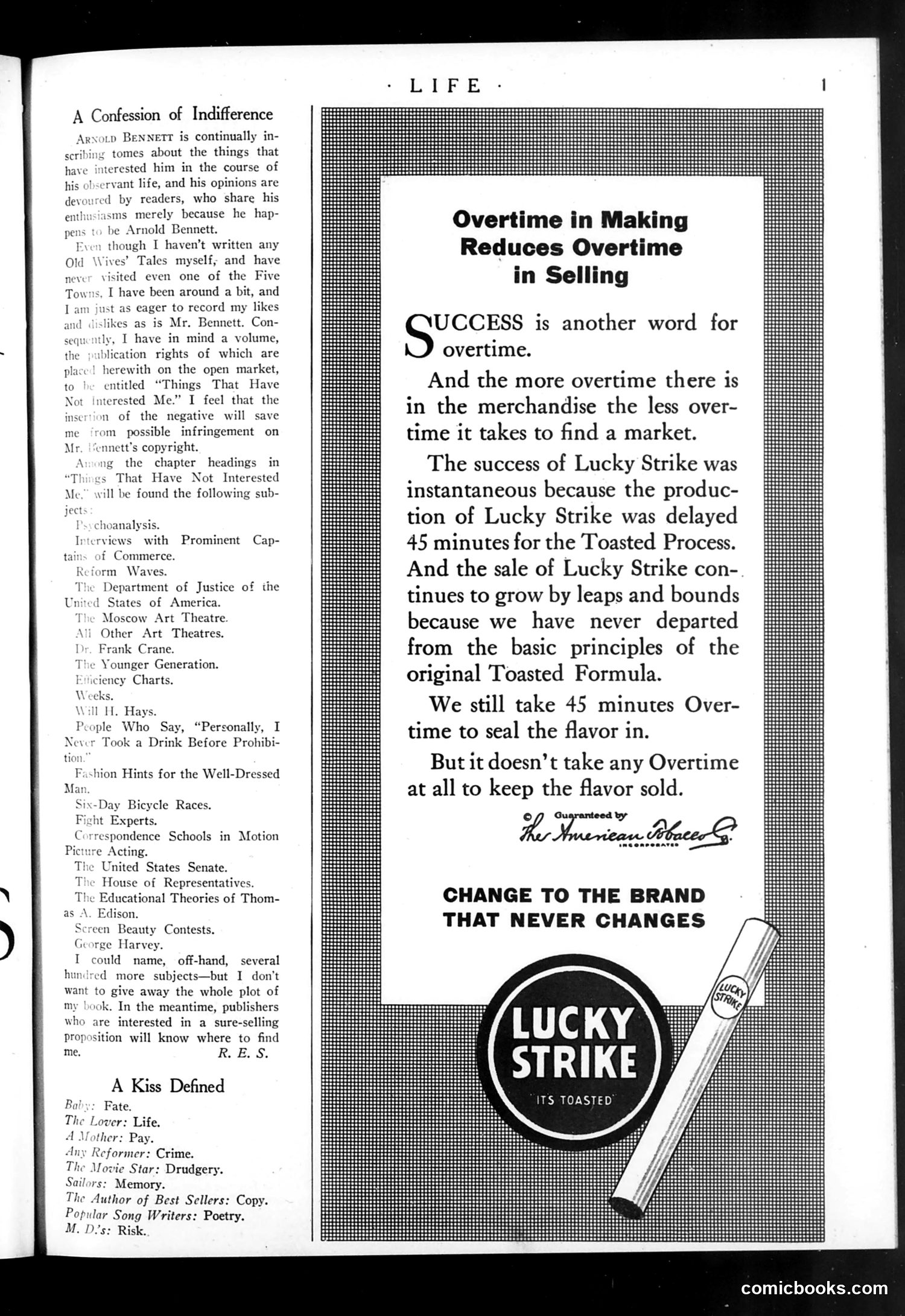
This page is primarily a **Lucky Strike cigarette advertisement**, not political satire. The ad occupies the right two-thirds of the page with the headline "Overtime in Making Reduces Overtime in Selling." The advertisement argues that Lucky Strike's "Toasted Process"—a 45-minute production method—creates superior flavor that sells itself quickly, requiring less sales effort ("overtime"). The tagline reads "CHANGE TO THE BRAND THAT NEVER CHANGES." The left column contains unrelated editorial content: a confession by Arnold Bennett about writing, chapter headings from his book, and various cultural references ("A Kiss Defined"). **This is commercial advertising masquerading as magazine content**, typical of early 20th-century Life magazine, which blended editorial and advertising. There is no political cartoon or satire here.
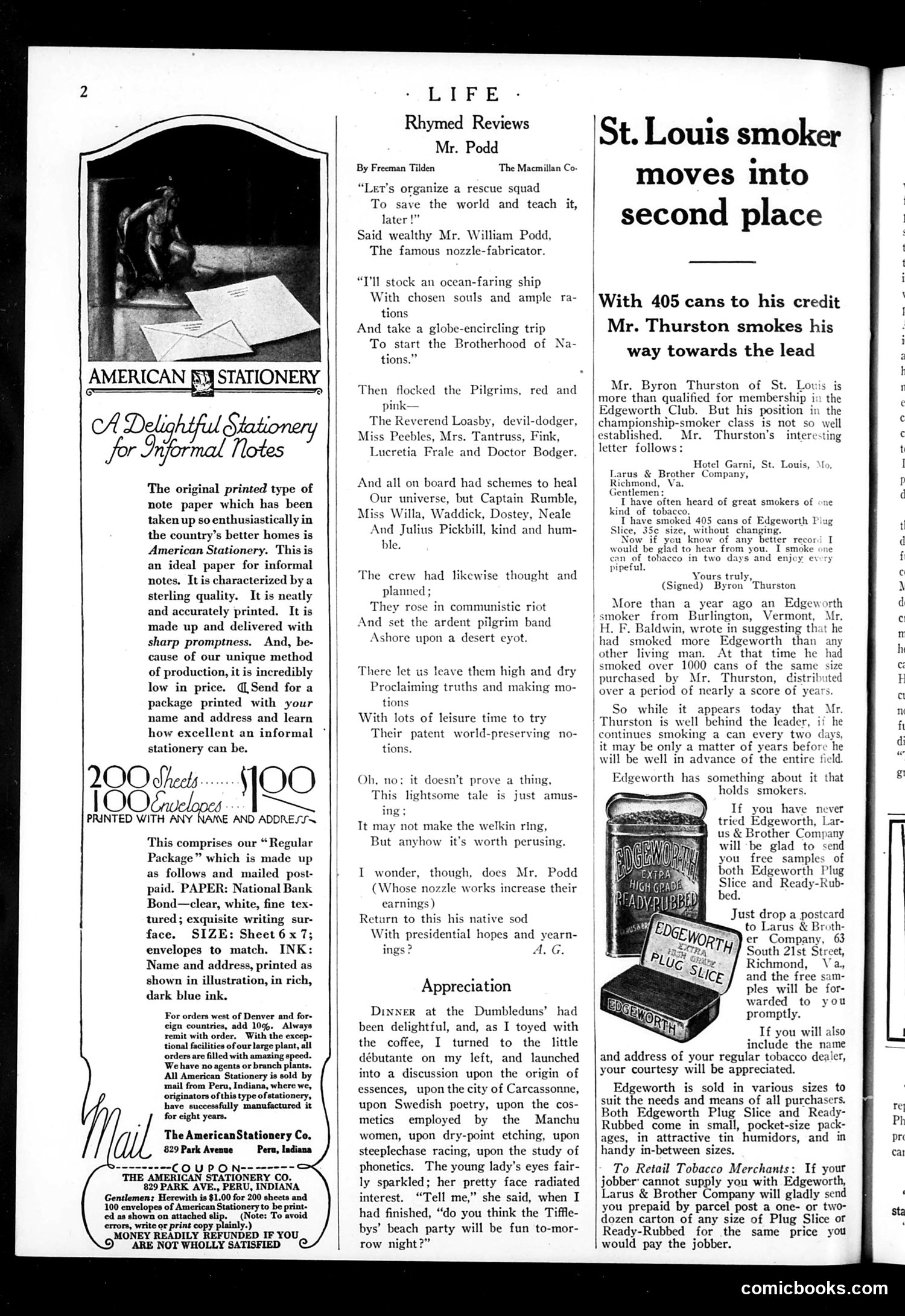
This page contains **advertising and brief articles** rather than political satire. The main content includes: 1. **American Stationery advertisement** (left): promoting high-quality note paper with sharp printing and low cost—standard commercial messaging. 2. **"Rhymed Reviews: Mr. Podd"** (center): A light satirical poem by Freeman Tilden about a wealthy nozzle-manufacturer with grandiose plans to organize a rescue squad and sail around the world. It's gentle social satire mocking pretentious wealthy individuals and their elaborate schemes—typical humor of the era. 3. **"St. Louis Smoker" article** (right): Celebrates Byron Thurston's record of smoking 405 cans of tobacco, with an Edgeworth tobacco advertisement. The page reflects early 20th-century commercial culture and mild class-based humor, with no significant political commentary.
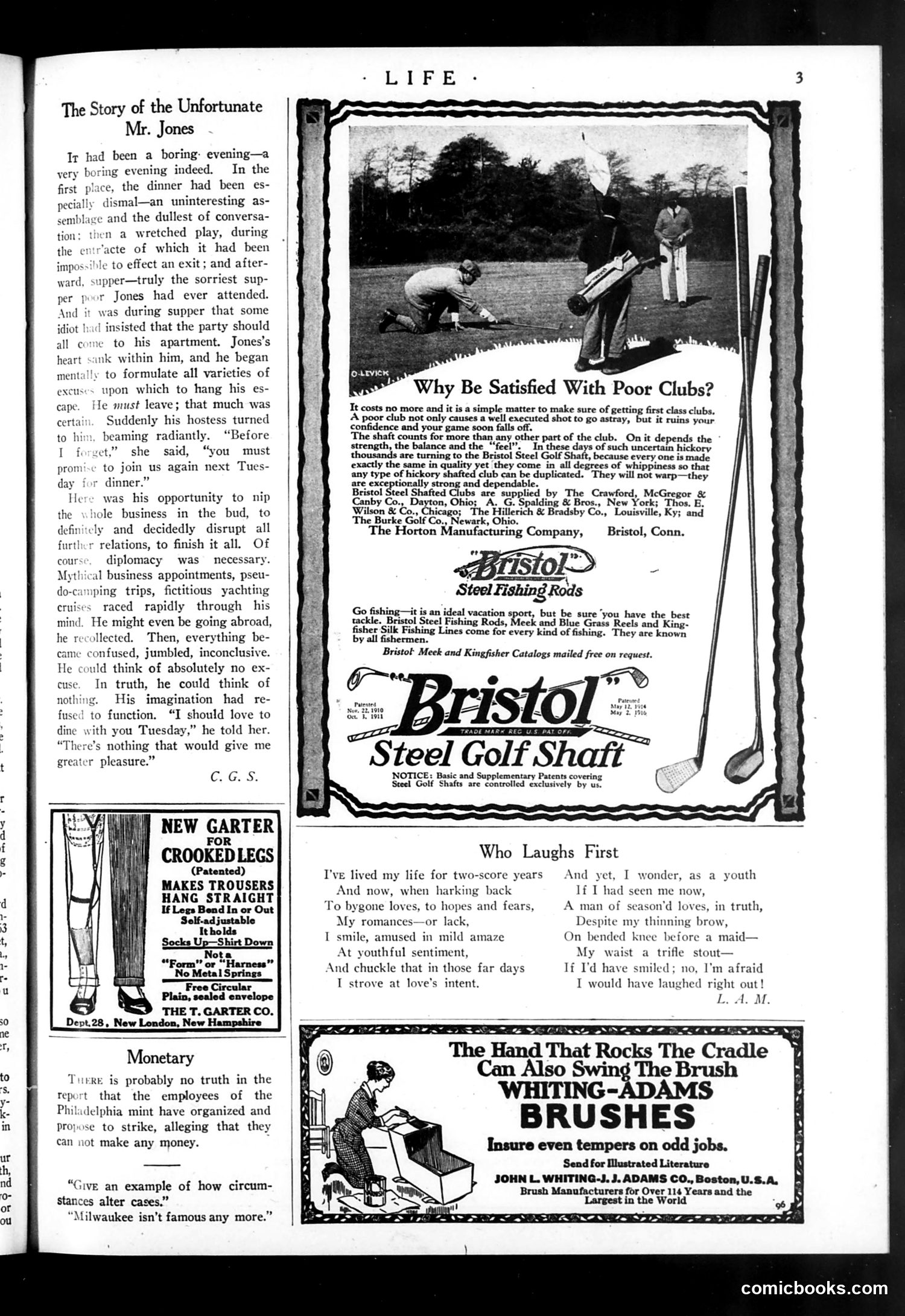
This page is primarily **advertising**, not political satire. The main content includes: **"The Story of the Unfortunate Mr. Jones"** (left): A humorous short story about a man pressured to host a dinner party that spirals into chaos—a relatable social satire about etiquette and obligation rather than politics. **Major advertisements:** - Bristol Steel Golf Shafts and Fishing Rods - T. Garter Co.'s crooked-leg garter solution - Whiting-Adams brushes **Poems included:** - "Who Laughs First" and "The Hand That Rocks The Cradle" appear to be light verse, likely contemporary social commentary in verse form. The page reflects early 20th-century consumer culture and genteel social anxieties rather than political commentary. No specific political figures or events are referenced.
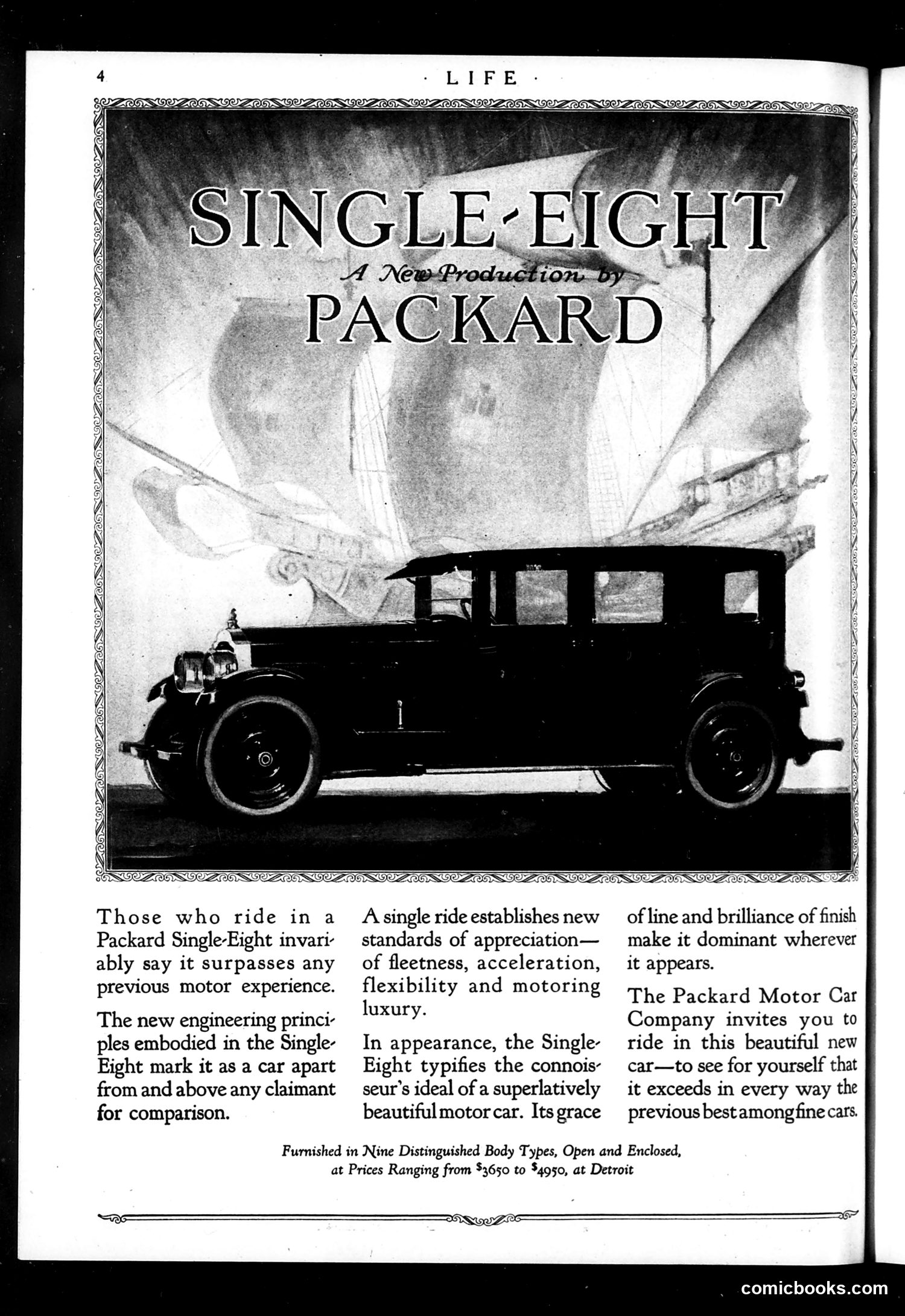
This is **not a political cartoon or satire** — it's a straightforward **automobile advertisement** for the Packard Single-Eight motor car, published in *Life* magazine. The page promotes Packard's new vehicle model, emphasizing its engineering innovations, speed, acceleration, and luxury features. The image shows a silhouetted side view of the automobile against a backdrop of a sailing ship, presumably suggesting progress and superiority. The ad targets wealthy consumers, highlighting that a single test drive establishes "new standards of appreciation" and claims the car "surpasses any previous motor experience." Pricing information ($2,650-$2,950 in Detroit) appears at the bottom. This represents early 20th-century automobile marketing in a general-interest magazine, positioned as aspirational content for affluent readers.
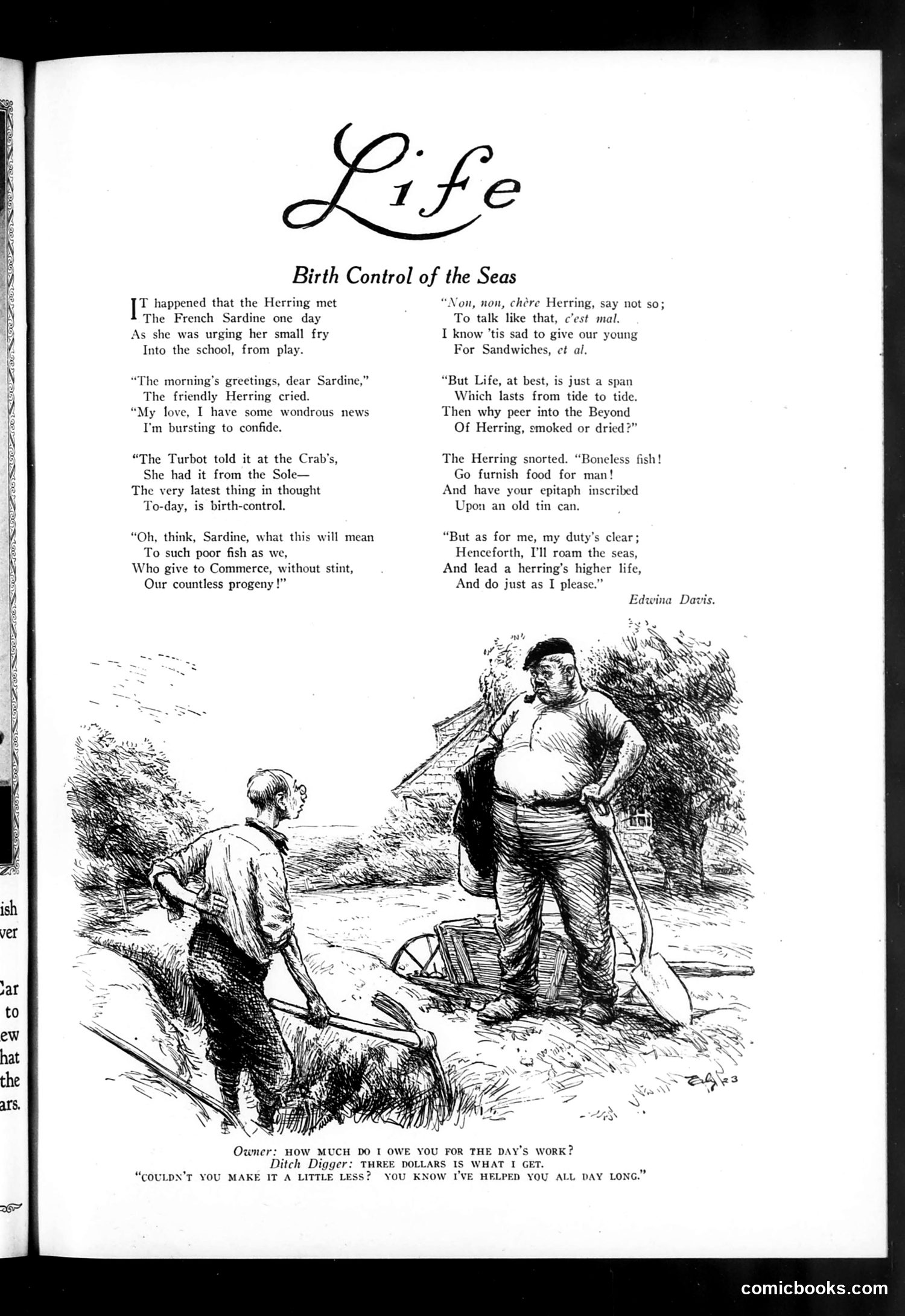
This is a satirical poem by Edvina Davis about overfishing and resource depletion. A French Sardine warns her offspring about "birth control"—limiting fish reproduction—because humans are harvesting so many fish that populations cannot sustain themselves. The poem's joke plays on contemporary birth control debates (a controversial topic in early 20th-century America) by applying them to marine life. The Herring character argues that fish must reduce breeding because commercial fishing is unsustainable: "To such poor fish as we, / Who give to Commerce, without stint, / Our countless progeny!" The illustration shows laborers digging, likely depicting the economic pressure driving overfishing. The satire critiques industrial fishing practices and their environmental consequences through dark humor.
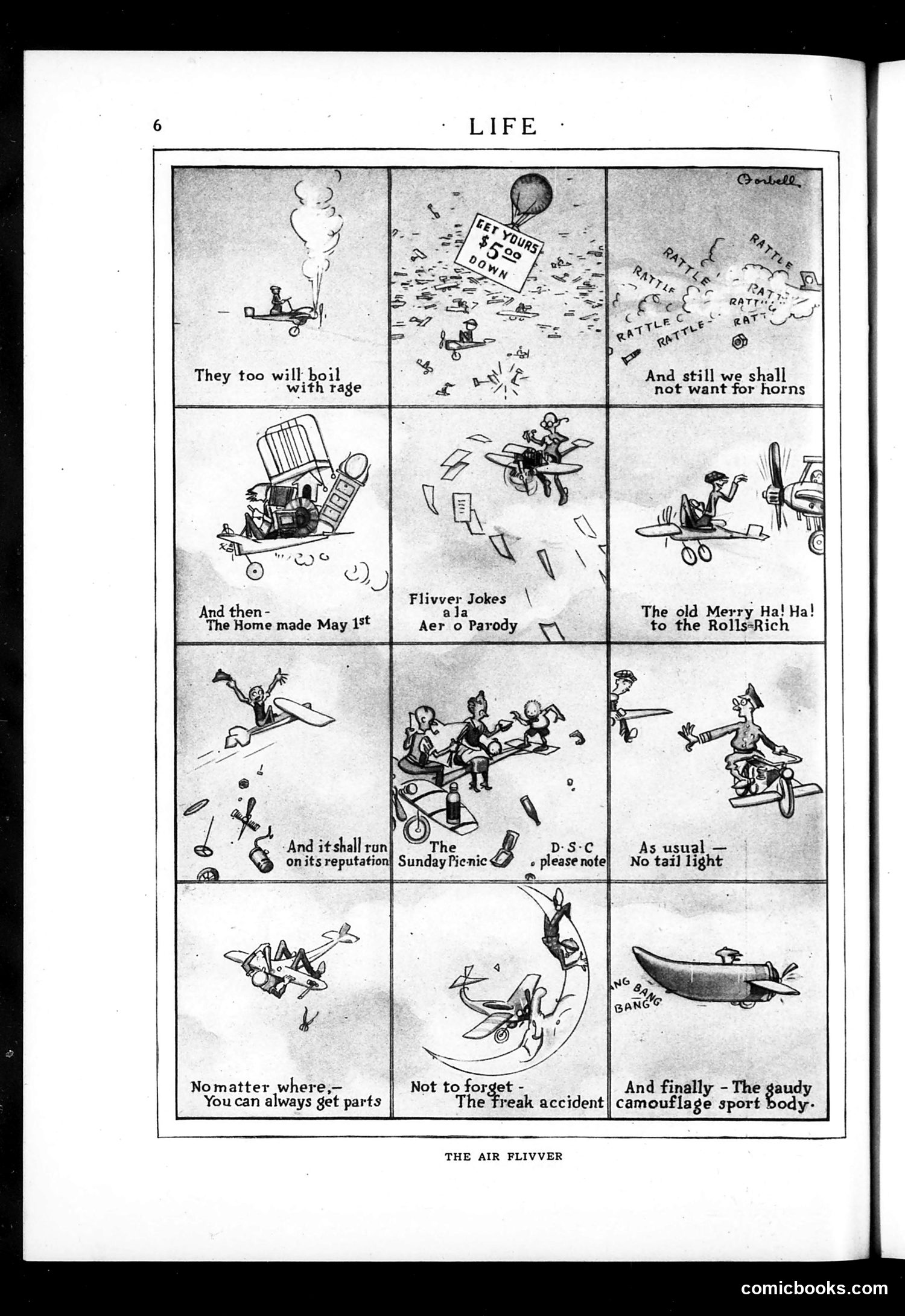
This comic strip satirizes the "flivver" (cheap automobile, likely referencing the Ford Model T) reimagined as a flying vehicle. The humor mocks both aviation enthusiasts' optimistic predictions and mass-production aspirations of the early automotive era. The strip portrays increasingly absurd disasters: engines that "boil with rage," crashes labeled "Fliver Jokes," collisions at picnics, and inevitable mechanical failures. The running joke—"You can always get parts" and "No tail light"—suggests that even as flying cars crash spectacularly, their cheap mass-production means spare parts remain readily available. The satire targets utopian visions of affordable personal aircraft while acknowledging the gap between marketing promises and dangerous reality. The "sandy camouflage sport body" final panel mocks styling attempts to make wreckage seem fashionable.
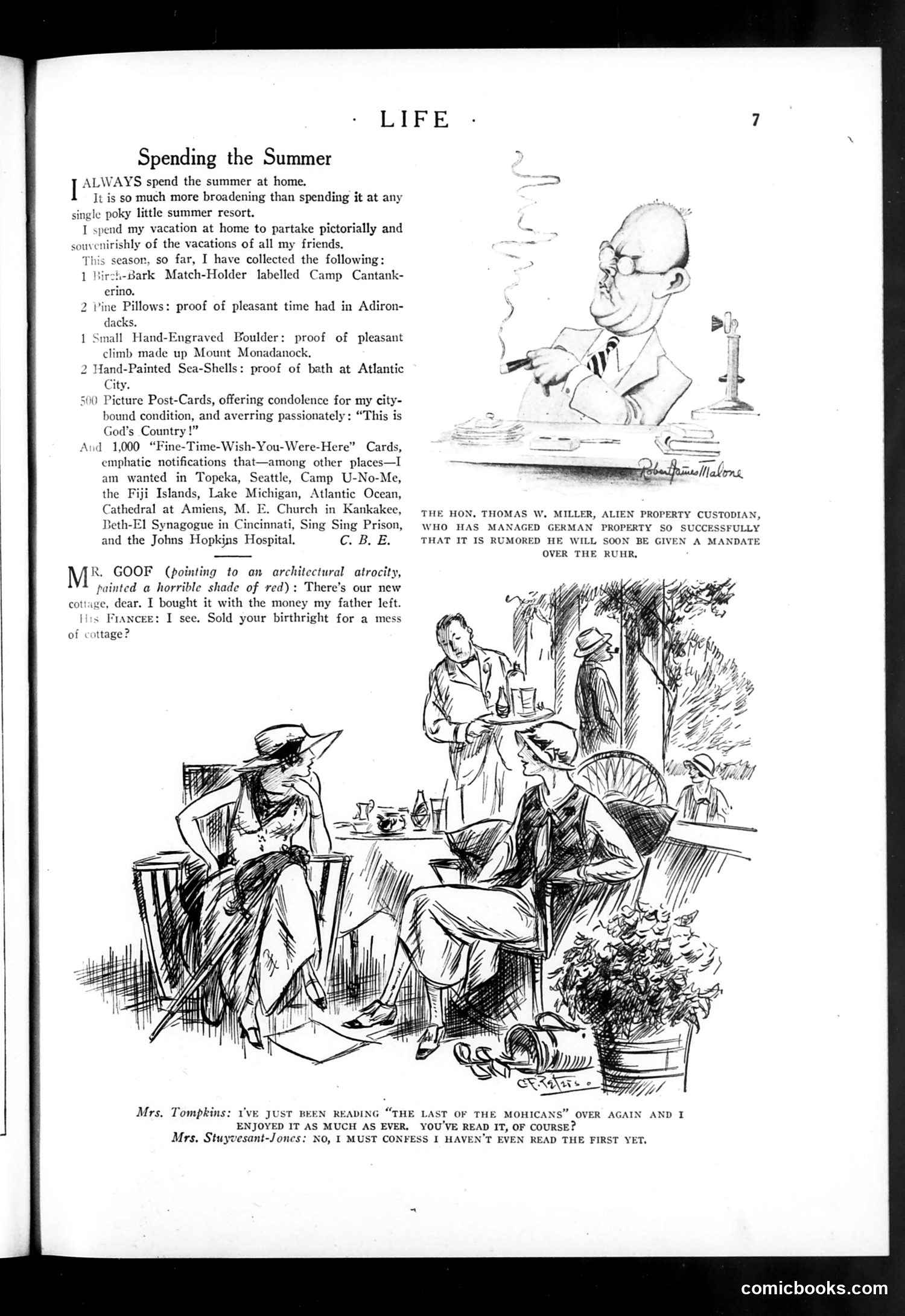
This page contains two distinct sections: **Upper Section ("Spending the Summer"):** A first-person essay about collecting summer mementos—postcards, souvenirs, and correspondence from various locations. The author lists nostalgic items from places like the Adirondacks, Atlantic City, and notably institutions (Cathedral, Church, Hospital), emphasizing how these objects preserve vacation memories. **Lower Section (Cartoon):** A domestic scene showing two women and a server in an outdoor garden setting. Mr. Goof criticizes the architectural style of their cottage (painted "a horrible shade of red"), claiming he bought it with money his father left. His fiancée responds by noting he sold his birthright "for a mess of cottage"—a biblical reference to Esau selling his birthright for pottage, satirizing frivolous spending on real estate. The humor targets nouveau-riche pretension and poor financial decisions.
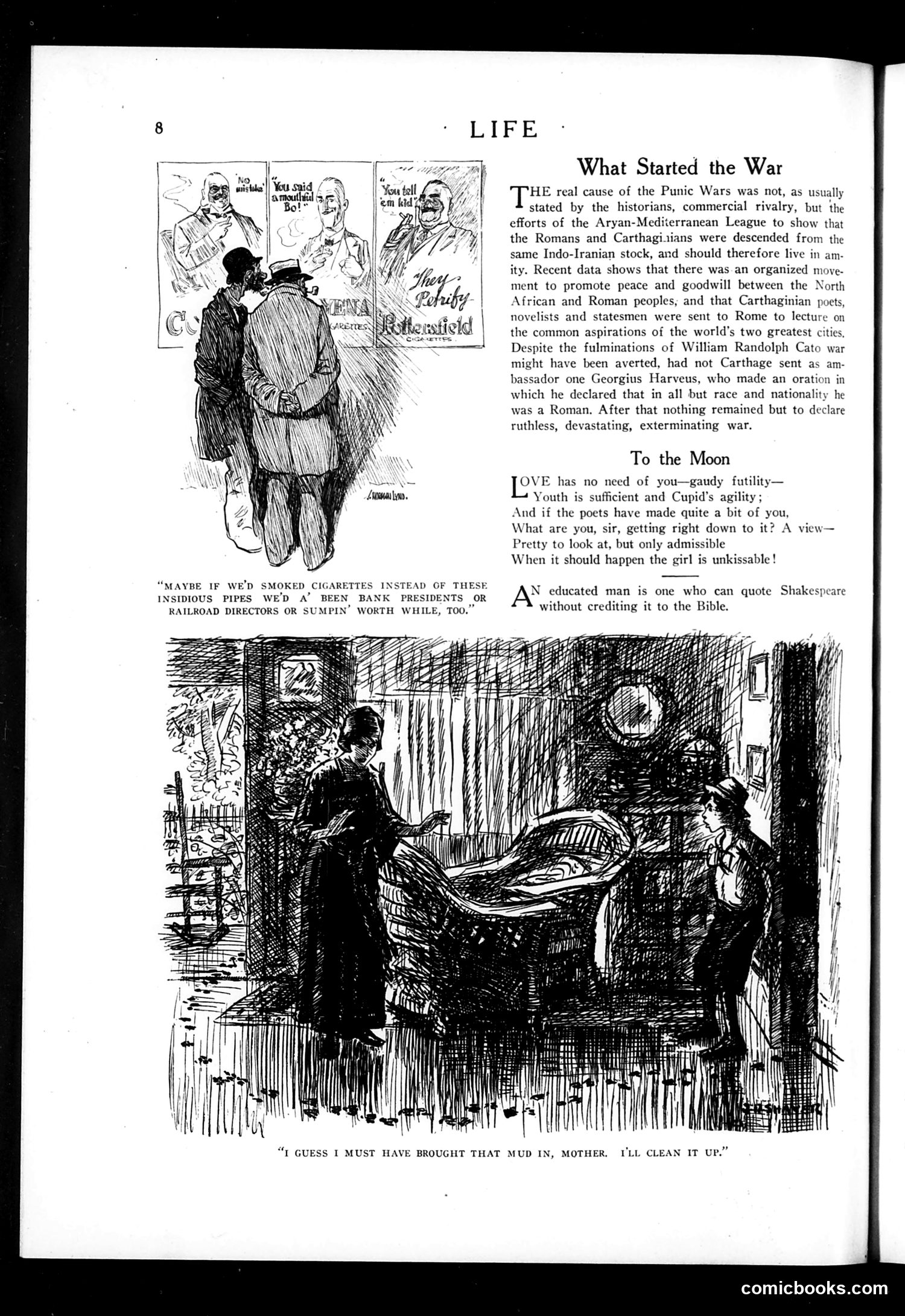
**Top Cartoon**: Shows two men examining propaganda posters. The caption references "bank presidents or railroad directors or senator North Wilkie, too," suggesting satire of wealthy industrialists and politicians. The joke implies these elites would prefer to spread propaganda about their own importance rather than discuss serious issues like cigarettes or pipes. **Bottom Illustration**: Depicts a domestic scene where a child has tracked mud inside. The mother figure stands disapprovingly as the child promises to clean it up. This appears to be humorous social commentary on household management and parenting—a gentle domestic joke rather than political satire. The page overall mixes political commentary on elite hypocrisy with genteel domestic humor typical of Life magazine's editorial style.
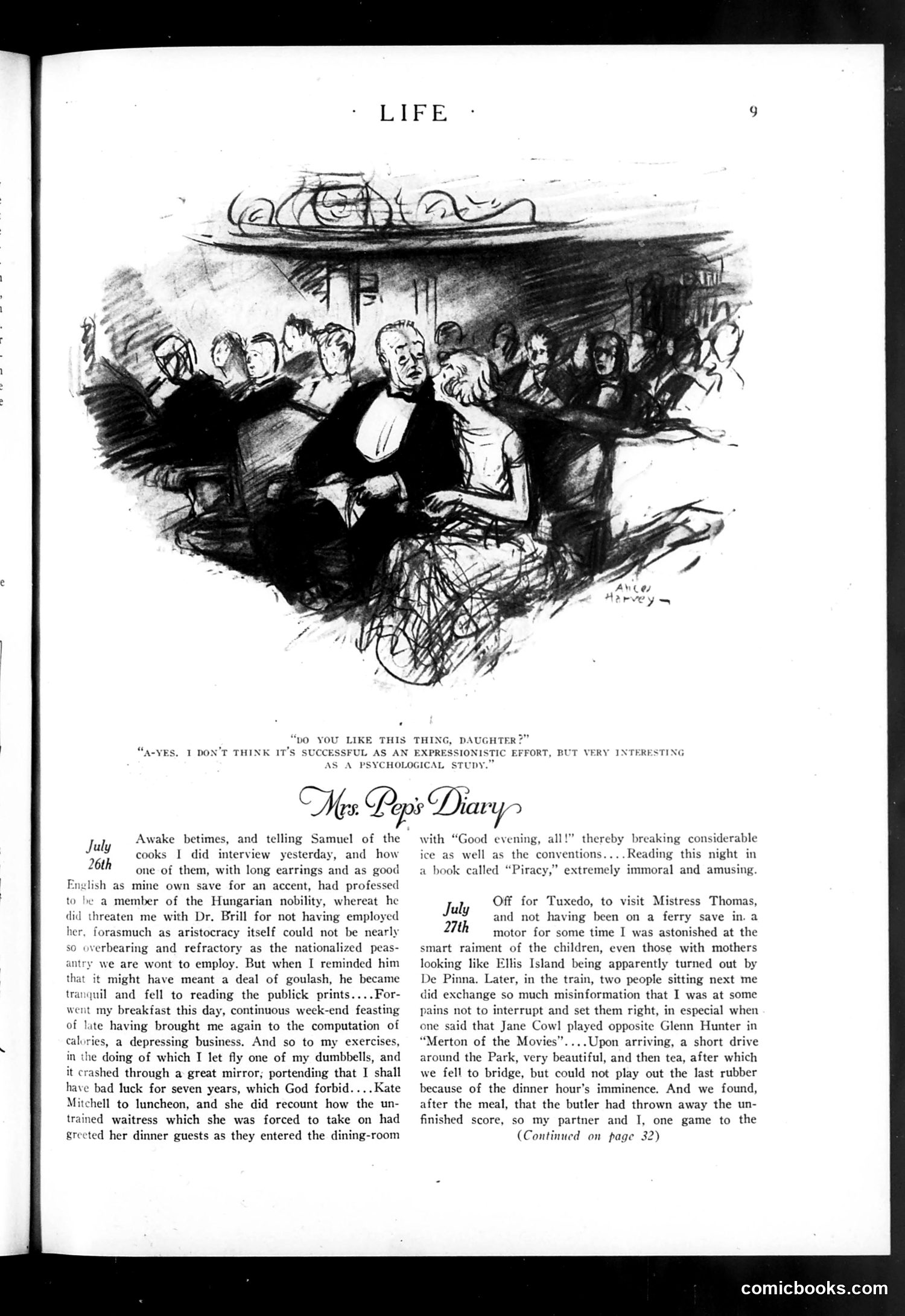
This page contains a sketch titled "Mrs Pep's Diary" rather than a political cartoon. The illustration shows a social gathering in what appears to be a ship's cabin or formal dining space, with well-dressed figures in formal attire. The diary entries describe mundane social activities: a Hungarian nobleman's visit, attending a theatrical production called "Piracy," and a motor trip to visit "Mistress Thomas." The humor derives from satirizing upper-class social pretensions and boredom—the narrator complains about "continuous week-end feasting" causing digestive problems and mentions a broken mirror and an awkward tennis game. This is social satire targeting affluent leisure activities and their tedious repetition, typical of Life magazine's satirical approach to wealthy society life.
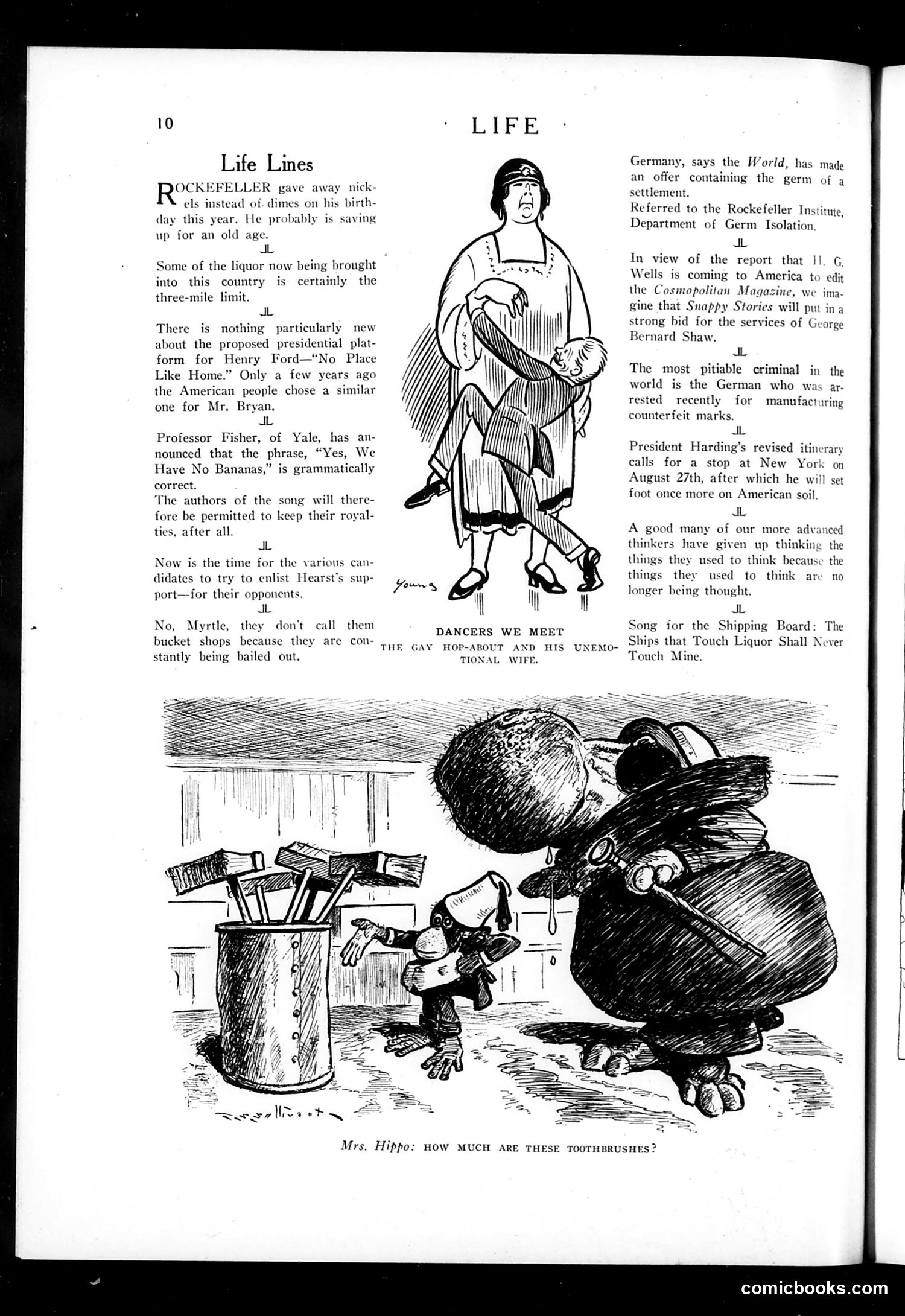
This cartoon satirizes Prohibition-era speakeasies and bootlegging. The illustration shows Mrs. Hippo asking about "toothbrushes" — a euphemism for illegal liquor. The small figure (likely a bootlegger or speakeasy operator) displays bottles in what appears to be a trash can, suggesting hidden or illicit alcohol sales disguised as legitimate goods. The caption's wordplay on "toothbrushes" reflects how Prohibition-era Americans used coded language to discuss contraband alcohol. The hippo characters represent ordinary citizens patronizing illegal establishments. The page's text references Rockefeller Institute germ research and Prohibition's liquor import limits, contextualizing the cartoon within contemporary debates about alcohol policy and law enforcement during the 1920s Prohibition era.
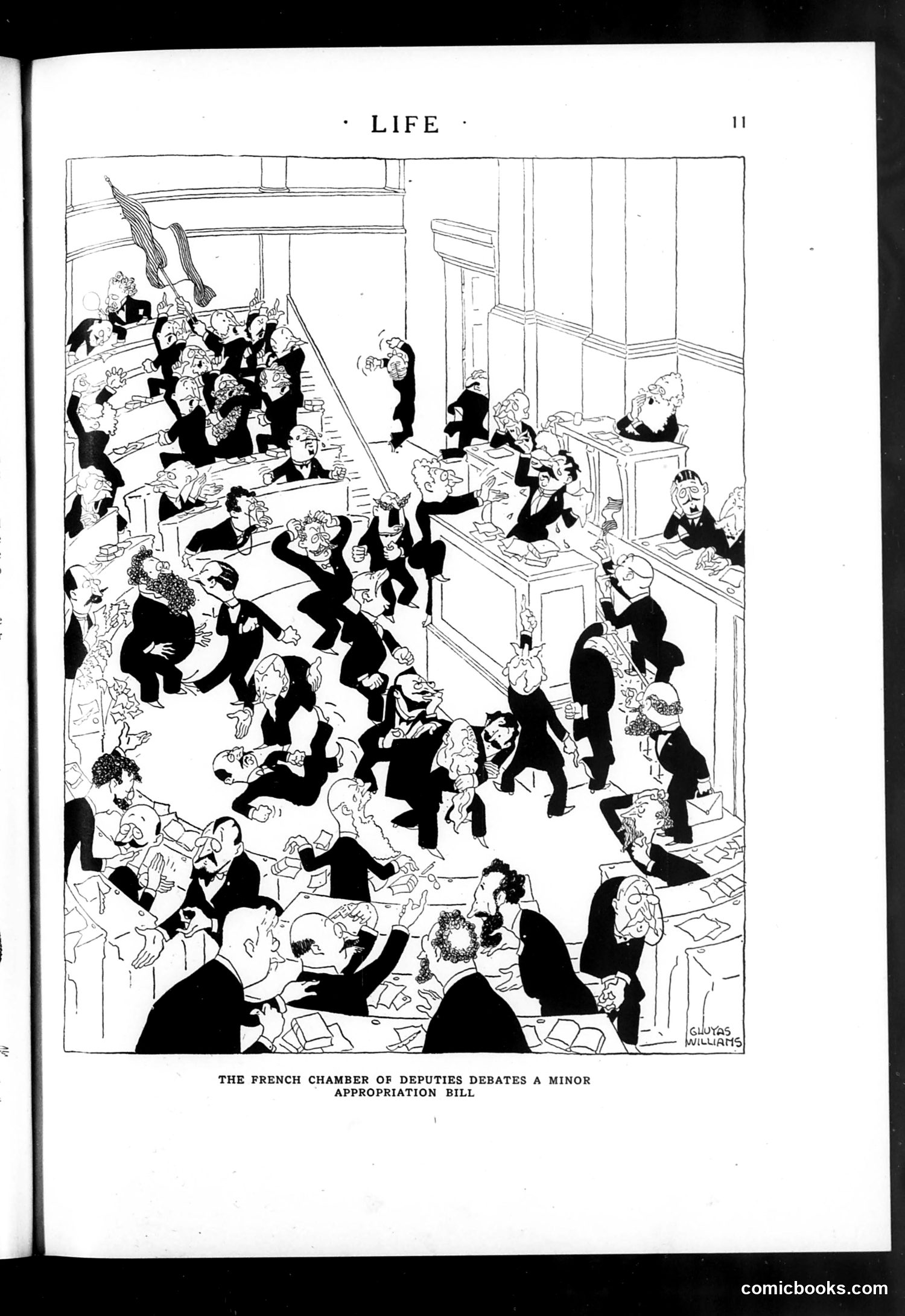
This is a satirical cartoon from *Life* magazine depicting the French Chamber of Deputies (parliament) in chaotic disorder during debate over a minor appropriations bill. The cartoon shows dozens of legislators in formal black suits gesticulating wildly, arguing, and generally creating mayhem—papers scattered across desks, some standing on furniture. The satire mocks the French parliamentary system as dysfunctional and prone to theatrical outbursts even over minor budget matters. The cartoon's point appears to be criticizing French political culture as prone to excessive drama and disorder. For modern readers, it reflects early 20th-century American stereotypes about European (particularly French) political instability and volatility—portraying parliamentary debate as unruly rather than dignified. The artist is credited as "Gluyas Williams" in the lower right.
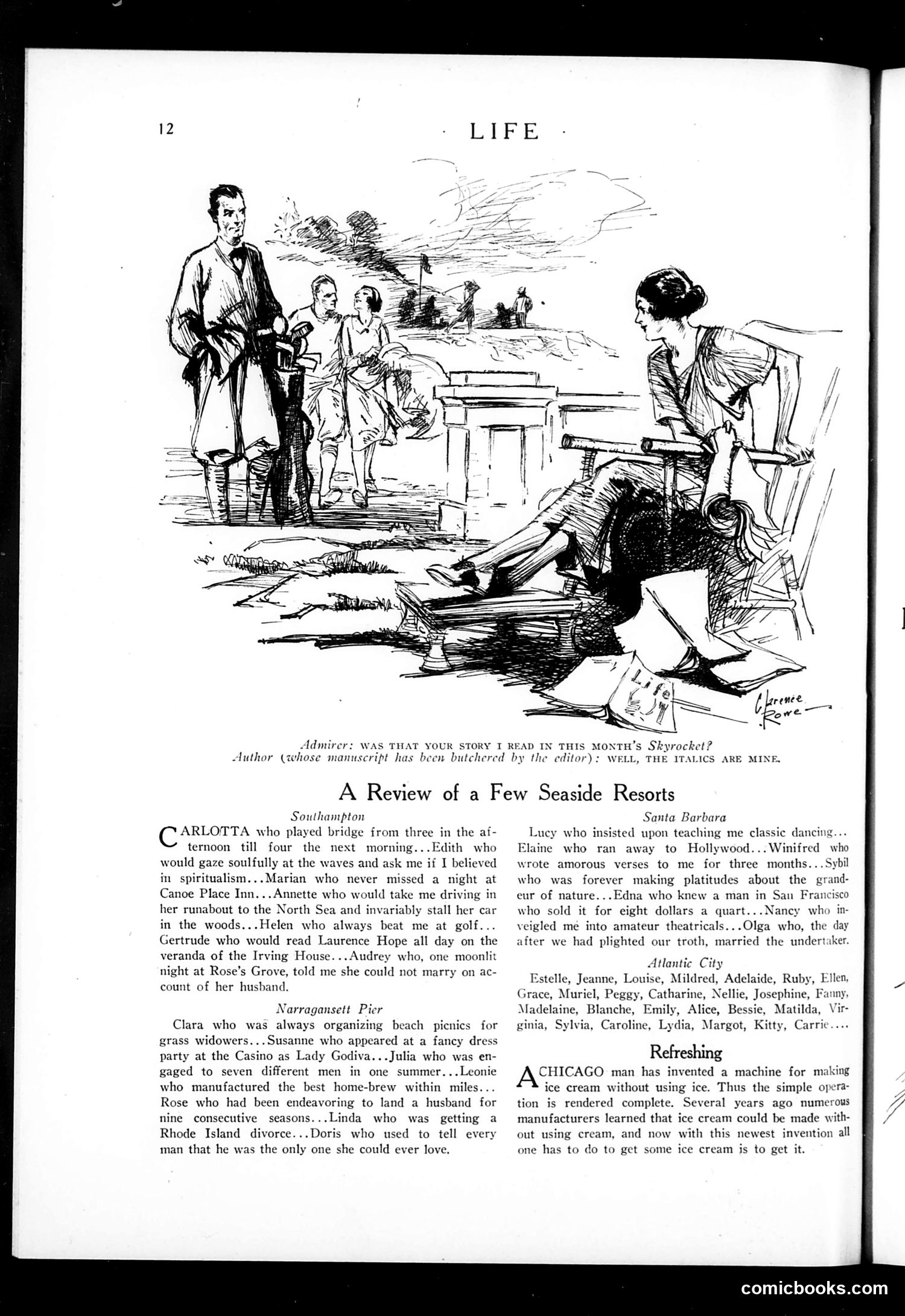
This page from *Life* magazine contains a satirical cartoon and social commentary about seaside resorts. The cartoon depicts a conversation between two people—a reclining woman reading and a standing man—in a beach setting. The caption reveals the joke: the man claims a manuscript he's showing was published in *Skylarocket* magazine, but admits "the italics are mine," suggesting he's taking credit for editorial work or embellishing his contributions. Below this is an article titled "A Review of a Few Seaside Resorts," listing names of people encountered at various locations (Southampton, Santa Barbara, Narragansett Pier, Atlantic City). This appears to be gentle social satire mocking the leisure class and their resort culture. The "Refreshing" section discusses a new ice cream-making invention, typical of the magazine's mix of humor and contemporary innovations.
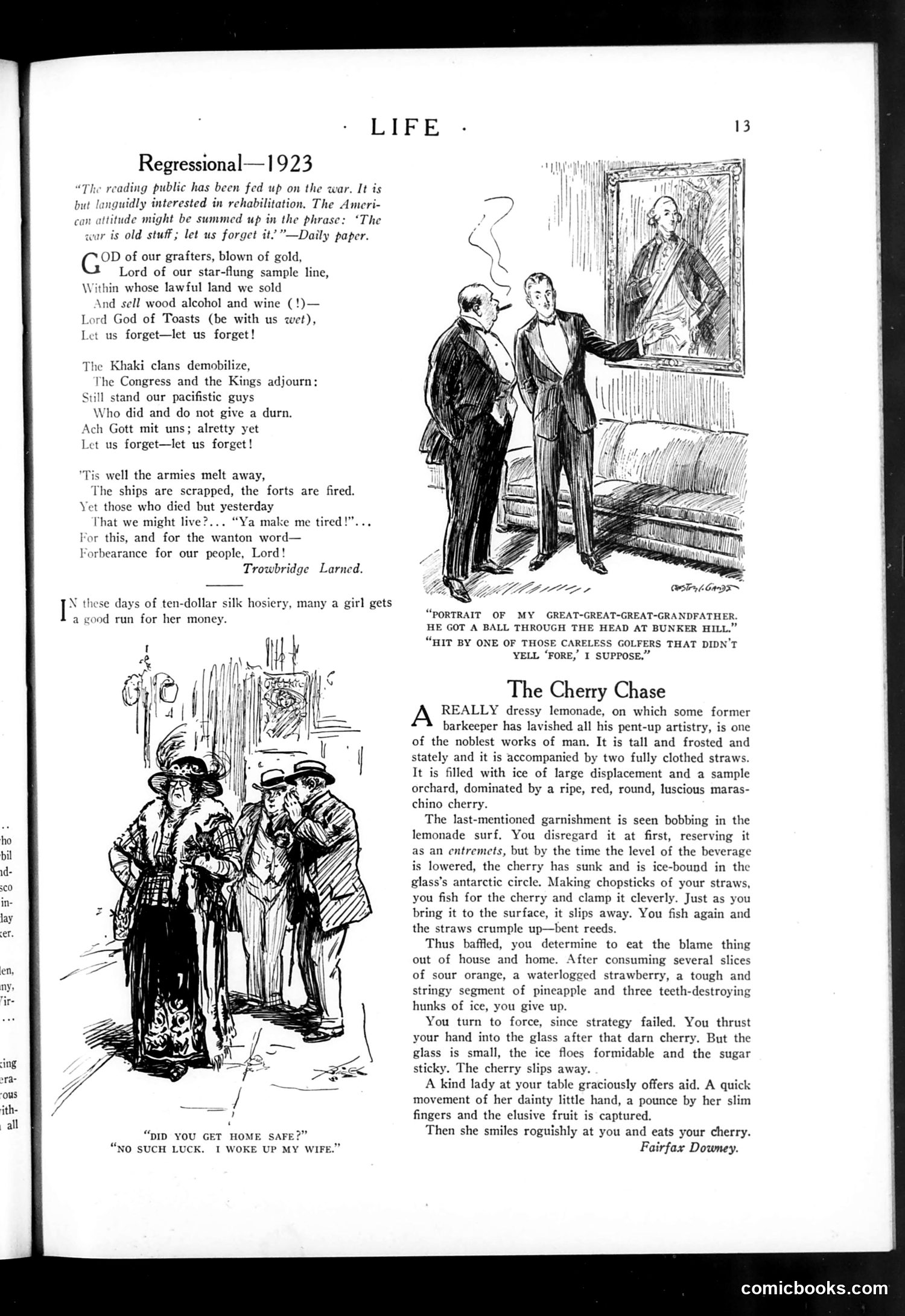
The page contains two distinct pieces: **"Regressional—1923"** is a poem satirizing post-WWI America's desire to forget the war and its costs. References to "Khaki clans" (veterans), melting armies, and scrapped ships mock national amnesia about sacrifice. The closing line urges "Forbearance for our people"—suggesting ironic criticism of this forgetting. **"The Cherry Chase"** is a humorous essay by Fairfax Downey about the futility of retrieving a maraschino cherry from a lemonade drink using straws. It's a lighthearted piece about a small domestic frustration, depicting the cherry as elusively "slip[ping] away." The accompanying illustrations show: one depicting a portrait viewing (related to the regrettable grandfather anecdote in the caption), and another showing two men in winter coats with the caption "Did you get home safe? So such luck. I woke up my wife."
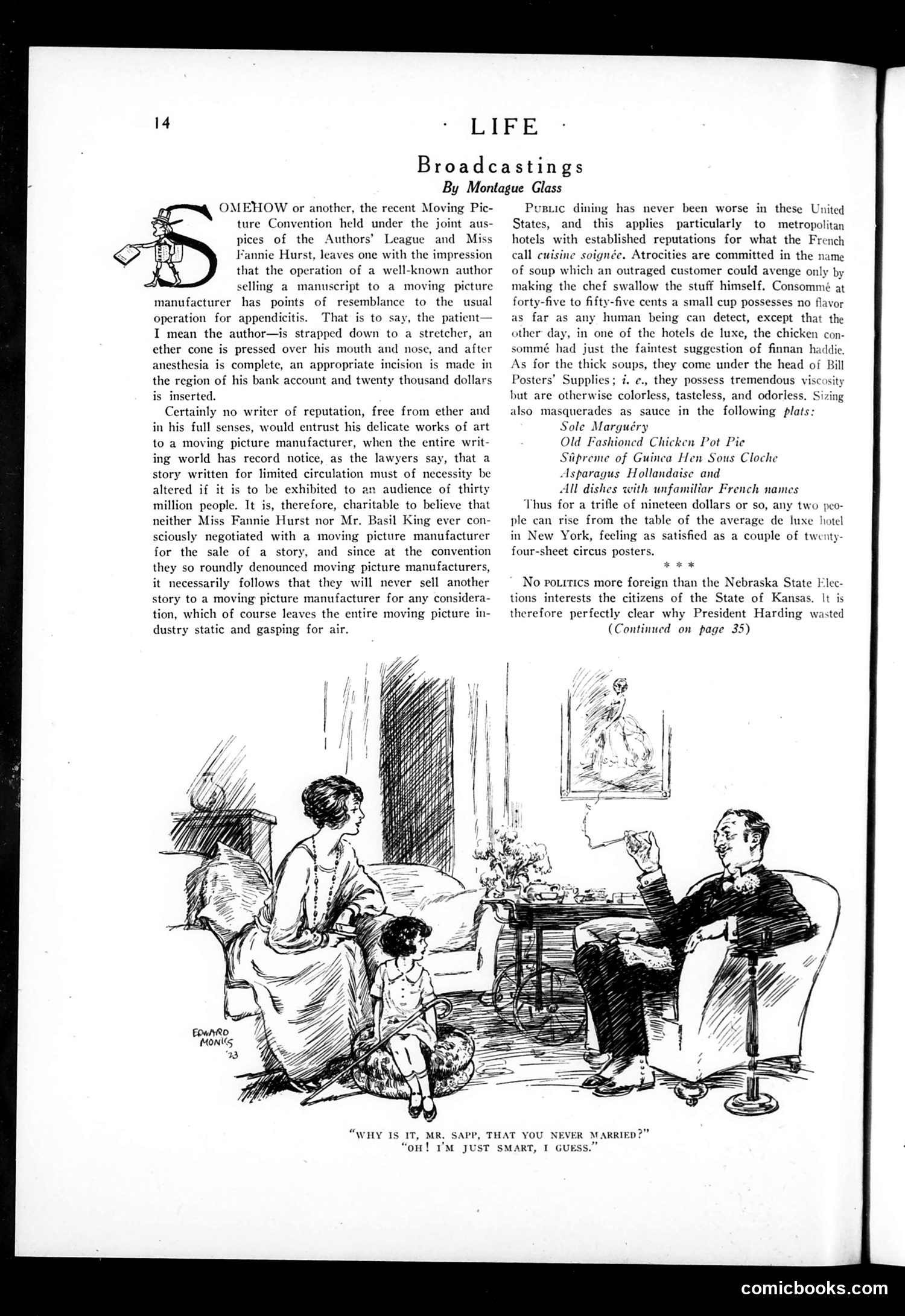
This page contains two distinct sections: **Upper text**: A satirical article by Montague Glass criticizing both the film industry's treatment of authors and the poor quality of restaurant dining in American hotels. Glass mocks the pretentious French names ("*cuisine soignée*") applied to mediocre food, listing absurdly fancy dish titles that disguise unpalatable reality. The author argues authors shouldn't trust their work to film manufacturers without proper contracts. **Cartoon**: An illustration by Edward Penfield depicts a domestic scene where a woman asks a man, "Why is it, Mr. Sapp, that you never married?" His response—"Oh! I'm just smart, I guess"—suggests satirical commentary on the bachelor lifestyle, implying marriage is something only foolish men would choose. Both sections employ humor to critique social institutions and masculine pretense.
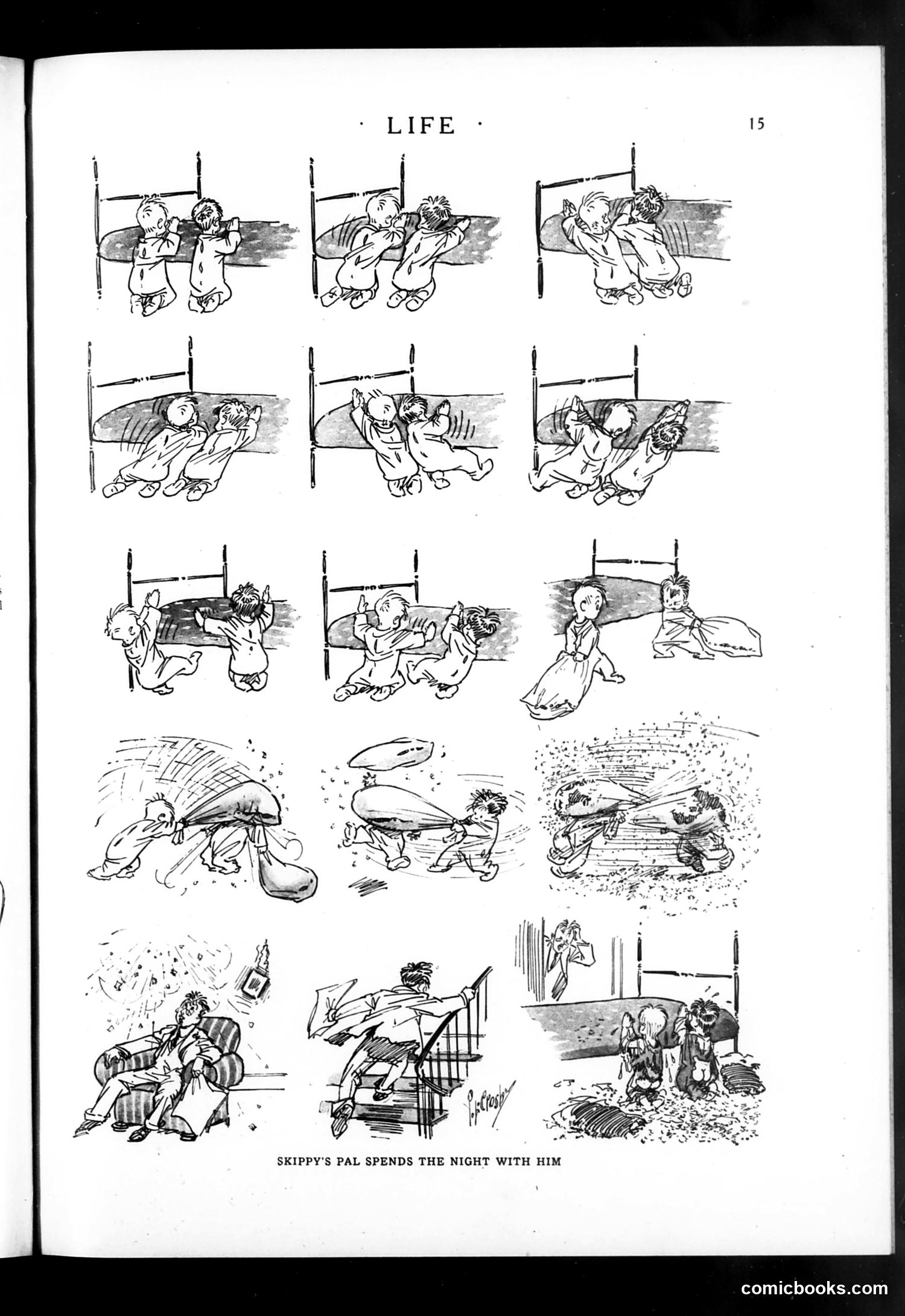
This is a comic strip sequence showing two children engaged in typical sleepover activities and mischief. The panels depict them: - Standing at a bed with a headboard - Playing, wrestling, and roughhousing - Creating chaos with bedding and pillows - Playing with what appears to be a toy airship or dirigible - One child sitting in a chair surrounded by mess - Engaging in increasingly wild nighttime behavior - Ending in exhaustion or sleep The humor derives from the relatable chaos children create during sleepovers—the escalating disorder, energy, and inevitable mess. This appears to be from "Skippy," a popular early 20th-century children's comic strip known for capturing authentic childhood adventures and misbehavior. The sequence humorously illustrates the gap between parental expectations and actual sleepover reality.
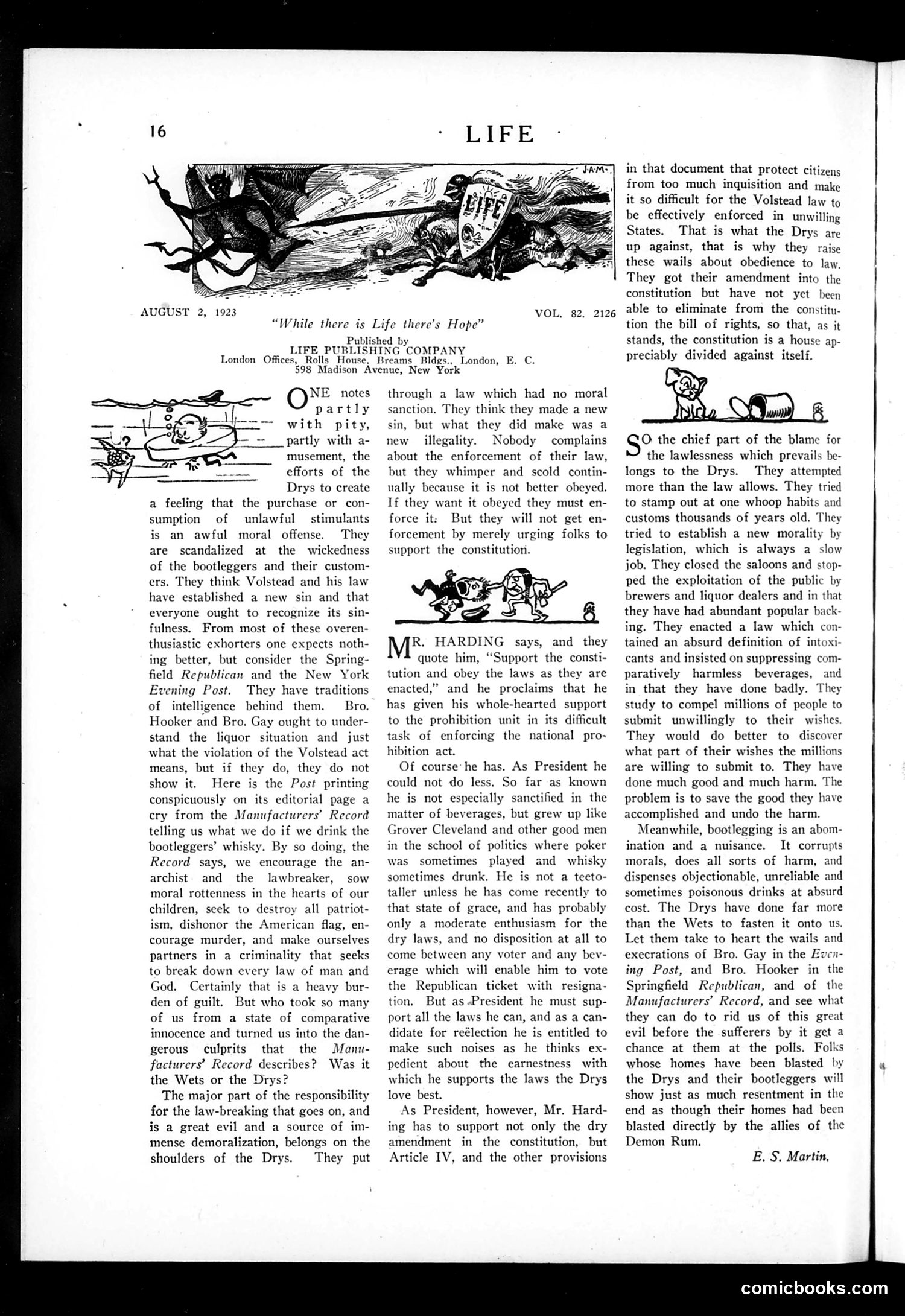
This page critiques Prohibition enforcement and the "Drys" (prohibitionists) who championed the Volstead Act. The cartoons show figures struggling under the weight of enforcement efforts. The editorial argues that **the Drys bear responsibility for lawbreaking**, not drinkers. It attacks the moral condemnation from publications like the *Manufacturers' Record*, which claims drinking bootleg whisky encourages anarchism and dishonors America. Life's position: the Drys created an unenforceable law lacking moral sanction, then blame citizens for breaking it. The piece notably addresses **President Harding's public support for Prohibition**. While acknowledging he must constitutionally enforce it, the author suggests Harding privately lacks enthusiasm for "dry laws"—a veiled reference to rumors about his personal habits. The core satire: Prohibitionists created an illegality, not a genuine moral wrong, then hypocritically demand obedience while refusing to enforce their own law adequately.
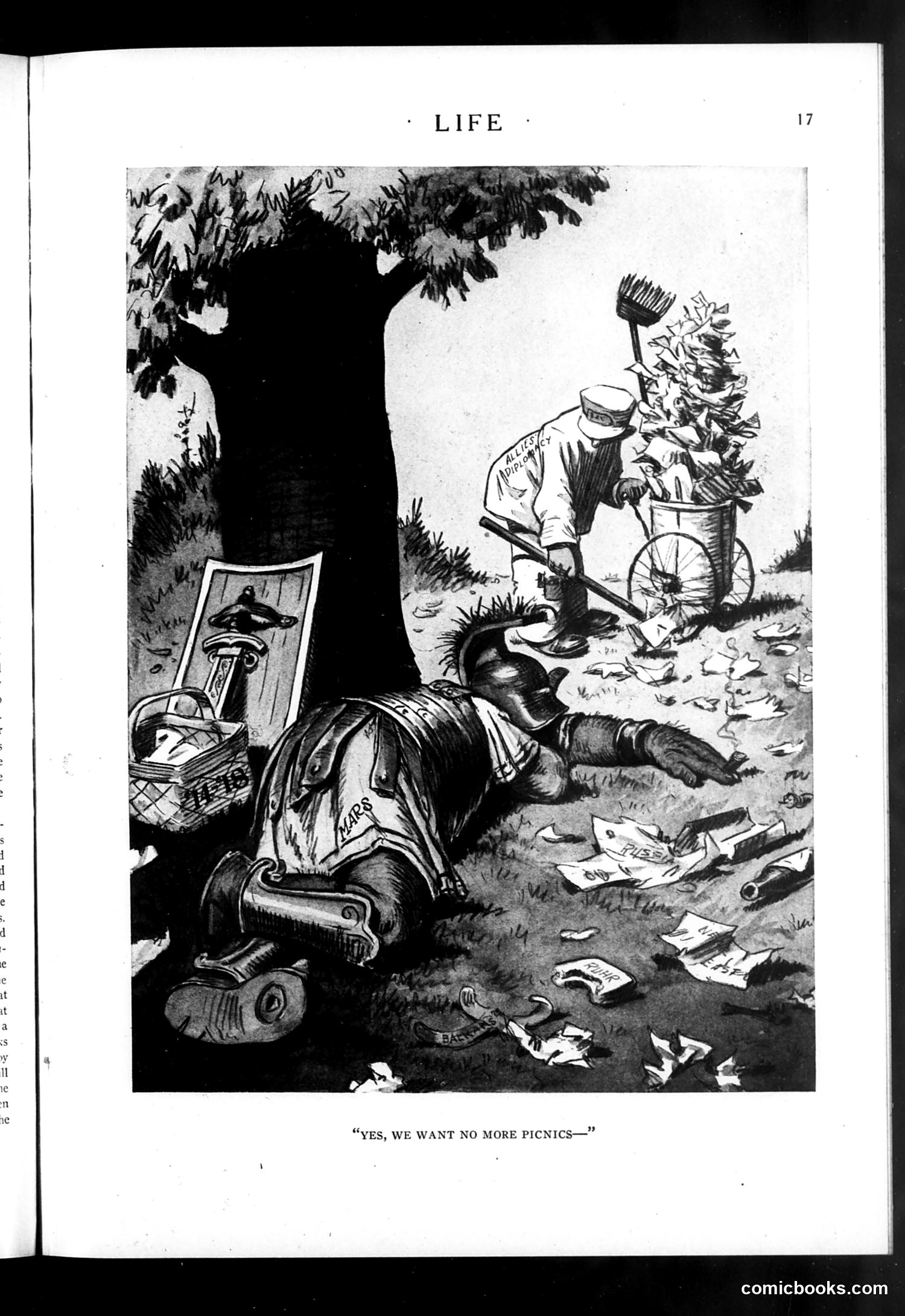
This satirical cartoon depicts a park ranger or park official discovering the aftermath of a picnic gone wrong. The ground is littered with debris—discarded food, bottles, papers, and scattered belongings. A donkey lies exhausted or injured in the foreground, while the official, looking exasperated, appears to be making a statement about ending picnics altogether. The satire targets careless picnickers who leave parks damaged and littered. The joke plays on the ranger's frustrated declaration: rather than ask visitors to clean up responsibly, he's simply banning picnics entirely—an absurdly extreme response to a social problem. This reflects early-to-mid 20th century concerns about public land preservation and the growing tension between recreation access and environmental stewardship. The cartoon mocks both visitor irresponsibility and institutional overreach.
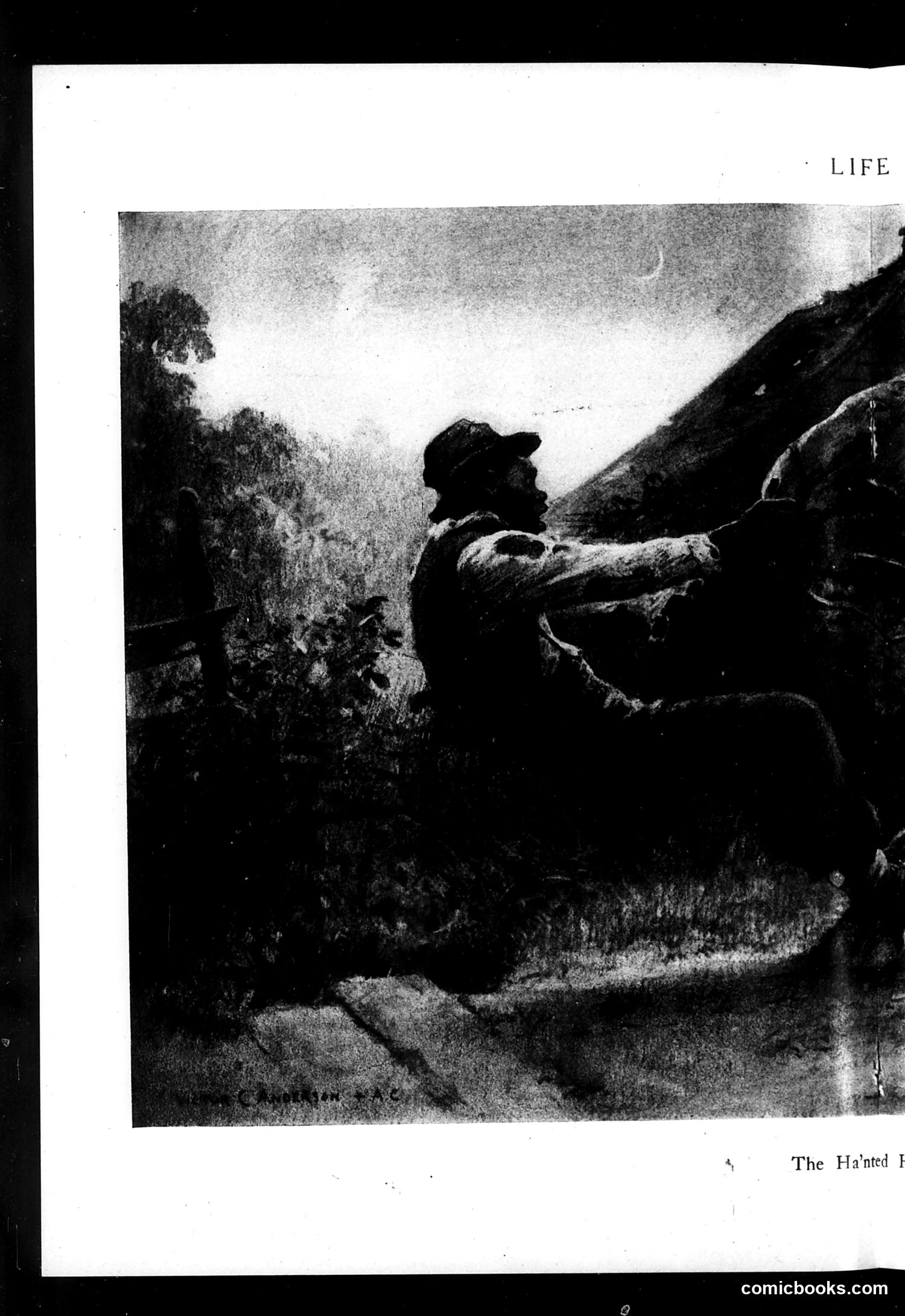
This appears to be a page from *Life* magazine featuring what the OCR text indicates is titled "The Ha'nted" (likely "The Haunted"). The black-and-white photograph shows a dramatic scene: a figure in dark clothing with an outstretched arm pointing or gesturing toward a mountainous landscape. The composition and theatrical quality suggest this may be either a still from a theatrical production or a satirical illustration rather than straightforward journalism. Without additional context or visible text beyond the partial title, I cannot definitively identify the specific political or social reference this cartoon addresses. The dramatic gesture and landscape setting suggest it may be commentary on warning, prophecy, or accusation, but the precise subject and satirical point remain unclear from this page alone.
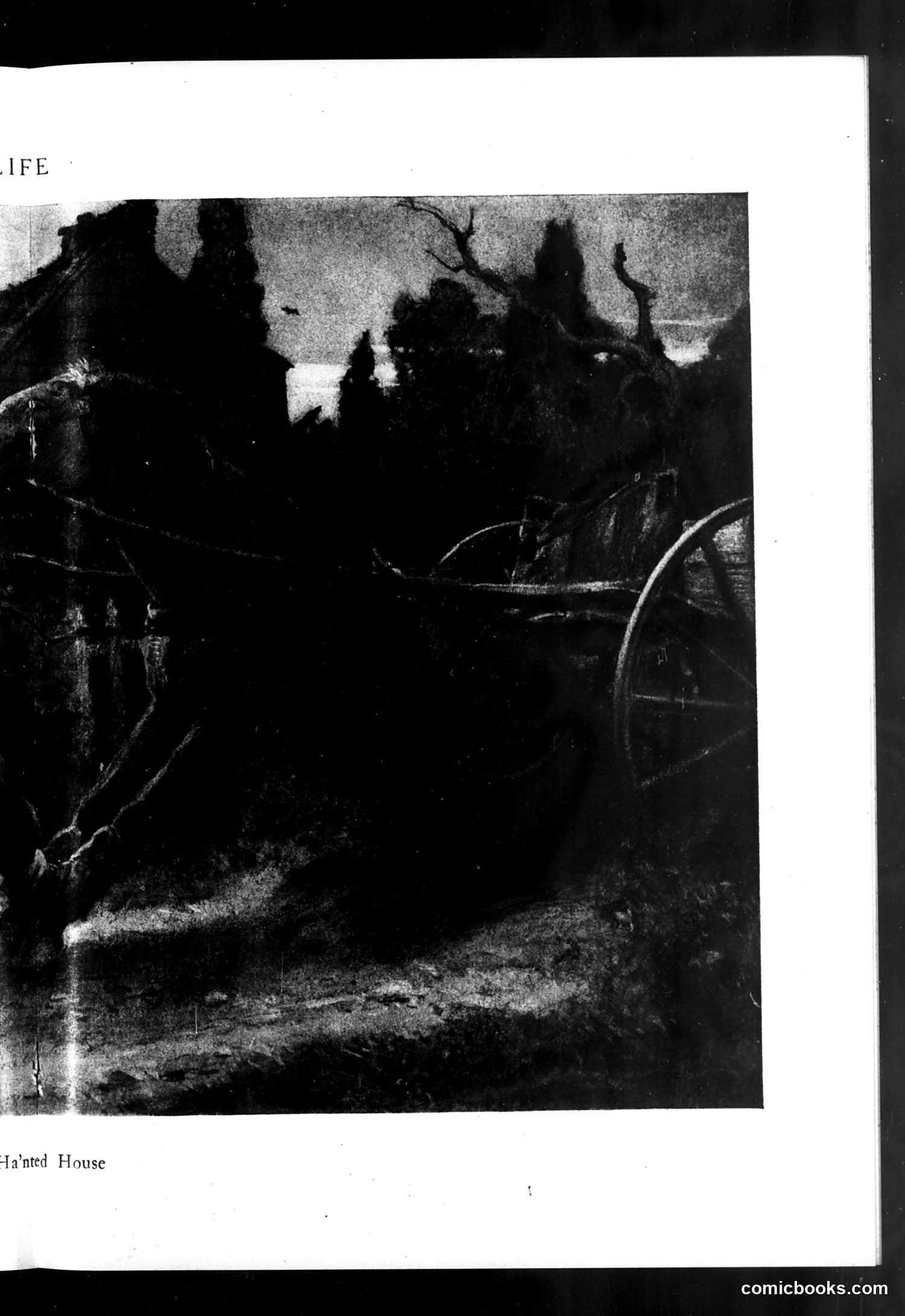
This page shows a black and white photograph labeled "Ha'nted House" (a playful misspelling of "Haunted House"). The image depicts silhouettes of figures that appear ghostly or supernatural in nature, with bare trees visible in the background, creating an eerie, Halloween-like atmosphere. Given the publication context of *Life* magazine—known for satirical commentary—this appears to be either a humorous Halloween-themed illustration or a visual joke playing on the concept of haunted houses. The deliberately dark, atmospheric photography creates an unsettling mood typical of ghost-story imagery. However, without additional surrounding context or text explaining the specific satirical point, the exact political or social commentary intended remains unclear.
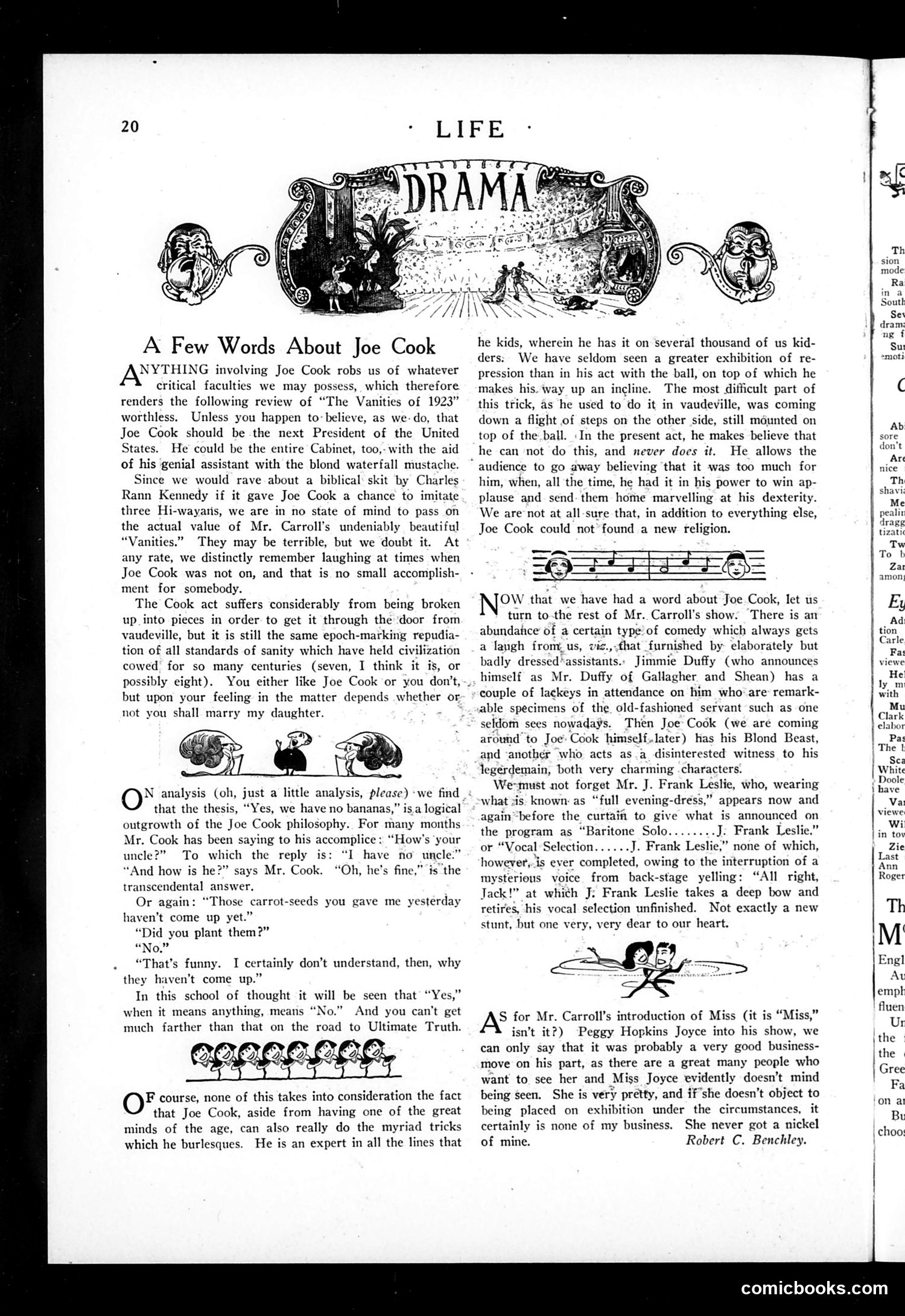
This is a drama review praising comedian Joe Cook's performance in the theatrical revue *The Vanities of 1923*. The author admits his criticism is worthless because Cook's comedic genius overwhelms rational judgment. Cook was a vaudeville performer known for absurdist humor—illogical dialogues like "How's your uncle?" / "I have no uncle"—that the reviewer compares to the popular song "Yes, We Have No Bananas." The satire celebrates Cook's philosophical nonsense as superior to conventional logic. The review also praises Cook's physical comedy: he performs difficult acrobatic tricks (balancing on a ball going uphill) but cleverly *pretends* he cannot complete them, denying audiences applause while secretly demonstrating mastery. This deliberate understatement of his abilities is presented as philosophically profound. The piece includes illustrations of Cook's comedic bits and mentions other performers in Carroll's show, though the main focus remains Cook's unique brand of vaudeville absurdism.
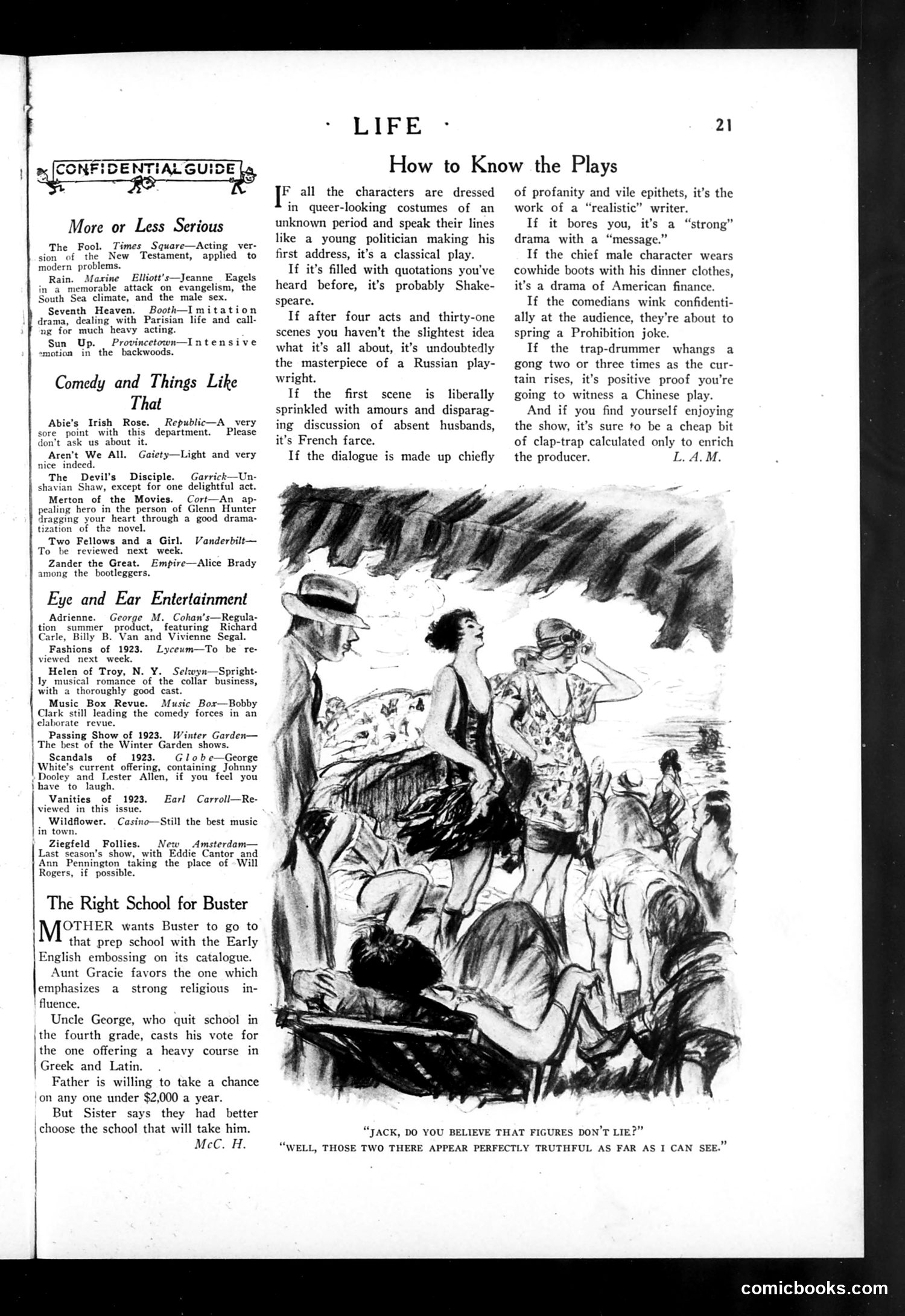
This page features a comedic guide mocking theater-goers' ability to identify play types by their superficial conventions. The satirist lists formulaic markers: classical plays feature archaic costumes and stilted delivery; Russian plays are incomprehensibly complex; French farces emphasize marital infidelity; American dramas inexplicably combine cowboy boots with formal wear; Chinese plays signal themselves with gong strikes. The deeper joke targets both theatrical pretension and audience gullibility—suggesting that serious drama often relies on artificial signifiers rather than genuine merit. The final barb is sharpest: if you actually *enjoy* the show, it's merely "cheap clap-trap" designed to fleece the producer's wallet. The accompanying cartoon (showing figures at what appears to be a beach or seaside) with its caption about "figures" and truthfulness complements this theme of deceptive appearances. This reflects 1920s skepticism toward Broadway's commercialism and intellectual posturing.
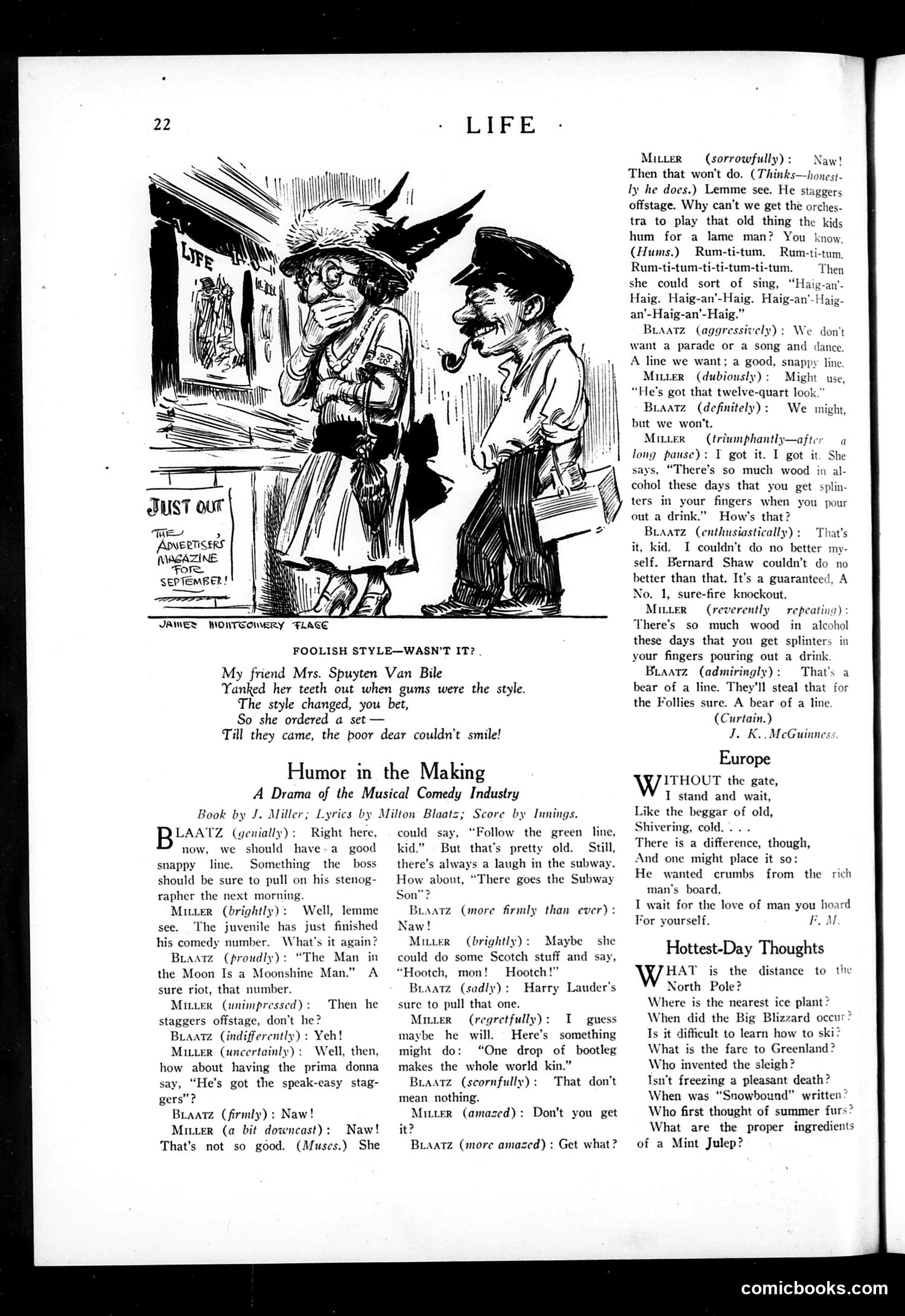
This page from *Life* magazine satirizes the musical comedy industry through a dialogue between Miller (a songwriter) and Blaatz (likely a producer or director). The cartoon and accompanying script mock the formulaic, cynical process of creating Broadway entertainment. The humor centers on how creative professionals manufacture "snappy lines" for shows—not through genuine artistry but through recycled gags and crude jokes. The example they debate is a crude joke about alcohol content causing splinters in fingers, which they treat as comedic gold despite its obvious awfulness. The satire targets the industry's cynicism: Blaatz dismisses better song ideas as "pretty old," and both men treat a terrible joke as a "guaranteed, No. 1, sure-fire knockout" simply because Bernard Shaw couldn't do better. The implication is that Broadway musical comedy relies on lowest-common-denominator humor rather than actual wit or originality. The lighter items ("Hottest-Day Thoughts") are trivial timefillers typical of the era's magazine content.
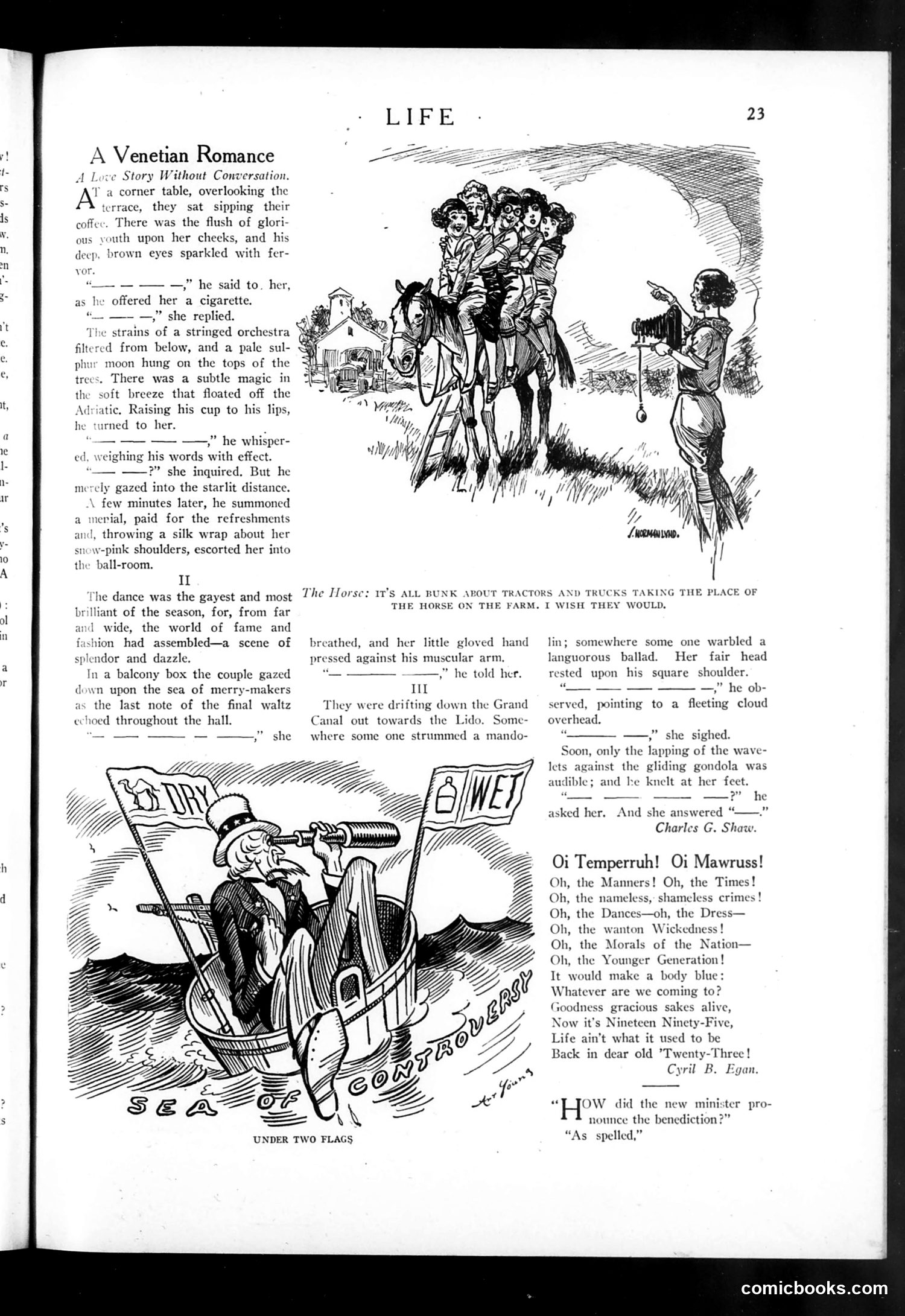
This satirical piece mocks the conventions of romantic literature and the speechlessness of modern youth. The story presents a stereotypical romantic scenario—a couple in Venice, moonlight, orchestral music—yet all dialogue is rendered as dashes, implying the characters have nothing to say to each other. The joke targets early 20th-century trends: young people's supposed inability or unwillingness to communicate meaningfully, despite being surrounded by romantic clichés. By replacing actual dialogue with blank lines, the author suggests modern romance is hollow performance rather than genuine connection. The separate cartoon titled "Under Two Flags" (showing a nautical figure) appears unrelated. Additionally, the page includes "Oi Temperruh! Oi Mawruss!"—a nostalgic lament about declining manners and morals among the younger generation, mocking older generations' complaints about modernity. This reinforces the page's theme of contemporary social criticism.
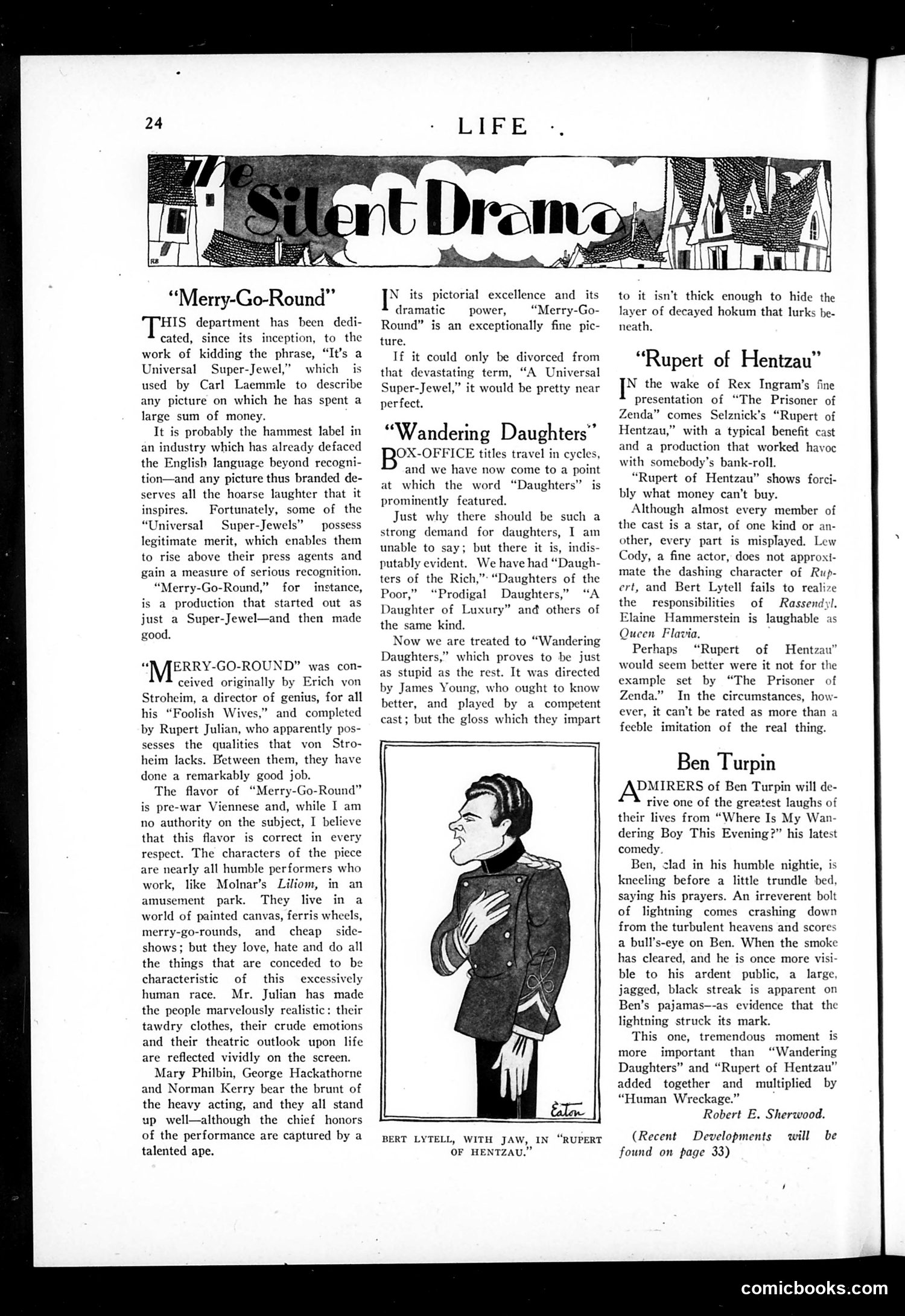
This page reviews three films. The critic mocks Universal's marketing slogan "Super-Jewel" for expensive but mediocre pictures. "Merry-Go-Round"—directed by the acclaimed Erich von Stroheim but completed by Rupert Julian—is praised as surprisingly good despite its label, depicting pre-war Vienna with realistic working-class characters in an amusement park setting. "Wandering Daughters" is dismissed as stupid hokum, part of a trend of "Daughters" titles flooding box offices. The critic finds the formula exhausted and uninspired. "Rupert of Hentzau" is criticized as a costly failure: though featuring star-studded casts (Bert Lytell, Lew Cody, Elaine Hammerstein), it cannot match the quality of the superior "Prisoner of Zenda." The review's point: money and famous actors cannot guarantee artistic merit in cinema.
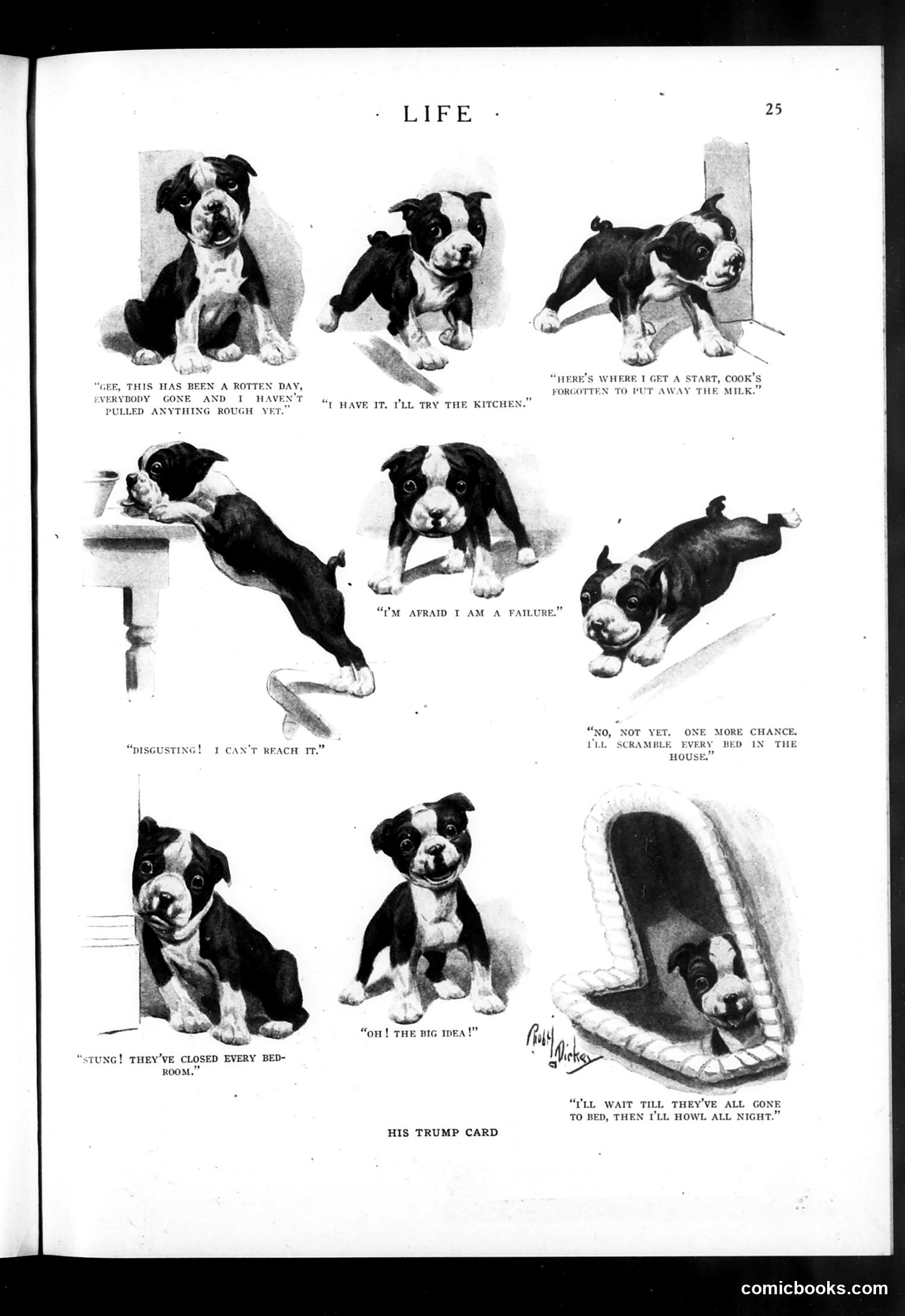
This humorous illustration from Life magazine presents nine sketches of a mischievous dog's inner monologue as it attempts various forms of household misconduct. The cartoons satirize pet behavior and household chaos through the dog's perspective. The sequence shows the dog's failed schemes: attempting theft from the kitchen, jumping on furniture, being unable to reach food, knocking things over, and ultimately resorting to nighttime howling as its "trump card"—its most effective weapon against the household. The humor operates on two levels: the obvious physical comedy of the dog's antics, and the anthropomorphization that gives the dog rational, scheming thoughts. The comic critiques both pet misbehavior and the power dynamic between pets and their owners, suggesting that despite human attempts at discipline, the dog's final recourse (noise disruption) remains unbeatable. The title "His Trump Card" emphasizes that howling is the dog's ace-in-the-hole strategy—its guaranteed way to win.
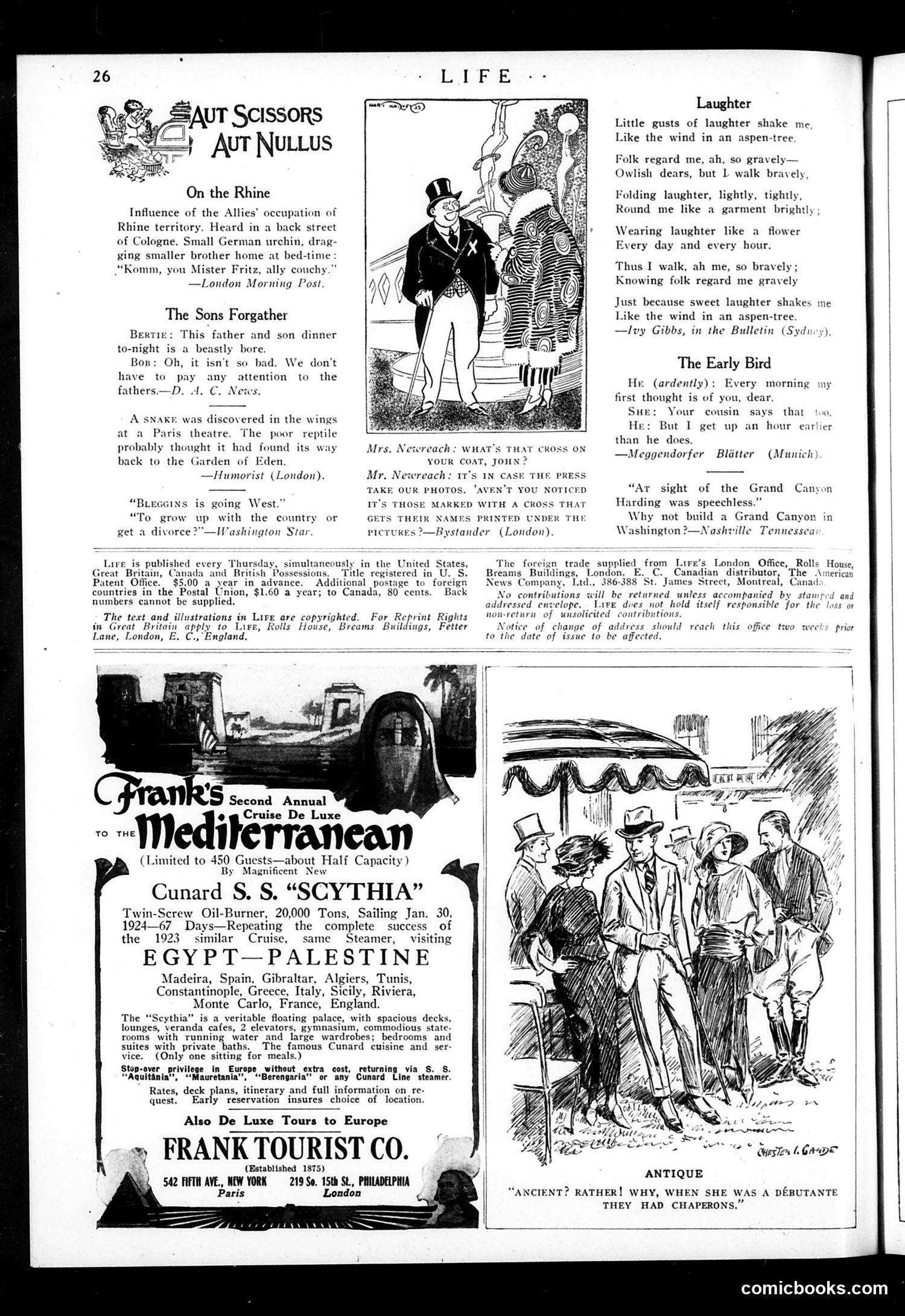
This page contains several brief satirical items and advertisements typical of Life's format: **"On the Rhine"** mocks post-WWI occupation dynamics: a small German boy tells his brother to come home, calling him "Mister Fritz, ally couchy"—satirizing how German children have absorbed Allied military presence into their vocabulary. **"The Sons Forgather"** is a simple generation-gap joke about fathers and sons ignoring each other at dinner. **The Newreach cartoon** appears to reference press photographers marking their coats with crosses to identify themselves during photo opportunities—likely satirizing media behavior at public events. The page is otherwise dominated by **luxury travel advertisements** for Cunard cruise lines and Frank Tourist Company, promoting Mediterranean and Egyptian cruises—reflecting the 1920s leisure industry boom. The poetry and miscellaneous jokes are filler typical of Life's satirical format. The overall content reflects early 1920s concerns: post-war European conditions, social customs, and consumer aspirations among wealthy American readers.
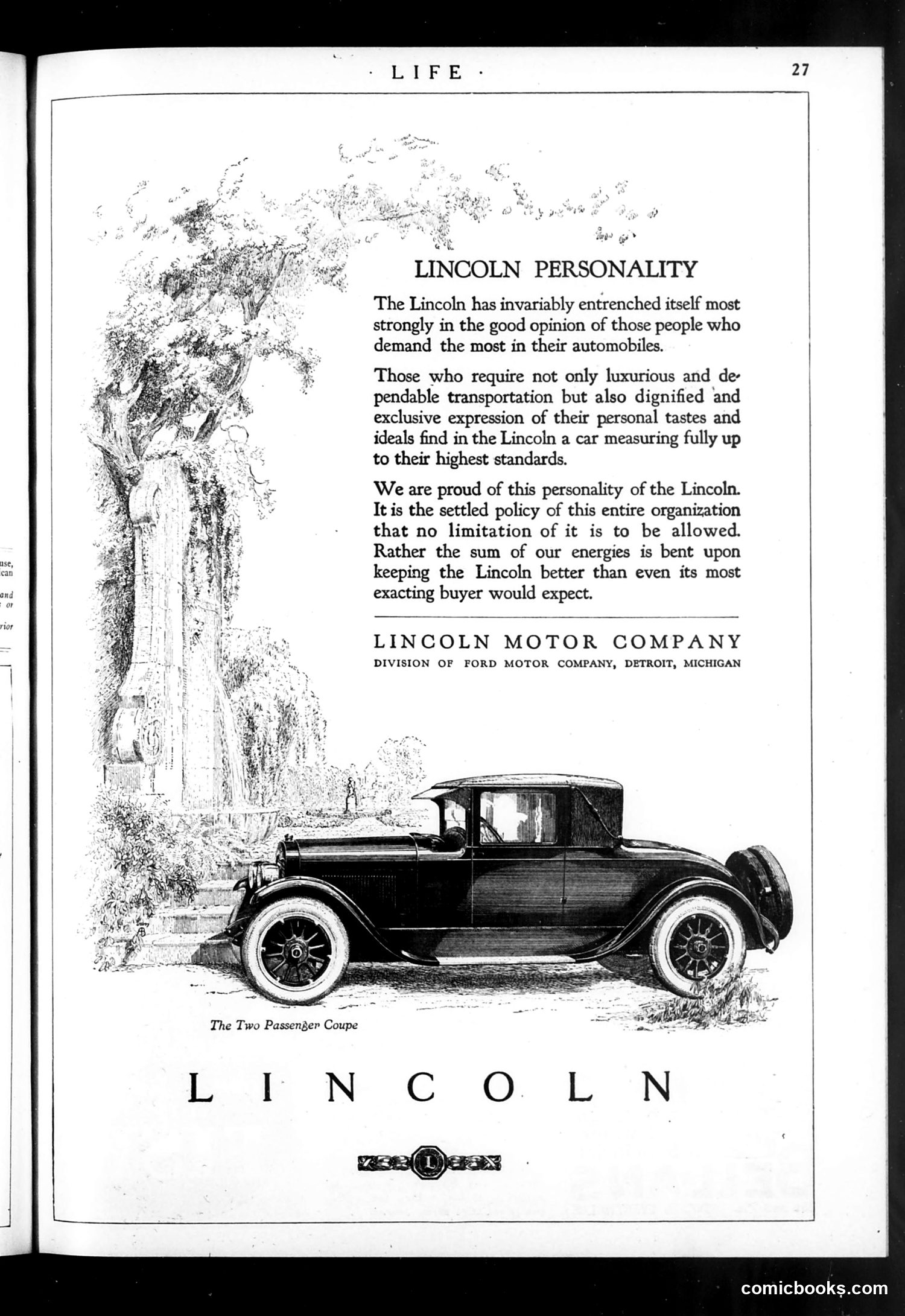
This is **not a cartoon or satire** — it's a straightforward automobile advertisement from Life magazine (page 27). The page promotes the **Lincoln Motor Company**, a division of Ford, featuring "The Two Passenger Coupe" model. The ad uses aspirational marketing language typical of the 1920s luxury car market, emphasizing that Lincoln appeals to discerning buyers who demand both "luxurious and dependable transportation" and "dignified and exclusive expression of their personal tastes." The imagery includes an artistic sketch of a tree (suggesting permanence and heritage) and a detailed drawing of the actual vehicle. The copy promises that Lincoln maintains uncompromising quality standards, always exceeding customer expectations. This represents early 20th-century automotive advertising targeting wealthy, status-conscious consumers.
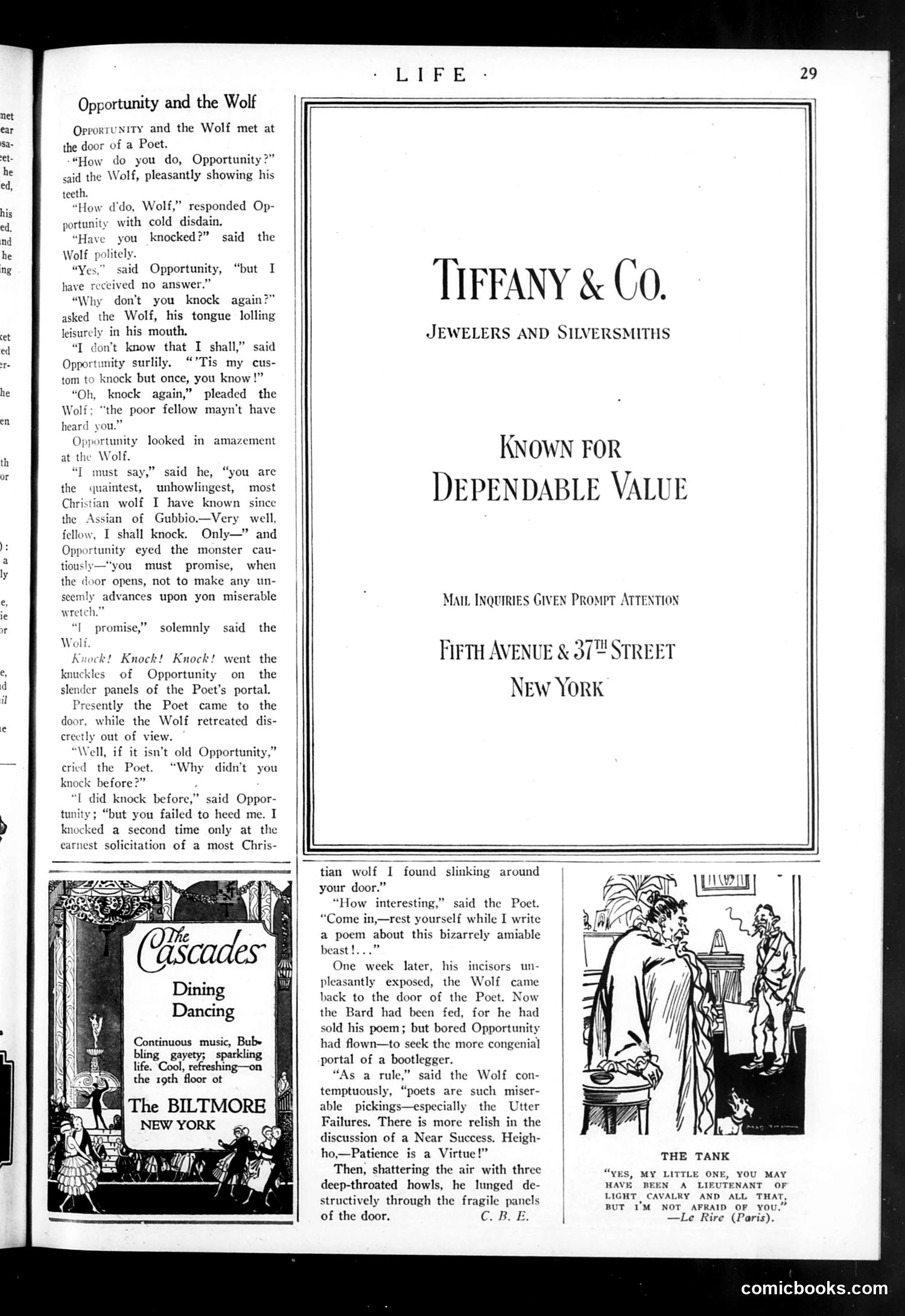
This is a satirical fable cautioning poets and creative types about lost opportunities. The Wolf represents danger or misfortune; Opportunity personifies chance itself. The narrative's moral: when Opportunity knocks, answer immediately. The Poet ignores Opportunity's first knock, so she returns only when persuaded by the Wolf—who then devours the Poet after he's had his brief success (selling a poem). The satire targets struggling artists who procrastinate or ignore their chances, then wonder why fortune abandons them. The "Christian wolf" is ironic—the Wolf behaves more honorably than Opportunity, who has rigid rules about knocking only once. The joke suggests that in real life, misfortune (the Wolf) may be more reliable than actual opportunity. The page also contains a Tiffany & Co. advertisement and an unrelated cartoon titled "The Tank" (bottom right).
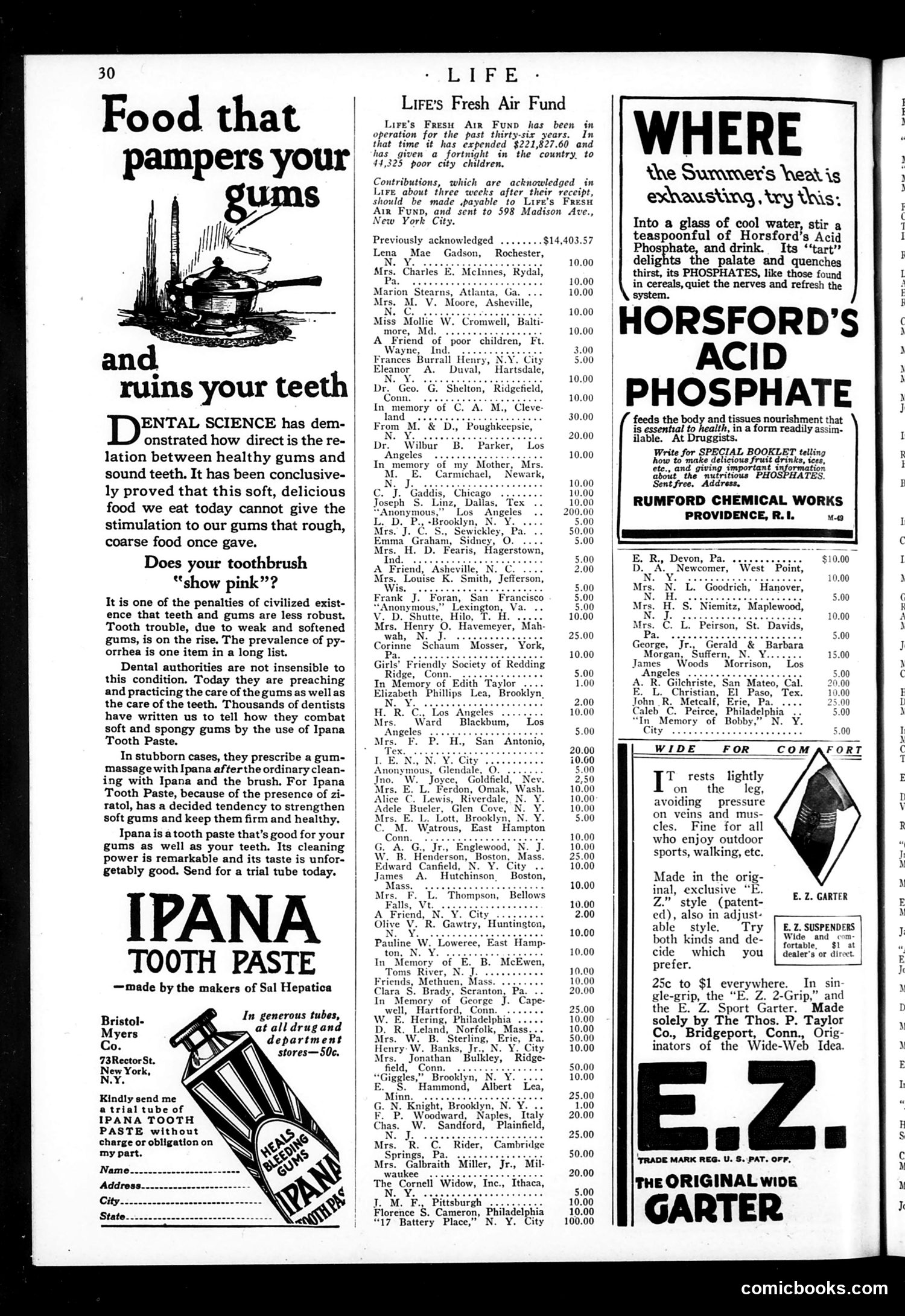
This page is primarily **advertising**, not political satire. It contains three unrelated advertisements: 1. **Ipana Tooth Paste** (left): A dental hygiene ad arguing that modern soft foods weaken gums, causing pyorrhea. It promotes Ipana's "ziratol" ingredient to strengthen soft, spongy gums—a common early-20th-century health concern. 2. **Life's Fresh Air Fund** (center): A charitable fundraising appeal listing donors who contributed to send poor city children to the countryside for two weeks. This reflects Progressive Era philanthropy. 3. **Horsford's Acid Phosphate** (right): A health tonic ad claiming phosphates provide nerve stimulation and refresh the system—typical of patent medicine marketing. The page reflects 1920s consumer anxieties: dental disease from "civilized" soft foods, urban poverty requiring charity, and commercial "scientific" remedies. No political figures or satire are present—this is straightforward period advertising demonstrating commercial and social preoccupations of the era.
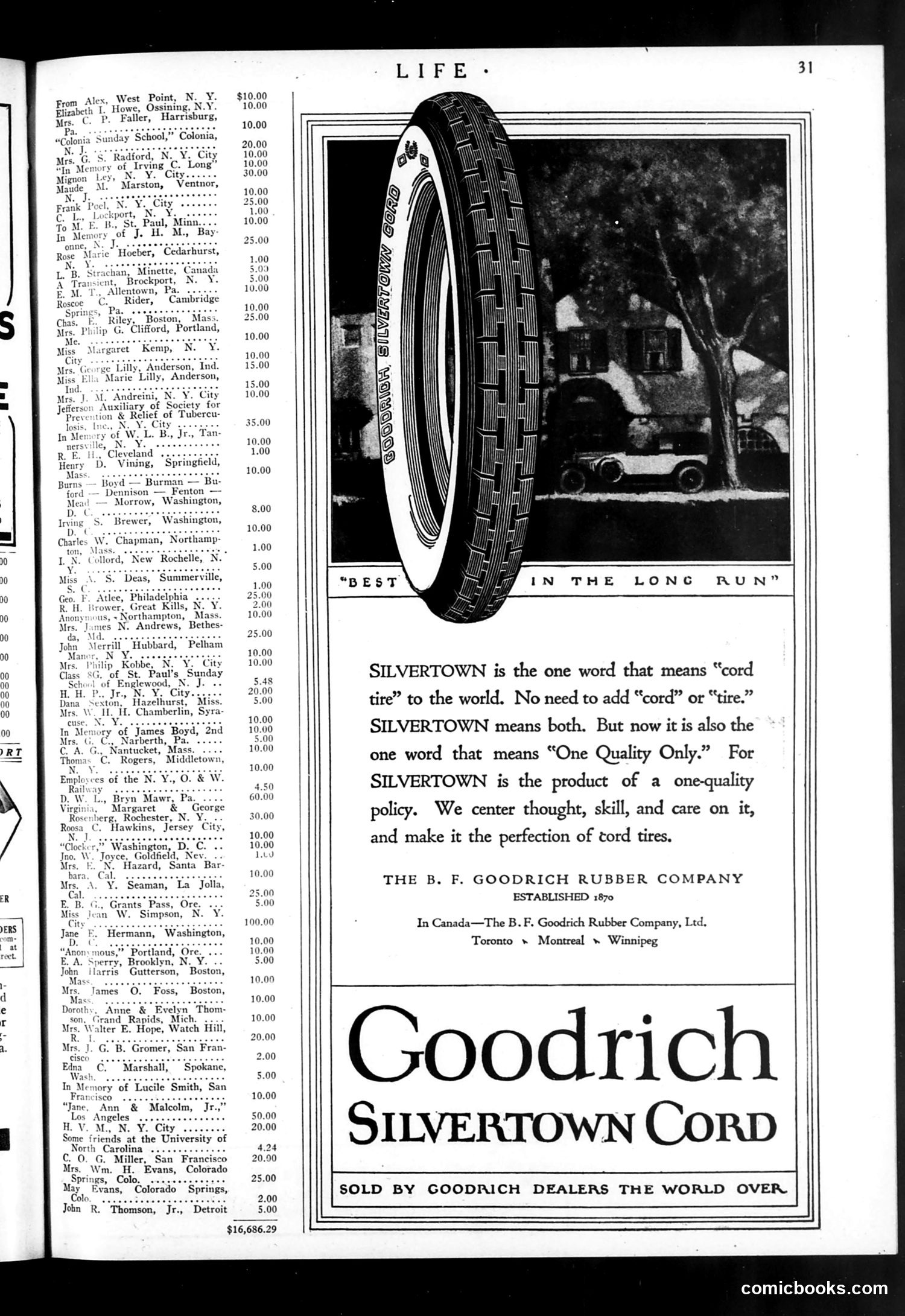
This page is primarily a **Goodrich Rubber Company advertisement** for Silvertown cord tires, not political satire. The main visual shows a large tire photographed against a scenic background with the tagline "Best in the Long Run." The ad's pitch emphasizes that "Silvertown" has become synonymous with "cord tire" itself—establishing brand dominance through linguistic association. The copy stresses the company's "one-quality policy," positioning the product as premium and reliable. The left column contains **donation acknowledgments** to Life magazine (apparently a fundraiser or subscription list), unrelated to the tire advertisement. This represents early 20th-century **corporate advertising strategy**: building brand identity by making the product name generic while claiming superior quality and longevity. No political content or satire is present on this page.
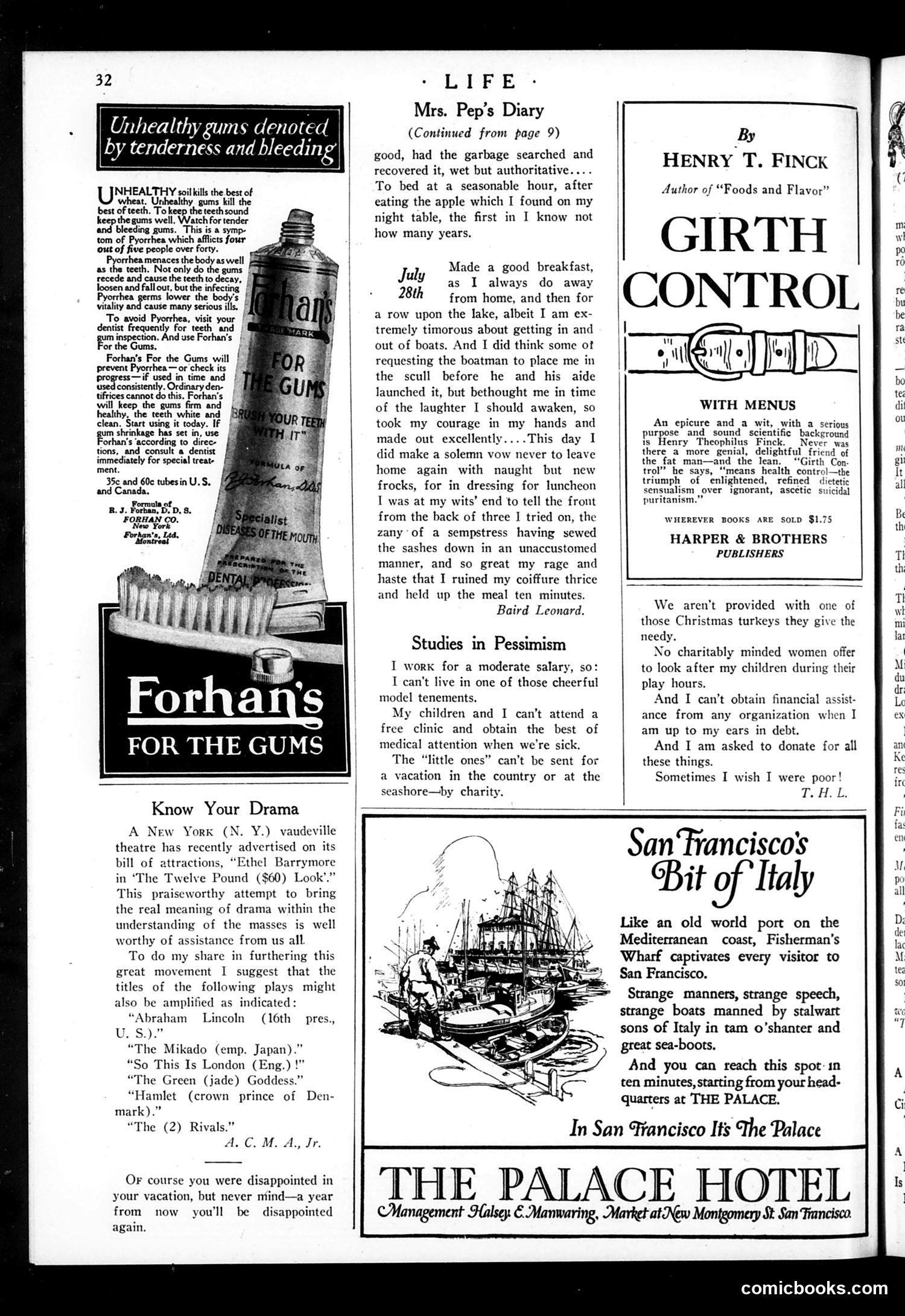
This page contains multiple satirical items reflecting early 20th-century American concerns: **"Forhan's for the Gums"** is a toothpaste advertisement that doubles as health commentary—pyorrhea (gum disease) affecting four of five people over forty appears as a widespread public health issue demanding commercial intervention. **"Know Your Drama"** satirizes the democratization of theater titles, where a vaudeville house adds explanatory subtitles (like identifying Ethel Barrymore's character by costume price) to make plays accessible to masses. The contributor humorously extends this with other famous plays, mocking both the need for such clarification and mass audiences' presumed ignorance. **"Mrs. Pep's Diary"** presents domestic humor about a woman frustrated by clothing sent from seamstresses with reversed sashes and ruined hairstyles. **"Studies in Pessimism"** offers dark social commentary: a moderate-salary worker cannot afford cheerful modern tenements, cannot access free clinics, and cannot afford vacations for children—critiquing both economic inequality and limited social welfare provisions. These pieces collectively reflect pre-Depression American class anxieties and commercial culture's reach into daily life.
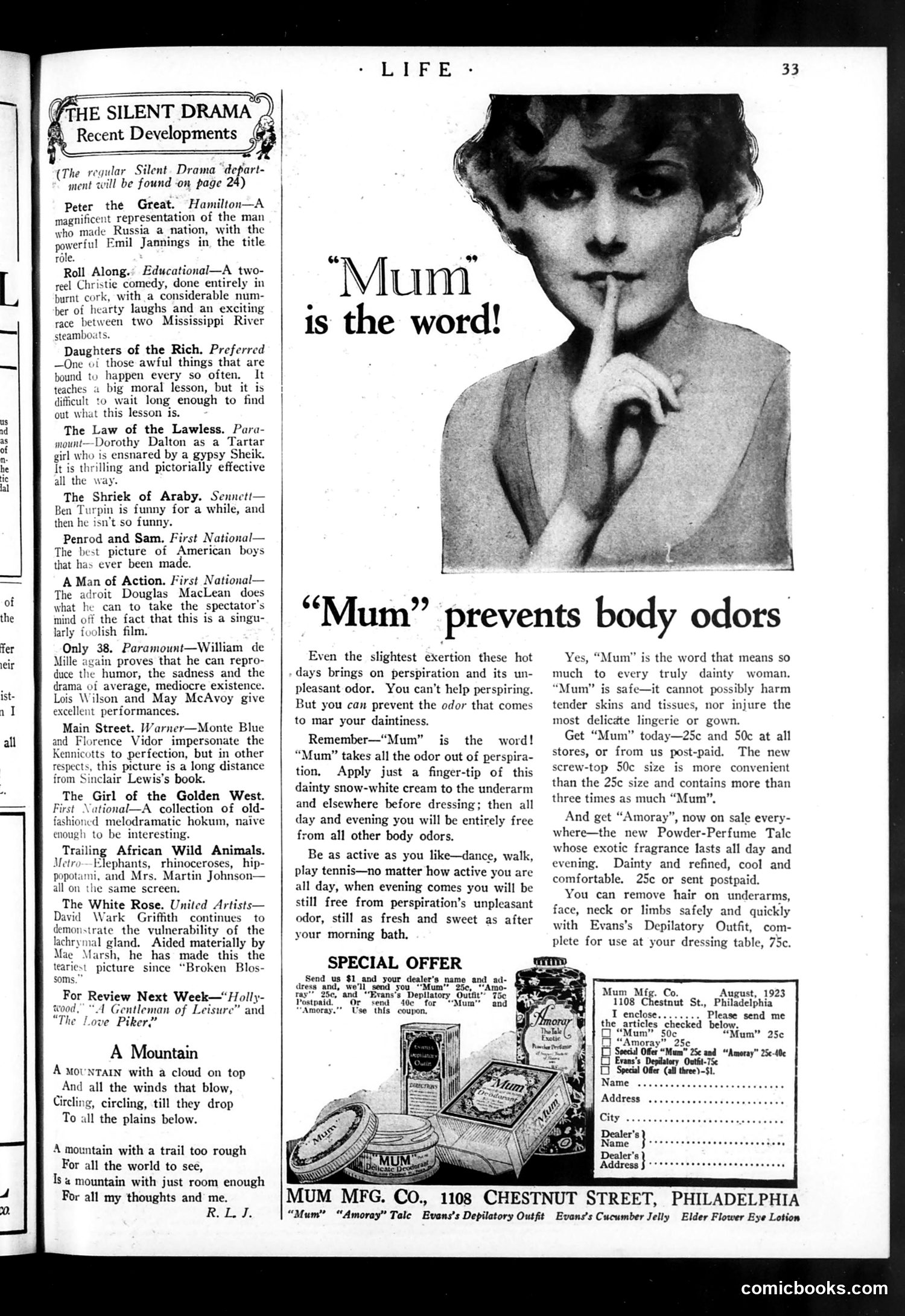
This page is primarily a **product advertisement** for "Mum" deodorant, not political satire. The layout mixes entertainment reviews (silent films) with commercial advertising—typical of 1920s magazines. The central image shows a woman with the headline **"'Mum' is the word!"**—a pun playing on the common expression meaning "keep quiet." The ad promotes Mum as a solution to perspiration odor, particularly important "these hot days." The pitch emphasizes that active women (dancing, tennis, walking) can remain "entirely free from all other body odors" with a simple cream application. The ad also promotes companion products: "Amoray" perfume and "Evans's Depilatory Outfit" (hair removal). This reflects **1920s attitudes toward female hygiene and propriety**: perspiration and body odors were presented as unacceptable for "truly dainty" women. The advertisement normalizes anxieties about female bodies while promising chemical solutions—a marketing strategy that became ubiquitous throughout the twentieth century.
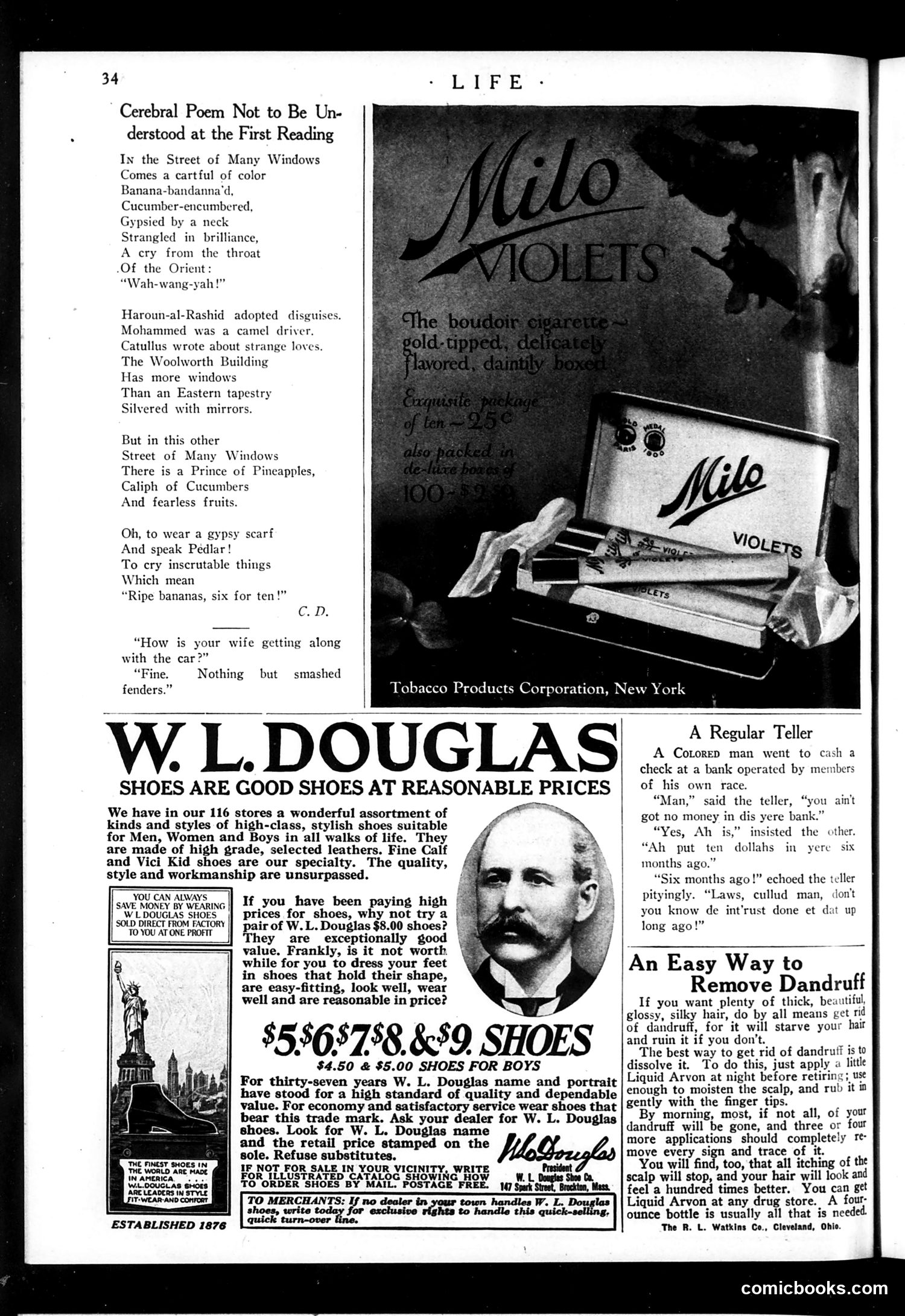
This page contains primarily **advertisements** rather than political cartoons. The main content includes: **"Cerebral Poem"** (top left): A modernist poem by C.D. describing street vendors selling produce in New York, with Oriental imagery ("Wah-wang-yah!"). It's whimsical rather than satirical—celebrating colorful street commerce and the exotic appeal of immigrant vendors selling exotic fruits like bananas and pineapples. **"A Regular Teller"** (right side): A brief joke with racist dialect humor, depicting a Black man attempting to withdraw money from his own bank. The humor relies on stereotyped speech patterns and the teller's condescending disbelief—reflecting the era's casual racial prejudice. The remainder is commercial advertising: W.L. Douglas shoes, Milo violets cigarettes, and a dandruff remedy. No political satire is present; this is a typical early 20th-century magazine page mixing light entertainment with advertising.
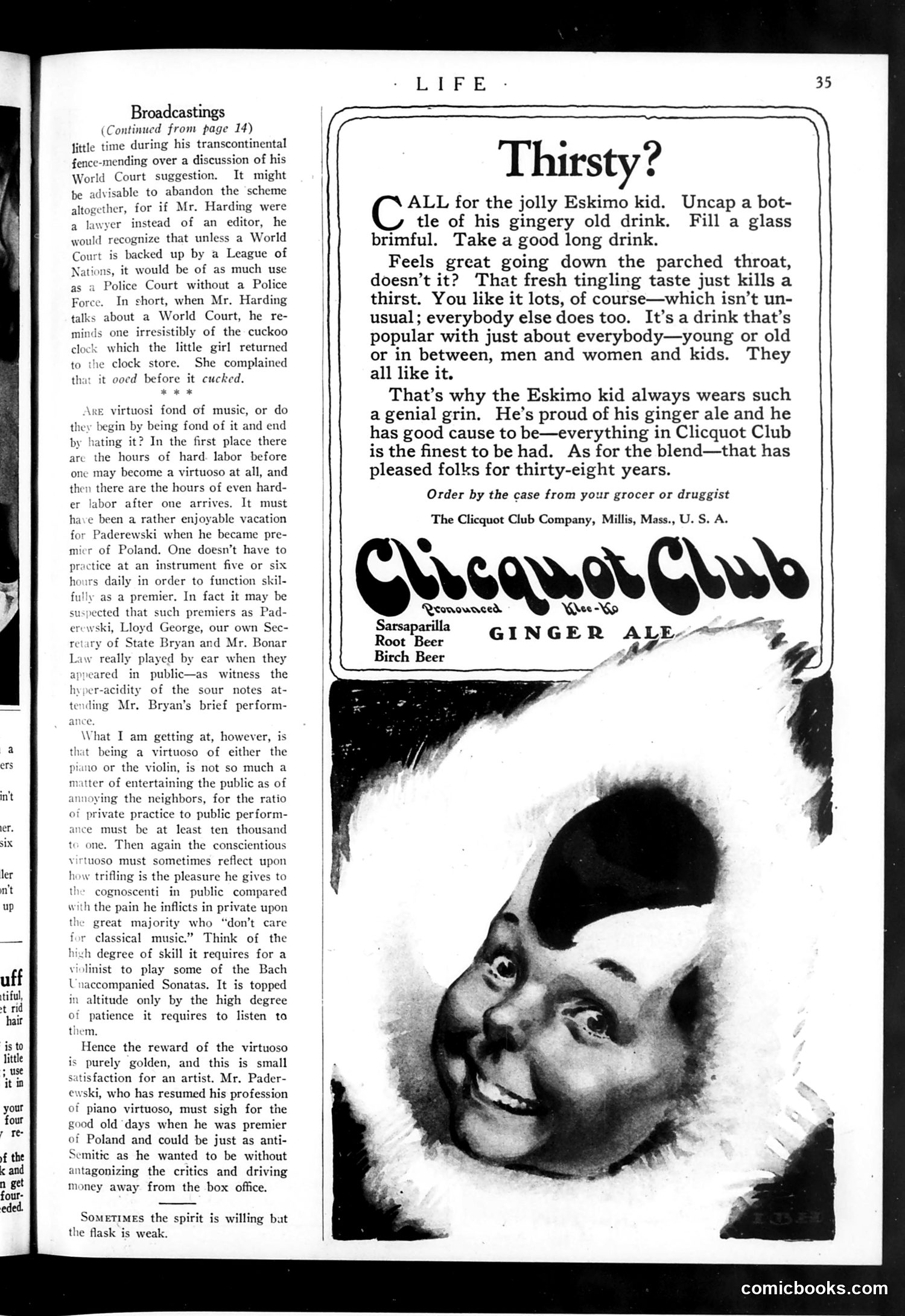
This page combines editorial commentary with advertising. The main text section critiques President Harding's proposal for a World Court, arguing it's meaningless without League of Nations backing—comparing it to a cuckoo clock that "ooed before it cucked" (a malfunctioning device). The piece also discusses virtuoso musicians, including Paderewski, former Premier of Poland, sardonically suggesting he preferred his political role because it allowed him to avoid practice while still annoying people publicly. The large advertisement dominates the right side, featuring an Eskimo child's face promoting Clicquot Club beverages (ginger ale, root beer, birch beer). The ad uses the stereotypical "jolly Eskimo kid" character to market soft drinks as universally appealing to all ages and genders. This reflects early 20th-century advertising practices that relied on ethnic caricature without self-consciousness about racial representation.
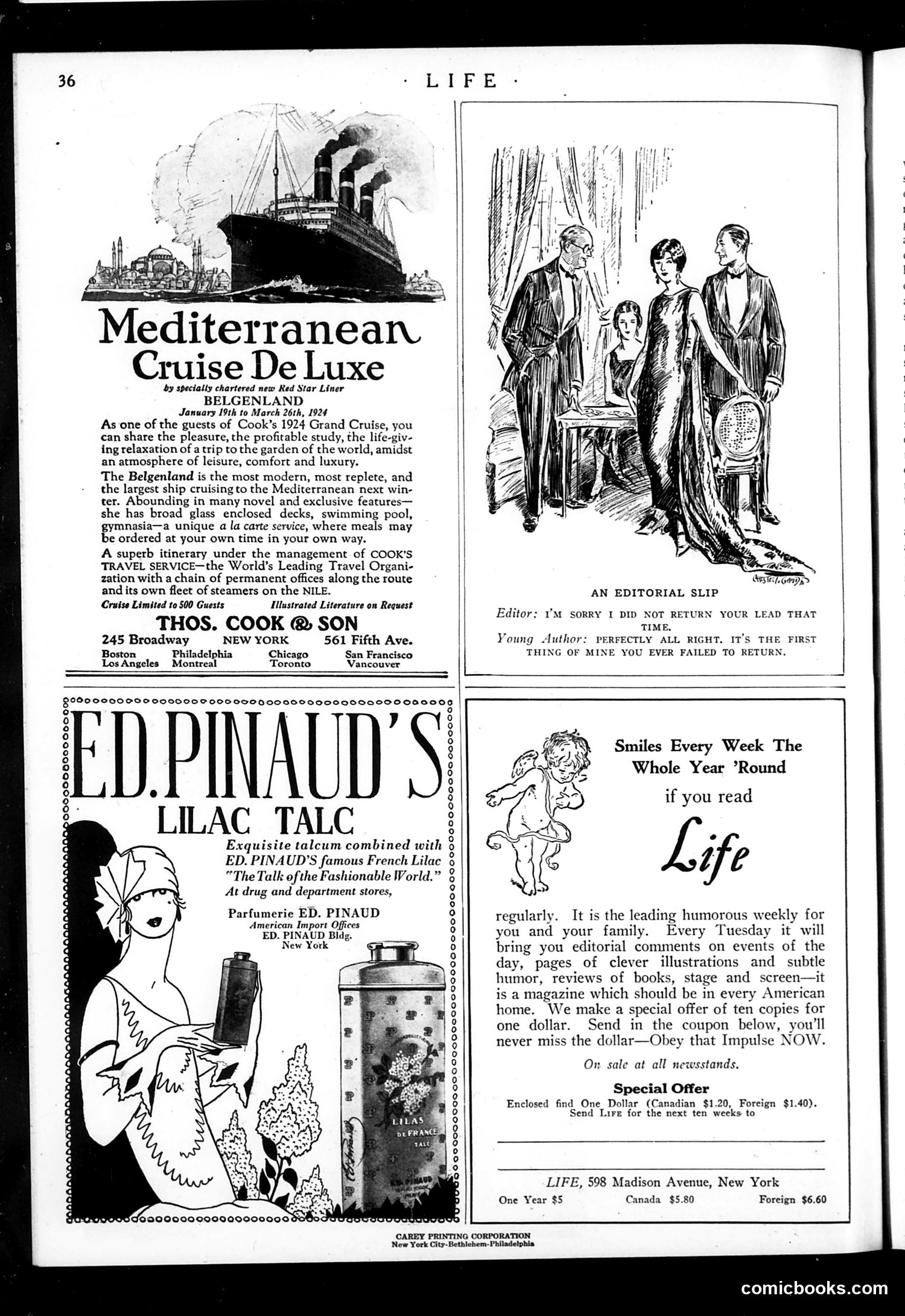
This page consists primarily of **advertisements** interspersed with two brief **humorous pieces**. The main ads promote luxury travel (Mediterranean cruise on the Belgenland ship), French talcum powder (Ed. Pinaud's Lilac Talc), and a subscription offer for *Life* magazine itself. The cartoon content includes: 1. **"An Editorial Slip"** — A joke about a young author whose manuscript was finally rejected by an editor, but the author quips that this is the *first* time the editor ever returned anything, implying the editor typically loses submissions. It's mild office humor about editorial incompetence. 2. **Life Magazine Subscription Ad** — Features a cherub and promotes *Life* as "the leading humorous weekly," emphasizing its editorial commentary, illustrations, and reviews of books and theater. The ad offers ten weeks for one dollar. The page reflects 1920s consumer culture and *Life*'s positioning as an affluent, sophisticated humor magazine for middle and upper-class readers.
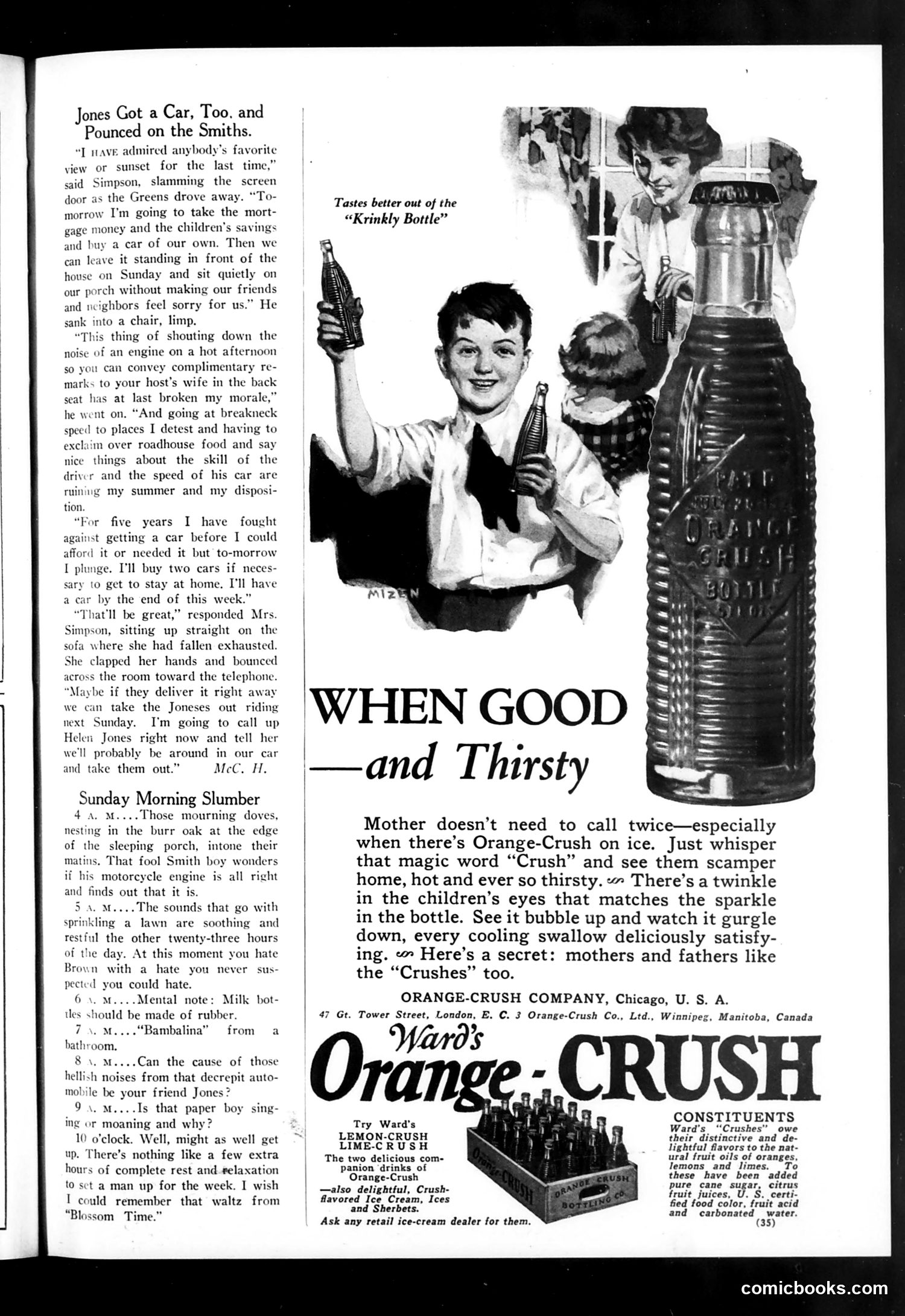
This Life magazine page contains **two distinct pieces**: ## Left Column: Social Satire A humorous domestic story depicts Mr. Simpson's frustration with car culture. He's exhausted by visiting neighbors' homes via automobile—enduring noisy drives, forced compliments about cars and drivers, and unwanted trips to places he dislikes. His breaking point: he decides to buy not one but *two* cars himself, so his family can stay home. The joke satirizes 1920s automobile aspirations and status anxiety: acquiring a car becomes necessary merely to *avoid* the social pressure of car visits. Mrs. Simpson immediately plans to invite the Joneses for a ride, perpetuating the cycle—the very behavior that drove Simpson mad. ## Right Column: Advertisement An Orange-Crush beverage ad features a boy and girl holding bottles, targeting families with messaging about children eagerly coming home for cold drinks. The ad emphasizes parental appeal and refreshment. **Historical context**: This reflects 1920s anxieties about automobile ownership becoming a social obligation and status marker among middle-class neighbors.
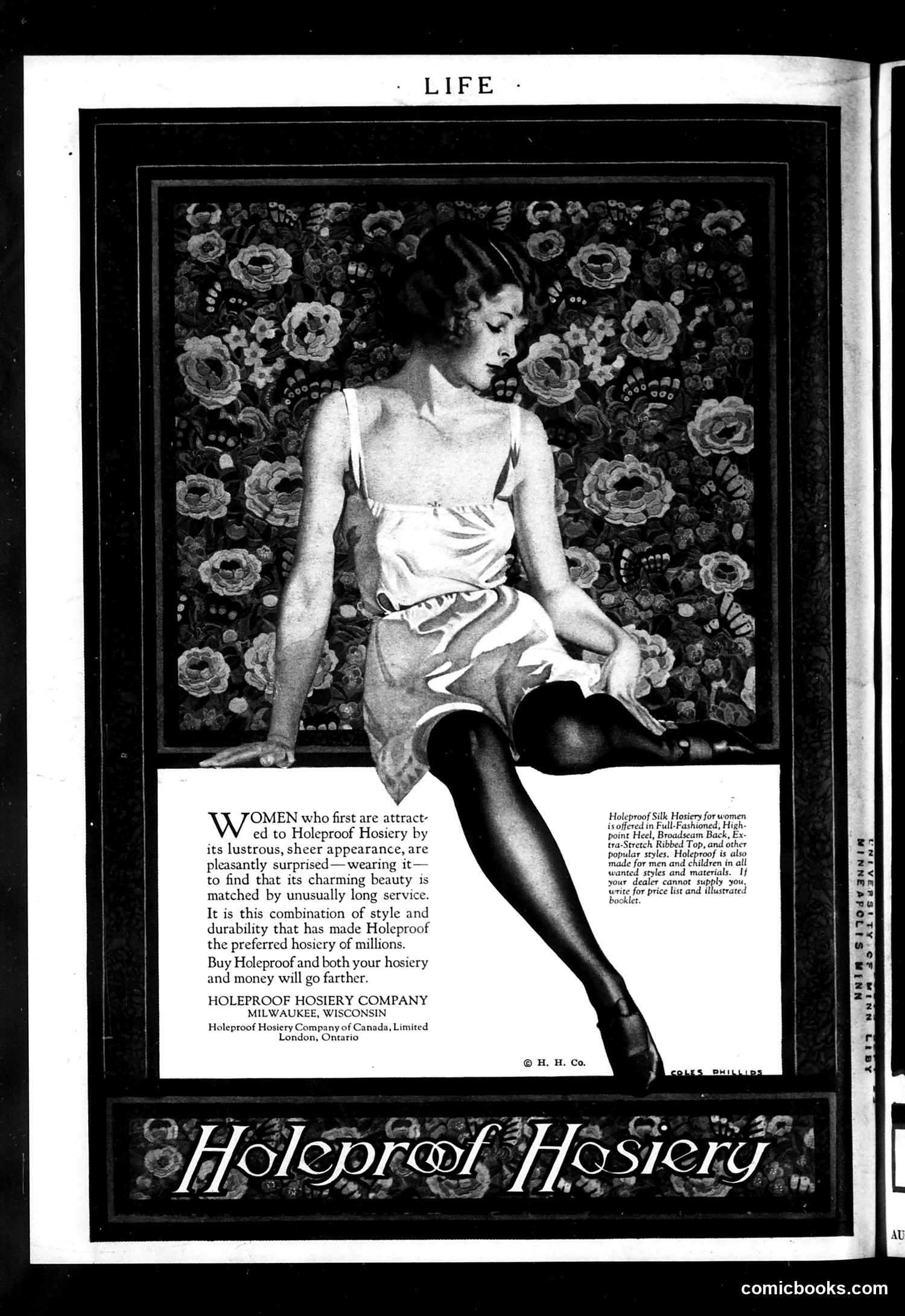
This is a **straightforward advertisement**, not satire or political commentary. It's a Holeproof Hosiery Company advertisement from *Life* magazine featuring a woman in elegant dress posed against a floral backdrop, displaying hosiery. The ad emphasizes that Holeproof stockings combine "lustrous, sheer appearance" with "unusually long service"—durability matched with style. The tagline "both your hosiery and money will go farther" appeals to value-conscious consumers, likely during an economically conscious era (possibly 1920s-1930s based on styling and typography). The visual reinforces the sales pitch: the model's pose and fashionable presentation demonstrate how the product enhances appearance, while the text reassures buyers about longevity. This represents typical early 20th-century consumer advertising that blended aspirational imagery with practical product benefits to appeal to women shoppers.