
Life, 1923-08-02 · page 26 of 40
Life — August 2, 1923 — page 26: what you’re looking at
What you’re looking at
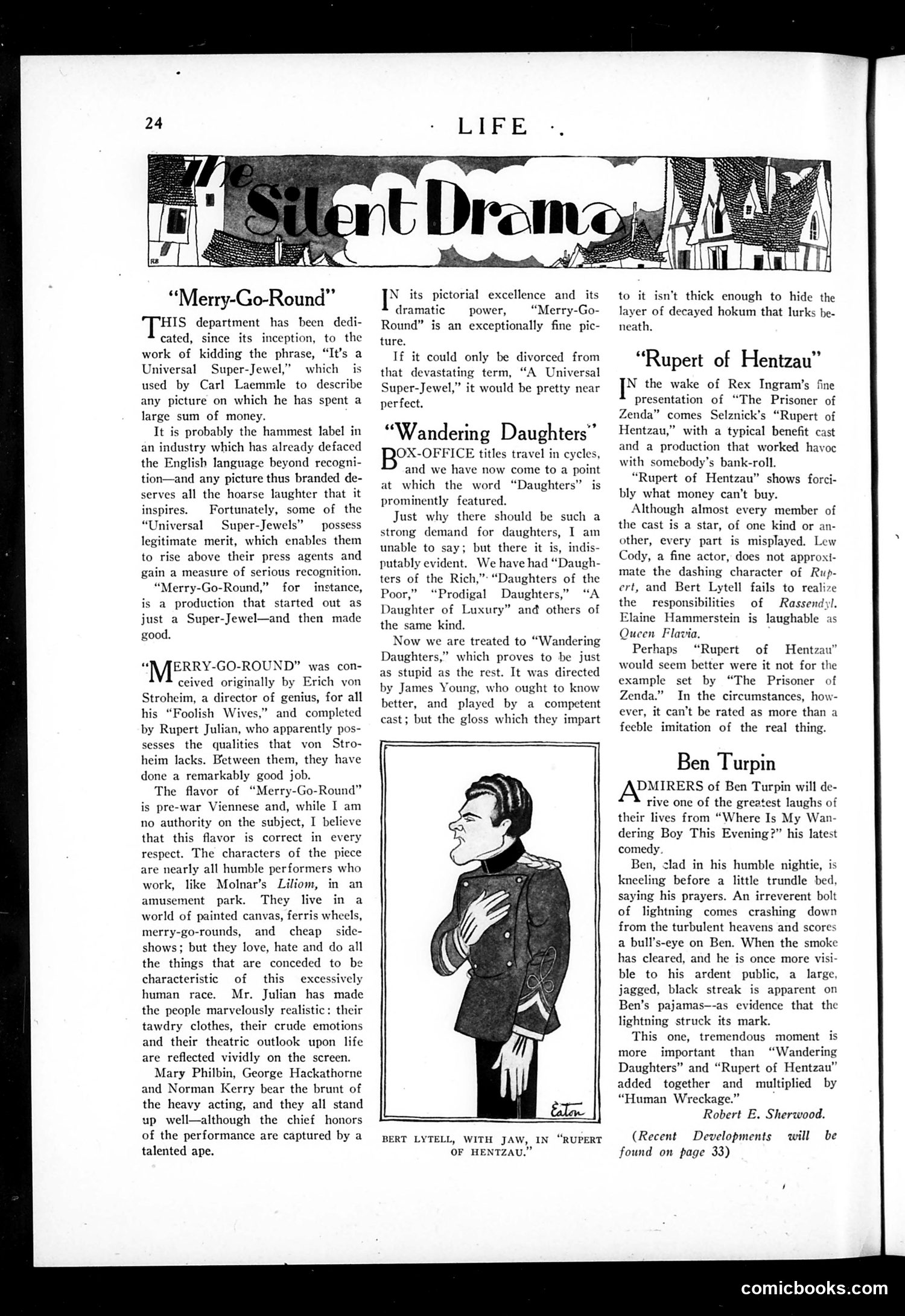
This page reviews three films. The critic mocks Universal's marketing slogan "Super-Jewel" for expensive but mediocre pictures. "Merry-Go-Round"—directed by the acclaimed Erich von Stroheim but completed by Rupert Julian—is praised as surprisingly good despite its label, depicting pre-war Vienna with realistic working-class characters in an amusement park setting. "Wandering Daughters" is dismissed as stupid hokum, part of a trend of "Daughters" titles flooding box offices. The critic finds the formula exhausted and uninspired. "Rupert of Hentzau" is criticized as a costly failure: though featuring star-studded casts (Bert Lytell, Lew Cody, Elaine Hammerstein), it cannot match the quality of the superior "Prisoner of Zenda." The review's point: money and famous actors cannot guarantee artistic merit in cinema.
📄 Transcribed text from this page (OCR, searchable)
Machine-transcribed from the original scan — historical spelling and the odd misread are preserved.
“Merry-Go-Round” 'HIS department has been dedi- cated, since its inception, to the work of kidding the phrase, “It’s a Universal Super-Jewel,” which is used by Carl Laemmle to describe any picture on which he has spent a large sum of money. It is probably the hammest label in an industry which has already defaced the English language beyond recogni- tion—and any picture thus branded de- serves all the hoarse laughter that it inspires. Fortunately, some of the “Universal Super-Jewels” _ possess legitimate merit, which enables them to rise above their press agents and gain a measure of serious recognition. “Merry-Go-Round,” for instance, is a production that started out as just a Super-Jewel—and then made good. “N\ JJERRY-GO-ROUND” was con- ceived originally by Erich yon Stroheim, a director of genius, for all his “Foolish Wives,” and completed by Rupert Julian, who apparently pos- sesses the qualities that von Stro- heim lacks. Between them, they have done a remarkably good job. The flavor of “Merry-Go-Round” is pre-war Viennese and, while I am no authority on the subject, I believe that this flavor is correct in every respect. The characters of the piece are nearly all humble performers who work, like Molnar’s Liliom, in an amusement park. They live in a world of painted canvas, ferris wheels, merry-go-rounds, and cheap _ side- shows; but they love, hate and do all the things that are conceded to be characteristic of this excessively human Mr. Julian has made the people marvelously realistic: their tawdry clothes, their crude emotions and their theatric outlook upon life are reflected vividly on the screen. Mary Philbin, George Hackathorne and Norman Kerry bear the brunt of the heavy acting, and they all stand up well—although the chief honors of the performance are captured by a talented ape. race. N its pictorial excellence and its dramatic power, “Merry-Go- Round” is an exceptionally fine pic- ture. If it could only be divorced from that devastating term, “A Universal Super-Jewel,” it would be pretty near perfect. “Wandering Daughters” OX-OFFICE titles travel in cycles, and we have now come to a point at which the word “Daughters” is prominently featured. Just why there should be such a strong demand for daughters, I am unable to say; but there it is, indis- putably evident. We have had “Daugh- ters of the Rich,” “Daughters of the Poor,” “Prodigal Daughters,” “A Daughter of Luxury” and others of the same kind. Now we are treated to “Wandering Daughte: which proves to be just as stupid as the rest. It was directed by James Young, who ought to know better, and played by a competent cast; but the gloss which they impart BERT LYTELL, WITH JAW, IN OF HENTZAU.” “RUPERT to it isn't thick enough to hide the layer of decayed hokum that lurks be- neath, “Rupert of Hentzau” I V the wake of Rex Ingram’s fine presentation of “The Prisoner of Zenda” comes Selznick’s “Rupert of Hentzau,” with a typical benefit cast and a production that worked havoc with somebody’s bank-roll. “Rupert of Hentzau” shows forci- bly what money can’t buy. Although almost every member of the cast is a star, of one kind or an- other, every part is misplayed. Lew Cody, a fine actor, does not approxi- mate the dashing character of Rup- ert, and Bert Lytell fails to realize the responsibilities of Rassendyl. Elaine Hammerstein is laughable as Queen Flavia. Perhaps “Rupert of Hentzau” would seem better were it not for the example set by “The Prisoner of Zenda.” In the circumstances, how- ever, it can’t be rated as more than a feeble imitation of the real thing. Ben Turpin ADMIRERS of Ben Turpin will de- rive one of the greatest laughs of their lives from “Where Is My Wan- dering Boy This Evening?” his latest comedy. Ben, clad in his humble nightie, is kneeling before a little trundle bed, saying his prayers. An irreverent bolt of lightning comes crashing down from the turbulent heavens and scores a bull’s-eye on Ben. When the smoke has cleared, and he is once more visi- ble to his ardent public, a large, jagged, black streak is apparent on Ben’s pajamas—-as evidence that the lightning struck its mark. This one, tremendous moment is more important than “Wandering Daughters” and “Rupert of Hentzau” added together and multiplied by “Human Wreckage.” Robert E. Sherwood. (Recent Developments will be found on page 33) comicbooks.com