
Life, 1923-08-02 · page 22 of 40
Life — August 2, 1923 — page 22: what you’re looking at
What you’re looking at
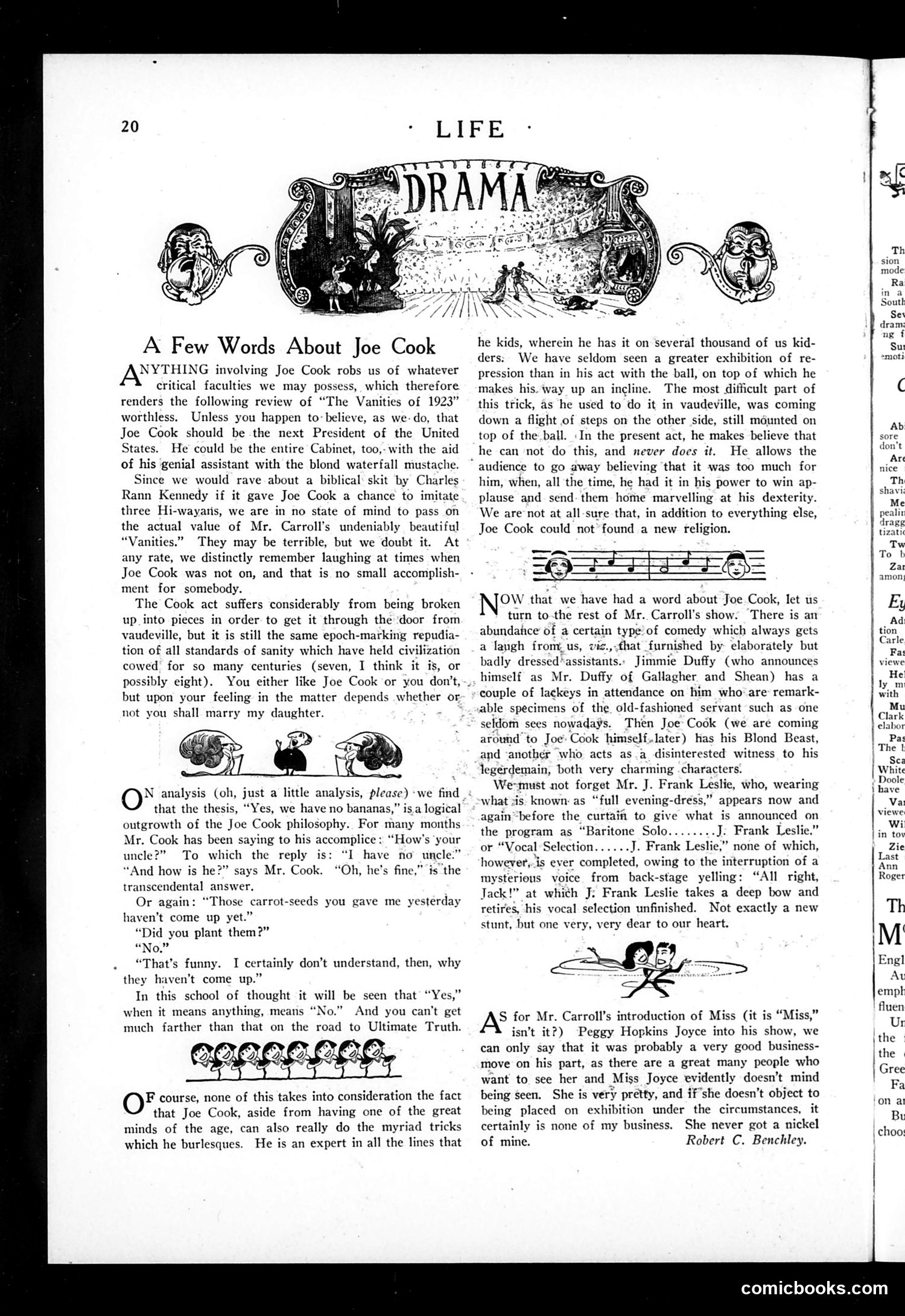
This is a drama review praising comedian Joe Cook's performance in the theatrical revue *The Vanities of 1923*. The author admits his criticism is worthless because Cook's comedic genius overwhelms rational judgment. Cook was a vaudeville performer known for absurdist humor—illogical dialogues like "How's your uncle?" / "I have no uncle"—that the reviewer compares to the popular song "Yes, We Have No Bananas." The satire celebrates Cook's philosophical nonsense as superior to conventional logic. The review also praises Cook's physical comedy: he performs difficult acrobatic tricks (balancing on a ball going uphill) but cleverly *pretends* he cannot complete them, denying audiences applause while secretly demonstrating mastery. This deliberate understatement of his abilities is presented as philosophically profound. The piece includes illustrations of Cook's comedic bits and mentions other performers in Carroll's show, though the main focus remains Cook's unique brand of vaudeville absurdism.
📄 Transcribed text from this page (OCR, searchable)
Machine-transcribed from the original scan — historical spelling and the odd misread are preserved.
A Few Words About Joe Cook YTHING involving Joe Cook robs us of whatever critical faculties we may possess, which therefore renders the following review of “The Vanities of 1923” worthless. Unless you happen to- believe, as we-do, that Joe Cook should be the next President of the United States. He could be the entire Cabinet, too,- with the aid of his genial assistant with the blond waterfall mustache. Since we would rave about a biblical skit by Charles Rann Kennedy if it gave Joe Cook a chance to imitate three Hi-wayatis, we are in no state of mind to pass on the actual value of Mr. Carroll’s undeniably beautiful “Vanities.” They may be terrible, but we doubt it. At any rate, we distinctly remember laughing at times when Joe Cook was not on, and that is no small accomplish- ment for somebody. The Cook act suffers considerably from being broken up_into pieces in order to get it through the ‘door from vaudeville, but it is still the same epoch-marking repudia- tion of all standards of sanity which have held civilization cowed for so many centuries (seven, I think it is, or possibly eight). You either like Joe Cook or you don't, -, but upon your feeling in the matter depends whether or not you shall marry my daughter. ? @©* analysis (oh, just a little analysis, please) -we find that the thesis, ‘Yes, we have no bananas,” is.a logical outgrowth of the Joe Cook philosophy. For many months Mr. Cook has been saying to his accomplice : “How's ‘your uncle?” To which the reply is: “I have no uncle.” “And how is he?” says Mr. Cook. “Oh, he's fine,” is the transcendental answer. Or again: “Those carrot-seeds you gave me yesterday haven't come up yet.” “Did you plant them?” “No.” “That's funny. I certainly don’t understand, then, why they haven’t come up.” In this school of thought it will be seen that “Yes,” when it means anything, means “No.” And you can't get much farther than that on the road to Ultimate Truth. F course, none of this takes into consideration the fact that Joe Cook, aside from having one of the great minds of the age, can also really do the myriad tricks which he burlesques. He is an expert in all the lines that he kids, wherein he has it on several thousand of us kid- ders: We have seldom seen a greater exhibition of re- pression than in his act with the ball, on top of which he makes his. way up an incline. The most difficult part of this trick, 4s he used to do it in vaudeville, was coming down a flight of steps on the other side, still mdunted on top of the ball. .In the present act, he makes believe that he can not do this, and never does it. He allows the “ audience to go away believing that it was too much for him, when, all the time, he had it in his power to win ap- plause and send- them home marvelling at his dexterity. We are not at all-sure that, in addition to everything else, Joe Cook could not’ found a new religion. OW that we have had a word about Joe Cook, Iet us turn tothe rest of Mr. Carroll’s show. There is an abundatce of a certain typeof comedy which always gets a laugh from: us, vic.,-fhat furnished by elaborately but badly dressed ‘assistants... Jimmie Duffy (who announces himself as Mr. Duffy of Gallagher and Shean) has a couple of lackeys in attendance on him who are remark- able specimens of the. old-fashioned servant such as one seldom sees nowadays. Then Joe Cook (we aré coming around to Joe: Cook himself.later) has his Blond Beast, and ‘another who acts as.a disinterested witness to his legéerdemain, both very charming .characters. We-must not forget Mr. J. Frank Leslie, who, wearing what sis. known: as “full evening-dress,” appears now and again“before the curtain to give what is announced on the program as “Baritone Solo.. J. Frank Leslie.” or “Vocal Selection...... J. Frank Leslie,” none of which, however,-is ever completed, owing to the interruption of a mysterious voice from back-stage yelling: “All right, Jack!” at whith J: Frank Leslie takes a deep bow and retires, his vocal selection unfinished. Not exactly a new stunt, but one very, very dear to our heart. S for Mr. Carroll’s introduction of Miss (it is “Miss,” isn’t it?) Peggy Hopkins Joyce into his show, we can only say that it was probably a very good business- move on his part, as there are a great many people who want to see her and Miss Joyce evidently doesn’t mind being seen. She is very pretty, and if’she doesn’t object to being placed on exhibition under the circumstances, it certainly is none of my business. She never got a nickel of mine. Robert C. Benchley. comicbooks.com Th sion mode Ra in a South Ser dram: ng f Sur “moti Me pealit dragg tizatic Tw To b Zar amon; Ey Ad tion Carle Fa: viewe He lym with Mu Clark elabor Pas | The t | Sez | White Doole { have Vai viewe Wi | in tov Zie Last Ann Roger Th M Engl At empl fluen Ur | the |the | | Gree Fa on at Bu | choo: