
Life, 1923-08-02 · page 18 of 40
Life — August 2, 1923 — page 18: what you’re looking at
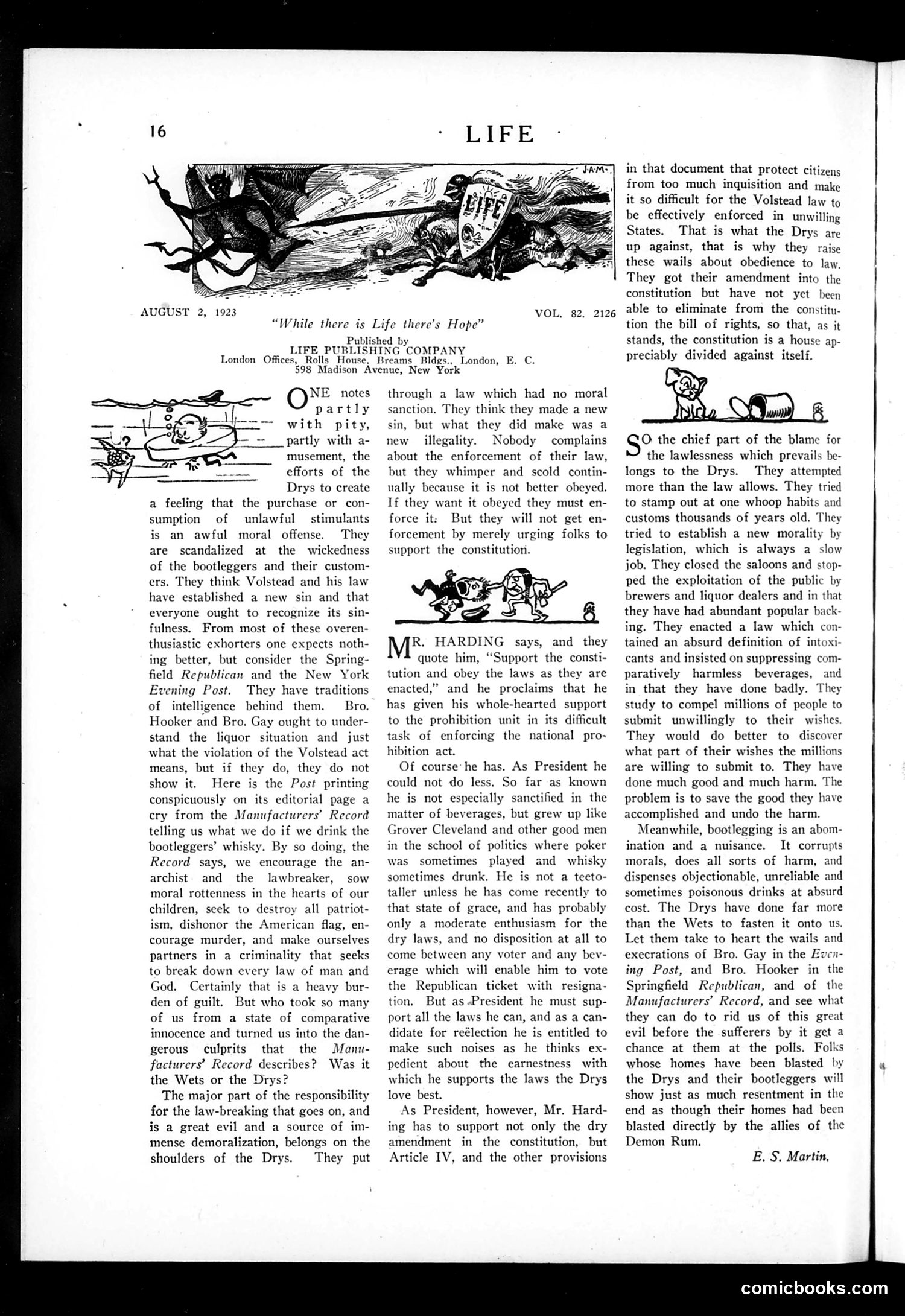
What you’re looking at
This page critiques Prohibition enforcement and the "Drys" (prohibitionists) who championed the Volstead Act. The cartoons show figures struggling under the weight of enforcement efforts. The editorial argues that **the Drys bear responsibility for lawbreaking**, not drinkers. It attacks the moral condemnation from publications like the *Manufacturers' Record*, which claims drinking bootleg whisky encourages anarchism and dishonors America. Life's position: the Drys created an unenforceable law lacking moral sanction, then blame citizens for breaking it. The piece notably addresses **President Harding's public support for Prohibition**. While acknowledging he must constitutionally enforce it, the author suggests Harding privately lacks enthusiasm for "dry laws"—a veiled reference to rumors about his personal habits. The core satire: Prohibitionists created an illegality, not a genuine moral wrong, then hypocritically demand obedience while refusing to enforce their own law adequately.
📄 Transcribed text from this page (OCR, searchable)
Machine-transcribed from the original scan — historical spelling and the odd misread are preserved.
AUGUST VOL. 82. “While there is Life there’s Hope” Published by LIFE PUBLISHING COMPANY London Offices, Rolls House, Breams_ Bldgs., London, E. C. 598 Madison Avenue, New York NE_ notes partly with pity, partly with a- musement, the efforts of the Drys to create a feeling that the purchase or con- sumption of unlawful — stimulants is an awful moral offense. They are scandalized at the wickedness of the bootleggers and their custom- ers. They think Volstead and his law have established a new sin and that everyone ought to recognize its sin- fulness. From most of these overen- thusiastic exhorters one expects noth- ing better, but consider the Spring- field Republican and the New York Evening Post. They have traditions of intelligence behind them. Bro. Hooker and Bro. Gay ought to under- stand the liquor situation and just what the violation of the Volstead act means, but if they do, they do not show it. Here is the Post printing conspicuously on its editorial page a cry from the Manufacturers’ Record telling us what we do if we drink the bootleggers’ whisky. By so doing, the Record says, we encourage the an- archist and the Jawbreaker, sow moral rottenness in the hearts of our children, seek to destroy all patriot- ism, dishonor the American flag, en- courage murder, and make ourselves partners in a criminality that seeks to break down every law of man and God. Certainly that is a heavy bur- den of guilt. But who took so many of us from a state of comparative innocence and turned us into the dan- gerous culprits that the Manu- facturers’ Record describes? Was it the Wets or the Drys? The major part of the responsibility for the law-breaking that goes on, and is a great evil and a source of im- mense demoralization, belongs on the shoulders of the Drys. They put through a law which had no moral sanction. They think they made a new sin, but what they did make was a new illegality. Nobody complains about the enforcement of their law, but they whimper and scold contin- ually because it is not better obeyed. If they want it obeyed they must en- force it: But they will not get en- forcement by merely urging folks to support the constitution. R. HARDING says, and they quote him, “Support the consti- tution and obey the laws as they are enacted,” and he proclaims that he has given his whole-hearted support to the prohibition unit in its difficult task of enforcing the national pro- hibition act. Of course he has. As President he could not do less. So far as known he is not especially sanctified in the matter of beverages, but grew up like Grover Cleveland and other good men in the school of politics where poker sometimes played and whisky sometimes drunk. He is not a teeto- taller unless he has come recently to that state of grace, and has probably only a moderate enthusiasm for the dry laws, and no disposition at all to come between any voter and any bev- erage which will enable him to vote the Republican ticket with resigna- tion. But as President he must sup- port all the laws he can, and as a can- didate for reélection he is entitled to make such noises as he thinks ex- pedient about the earnestness with which he supports the laws the Drys love best. As President, however, Mr. Hard- ing has to support not only the dry amendment in the constitution, but Article IV, and the other provisions was 2126 in that document that protect citizens from too much inquisition and make it so difficult for the Volstead law to be effectively enforced in unwilling States. That is what the Drys are up against, that is why they raise these wails about obedience to law. They got their amendment into the constitution but have not yet been able to eliminate from the constitu- tion the bill of rights, so that, as it stands, the constitution is a house ap- preciably divided against itself. O the chief part of the blame for the lawlessness which prevails be- longs to the Drys. They attempted more than the law allows. They tried to stamp out at one whoop habits and customs thousands of years old. They tried to establish a new morality by legislation, which is always a slow job. They closed the saloons and stop- ped the exploitation of the public by brewers and liquor dealers and in that they have had abundant popular back- ing. They enacted a law which con- tained an absurd definition of intoxi- cants and insisted on suppressing com- paratively harmless beverages, and in that they have done badly. They study to compel millions of people to submit unwillingly to their wishes. They would do better to discover what part of their wishes the millions are willing to submit to. They have done much good and much harm. The problem is to save the good they have accomplished and undo the harm. Meanwhile, bootlegging is an abom- ination and a nuisance. It corrupts morals, does all sorts of harm, and dispenses objectionable, unreliable and sometimes poisonous drinks at absurd cost. The Drys have done far more than the Wets to fasten it onto us. Let them take to heart the wails and execrations of Bro. Gay in the Even- ing Post, and Bro. Hooker in the Springfield Republican, and of the Manufacturers’ Record, and see what they can do to rid us of this great evil before the sufferers by it get a chance at them at the polls. Folks whose homes have been blasted by the Drys and their bootleggers will show just as much resentment in the end as though their homes had been blasted directly by the allies of the Demon Rum. E. S. Martin. comicbooks.com