
Life, 1923-08-02 · page 23 of 40
Life — August 2, 1923 — page 23: what you’re looking at
What you’re looking at
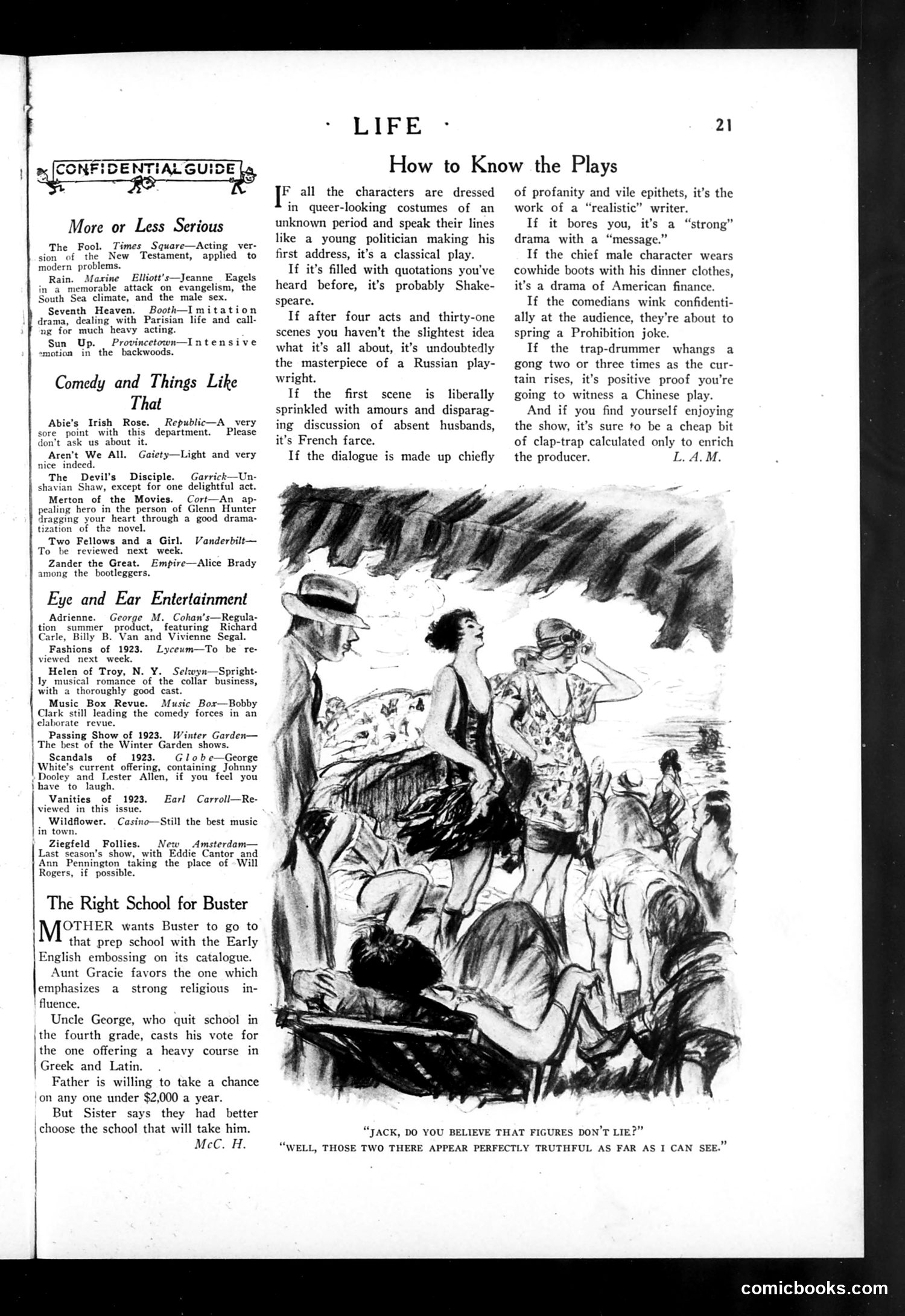
This page features a comedic guide mocking theater-goers' ability to identify play types by their superficial conventions. The satirist lists formulaic markers: classical plays feature archaic costumes and stilted delivery; Russian plays are incomprehensibly complex; French farces emphasize marital infidelity; American dramas inexplicably combine cowboy boots with formal wear; Chinese plays signal themselves with gong strikes. The deeper joke targets both theatrical pretension and audience gullibility—suggesting that serious drama often relies on artificial signifiers rather than genuine merit. The final barb is sharpest: if you actually *enjoy* the show, it's merely "cheap clap-trap" designed to fleece the producer's wallet. The accompanying cartoon (showing figures at what appears to be a beach or seaside) with its caption about "figures" and truthfulness complements this theme of deceptive appearances. This reflects 1920s skepticism toward Broadway's commercialism and intellectual posturing.
📄 Transcribed text from this page (OCR, searchable)
Machine-transcribed from the original scan — historical spelling and the odd misread are preserved.
More or Less Serious The Fool. Times Square—Acting ver- sion of the New Testament, applied to modern problems. Rain. Maxine Elliott’s—Jeanne_ Eagels in a memorable attack on evangelism, the South Sea climate, and the male sex. Seventh Heaven. Booth—Imitation drama, dealing with Parisian life and call- ng for much heavy acting. Sun Up. Provincetown—Intensive emotion in the backwoods. Comedy and Things Like That Abie’s Irish Rose. Republic—A sore point with this’ department. don’t ask us about it. Aren't We All. Gaiety—Light and very nice indeed. The Devil's Disciple. Garrick—Un- shavian Shaw, except for one delightful act. Merton of the Movies. t—An ap- pealing hero in the person of Glenn Hunter Gragging your heart through a good drama- tization of the novel. Two Fellows and a Girl. To be reviewed next we Zander the Great. Empire—Alice Brady among the bootleggers. Eye and Ear Entertainment Adrienne. George M. Cohan’s—Regula- tion summer product, ‘featuring Richard Carle, Billy B. Van and Vivienne Segal. Fashions of 1923. Lyceum—To be re- viewed next week. Helen of Troy, N. Y. Selwyn—Spright- ly musical romance of the collar business, with a thoroughly good cast. Music Box Revue. Music Box—Bobby Clark still leading the comedy forces in an elaborate revue. Passing Show of 1923. Winter Garden— | The best of the Winter Garden shows. |. Scandals of 1923. Glob e—George White’s current offering, containing Johnny ‘Dooley and Lester Allen, if you feel you \have to laugh. Vanities of 1923. viewed in this issue. Wildflower. Casino—Still the best music | in town. Ziegfeld Follies. New — Amsterdam— Last season's show, with Eddie Cantor and Ann Pennington taking the place of Will Rogers, if possible. The Right School for Buster OTHER wants Buster to go to that prep school with the Early English embossing on its catalogue. Aunt Gracie favors the one which emphasizes a strong religious in- fluence. Uncle George, who quit school in \the fourth grade, casts his vote for the one offering a heavy course in | Greek and Latin. Father is willing to take a chance on any one under $2,000 a year. But Sister says they had very Please Vanderbilt— Earl Carroll—Re- better | choose the school that will take him. | McC. H. LIFE I all the characters are dressed in queer-looking costumes of an unknown period and speak their lines like a young politician making his first address, it’s a classical play. If it’s filled with quotations you've heard before, it’s probably Shake- speare. If after four acts and thirty-one scenes you haven't the slightest idea what it’s all about, it’s undoubtedly the masterpiece of a Russian play- wright. If the first scene is liberally sprinkled with amours and disparag- ing discussion of absent husbands, it’s French farce. If the dialogue is made up chiefly How to Know the Plays of profanity and vile epithets, it’s the work of a “realistic” writer. If it bores you, it’s a “strong” drama with a “message.” If the chief male character wears cowhide boots with his dinner clothes, it's a drama of American finance. If the comedians wink confidenti- ally at the audience, they're about to spring a Prohibition joke. If the trap-drummer whangs a gong two or three times as the cur- tain rises, it's positive proof you're going to witness a Chinese play. And if you find yourself enjoying the show, it’s sure to be a cheap bit of clap-trap calculated only to enrich the producer. L. A.M. “JACK, DO YOU BELIEVE THAT FIGURES DON’T LIE?” “WELL, THOSE TWO THERE APPEAR PERFECTLY TRUTHFUL AS FAR AS I CAN SEE.” comicbooks.com