
A complete issue · 36 pages · 1923
Life — March 1, 1923
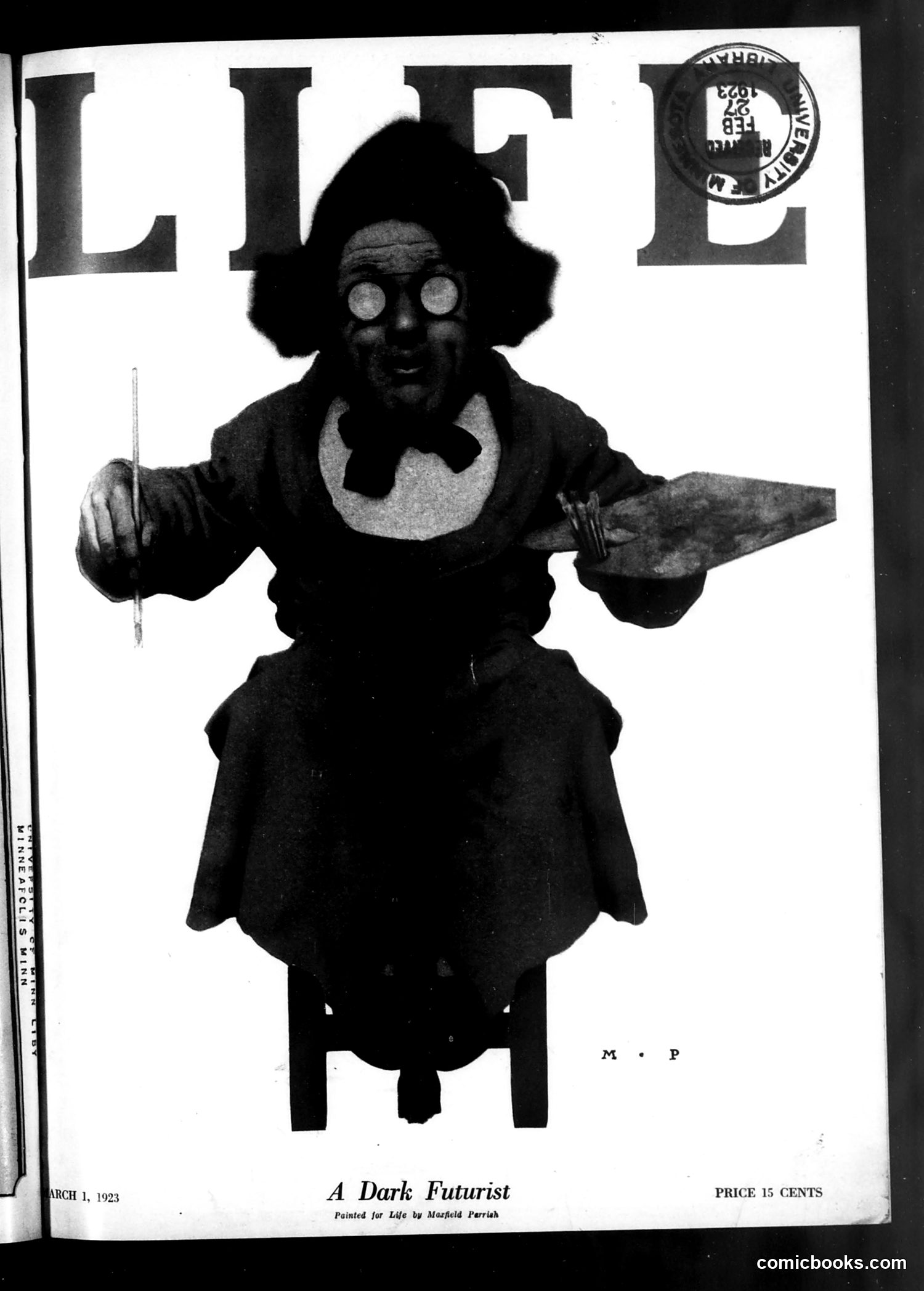
This cover satirizes an avant-garde artistic movement, likely Futurism or Dada, movements that rejected traditional aesthetics. The figure wears exaggerated goggles and holds a paintbrush and palette in a deliberately awkward, confrontational pose. The distorted, geometric body—sitting unnaturally on a chair—mocks the movement's abstraction and rejection of representational art. The caption "A Dark Futurist" and credit "Painted for Life by Mansfield Parrish" suggests this caricature ridicules experimental artists as impractical eccentrics. The price (15 cents) and format indicate this was mainstream American satire targeting the artistic avant-garde as absurd and incomprehensible to ordinary readers. The cartoon expresses establishment skepticism toward modernist movements gaining prominence in the 1920s.

This page is **primarily advertising**, not satire or political commentary. It's a 1923 advertisement for the American Radiator Company's "Ideal TYPE A" boiler system. The ad features a testimonial from Edwin Goodall of Hackensack, New Jersey, who replaced his old heating plant with an Ideal boiler. Goodall's quote—"I call it almost human; its appetite is exceedingly considerate of my pocketbook"—personifies the machine as thoughtfully economical. The painting by Arthur Keller shows the boiler itself. The ad's humor is gentle wordplay about the machine's "human" efficiency rather than political satire. The message targets homeowners concerned about fuel costs, positioning the product as a practical investment that "pays for itself in the fuel it saves."
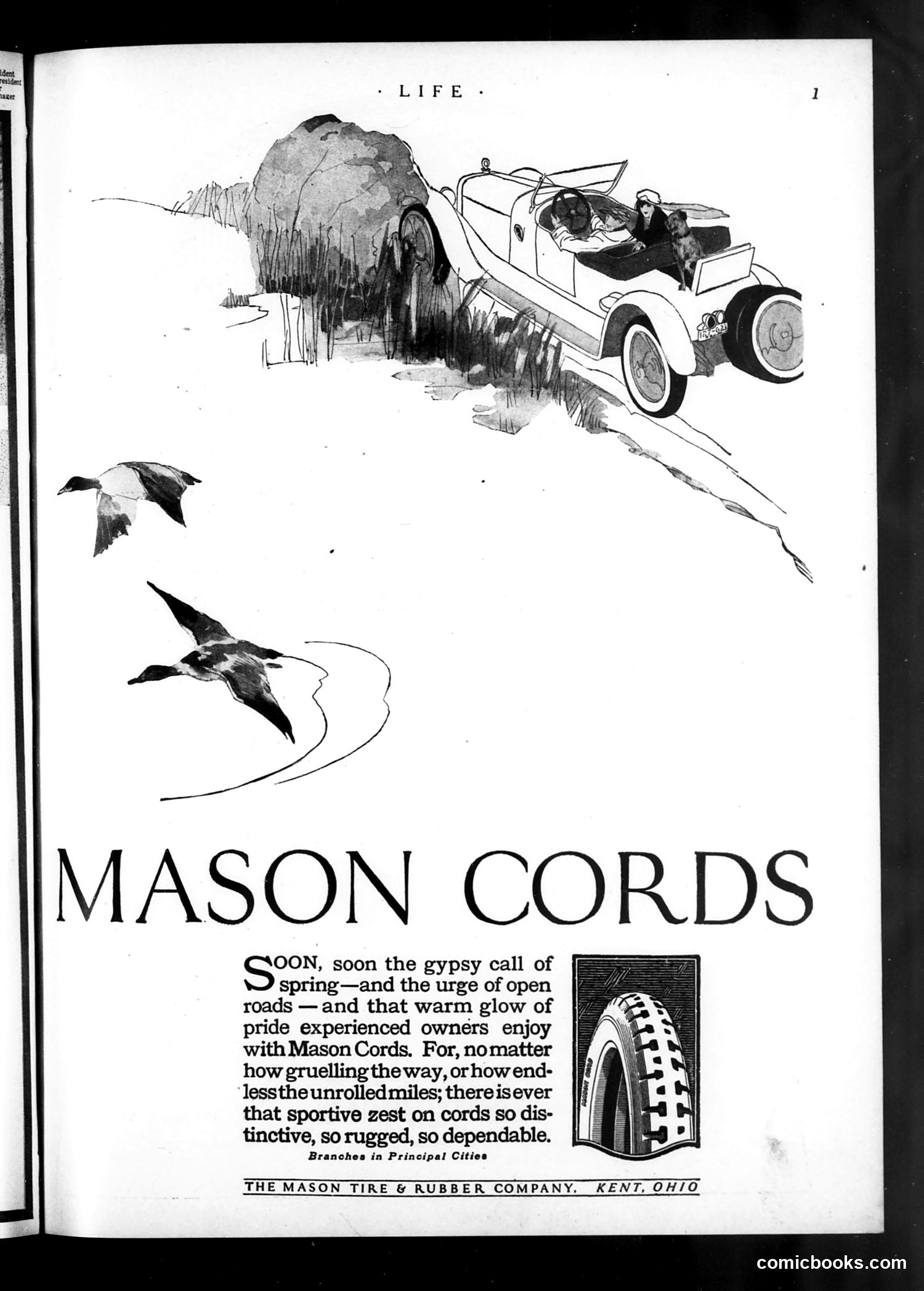
This is a **Mason Tire & Rubber Company advertisement** from Life magazine, not political satire. The ad depicts a stylized early-1920s automobile with passengers encountering birds in flight, likely representing the "gypsy call of spring" and "open roads" mentioned in the text. The imagery emphasizes freedom, leisure travel, and the joy of driving—aspirational themes for the era. The advertisement's central claim is that Mason Cords tires are dependable for extended driving ("gruelling the way") and long distances ("unrolled miles"). The distinctive tire tread pattern is shown in the inset image. This reflects early automotive advertising's focus on durability and adventure, appealing to owners eager to use newly affordable cars for recreational travel during the post-WWI economic boom.
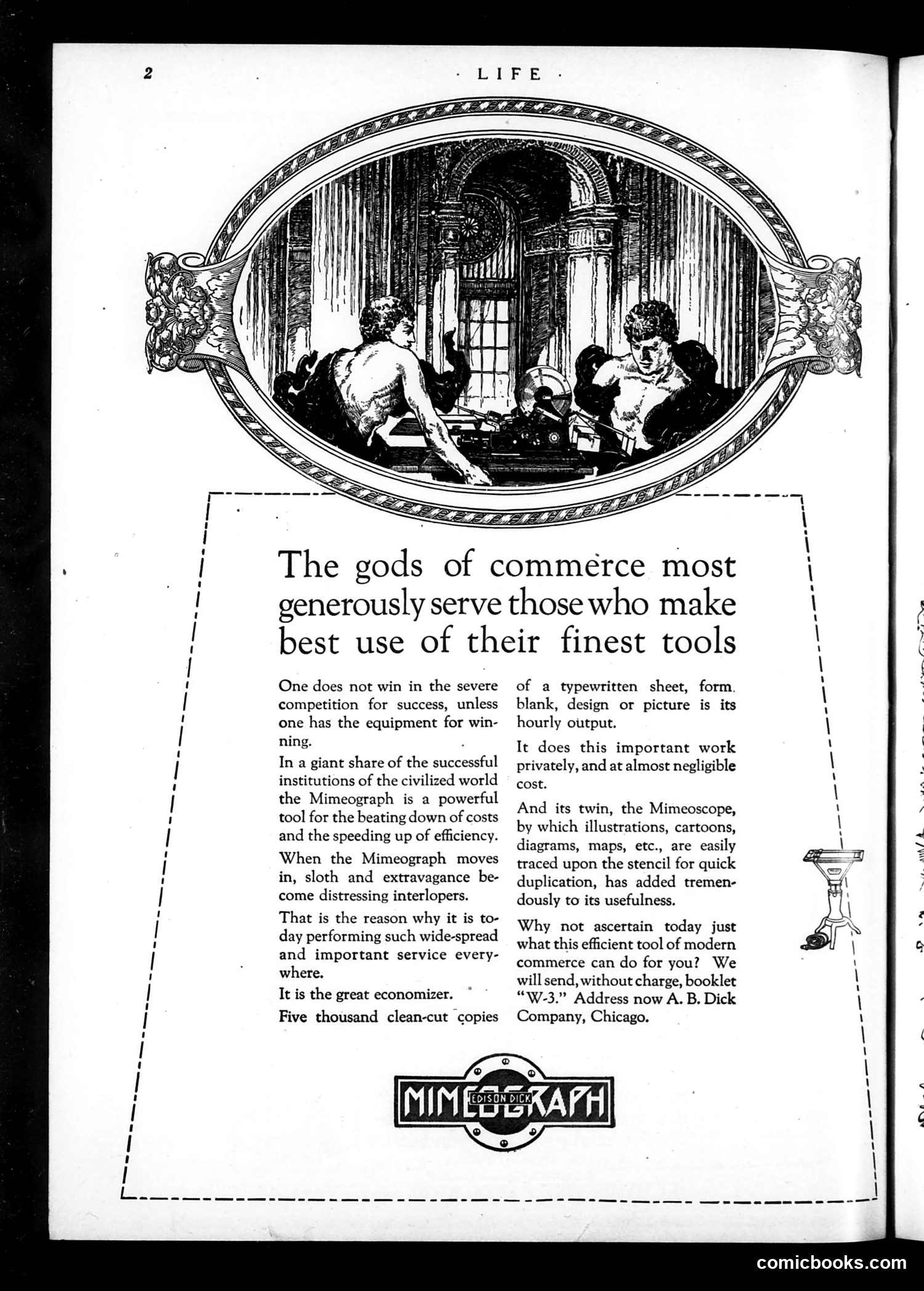
This is primarily a **Mimeograph company advertisement**, not satire. The ad promotes the Mimeograph machine as essential business equipment for "modern commerce." The ornate oval illustration shows two figures in what appears to be an elegant office setting, likely representing successful businesspeople benefiting from the technology. The ad's title claims "the gods of commerce most generously serve those who make best use of their finest tools." The copy emphasizes the Mimeograph's role in reducing costs and increasing efficiency—it produces clean copies of typewritten forms, designs, and illustrations "privately, and at almost negligible cost." The text highlights its "twin," the Mimeoscope, for tracing illustrations. This reflects early-20th-century American business culture's faith in mechanization and efficiency as paths to commercial success. The ad concludes with an offer for a free booklet from A.B. Dick Company, Chicago.
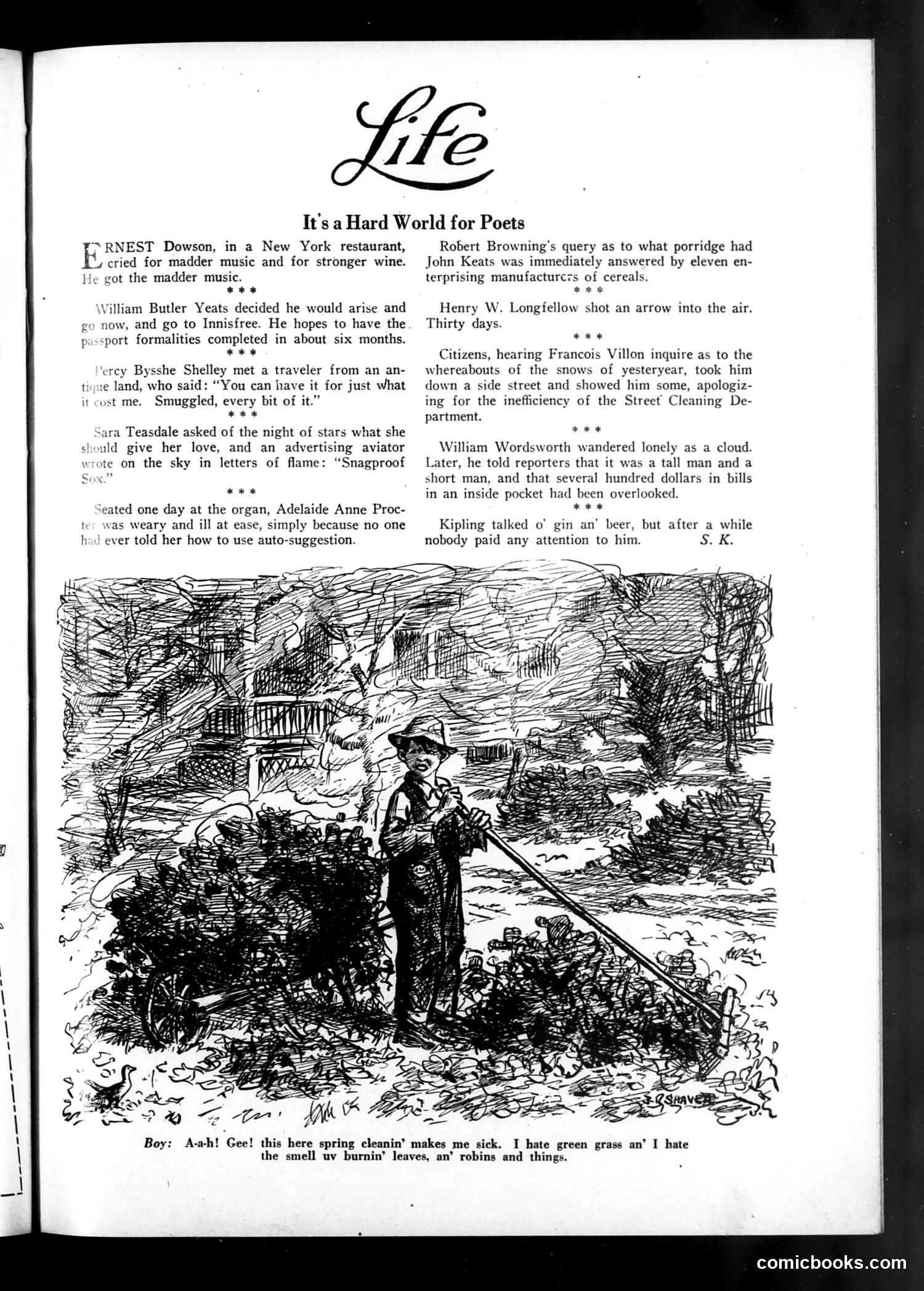
This page from *Life* magazine contains brief satirical anecdotes about famous literary and cultural figures, titled "It's a Hard World for Poets." The main illustration depicts a boy complaining about spring cleaning—"A-sh! Gee! this here spring cleanin' makes me sick. I hate green grass an' I hate the smell uv burnin' leaves, an' robins and things." The anecdotes mock various celebrities: Ernest Dowson's demand for "madder music and stronger wine," William Butler Yeats seeking passport formalities, Sara Teasdale's romantic concerns, and William Wordsworth wandering "like a cloud." The final reference to Kipling talking about gin illustrates the page's running joke: these celebrated poets and writers face mundane, often ridiculous real-world complications, undermining their romanticized public images. The satire targets the gap between artistic pretension and ordinary life's tedium.
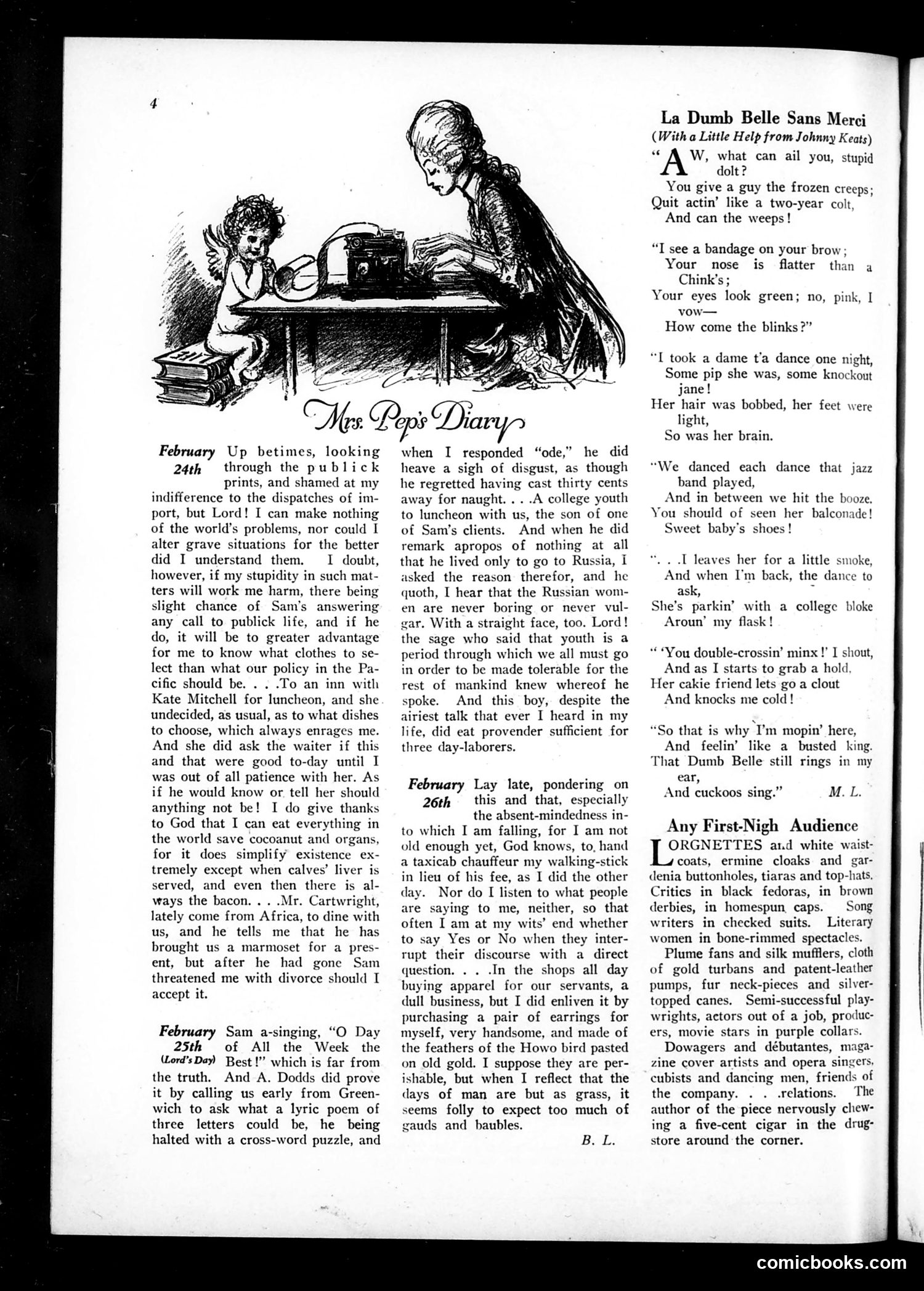
This page contains a satirical diary column rather than a political cartoon. "Mrs. Pep's Diary" presents social commentary through a woman's observations about upper-class society and courtship customs in what appears to be the 1920s (based on references to "jazz," "balconade," and "college bloke"). The diary entries mock young men's perceived laziness and lack of ambition—one college youth only wants to go to Russia, another eats constantly. The right column reprints "La Dumb Belle Sans Merci," a parody poem about a flighty young woman who dances, drinks, and flirts without substance. The satire targets both young men's vapidity and young women's superficiality during the Jazz Age, reflecting contemporary anxieties about changing social values and courtship norms.
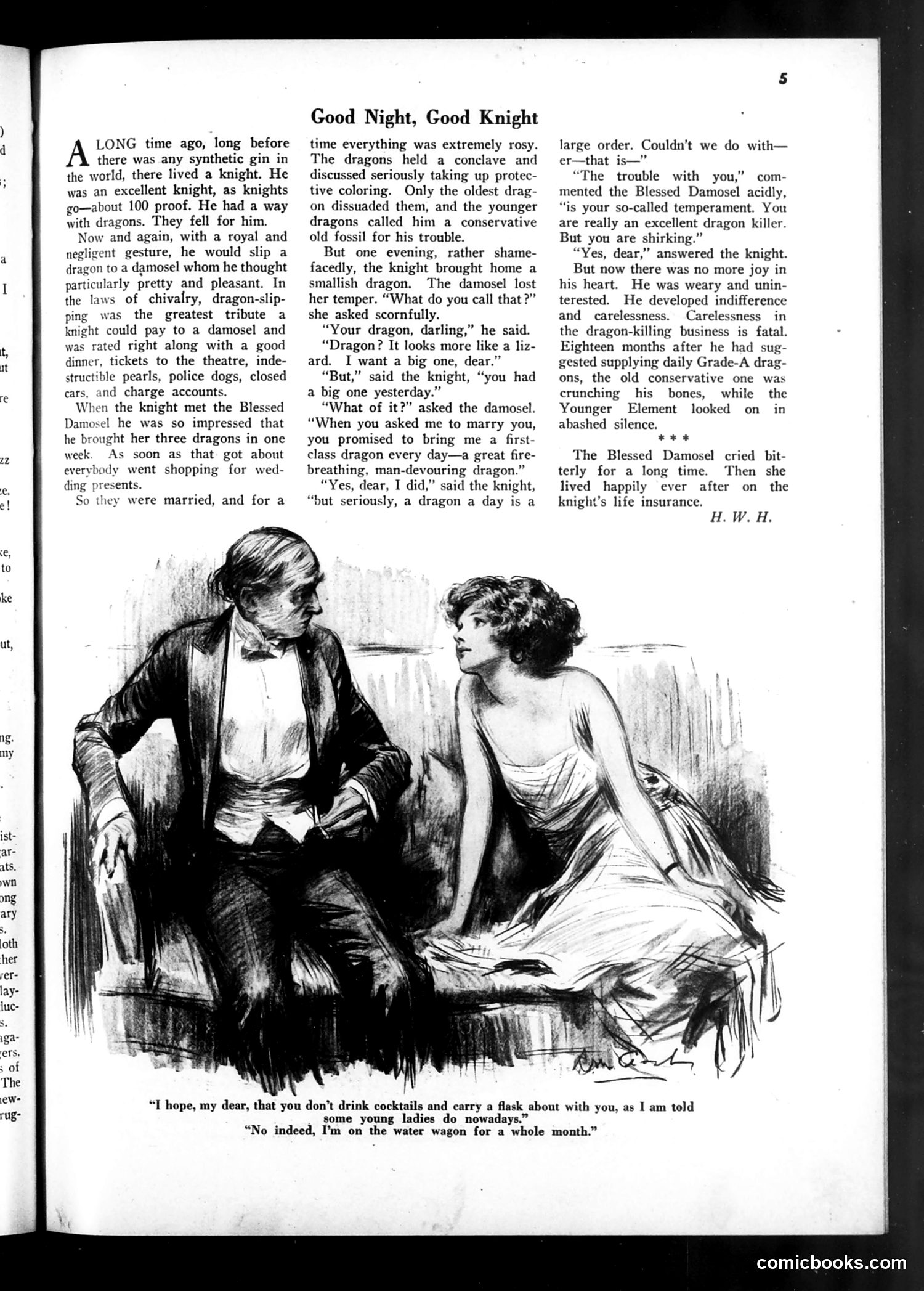
This is a humorous story about a knight who married and promised to bring home a first-class dragon daily. His wife complains he's become negligent—no longer delivering dragons as promised. She calls him an "excellent dragon killer" but notes his current carelessness. The illustration shows a couple in formal evening dress having a domestic conversation, likely depicting the story's denouement where the knight admits he can no longer sustain his dragon-hunting commitment. The satire appears to mock marital expectations and male promises made before marriage. The fantasy premise of daily dragon-hunting serves as a humorous stand-in for other husband-duties or provisions, suggesting the gap between courtship promises and post-marital reality—a timeless domestic comedy theme played for satirical effect.
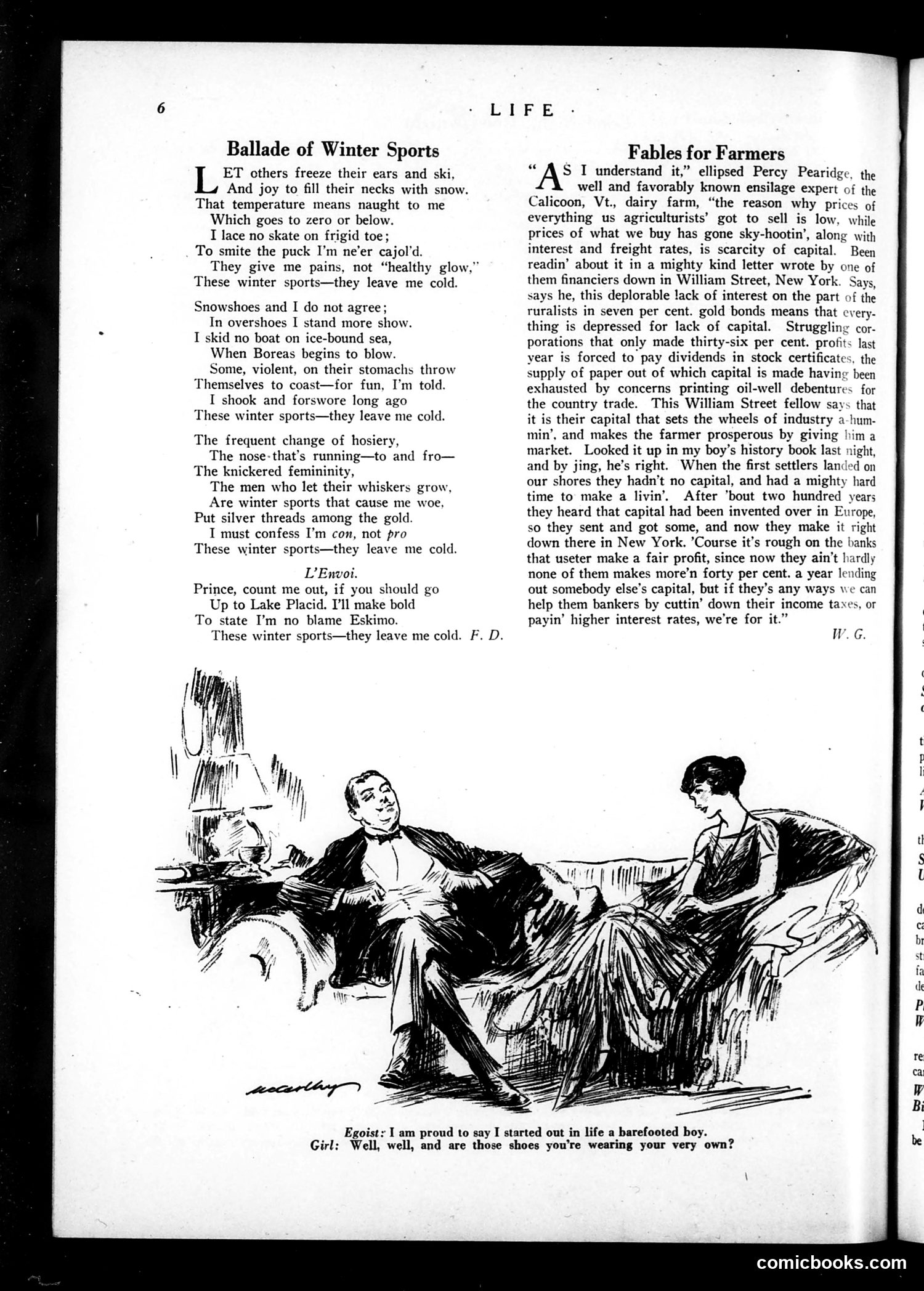
The page contains two distinct pieces: **"Ballade of Winter Sports"** (left): A poem dismissing winter sports as unpleasant, authored "F.D." The speaker rejects skiing and ice-skating as cold and uncomfortable, preferring warmer alternatives. It's a humorous complaint about seasonal activities. **"Fables for Farmers"** (right): An article by W.G. discussing agricultural economic hardship. Percy Peardige, a Vermont dairy farmer, explains that farmers lack capital—their money goes to banks and creditors while agricultural prices remain depressed. The piece critiques how wealthy Wall Street interests control industry and farming through capital control, leaving farmers perpetually struggling. **Cartoon below**: Depicts a well-dressed man boasting to a woman that he started as a barefoot boy, now wearing fine shoes. Her response—questioning if he actually owns them—is satirical commentary on false prosperity and debt.
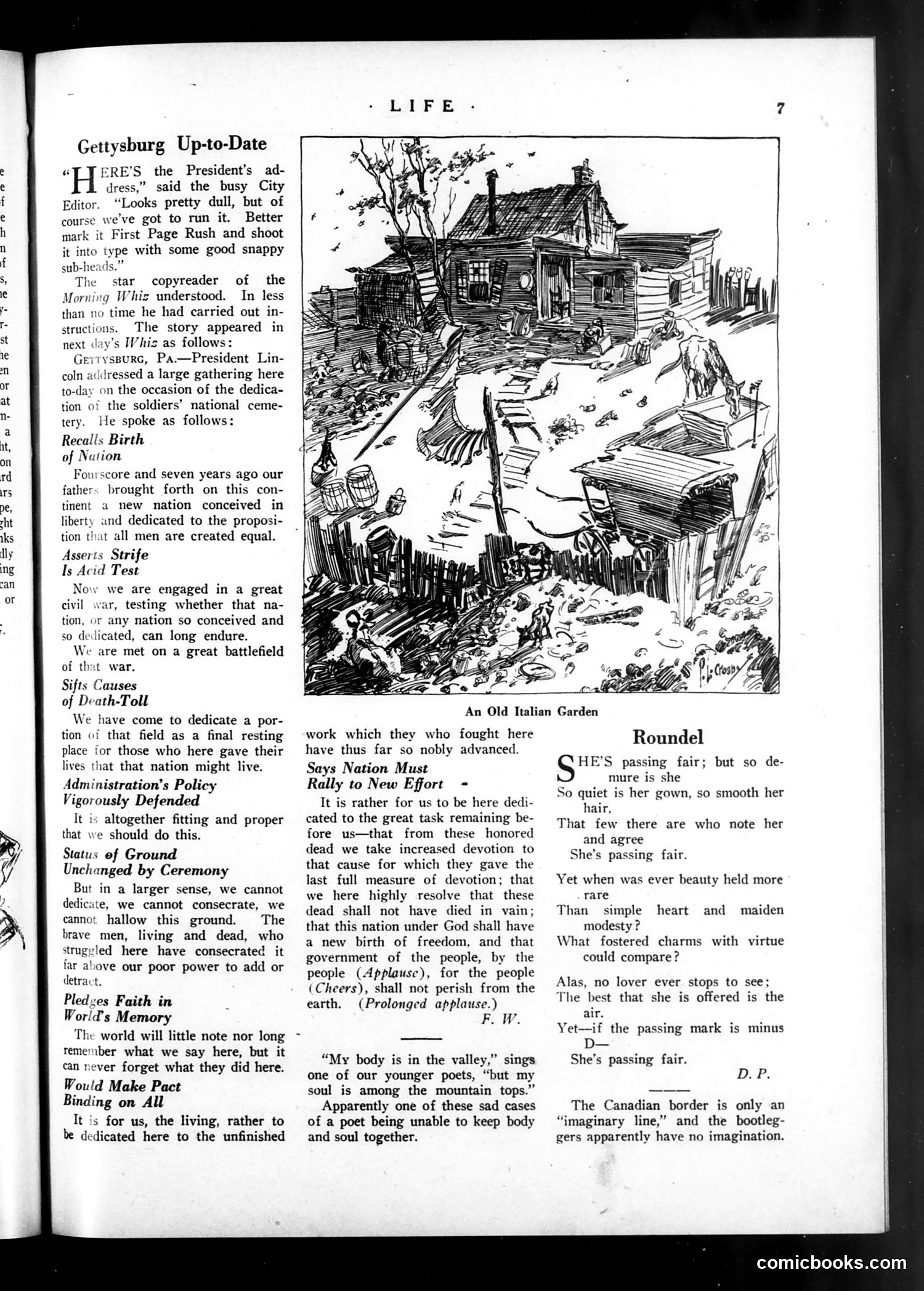
This page satirizes contemporary coverage of President Lincoln's Gettysburg Address dedication ceremony. The left column mocks how newspapers sensationalize events—an editor dismisses the President's remarks as "pretty dull" and demands it be rewritten for "First Page Rush" with "snappy sub-heads." The accompanying sketch shows a dilapidated farmhouse labeled "An Old Italian Garden," likely satirizing the gap between the battlefield's actual devastation and how media might romanticize or misrepresent it for readers. The satire targets 1860s journalism practices: shallow editorial judgment, sensationalism over substance, and misrepresentation of serious historical events. The joke is that newspapers would trivialize Lincoln's momentous address through typical yellow-journalism tactics.
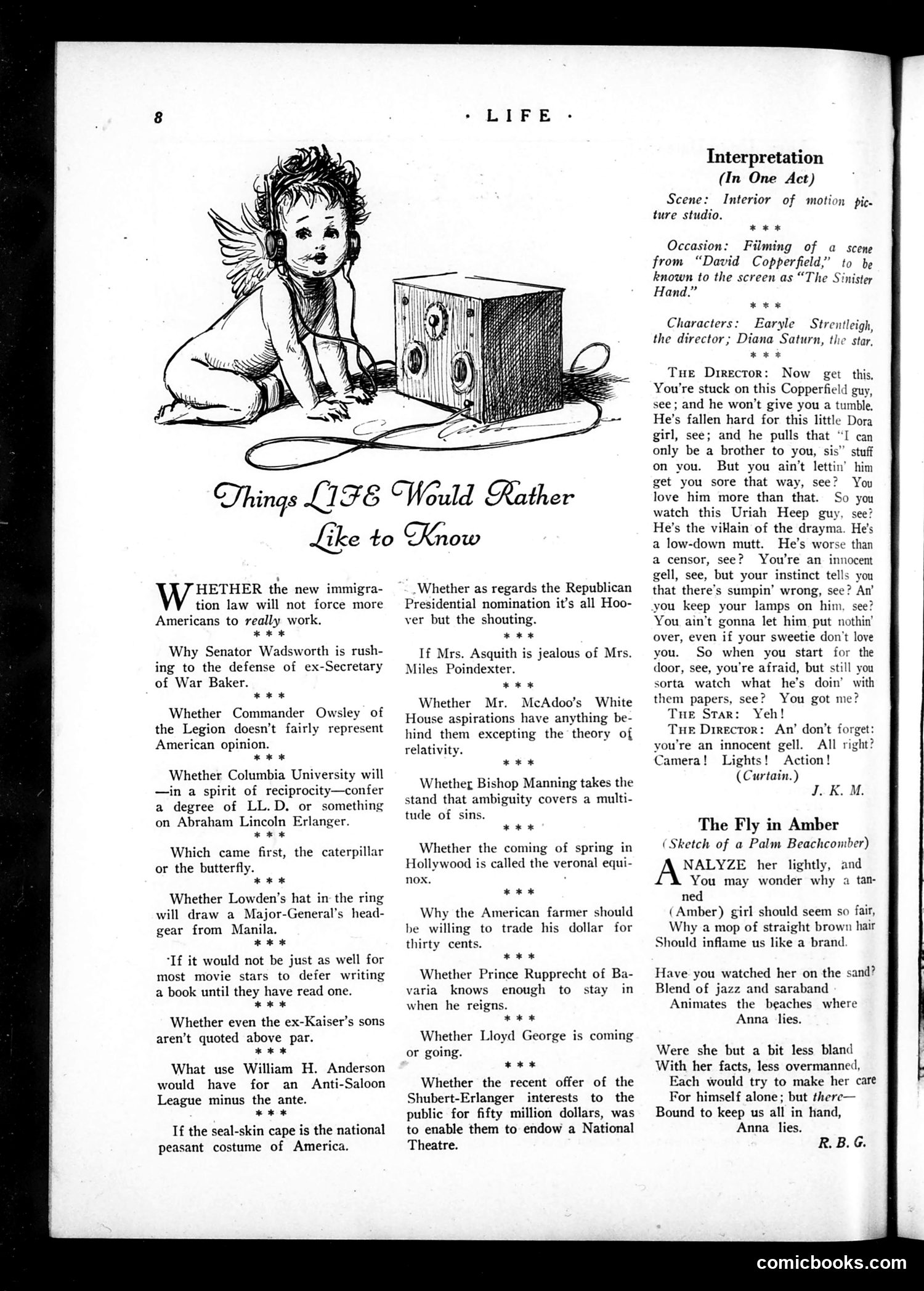
This page from *Life* magazine contains satirical commentary on contemporary 1920s issues rather than a political cartoon. The left column lists provocative rhetorical questions—"Things Life Would Rather Like to Know"—addressing topics like immigration policy, war, Republican politics, and American farming practices. The illustration shows a cherub examining a motion-picture camera, accompanying the piece's satirical tone. The right side includes theatrical content: "Interpretation (In One Act)" scripts a humorous film-studio scene, while "The Fly in Amber" presents poetry about an "Amber" girl character. The overall effect is *Life*'s characteristic blend of cultural commentary, insider Hollywood humor, and social critique—poking fun at politicians, institutions, and contemporary anxieties through witty questioning and theatrical mockery rather than visual caricature.
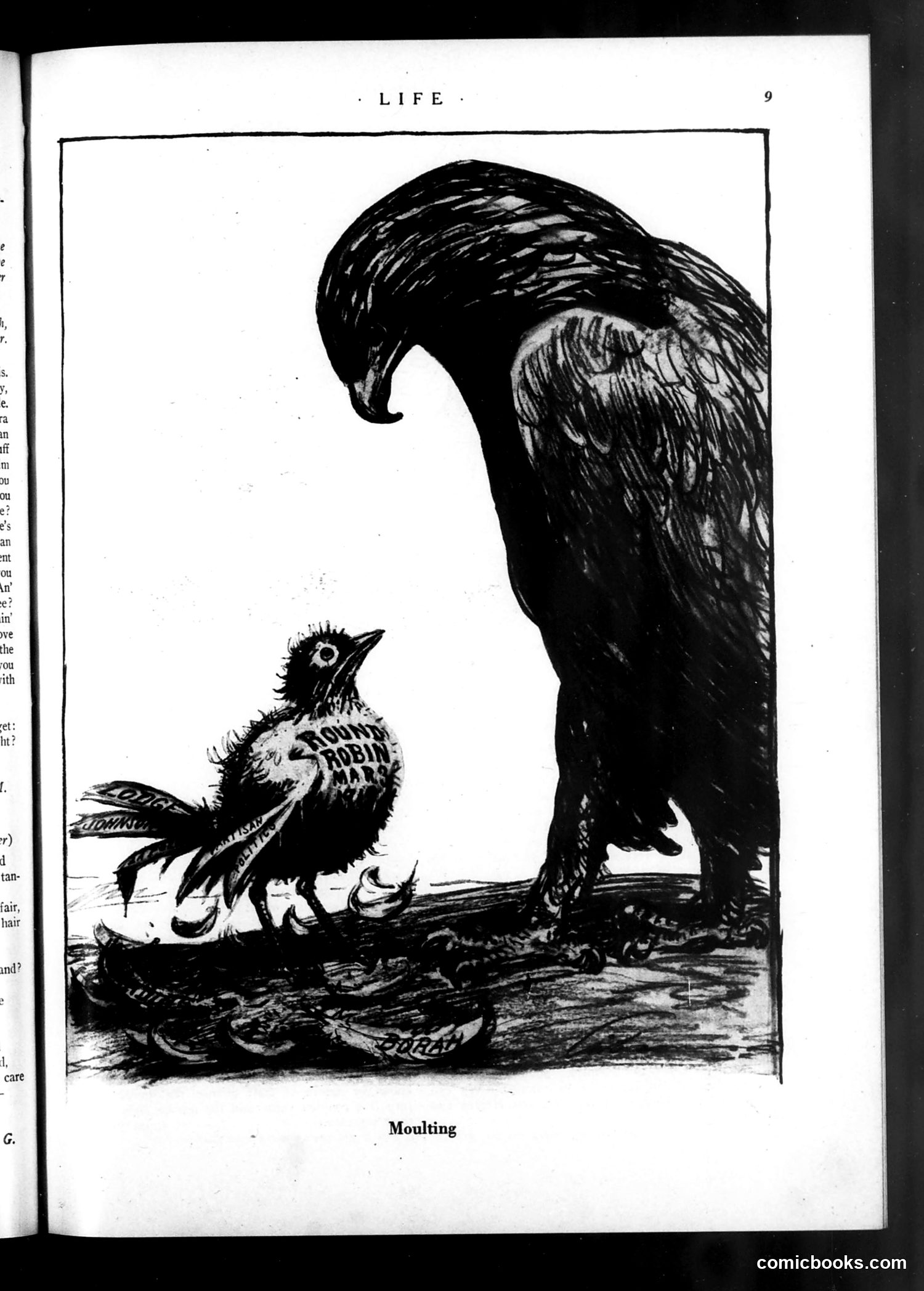
This cartoon depicts a large eagle shedding its feathers while a small bird labeled "ROUND ROBIN" watches. The eagle appears to be in a state of decline or deterioration. "Moulting" likely refers to a political figure or institution losing power, influence, or support—the process of being stripped down. The "Round Robin" (a term for a petition or letter signed in circular fashion) suggests public protest or organized opposition against the larger entity represented by the eagle. The eagle, traditionally symbolizing American authority and strength, is shown vulnerable and diminished. This was likely commentary on a specific political scandal, policy failure, or loss of public confidence during Life magazine's publication period, though the exact reference remains unclear without additional context.
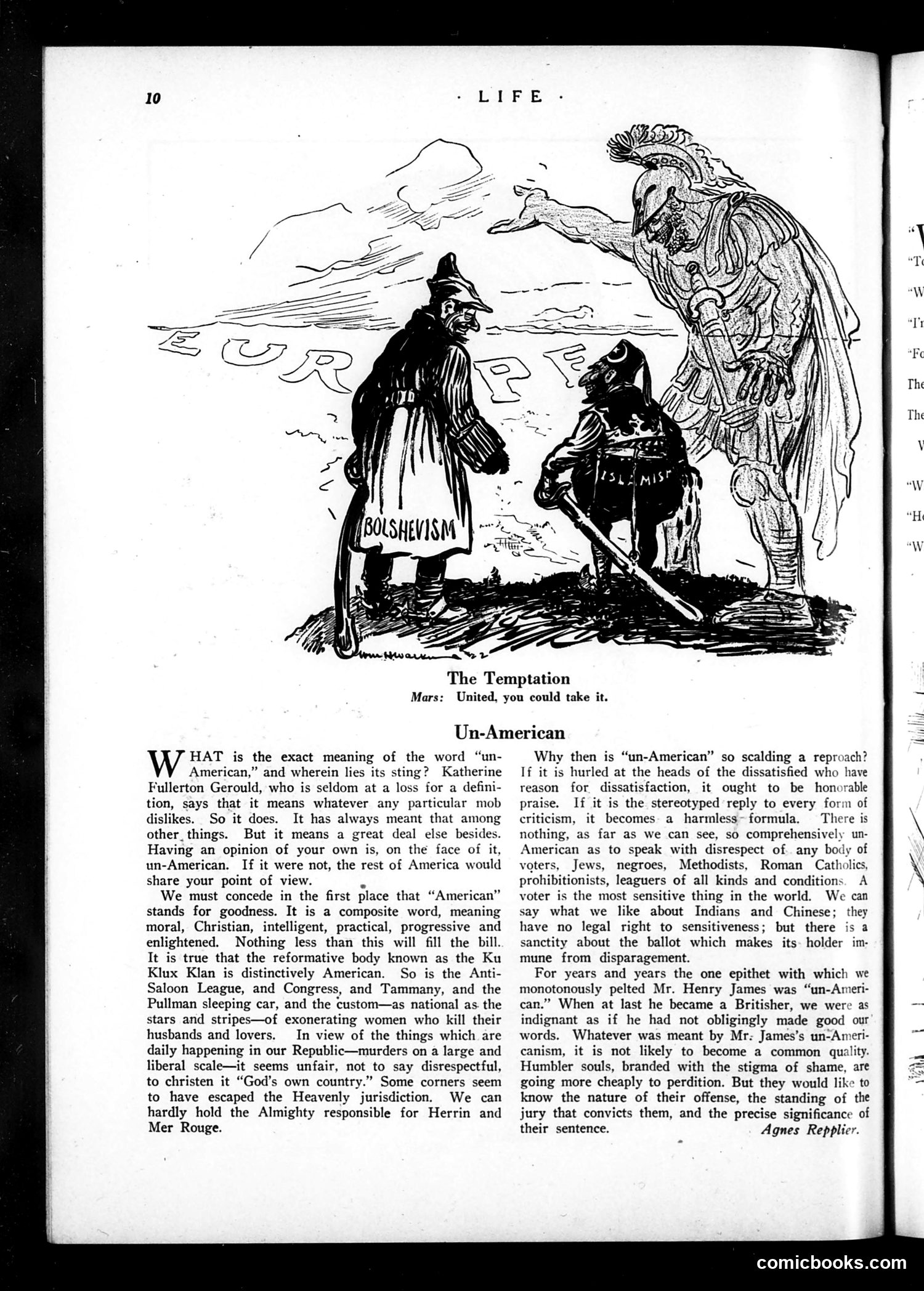
**The Cartoon:** The image depicts Mars (god of war, depicted as a winged military figure) tempting two figures labeled "Bolshevism" and "Islamism" with the word "Europe" written in the background. Mars says: "United, you could take it." **The Satire:** This reflects post-WWI anxieties about geopolitical threats. The cartoon warns that if Bolshevism (Soviet communism) and Islamic movements united, they could destabilize or conquer Europe. It personifies ideologies as agents capable of conspiracy, suggesting Mars/war itself encourages this dangerous alliance. **Context:** Published during the 1920s Red Scare period, when Americans feared communist expansion and viewed Islamic nations as threats, the cartoon expresses contemporary paranoia about revolutionary ideologies and non-Western powers conspiring against Western civilization.
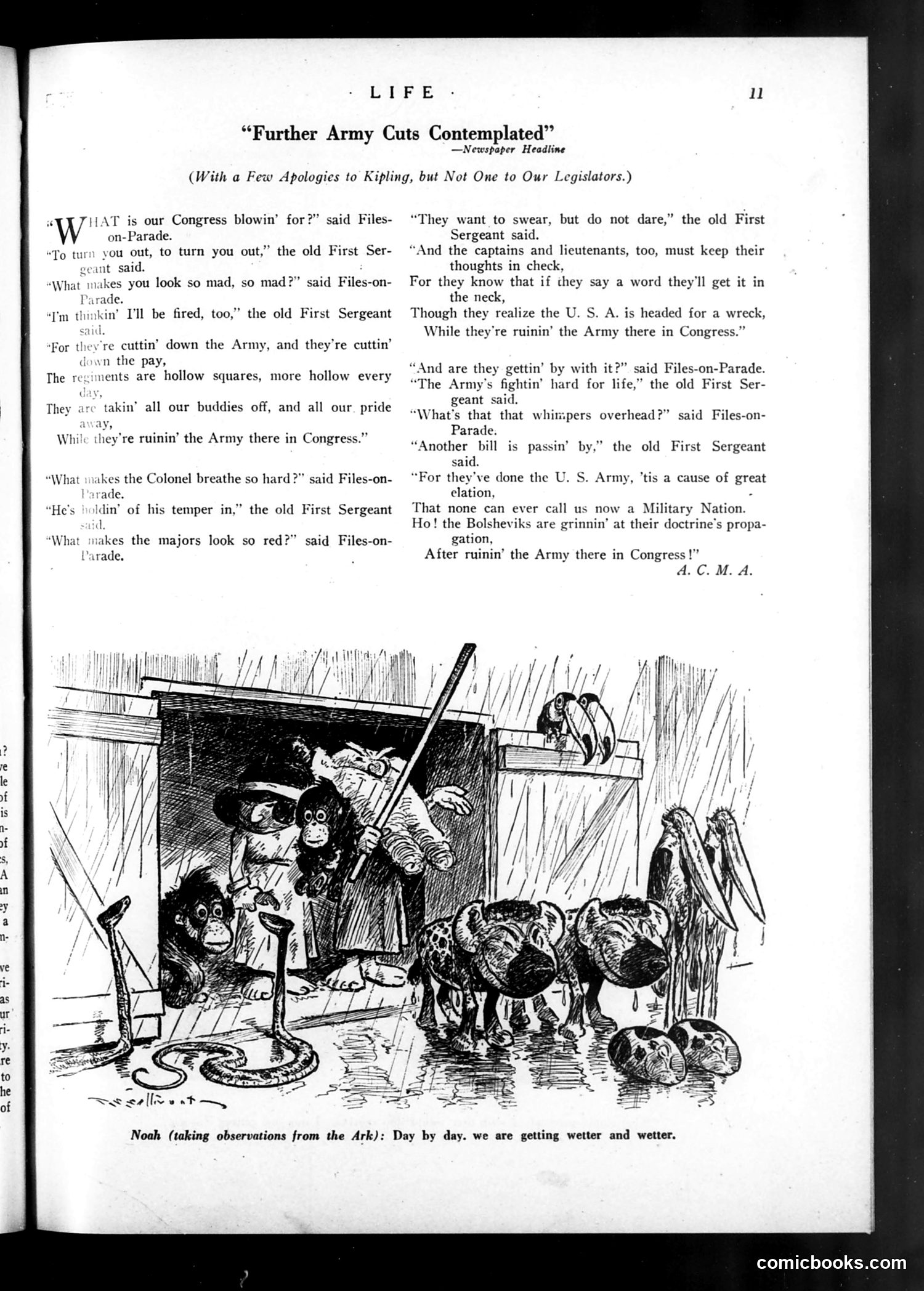
This page satirizes Congressional debates over Army budget reductions. The dialogue between "Files-on-Parade" (a soldier character) and a "First Sergeant" mocks Congress's cost-cutting measures—described as "cuttin' down the Army" and reducing pay while "takin' all our buddies off." The illustration depicts Noah's Ark filled with animals, captioned "Day by day, we are getting wetter and wetter." This uses the Biblical flood metaphor to suggest the Army is metaphorically drowning under budget cuts, with soldiers like animals helplessly aboard a sinking vessel. The satire implies Congress is destructively dismantling the military while claiming to strengthen it—making soldiers unable to speak freely without consequences. The piece expresses satirical outrage at perceived legislative incompetence threatening national defense.
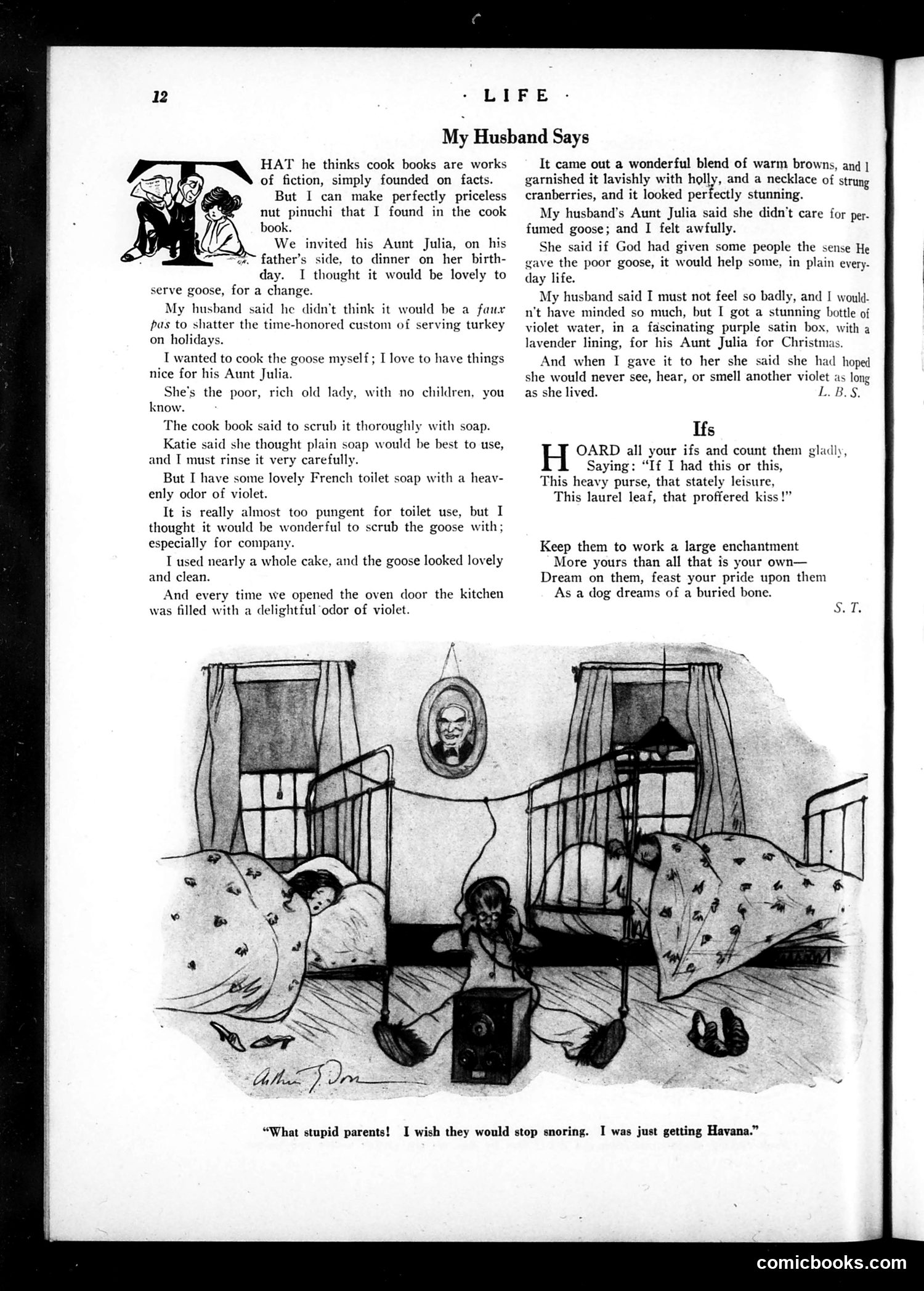
This page contains two distinct pieces: **"My Husband Says"** (top): A domestic humor column where a wife describes cooking a goose for her Aunt Julia using French toilet soap to scrub it clean. The husband dismisses her concerns about this unconventional method. The satire mocks both pretentious domestic practices and marital dynamics where husbands dismiss their wives' practical concerns. **"Ifs"** (right): A short poem about counting one's "ifs" (regrets or conditional thoughts) as possessions, comparing them to a dog dreaming of a buried bone. **Bottom cartoon**: Shows parents snoring loudly while a child in bed complains "What stupid parents! I wish they would stop snoring. I was just getting Havana." The joke appears to reference a child's interrupted dream about Havana, Cuba—suggesting pre-prohibition American interest in Cuban leisure.
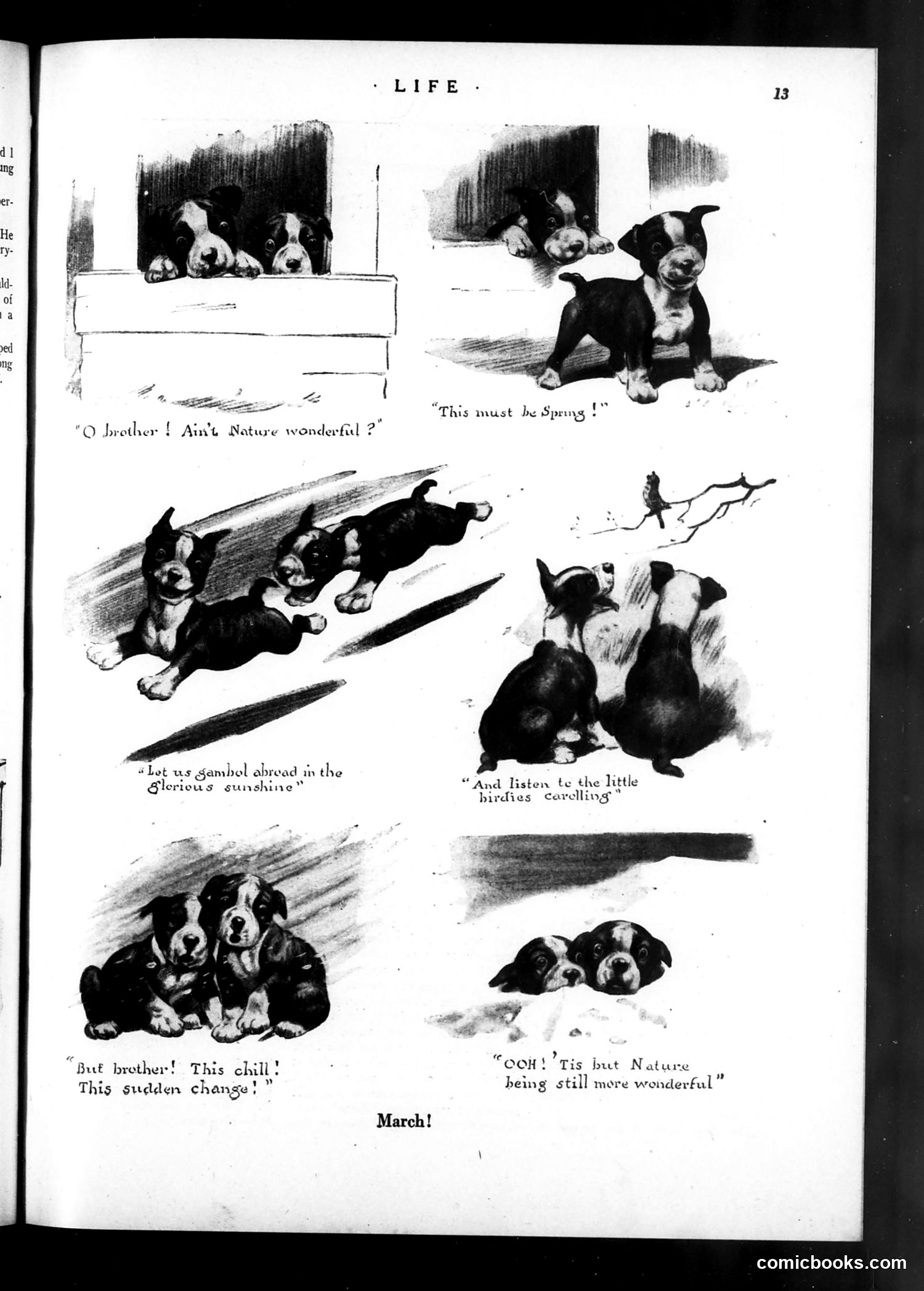
This is a humorous illustrated comic strip depicting dogs responding to spring weather changes in March. The six panels show dogs in various poses with captions: 1. Three dogs in a pen marveling at nature 2. One dog stretching, declaring "This must be Spring!" 3. Dogs running outdoors, saying "Let us gambol abroad in the Glorious sunshine" 4. Dogs listening to birds singing 5. Dogs huddled together noting "This chill! This sudden change!" 6. Dogs back in snow, observing "OOH! 'Tis but Nature being still more wonderful" The satire playfully mocks March's unpredictable weather—the transition between winter and spring—by anthropomorphizing dogs commenting on the temperature fluctuations. The joke lies in the dogs' philosophical acceptance of nature's contradictions, treating weather whiplash as a natural marvel rather than frustration.
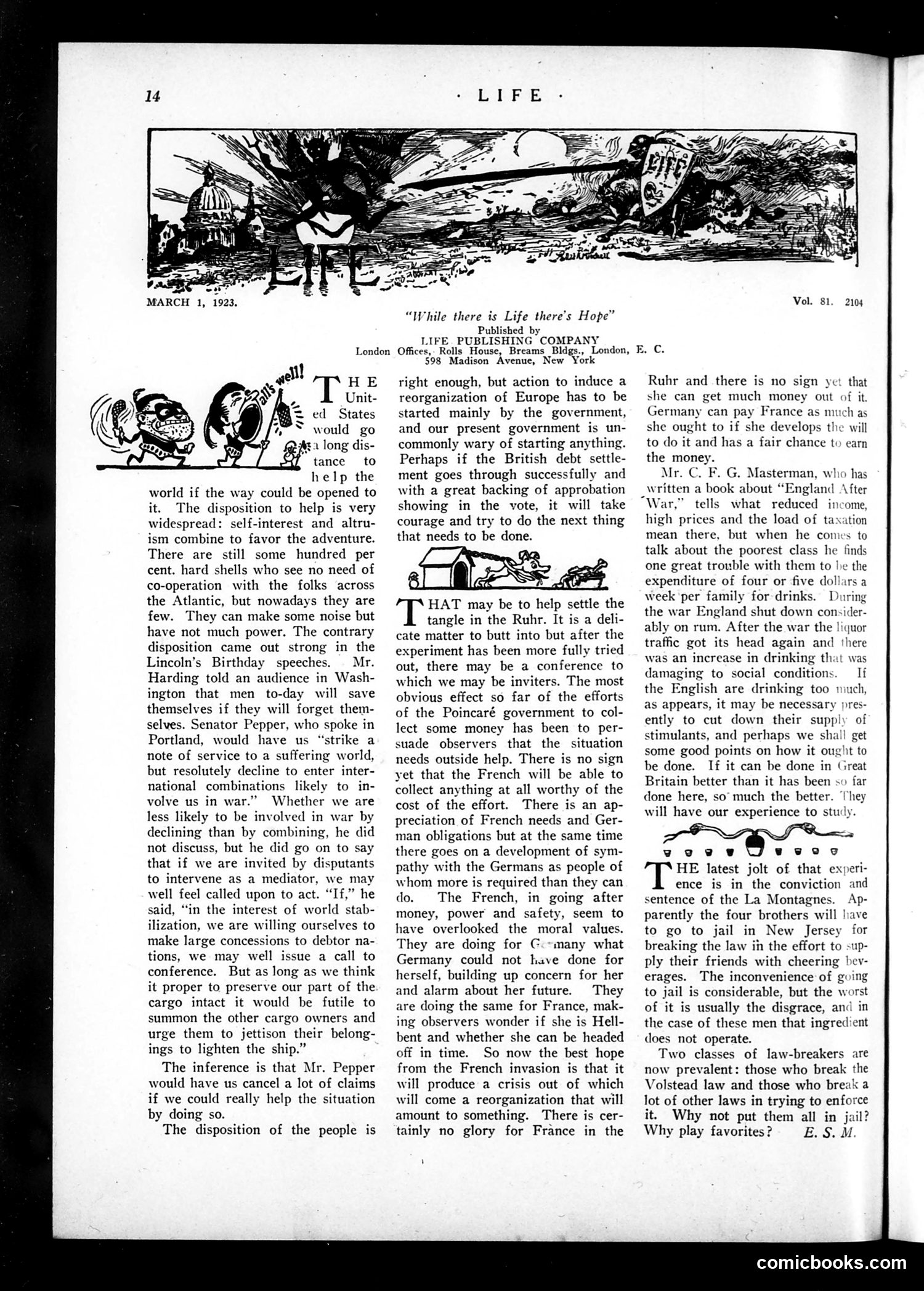
The small cartoon at the page's top shows two figures (appears to be personifications of nations) struggling or dancing together, likely representing France and Germany attempting cooperation after World War I. The article discusses post-war European reconstruction, particularly regarding the Ruhr region (German industrial area under Allied control due to war reparations). The text references Senator Pepper's proposal for U.S. intervention to help stabilize Europe, the British debt settlement, and French-German relations. A secondary piece discusses moral decline in post-war Britain, citing increased drinking and crime as social consequences of the war. The overall theme reflects 1920s debates about American isolationism versus international involvement in Europe's economic and political recovery.
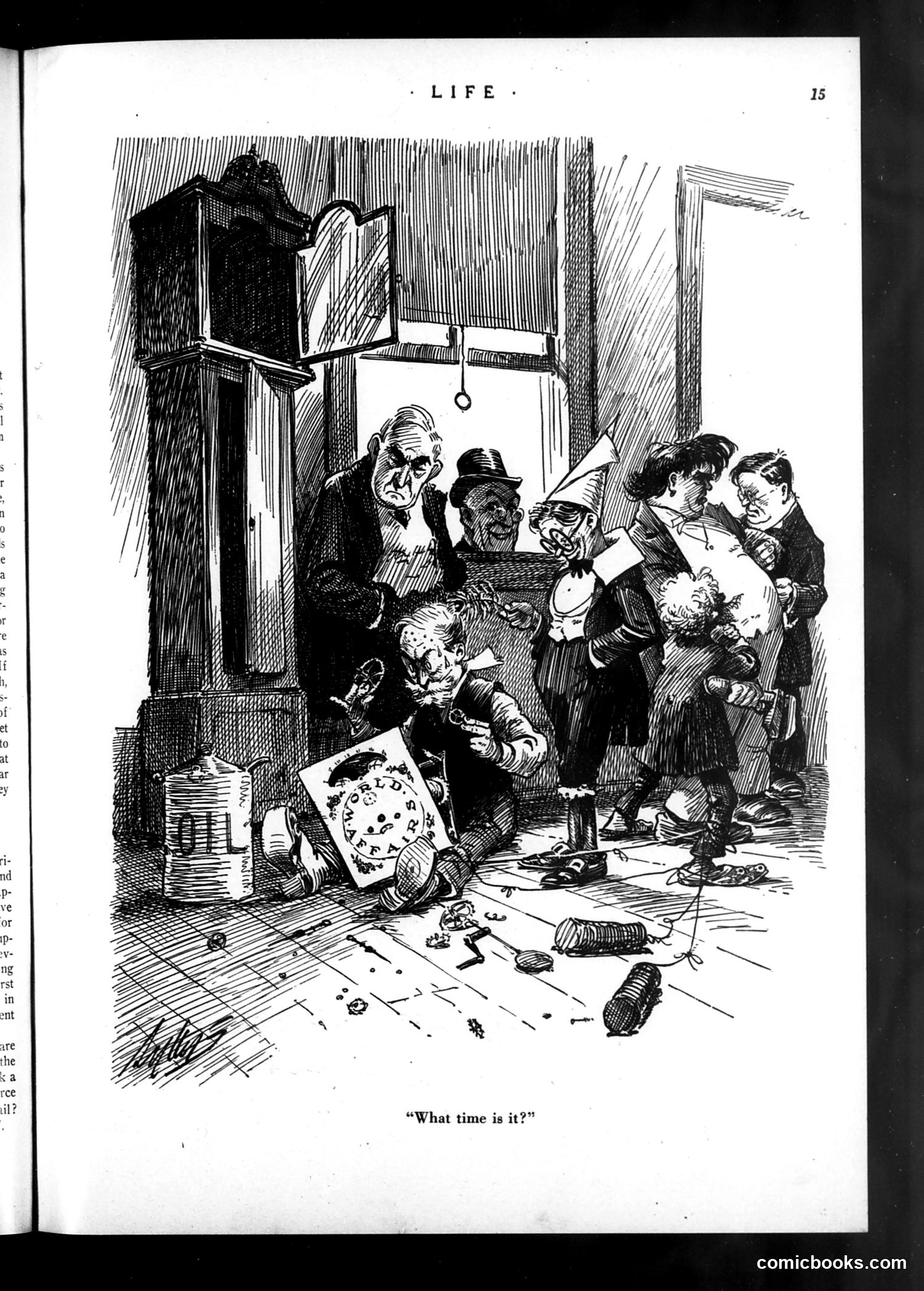
This cartoon depicts a group of working-class men and children gathered in a tenement or basement space, examining what appears to be a broken clock or timepiece on the floor. The figure asking "What time is it?" seems to be seeking practical information, but the scene suggests irony: these appear to be impoverished people without access to reliable timekeeping—a basic necessity for working lives dependent on punctuality. The satire likely critiques the harsh conditions of urban poverty and working-class existence in early 20th-century America. The scattered debris and cramped quarters emphasize deprivation. The question carries implicit commentary: those struggling to survive lack even simple tools that more affluent citizens take for granted. It's social commentary on economic inequality masked as a simple, darkly humorous scene.
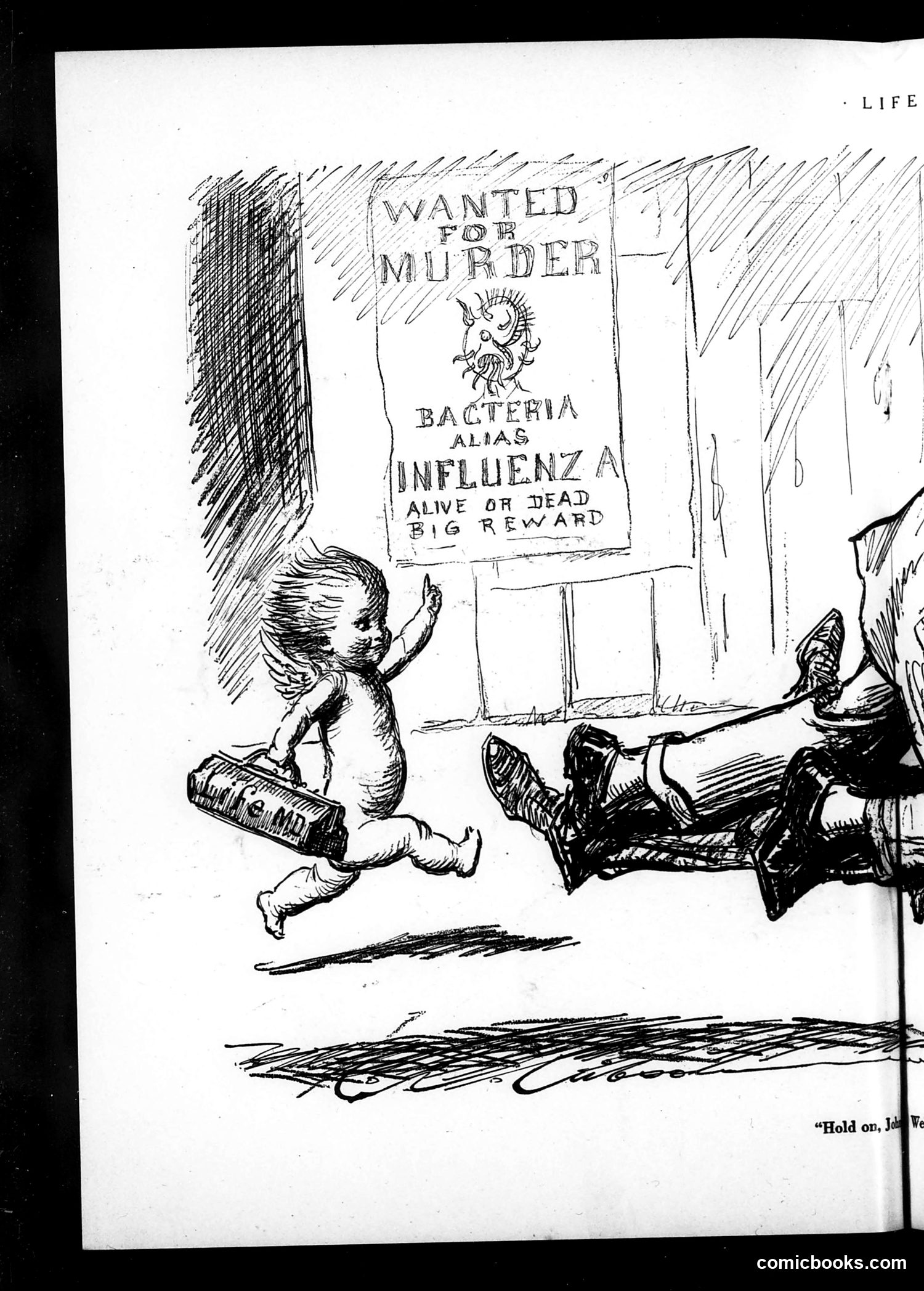
This cartoon depicts the 1918 influenza pandemic through a "wanted poster" visual gag. A cherubic child character points at a posted reward notice seeking "Bacteria Alias Influenza—Alive or Dead, Big Reward." The cartoon anthropomorphizes the influenza virus as a criminal fugitive, making the microscopic threat tangible and darkly humorous for contemporary readers facing the deadly flu. The "wanted poster" format—common for outlaws—transforms disease into an enemy to be hunted and captured, reflecting public anxiety and desire for control during a devastating health crisis that killed millions globally. The satire mocks both the invisible nature of viral threats and society's helplessness against them, while the child's innocent gesture emphasizes the epidemic's threat to all ages.
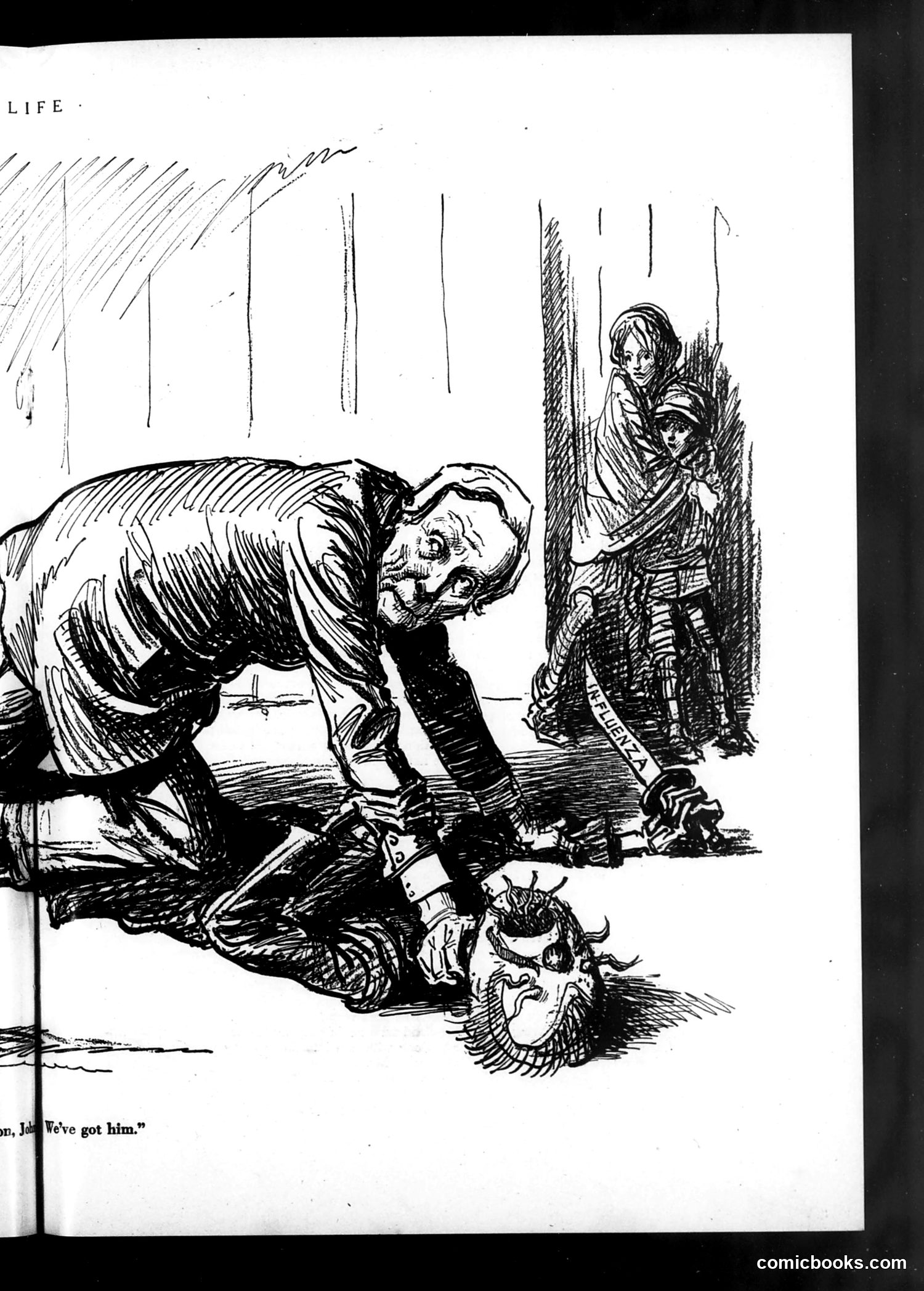
This political cartoon from *Life* magazine depicts a military or authority figure bending over a fallen demon or devil-like creature, with another armed figure visible in a doorway behind them. The caption reads "We've got him." The satire appears to reference a military victory or the capture of an enemy, with the demon symbolizing an evil force or opposing power. The artistic style—heavy cross-hatching and exaggerated features—is typical of early-to-mid 20th century American political cartooning. Without the publication date visible, the specific historical context remains unclear. The demon could represent Nazism, fascism, communism, or another contemporary threat, but I cannot definitively identify which conflict or event this references based solely on the image and partial text provided.
This page reviews contemporary Broadway productions, primarily focusing on two plays: "The Laughing Lady" (starring Ethel Barrymore) and "Icebound" (with actor Harris). **The Satire:** The writer uses gentle mockery to critique both theatrical taste and predictable plot formulas. The main joke appears in the "Icebound" section: the critic ridicules the clichéd "black satchel" scene where a heroine announces her departure, only to be intercepted at the stairs by the hero realizing he loves her. Life sarcastically notes they've offered a prize to any heroine who actually *escapes* without this interruption—a prize their bankers still hold because no such play exists. This mocks the formulaic, contrived nature of contemporary drama. **The Context:** The reviews assume readers are familiar with major theatrical names (Ethel, John, and Lionel Barrymore) but acknowledge most playgoers won't recognize supporting actors. The page critiques both overly genteel British drawing-room comedies and earnest American plays that rely on predictable emotional beats rather than genuine dramatic innovation.
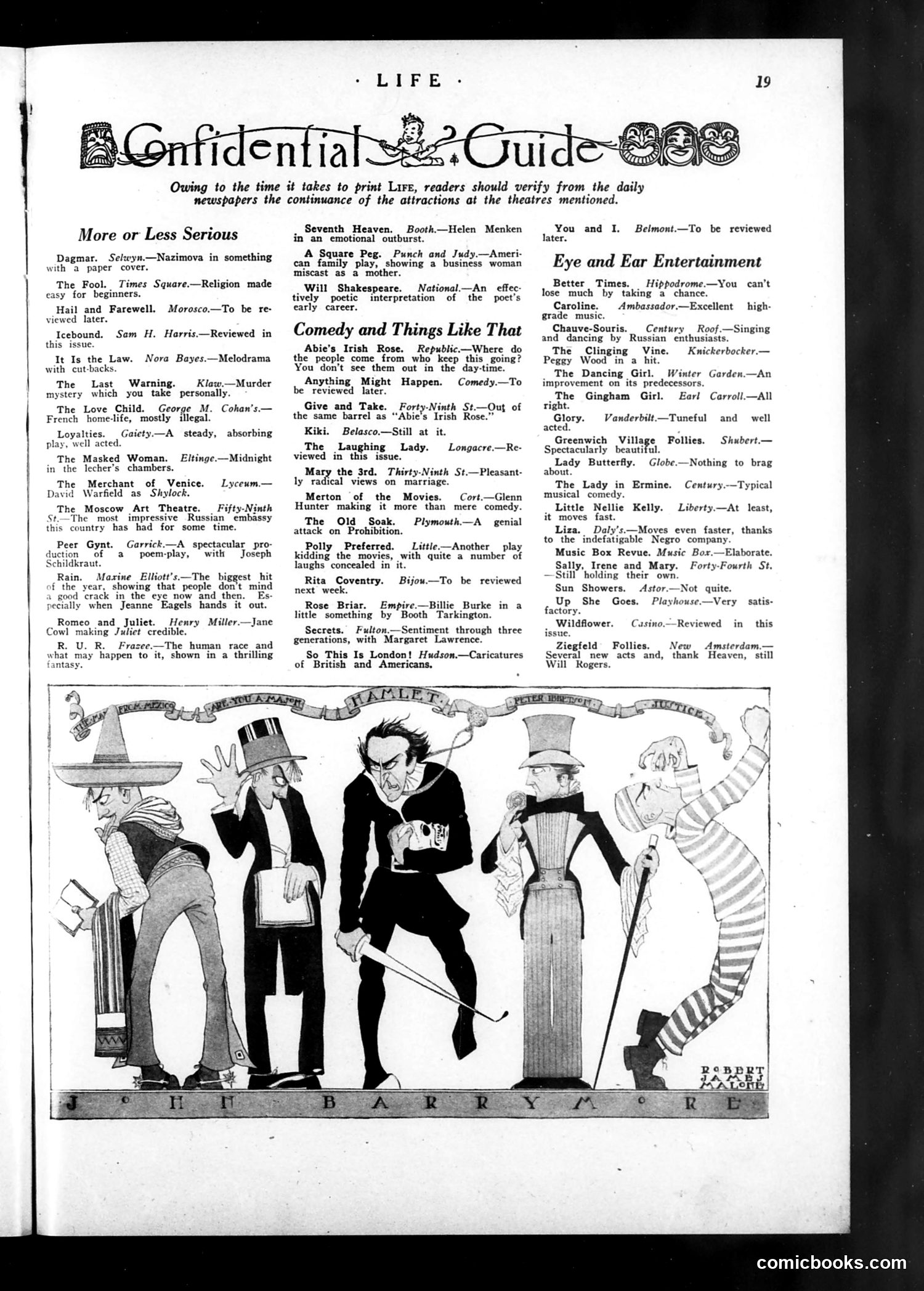
This page is a **theater review guide** from Life magazine's "Confidential Guide" section, listing Broadway shows and entertainments currently running. It's organized into categories: "More or Less Serious" plays and "Comedy and Things Like That," plus "Eye and Ear Entertainment" (musicals/revues). The reviews are snappy, one-line judgments—some praising ("Rain" is "the biggest hit of the year"), others sarcastic. Notably, **"Abie's Irish Rose" gets mocked** ("Where do the people come from who keep this going?"), suggesting it was a popular but critically dismissed show. The **cartoon at bottom** (credited to Barret) depicts various theatrical characters in exaggerated caricature—likely representing different show types or comedic stereotypes common to 1920s theater. The page reflects the vibrant Broadway scene of the early 1920s, when theater was America's primary entertainment before cinema dominated.
This is a literary criticism column—not a political cartoon—from Life magazine's "Books: Life and Letters" section. The page discusses the state of modern poetry criticism circa 1920. The key argument: poetry receives far less public attention than prose, and contemporary readers are "violently divided" over T.S. Eliot's merit—some view him as great, others as mentally unfit. The writer (Diana Warwick) satirizes the proliferation of mediocre "minor poets"—misunderstood young men, aimless women writing free verse, sentimental imitators of Wordsworth, and nostalgic elderly writers. The column then reviews specific poetry collections, including Life's own anthology orchestrated with musical instruments (banjo, saxophone, etc.), praising Paul Whiteman's caliber. It also discusses Edwin Arlington Robinson's psychological depth and notes that English children's poetry shows superior classical education compared to American work. No cartoons are visible; this is purely literary criticism and book recommendations.
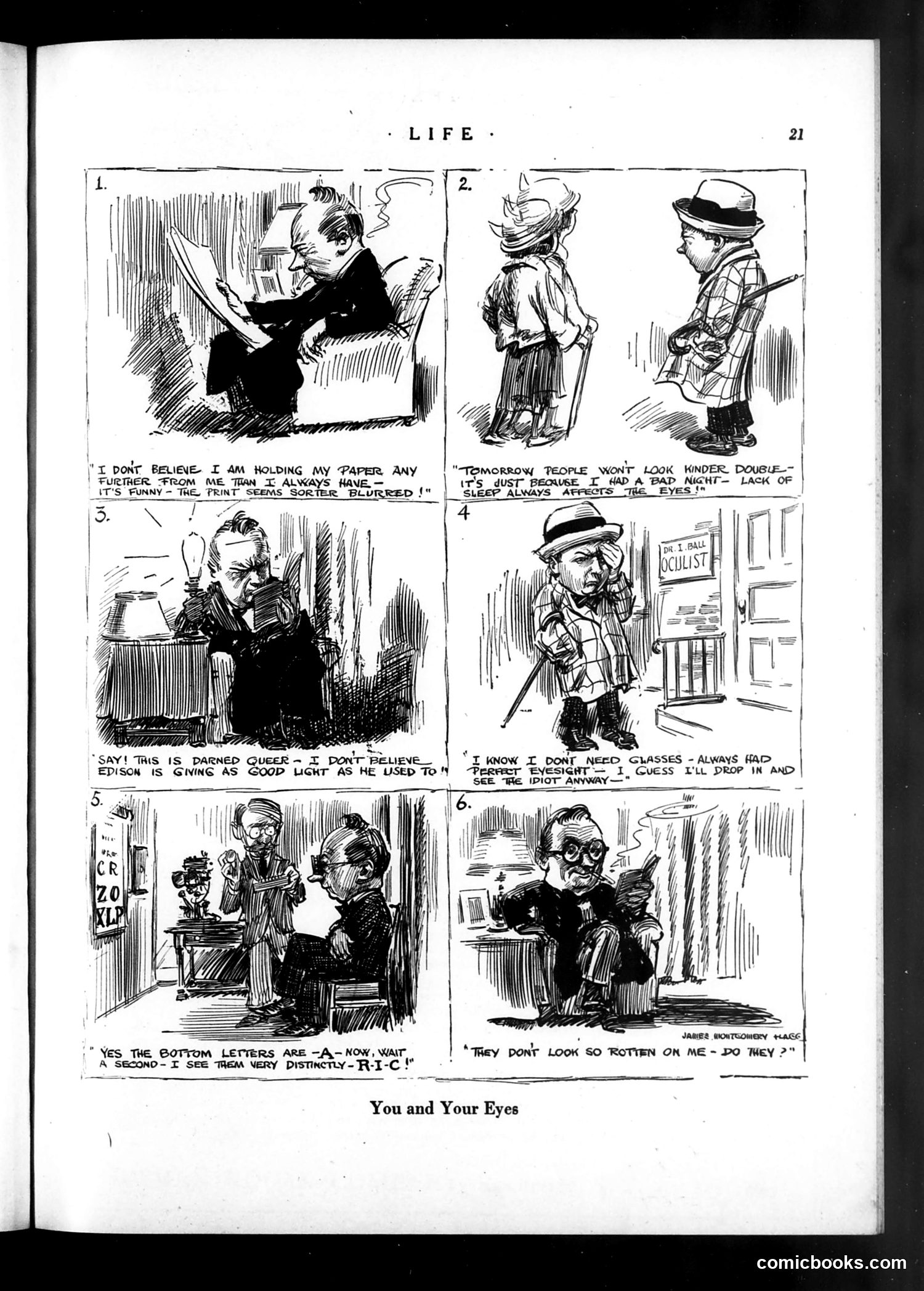
This six-panel satirical strip mocks men making excuses about their eyesight and vision problems. Each panel shows a man denying he needs glasses or admitting vision issues: Panel 1: A man claims his papers look fine despite obvious blur. Panel 2: A character dismisses looking "kinder" as merely due to lack of sleep. Panel 3: A man questions whether Edison's lightbulb is "darn'd queer." Panel 4: He insists he doesn't need glasses, having "always had perfect eyesight." Panel 5: He claims he can read tiny letters perfectly ("A...R-I-C"). Panel 6: Despite deteriorated appearance, he denies looking "rotten." The satire targets male stubbornness and vanity—men refusing to admit aging vision problems rather than wear corrective glasses. The deteriorating appearance across panels emphasizes how denial worsens their condition, a common comedic theme in early 20th-century magazines.
This page critiques both moviegoing audiences and film industry quality. The author uses Alice Duer Miller's observation that *movie critics don't attend films, while moviegoers don't critique them* — establishing that cinema lacks serious intellectual engagement. The piece argues movies are "undeniably low" not due to the medium itself but because studios chase mass profit over artistic merit. Educated audiences boycott Hollywood, viewing it as a "den of iniquity" filled with immoral behavior and low-quality output (referencing the film "Why Girls Leave Home"). However, the author offers hope: a "determined minority" is establishing non-commercial art theatres devoted to cinema's potential—modeled on theater movements like the Washington Square Players and Provincetown Players, which later influenced mainstream Broadway. The argument: if intelligent people support quality films and serious venues develop them (similar to how theatrical art movements succeeded), cinema can elevate from mere entertainment to legitimate art form.
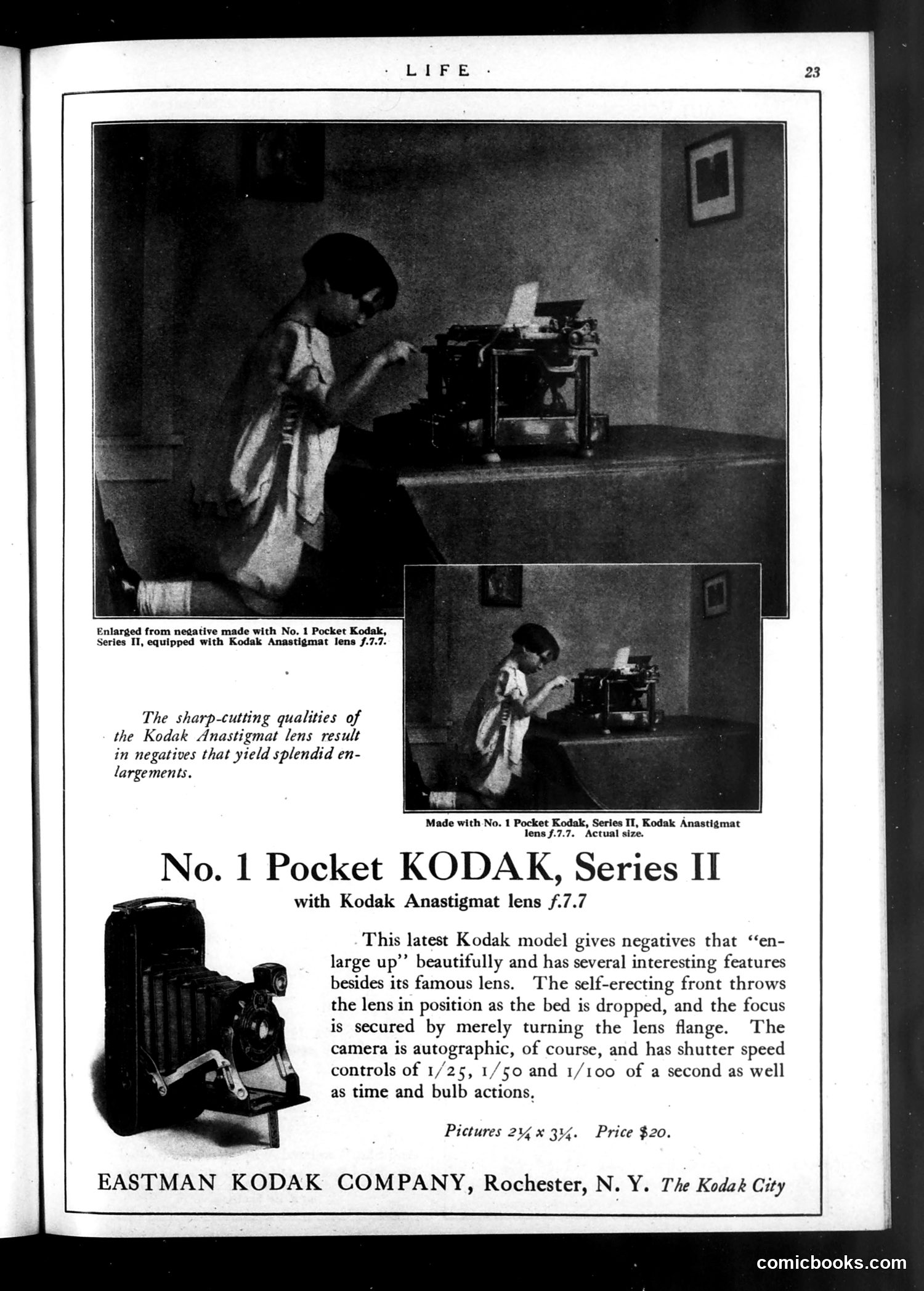
This is a **product advertisement**, not a cartoon or satire. It promotes the **No. 1 Pocket Kodak, Series II camera** manufactured by Eastman Kodak Company. The page demonstrates the camera's capabilities through two photographs of a woman using the device indoors. The top image is an enlargement made from a negative shot with this camera; the bottom shows the actual-size negative, illustrating the advertised claim that the camera's Anastigmat lens f.7.7 produces sharp negatives suitable for high-quality enlargements. The text highlights technical features: self-erecting front, focus adjustment via lens flange, autographic capability, and shutter speeds of 1/25, 1/50, and 1/100 second. The camera cost $20 and produced 2¼ × 3¼ inch pictures. This represents early 20th-century camera marketing emphasizing technical precision and ease-of-use for amateur photographers.
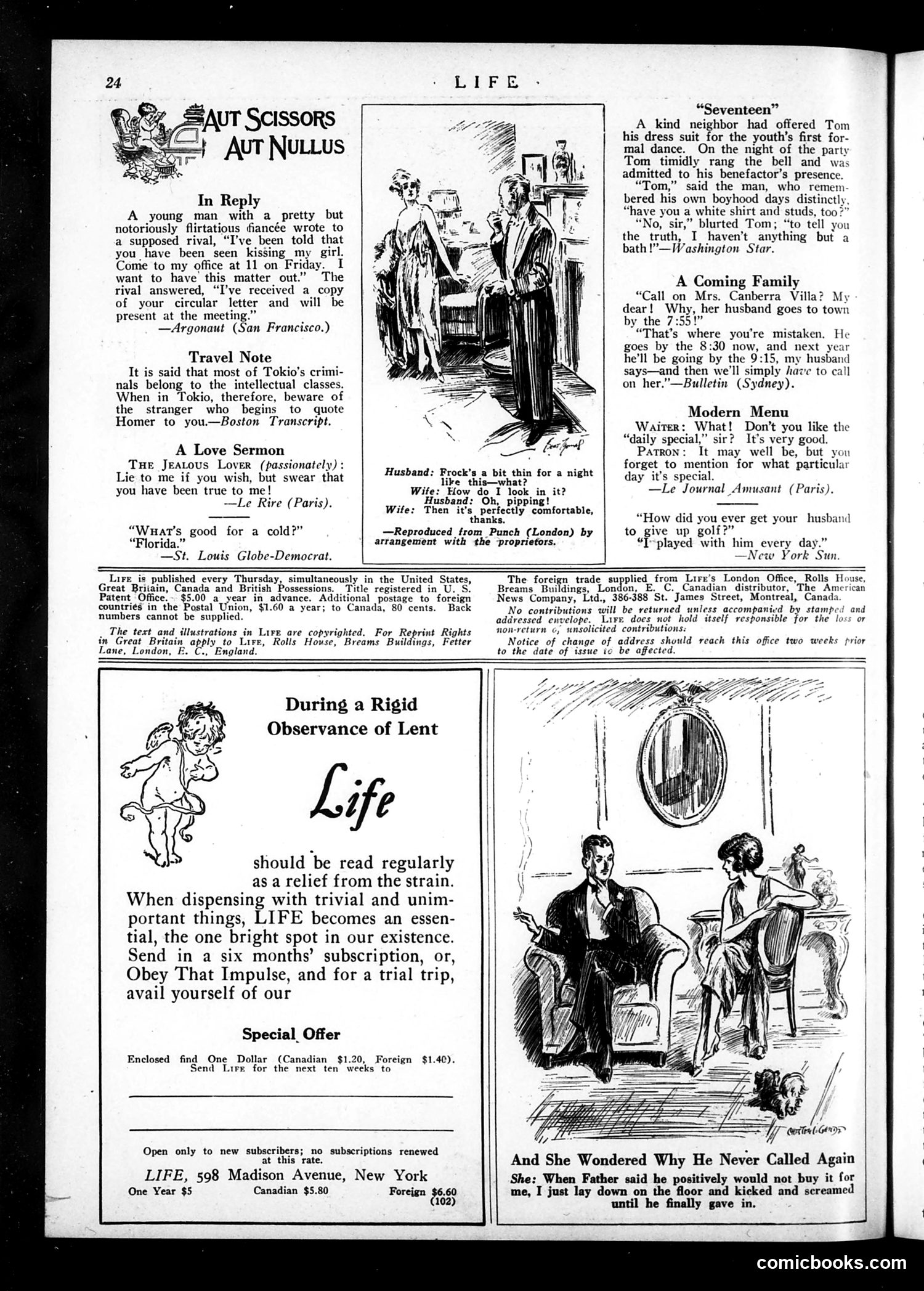
This page contains **short humorous anecdotes and jokes** collected from various international sources, plus advertising for Life magazine subscriptions. The cartoons and humor target **everyday social absurdities**: a man receiving dozens of identical challenge letters from his fiancée's supposed rivals (satirizing either her promiscuity or his gullibility); a husband complimenting his wife's appearance only when it serves comfort rather than genuine aesthetics; a waiter failing to specify *which* day's "special" is being served. The "Seventeen" item mocks youthful embarrassment—a boy attending his first formal dance lacks proper attire and admits to owning only a bathrobe, suggesting class anxiety or naiveté. The cartoons use **gentle, domestic satire** rather than political commentary. They mock courtship rituals, marital dynamics, social climbing, and male incompetence at romance and etiquette—themes central to Life magazine's humor across this era. The page itself functions as **advertisement**, promoting Life as essential reading during Lent as "relief from the strain."
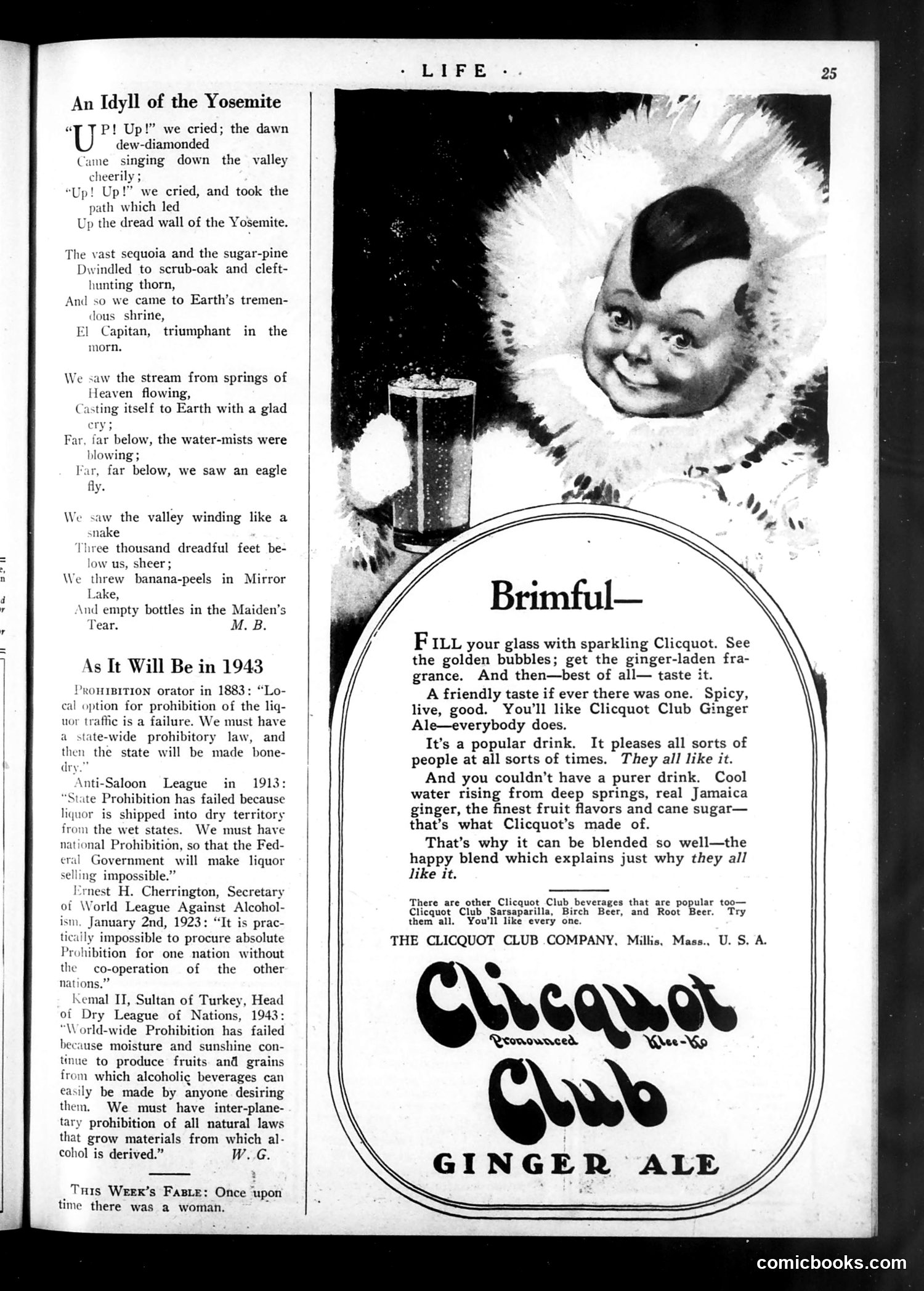
This page mixes poetry, satire, and advertising from what appears to be the early 1920s Prohibition era. **The Satire ("As It Will Be in 1943"):** The left column mocks escalating Prohibition demands. It traces a progression: 1883 advocates wanted state-wide bans; 1913 prohibitionists demanded national laws; 1923 reformers admit one nation alone can't enforce it; the joke concludes that by 1943, prohibition will require "inter-planetary" enforcement since nature itself produces fermentable materials. This satirizes the absurd futility of Prohibition—each failed level of restriction only led advocates to demand the next, more sweeping level. **The Advertisement:** The dominant right side advertises Clicquot Club Ginger Ale. The irony is unmistakable: while the satire attacks Prohibition's impossibility, the ad for a soft drink occupies the page. The cherubic baby mascot and emphatic copy appear to be promoting ginger ale as a wholesome alternative during Prohibition, though the juxtaposition itself becomes part of the commentary on the era's contradictions.
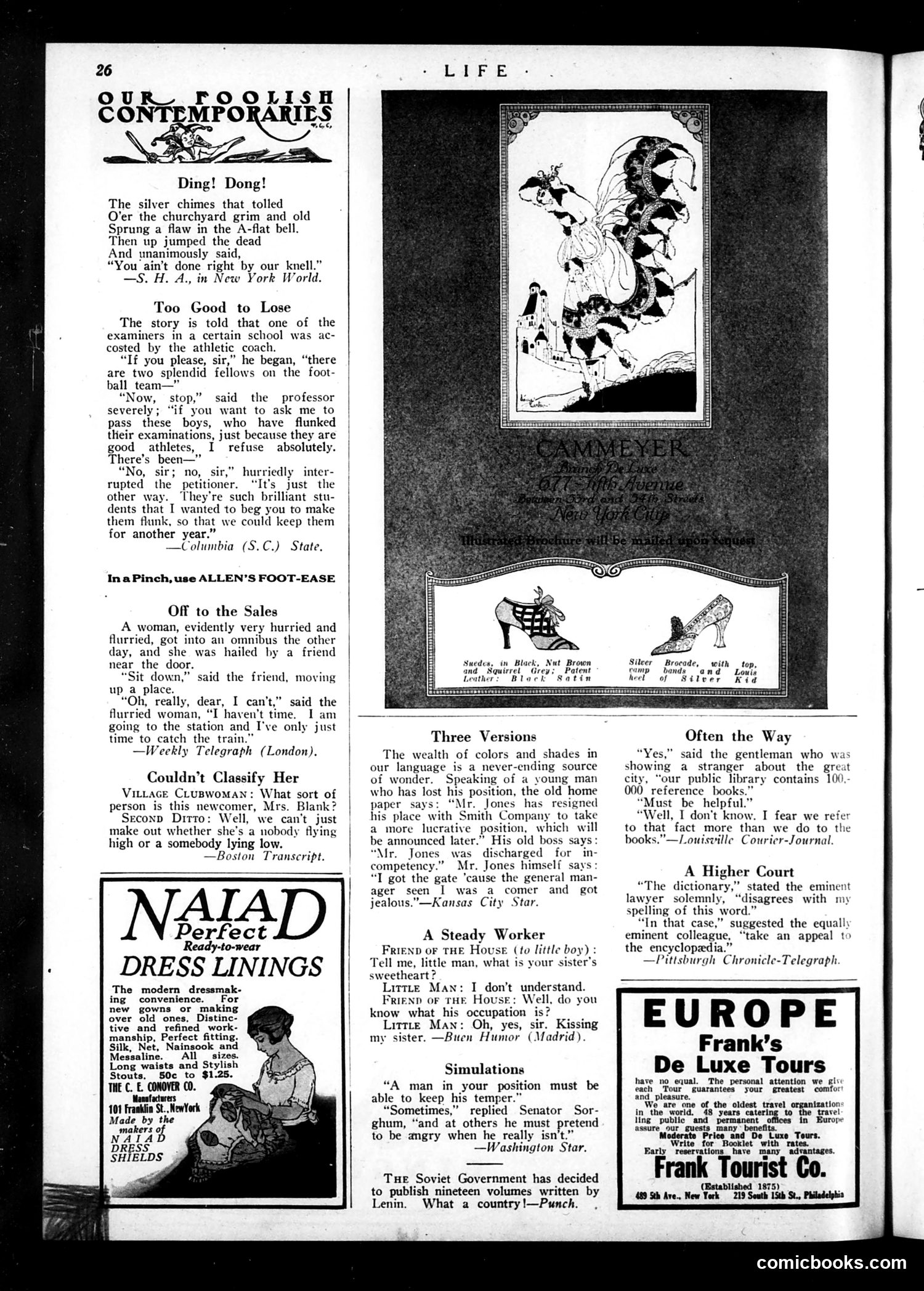
This is a **humor and satire page** from *Life* magazine, primarily containing short jokes and anecdotes on social and workplace topics. **The cartoons and jokes satirize:** - **Academic vs. Athletic priorities**: A coach asks a professor to fail brilliant football players to keep them on the team longer—mocking how schools prioritize athletics over academics. - **Language and euphemism**: "Three Versions" mocks how the same event gets described differently by newspapers ("resigned"), employers ("discharged"), and the fired worker ("got the gate")—satirizing how language obscures reality. - **Social climbing and pretense**: "Couldn't Classify Her" jokes about a newcomer who's hard to categorize socially—whether she's "a nobody flying high or a somebody lying low." - **Soviet propaganda excess**: A brief jab at Lenin's government publishing 19 volumes of his writings, implying absurd overproduction. The page reflects early 20th-century American anxieties about status, institutional corruption, and post-revolutionary Russia.
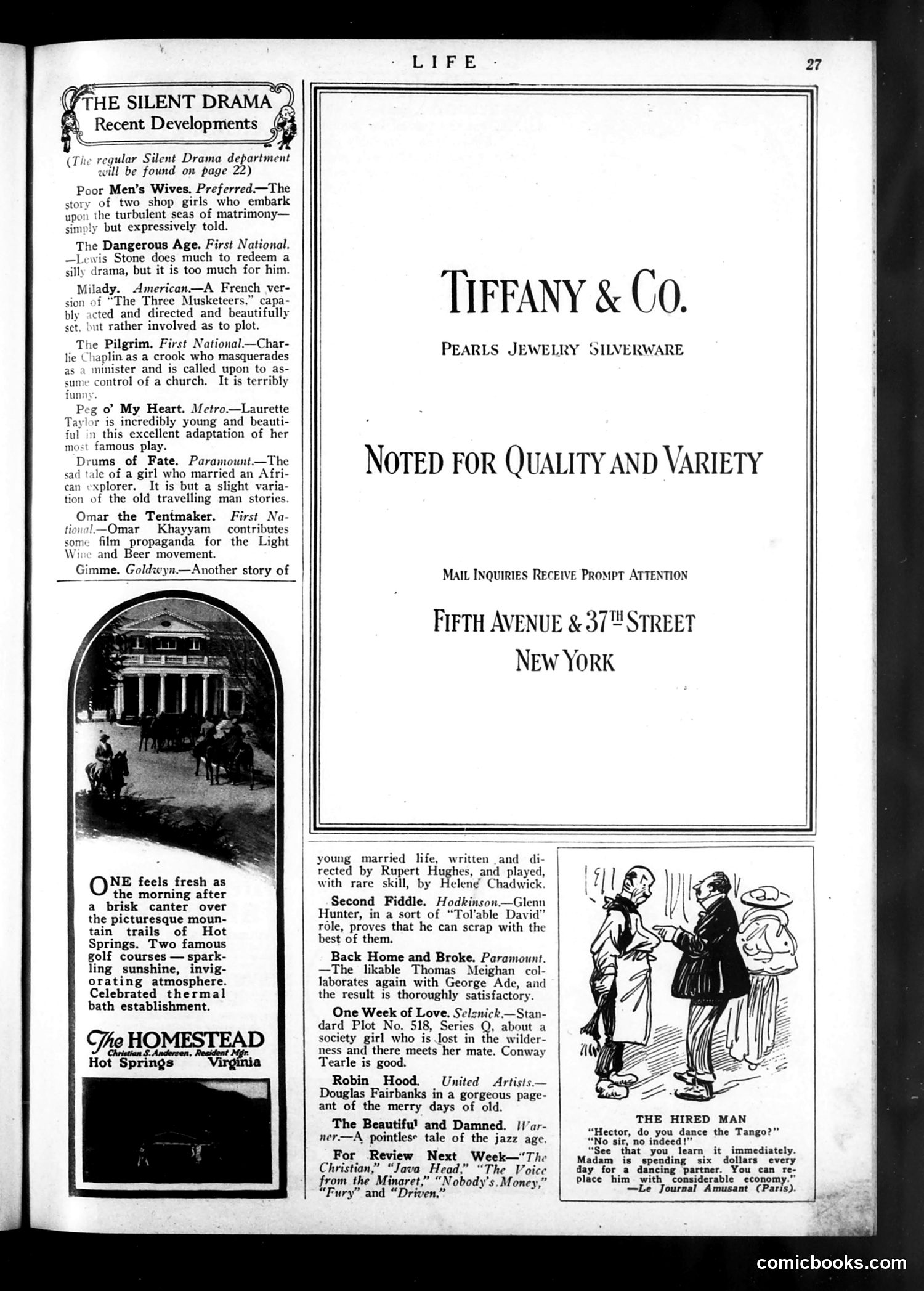
This page is primarily a **film review section** ("The Silent Drama: Recent Developments") covering early 1920s silent movies, with a notable cartoon at the bottom. ## The Cartoon ("The Hired Man") The small cartoon depicts a domestic interaction about dancing. A man asks a woman, "Do you dance the Tango?" She replies, "No indeed!" He then suggests she should learn immediately, since he's spending six dollars daily on a dancing partner—but she could replace him "with considerable economy." **The joke**: It's a play on the servant/employer relationship. The "hired man" proposes the woman learn to dance so she won't need to pay him for that service, making him more economically valuable by reducing her expenses elsewhere. The satire targets either domestic servants' hustling for job security or critiques wasteful spending on luxuries like dancing instruction during this era. The cartoon is credited to *Le Journal Amusant* (Paris), indicating Life republished international humor. The page also includes a **Tiffany & Co. advertisement** and promotional content for Hot Springs, Virginia's resort amenities.
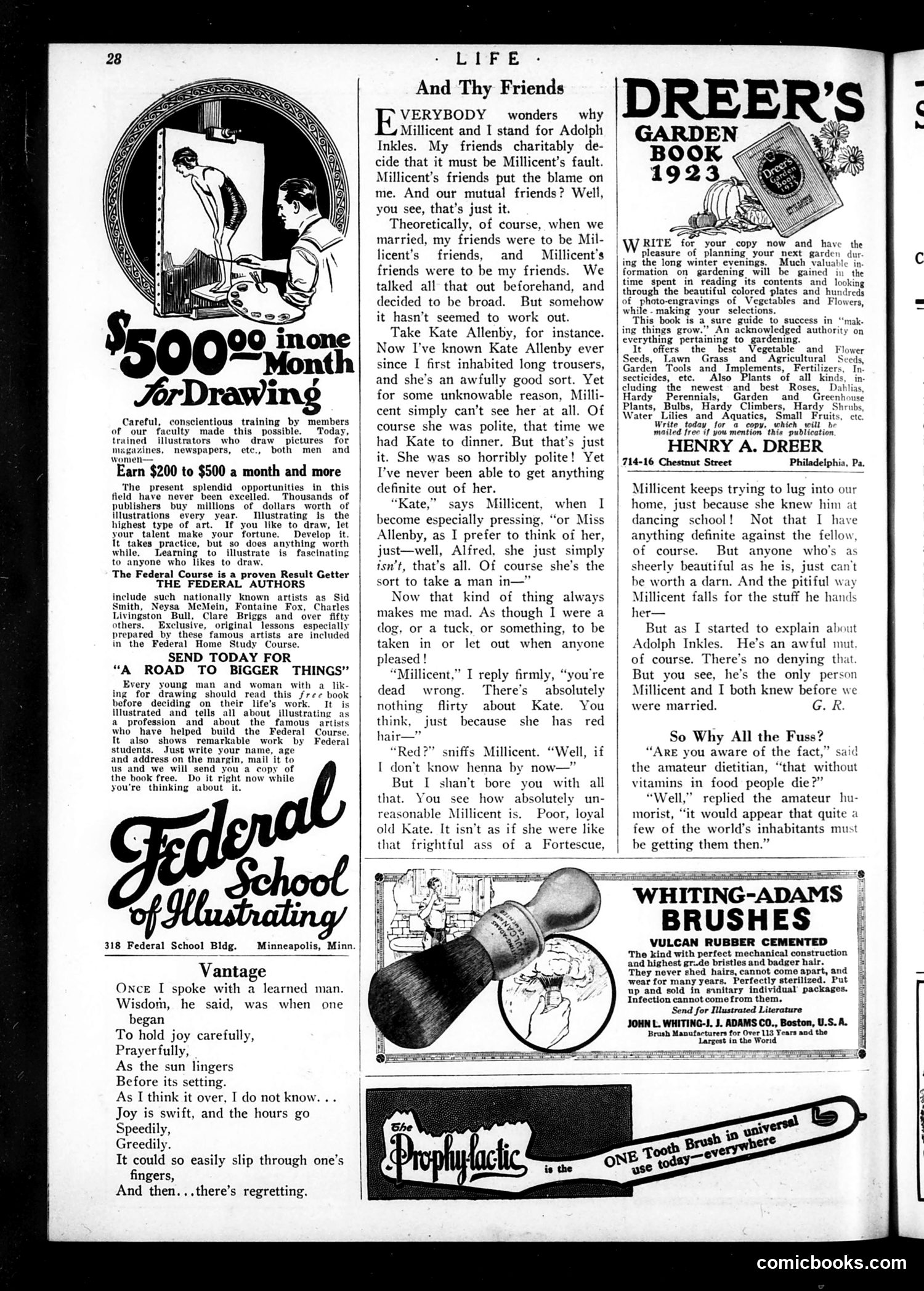
This page contains primarily **advertisements and light social commentary**, not political satire. The main content is a humorous short story titled "And Thy Friends" about marital friction. The narrator (Alfred) defends his friendship with Kate Allenby to his wife Millicent, who dislikes Kate without explanation. The joke relies on the familiar domestic tension of spouses disapproving of each other's friends—Millicent finds Kate unsuitable but won't articulate why, dismissing her as simply "isn't." Alfred's frustration is played for comedy. The page is dominated by **advertisements**: Federal School of Illustrating (promoting correspondence courses), Dreer's Garden Book, Whiting-Adams Brushes, and Prophylactic toothbrushes. A poem titled "Vintage" appears at bottom left. No political figures or events are referenced. This is a typical 1923 *Life* page mixing humorous domestic fiction with period product advertising.
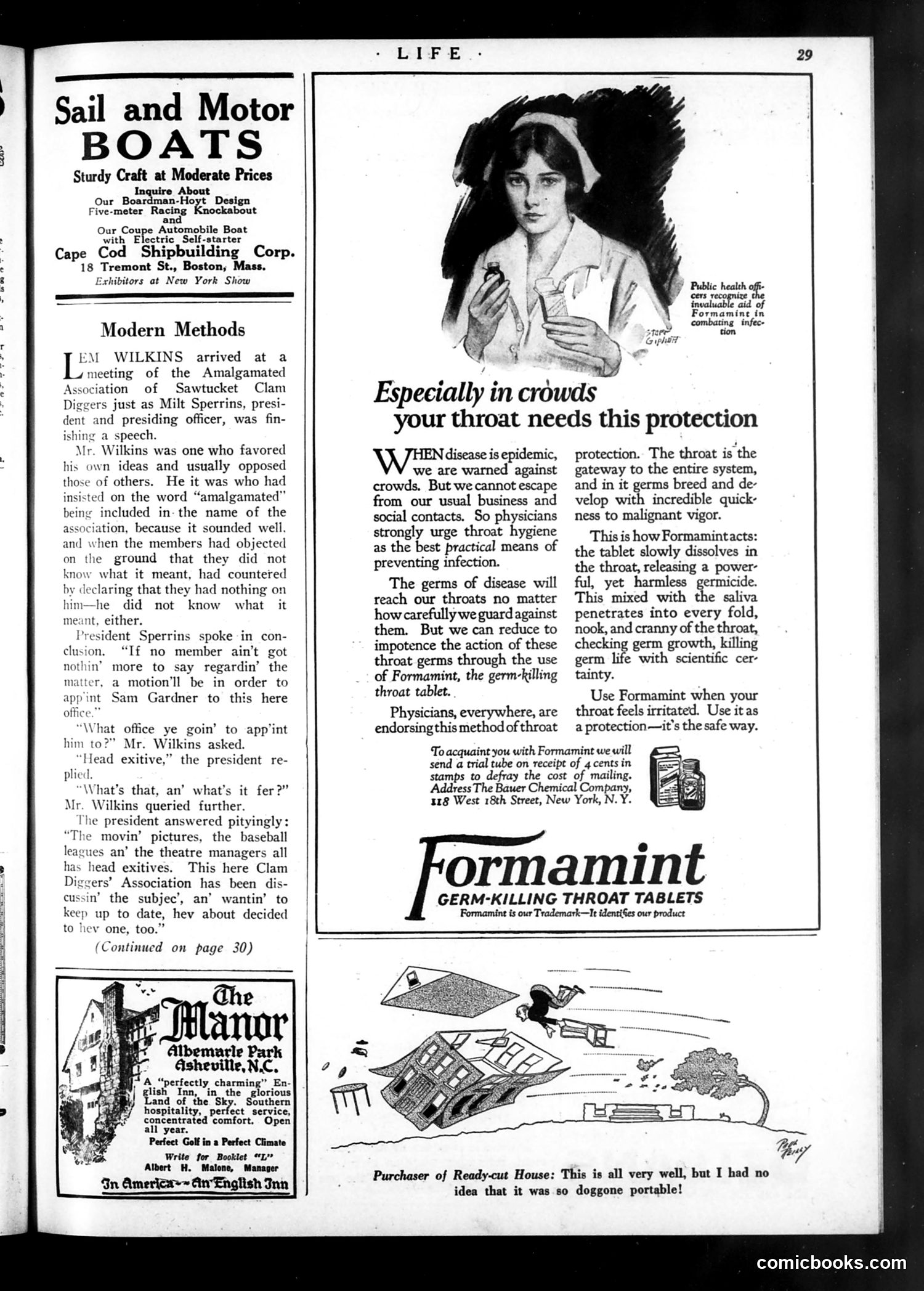
This page contains **mostly advertisements and a short humorous story**, with one editorial cartoon. **The Main Story** ("Modern Methods") satirizes small-town organizational pretension. Lem Wilkins attends a clam diggers' association meeting where President Sperrins proposes appointing a "Head Executive"—mimicking corporate America's bureaucracy. Wilkins, who previously insisted on the fancy word "amalgamated" despite not understanding it, now questions what a "Head Executive" does and why they need one. Sperrins defensively explains that baseball leagues and theaters have them, so they should too. The satire mocks rural organizations blindly copying big-business jargon and structures without understanding their purpose. **The Cartoon** (bottom) shows a man standing amid scattered pieces of a prefabricated house, remarking he didn't realize ready-cut homes were "portable"—joking that the house fell apart during delivery or assembly. **Advertisements** include boats, a North Carolina inn, and Formamint throat tablets (a period medical product).
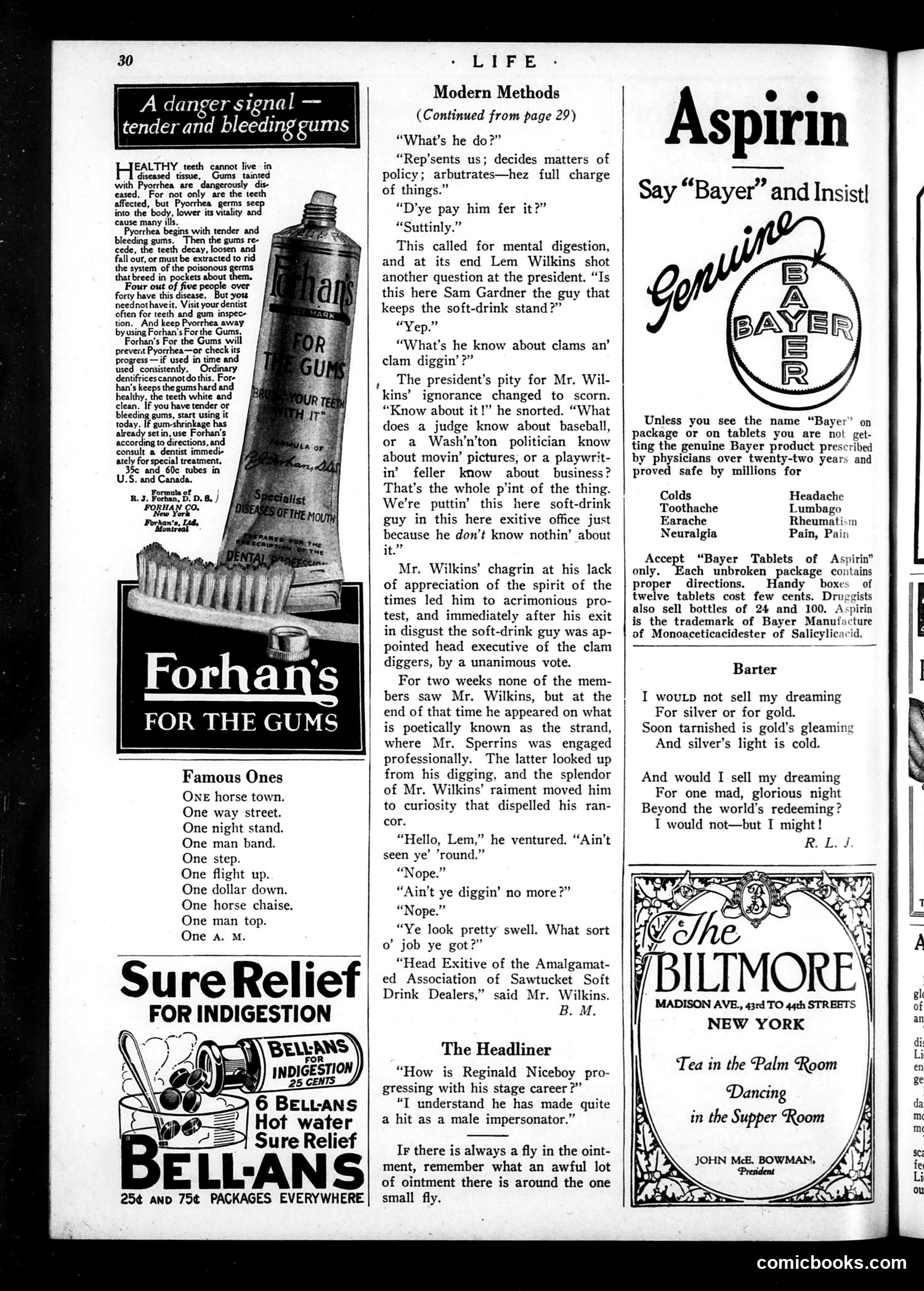
This page contains primarily **advertisements and short humorous pieces**, not political satire in the traditional sense. The main content includes: **"Modern Methods"** — A satirical dialogue mocking bureaucratic incompetence. A soft-drink stand operator is appointed head of a clam-diggers' association *because* he knows nothing about clams, embodying the absurd principle that expertise is irrelevant to management. This critiques early-20th-century political patronage and incompetent appointments to office. **Product Advertisements**: Forhan's toothpaste (for gum disease/pyorrhea), Bellans (indigestion remedy), and Bayer Aspirin dominate the page—typical of Life's revenue model. **Minor humor pieces** include "Famous Ones" (wordplay) and "The Headliner" (a joke about a male impersonator). The satire is gentle and localized rather than topical—poking fun at universal human follies and everyday incompetence rather than specific political figures or events. The overall tone reflects Life's role as entertainment and advertising vehicle for middle-class American readers.
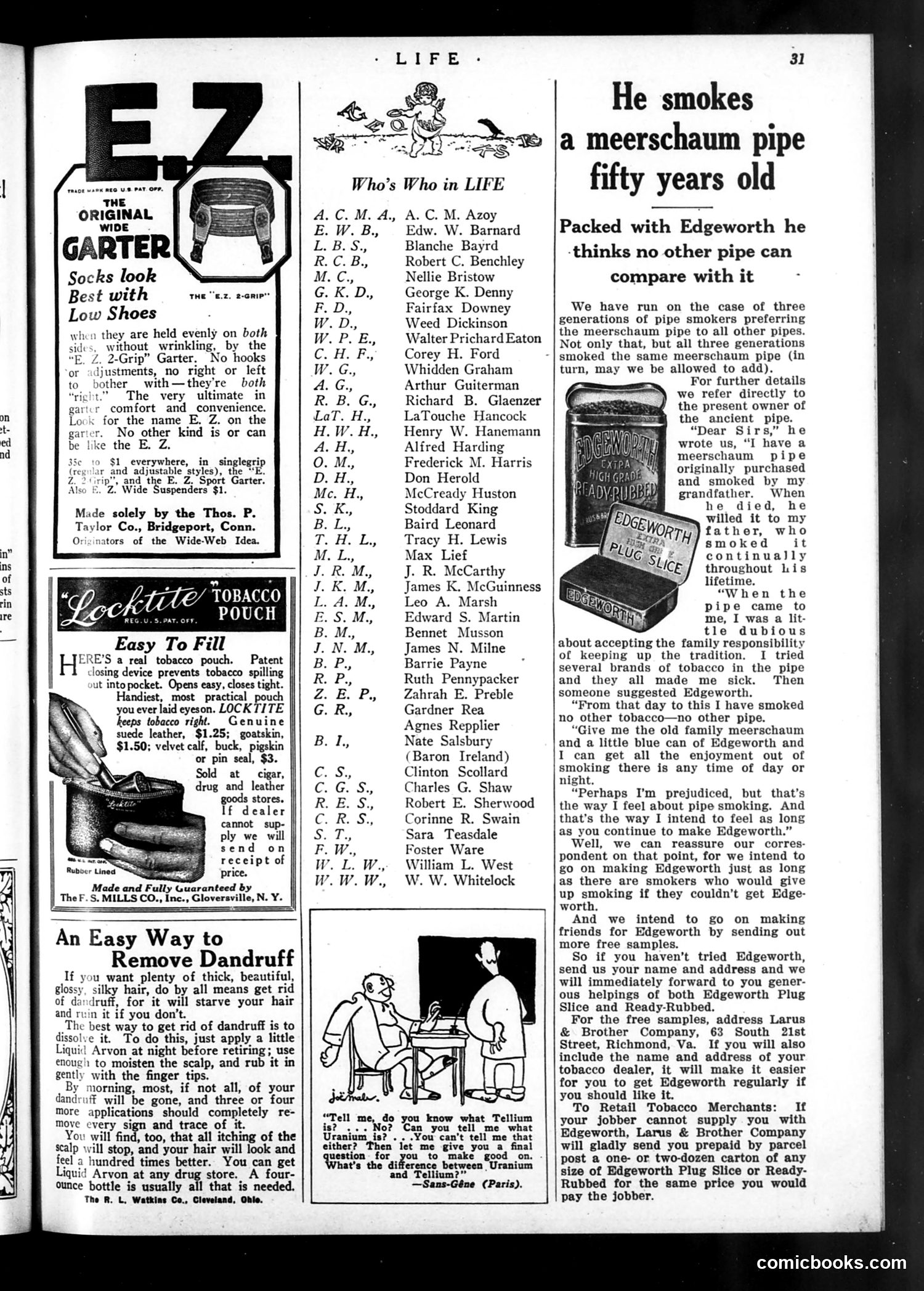
This page is primarily **advertisements and magazine credits**, not political satire. The main content includes: 1. **Product ads**: E.Z. garters (sock holders), Locktite tobacco pouches, Liquid Arvon dandruff treatment, and Edgeworth pipe tobacco. 2. **"Who's Who in LIFE"**: A staff/contributor list—names of writers and artists working for *Life* magazine at this time. 3. **Two cartoons** (minor): A small illustrated joke about uranium vs. tellurium (a chemistry pun), and another showing someone asking about the difference between two elements. 4. **The featured testimonial**: An Edgeworth tobacco ad where a customer claims his grandfather's meerschaum pipe—passed down through three generations—smokes best when packed with Edgeworth brand tobacco. There is **no political satire or social commentary** on this page. It's a straightforward mix of advertising and magazine housekeeping typical of *Life* in this era (appears to be 1920s based on styling). The humor is gentle and commercial rather than satirical.
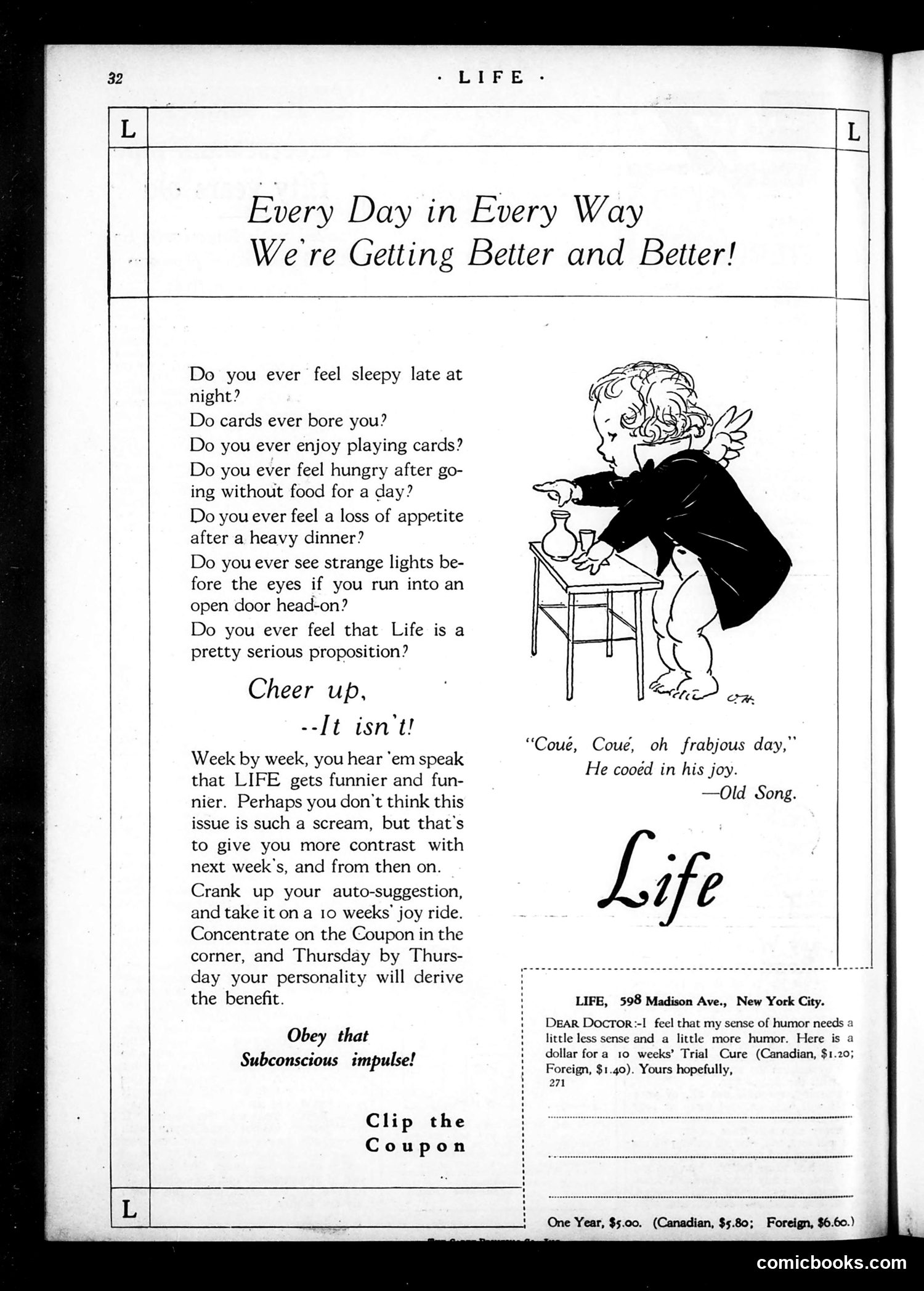
This page satirizes the popular self-help movement of the era, particularly **Émile Coué's autosuggestion method** (referenced in the text and illustrated by the cheerful figure). Coué's famous mantra was "Every day in every way I'm getting better and better"—which Life mockingly adopts as its headline. The page poses absurd, mundane complaints (sleepiness, card boredom, hunger) as if they're serious afflictions requiring cure. Life then advertises itself as the remedy: read our magazine for 10 weeks, practice "auto-suggestion" by concentrating on our coupon, and supposedly your personality will improve through humor. It's satire aimed at both the pseudoscientific wellness craze and Life's own commercialism—essentially mocking the very self-improvement culture while simultaneously trying to sell subscriptions as a "joy ride" cure-all. The joke undercuts its own sales pitch.
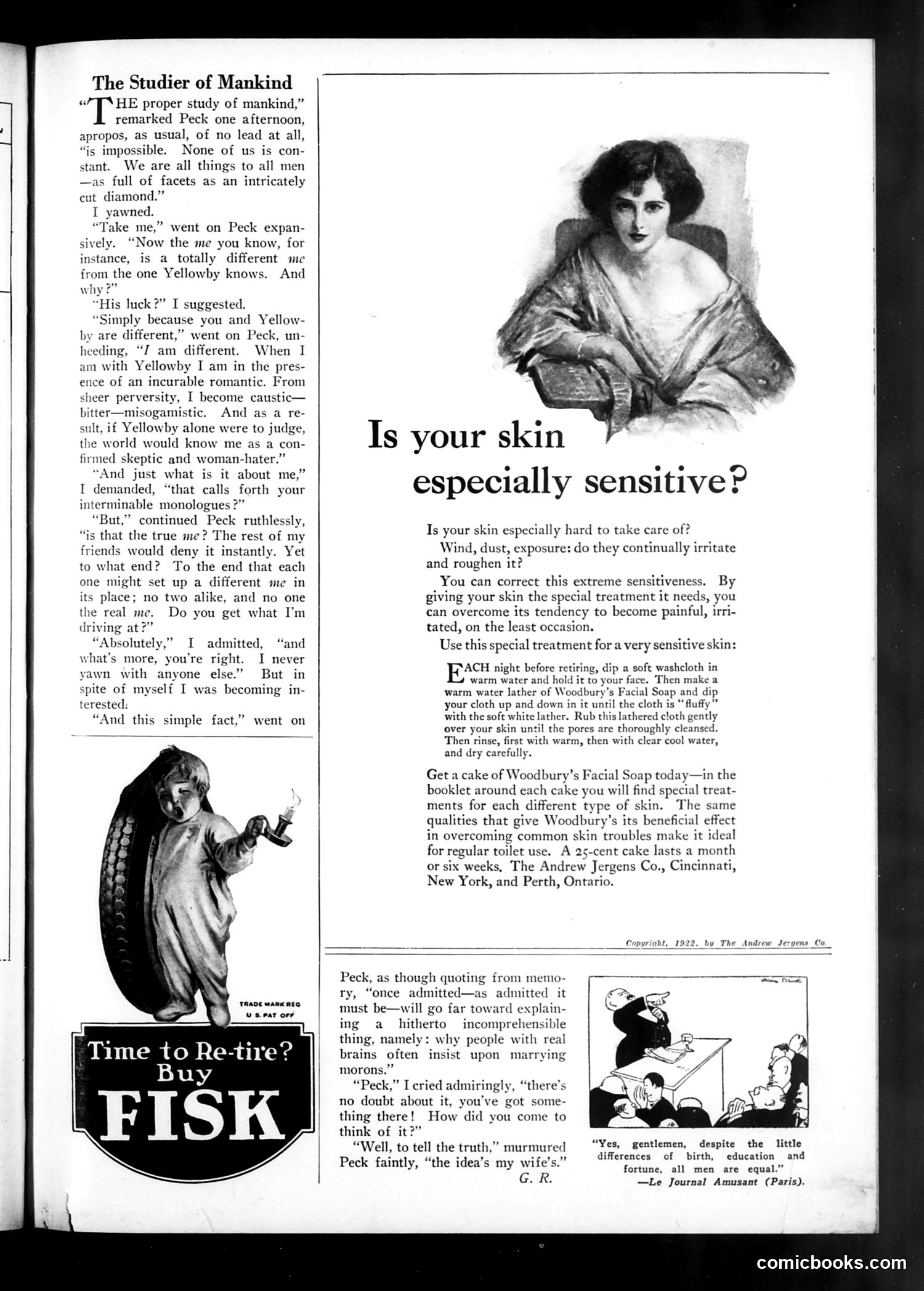
This page combines a satirical short story with period advertising. The main narrative features a character named Peck expounding on philosophy—specifically that human nature is inconsistent, with people presenting different versions of themselves to different audiences. The joke culminates when Peck credits his clever observation to his wife, undercutting his pretentious intellectualism. The cartoon at bottom (credited to *Le Journal Amusant*, Paris) reinforces this theme: a man lectures that "all men are equal" despite birth/education differences, while his servant visibly struggles with his heavy luggage—visual irony about class inequality. The dominant advertisement for **Woodbury's Facial Soap** (a real 1920s brand) occupies the right side, targeting women with sensitive skin concerns. This juxtaposition—serious philosophical discussion alongside beauty product marketing—reflects *Life*'s dual nature as satirical commentary mixed with commercial content typical of 1920s magazines.
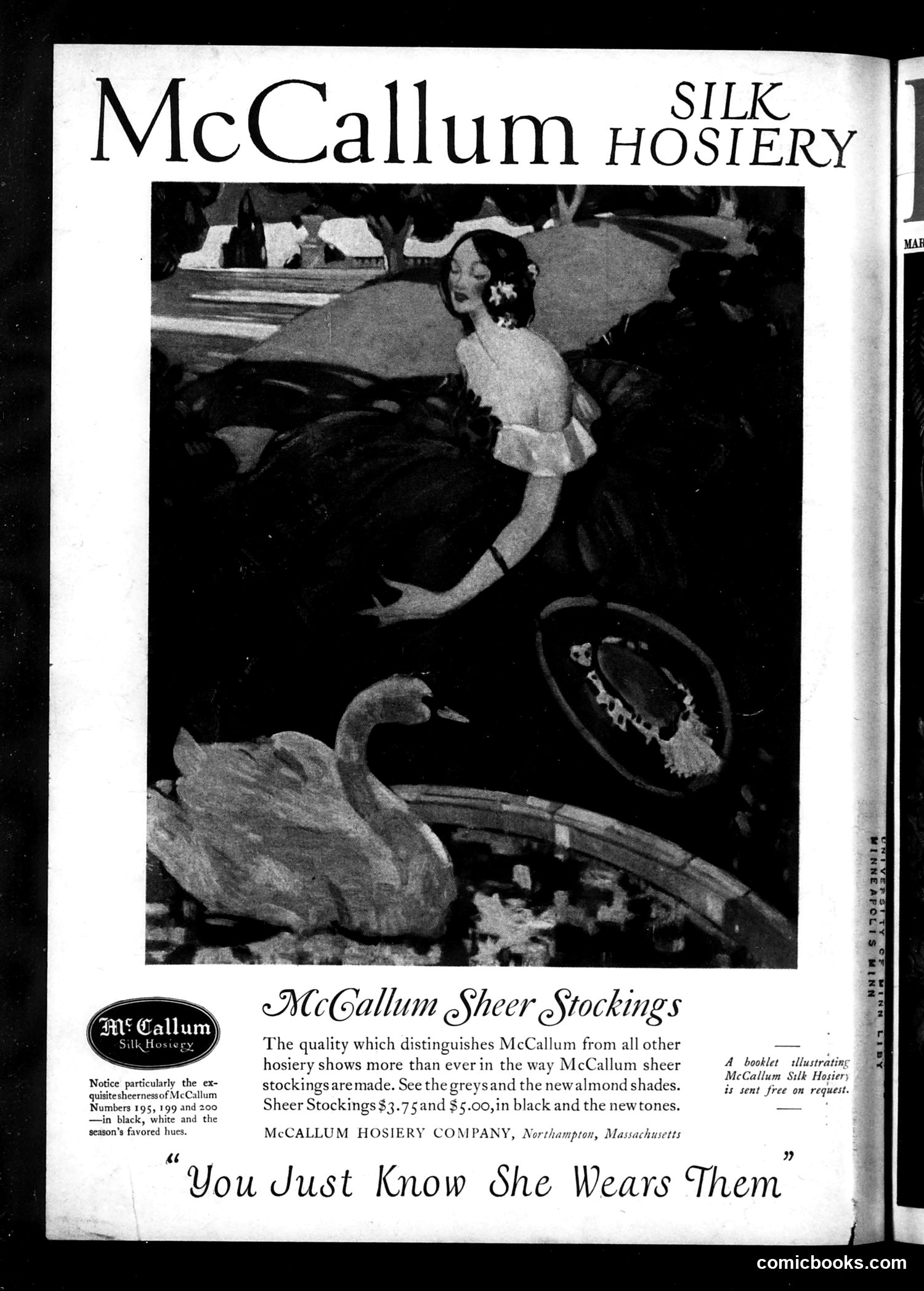
This is a **product advertisement**, not political satire. It promotes McCallum brand silk stockings, a luxury hosiery item popular in the early 20th century. The image shows a woman in an elegant, romantic scene with swans and classical elements, emphasizing luxury and femininity. The advertisement highlights that McCallum stockings are distinguished by their exceptional sheerness, available in colors like grey, almond, black, and seasonal tones, priced at $3.75–$5.00. The tagline "You Just Know She Wears Them" suggests that wearing McCallum stockings signals refinement and taste—a status marker for women of means. The accompanying text notes the "exquisite sheeriness" as the key selling point. This reflects early-1900s marketing that associated hosiery quality with social standing and attractiveness, targeting women who could afford premium products.