
Life, 1923-03-01 · page 24 of 36
Life — March 1, 1923 — page 24: what you’re looking at
What you’re looking at
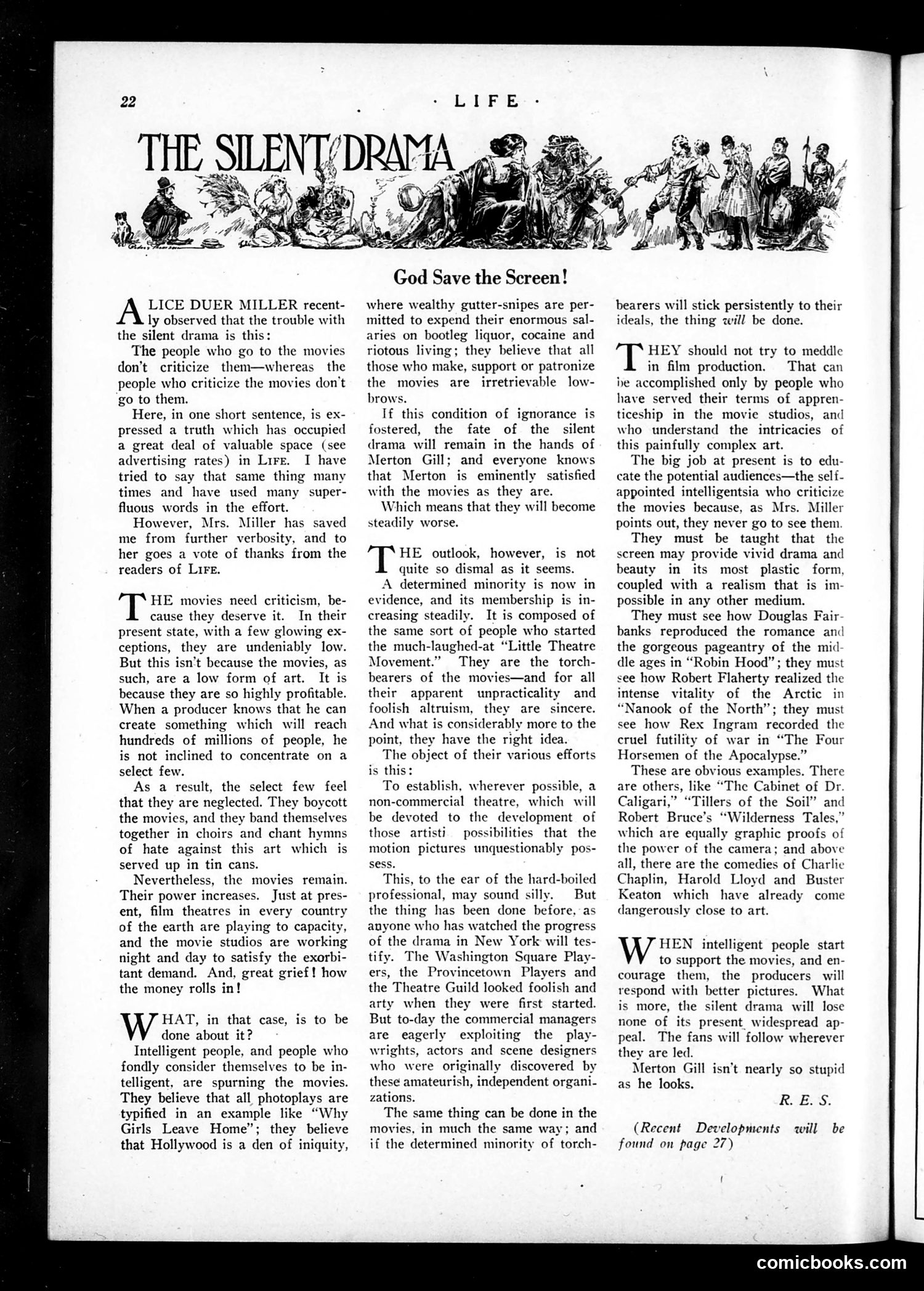
This page critiques both moviegoing audiences and film industry quality. The author uses Alice Duer Miller's observation that *movie critics don't attend films, while moviegoers don't critique them* — establishing that cinema lacks serious intellectual engagement. The piece argues movies are "undeniably low" not due to the medium itself but because studios chase mass profit over artistic merit. Educated audiences boycott Hollywood, viewing it as a "den of iniquity" filled with immoral behavior and low-quality output (referencing the film "Why Girls Leave Home"). However, the author offers hope: a "determined minority" is establishing non-commercial art theatres devoted to cinema's potential—modeled on theater movements like the Washington Square Players and Provincetown Players, which later influenced mainstream Broadway. The argument: if intelligent people support quality films and serious venues develop them (similar to how theatrical art movements succeeded), cinema can elevate from mere entertainment to legitimate art form.
📄 Transcribed text from this page (OCR, searchable)
Machine-transcribed from the original scan — historical spelling and the odd misread are preserved.
LICE DUER MILLER recent- ly observed that the trouble with the silent drama is this: The people who go to the movies don’t criticize them—whereas the people who criticize the movies don’t go to them. Here, in one short sentence, is ex- pressed a truth which has occupied a great deal of valuable space (see advertising rates) in Lire. I have tried to say that same thing many times and have used many super- fluous words in the effort. However, Mrs. Miller has saved me from further verbosity, and to her goes a vote of thanks from the readers of Lire. HE movies need criticism, be- cause they deserve it. In their present state, with a few glowing ex- ceptions, they are undeniably low. But this isn’t because the movies, as such, are a low form of art. It is because they are so highly profitable. When a producer knows that he can create something which will reach hundreds of millions of people, he is not inclined to concentrate on a select few. As a result, the select few feel that they are neglected. They boycott the movies, and they band themselves together in choirs and chant hymns of hate against this art which is served up in tin cans. Nevertheless, the movies remain. Their power increases. Just at pres- ent, film theatres in every country of the earth are playing to capacity, and the movie studios are working night and day to satisfy the exorbi- tant demand. And, great grief! how the money rolls in! HAT, in that case, is to be done about it? Intelligent people, and people who fondly consider themselves to be in- telligent, are spurning the movies. They believe that all photoplays are typified in an example like “Why Girls Leave Home”; they believe that Hollywood is a den of iniquity, God Save the Screen! where wealthy gutter-snipes are per- mitted to expend their enormous sal- aries on bootleg liquor, cocaine and riotous living; they believe that all those who make, support or patronize the movies are irretrievable low- brows. If this condition of ignorance is fostered, the fate of the silent drama will remain in the hands of Merton Gill; and everyone knows that Merton is eminently satisfied with the movies as they are. Which means that they will become steadily worse. HE outlook, however, is not quite so dismal as it seems. A determined minority is now in evidence, and its membership is in- creasing steadily. It is composed of the same sort of people who started the much-laughed-at “Little Theatre Movement.” They are the torch- bearers of the movies—and for all their apparent unpracticality and foolish altruism, they are sincere. And what is considerably more to the point, they have the right idea. The object of their various efforts is this: To establish, wherever possible, a non-commercial theatre, which will be devoted to the development of those artisti possibilities that the motion pictures unquestionably pos- sess. This, to the ear of the hard-boiled professional, may sound silly. But the thing has been done before, as anyone who has watched the progress of the drama in New York will te tify. The Washington Square Play- ers, the Provincetown Players and the Theatre Guild looked foolish and arty when they were first started. But to-day the commercial managers are eagerly exploiting the play- wrights, actors and scene designers who were originally discovered by these amateurish, independent organi- zations. The same thing can be done in the movies, in much the same way; and if the determined minority of torch- bearers will stick persistently to their ideals, the thing will be done. HEY should not try to meddle in film production. That can be accomplished only by people who have served their terms of appren- ticeship in the movie studios, and who understand the intricacies of this painfully complex art. The big job at present is to edu- cate the potential audiences—the self- appointed intelligentsia who criticize the movies because, as Mrs. Miller points out, they never go to see them They must be taught that the screen may provide vivid drama and beauty in its most plastic form, coupled with a realism that is im- possible in any other medium. They must see how Douglas Fair- banks reproduced the romance and the gorgeous pageantry of the mid dle ages in “Robin Hood”; they must see how Robert Flaherty realized the intense vitality of the Arctic in “Nanook of the North”; they must see how Rex Ingram recorded the cruel futility of war in “The Four Horsemen of the Apocalypse.” These are obvious examples. There are others, like “The Cabinet of Dr. Caligari,” “Tillers of the Soil” and Robert Bruce’s “Wilderness Tales,” which are equally graphic proofs of the power of the camera; and above all, there are the comedies of Charlie Chaplin, Harold Lloyd and Buster Keaton which have already come dangerously close to art. HEN intelligent people start to support the movies, and en- courage them, the producers will respond with better pictures. What is more, the silent drama will lose none of its present. widespread ap- peal. The fans will follow wherever they are led. Merton Gill isn’t nearly so stupid as he looks. RSES. (Recent Developments will be found on page 27) comicbooks.com