
Life, 1923-03-01 · page 12 of 36
Life — March 1, 1923 — page 12: what you’re looking at
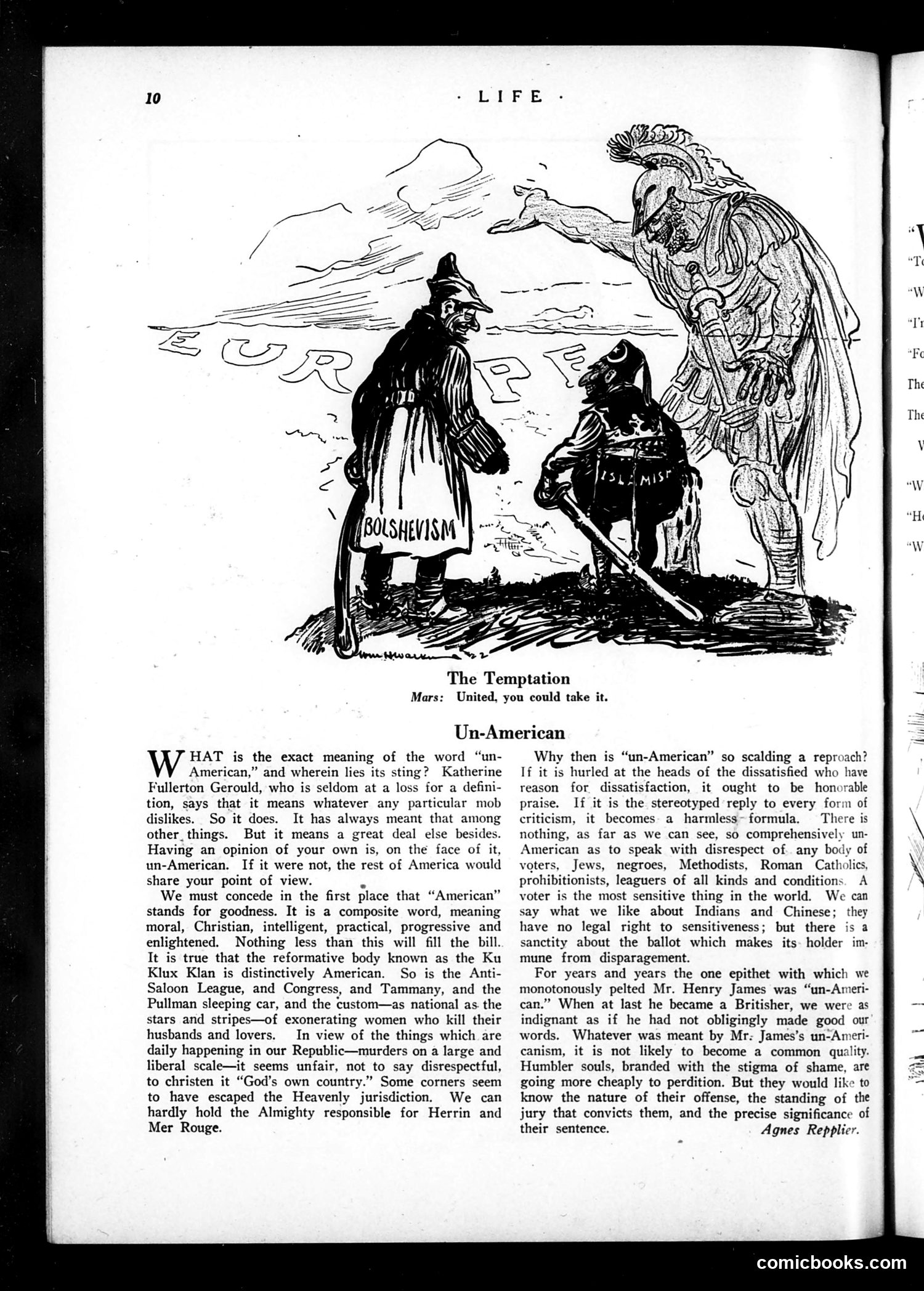
What you’re looking at
**The Cartoon:** The image depicts Mars (god of war, depicted as a winged military figure) tempting two figures labeled "Bolshevism" and "Islamism" with the word "Europe" written in the background. Mars says: "United, you could take it." **The Satire:** This reflects post-WWI anxieties about geopolitical threats. The cartoon warns that if Bolshevism (Soviet communism) and Islamic movements united, they could destabilize or conquer Europe. It personifies ideologies as agents capable of conspiracy, suggesting Mars/war itself encourages this dangerous alliance. **Context:** Published during the 1920s Red Scare period, when Americans feared communist expansion and viewed Islamic nations as threats, the cartoon expresses contemporary paranoia about revolutionary ideologies and non-Western powers conspiring against Western civilization.
📄 Transcribed text from this page (OCR, searchable)
Machine-transcribed from the original scan — historical spelling and the odd misread are preserved.
The Temptation Mars: United, you could take it. Un-American HAT is the exact meaning of the word “un- American,” and wherein lies its sting? Katherine Fullerton Gerould, who is seldom at a loss for a defini- tion, says that it means whatever any particular mob dislikes. So it does. It has always meant that among other_things. But it means a great deal else besides. Having an opinion of your own is, on the face of it, un-American. If it were not, the rest of America would share your point of view. e We must concede in the first place that “American” stands for goodness. It is a composite word, meaning moral, Christian, intelligent, practical, progressive and enlightened. Nothing less than this will fill the bill. It is true that the reformative body known as the Ku Klux Klan is distinctively American. So is the Anti- Saloon League, and Congress, and Tammany, and the Pullman sleeping car, and the custom—as national as. the stars and stripes—of exonerating women who kill their husbands and lovers. In view of the things which are daily happening in our Republic—murders on a large and liberal scale—it seems unfair, not to say disrespectful, to christen it “God’s own country.” Some corners seem to have escaped the Heavenly jurisdiction. We can hardly hold the Almighty responsible for Herrin and Mer Rouge. Why then is “un-American” so scalding a reproach? If it is hurled at the heads of the dissatisfied who have reason for dissatisfaction, it ought to be honorable praise. If it is the stereotyped reply to every form of criticism, it becomes a harmless~ formula. There is nothing, as far as we can see, so comprehensively un- American as to speak with disrespect of. any body of voters, Jews, negroes, Methodists, Roman Catholics, prohibitionists, leaguers of all kinds and conditions. A voter is the most sensitive thing in the world. We can say what we like about Indians and Chinese; they have no legal right to sensitiveness; but there is a sanctity about the ballot which makes its- holder im- mune from disparagement. For years and years the one epithet with which we monotonously pelted Mr. Henry James was “un-Ameri- can.” When at last he became a Britisher, we were as indignant as if he had not obligingly made good our words. Whatever was meant by Mr: James’s un-Ameri- canism, it is not likely to become a common quality. Humbler souls, branded with the stigma of shame, are going more cheaply to perdition. But they would like to know the nature of their offense, the standing of the jury that convicts them, and the precise significance of their sentence. Agnes Repplier. comicbooks.com