
Life, 1923-03-01 · page 20 of 36
Life — March 1, 1923 — page 20: what you’re looking at
What you’re looking at
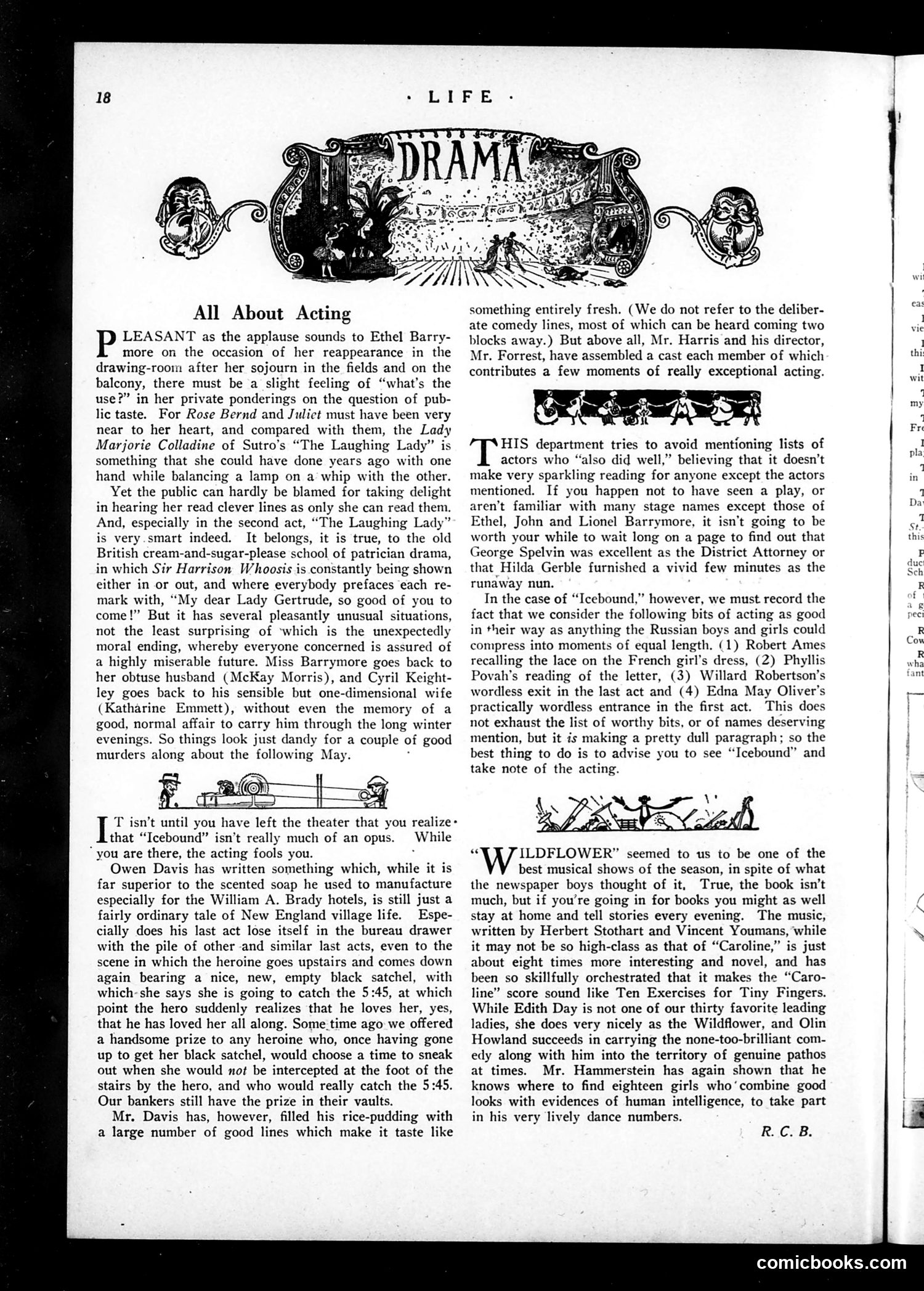
This page reviews contemporary Broadway productions, primarily focusing on two plays: "The Laughing Lady" (starring Ethel Barrymore) and "Icebound" (with actor Harris). **The Satire:** The writer uses gentle mockery to critique both theatrical taste and predictable plot formulas. The main joke appears in the "Icebound" section: the critic ridicules the clichéd "black satchel" scene where a heroine announces her departure, only to be intercepted at the stairs by the hero realizing he loves her. Life sarcastically notes they've offered a prize to any heroine who actually *escapes* without this interruption—a prize their bankers still hold because no such play exists. This mocks the formulaic, contrived nature of contemporary drama. **The Context:** The reviews assume readers are familiar with major theatrical names (Ethel, John, and Lionel Barrymore) but acknowledge most playgoers won't recognize supporting actors. The page critiques both overly genteel British drawing-room comedies and earnest American plays that rely on predictable emotional beats rather than genuine dramatic innovation.
📄 Transcribed text from this page (OCR, searchable)
Machine-transcribed from the original scan — historical spelling and the odd misread are preserved.
All About Acting LEASANT as the applause sounds to Ethel Barry- more on the occasion of her reappearance in the drawing-room after her sojourn in the fields and on the balcony, there must be a slight feeling of “what's the use?” in her private ponderings on the question of pub- lic taste. For Rose Bernd and Julict must have been very near to her heart, and compared with them, the Lady Marjorie Colladine of Sutro’s “The Laughing Lady” is something that she could have done years ago with one hand while balancing a lamp on a whip with the other. Yet the public can hardly be blamed for taking delight in hearing her read clever lines as only she can read them. And, especially in the second act, “The Laughing Lady” is very.smart indeed. It belongs, it is true, to the old British cream-and-sugar-please school of patrician drama, in which Sir Harrison Whoosis is constantly being shown either in or out, and where everybody prefaces each re- mark with, “My dear Lady Gertrude, so good of you to come!” But it has several pleasantly unusual situations, not the least surprising of ‘which is the unexpectedly moral ending, whereby everyone concerned is assured of a highly miserable future. Miss Barrymore goes back to her obtuse husband (McKay Morris), and Cyril Keight- ley goes back to his sensible but one-dimensional wife (Katharine Emmett), without even the memory of a good, normal affair to carry him through the long winter evenings. So things look just dandy for a couple of good murders along about the following May. . I T isn’t until you have left the theater that you realize- that “Icebound” isn’t really much of an opus. While “you are there, the acting fools you. . Owen Davis has written something which, while it is far superior to the scented soap he used to manufacture especially for the William A. Brady hotels, is still just a fairly ordinary tale of New England village life. Espe- cially does his last act lose itself in the bureau drawer with the pile of other and similar last acts, even to the scene in which the heroine goes upstairs and comes down again bearing a nice, new, empty black satchel, with which-she says she is going to catch the 5:45, at which point the hero suddenly realizes that he loves her, yes, that he has loved her all along. Some.time ago we offered a handsome prize to any heroine who, once having gone up to get her black satchel, would choose a time to sneak out when she would not be intercepted at the foot of the stairs by the hero, and who would really catch the 5:45. Our bankers still have the prize in their vaults. Mr. Davis has, however, filled his rice-pudding with a large number of good lines which make it taste like something entirely fresh. (We do not refer to the deliber- ate comedy lines, most of which can be heard coming two blocks away.) But above all, Mr. Harris and his director, Mr. Forrest, have assembled a cast each member of which contributes a few moments of really exceptional acting. Te department tries to avoid mentioning lists of actors who “also did well,” believing that it doesn’t make very sparkling reading for anyone except the actors mentioned. If you happen not to have seen a play, or aren’t familiar with many stage names except those of Ethel, John and Lionel Barrymore, it isn’t going to be worth your while to wait long on a page to find out that George Spelvin was excellent as the District Attorney or that Hilda Gerble furnished a vivid few minutes as the runaway nun. In the case of “Icebound,” however, we must record the fact that we consider the following bits of acting as good in their way as anything the Russian boys and girls could compress into moments of equal length. (1) Robert Ames recalling the lace on the French girl’s dress, (2) Phyllis Povah’s reading of the letter, (3) Willard Robertson’ wordless exit in the last act and (4) Edna May Oliver's practically wordless entrance in the first act. This does not exhaust the list of worthy bits, or of names deserving mention, but it is making a pretty dull paragraph; so the best thing to do is to advise you to see “Icebound” and take note of the acting. € ILDFLOWER” seemed to us to be one of the best musical shows of the season, in spite of what the newspaper boys thought of it, True, the book isn’t much, but if you’re going in for books you might as well stay at home and tell stories every evening. The music, written by Herbert Stothart and Vincent Youmans, while it may not be so high-class as that of “Caroline,” is just about eight times more interesting and novel, and has been so skillfully orchestrated that it makes the “Caro- line” score sound like Ten Exercises for Tiny Fingers. While Edith Day is not one of our thirty favorite leading ladies, she does very nicely as the Wildflower, and Olin Howland succeeds in carrying the none-too-brilliant com- edy along with him into the territory of genuine pathos at times. Mr. Hammerstein has again shown that he knows where to find eighteen girls who’combine good looks with evidences of human intelligence, to take part in his very lively dance numbers. R.C. B. Da’ this due Sch ug peci Cow wha fant comicbooks.com