
Life, 1923-03-01 · page 22 of 36
Life — March 1, 1923 — page 22: what you’re looking at
What you’re looking at
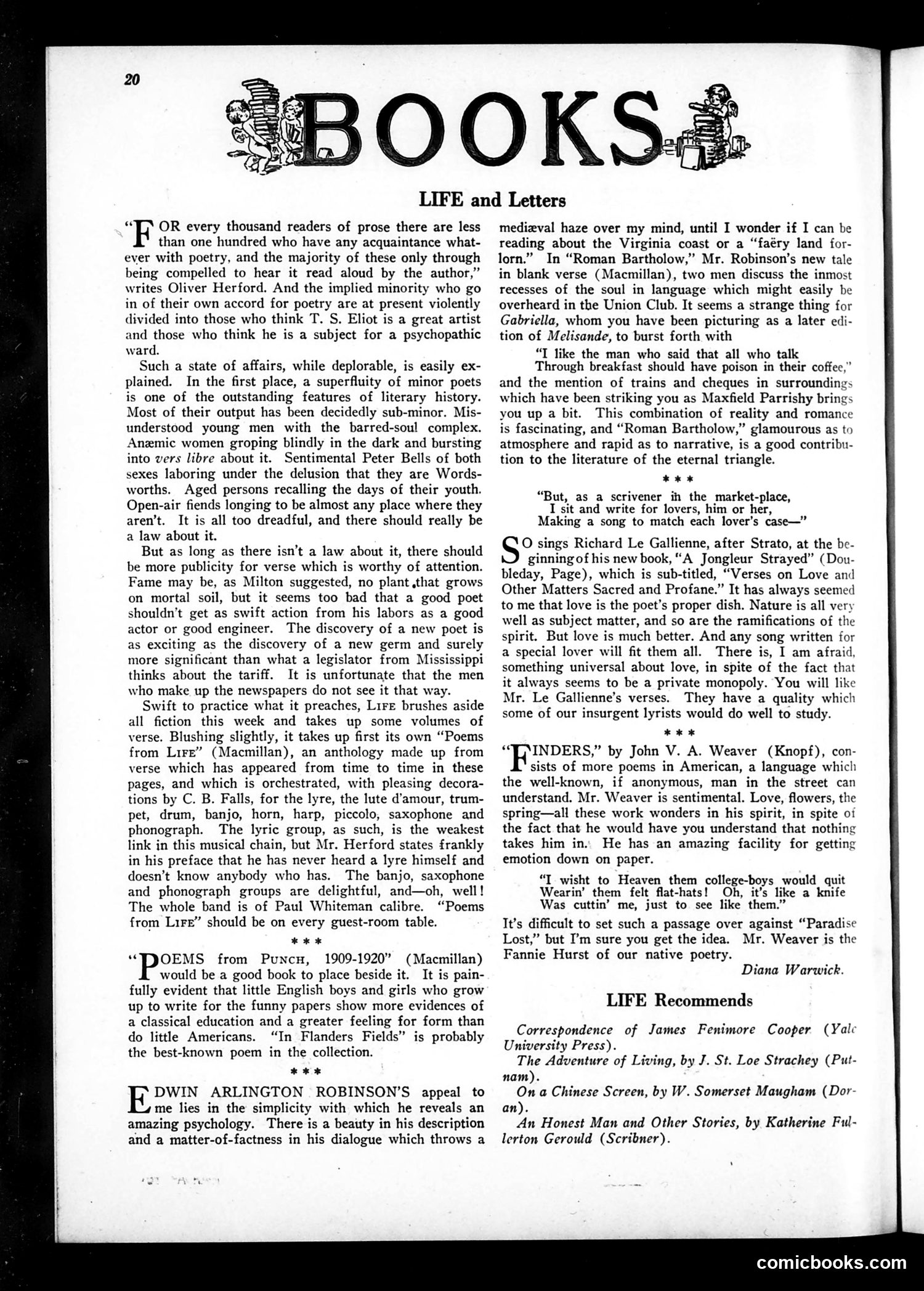
This is a literary criticism column—not a political cartoon—from Life magazine's "Books: Life and Letters" section. The page discusses the state of modern poetry criticism circa 1920. The key argument: poetry receives far less public attention than prose, and contemporary readers are "violently divided" over T.S. Eliot's merit—some view him as great, others as mentally unfit. The writer (Diana Warwick) satirizes the proliferation of mediocre "minor poets"—misunderstood young men, aimless women writing free verse, sentimental imitators of Wordsworth, and nostalgic elderly writers. The column then reviews specific poetry collections, including Life's own anthology orchestrated with musical instruments (banjo, saxophone, etc.), praising Paul Whiteman's caliber. It also discusses Edwin Arlington Robinson's psychological depth and notes that English children's poetry shows superior classical education compared to American work. No cartoons are visible; this is purely literary criticism and book recommendations.
📄 Transcribed text from this page (OCR, searchable)
Machine-transcribed from the original scan — historical spelling and the odd misread are preserved.
LIFE and Letters “T’ OR every thousand readers of prose there are less than one hundred who have any acquaintance what- ever with poetry, and the majority of these only through being compelled to hear it read aloud by the author,” writes Oliver Herford. And the implied minority who go in of their own accord for poetry are at present violently divided into those who think T. S. Eliot is a great artist and those who think he is a subject for a psychopathic ward. Such a state of affairs, while deplorable, is easily ex- plained. In the first place, a superfluity of minor poets is one of the outstanding features of literary history. Most of their output has been decidedly sub-minor. Mis- understood young men with the barred-soul complex. Anzmic women groping blindly in the dark and bursting into vers libre about it. Sentimental Peter Bells of both sexes laboring under the delusion that they are Words- worths. Aged persons recalling the days of their youth. Open-air fiends longing to be almost any place where they aren’t. It is all too dreadful, and there should really be a law about it. But as long as there isn’t a law about it, there should be more publicity for verse which is worthy of attention. Fame may be, as Milton suggested, no plant that grows on mortal soil, but it seems too bad that a good poet shouldn’t get as swift action from his labors as a good actor or good engineer. The discovery of a new poet is as exciting as the discovery of a new germ and surely more significant than what a legislator from Mississippi thinks about the tariff. It is unfortunate that the men who make up the newspapers do not see it that way. Swift to practice what it preaches, Lire brushes aside all fiction this week and takes up some volumes of verse. Blushing slightly, it takes up first its own “Poems from Lire” (Macmillan), an anthology made up from verse which has appeared from time to time in these pages, and which is orchestrated, with pleasing decora- tions by C. B. Falls, for the lyre, the lute d’amour, trum- pet, drum, banjo, horn, harp, piccolo, saxophone and phonograph. The lyric group, as such, is the weakest link in this musical chain, but Mr. Herford states frankly in his preface that he has never heard a lyre himself and doesn’t know anybody who has. The banjo, saxophone and phonograph groups are delightful, and—oh, well! The whole band is of Paul Whiteman calibre. “Poems from LiFe” should be on every guest-room table. eK ‘““DJOEMS from Puncu, 1909-1920” (Macmillan) would be a good book to place beside it. It is pain- fully evident that little English boys and girls who grow up to write for the funny papers show more evidences of a classical education and a greater feeling for form than do little Americans. “In Flanders Fields” is probably the best-known poem in the collection. eee DWIN ARLINGTON ROBINSON’S appeal to me lies in the simplicity with which he reveals an amazing psychology. There is a beauty in his description and a matter-of-factness in his dialogue which throws a medizval haze over my mind, until I wonder if I can be reading about the Virginia coast or a “faéry land for- lorn.” In “Roman Bartholow,” Mr. Robinson’s new tale in blank verse (Macmillan), two men discuss the inmost recesses of the soul in language which might easily be overheard in the Union Club. It seems a strange thing for Gabriella, whom you have been picturing as a later edi- tion of Melisande, to burst forth with “T like the man who said that all who talk Through breakfast should have poison in their coffee,” and the mention of trains and cheques in surroundings which have been striking you as Maxfield Parrishy brings you up a bit. This combination of reality and romance is fascinating, and “Roman Bartholow,” glamourous as to atmosphere and rapid as to narrative, is a good contribu- tion to the literature of the eternal triangle. ee* “But, as a scrivener ih the market-place, I sit and write for lovers, him or her, Making a song to match each lover’s case—” O sings Richard Le Gallienne, after Strato, at the be- ginning of his new book, “A Jongleur Strayed” (Dou- bleday, Page), which is sub-titled, “Verses on Love and Other Matters Sacred and Profane.” It has always seemed to me that love is the poet’s proper dish. Nature is all very well as subject matter, and so are the ramifications of the spirit. But love is much better. And any song written for a special lover will fit them all. There is, I am afraid, something universal about love, in spite of the fact that it always seems to be a private monopoly. You will like Mr. Le Gallienne’s verses. They have a quality which some of our insurgent lyrists would do well to study. * kK “TXINDERS,” by John V. A. Weaver (Knopf), con- sists of more poems in American, a language which the well-known, if anonymous, man in the street can understand. Mr. Weaver is sentimental. Love, flowers, the spring—all these work wonders in his spirit, in spite of the fact that he would have you understand that nothing takes him in. He has an amazing facility for getting emotion down on paper. “I_wisht to Heaven them college-boys would quit Wearin’ them felt flat-hats! Oh, it’s like a knife Was cuttin’ me, just to see like them.” It’s difficult to set such a passage over against “Paradise Lost,” but I’m sure you get the idea. Mr. Weaver is the Fannie Hurst of our native poetry. Diana Warwick. LIFE Recommends Correspondence of James Fenimore Cooper (Yale University Press). The Adventure of Living, by J. St. Loe Strachey (Put- nam). On a Chinese Screen, by W. Somerset Maugham (Dor- an). An Honest Man and Other Stories, by Katherine Ful- lerton Gerould (Scribner). comicbooks.com