
Life, 1923-03-01 · page 7 of 36
Life — March 1, 1923 — page 7: what you’re looking at
What you’re looking at
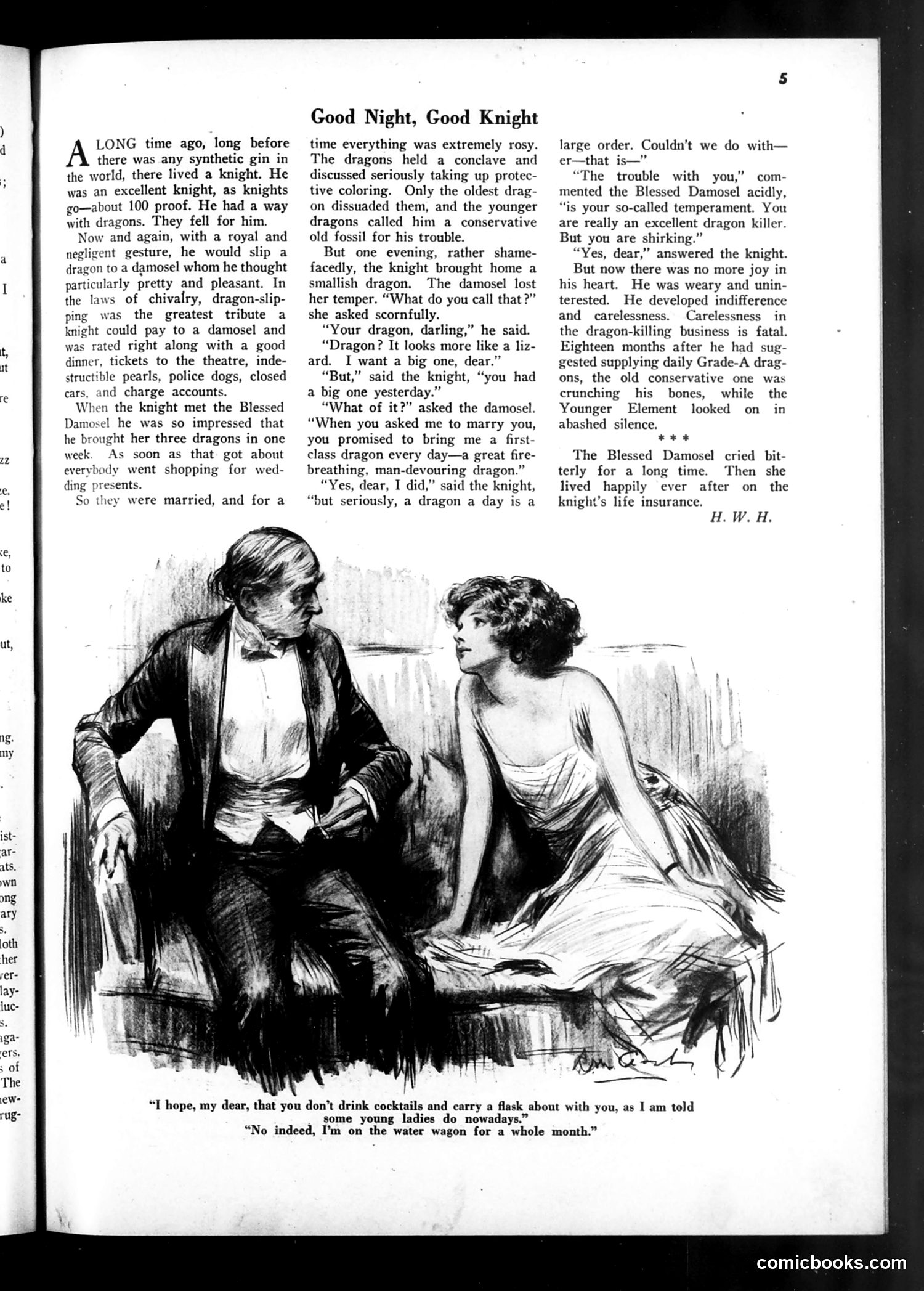
This is a humorous story about a knight who married and promised to bring home a first-class dragon daily. His wife complains he's become negligent—no longer delivering dragons as promised. She calls him an "excellent dragon killer" but notes his current carelessness. The illustration shows a couple in formal evening dress having a domestic conversation, likely depicting the story's denouement where the knight admits he can no longer sustain his dragon-hunting commitment. The satire appears to mock marital expectations and male promises made before marriage. The fantasy premise of daily dragon-hunting serves as a humorous stand-in for other husband-duties or provisions, suggesting the gap between courtship promises and post-marital reality—a timeless domestic comedy theme played for satirical effect.
📄 Transcribed text from this page (OCR, searchable)
Machine-transcribed from the original scan — historical spelling and the odd misread are preserved.
LONG time ago, long before there was any synthetic gin in the world, there lived a knight. He was an excellent knight, as knights go—about 100 proof. He had a way with dragons. They fell for him. Now and again, with a royal and negligent gesture, he would slip a dragon to a damosel whom he thought particularly pretty and pleasant. In the laws of chivalry, dragon-slip- ping was the greatest tribute a knight could pay to a damosel and was rated right along with a good dinner, tickets to the theatre, inde- structible pearls, police dogs, closed cars, and charge accounts. When the knight met the Blessed Damosel he was so impressed that he brought her three dragons in one week. As soon as that got about everybody went shopping for wed- y were married, and for a Good Night, Good Knight time everything was extremely rosy. The dragons held a conclave and discussed seriously taking up protec- tive coloring. Only the oldest drag- on dissuaded them, and the younger dragons called him a conservative old fossil for his trouble. But one evening, rather shame- facedly, the knight brought home a smallish dragon, The damosel lost her temper. “What do you call that?” she asked scornfully. “Your dragon, darling,” he said. “Dragon? It looks more like a liz- ard. I want a big one, dear.” “But,” said the knight, “you had a big one yesterday.” “What of it?” asked the damosel. “When you asked me to marry you, you promised to bring me a first- class dragon every day—a great fire- breathing, man-devouring dragon.” “Yes, dear, I did,” said the knight, “but seriously, a dragon a day is a large order. Couldn't we do with— er—that is—” “The trouble with you,” com- mented the Blessed Damosel acidly, “is your so-called temperament. You are really an excellent dragon killer. But you are shirking.” “Yes, dear,” answered the knight. But now there was no more joy in his heart. He was weary and unin- terested. He developed indifference and carelessness. Carelessness in the dragon-killing business is fatal. Eighteen months after he had sug- gested supplying daily Grade-A drag- ons, the old conservative one was crunching his bones, while the Younger Element looked on in abashed silence. *** The Blessed Damosel cried _bit- terly for a long time. Then she lived happily ever after on the knight’s life insurance. H.W. H. “I hope, my dear, that you don’t drink cocktails and carry a flask about with you, as I am told some young ladies do nowadays.” “No indeed, I’m on the water wagon for a whole month.” comicbooks.com