
A complete issue · 36 pages · 1923
Life — February 15, 1923
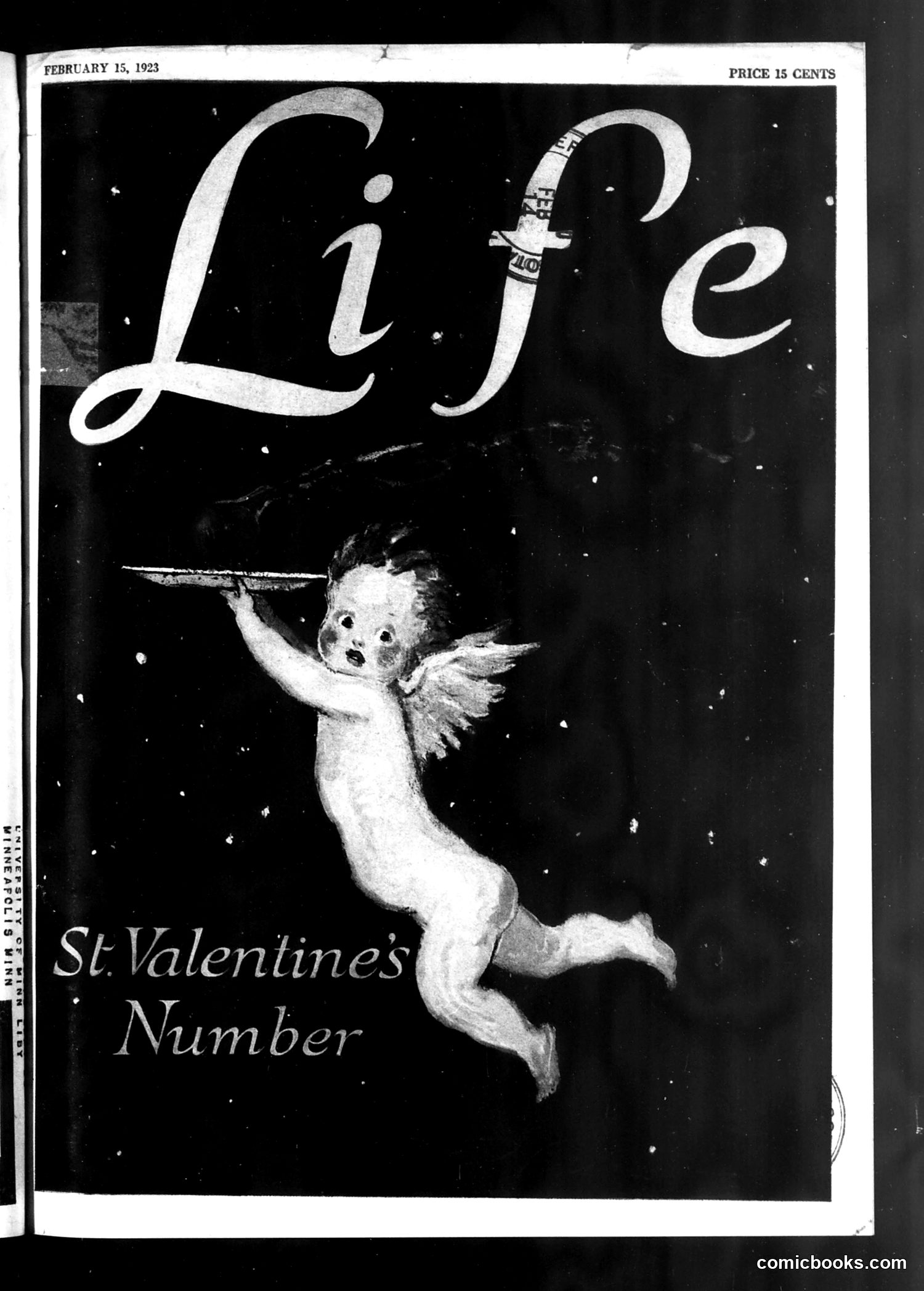
This is the **St. Valentine's Day Number** cover of *Life* magazine, priced at 15 cents. The artwork features a cherub (Cupid) playing a flute while flying through a starry night sky. The large decorative letters spelling "Life" dominate the upper portion. This is a **holiday-themed cover**, not political satire. The cherub and flute reference classical Valentine's Day imagery associated with Cupid, the Roman god of love. The design uses elegant Art Deco-style typography typical of 1920s magazine covers. The special Valentine's edition likely contained humorous content about romance and courtship—common themes for *Life* magazine's satirical approach to American social life during the Jazz Age.
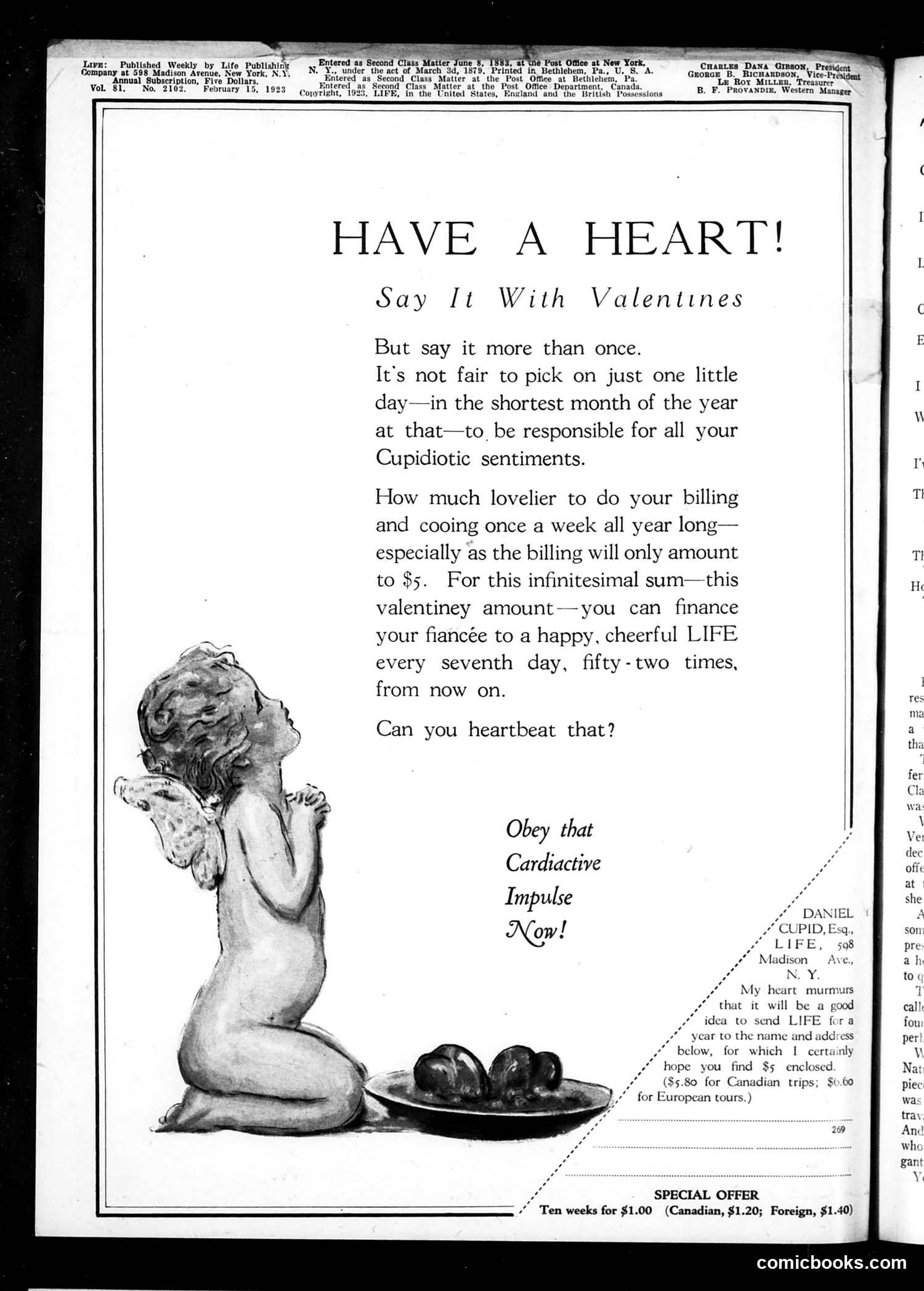
This page is primarily an **advertisement for Life magazine subscriptions**, not a political cartoon. The central image is a classical cherub (Cupid) with hearts, used as a Valentine's Day marketing appeal. The "satire" here is gentle and commercial: the ad argues that rather than limiting romantic gestures to Valentine's Day alone, readers should subscribe to Life weekly year-round for ongoing "billing and cooing"—a humorous play on romantic behavior. The pitch promises 52 annual "valentineys" for just $5. The classical cherub imagery and the pun on "Cardactive Impulse" represent typical 1920s advertising style—using traditional romantic iconography to sell magazine subscriptions. This is advertising satire, not political commentary. The special offer prices ($1.00 domestic, $1.20 Canadian, $1.40 foreign) date this to February 15, 1923.
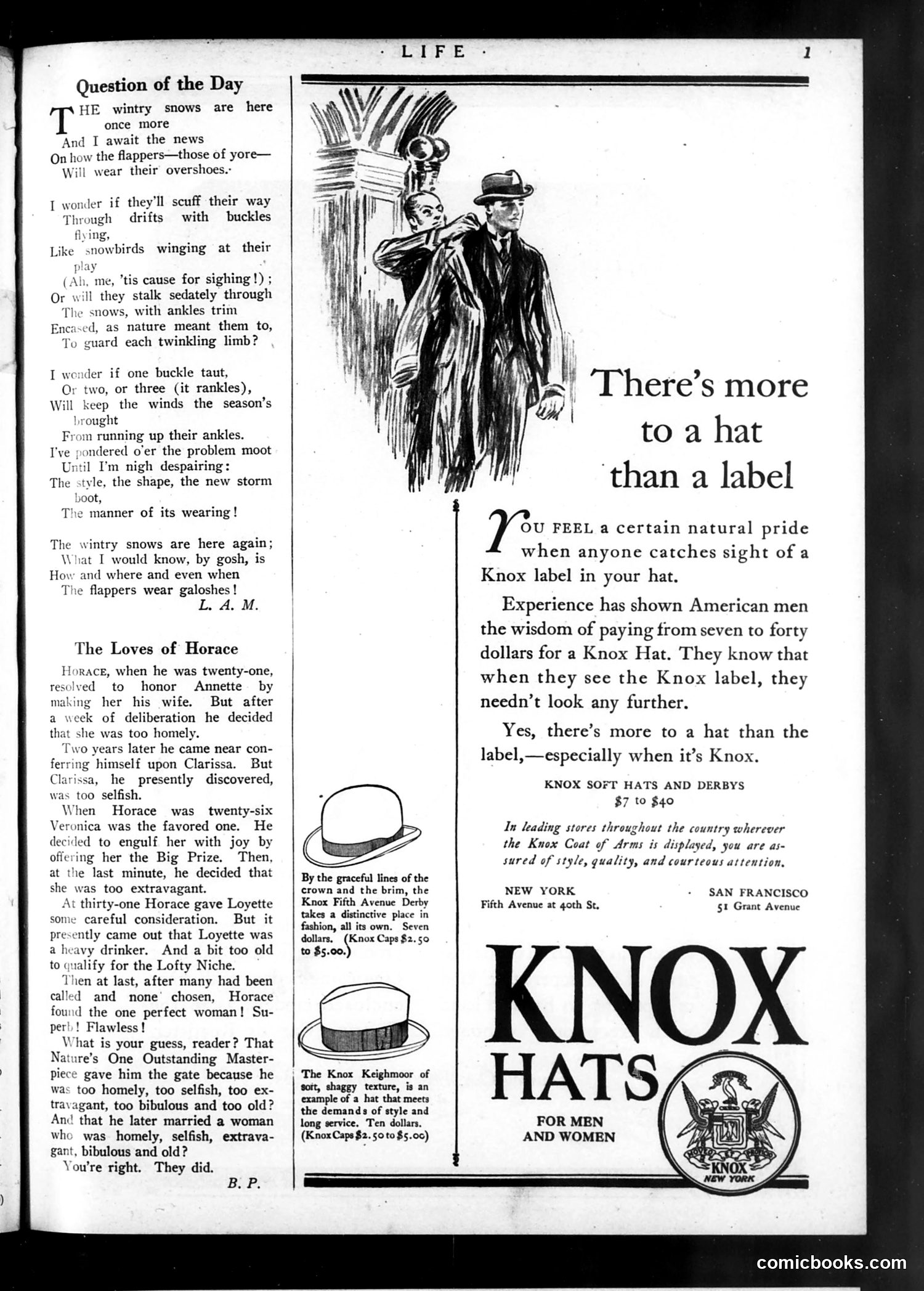
This page contains two distinct sections: **"Question of the Day"** (left): A humorous poem by L.A.M. pondering how women's fashionable overshoes will function in winter snow—questioning whether decorative buckles and trim can actually protect ankles and keep snow out, or if they're purely ornamental. **"The Loves of Horace"** (bottom left): A satirical story by B.P. narrating how a man named Horace repeatedly married poorly, choosing women for wrong reasons (loneliness, pity, companionship), yet each marriage failed due to the women's selfishness or incompatibility. The punchline suggests the pattern was Horace's own fault. **Knox Hats Advertisement** (right): A full advertisement emphasizing that Knox hat labels signify quality and craftsmanship worth premium prices ($7-$40), with illustrations of featured derby and Knightsbridge styles. The page blends satirical commentary on fashion and relationships with branded advertising.
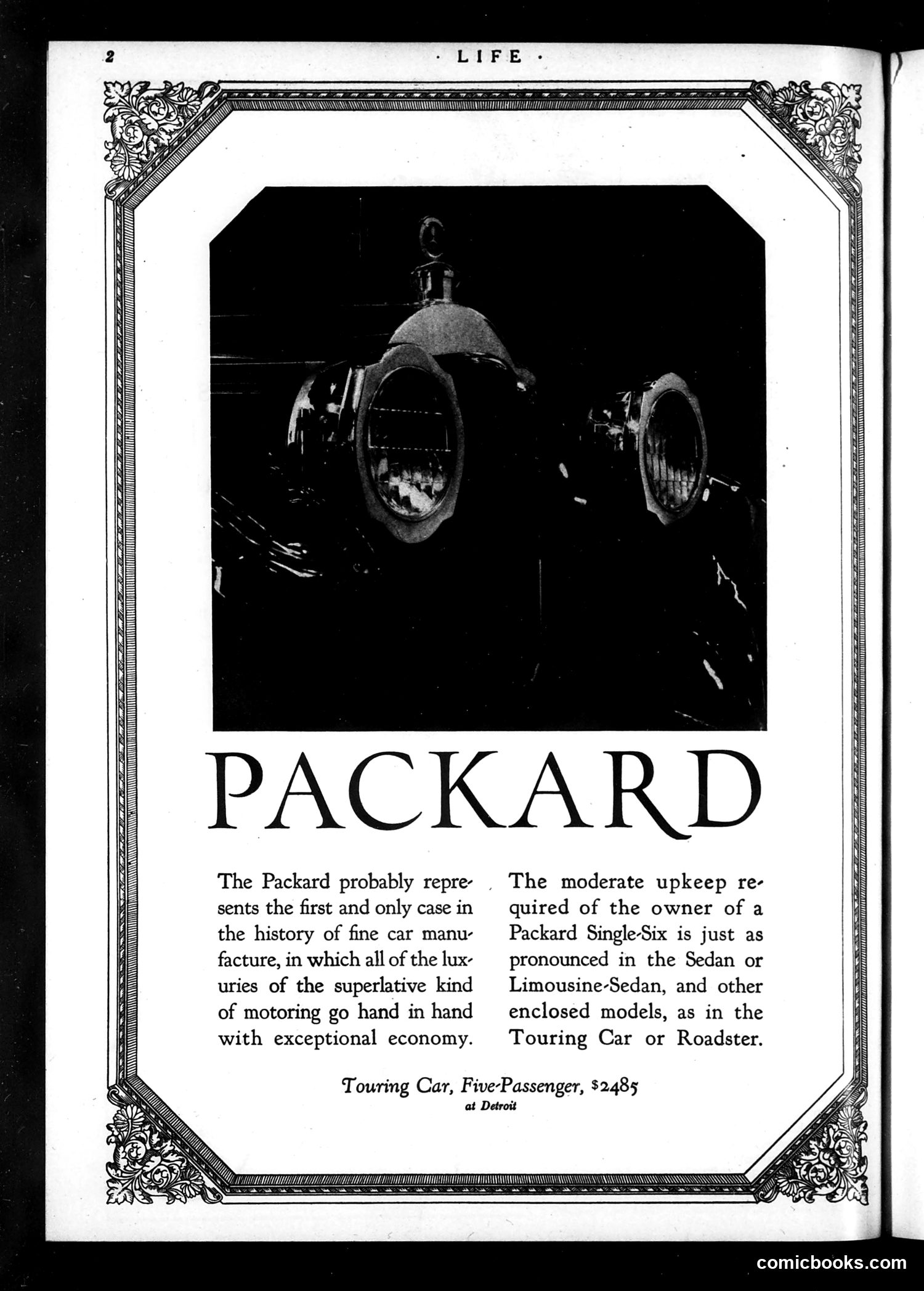
This page is **not a cartoon or satire**—it's a straightforward automobile advertisement for the Packard Single-Six luxury car, published in *Life* magazine. The image shows a front view of an early 1920s Packard automobile with prominent round headlights. The accompanying text promotes the vehicle's key selling point: it combined "luxuries of the superlative kind" with "exceptional economy"—a claim targeting wealthy buyers concerned about fuel costs and maintenance. The ad emphasizes the moderate upkeep required and lists the Touring Car model at $2,485 (Detroit). This represents standard advertising copy from the era, not editorial satire.
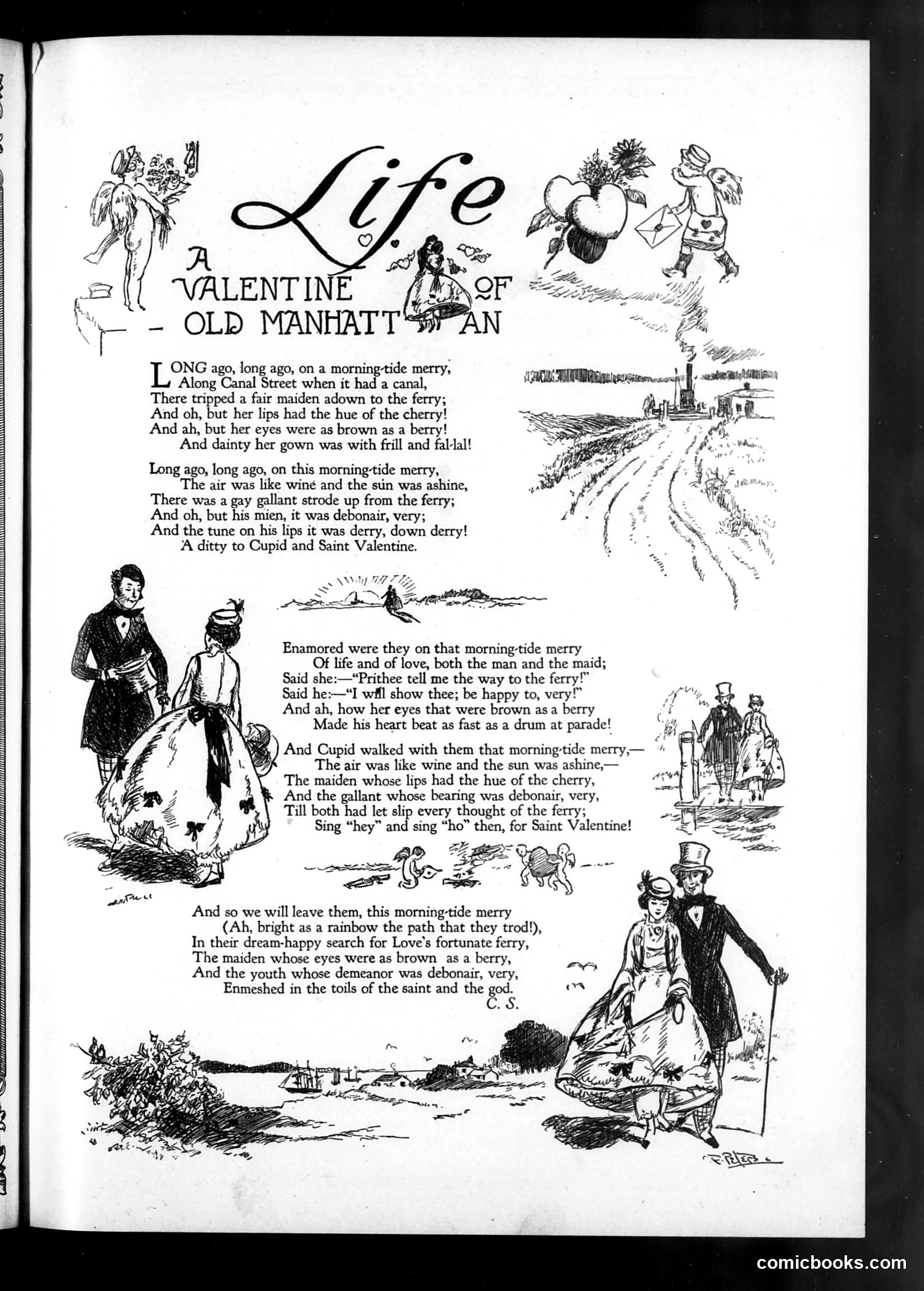
This is a romantic poem by C.S. (likely Charles S. Sanford or similar contributor) celebrating early New York City. The piece is nostalgic rather than satirical—it romanticizes a "long ago" encounter between a maiden with "brown as a berry" eyes and a debonair young man on a morning ferry crossing in Manhattan. The accompanying illustrations depict period-appropriate scenes: couples in Victorian dress, riverside landscapes, and ferry boats. The poem emphasizes idealized lost love and the beauty of old New York, with references to Saint Valentine's Day as the thematic frame. This appears to be sentimental editorial content rather than political satire—typical of *Life* magazine's mixed approach to humor and sentiment in the early 20th century.
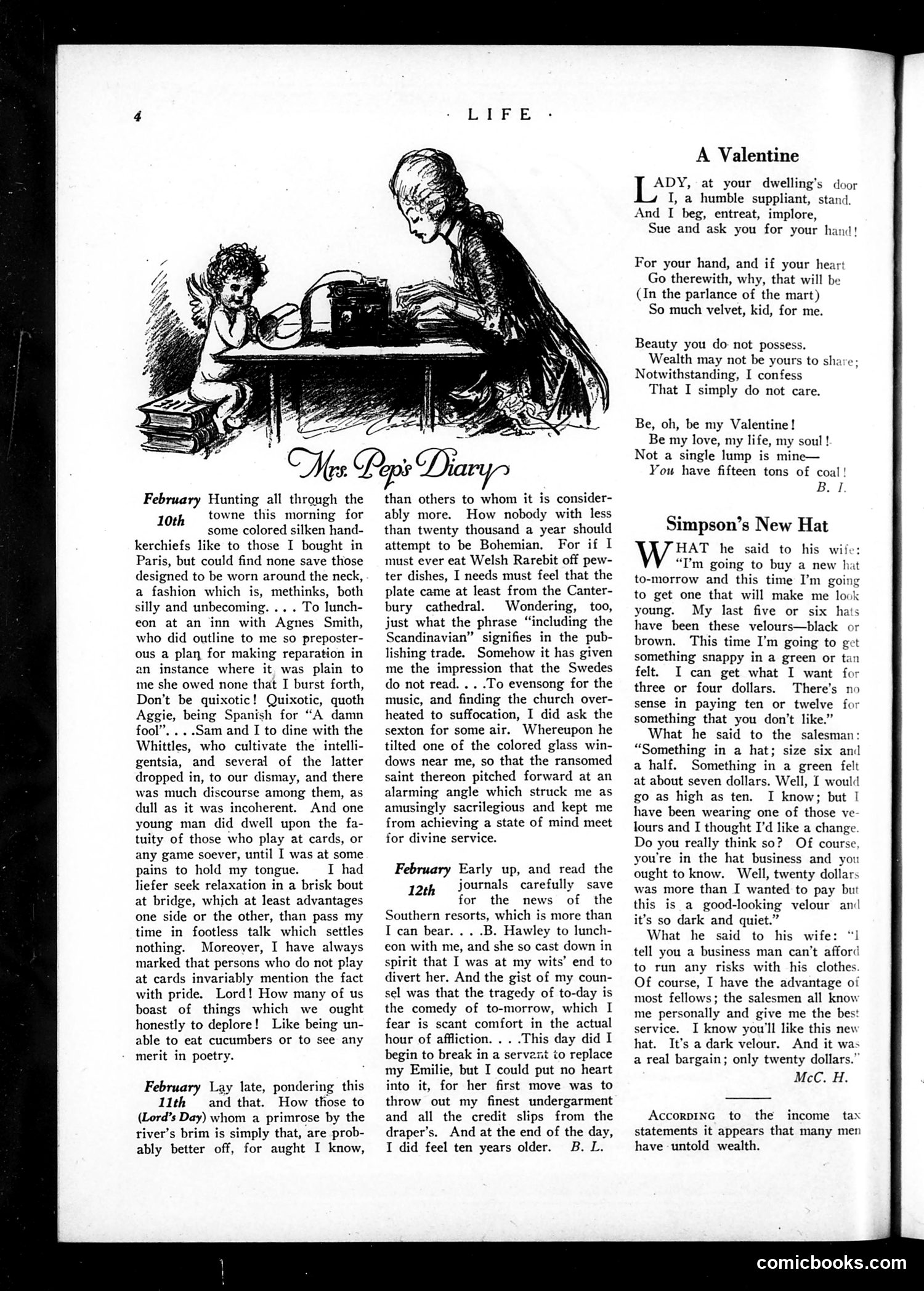
This page contains three distinct pieces of satirical content: **"Mrs. Pep's Diary" (Feb. 10th):** A gossipy diary entry mocking fashionable society women obsessed with trivial status concerns—Bohemian affectations, expensive silks, card-playing, and gossip. The satire targets the shallowness of upper-class leisure activities. **"A Valentine":** A romantic poem mocking sentimental Valentine's Day sentimentality, likely parodying overwrought period love poetry. **"Simpson's New Hat":** A dialogue satirizing working-class men's aspirations and their wives' practical skepticism. The husband wants an expensive hat ($20) he can't afford; the wife questions his financial priorities. It mocks masculine vanity and marital financial disputes. The illustration shows an impoverished couple at a simple table, emphasizing the class contrast with the society content above. All three pieces use gentle satire of social pretension and human folly.
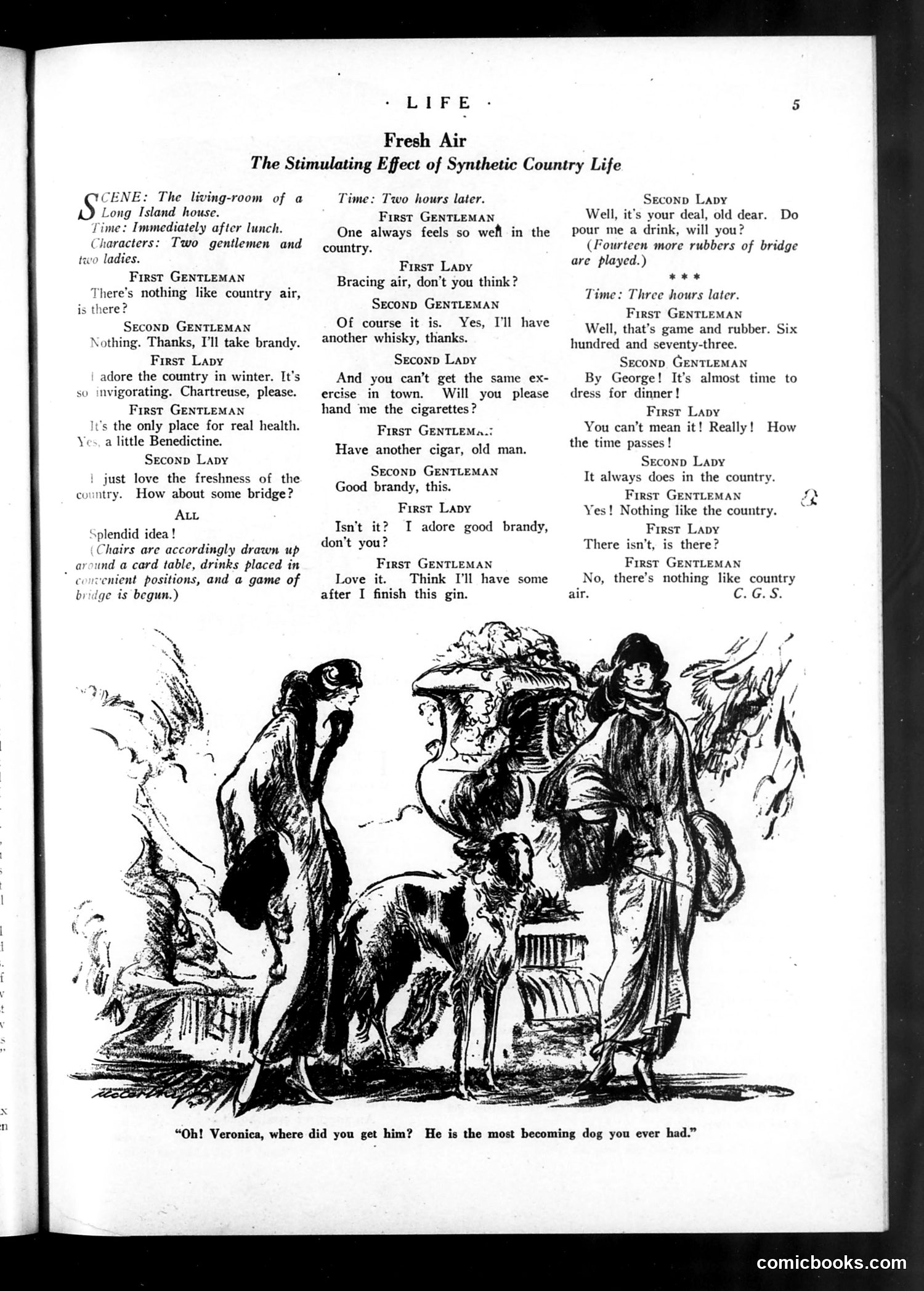
This is a satirical sketch about urban dwellers pretending to enjoy rural life. The scene shows two gentlemen and two ladies in a living room claiming to love "country air," though they're indoors playing cards and drinking brandy and gin—not actually experiencing nature. The satire mocks the affectation of wealthy city people who romanticize country living as healthful and invigorating while merely simulating it through conversation and alcohol. The characters repeatedly praise the "country" while doing nothing but socializing indoors. The illustration depicts them gathered around a card table, and the caption about the dog ("Oh! Veronica, where did you get him?") suggests even their pets are fashionable acquisitions rather than genuine country companions.
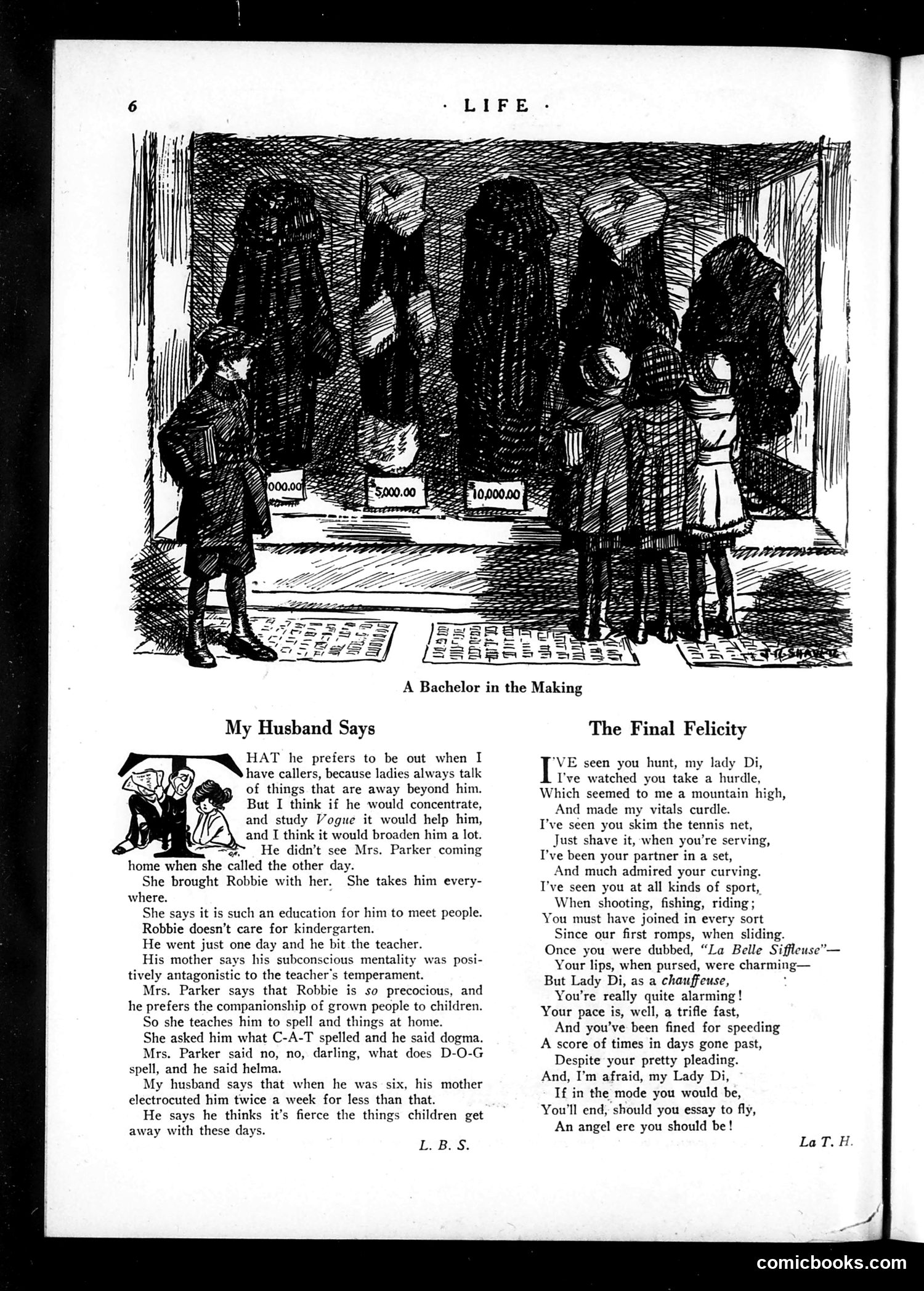
This page satirizes gender relations and marriage expectations of the early 20th century. The main cartoon depicts a shop window displaying three dressmaker's dummies labeled with prices ($5,000, $10,000), with children observing outside—suggesting women are commodities to be "purchased" through marriage. The accompanying texts mock husbands' preferences and domestic expectations. "My Husband Says" criticizes a man who prefers avoiding his wife's social gatherings and doesn't support his son's education. "The Final Felicity" ironically praises a wife for her athletic accomplishments while remaining subservient ("chauffeuse"). The satire targets the reduction of women to domestic servants and ornamental wives, while mocking male selfishness and limited vision regarding female potential.
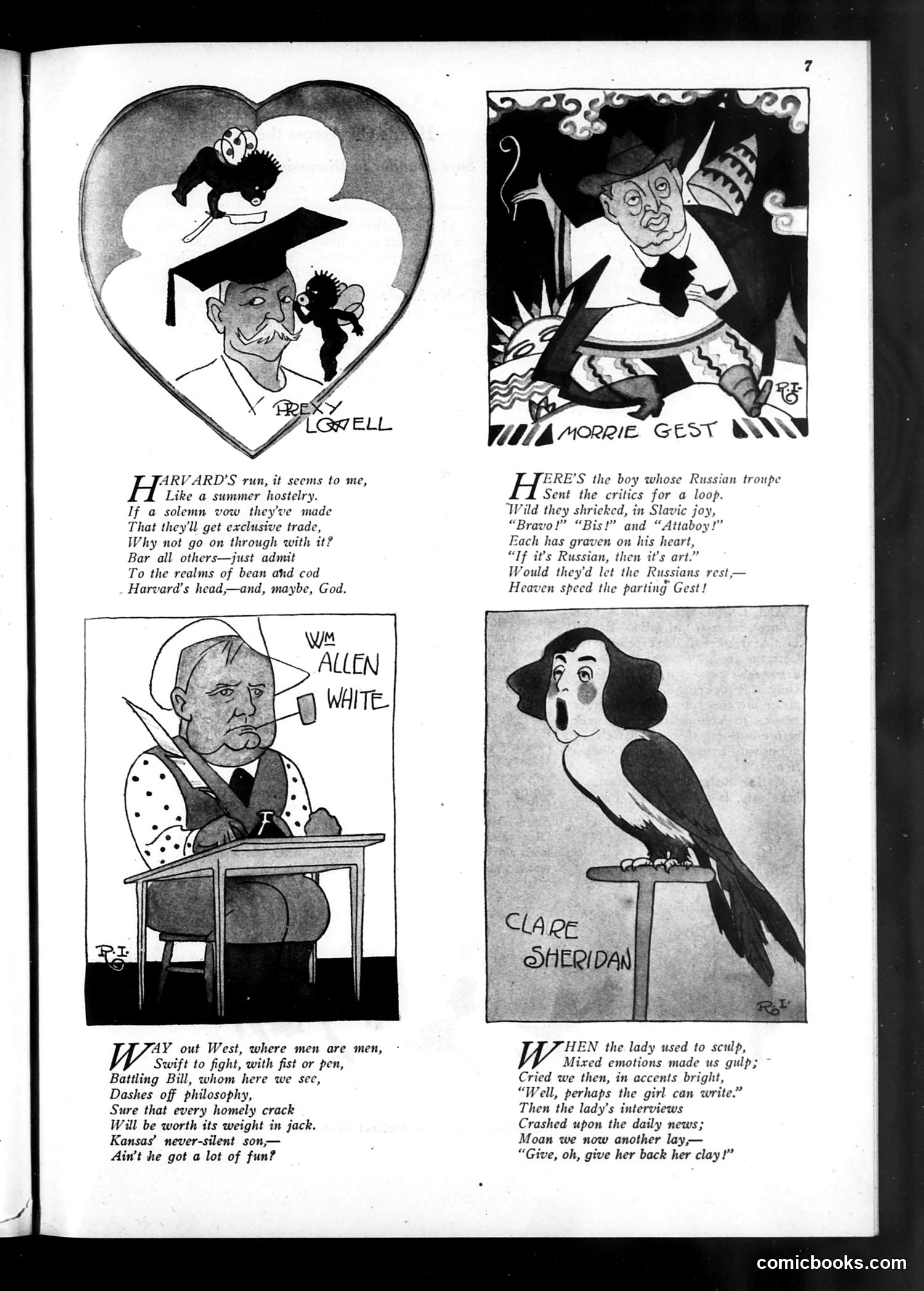
This page contains four separate caricature sketches with accompanying verse, typical of Life's satirical format. **Percy Lowell** (top left): Depicted with a mortarboard and small figures, the verse mocks Harvard's prestige, suggesting its graduates should "admit" superiority rather than pretending otherwise. **Morrie Gest** (top right): Shown as a theatrical impresario, the poem references his involvement with Russian performers, likely the Russian Ballet's American tour, ironizing his role as cultural ambassador. **Wim Allen White** (bottom left): Portrayed at a desk in Kansas, the verse praises him as a plainspoken "man's man" representing frontier values against Eastern intellectualism. **Clare Sheridan** (bottom right): Depicted as a parrot-like figure, the verse sarcastically comments on her sculptural career, suggesting critics initially dismissed her work before reconsidering. These represent prominent 1920s cultural figures under satirical review.
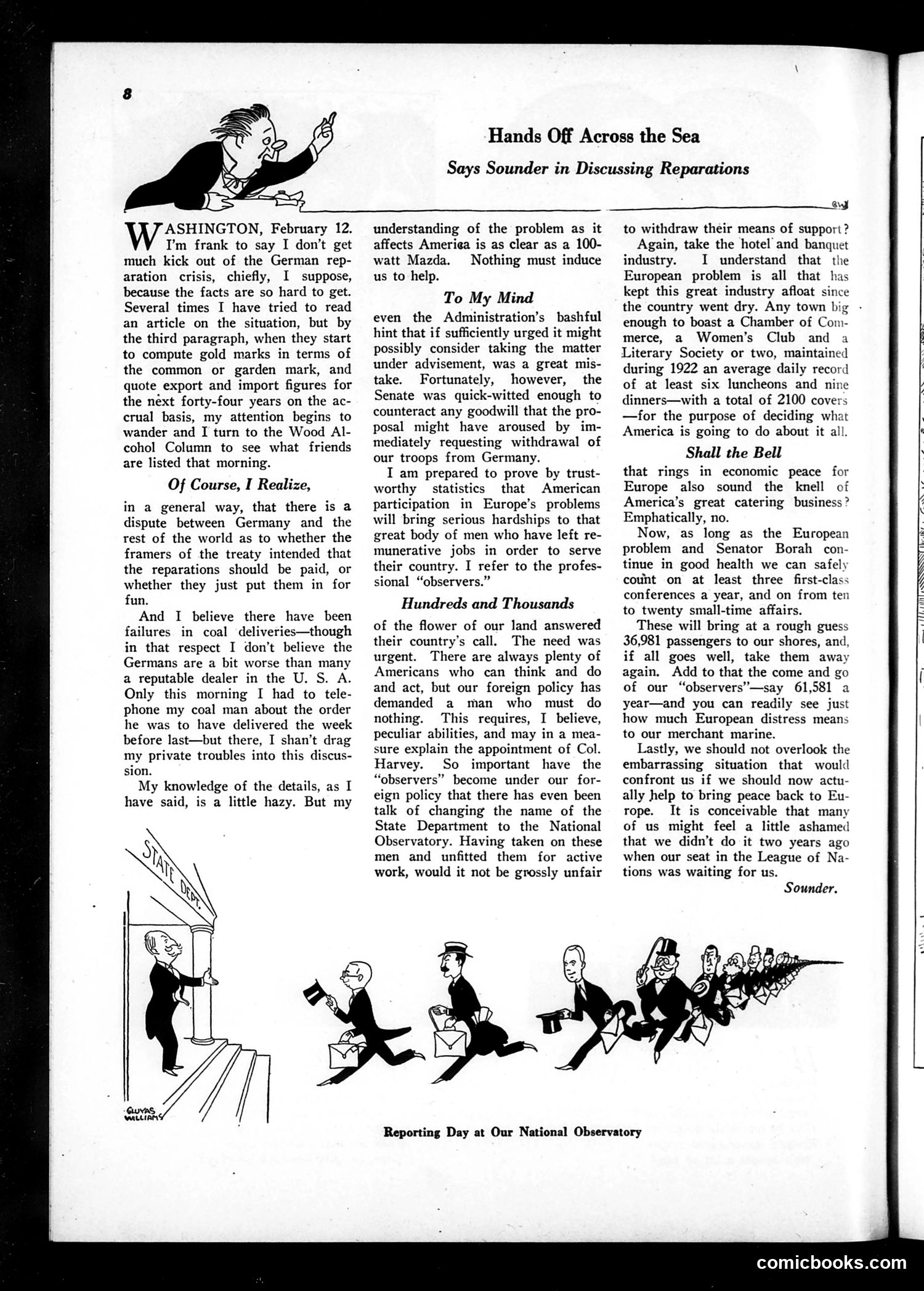
This page from *Life* magazine (dated February 12, based on the dateline) features political commentary by "Sounder" on German reparations after World War I. The main cartoon at bottom, titled "Reporting Day at Our National Observatory," depicts figures running frantically toward a building labeled "State Department," carrying documents and briefcases. This satirizes the chaos and urgency surrounding America's involvement in post-war European reparations negotiations. The article argues against American financial responsibility for German reparations, suggesting Europeans should resolve their own problems. Sounder criticizes the idea that America should "help" Europe economically, warning it could harm American business—particularly the hotel and catering industry, which depended on European tourism. The cartoon mocks the State Department's frantic activity over these diplomatic matters.
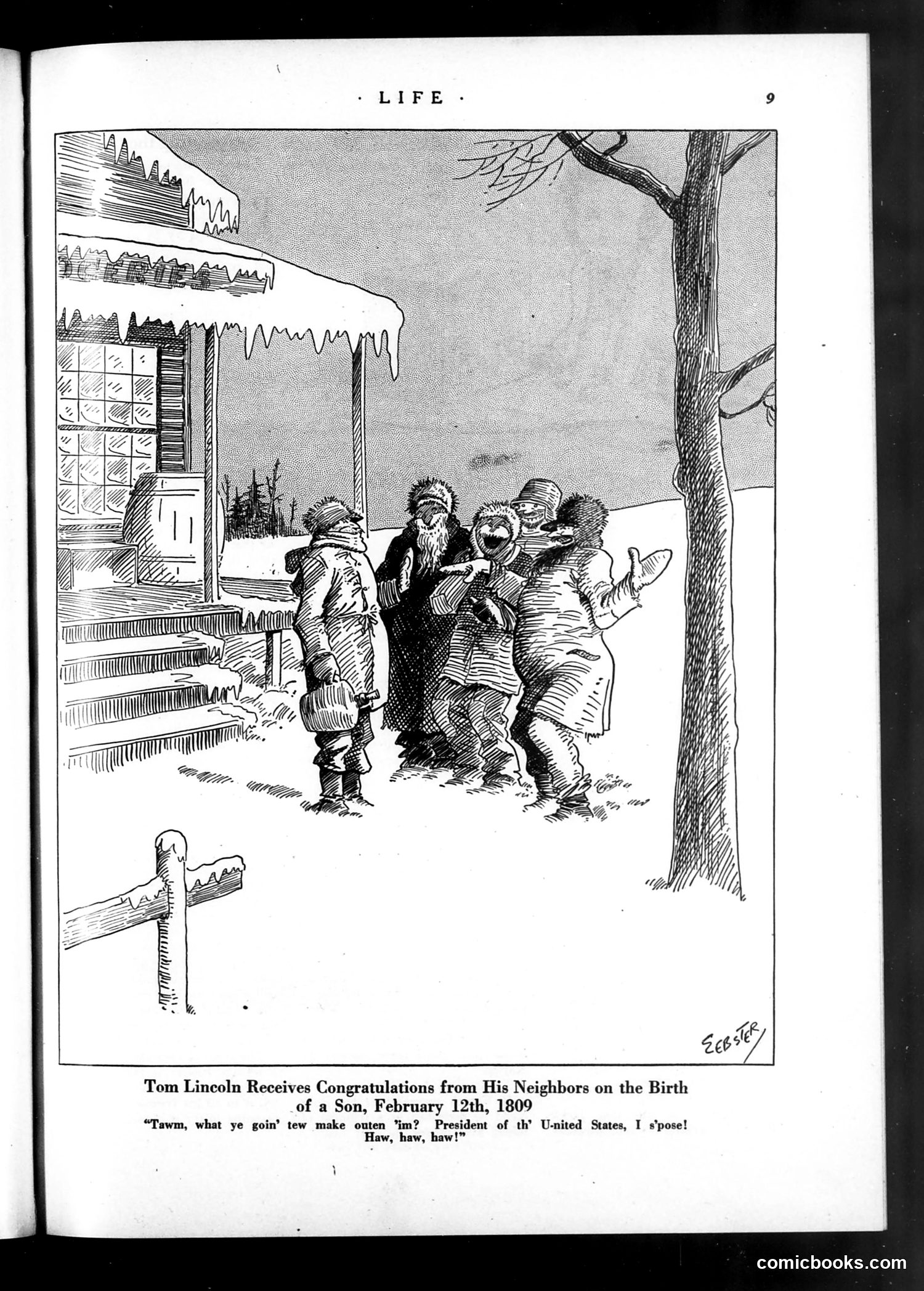
This cartoon depicts **Tom Lincoln (Abraham Lincoln's father) receiving congratulations from neighbors** on February 12, 1809—Abraham Lincoln's birth date. The crude frontier setting shows a log cabin with icicles, a bare tree, and a wooden cross fence, emphasizing the humble circumstances of Lincoln's birth. The joke's humor lies in the neighbors' mock-grandiose prediction in dialect: "Tawn, what ye goin' tew make often 'im? President of th' United States, I s'pose! Haw, haw, haw!" This is **satirical prophecy**—the cartoon assumes its readers know Lincoln became president, making the neighbors' joking prediction seem remarkably prescient. The exaggerated backwoods dialect and rough setting underscore the irony: that a child born in such poverty and ignorance could rise to the nation's highest office. The satire likely comments on the improbability or unlikelihood of such an ascent.
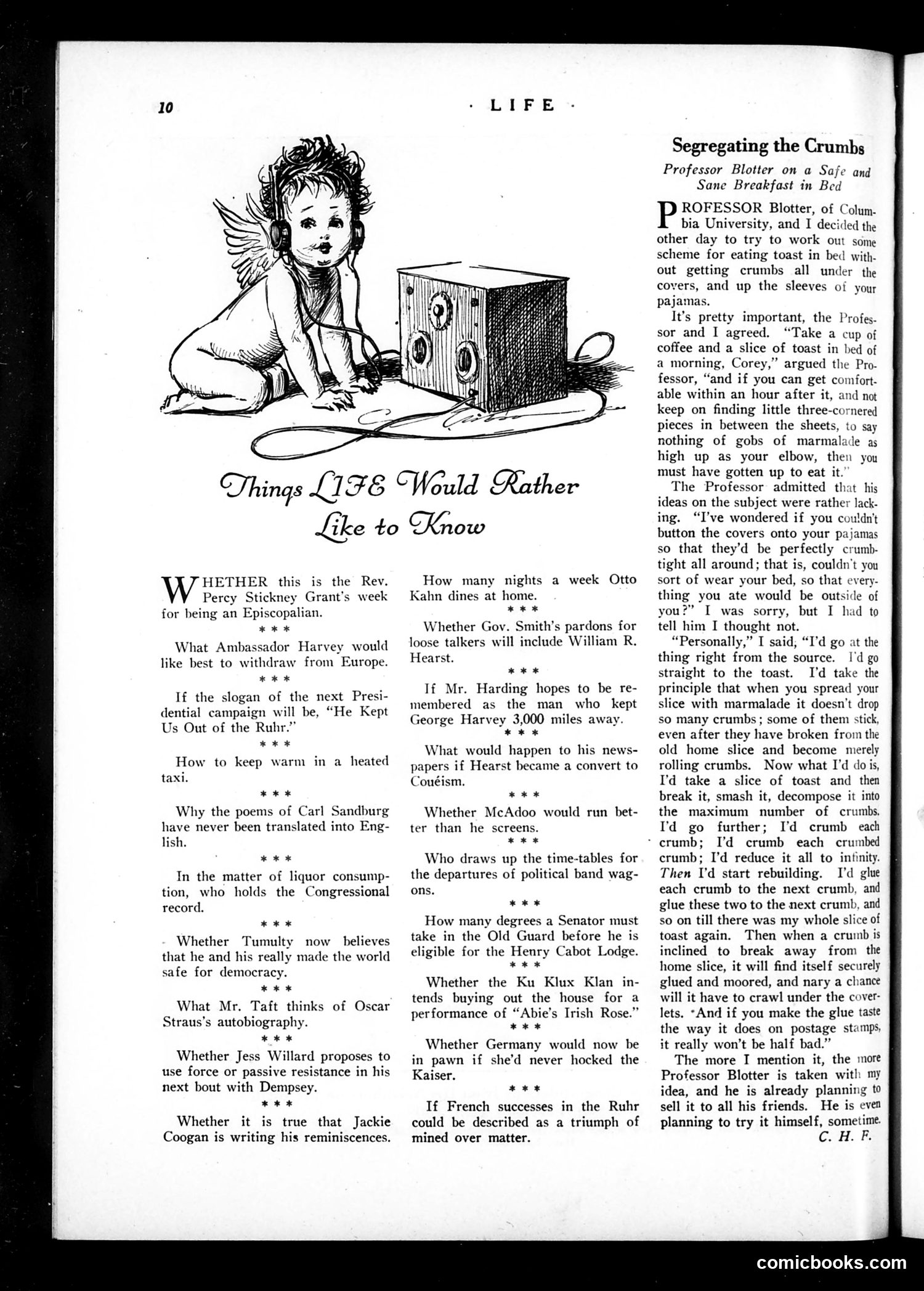
This page from *Life* magazine contains two sections: **Top illustration**: A cherub figure with a mechanical box labeled "Things L138 Would Rather Like to Know"—a humorous feature asking whimsical questions about contemporary public figures and events. **Main article**: "Segregating the Crumbs," featuring Professor Blotter of Columbia University detailing an absurd scheme for eating toast in bed without creating crumbs. The satire mocks the impracticality of overly elaborate solutions to minor everyday problems. The article parodies pedantic academic thinking through Professor Blotter's ridiculous suggestions: buttoning pajamas, breaking toast into smaller pieces, and reassembling crumbs with glue. The "Things L138" questions reference contemporary political and cultural figures (though specific identities aren't visible here), typical of *Life*'s satirical commentary on newsworthy people.
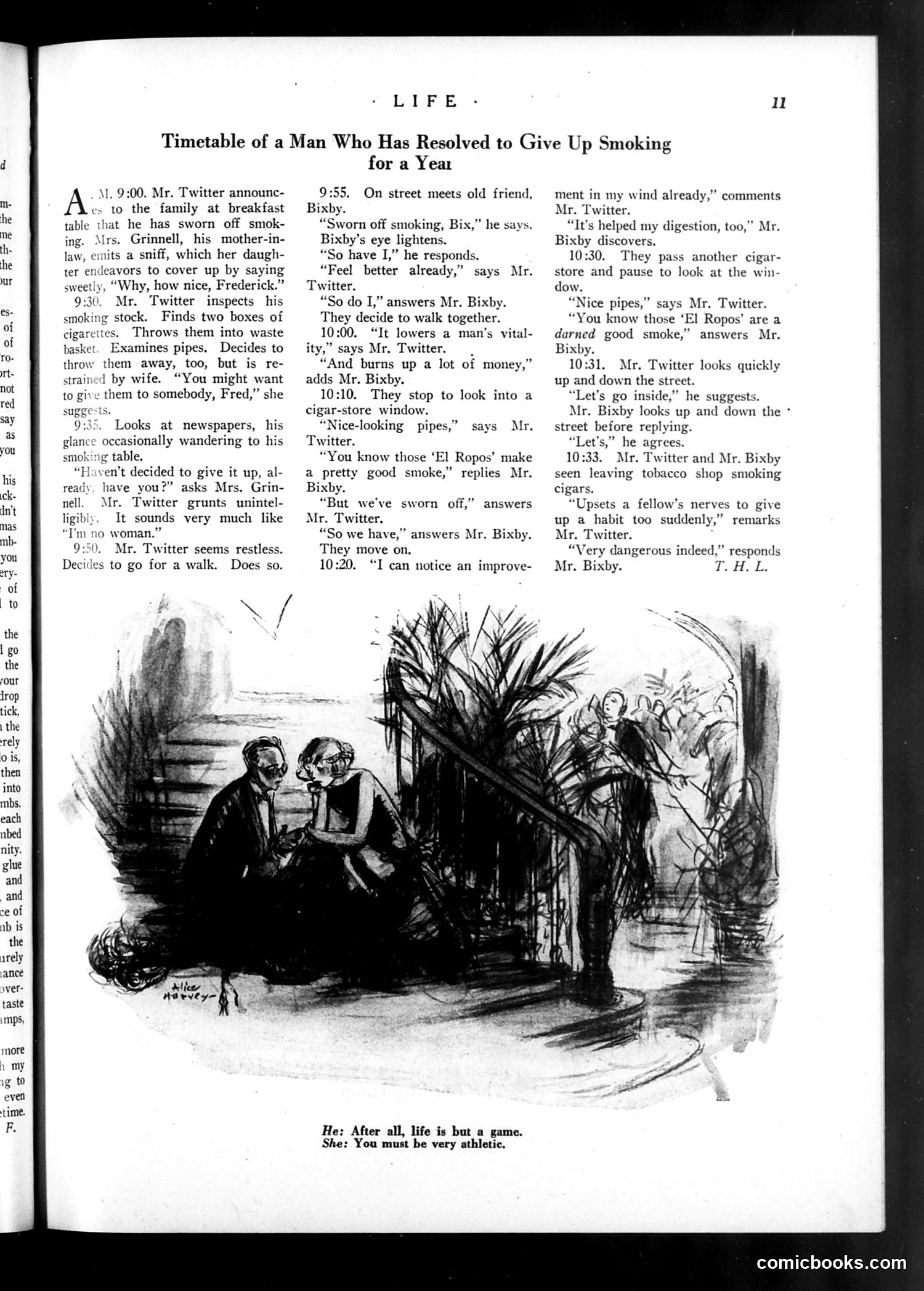
This is a humorous narrative about Mr. Twitter's failed New Year's resolution to quit smoking. The piece chronicles his gradual backsliding: he starts by discarding cigarettes at 9:00 AM, inspects tobacco shops by 9:55, encounters a friend ("Mr. Bixby") and begins rationalizing, admires pipe tobacco, and by 10:33 is purchasing cigars again. The accompanying sketch depicts two men conversing outdoors, likely representing Twitter and Bixby's fateful meeting. The caption below—"He: After all, life is but a game. She: You must be very athletic"—appears unrelated, suggesting either a separate cartoon or editorial comment on human weakness and self-delusion. The satire mocks the universal failure of New Year's resolutions, particularly smoking cessation, through precise, darkly comic timing.
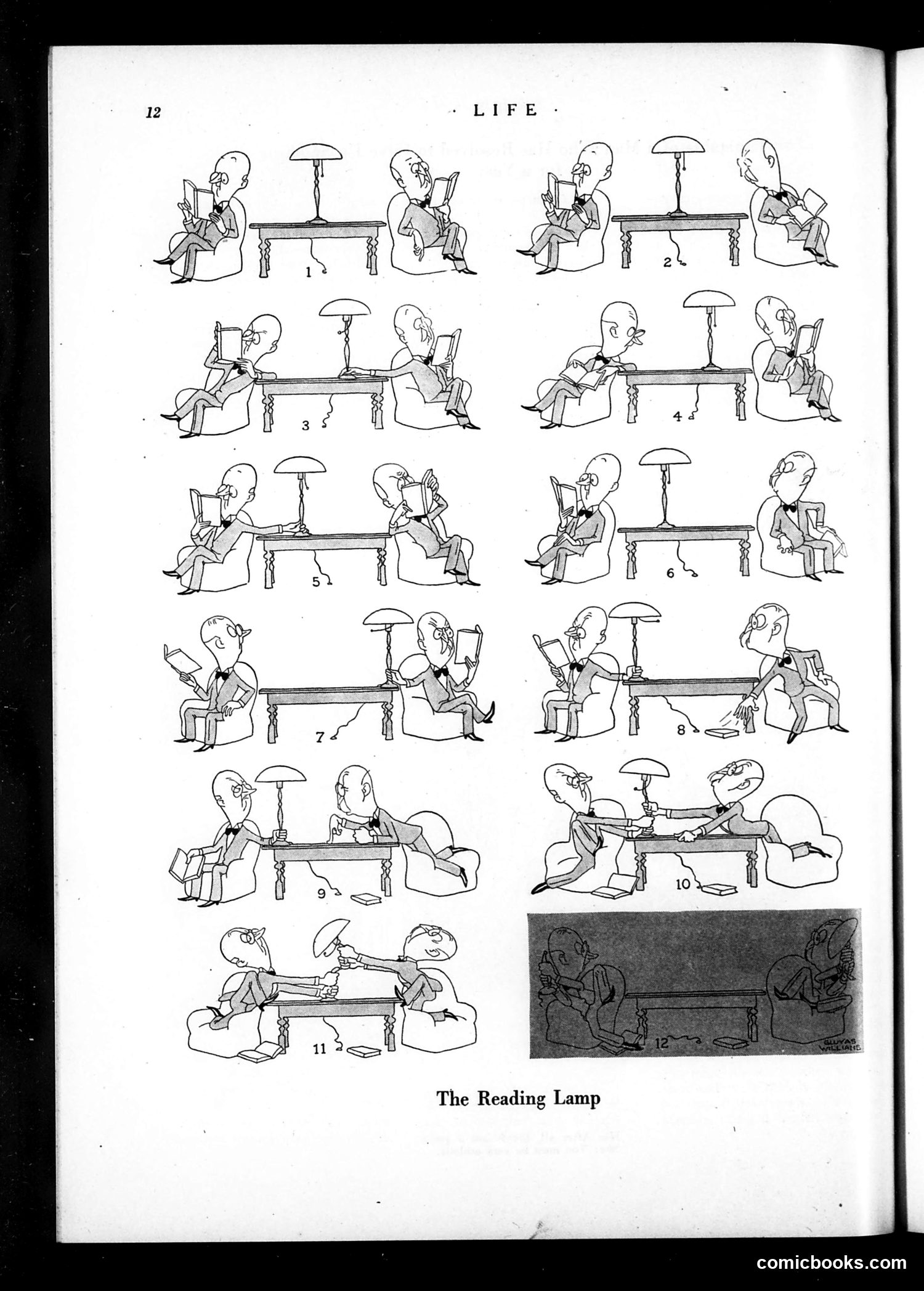
This is a sequential comic strip depicting two men sitting across a table under a reading lamp, engaged in what appears to be an escalating conflict. The 11 numbered panels show a progression from civil conversation (panels 1-2) through increasingly aggressive confrontation, culminating in physical violence by panel 11. The satire likely mocks how minor disagreements between people can spiral into absurd hostility. The "reading lamp" setting—typically associated with intellectual discourse—contrasts sharply with the characters' descent into brutish behavior. This appears to be early 20th-century commentary on human nature, demonstrating how quickly civility deteriorates into animalistic conflict, regardless of refined surroundings.
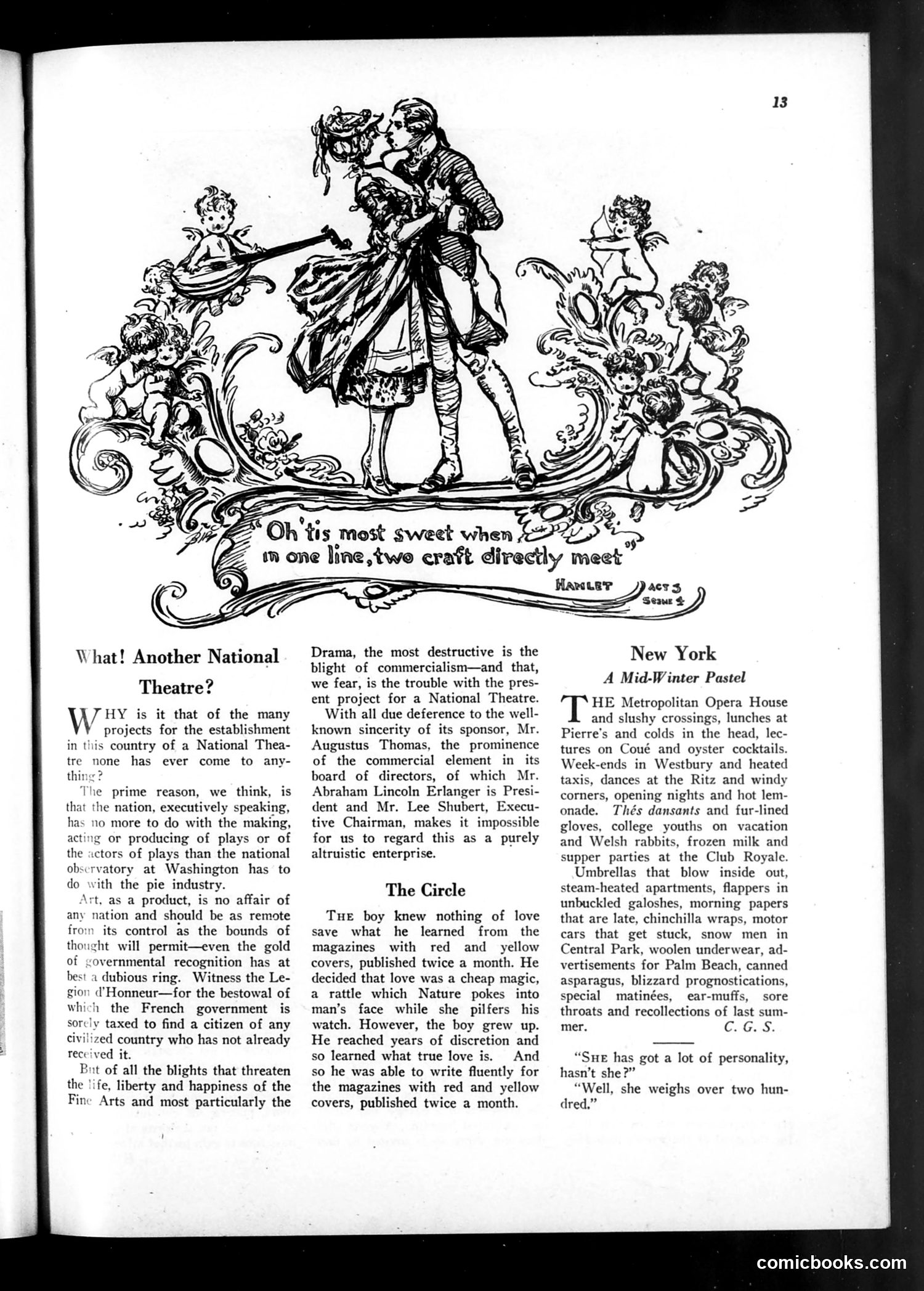
The illustrated header depicts a scene from *Hamlet* (Act 3, Scene 2), showing the famous line "Oh 'tis most sweet when in one line, two craft directly meet." The image shows a man in period dress holding a woman aloft while cherubs and ornamental flourishes surround them—a romanticized theatrical moment. Below, the text discusses a proposed National Theatre for America. The author argues such projects fail because they become controlled by commercial interests rather than artistic ones. Specifically, the article criticizes the current National Theatre proposal, noting that its board includes businessmen like Augustus Thomas and Abraham Lincoln Erlanger, whose commercial priorities allegedly undermine the project's artistic integrity. The *Hamlet* quote appears ironic—suggesting duplicity in the theatrical establishment itself.
The page features editorial commentary on post-WWI international politics. The text criticizes Secretary of State Charles Evans Hughes for not resigning, arguing his approach to foreign affairs lacks boldness. The article discusses Britain's "burden" regarding war debts and compares Greek-Turkish relations favorably to British policy disputes. It references Rev. Yale Owen's reporting on Armenian-Turkish relations, suggesting the Turks treated Armenians better than Greeks did. The decorative masthead illustrations (skull imagery, flying eagle) are typical Life magazine ornamental headers, not specific political caricatures. The overall tone expresses frustration with cautious American diplomatic strategy during the complex post-war settlement period, advocating for more assertive international engagement to resolve lingering conflicts and economic burdens from the war.
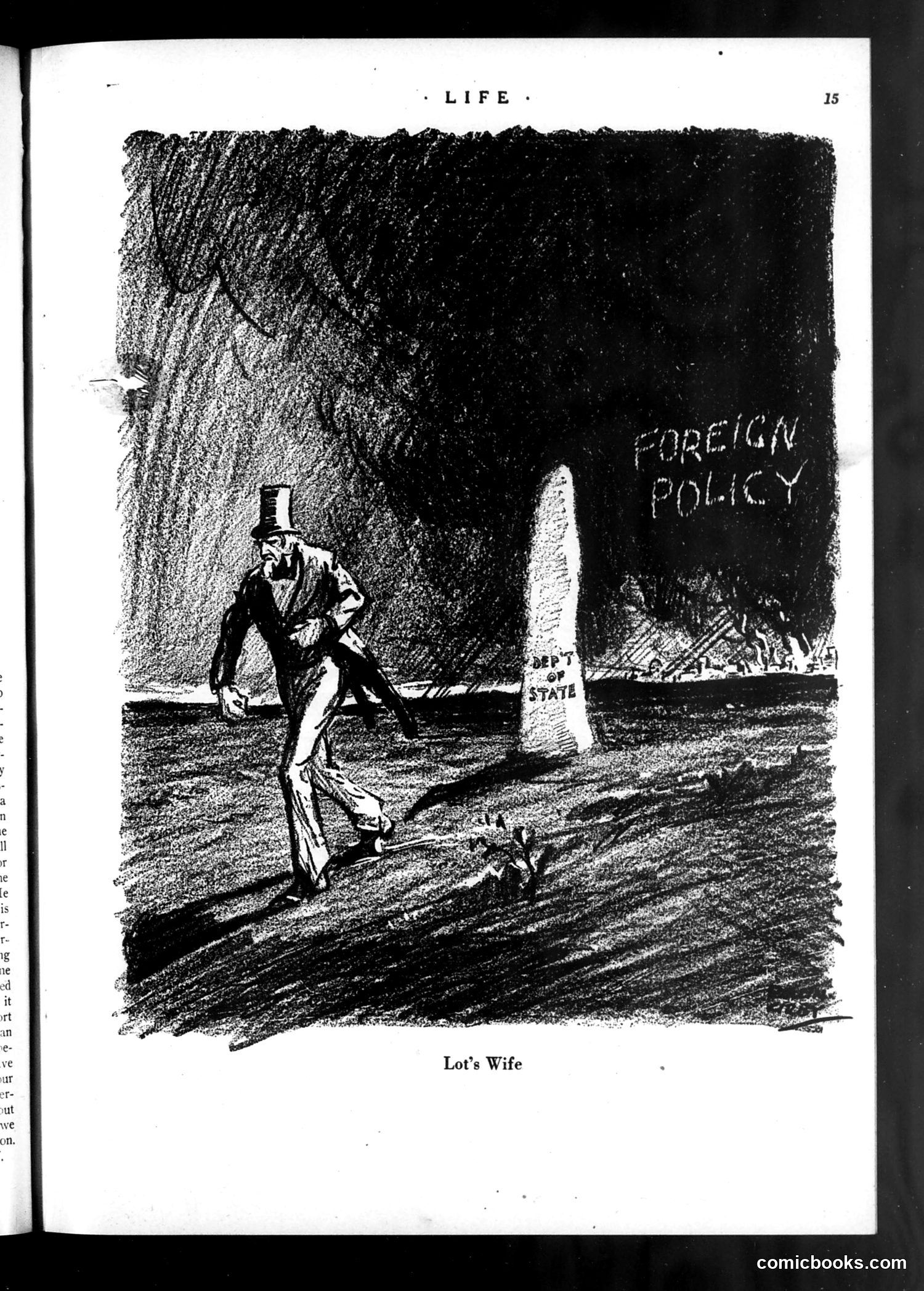
This is a satirical cartoon from Life magazine referencing the biblical story of Lot's wife, who was turned to salt for looking back at Sodom and Gomorrah despite being warned not to. The cartoon depicts a thin, formally-dressed man (appearing to be a diplomat or government official) in a top hat, looking back at a pillar labeled "FOREIGN POLICY" and "DEPT OF STATE." The visual metaphor suggests that the figure is "looking back" at foreign policy decisions—likely criticizing political leaders for being distracted by or clinging to past policies rather than moving forward. The satirical point: government officials risk becoming irrelevant (like Lot's wife turned to salt) if they remain fixated on outdated foreign policy positions instead of adapting to current realities.
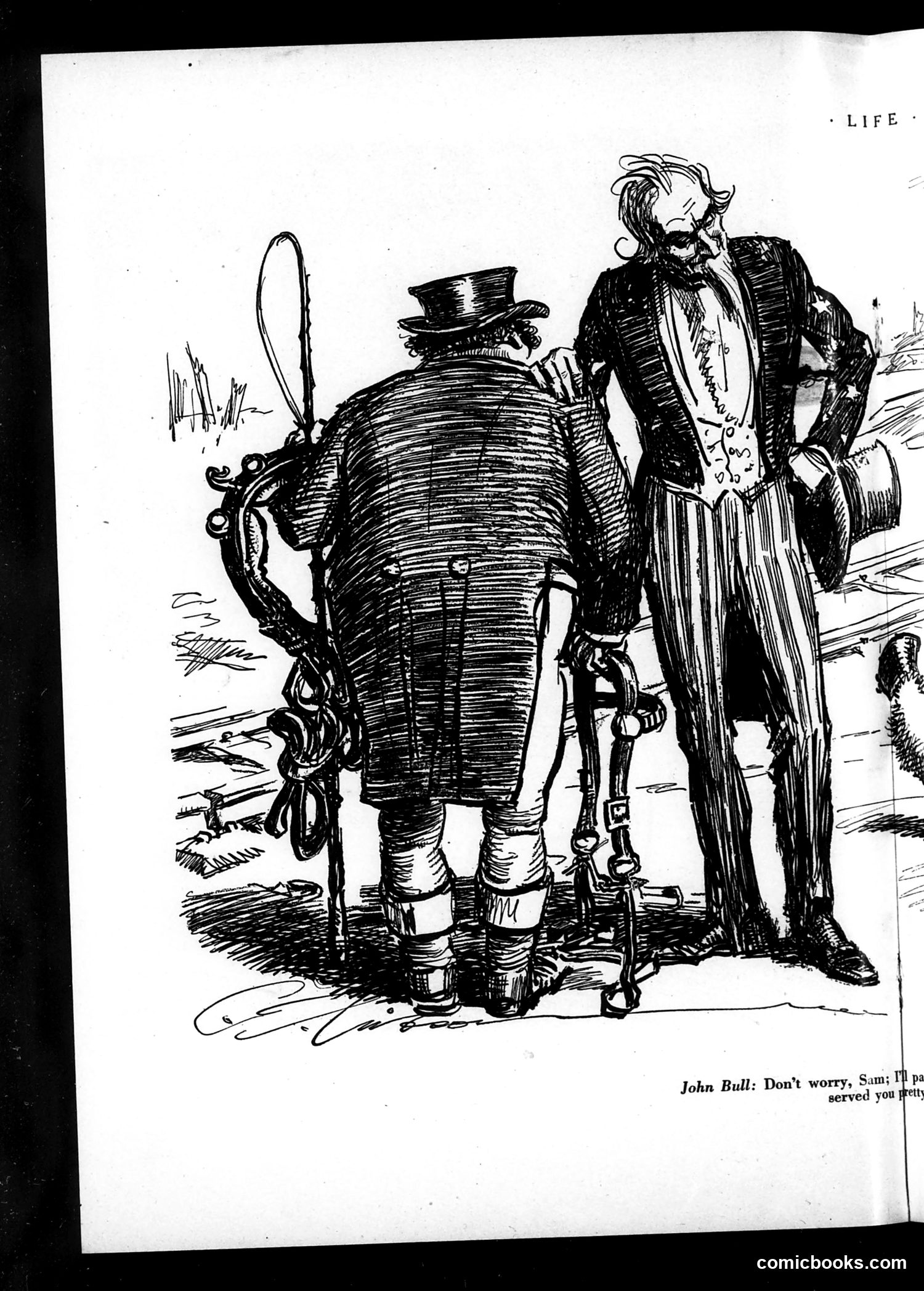
This is a satirical cartoon featuring two figures representing nations in personified form: - **John Bull** (left, in top hat): The traditional British personification, shown from behind - **Sam** (right): Likely Uncle Sam, representing the United States, depicted with a beard and formal attire The cartoon shows John Bull reassuring Sam with the caption "Don't worry, Sam; I'll pay—served you [text cut off]." The imagery suggests a financial or military transaction between Britain and America, likely referencing World War I-era matters when Britain was borrowing heavily from the U.S. or American supplies/support were being provided. The satire appears to concern British-American relations and economic interdependence during this period, with Bull offering reassurance about payment or reciprocal service.
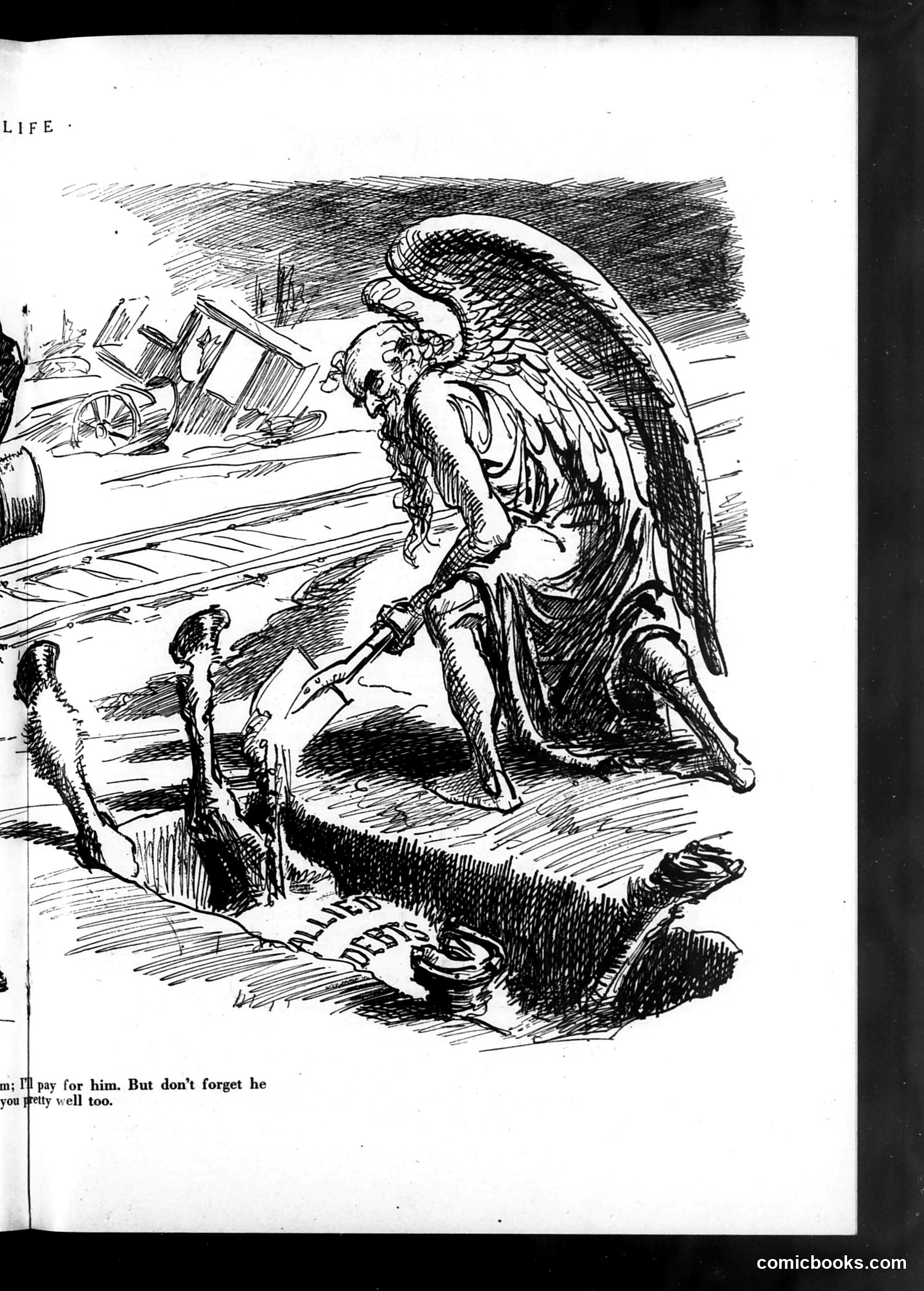
This appears to be a satirical cartoon from *Life* magazine depicting **Death** (personified as a skeletal, winged figure) standing over what seems to be wreckage or a disaster scene. The figure holds a scythe and towers over smaller human figures below. The visible text fragment reads: "I'll pay for him. But don't forget he you pretty well too," suggesting a dialogue about payment or compensation. Without clearer context about the publication date or complete text, the specific political or social reference remains **unclear**. However, the imagery—Death presiding over destruction and wreckage—likely satirizes war casualties, industrial accidents, or another contemporary tragedy where someone powerful makes glib promises of compensation while many have died. The cartoon's point appears to be **cynicism about accountability**: money cannot restore lives lost in disasters.
This is a theater review column criticizing musical comedies of the era (appears to be 1920s based on references). The critic expresses jaded resignation toward the genre, having become numb to poor quality shows. The review skewers "Lady Butterfly" for relying on tired, ancient jokes—specifically mentioning worn-out references to Coué (a self-help fad) and the phrase "every day and in every way" (Coué's famous mantra). The critic contrasts this with Will Rogers, praising him as the only performer who successfully delivers timely material while maintaining lasting appeal. Reviewing another show at the Winter Garden, the critic offers backhanded compliments about its "perhaps a little better than usual" quality. Notable performers mentioned include Jack Pearl, Lou Holtz, and Marie Dressler, with sardonic observations about casting choices and their effectiveness. The overall satire targets the stagnation of musical comedy writing and the desperation of audiences who laugh at anything, while acknowledging good performances occasionally emerge despite poor material.
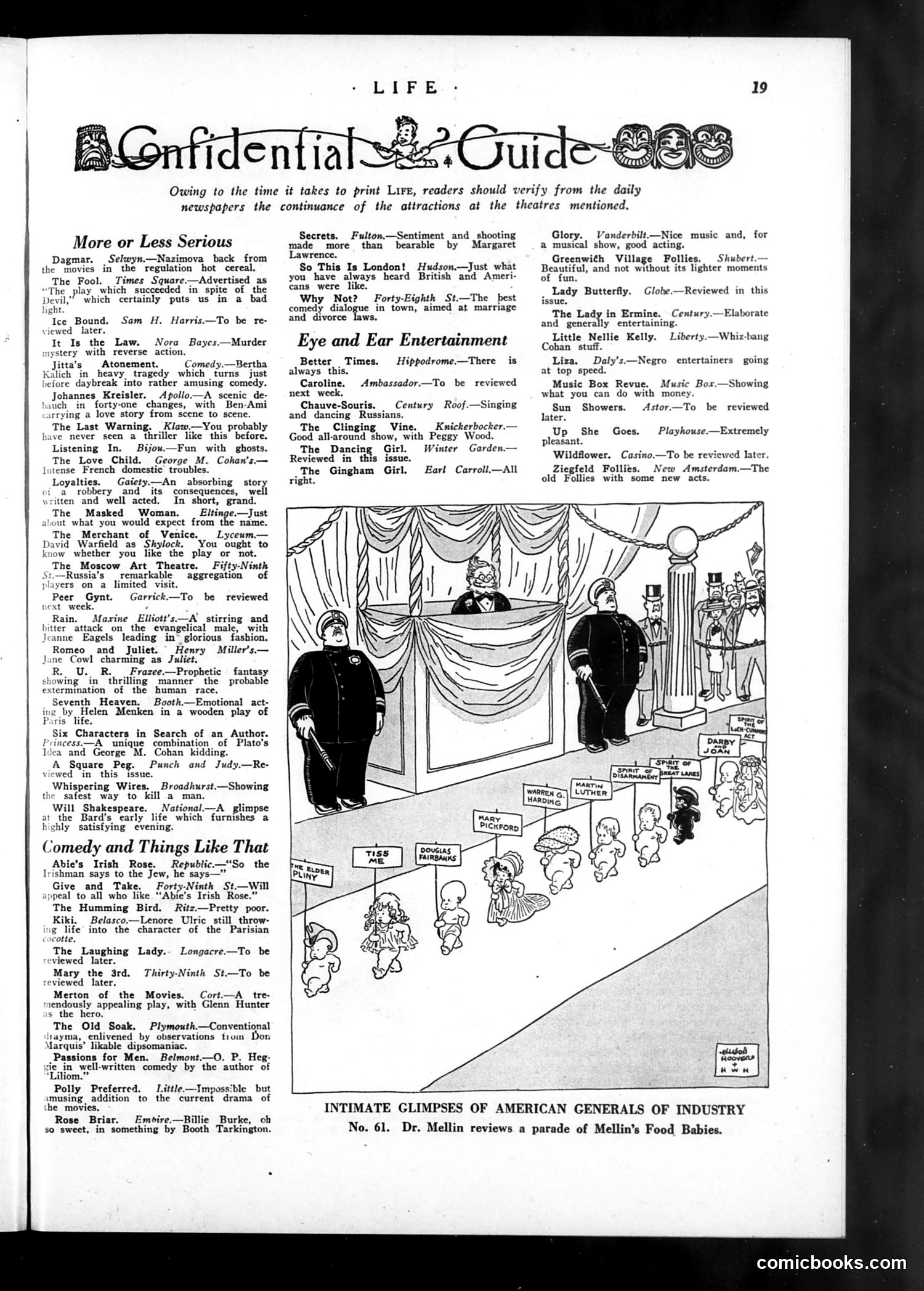
This page is primarily a **theater review guide** for Broadway shows in the 1920s, not a political cartoon. The main illustration shows **Dr. Mellin reviewing a parade of "Mellin's Food Babies"**—an advertisement for infant formula disguised as satirical commentary on the entertainment industry. The humor works on two levels: First, the parade of tiny uniformed figures labeled with actors' names suggests theater producers manufacture entertainment like a factory produces baby food. Second, it's a visual pun—these performers are treated as interchangeable "products" rather than artists. The satirical point: Broadway talent is mass-produced and standardized, much like commercial goods. The reviews themselves are acerbic one-liners mocking popular shows. For instance, *Abie's Irish Rose* is parodied as derivative ethnic humor, while *R.U.R.* is noted as "prophetic" (likely referencing its early science-fiction warning about technological replacement of humans). The page reflects 1920s cultural anxieties about commercialization and standardization infiltrating American art and industry.
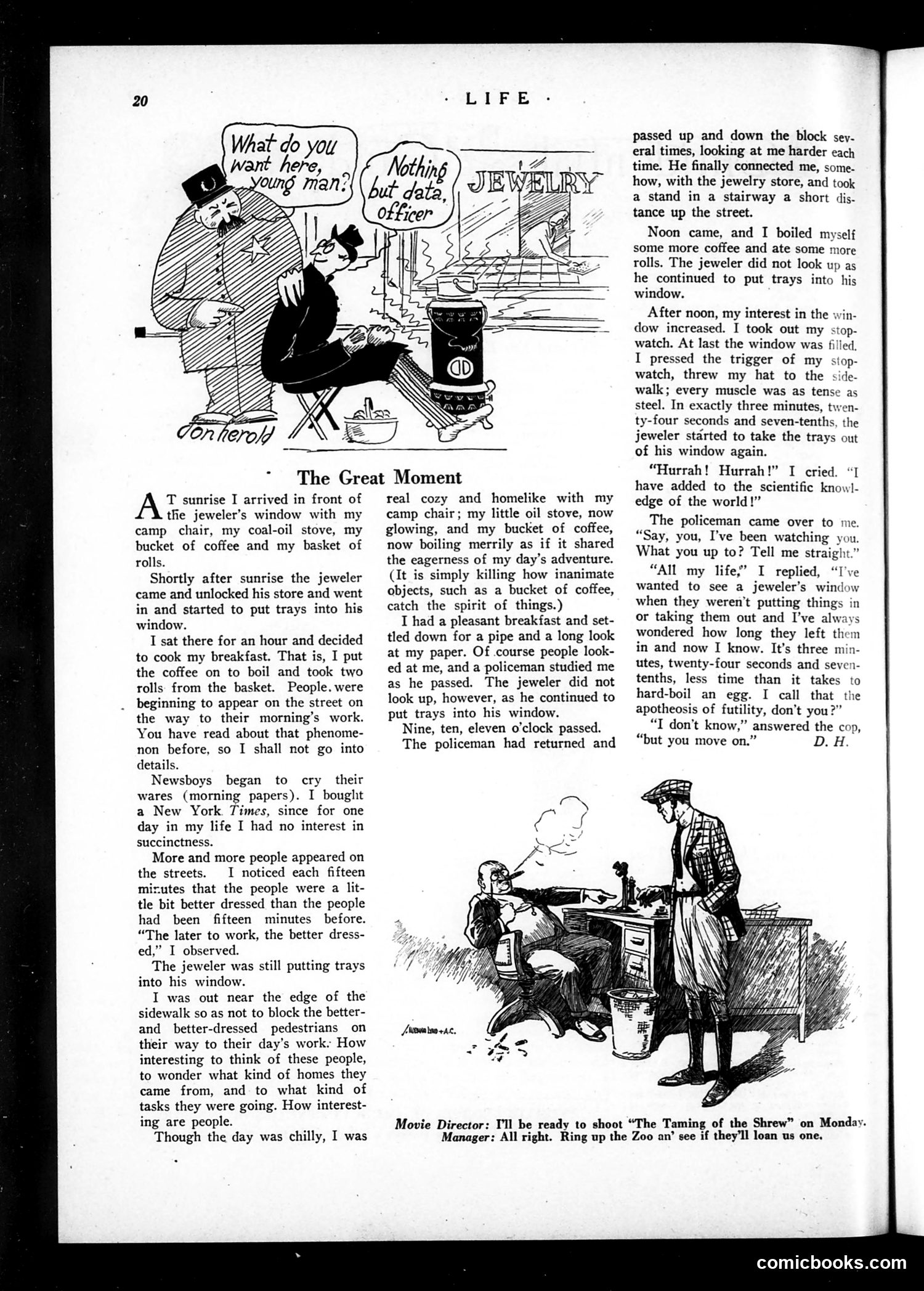
This page satirizes obsessive time-wasting and the absurdity of pointless observation. The main cartoon (top) shows a "data officer" in an office—a humorous dig at bureaucratic jobs that generate no real value, just paperwork. The longer story describes a man camping outside a jeweler's window to scientifically measure how long merchandise displays remain filled. He camps there all day with a stove and supplies, drawing police suspicion, then celebrates "discovering" it takes 3 minutes 24.7 seconds—treating trivial data as scientific achievement. The satire targets early 20th-century "efficiency experts" and the obsession with measuring and quantifying everything, no matter how meaningless. The bottom cartoon mocks Hollywood's casual attitudes, conflating "taming" an animal with filming Shakespeare. The overall message: modern society wastes energy on pointless precision and documentation.
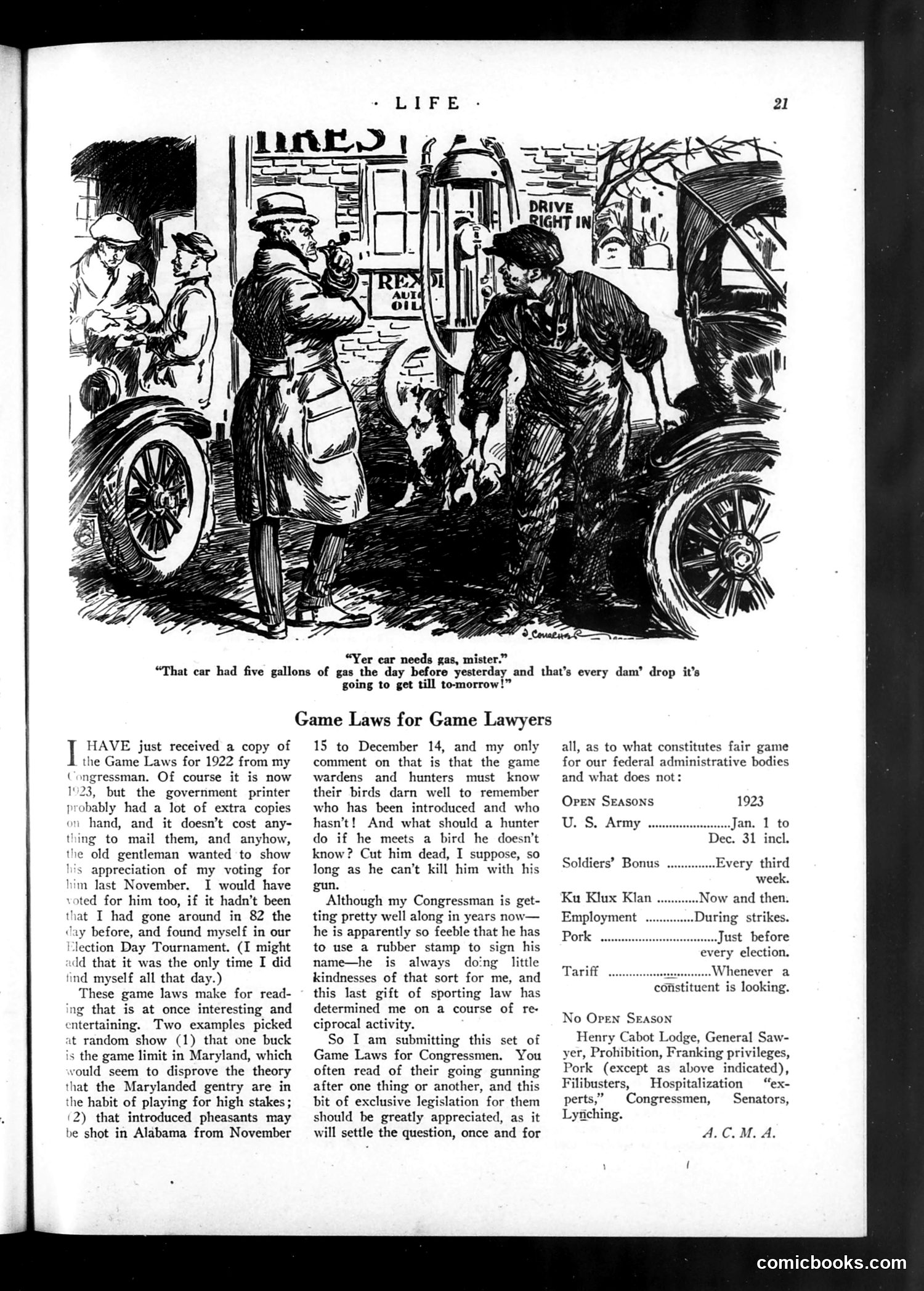
This 1923 *Life* satire mocks Congress by presenting mock "Game Laws" treating politicians as huntable game. The top cartoon depicts a gas-station attendant confronting a driver about fuel consumption—a setup for the joke below. The article's author receives outdated 1922 game laws from his congressman in 1923, prompting satirical revenge: proposing hunting seasons for congressmen themselves. The "open seasons" list ridicules contemporary political targets: the U.S. Army, soldiers' bonuses, the Ku Klux Klan, employment issues, pork-barrel spending, and tariffs. The "no open season" list includes Henry Cabot Lodge (a senator), Prohibition, and lynching—suggesting these topics are too controversial or protected to critique openly. The satire attacks congressional dysfunction, waste, favoritism, and complicity with groups like the KKK during the 1920s resurgence. It's essentially calling politicians fair game for public criticism.
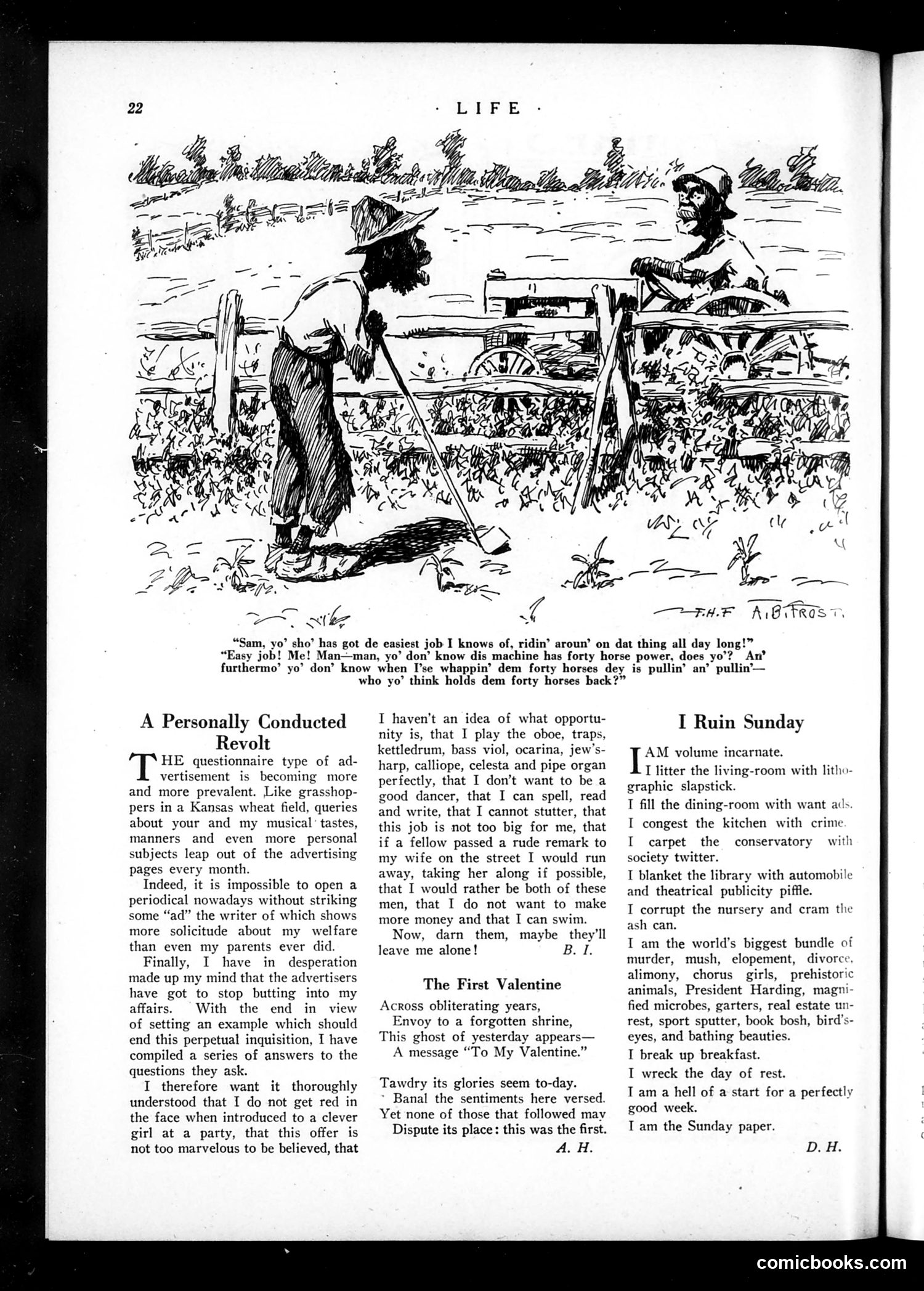
The page contains three distinct pieces of satirical writing from *Life* magazine: **Top Cartoon:** A dialect-humor piece titled "The Altruist" depicting two men with a farm machine. One claims his job is "easy," but his companion explains the machine has "forty horse power" that must be constantly controlled—a joke about the difficulty of managing powerful new farm technology. This reflects early 20th-century anxiety about mechanized agriculture. **Left Column:** "A Personally Conducted Revolt" by B.I., sarcastically listing answers to invasive questionnaires from advertisers. The author mock-complies with impossible claims (perfect musician, excellent dancer, cowardly husband) to mock advertising's intrusiveness and personal nature of marketing inquiries. **Right Column:** Two brief poems—"The First Valentine" (A.H.) nostalgically contrasting an old Valentine's charm with modern sentiments, and "I Ruin Sunday" (D.H.), a humorous self-indictment where the Sunday newspaper itself boasts of corrupting the day with crime, gossip, and President Harding coverage. All three mock modern conveniences and consumer culture's intrusions into private life.
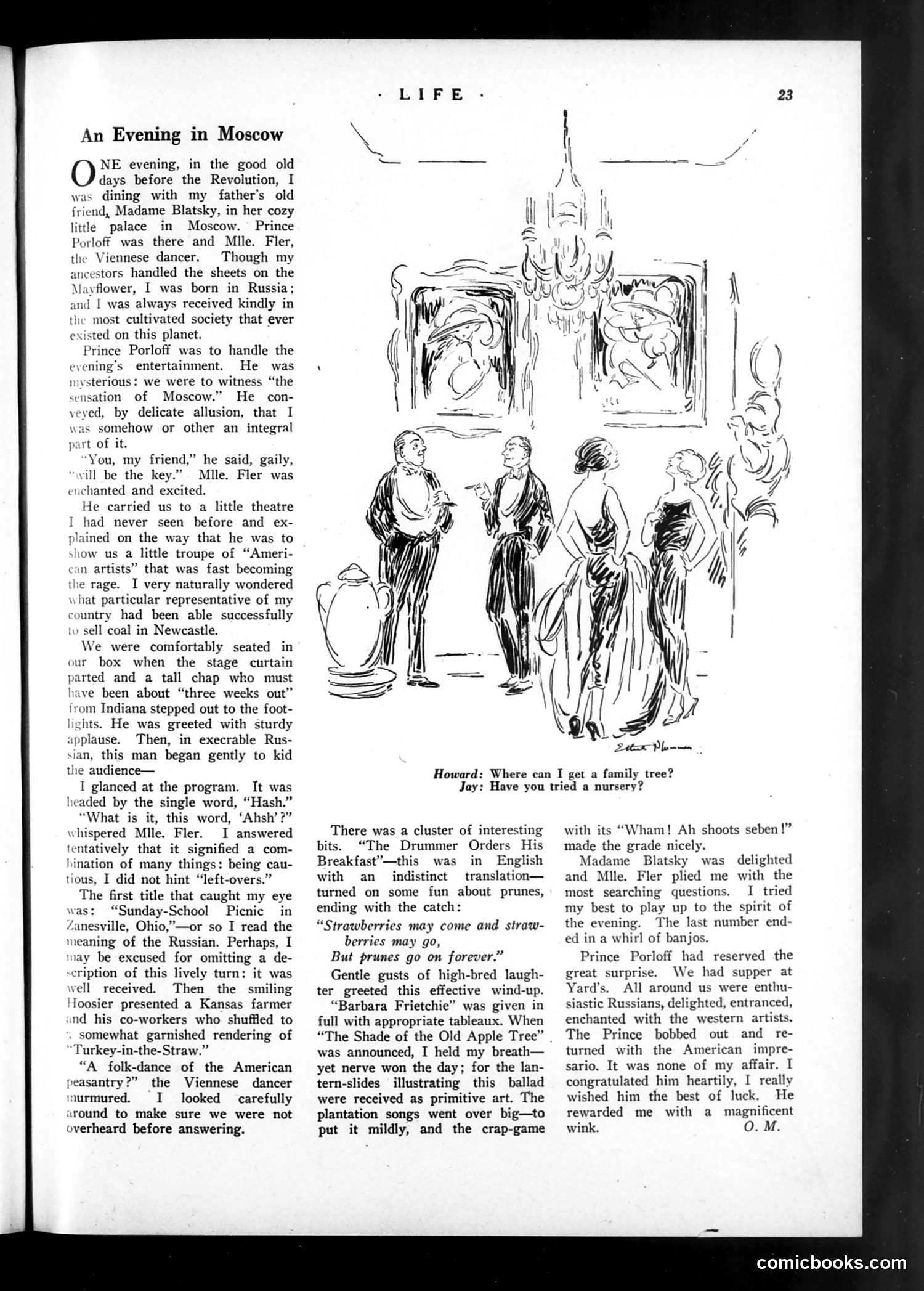
This humorous essay mocks Russian fascination with American popular culture in pre-Revolutionary Moscow. The narrator, descended from Russian nobility but American-born, attends an exclusive salon where a visiting American impresario presents vaudeville-style entertainment to wealthy Russian aristocrats. The satire targets two audiences: Russians who treat crude American acts (folk dances, sentimental ballads, minstrel songs) as high art worthy of sophisticated appreciation, and Americans who peddle this entertainment abroad as cultural exports. The joke is the cultural inversion—what ordinary Americans recognize as lowbrow entertainment ("Turkey in the Straw," crap-game numbers) becomes "primitive art" to Moscow's elite. The cartoon illustration shows well-dressed Russians and Westerners in an ornate palace setting, visualizing the clash between refined European salon culture and American variety-show entertainment. The byline "O.M." suggests authorship, though the writer's identity isn't definitively stated in visible text.
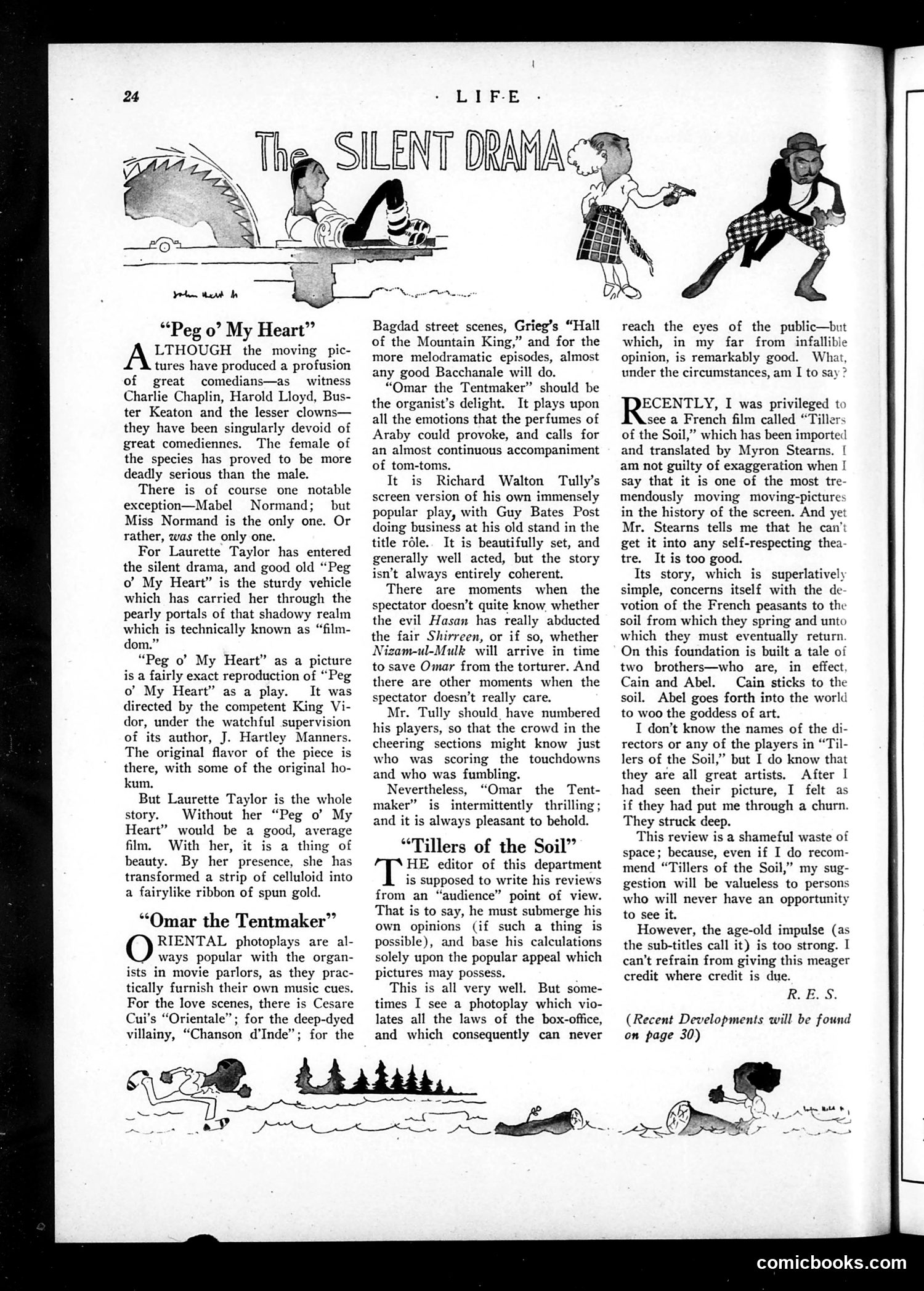
This page reviews three silent films from the early 1920s. The critic discusses **"Peg o' My Heart,"** praising actress Laurette Taylor as a rare female comedic talent in silent film (contrasting her with male stars like Chaplin and Keaton). He notes that female performers were generally "more deadly serious than the male." **"Omar the Tentmaker"** is reviewed as competently made but narratively confusing—the critic humorously suggests the director should have "numbered his players" so audiences could follow who was doing what, comparing it to a football game where spectators don't know "who was scoring the touchdowns." **"Tillers of the Soil,"** a French import, receives high praise but the reviewer laments it cannot find distribution because it's "too good"—implying quality films couldn't reach mainstream audiences if they lacked commercial appeal. The tension between artistic merit and box-office viability anchors his critique.
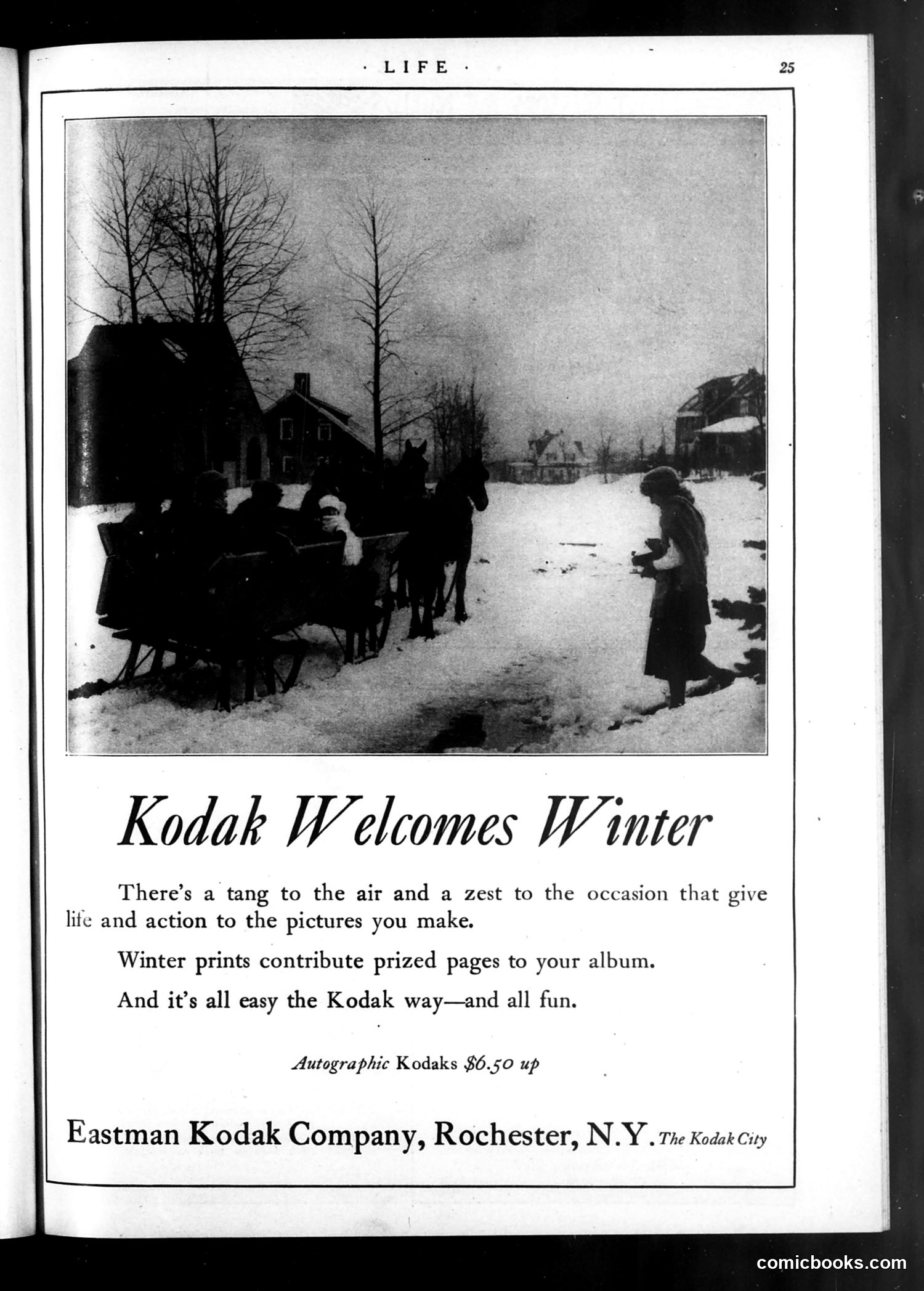
This is a Kodak camera advertisement, not political satire. The page shows a winter scene with people and a horse-drawn sleigh on a snowy road lined with bare trees and rural buildings. The ad argues that winter photography produces particularly striking images worth preserving in photo albums. It emphasizes the ease and enjoyment of winter picture-taking "the Kodak way," positioning seasonal photography as a leisure activity. The "Autographic Kodaks" reference indicates a camera model feature allowing photographers to write notes directly on film negatives. The ad targets amateur photographers by suggesting winter's natural drama and contrast make superior photographs, encouraging camera purchases at the listed price point.
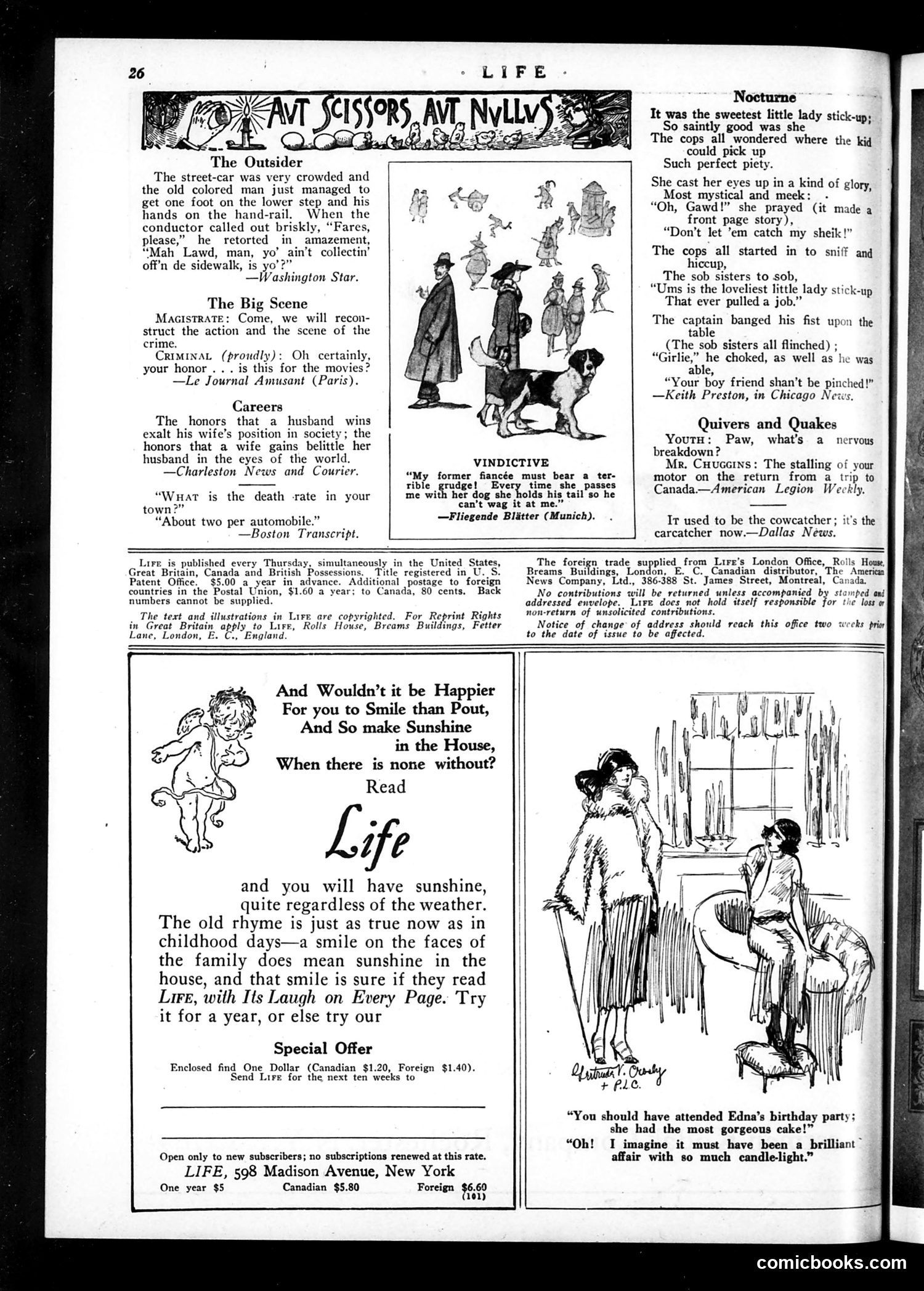
This page from *Life* magazine (a satirical weekly) contains brief humorous anecdotes and advertisements rather than political cartoons. The jokes reflect early 20th-century American social anxieties: **Notable content:** - **"The Outsider"**: A Black streetcar passenger humorously protests being asked for fare while still boarding—satirizing segregation-era transit indignities. - **"Nocturne"**: A satirical poem about a female robbery suspect who prays piously during arrest, manipulating sympathetic newspaper reporters ("sob sisters") and police. It mocks both sentimental journalism and public gullibility. - **Automobile jokes**: References to car-related deaths and breakdowns reflect early automotive-age anxieties. - **Gender commentary**: A note that wives' professional honors diminish husbands' social standing—critiquing rigid gender hierarchies of the era. The page primarily serves as advertisement for *Life* subscriptions, promoting it as family entertainment that brings "sunshine in the house."
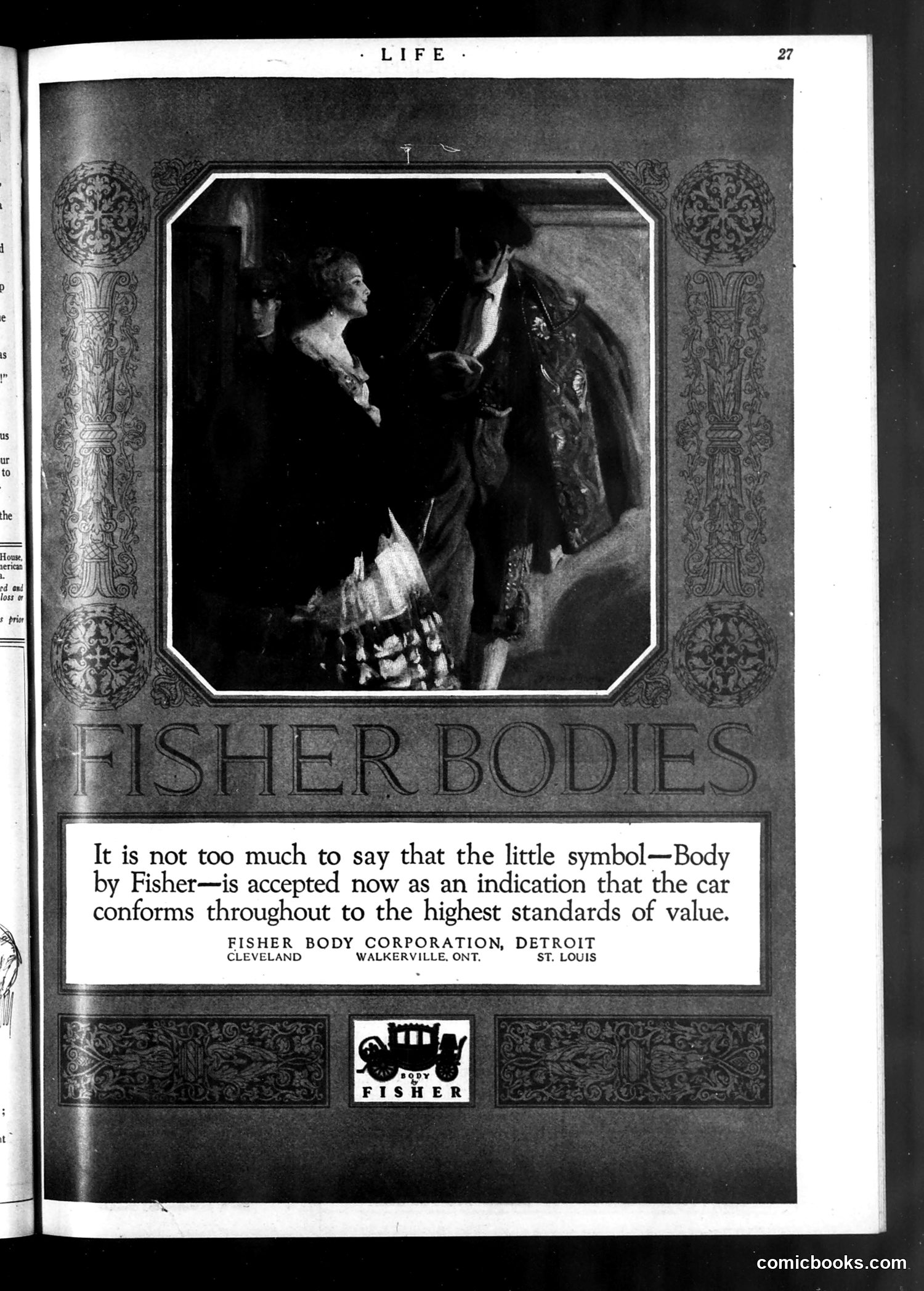
This is a full-page advertisement for Fisher Body Corporation, an automobile body manufacturer. The image shows what appears to be elegantly dressed figures in formal attire, likely representing wealthy or upper-class consumers. The ad claims that the "Body by Fisher" trademark has become a prestigious symbol indicating high quality and value in automobiles. This represents early automotive advertising strategy—establishing brand cachet by associating the product with luxury and refinement. The ornate decorative borders and formal photographic style reinforce the message of quality and sophistication. The multiple factory locations listed (Detroit, Cleveland, Walkerville, St. Louis) indicate Fisher Body's significant manufacturing scale during this era of automotive expansion.
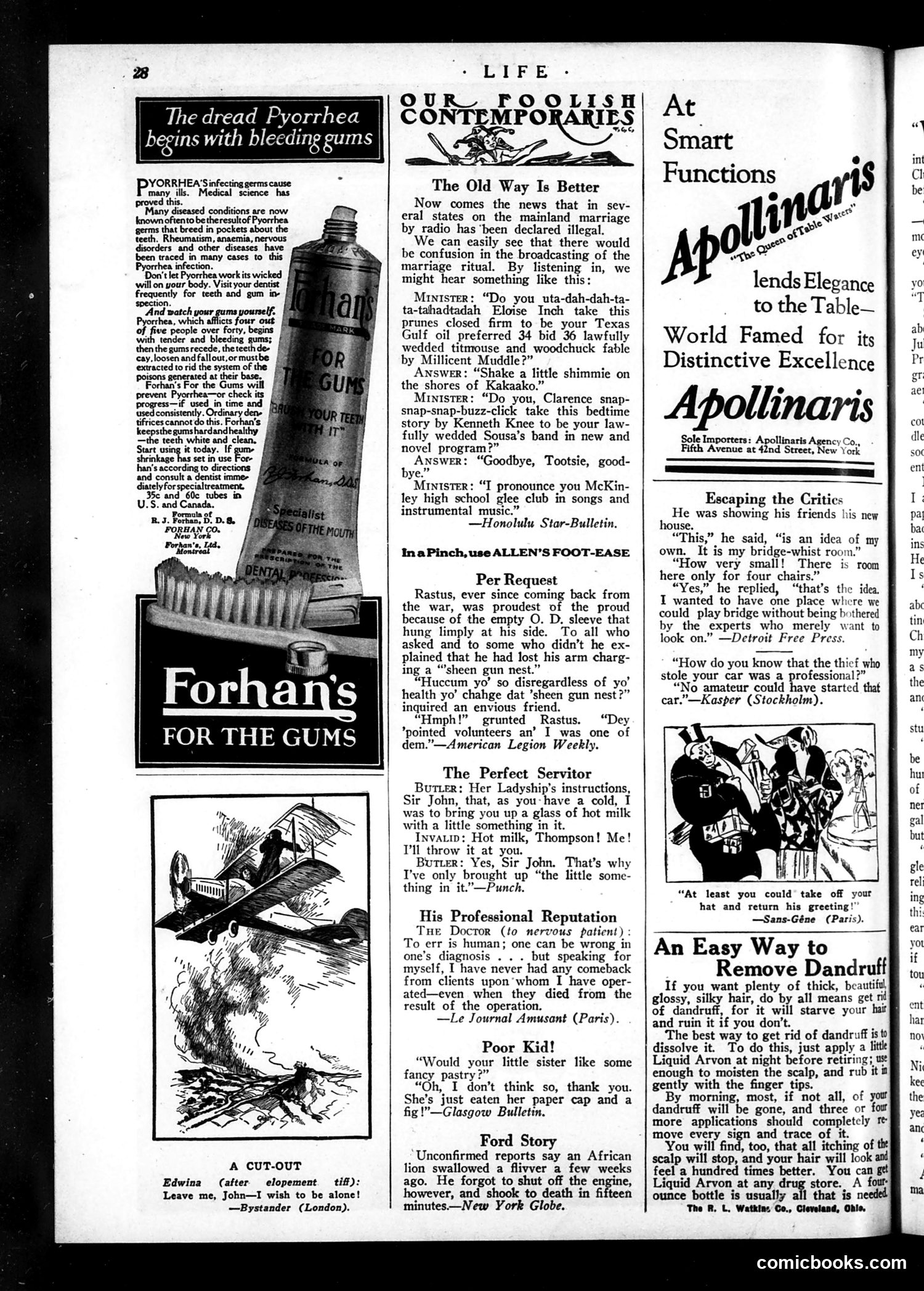
This page from *Life* magazine combines advertisements with satirical humor pieces typical of early 20th-century American satire. **Main Satirical Content:** The centerpiece, "Our Foolish Contemporaries," mocks emerging radio technology by imagining a radio-broadcast wedding ceremony disrupted by static and interference—jokes about several U.S. states banning such marriages. The humor relies on readers' unfamiliarity with radio broadcasting and exaggerates the chaos interference might cause. Other brief comedic pieces include: a joke about a World War I veteran claiming an arm loss from charging a "machine gun nest" (playing on post-war bragging); a butler's dry wit about a doctor with a perfect professional record (because dead patients can't complain); and a child eating her paper cap. **Advertisements:** The page is heavily populated with period ads for Forhan's toothpaste (addressing "pyorrhea"), Apollinaris mineral water, Allen's Foot-Ease, and other consumer products using health-scare tactics common to 1920s-era marketing. The humor assumes readers' anxiety about new technology and their familiarity with radio's then-novel presence in American life.
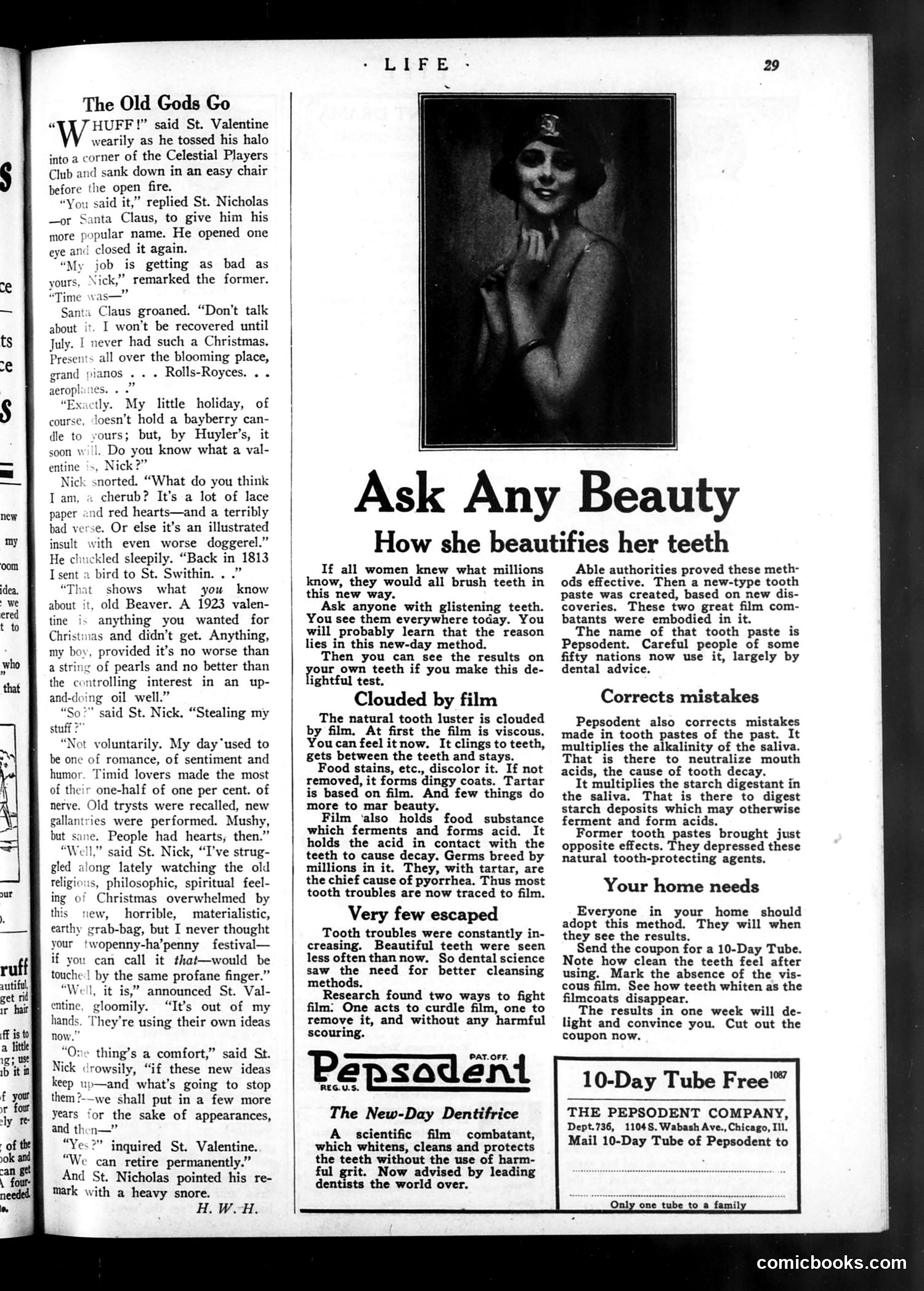
This satirical dialogue features Saint Valentine and Saint Nicholas (Santa Claus) as weary mythological figures complaining about how modern commercialism has corrupted their holidays. **The satire's point:** Both saints lament that their once-sacred observances have become materialistic spectacles. Valentine describes 1923 Valentine's Day as purely transactional—"anything you wanted for Christmas and didn't get"—stripped of romance and sentiment. Santa similarly grieves that Christmas is now overwhelmed by "materialistic" excess (Rolls-Royces, grand pianos, aeroplanes) rather than spiritual meaning. **The darker joke:** The saints conclude they might as well retire permanently since their holidays have been so thoroughly commodified there's no point maintaining the pretense. This reflects 1920s anxieties about modernization eroding traditional values. The advertisement for Pepsodent toothpaste ironically underscores the page's theme—even tooth-brushing has become a scientifically marketed consumer concern.
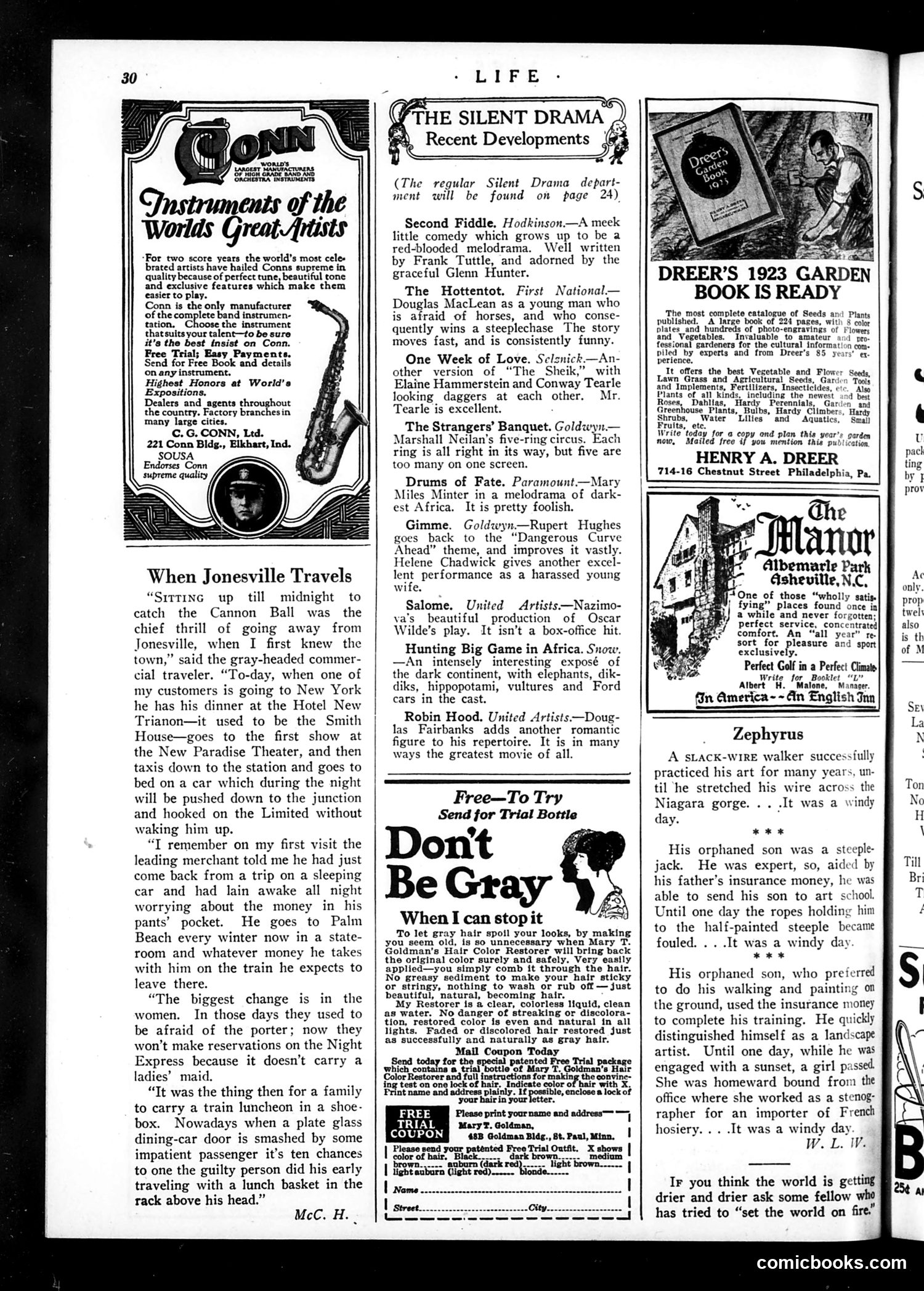
This is primarily an **advertising and entertainment content page** from Life magazine, circa early 1920s. The main elements are: **"When Jonesville Travels"** — A nostalgic humor piece contrasting small-town life then versus now. It satirizes how modernization and increased wealth have transformed travel habits: once, merchants worried about carrying money; now they vacation in Palm Beach. Women no longer fear porters or need chaperones. The joke reflects anxieties about rapid social change and class mobility during the prosperous 1920s. **Silent Drama Reviews** — Brief movie critiques of contemporary films (Douglas Fairbanks, Mary Miles Minter, etc.), typical of Life's entertainment coverage. **"Don't Be Gray" Advertisement** — A hair-coloring product ad using period-typical messaging about maintaining attractiveness. The page demonstrates Life's blend of satirical social commentary with consumer advertising, targeting an educated, middle-class readership navigating unprecedented modernization and leisure opportunities.
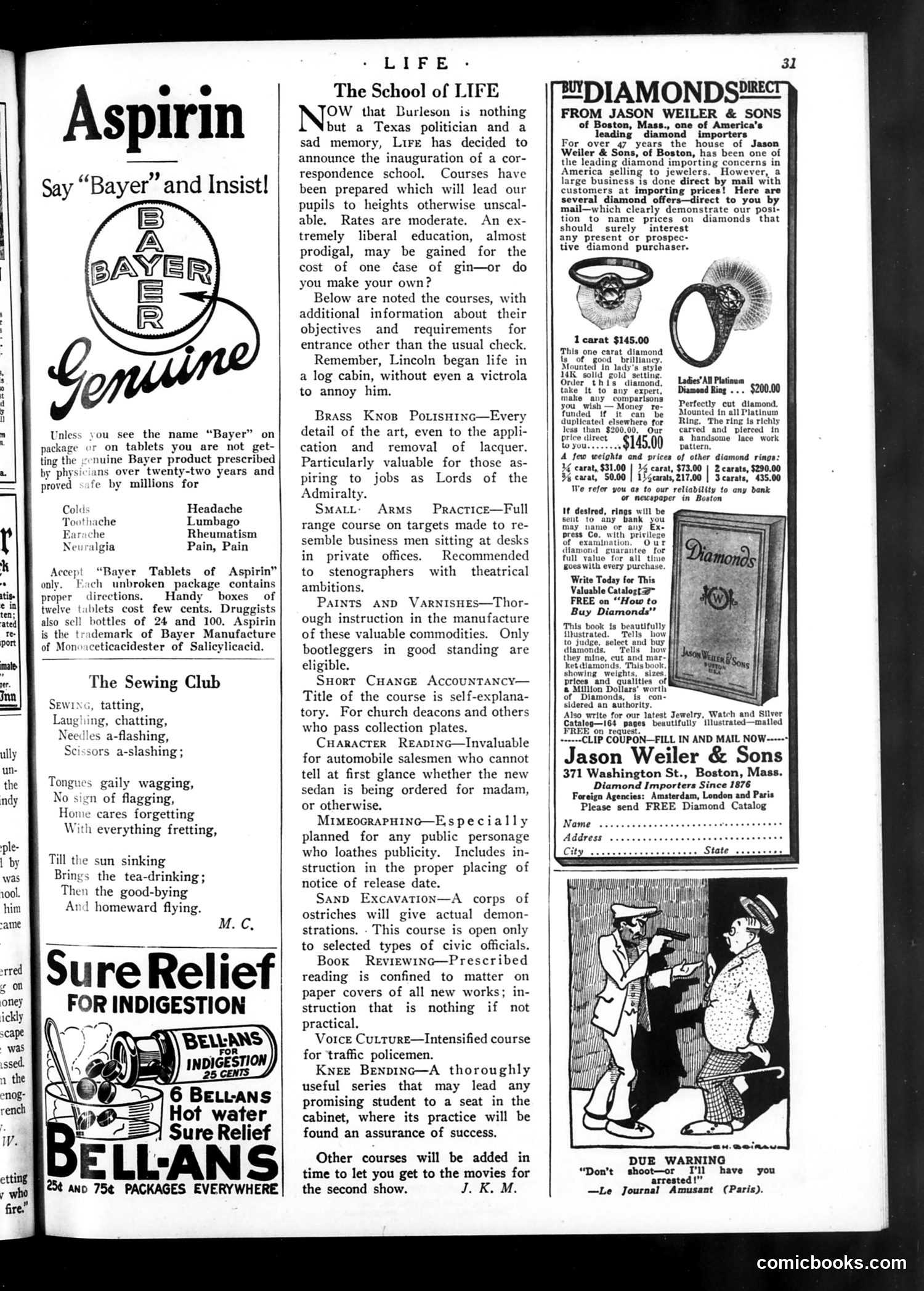
This page contains mostly **advertisements and satirical course listings** rather than political cartoons requiring historical context. The main satirical content is "The School of Life"—a mock correspondence school mocking Prohibition-era corruption and incompetence. References include: - **Burleson**: Albert Burleson, Wilson's Postmaster General, appears to be criticized as merely "a Texas politician"—the satire suggests he's now irrelevant. - **Bootlegging courses**: The "Paints and Varnishes" course jokes that "only bootleggers in good standing are eligible," satirizing Prohibition's widespread violation. - **Corruption satire**: "Short Change Accountancy" mocks church officials embezzling collection plates; "Sand Excavation" ridicules officials burying scandals (ostrich heads in sand). - **Cabinet knee-bending**: The final course sardonically suggests political success requires servility. The humor targets 1920s-era political and social hypocrisy during Prohibition. The page also features period advertisements for Bayer Aspirin, Bell-Ans indigestion remedy, and diamond imports.
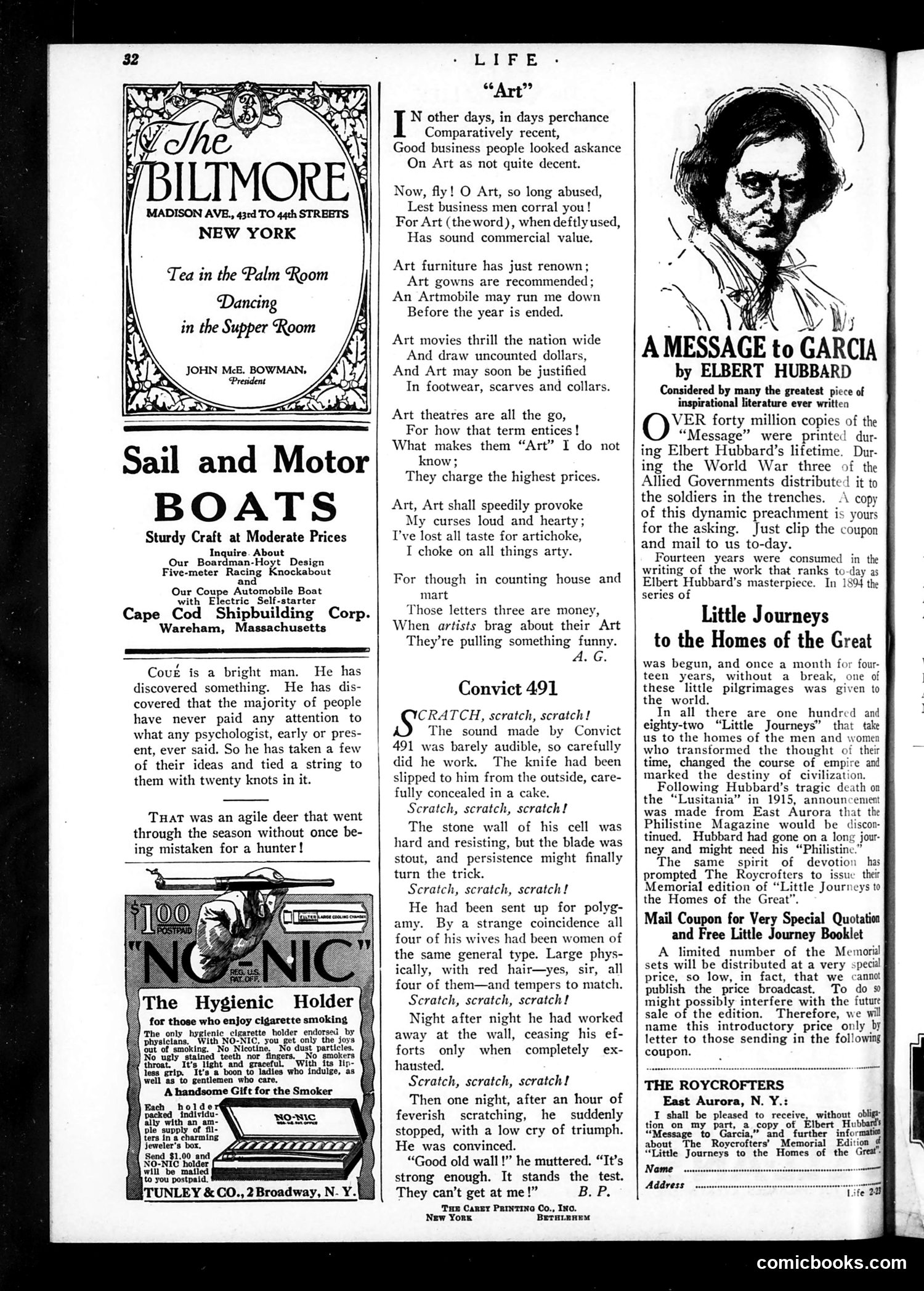
This page contains several distinct elements: **"Art" Poem (A.G., author unknown):** A satirical critique of how "Art" became commercialized. The poet laments that businesspeople—formerly dismissive of art—now cynically use the word "Art" to sell anything (furniture, automobiles, theater tickets) at premium prices. The satire targets both commercial exploitation of artistic language and artists who "brag" about their work while participating in this marketplace. **"Convict 491" Story (B.P., author unknown):** A humorous tale of a prisoner convicted of polygamy who escapes by scratching through his cell wall with a smuggled knife—only to discover, after breaking through, that the wall's strength proved his imprisonment was secure. The joke mocks wasted effort and ironic outcomes. **"A Message to Garcia" Advertisement:** Promotes Elbert Hubbard's famous motivational essay, claiming 40 million copies distributed during his lifetime and use by Allied governments during WWI. This was genuine historical fact—the essay became enormously popular. The page is primarily **advertising and humorous content** rather than political satire, reflecting Life magazine's satirical-yet-commercial nature of this era.
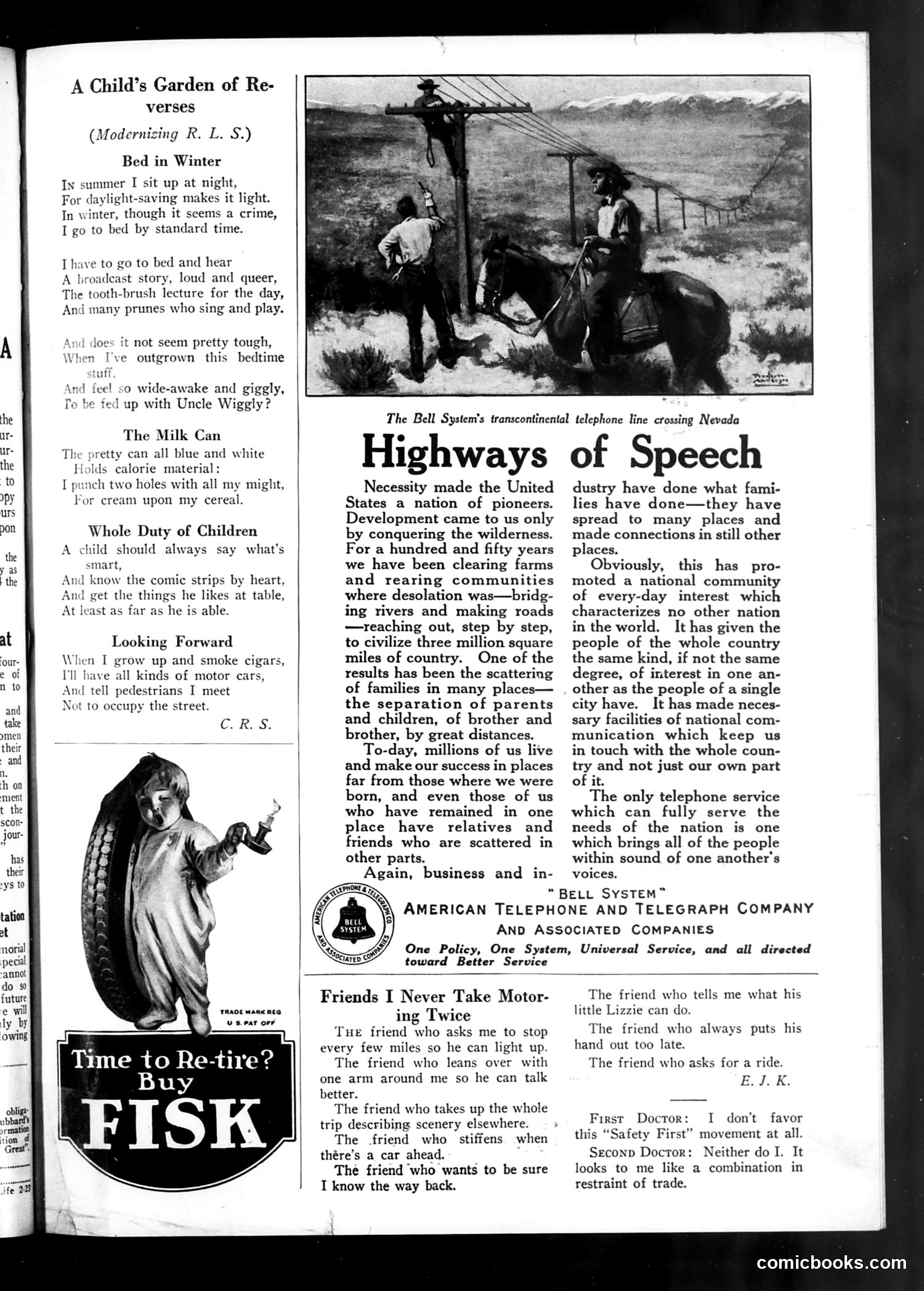
This page contains **satirical poetry and advertisements** rather than political cartoons proper. **"A Child's Garden of Reverses"** modernizes Robert Louis Stevenson's classic children's poetry by satirizing contemporary 1920s concerns: daylight-saving time, radio broadcasts, children's independence, and automobiles. The humor targets how modern technology disrupts traditional childhood and family routines. **"Highways of Speech"** is a Bell Telephone System advertisement justifying national telephone infrastructure as necessary for maintaining family and business connections across America's dispersed population. It frames telephony as essential to national cohesion. **"Friends I Never Take Motoring Twice"** humorously catalogs annoying car passengers—those who distract drivers, give unwanted commentary, or exhibit nervous backseat behavior. The final **doctor joke** satirizes the newly emerging "Safety First" movement, with physicians claiming it restricts trade—a cynical jab suggesting safety advocates threaten profit-driven industries. Overall, the page reflects post-WWI American anxieties about modernization, technology's social impacts, and commercialism.
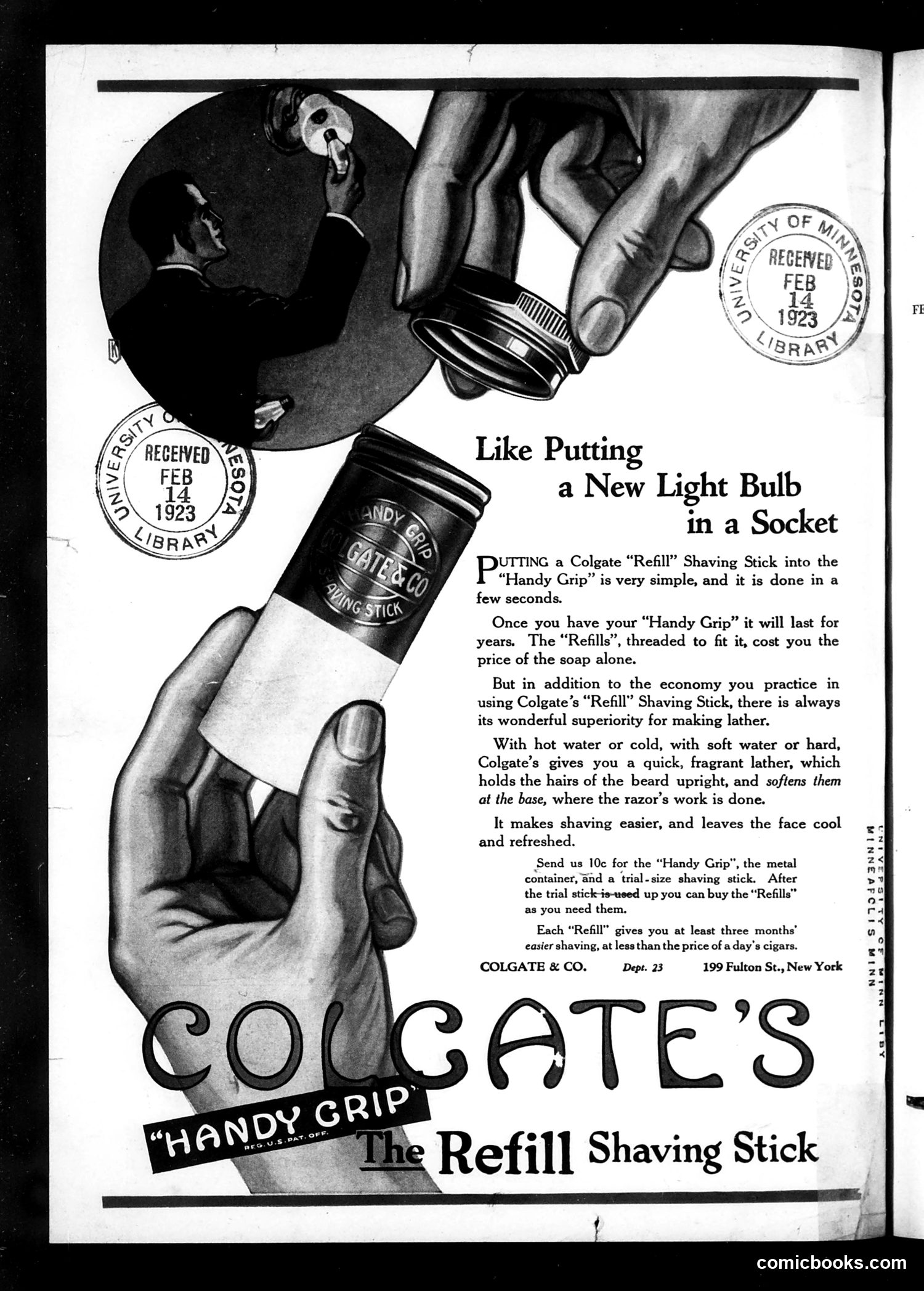
This is a **product advertisement**, not political satire or a cartoon. It promotes Colgate's "Handy Grip" refillable shaving stick, circa 1923 (per the library stamp). The page uses the metaphor stated in the headline—inserting a refill is "Like Putting a New Light Bulb in a Socket"—to illustrate the product's convenience. The imagery shows hands demonstrating the simple insertion mechanism. The marketing pitch emphasizes **economy**: you buy the metal grip once, then purchase inexpensive refills rather than full products. This was a novel selling point in early 20th-century consumer goods. The copy also highlights product benefits: superior lather, easier shaving, and leaving skin "cool and refreshed." A closing line compares the cost favorably to "a day's cigars"—suggesting the target audience was men with disposable income. There is no satire or hidden meaning; this is straightforward commercial advertising using the novelty of refillable design as a competitive advantage.