
Life, 1923-02-15 · page 10 of 36
Life — February 15, 1923 — page 10: what you’re looking at
What you’re looking at
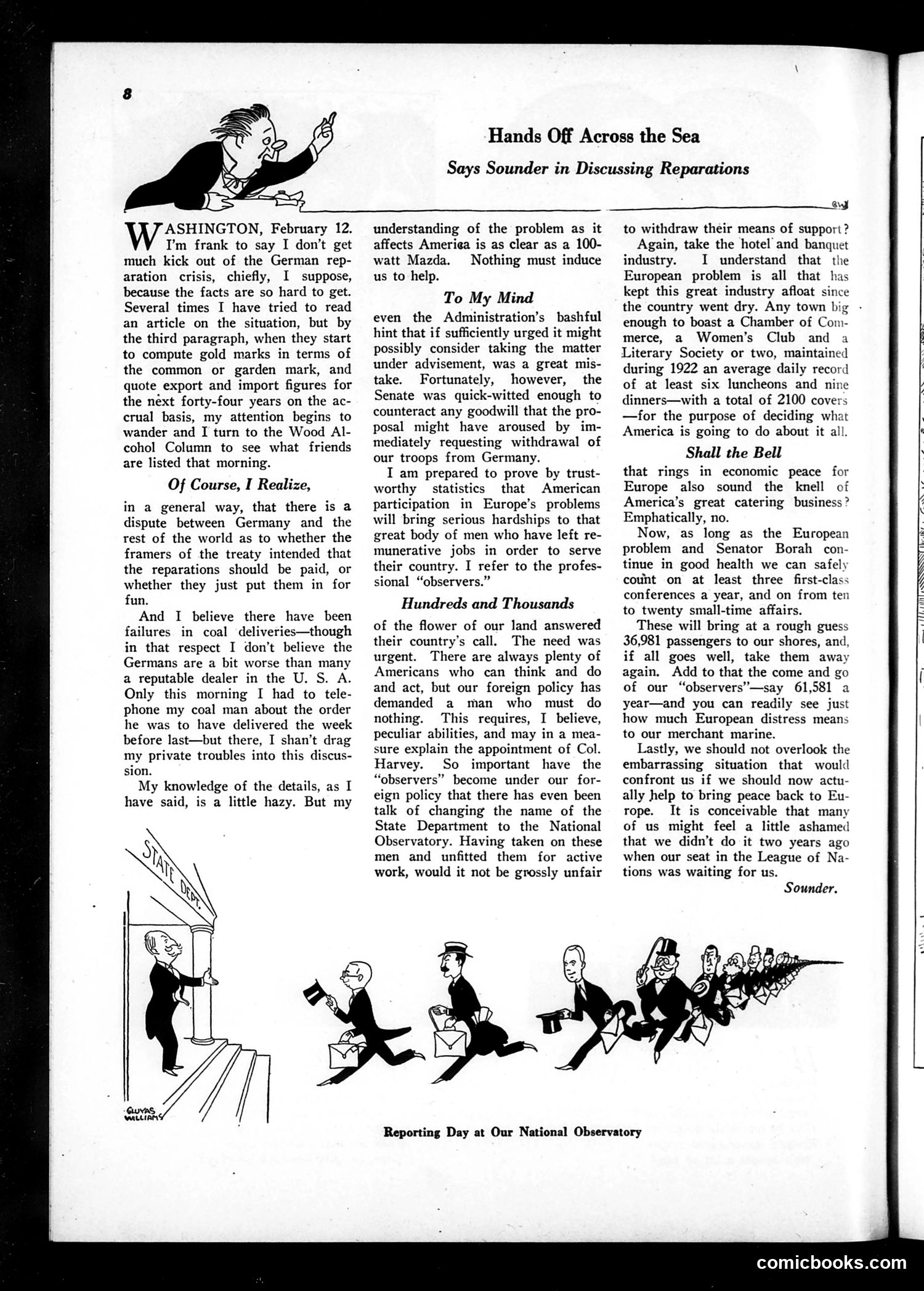
This page from *Life* magazine (dated February 12, based on the dateline) features political commentary by "Sounder" on German reparations after World War I. The main cartoon at bottom, titled "Reporting Day at Our National Observatory," depicts figures running frantically toward a building labeled "State Department," carrying documents and briefcases. This satirizes the chaos and urgency surrounding America's involvement in post-war European reparations negotiations. The article argues against American financial responsibility for German reparations, suggesting Europeans should resolve their own problems. Sounder criticizes the idea that America should "help" Europe economically, warning it could harm American business—particularly the hotel and catering industry, which depended on European tourism. The cartoon mocks the State Department's frantic activity over these diplomatic matters.
📄 Transcribed text from this page (OCR, searchable)
Machine-transcribed from the original scan — historical spelling and the odd misread are preserved.
ASHINGTON, February 12. I’m frank to say I don’t get much kick out of the German rep- aration crisis, chiefly, I suppose, because the facts are so hard to get. Several times I have tried to read an article on the situation, but by the third paragraph, when they start to compute gold marks in terms of the common or garden mark, and quote export and import figures for the next forty-four years on the ac- crual basis, my attention begins to wander and I turn to the Wood Al- cohol Column to see what friends are listed that morning. Of Course, I Realize, in a general way, that there is a dispute between Germany and the rest of the world as to whether the framers of the treaty intended that the reparations should be paid, or whether they just put them in for fun. And I believe there have been failures in coal deliveries—though in that respect I don’t believe the Germans are a bit worse than many a reputable dealer in the U. S. A. Only this morning I had to tele- phone my coal man about the order he was to have delivered the week before last—but there, I shan’t drag my private troubles into this discus- sion. My knowledge of the details, as I have said, is a little hazy. But my Hands Off Across the Sea Says Sounder in Discussing Reparations Si understanding of the problem as it affects Ameriga is as clear as a 100- watt Mazda. Nothing must induce us to help. To My Mind even the Administration’s bashful hint that if sufficiently urged it might possibly consider taking the matter under advisement, was a great mis- take. Fortunately, however, the Senate was quick-witted enough to counteract any goodwill that the pro- posal might have aroused by im- mediately requesting withdrawal of our troops from Germany. I am prepared to prove by trust- worthy statistics that American participation in Europe’s problems will bring serious hardships to that great body of men who have left re- munerative jobs in order to serve their country. I refer to the profes- sional “observers.” Hundreds and Thousands of the flower of our land answered their country’s call. The need was urgent. There are always plenty of Americans who can think and do and act, but our foreign policy has demanded a man who must do nothing. This requires, I believe, peculiar abilities, and may in a mea- sure explain the appointment of Col. Harvey. So important have the “observers” become under our for- eign policy that there has even been talk of changing the name of the State Department to the National Observatory. Having taken on these men and unfitted them for active work, would it not be grossly unfair to withdraw their means of support? Again, take the hotel and banquet industry. I understand that the European problem is all that has kept this great industry afloat since the country went dry. Any town big - enough to boast a Chamber of Com- merce, a Women’s Club and a Literary Society or two, maintained during 1922 an average daily record of at least six luncheons and nine dinners—with a total of 2100 covers —for the purpose of deciding what America is going to do about it all. Shall the Bell that rings in economic peace for Europe also sound the knell of America’s great catering business? Emphatically, no. Now, as long as the European problem and Senator Borah con- tinue in good health we can safely count on at least three first-class conferences a year, and on from ten to twenty small-time affairs. These will bring at a rough guess 36,981 passengers to our shores, and, if all goes well, take them away again. Add to that the come and go of our “observers”—say 61,581 a year—and you can readily see just how much European distress means to our merchant marine. Lastly, we should not overlook the embarrassing situation that would confront us if we should now actu- ally help to bring peace back to Eu- rope. It is conceivable that many of us might feel a little ashamed that we didn’t do it two years ago when our seat in the League of Na- tions was waiting for us. Sounder. Reporting Day at Our National Observatory comicbooks.com