
Life, 1923-02-15 · page 26 of 36
Life — February 15, 1923 — page 26: what you’re looking at
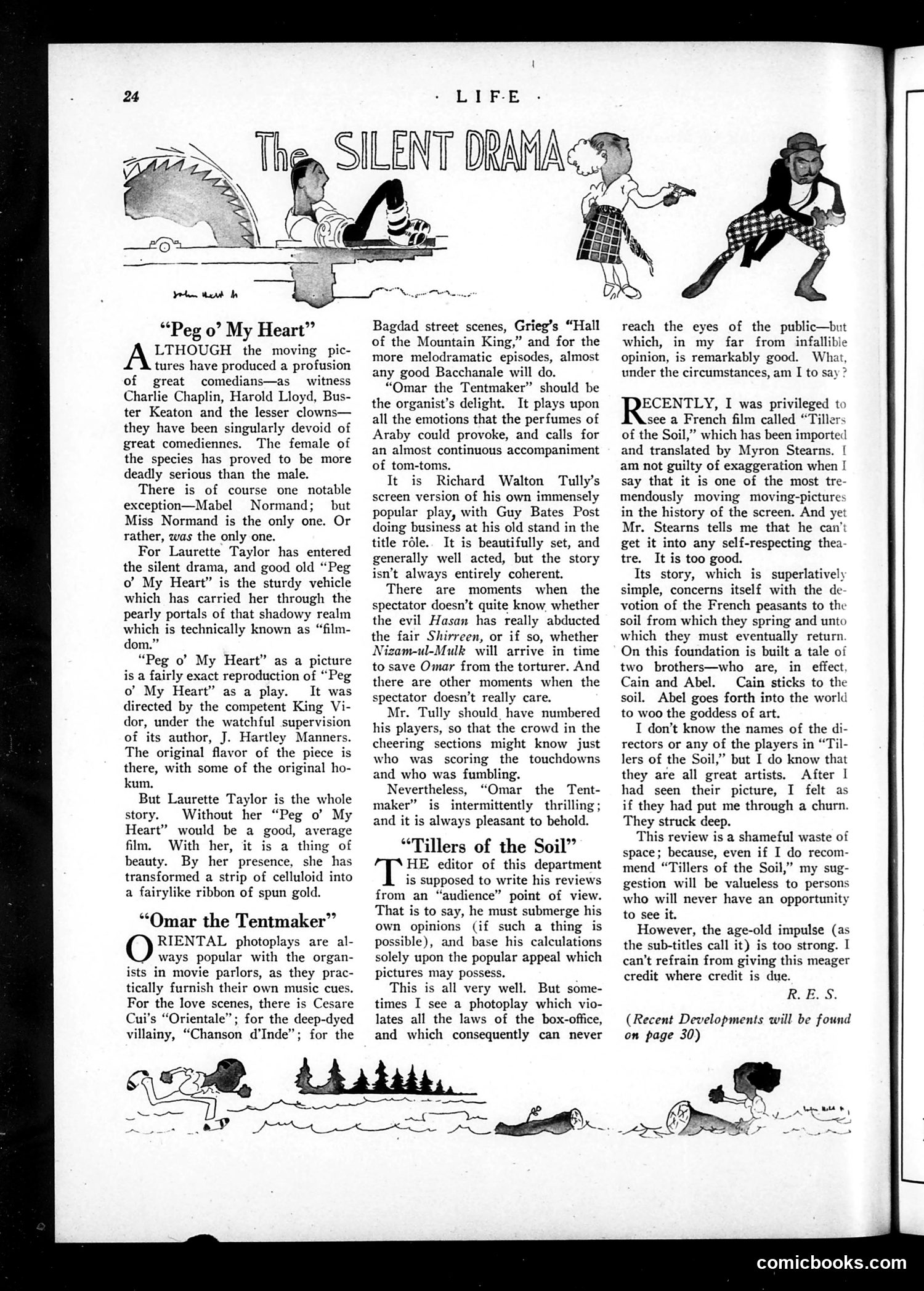
What you’re looking at
This page reviews three silent films from the early 1920s. The critic discusses **"Peg o' My Heart,"** praising actress Laurette Taylor as a rare female comedic talent in silent film (contrasting her with male stars like Chaplin and Keaton). He notes that female performers were generally "more deadly serious than the male." **"Omar the Tentmaker"** is reviewed as competently made but narratively confusing—the critic humorously suggests the director should have "numbered his players" so audiences could follow who was doing what, comparing it to a football game where spectators don't know "who was scoring the touchdowns." **"Tillers of the Soil,"** a French import, receives high praise but the reviewer laments it cannot find distribution because it's "too good"—implying quality films couldn't reach mainstream audiences if they lacked commercial appeal. The tension between artistic merit and box-office viability anchors his critique.
📄 Transcribed text from this page (OCR, searchable)
Machine-transcribed from the original scan — historical spelling and the odd misread are preserved.
/ os “Peg o’ My Heart” noes the moving pic- tures have produced a profusion of great comedians—as witness Charlie Chaplin, Harold Lloyd, Bus- ter Keaton and the lesser clowns— they have been singularly devoid of great comediennes. The female of the species has proved to be more deadly serious than the male. There is of course one notable exception—Mabel Normand; but Miss Normand is the only one. Or rather, was the only one. For Laurette Taylor has entered the silent drama, and good old “Peg o’ My Heart” is the sturdy vehicle which has carried her through the pearly portals of that shadowy realm which is technically known as “film- dom.” “Peg o’ My Heart” as a picture is a fairly exact reproduction of “Peg o’ My Heart” as a play. It was directed by the competent King Vi- dor, under the watchful supervision of its author, J. Hartley Manners. The original flavor of the piece is there, with some of the original ho- kum. But Laurette Taylor is the whole story. Without her “Peg o’ My Heart” would be a good, average film. With her, it is a thing of beauty. By her presence, she has transformed a strip of celluloid into a fairylike ribbon of spun gold. “Omar the Tentmaker” RIENTAL photoplays are al- ways popular with the organ- ists in movie parlors, as they prac- tically furnish their own music cues. For the love scenes, there is Cesare Cui’s “Orientale”; for the deep-dyed villainy, “Chanson d’Inde”; for the Ae, Bagdad street scenes, Grieg’s “Hall of the Mountain King,” and for the more melodramatic episodes, almost any good Bacchanale will do. “Omar the Tentmaker” should be the organist’s delight. It plays upon all the emotions that the perfumes of Araby could provoke, and calls for an almost continuous accompaniment of tom-toms. It is Richard Walton Tully’s screen version of his own immensely popular play, with Guy Bates Post doing business at his old stand in the title rdle.. It is beautifully set, and generally well acted, but the story isn’t always entirely coherent. There are moments when the spectator doesn’t quite know, whether the evil Hasan has really abducted the fair Shirreen, or if so, whether Nizam-ul-Mulk will arrive in time to save Omar from the torturer. And there are other moments when the spectator doesn’t really care. Mr. Tully should, have numbered his players, so that the crowd in the cheering sections might know just who was scoring the touchdowns and who was fumbling. Nevertheless, “Omar the Tent- maker” is intermittently thrilling; and it is always pleasant to behold. “Tillers of the Soil” HE editor of this department is supposed to write his reviews from an “audience” point of view. That is to say, he must submerge his own opinions (if such a thing is possible), and base his calculations solely upon the popular appeal which pictures may possess. This is all very well. But some- times I see a photoplay which vio- lates all the laws of the box-office, and which consequently can never reach the eyes of the public—but which, in my far from infallible opinion, is remarkably good. What, under the circumstances, am I to say? ECENTLY, I was privileged to see a French film called “Tillers of the Soil,” which has been imported and translated by Myron Stearns. [ am not guilty of exaggeration when | say that it is one of the most tre- mendously moving moving-pictures in the history of the screen. And yet Mr. Stearns tells me that he can't get it into any self-respecting thea- tre. It is too good. Its story, which is superlatively simple, concerns itself with the de votion of the French peasants to the soil from which they spring and unto which they must eventually return. On this foundation is built a tale of two brothers—who are, in effect, Cain and Abel. Cain sticks to the soil. Abel goes forth into the world to woo the goddess of art. I don’t know the names of the di- rectors or any of the players in “Til- lers of the Soil,” but I do know that they are all great artists. After I had seen their picture, I felt as if they had put me through a churn. They struck deep. This review is a shameful waste of space; because, even if I do recom- mend “Tillers of the Soil,” my sug- gestion will be valueless to persons who will never have an opportunity to see it. However, the age-old impulse (as the sub-titles call it) is too strong. I can’t refrain from giving this meager credit where credit is due. ROE..S. (Recent Developments will be found on page 30) comicbooks.com