
Life, 1923-02-15 · page 21 of 36
Life — February 15, 1923 — page 21: what you’re looking at
What you’re looking at
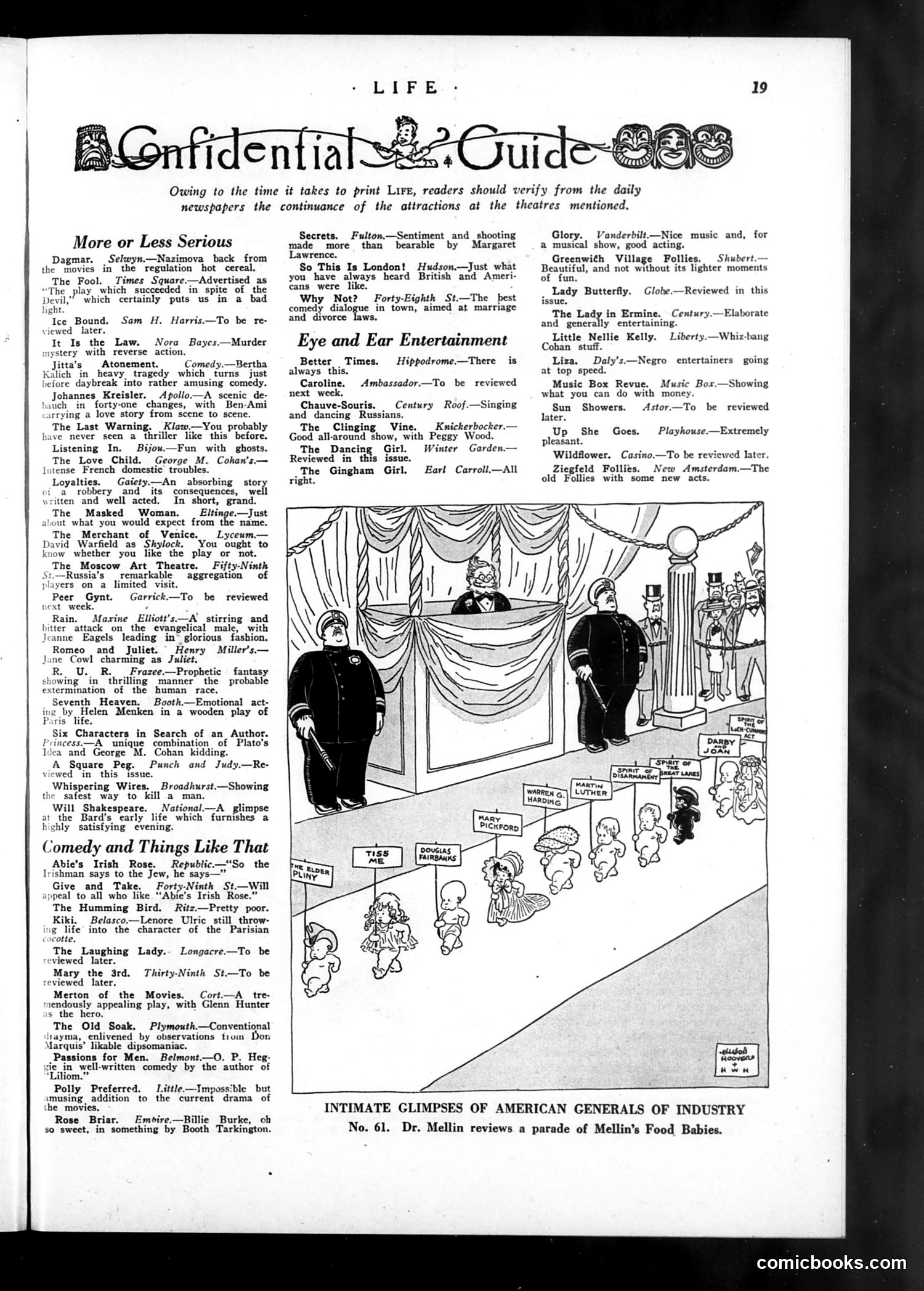
This page is primarily a **theater review guide** for Broadway shows in the 1920s, not a political cartoon. The main illustration shows **Dr. Mellin reviewing a parade of "Mellin's Food Babies"**—an advertisement for infant formula disguised as satirical commentary on the entertainment industry. The humor works on two levels: First, the parade of tiny uniformed figures labeled with actors' names suggests theater producers manufacture entertainment like a factory produces baby food. Second, it's a visual pun—these performers are treated as interchangeable "products" rather than artists. The satirical point: Broadway talent is mass-produced and standardized, much like commercial goods. The reviews themselves are acerbic one-liners mocking popular shows. For instance, *Abie's Irish Rose* is parodied as derivative ethnic humor, while *R.U.R.* is noted as "prophetic" (likely referencing its early science-fiction warning about technological replacement of humans). The page reflects 1920s cultural anxieties about commercialization and standardization infiltrating American art and industry.
📄 Transcribed text from this page (OCR, searchable)
Machine-transcribed from the original scan — historical spelling and the odd misread are preserved.
Owing to the time it takes to print Lire, readers should verify from the daily newspapers the continuance of the attractions at the theatres mentioned, More or Less Serious Dagmar. Selwyn.—Nazimova back from the movies in the regulation hot cereal. The Fool. Times Square.—Advertised as “The play which succeeded in spite of the Devil,” which certainly puts us in a bad light. Ice Bound. viewed later. It Is the Law. Nora Baycs.—Murder .ystery with reverse action. Jitta’s Atonement. Comedy.—Bertha Kalich in heavy tragedy which turns just ‘efore daybreak into rather amusing comedy. Johannes Kreisler. Apollo.—A scenic de- hauch in forty-one changes, with Ben-Ami srrying a love story from scene to scene. The Last Warning. Klaw.—You probably have never seen a thriller like this before. Listening In. Bijou.—Fun with ghosts. The Love Child. George M. Cohan’s.— Intense French domestic troubles. Loyalties. Gaiety—An absorbing stor cf a robbery and its consequences, well \ritten and well acted. In short, grand. The Masked Woman. _ Eltinge.—Just about what you would expect from the name. The Merchant of Venice. Lyceum— David Warfield as Shylock. You ought to know whether you like the play or not. The Moscow Art Theatre. Fifty-Ninth St.—Russia’s remarkable aggregation of players on a limited visit. Peer Gynt. Garrick.—To be next week. : Rain. Maxine Elliott’s—A stirring and bitter attack on the evangelical male, with Jeanne Eagels leading in’ glorious fashion. Romeo and Juliet. Henry Miller’s.— Jane Cowl charming as Juliet. R. U.. R. | Frazee—Prophetic showing ‘in thrilling manner the extermination of the human race. Seventh Heaven. Booth.—Emotional act- ii gen Menken in a wooden play of Paris’ life. Six Characters in Search of an_ Author. Princess.—A unique combination of Plato's Idea and George M. Cohan kidding. Sam H. Harris.—To be re- reviewed fantasy probable A Square Peg. wed in this issue. Whispering Wires. he safest way to kill a man. Punch and Judy.—Re- Broadhurst.—Showing Will Shakespeare. National. A_ glimpse the Bard’s early life which furnishes a hly satisfying evening. Comedy and Things Like That Abie’s Irish Rose. Republic.—‘So the rishman says to the Jew, he says—” Give and Take, Forty-Ninth St.—Will appeal to all who like “‘Abie’s Irish Rose.” The Humming Bird. Rits.—Pretty poor. Kiki. Belasco—Lenore Ulric still, throw- g life into the character of the Parisian rcotte. The Laughing Lady. viewed later. Mary the 3rd. reviewed later. Merton of the Movies. Cort.—A tre- xendously appealing play, with Glenn Hunter s the hero. The Old Soak. Plymouth.—Conventional tayma, enlivened by observations trum Don Marquis’ likable dipsomaniac. Passions for Men. Belmont—O. P. Heg- in well-written comedy by the author of Liliom.’ Polly Preferred. Little. —T sible but ‘musing addition to the current drama of he movies. Rose Briar. Embire.—Billie Bur! so sweet, in something by Booth Tarki Longacre.—To be Thirty-Ninth St—To be Secrets. made more Lawrence. So This Is London! Hudson.—Just what you have always heard British and Ameri- cans were like. Why Not? Forty-Eighth St.—The best comedy dialogue in town, aimed at marriage and divorce laws. Eye and Ear Entertainment Better Times. always this. Caroline. next week. Chauve-Souris. Century Roof.—Singing and dancing Russians. The Clinging Vine. _Knickerbocker.— Good all-around show, with Peggy Wood. The Dancing Girl. Winter Garden.— Reviewed in this issue. The Gingham Girl. right. Fulton,—Sentiment and shooting than bearable by Margaret Hippodrome.—There is Ambassador.—To be reviewed Earl Carroll.—All Glory. Vanderbilt.—Nice music and, for a musical show, good acting. Greenwith Village Follies. Shubert: Beautiful, and not without its lighter moments of fun. , Lady Butterfly. issue. The Lady in Ermine. Century.—Elaborate and generally entertaining. Little Nellie Kelly. Liberty.—Whiz-bang Cohan stuff. Liza. Daly’s.—Negro entertainers going at top speed. Music Box Revue. Music Box. what you can do with money. Sun Showers. Astor.—To be reviewed later. Up She pleasant. Wildflower. Casino.—To be reviewed later. Ziegfeld Follies. New Amsterdam.—The old Follies with some new acts. Globe.—Reviewed in this Showing Goes. Playhouse.—Extremely INTIMATE GLIMPSES OF AMERICAN GENERALS OF INDUSTRY No. 61. Dr. Mellin reviews a parade of Mellin’s Food Babies. comicbooks.com