
Life, 1923-02-15 · page 25 of 36
Life — February 15, 1923 — page 25: what you’re looking at
What you’re looking at
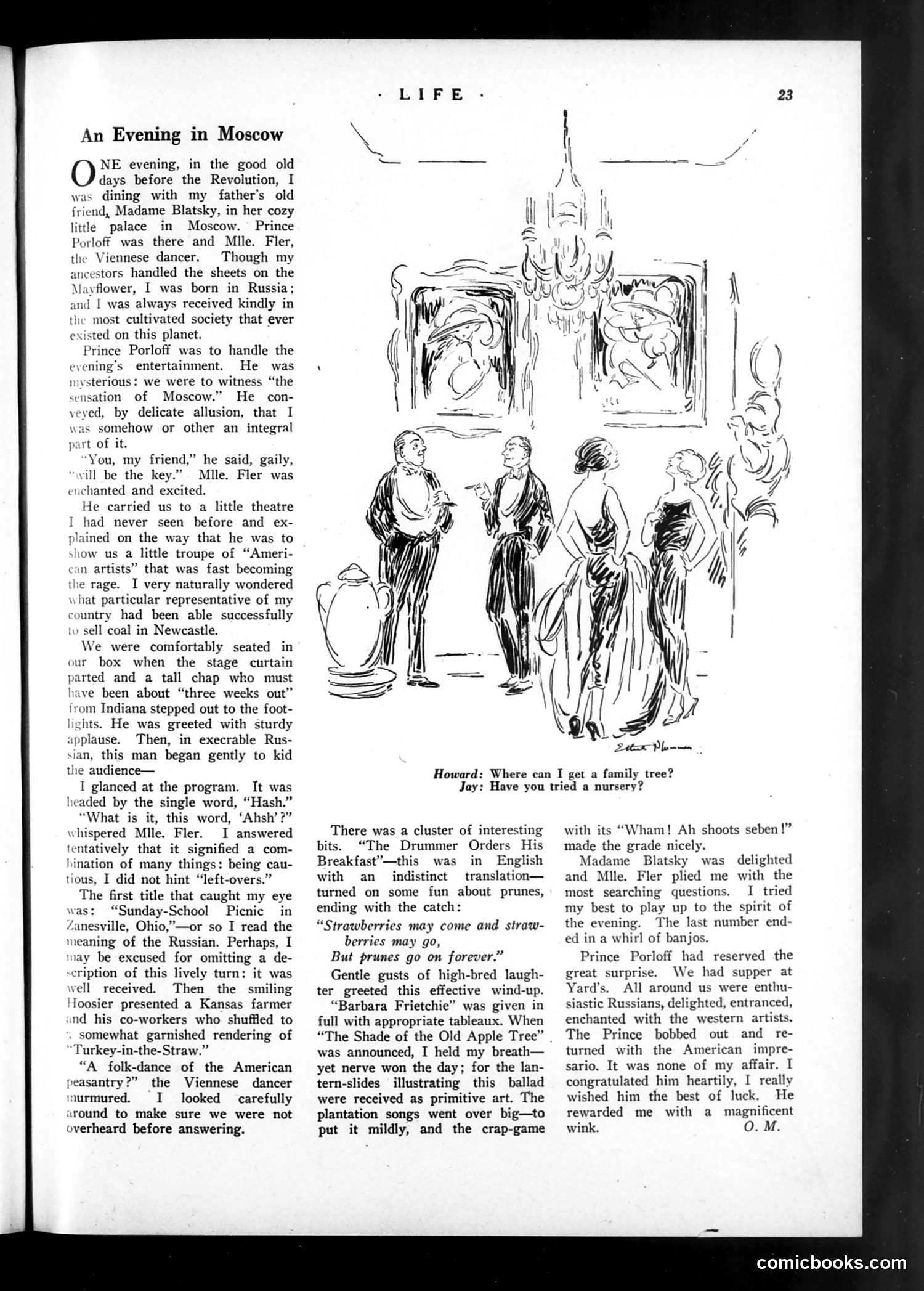
This humorous essay mocks Russian fascination with American popular culture in pre-Revolutionary Moscow. The narrator, descended from Russian nobility but American-born, attends an exclusive salon where a visiting American impresario presents vaudeville-style entertainment to wealthy Russian aristocrats. The satire targets two audiences: Russians who treat crude American acts (folk dances, sentimental ballads, minstrel songs) as high art worthy of sophisticated appreciation, and Americans who peddle this entertainment abroad as cultural exports. The joke is the cultural inversion—what ordinary Americans recognize as lowbrow entertainment ("Turkey in the Straw," crap-game numbers) becomes "primitive art" to Moscow's elite. The cartoon illustration shows well-dressed Russians and Westerners in an ornate palace setting, visualizing the clash between refined European salon culture and American variety-show entertainment. The byline "O.M." suggests authorship, though the writer's identity isn't definitively stated in visible text.
📄 Transcribed text from this page (OCR, searchable)
Machine-transcribed from the original scan — historical spelling and the odd misread are preserved.
An Evening in Moscow NE evening, in the good old days before the Revolution, I was dining with my father’s old friend, Madame Blatsky, in her cozy little palace in Moscow. Prince Porloff was there and Mlle. Fler, the Viennese dancer. Though my ancestors handled the sheets on the fower, I was born in Russia; and | was always received kindly in the most cultivated society that ever existed on this planet. Prince Porloff was to handle the evening’s entertainment. He was mysterious: we were to witness “the sensation of Moscow.” He con- yeyed, by delicate allusion, that I was somehow or other an integral part of it. ‘You, my friend,” he said, gaily, vill be the key.” Mlle. Fler was enchanted and excited. He carried us to a little theatre I had never seen before and ex- plained on the way that he was to show us a little troupe of “Ameri- im artists” that was fast becoming ve rage. I very naturally wondered vhat particular representative of my country had been able successfully to sell coal in Newcastle. We were comfortably seated in our box when the stage curtain parted and a tall chap who must have been about “three weeks out” irom Indiana stepped out to the foot- lights. He was greeted with sturdy applause. Then, in execrable Rus- sian, this man began gently to kid the audience— I glanced at the program. It was headed by the single word, “Hash.” “What is it, this word, ‘Ahsh’?” whispered Mlle. Fler. I answered tentatively that it signified a com- hination of many things: being cau- tious, I did not hint “left-overs.” The first title that caught my eye : “Sunday-School Picnic in esville, Ohio,”—or so I read the meaning of the Russian. Perhaps, I may be excused for omitting a de- cription of this lively turn: it was vell received. Then the smiling Hoosier presented a Kansas farmer ind his co-workers who shuffled to . somewhat garnished rendering of Turkey-in-the-Straw.” “A folk-dance of the American peasantry?” the Viennese dancer murmured. I looked carefully around to make sure we were not overheard before answering. Howard: Where can I get a family tree? Jay: Have you tried a nursery? There was a cluster of interesting bits. “The Drummer Orders His Breakfast”—this was in English with an indistinct translation— turned on some fun about prunes, ending with the catch: “Strawberries may come and straw- berries may go, But prunes go on forever.” Gentle gusts of high-bred laugh- ter greeted this effective wind-up. “Barbara Frietchie” was given in full with appropriate tableaux. When “The Shade of the Old Apple Tree” was announced, I held my breath— yet nerve won the day; for the lan- tern-slides illustrating this ballad were received as primitive art. The plantation songs went over big—to put it mildly, and the crap-game with its “Wham! Ah shoots seben!” made the grade nicely. Madame Blatsky was delighted and Mlle. Fler plied me with the most searching questions. I tried my best to play up to the spirit of the evening. The last number end- ed in a whirl of banjos. Prince Porloff had reserved the great surprise. We had supper at Yard’s. All around us were enthu- iastic Russians, delighted, entranced, enchanted with the western artists. The Prince bobbed out and re- turned with the American impre- sario. It was none of my affair. I congratulated him heartily, I really wished him the best of luck. He rewarded me with a magnificent wink. 0. M. sias comicbooks.com