
Life, 1923-02-15 · page 15 of 36
Life — February 15, 1923 — page 15: what you’re looking at
What you’re looking at
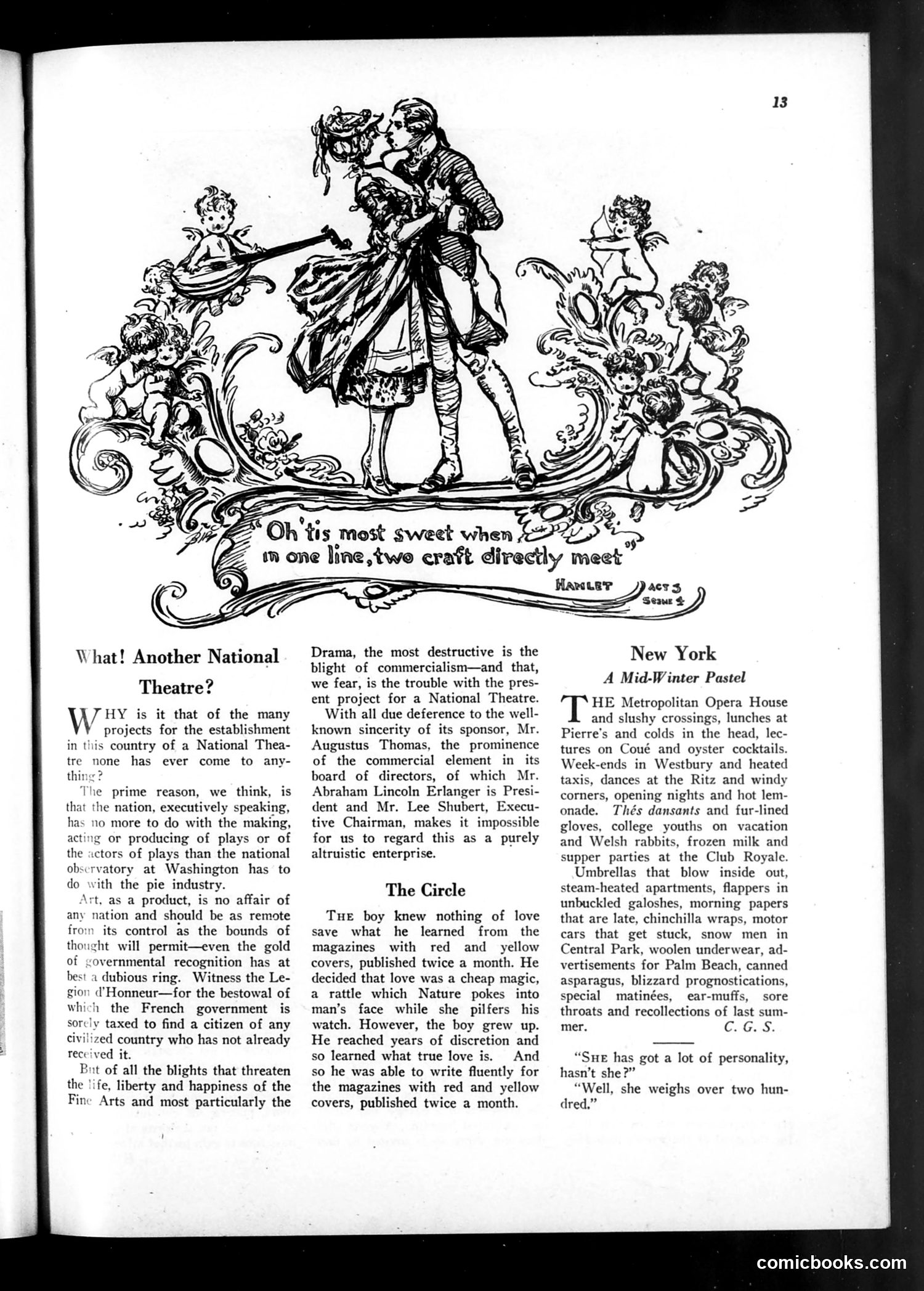
The illustrated header depicts a scene from *Hamlet* (Act 3, Scene 2), showing the famous line "Oh 'tis most sweet when in one line, two craft directly meet." The image shows a man in period dress holding a woman aloft while cherubs and ornamental flourishes surround them—a romanticized theatrical moment. Below, the text discusses a proposed National Theatre for America. The author argues such projects fail because they become controlled by commercial interests rather than artistic ones. Specifically, the article criticizes the current National Theatre proposal, noting that its board includes businessmen like Augustus Thomas and Abraham Lincoln Erlanger, whose commercial priorities allegedly undermine the project's artistic integrity. The *Hamlet* quote appears ironic—suggesting duplicity in the theatrical establishment itself.
📄 Transcribed text from this page (OCR, searchable)
Machine-transcribed from the original scan — historical spelling and the odd misread are preserved.
LZ m one line,twe craft direct WAS What! Another National Theatre? W HY is it that of the many projects for the establishment in this country of a National Thea- tre none has ever come to any- ie prime reason, we think, is the nation, executively speaking, s no more to do with the making, ing or producing of plays or of e actors of plays than the national crvatory at Washington has to ith the pie industry. rt, as a product, is no affair of nation and should be as remote n its control as the bounds of ight will permit—even the gold overnmental recognition has at i dubious ring. Witness the Le- 1 d’Honneur—for the bestowal of ich the French government is ly taxed to find a citizen of any lized country who has not already ved it. snt of all the blights that threaten fe, liberty and happiness of the Arts and most particularly the Drama, the most destructive is the blight of commercialism—and that, we fear, is the trouble with the pres- ent project for a National Theatre. With all due deference to the well- known sincerity of its sponsor, Mr. Augustus Thomas, the prominence of the commercial element in its board of directors, of which Mr. Abraham Lincoln Erlanger is Presi- dent and Mr. Lee Shubert, Execu- tive Chairman, makes it impossible for us to regard this as a purely altruistic enterprise. The Circle Tue boy knew nothing of love save what he learned from the magazines with red and yellow covers, published twice a month. He decided that love was a cheap magic, a rattle which Nature pokes into man’s face while she pilfers his watch. However, the boy grew up. He reached years of discretion and so learned what true love is. And so he was able to write fluently for the magazines with red and yellow covers, published twice a month. pono ly meet Harner —— ars SF ‘Seaue ry) New York A Mid-Winter Pastel HE Metropolitan Opera House and slushy crossings, lunches at Pierre's and colds in the head, lec- tures on Coué and oyster cocktails. Week-ends in Westbury and heated taxis, dances at the Ritz and windy corners, opening nights and hot lem- onade. Thés dansants and fur-lined gloves, college youths on vacation and Welsh rabbits, frozen milk and supper parties at the Club Royale. Umbrellas that blow inside out, steam-heated apartments, flappers in unbuckled galoshes, morning papers that are late, chinchilla wraps, motor cars that get stuck, snow men in Central Park, woolen underwear, ad- vertisements for Palm Beach, canned asparagus, blizzard prognostications, special matinées, ear-muffs, sore throats and recollections of last sum- mer. C..G.S. “SHE has got a lot of personality, hasn’t she?” “Well, she weighs over two hun- dred.” comicbooks.com