
Life, 1923-02-15 · page 20 of 36
Life — February 15, 1923 — page 20: what you’re looking at
What you’re looking at
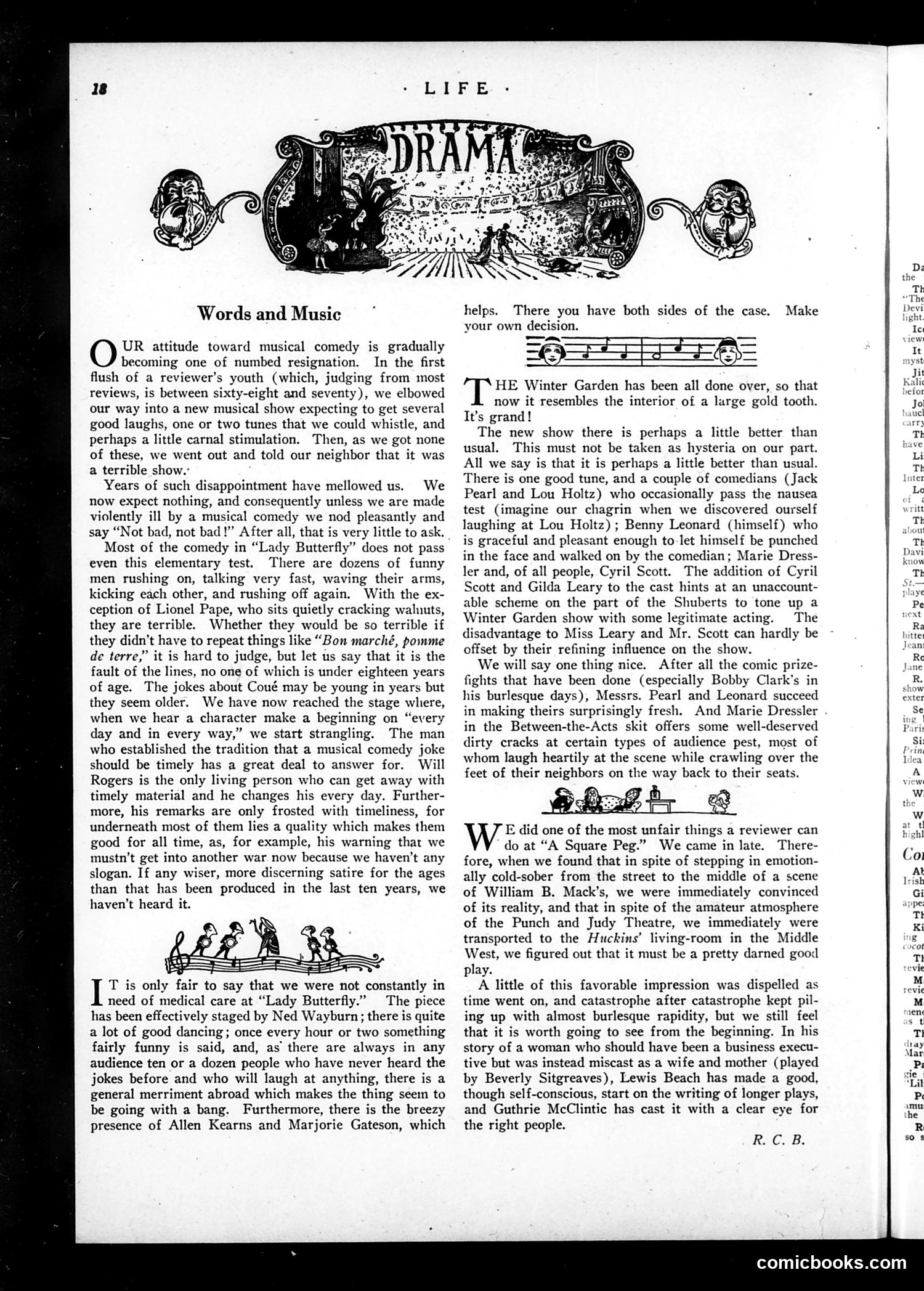
This is a theater review column criticizing musical comedies of the era (appears to be 1920s based on references). The critic expresses jaded resignation toward the genre, having become numb to poor quality shows. The review skewers "Lady Butterfly" for relying on tired, ancient jokes—specifically mentioning worn-out references to Coué (a self-help fad) and the phrase "every day and in every way" (Coué's famous mantra). The critic contrasts this with Will Rogers, praising him as the only performer who successfully delivers timely material while maintaining lasting appeal. Reviewing another show at the Winter Garden, the critic offers backhanded compliments about its "perhaps a little better than usual" quality. Notable performers mentioned include Jack Pearl, Lou Holtz, and Marie Dressler, with sardonic observations about casting choices and their effectiveness. The overall satire targets the stagnation of musical comedy writing and the desperation of audiences who laugh at anything, while acknowledging good performances occasionally emerge despite poor material.
📄 Transcribed text from this page (OCR, searchable)
Machine-transcribed from the original scan — historical spelling and the odd misread are preserved.
Words and Music UR attitude toward musical comedy is gradually becoming one of numbed resignation. In the first flush of a reviewer’s youth (which, judging from most reviews, is between sixty-eight and seventy), we elbowed our way into a new musical show expecting to get several good laughs, one or two tunes that we could whistle, and perhaps a little carnal stimulation. Then, as we got none of these, we went out and told our neighbor that it was a terrible show.’ Years of such disappointment have mellowed us. We now expect nothing, and consequently unless we are made violently ill by a musical comedy we nod pleasantly and say “Not bad, not bad!” After all, that is very little to ask. Most of the comedy in “Lady Butterfly” does not pass even this elementary test. There are dozens of funny men rushing on, talking very fast, waving their arms, kicking each other, and rushing off again. With the ex- ception of Lionel Pape, who sits quietly cracking walnuts, they are terrible. Whether they would be so terrible if they didn’t have to repeat things like “Bon marché, pomme de terre,” it is hard to judge, but let us say that it is the fault of the lines, no one of which is under eighteen years of age. The jokes about Coué may be young in years but they seem older. We have now reached the stage where, when we hear a character make a beginning on “every day and in every way,” we start strangling. The man who established the tradition that a musical comedy joke should be timely has a great deal to answer for. Will Rogers is the only living person who can get away with timely material and he changes his every day. Further- more, his remarks are only frosted with timeliness, for underneath most of them lies a quality which makes them good for all time, as, for example, his warning that we mustn’t get into another war. now because we haven't any slogan. If any wiser, more discerning satire for the ages than that has been produced in the last ten years, we haven't heard it. need of medical care at “Lady Butterfly.” The piece has been effectively staged by Ned Wayburn; there is quite a lot of good dancing; once every hour or two something fairly funny is said, and, as there are always in any audience ten or a dozen people who have never heard the jokes before and who will laugh at anything, there is a general merriment abroad which makes the thing seem to be going with a bang. Furthermore, there is the breezy presence of Allen Kearns and Marjorie Gateson, which helps. There you have both sides of the case. Make your own decision. HE Winter Garden has been all done over, so that now it resembles the interior of a large gold tooth. It’s grand! The new show there is perhaps a little better than usual. This must not be taken as hysteria on our part. All we say is that it is perhaps a little better than usual. There is one good tune, and a couple of comedians (Jack Pearl and Lou Holtz) who occasionally pass the nausea test (imagine our chagrin when we discovered ourself laughing at Lou Holtz); Benny Leonard (himself) who is graceful and pleasant enough to let himself be punched in the face and walked on by the comedian; Marie Dress- ler and, of all people, Cyril Scott. The addition of Cyril Scott and Gilda Leary to the cast hints at an unaccount- able scheme on the part of the Shuberts to tone up a Winter Garden show with some legitimate acting. The disadvantage to Miss Leary and Mr. Scott can hardly be offset by their refining influence on the show. We will say one thing nice. After all the comic prize- fights that have been done (especially Bobby Clark’s in his burlesque days), Messrs. Pearl and Leonard succeed in making theirs surprisingly fresh. And Marie Dressler in the Between-the-Acts skit offers some well-deserved dirty cracks at certain types of audience pest, most of whom laugh heartily at the scene while crawling over the feet of their neighbors on the way back to their seats. E did one of the most unfair things a reviewer can do at “A Square Peg.” We came in late. There- fore, when we found that in spite of stepping in emotion- ally cold-sober from the street to the middle of a scene of William B. Mack’s, we were immediately convinced of its reality, and that in spite of the amateur atmosphere of the Punch and Judy Theatre, we immediately were transported to the Huckins’ living-room in the Middle West, we figured out that it must be a pretty darned good play. A little of this favorable impression was dispelled as time went on, and catastrophe after catastrophe kept pil- ing up with almost burlesque rapidity, but we still feel that it is worth going to see from the beginning. In his story of a woman who should have been a business execu- tive but was instead miscast as a wife and mother (played by Beverly Sitgreaves), Lewis Beach has made a good, though self-conscious, start on the writing of longer plays, and Guthrie McClintic has cast it with a clear eye for the right people. RCC B. comicbooks.com