
A complete issue · 40 pages · 1923
Life — February 1, 1923
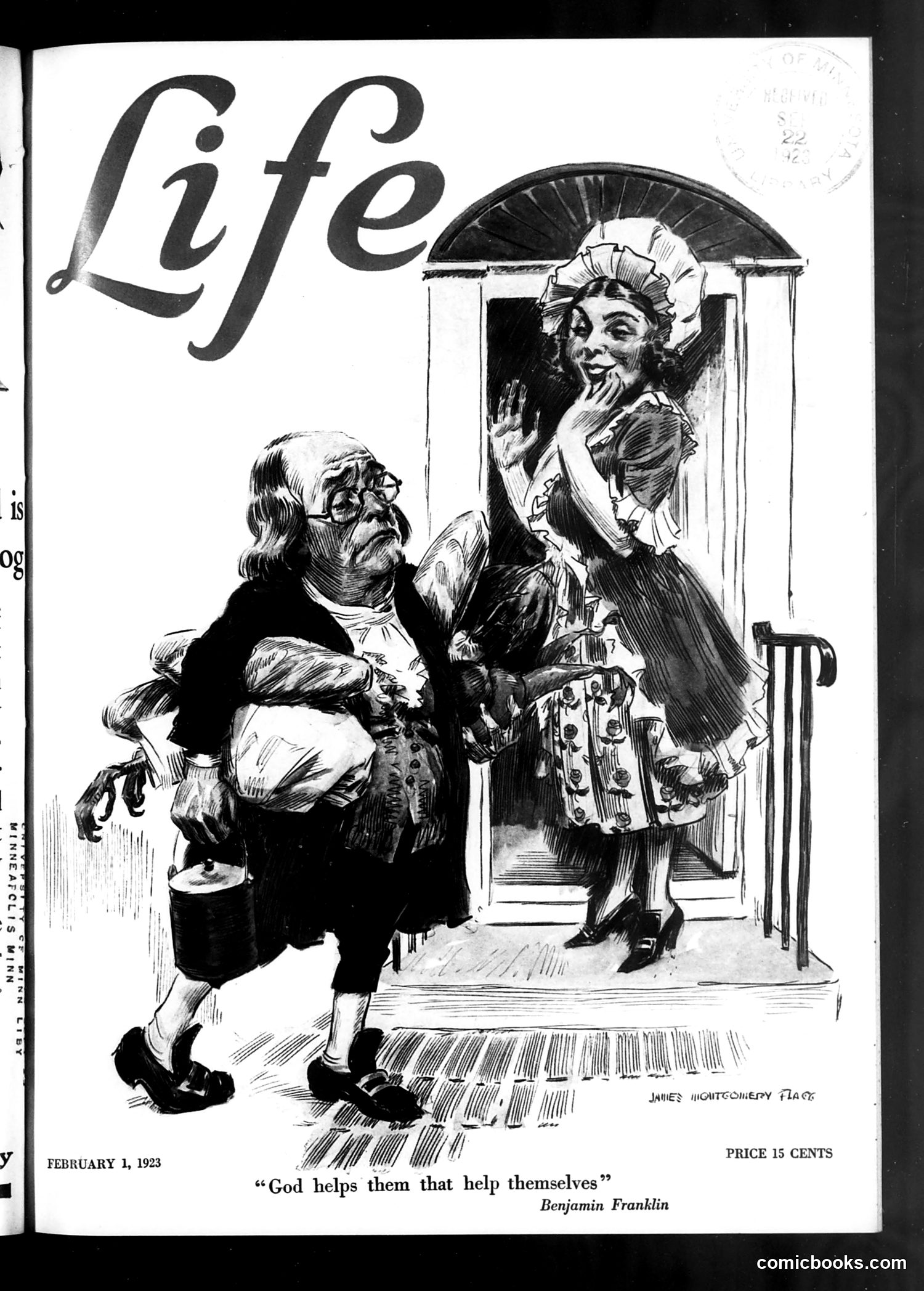
This satirical cartoon illustrates Benjamin Franklin's maxim "God helps them that help themselves." The scene depicts a portly, elderly man (appearing to represent an older generation or establishment figure) watching from inside a doorway as a woman in fashionable 1920s dress—with bobbed hair and a cloche hat—departs or arrives. The joke likely critiques the "modern woman" of the Jazz Age, who embodied new independence and social freedoms that shocked traditional society. The contrast between the disapproving older figure and the confident, stylish younger woman suggests generational tension over changing social values. The Franklin quote implies the younger generation's self-reliance, whether viewed approvingly or critically, was the natural consequence of their determination to shape their own lives.
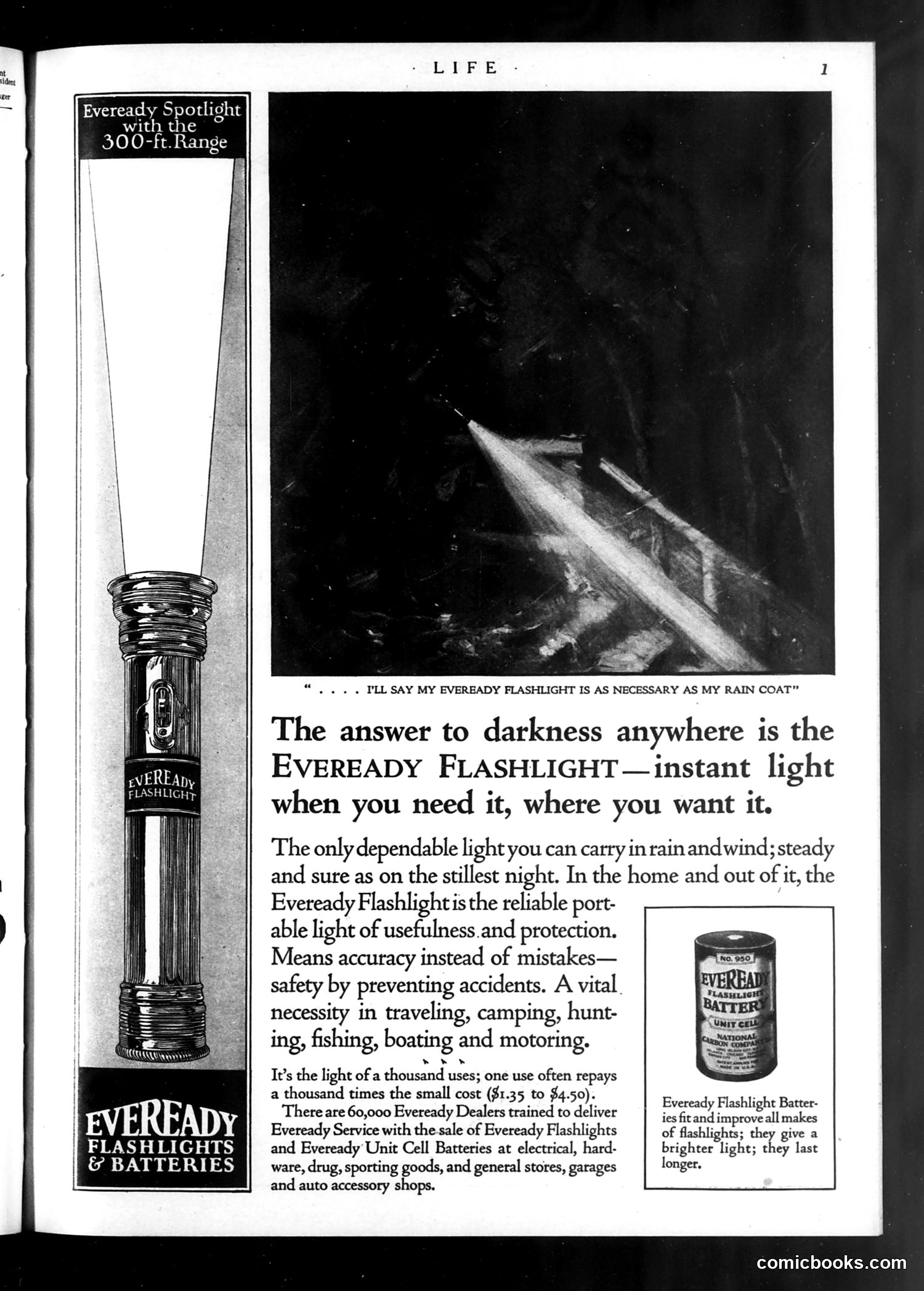
This page is **primarily an advertisement**, not satirical content. It promotes Eveready Flashlights & Batteries, featuring a large product image on the left showing a spotlight beam with the "300-ft. Range" specification. The advertisement uses a testimonial quote—"I'll say my Eveready flashlight is as necessary as my rain coat"—to establish the product's reliability. The marketing copy emphasizes practical utility: the flashlight provides "instant light when you need it" for home, camping, hunting, and travel. There is **no political satire or cartoon commentary** on this page. The dramatic nighttime photograph showing the flashlight beam cutting through darkness is purely illustrative advertising meant to demonstrate product effectiveness to potential consumers.
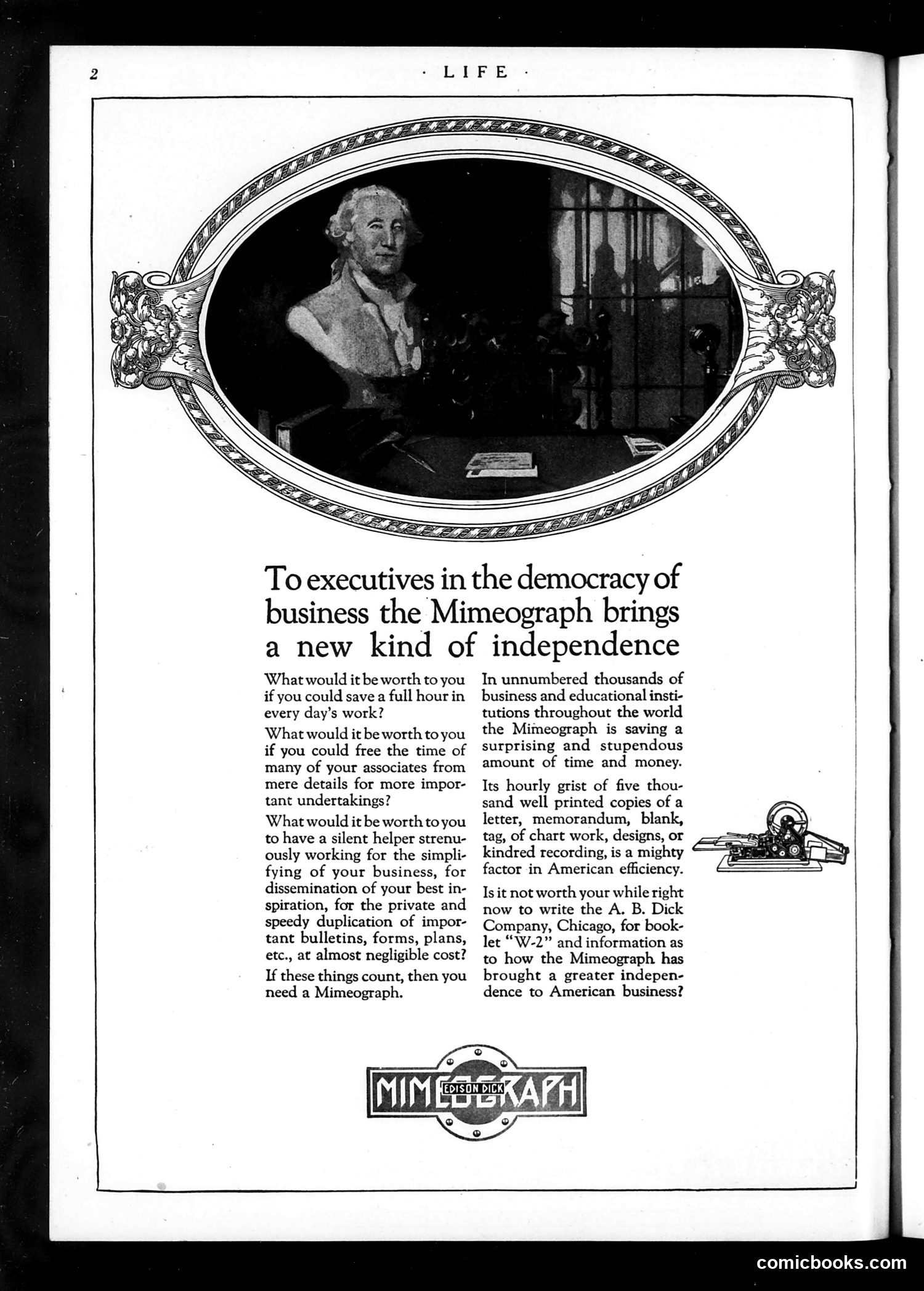
This is **advertising, not satire or editorial content**. It's a full-page promotional piece for the Mimeograph machine by A.B. Dick Company. The page uses a bust sculpture (appearing to depict a businessman or industrialist, though unidentified) framed ornamentally to appeal to executives. The ad's pitch emphasizes how mimeographs increase business efficiency by rapidly duplicating documents—letters, memos, forms, plans—at minimal cost. The "democracy of business" framing suggests democratizing access to professional document reproduction, previously expensive or time-consuming. The repeated rhetorical questions target busy executives by quantifying time-savings. This reflects early 20th-century industrial-era marketing: positioning new office technology as essential to American business competitiveness and employee productivity.
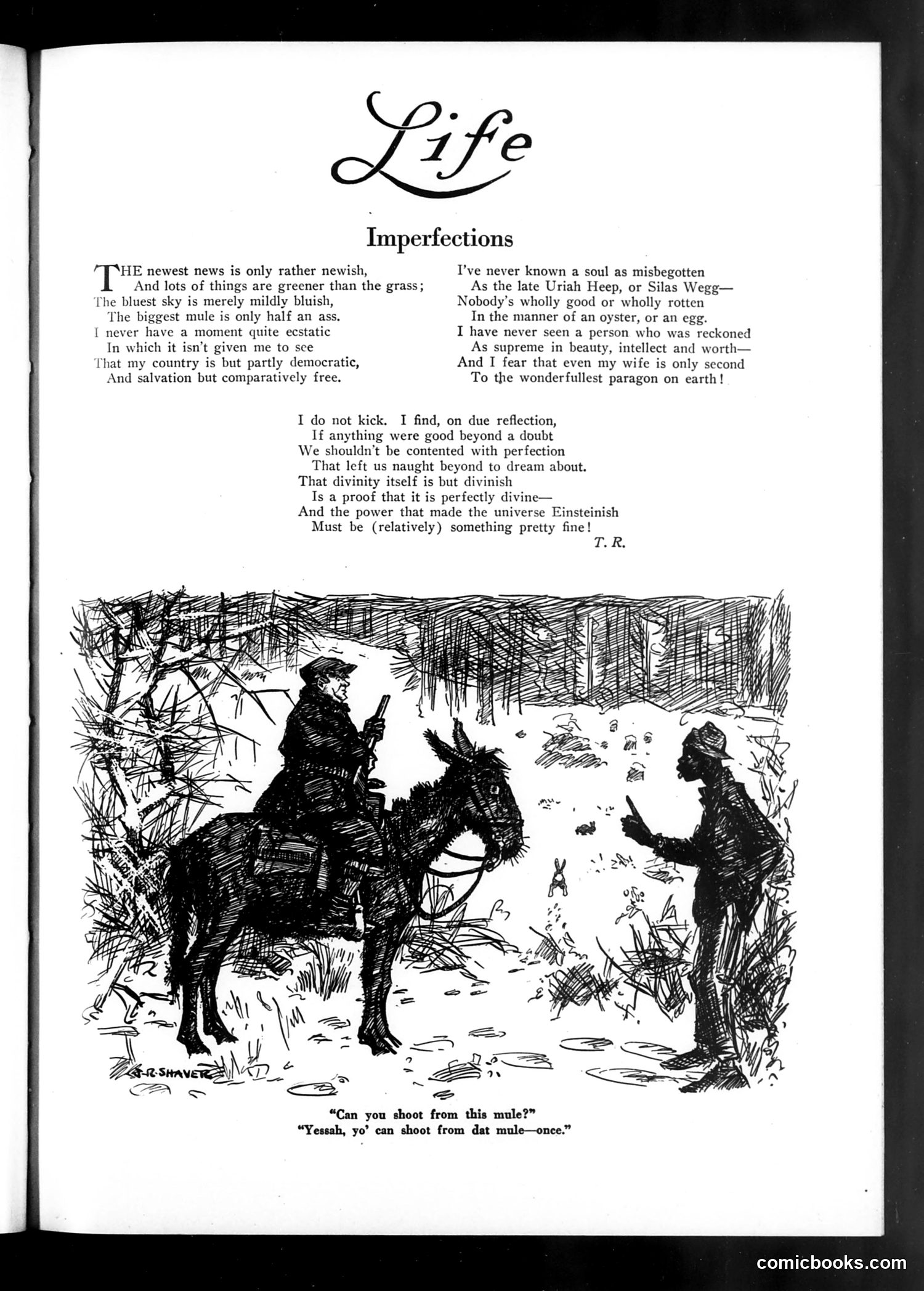
The poem "Imperfections" by T.R. uses self-deprecating humor to critique American society. The author claims ignorance about politics, accepts that democracy is "partly" democratic, and jests that his wife represents "the wonderfullest paragon on earth"—suggesting she's actually quite flawed. The cartoon below depicts a soldier on a mule encountering another soldier. The caption reads: "Can you shoot from this mule?" / "Yessuh, yo' can shoot from dat mule—once." This appears to be military humor about the unpredictability and bucking nature of mules during wartime. The dialect suggests this references American military experience, possibly WWI-era. The joke's point: attempting to shoot from a mule is impractical because the animal will immediately throw its rider.
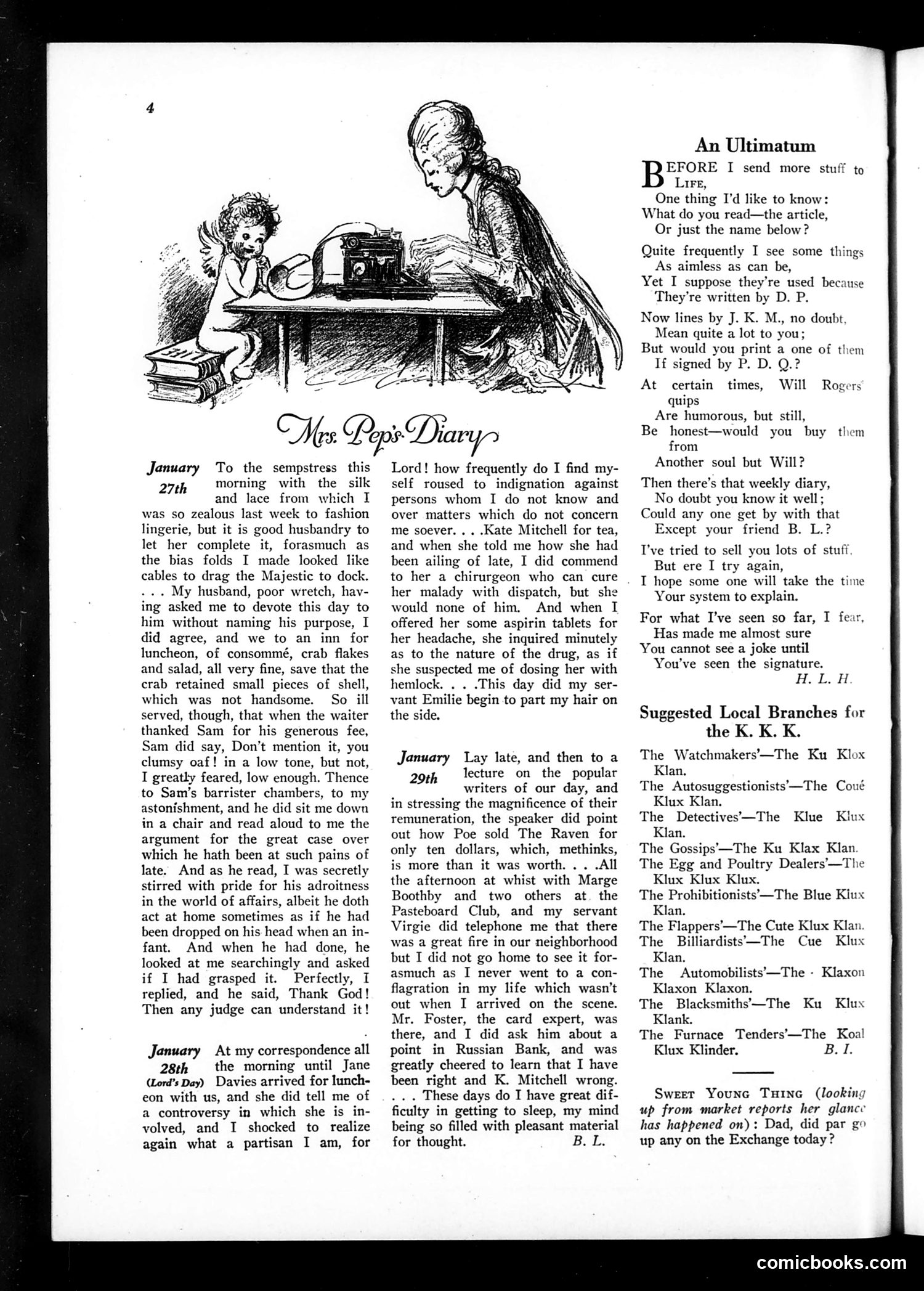
The main cartoon illustrates "Mrs. Pep's Diary," a fictional society column featuring domestic life commentary. The sketch shows a woman at a typewriter with a cherub-like figure (representing inspiration or muse), depicting the creation of gossip content. The diary entries mock upper-class pretension and social hypocrisy—complaining about servants, fashion dilemmas, and trivial social events while claiming moral superiority. The "Ultimatum" poem critiques editorial practices, questioning whether unsigned pieces by pseudonymous writers (like "D.P." or "J.K.M.") should be published. The page also lists satirical "K.K.K." branches—actually mocking various social groups (watchmakers, gossips, detectives) using absurdist wordplay, likely satirizing contemporary social anxieties or fads rather than directly referencing the actual Klan.
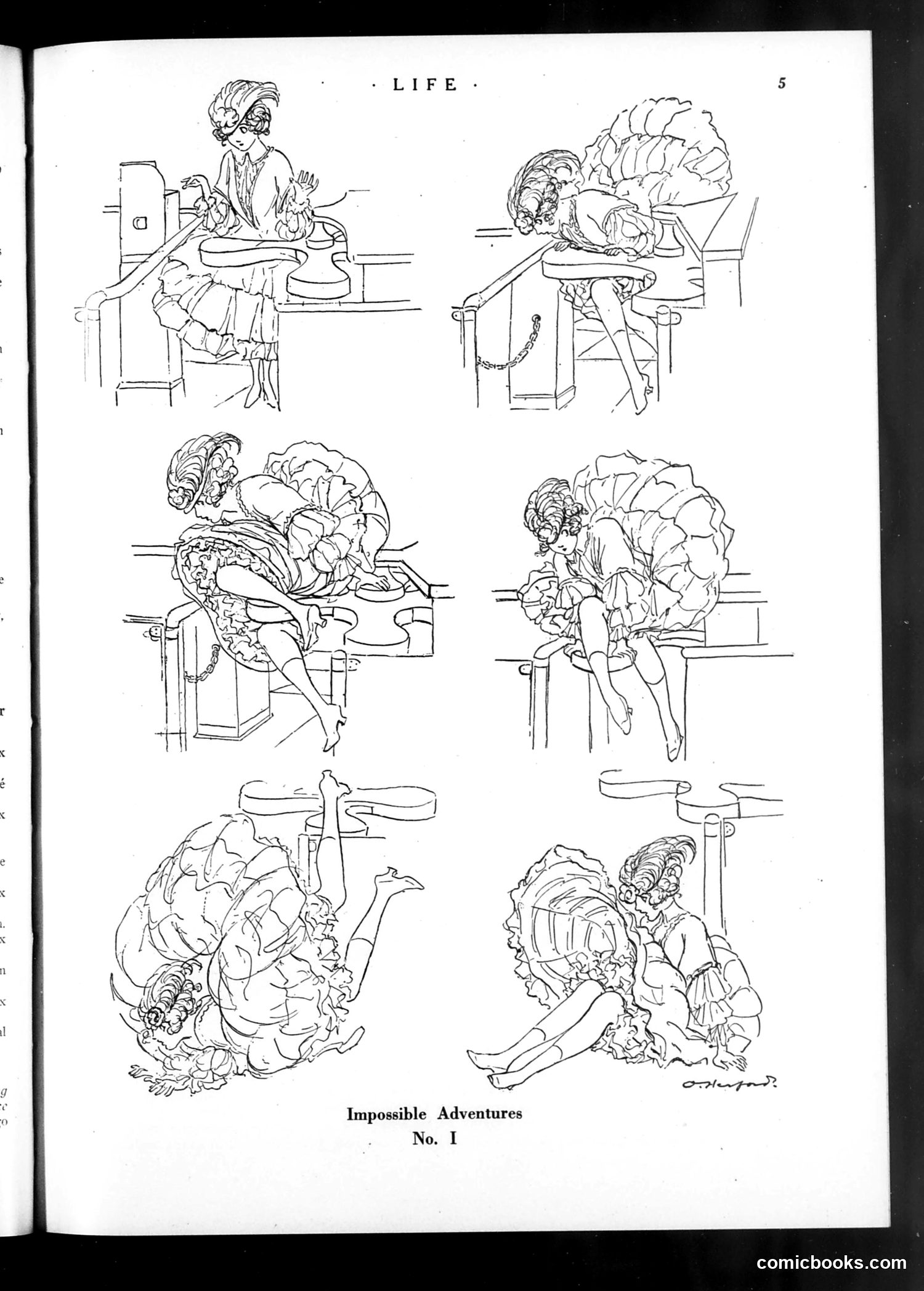
This page from *Life* magazine presents surreal, humorous illustrations labeled "Impossible Adventures." The six panels depict increasingly absurd scenarios featuring fashionably dressed women in 1920s-style clothing engaged in physically impossible or gravity-defying acts—sitting on enormous cabbage heads, contorting inside teapots, and performing other contorted poses. The satire appears to mock both the elaborate, restrictive fashions of the era (particularly the voluminous, sculptural hats and corseted silhouettes) and perhaps the "modern woman" of the Jazz Age. By literally depicting women folding themselves into vegetables and household objects, the cartoonist humorously suggests that contemporary fashion and social expectations require women to perform impossible physical feats or abandon reason altogether. The title itself signals this is deliberate nonsense—entertainment through the absurd.
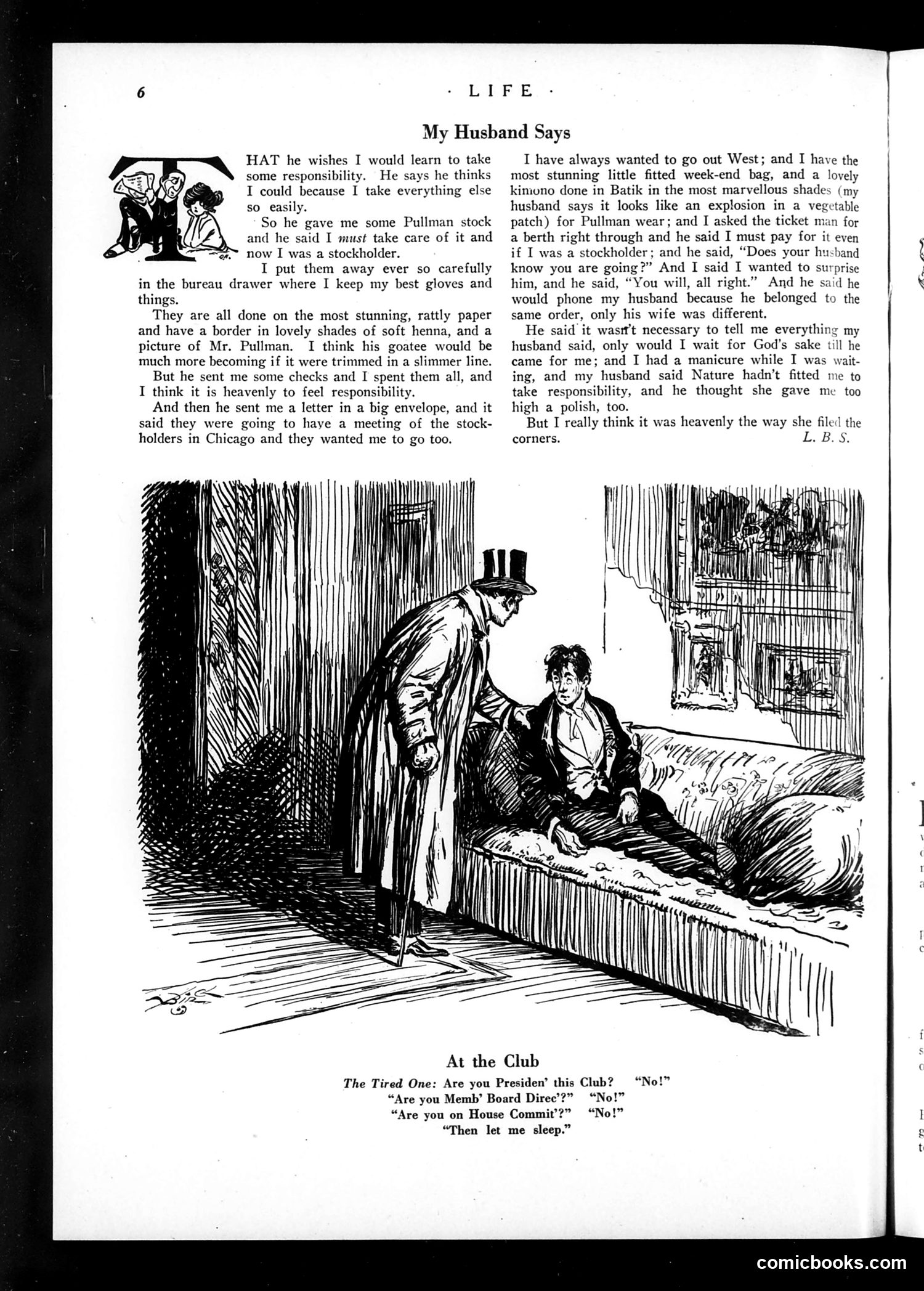
This page contains two pieces of satirical content: **"My Husband Says"** (upper section): A domestic humor column where a wife describes her husband's expectations. He wants her to take responsibility but then contradicts himself—saying she couldn't handle stock investments, yet pressuring her to attend a stockholders meeting in Chicago. The satire mocks male hypocrisy: husbands wanted women obedient yet blamed them for being passive. **"At the Club"** (cartoon, lower section): A tired man at a club responds "No!" to questions about holding various positions (President, Board Director, House Committee member), then says "Then let me sleep." The joke satirizes the social pressure on men to take on voluntary roles and responsibilities, leaving them exhausted. Both pieces comment on gender expectations and social obligations of the early-to-mid 20th century.
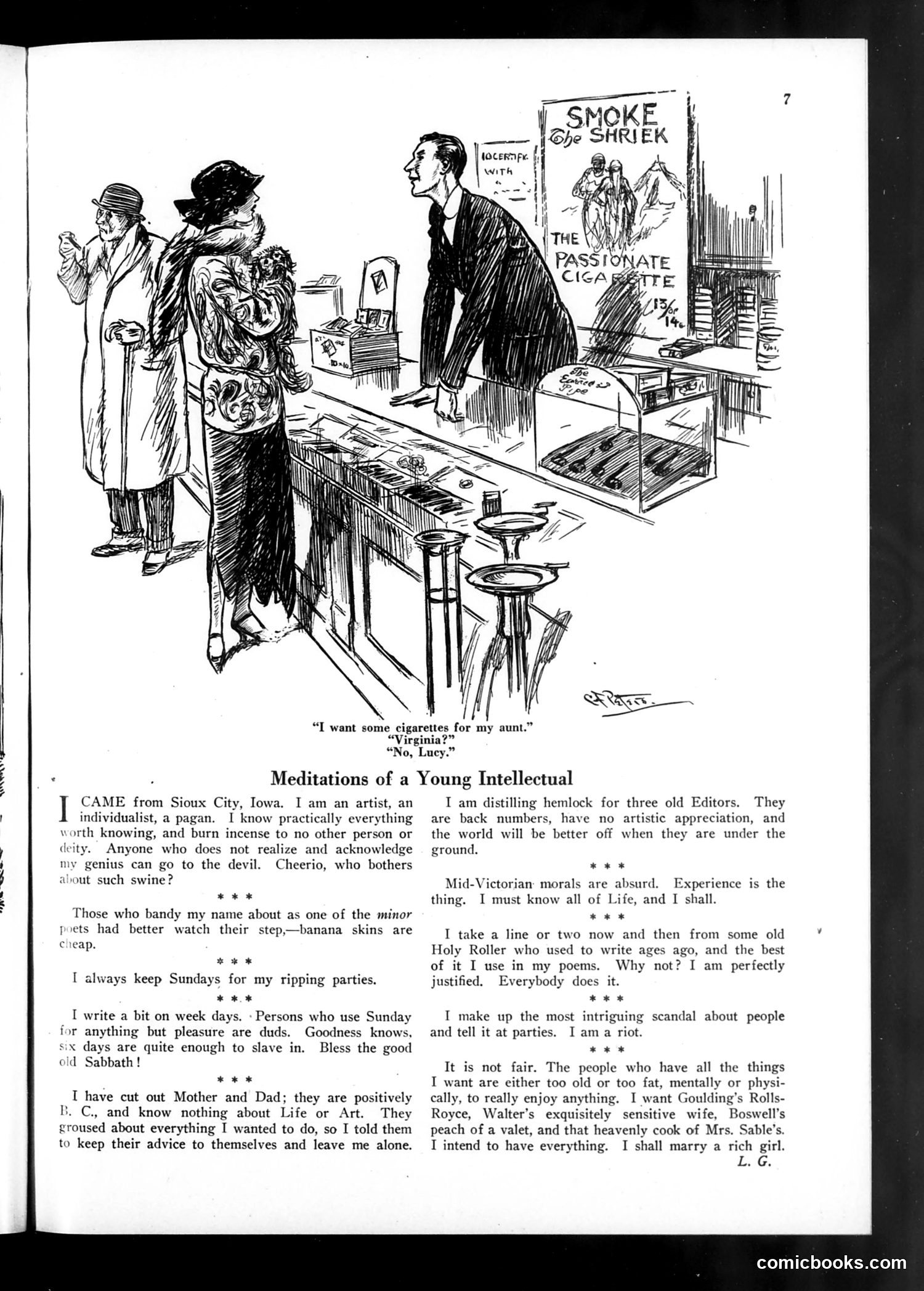
The cartoon depicts a cigarette shop scene where a young man browses while two customers (appearing to be older gentlemen) stand nearby. A prominent poster advertises "Smoke the Shriek" and "The Passionate Cigarette." Below, the text "Meditations of a Young Intellectual" presents satirical commentary from a self-described "individualist" and "pagan" from Iowa. The narrator boasts of rejecting conventional morality, dismissing his parents' values, frequenting Sunday "ripping parties," and fabricating scandals at social gatherings to appear important. The satire targets young intellectual poseurs of the era—those adopting bohemian affectations and moral relativism while pursuing wealth and status. The cigarette brand "The Passionate Cigarette" likely mocks the affected sophistication such individuals cultivate. The overall piece ridicules the pretensions of would-be rebels who embrace hedonism while remaining fundamentally materialistic.
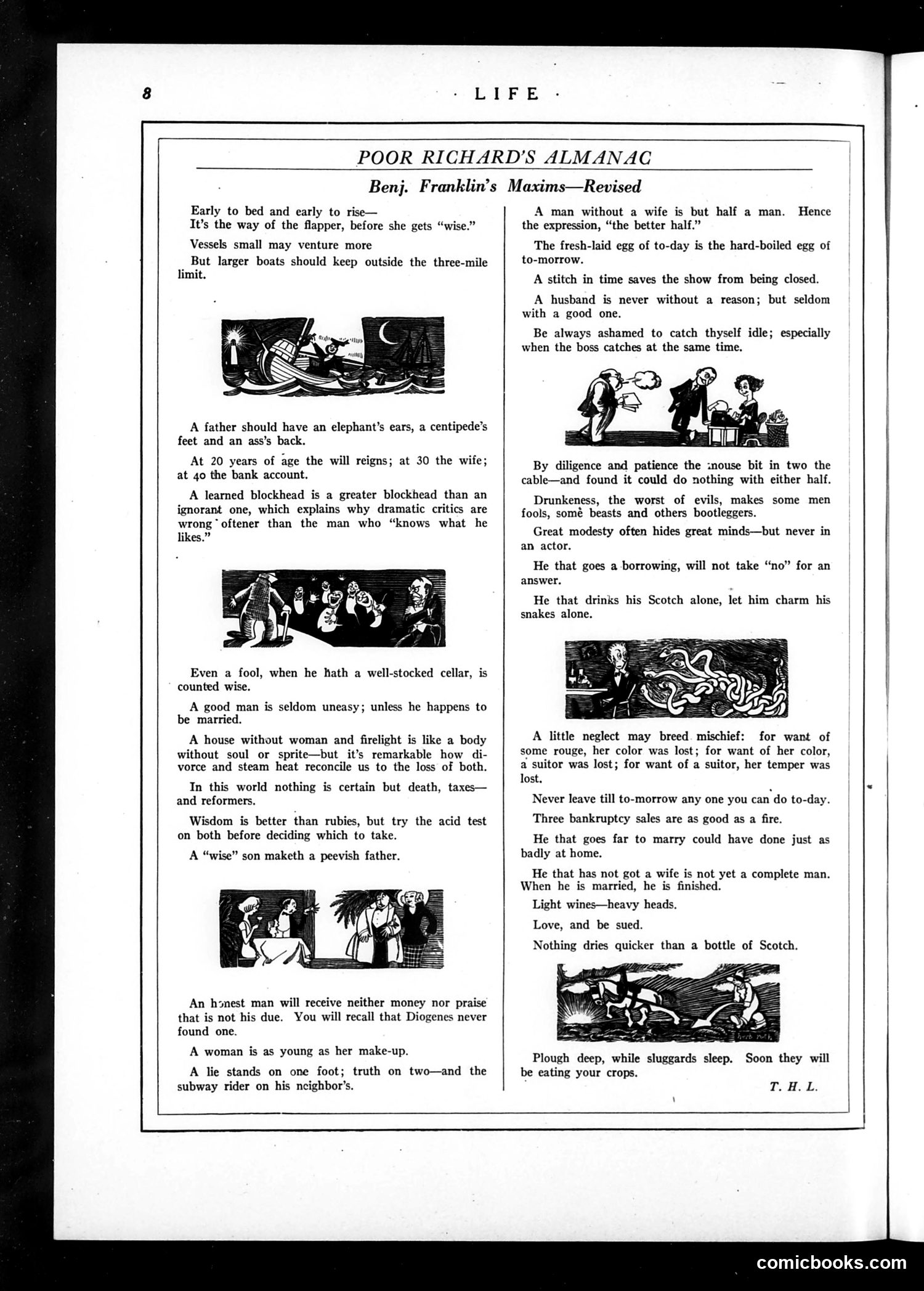
This page presents satirical rewrites of Benjamin Franklin's famous aphorisms from *Poor Richard's Almanac*. The original maxims promoted thrift, hard work, and virtue; Life magazine's "revised" versions subvert these messages with cynical modern observations. For example, Franklin's "Early to bed and early to rise" becomes commentary on flapper culture. "A house without woman and firelight" is reframed to question marriage's value. References to drinking Scotch, bankruptcy, and sexual behavior mock Victorian morality and 1920s excess. The woodcut illustrations accompanying the text depict scenes of revelry, drunkenness, and domestic chaos—visually reinforcing the satire's critique of modern society's abandonment of Puritan ideals. The byline "T. H. L." indicates the revisions' author.
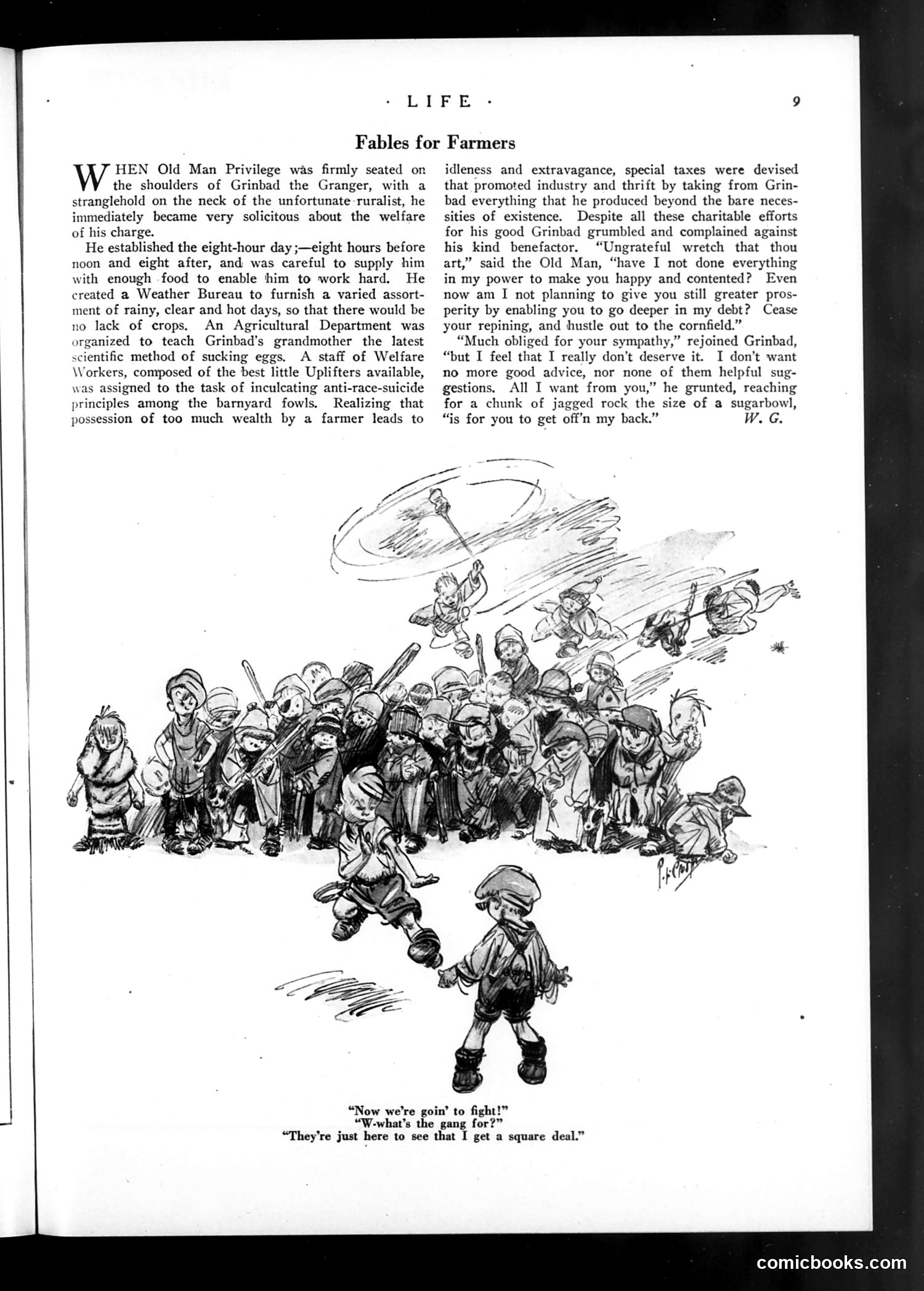
This satirical fable criticizes wealthy farmer "Old Man Privilege" who exploits an impoverished rural laborer named Grimnab through harsh working conditions (8-hour shifts before and after noon) and meager food rations. When Grimnab seeks sympathy and help, Privilege dismisses him, offering only cruel mockery—literally telling him to "get off'n my back" by throwing a rock at him. The cartoon below depicts the consequence: Grimnab, now joined by a mob of fellow workers ("They're just here to see that I get a square deal"), confronts Privilege with collective action and threat of violence ("Now we're goin' to fight!"). The satire warns wealthy landowners that exploitation breeds working-class solidarity and eventual uprising. It reflects early 20th-century American labor tensions and socialist critique of agricultural wealth inequality.
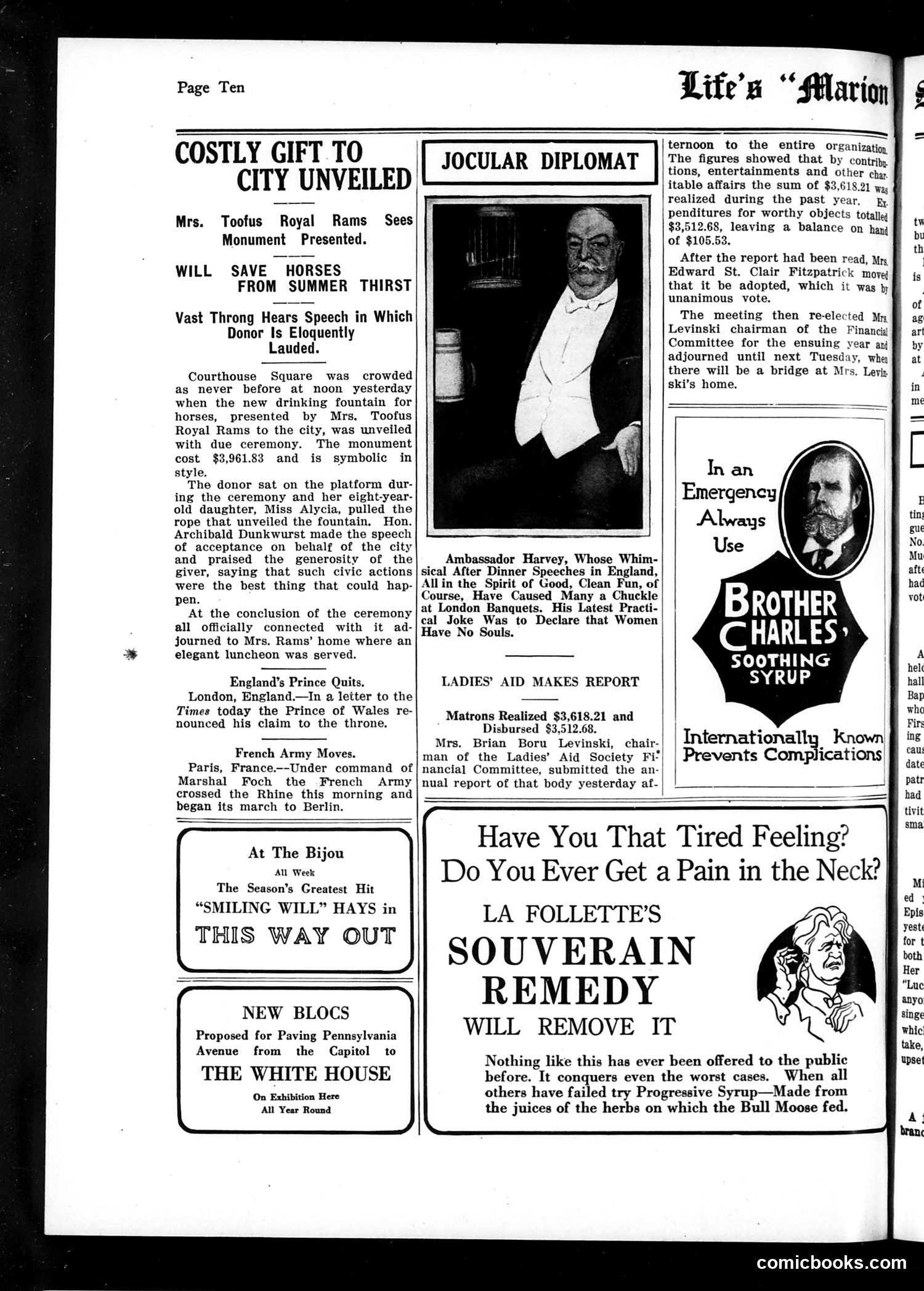
This page is primarily **advertising and news items** rather than political satire. The main content includes: **News Stories:** - A fountain monument donated by Mrs. Toofus Royal Rams to the city (cost: $3,961.83) - Brief items about Prince of Wales renouncing his claim, French Army movements, and a Ladies' Aid Society financial report **Advertisements:** - Brother Charles' Soothing Syrup (patent medicine claiming to "prevent complications") - La Follette's Souverain Remedy (advertised as cure for neck pain and tiredness) - Notices for The Bijou theater and proposed White House building plans The page lacks significant political cartoons or satirical commentary. It reflects early 20th-century publication style mixing local news with patent medicine advertisements—products now recognized as likely ineffective or even harmful.
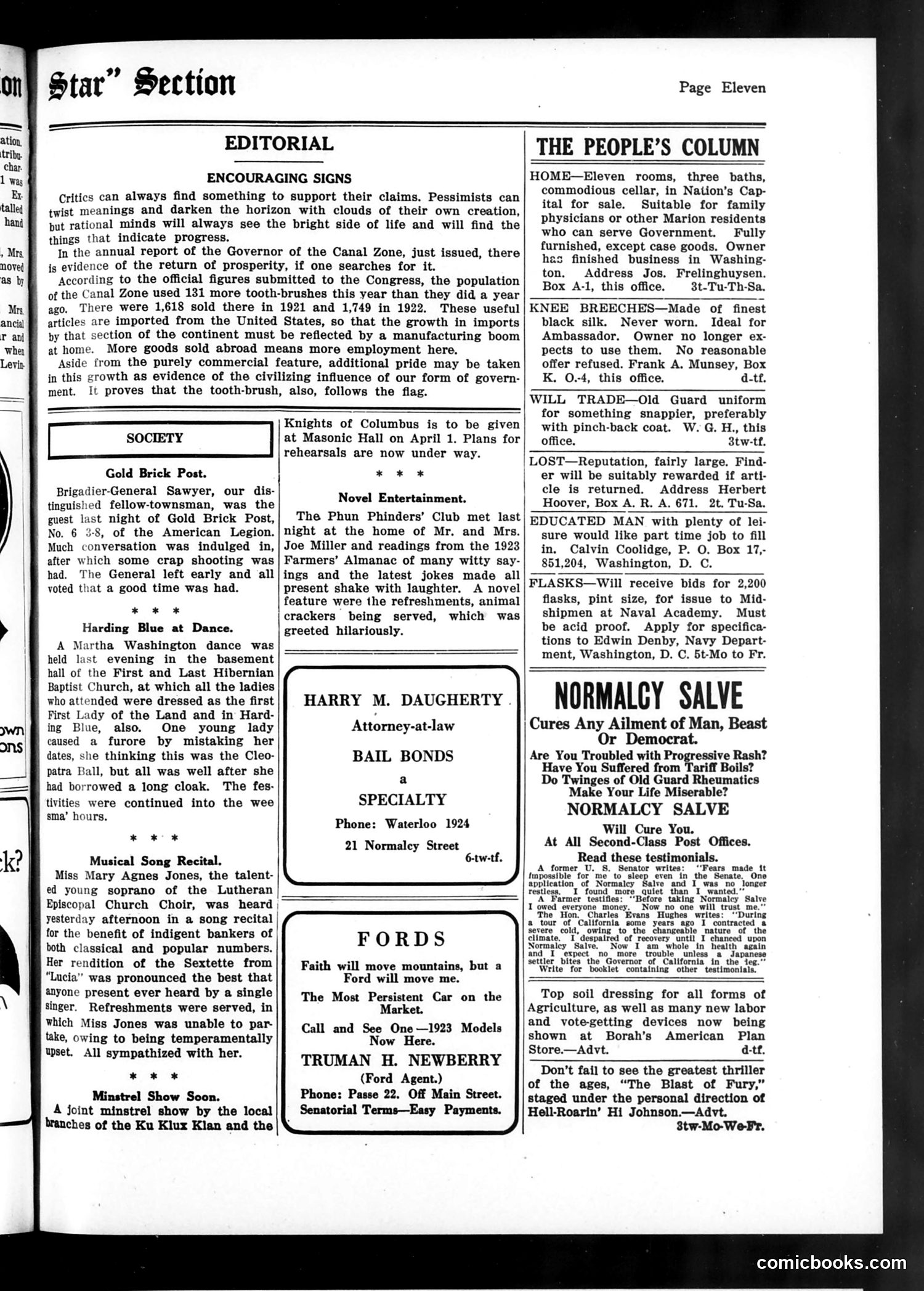
This is primarily a **"Star" Section** page of classified advertisements and social announcements rather than satirical content. The page contains: **Editorial Section**: "Encouraging Signs" discusses Canal Zone population growth and commercial development, arguing these demonstrate governmental progress. **Society Section**: Social announcements covering local events—a Gold Brick Post dance, a Martha Washington dance at a Baptist church, and a musical recital by soprano Mary Agnes Jones. **The People's Column**: Classified ads for real estate, services, and lost items. **Advertisements**: Including Normalcy Salve (a dubious patent medicine claiming to cure various ailments), Ford automobiles, and other commercial services. The page reflects 1920s American newspaper format with modest, straightforward content rather than political satire or caricature.
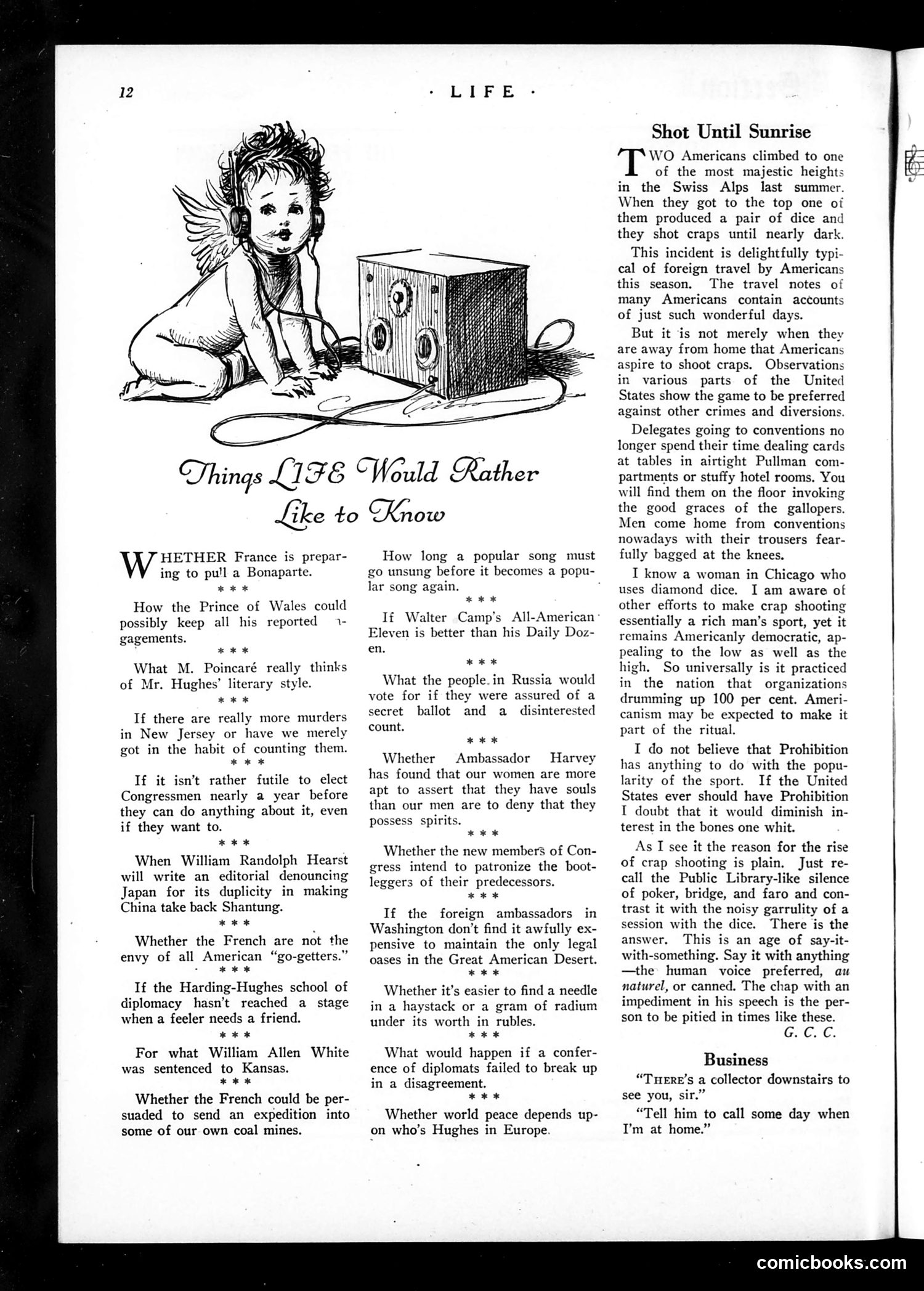
This page from *Life* magazine contains a satirical column titled "Things LIFE Would Rather Like to Know." The illustration shows a cherub or cupid figure with dice and a radio, visually introducing the theme. The column presents a series of rhetorical questions mocking current events and public figures, including references to: - France's potential political collapse - The Prince of Wales's romantic engagements - Crime rates in New Jersey - Congressional gridlock - William Randolph Hearst's anti-Japanese editorial stance - Prohibition's effectiveness in America - Ambassador Harvey's diplomatic activities - Congress's integrity The satire targets political hypocrisy, governmental ineffectiveness, and sensational journalism. A separate section titled "Business" contains brief humorous dialogue about a debt collector. The overall tone is cynical commentary on 1920s American politics and society.
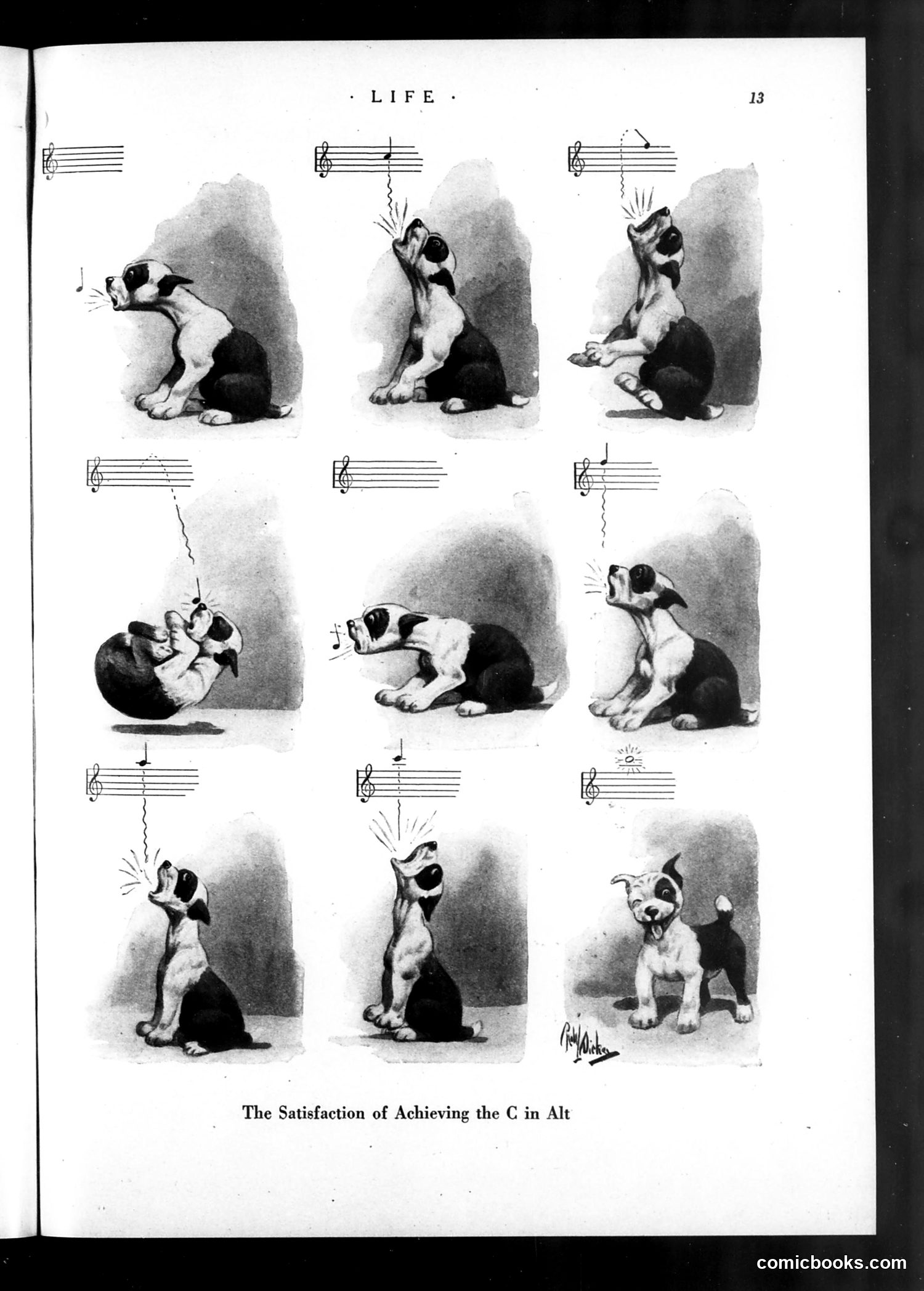
This is a humorous musical satire showing a small dog attempting to hit a high musical note—specifically a C in the alto clef. The nine sequential panels, each labeled with musical notation, depict the dog's escalating struggle and eventual triumphant achievement of the note. The joke targets classical music training and vocal performance. "Achieving the C in Alt" (a high note requiring significant vocal skill) is portrayed as absurdly difficult, with the dog straining, contorting, and suffering through various increasingly desperate poses to produce the sound. The final panel shows the dog satisfied but exhausted after success. The satire mocks both the pretentiousness of classical vocal instruction and the disproportionate pride singers take in mastering challenging notes.
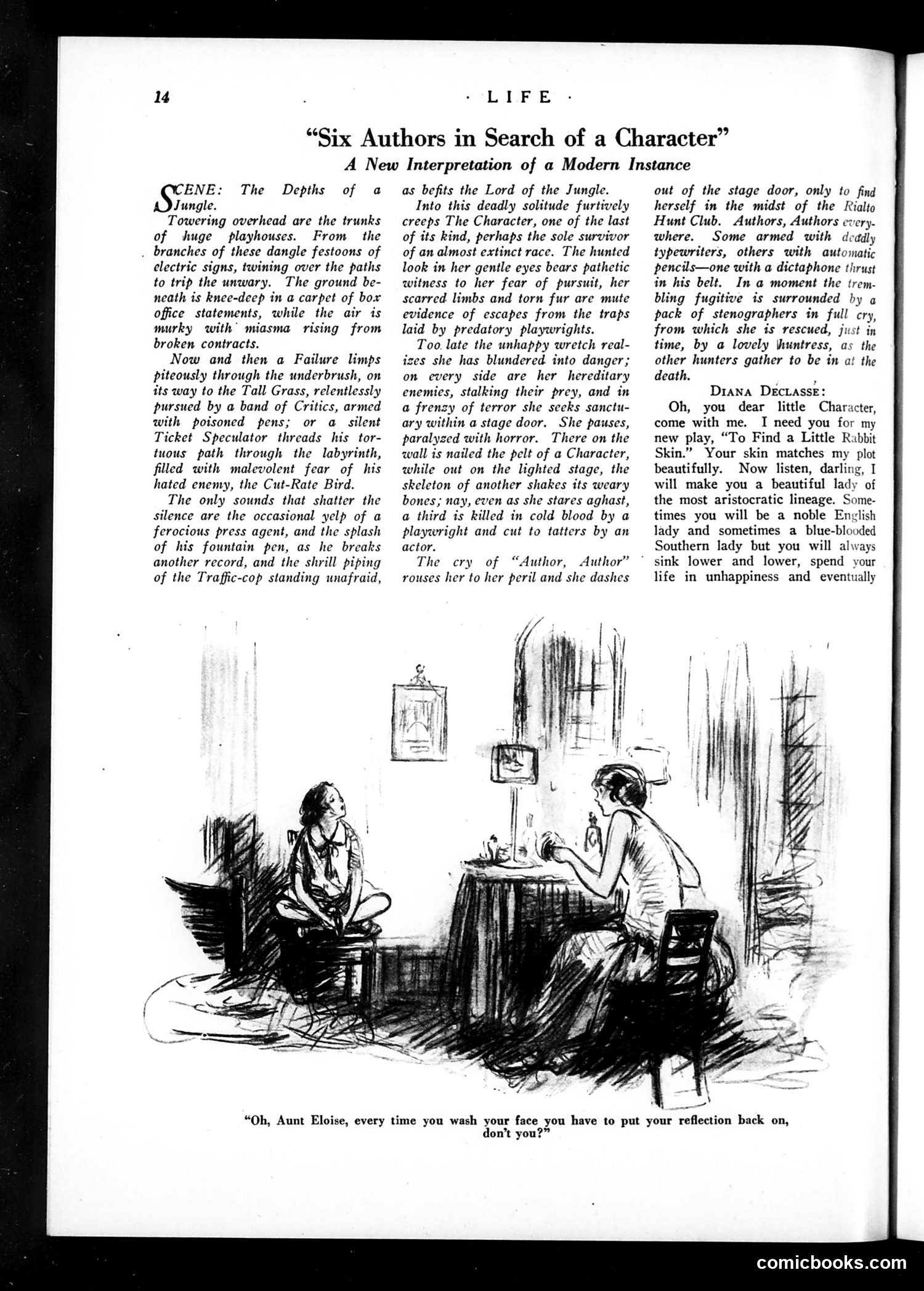
This page satirizes a theatrical work (likely referencing Pirandello's "Six Characters in Search of an Author"). The text describes a jungle setting where a mysterious "Character" eludes six authors pursuing her through various traps and dangers. The cartoon below shows two women in conversation. The caption reads: "Oh, Aunt Eloise, every time you wash your face you have to put your reflection back on, don't you?" This is a witty insult joke playing on dated female beauty standards—the implication being that Aunt Eloise's face is so plain or aged that her reflection appears to be artificial makeup rather than natural features. The humor relies on early 20th-century preoccupations with cosmetics and feminine appearance.
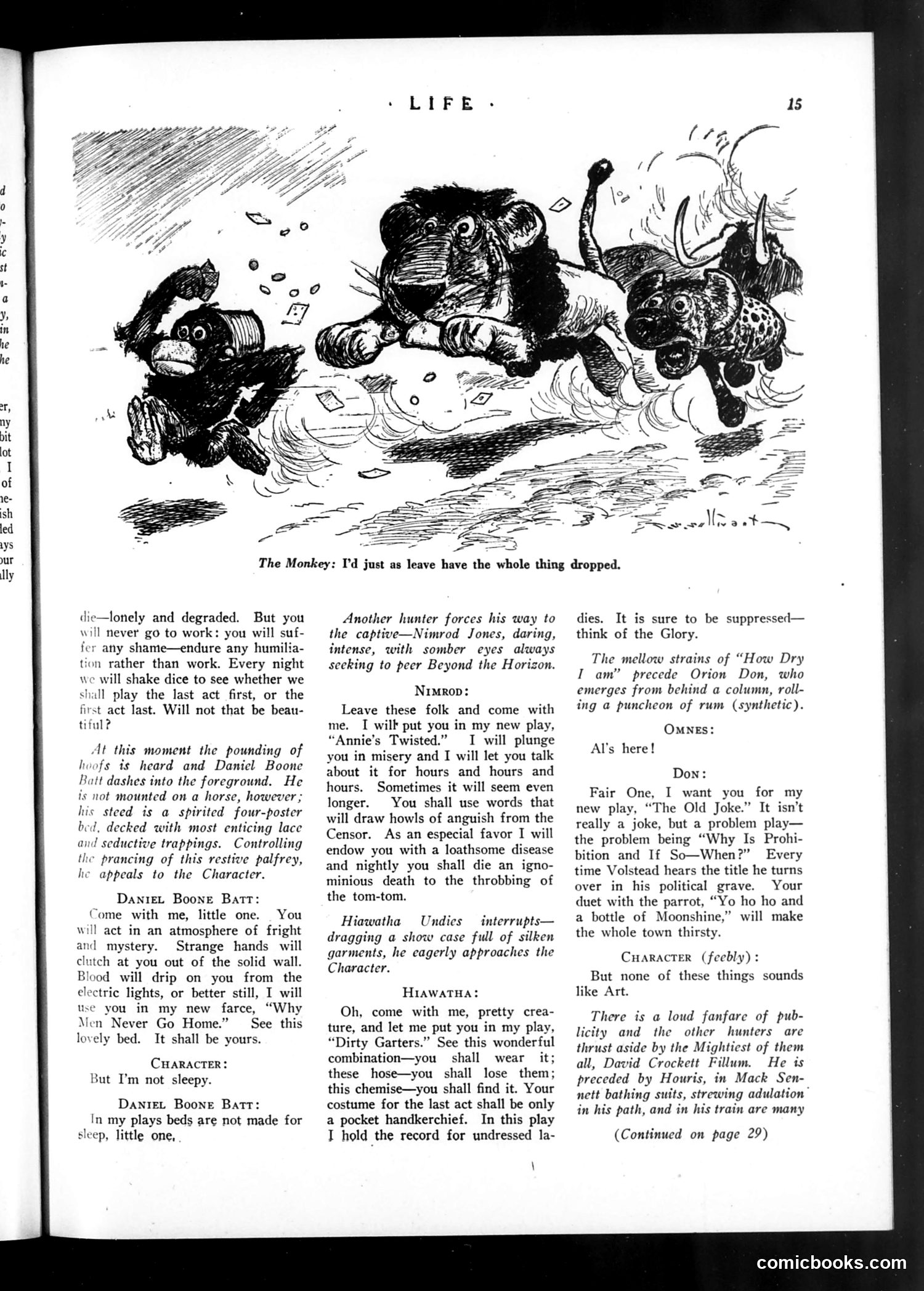
This cartoon satirizes early 20th-century Broadway theater and its competing producer-showmen. A small figure (likely representing theatrical talent or "the Character") is being pursued by five flamboyant producers, each offering increasingly absurd stage roles: - **Daniel Boone Batt** pitches a mystery farce featuring an ornate bed - **Nimrod Jones** promises misery and disease ("Annie's Twisted") - **Hiawatha** (appearing to reference vaudeville's exoticism) offers burlesque with minimal costumes - **Orion Don** promotes a Prohibition-era "problem play" with synthetic rum - Each promises exploitation dressed as artistic opportunity The character's desperate refrain—"I'd just as leave have the whole thing dropped"—captures the satire's point: Broadway producers cynically manufacture sensationalism (sex, violence, topical controversy) while claiming artistic merit. The "monkey" caption suggests these pitches are circus acts, not legitimate theater. This mocks 1920s theater's commercialism versus actual artistry.
This editorial page addresses France's occupation of Germany's Ruhr Valley (industrial heartland) to enforce war reparations payments. The author argues France is justified—she possesses Europe's strongest military and needs security against German resurgence. The Ruhr and Silesia, described as "Pennsylvania of Germany," are Germany's industrial power base; French control protects her. However, the piece questions France's long-term strategy: can she sustain occupation indefinitely? The author suggests France will likely accept a "reasonable bargain" rather than pursue continental domination, noting she lacks spare manpower after WWI's devastation. Crucially, the author holds **America responsible** for France's predicament, arguing U.S. military intervention in Europe created reparations demands that were "about three times more than she could meet." This reflects American isolationist sentiment post-WWI—regret over involvement and reluctance to help resolve its consequences.
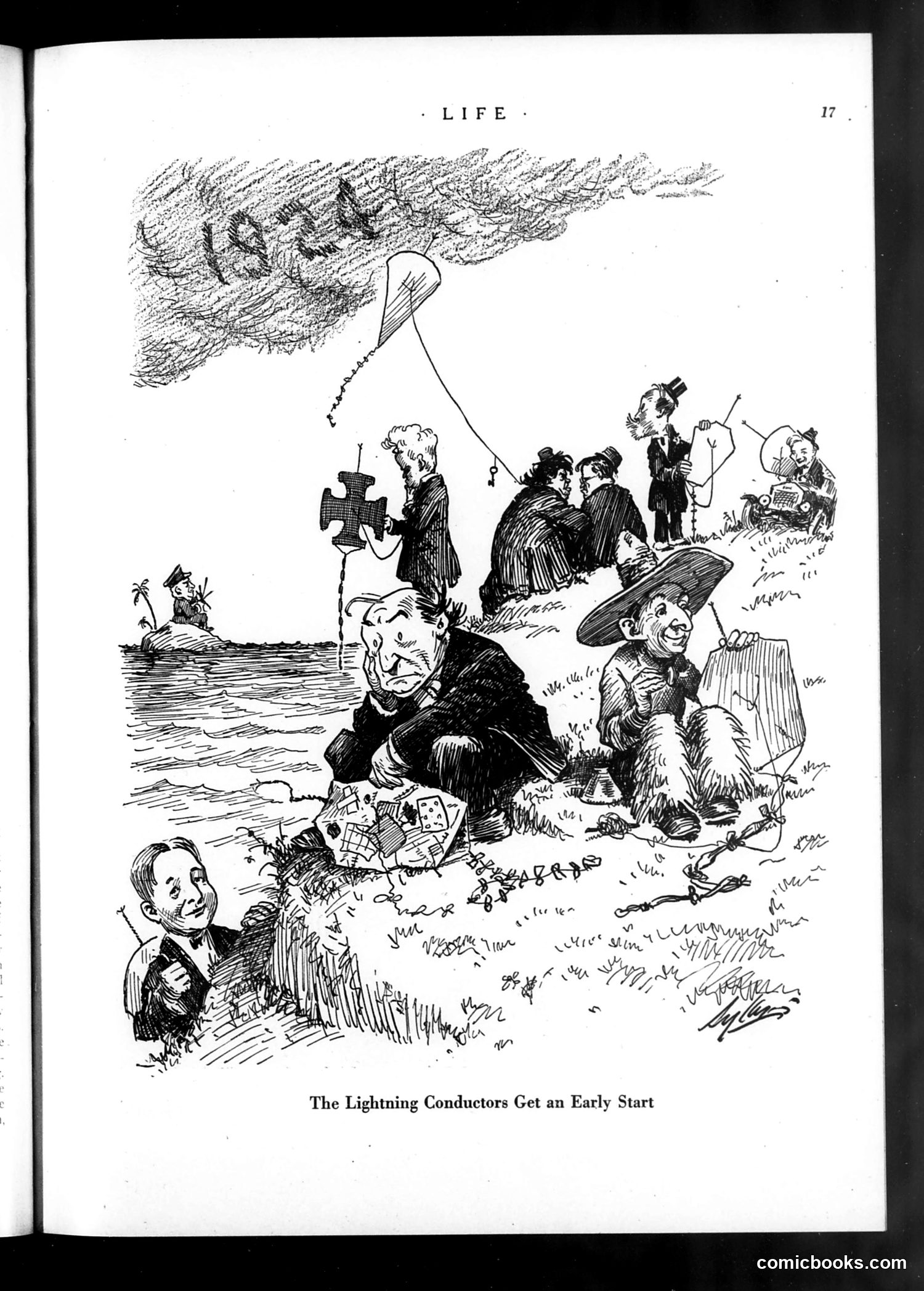
This satirical cartoon depicts a group of caricatured figures outdoors during a storm, with lightning visible in the sky above. The title "Lightning Conductors" is a pun—these men are literally attempting to conduct (direct) lightning, while the phrase suggests they're "conducting" themselves improperly or hastily. The cartoon appears to mock political or social figures who are rushing into something dangerous or ill-advised. The exaggerated facial features and postures suggest ridicule of specific public figures, though without additional context, their precise identities remain unclear. The stormy setting reinforces the danger and chaos of their endeavor. The humor relies on the double meaning of "conductors" and the visual absurdity of the scene.
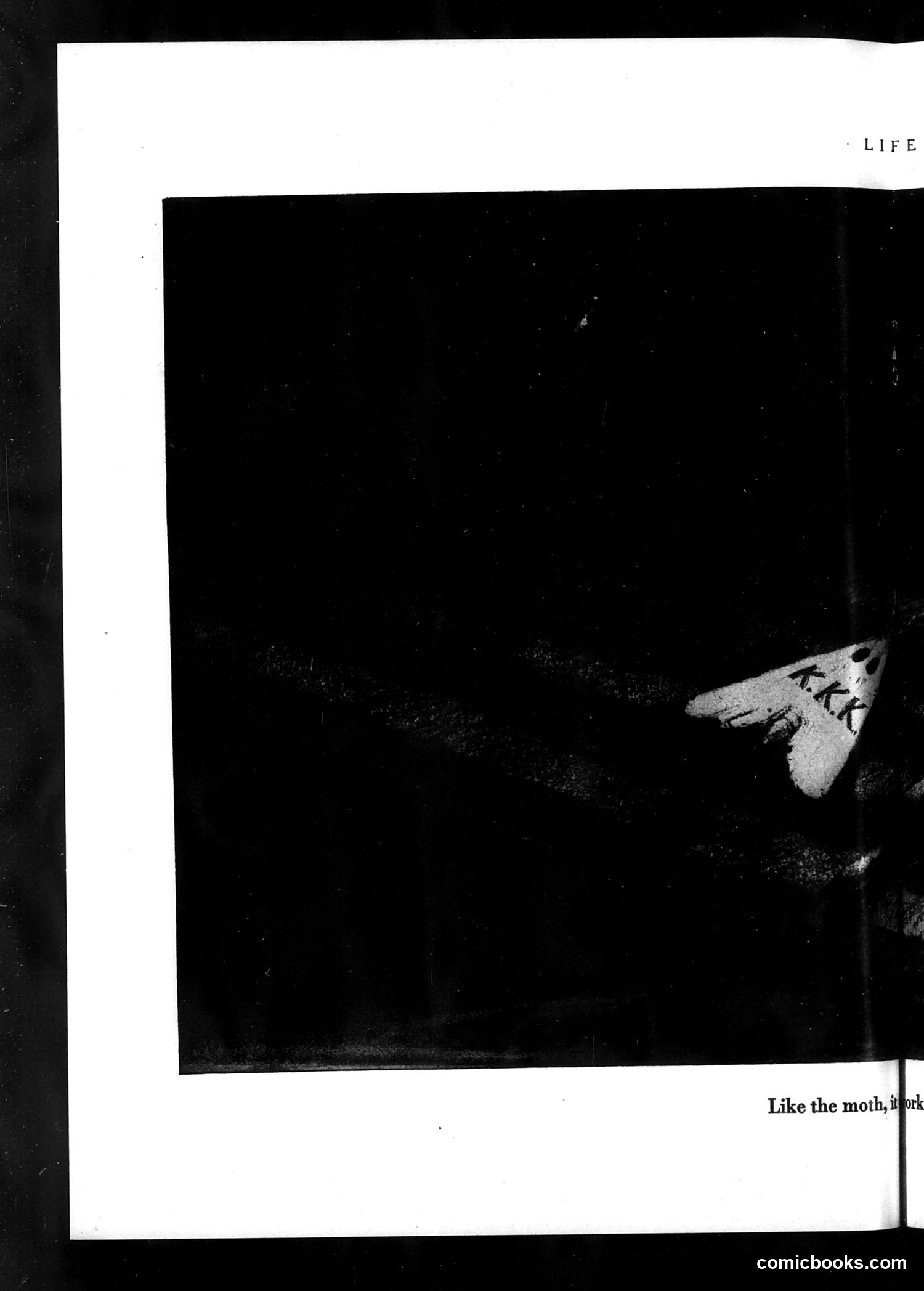
This page appears to be from a Life magazine article or advertisement, though the content is largely obscured by a large black rectangular image. In the lower right corner is a moth illustration with visible markings or text on its wings. The caption reads "Like the moth, it fork" (likely corrupted OCR), suggesting a comparison or metaphor involving the moth's behavior or characteristics. Without clearer visibility of the full page content, accompanying text, or additional context, I cannot definitively identify what political or social subject this satire addresses. The moth imagery could reference attraction to danger, camouflage, or transformation—common metaphorical themes in political cartooning—but the specific target or point of the satire remains unclear from what's legible here.
This appears to be a mostly blank page from *Life* magazine with a large black-and-white photograph dominating the layout. The image shows what looks like industrial or agricultural rows—possibly a factory floor, mine, or terraced field—photographed at night or in low light, creating stark contrast. The partial caption at bottom reads "...oth, it works in the dark," which is cut off and doesn't provide full context. Without the complete caption or accompanying text, I cannot definitively identify what specific subject, event, or satire this photograph illustrates. The phrase suggests something functioning covertly or secretly, but the photograph's exact subject and the intended satirical point remain unclear from what's visible here.
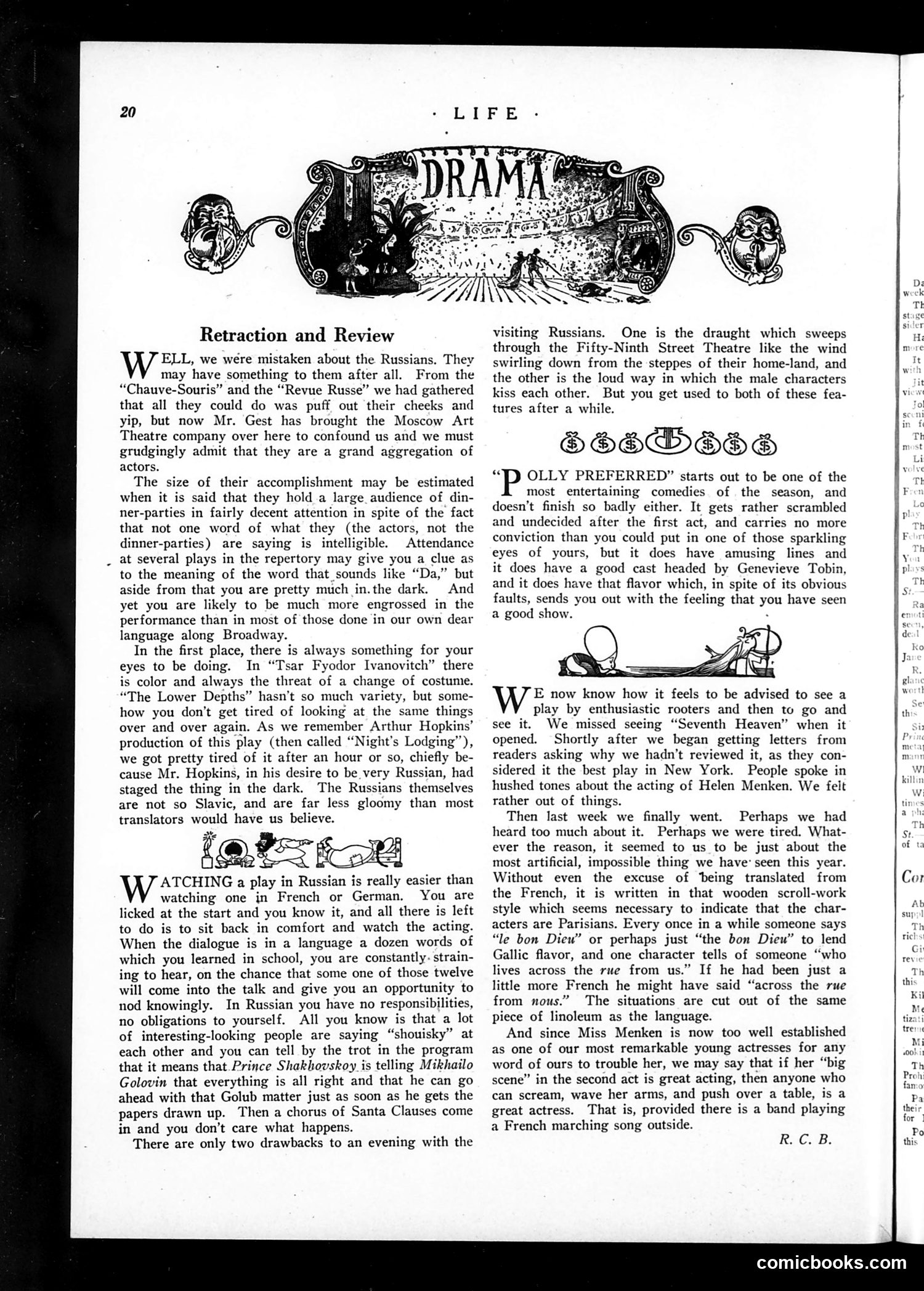
This page reviews recent theater productions, primarily the Moscow Art Theatre company's visit to New York. The critic acknowledges initial prejudice against Russian theater—previously dismissing it as mere "puffing out cheeks and yipping"—but admits the company's acting accomplishments are genuinely impressive, despite audiences understanding no Russian dialogue. The review argues that language barriers paradoxically enhance the experience: without understanding words, viewers focus entirely on physical performance and staging. The critic contrasts this favorably with Arthur Hopkins' overly dark American production of "The Lower Depths," suggesting Russian performers are "far less gloomy" than Western adaptations suggest. Additional brief reviews cover "Polly Preferred" (a mediocre comedy with Genevieve Tobin) and reference missing "Seventh Heaven" entirely. The satire targets American theatrical snobbery and xenophobia—reversing initial dismissal of Russian culture into grudging admiration, while highlighting how language barriers create unexpected advantages for foreign performance.
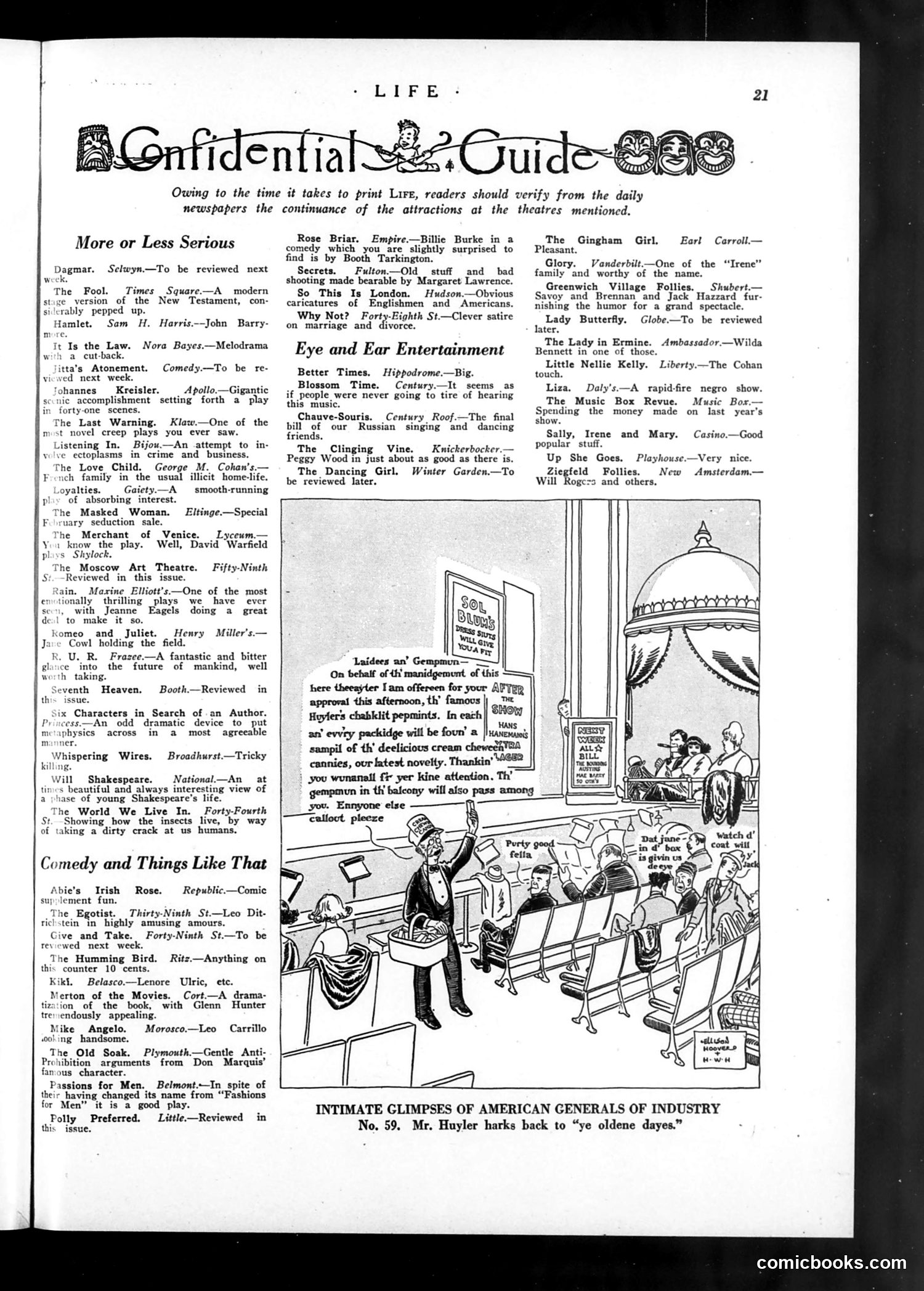
This is primarily a **theater review page** from Life magazine's "Confidential Guide" section, listing Broadway shows with brief critical assessments. The page covers both serious drama ("Hamlet," "Romeo and Juliet") and comedies ("Abie's Irish Rose," "The Old Soak"). The **single cartoon** at bottom depicts a scene labeled "Ladies an' Gennlemen" at what appears to be a theater balcony or box seating area. A man in formal dress (likely a theater manager or usher) addresses well-dressed patrons. The caption references "Mr. Huyler harks back to 'ye olde days,'" suggesting satire about nostalgia or outdated theatrical practices. The humor likely mocks either theatrical pretension, old-fashioned audience behavior, or management's attempt to recreate past grandeur. Without identifying "Huyler" specifically, the joke appears to critique someone's retrograde approach to modern entertainment.
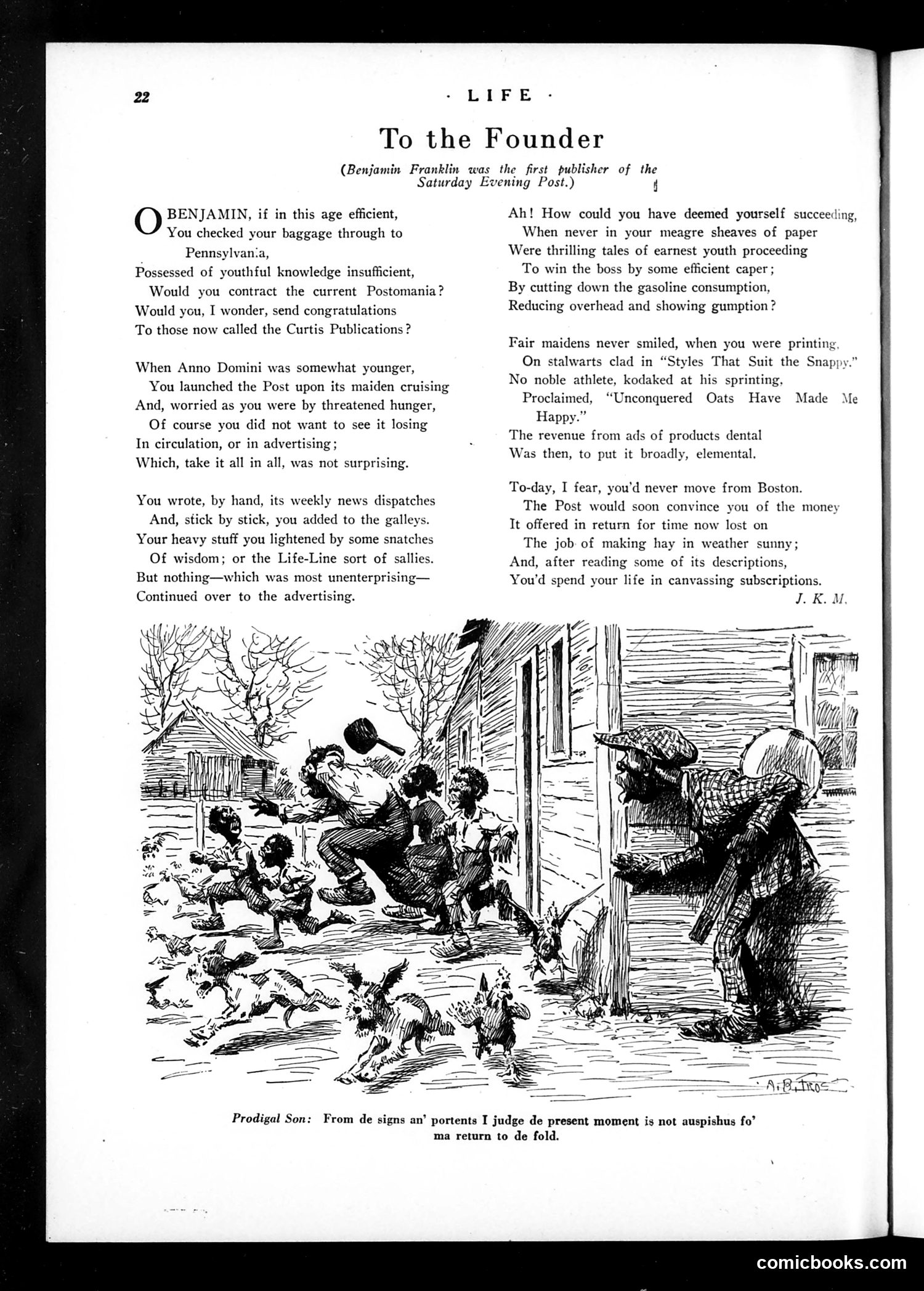
This poem satirizes the modern commercialization of the *Saturday Evening Post* under the Curtis Publishing Company, contrasting it with Benjamin Franklin's original vision. **The Satire:** The poet imagines Franklin returning to see his publication transformed into an advertising-driven enterprise. Franklin's modest, wisdom-filled dispatches have been replaced by advertiser-friendly content: fake success stories about workers improving efficiency, testimonials from athletes endorsing oat cereal, and dental product ads. The point: modern publishers like Curtis have abandoned editorial integrity for revenue. **The Illustration:** Shows a ragged man (labeled "Prodigal Son") observing children and dogs playing outside a house, deciding not to return "home"—a visual metaphor for Franklin rejecting his corrupted creation. **Historical Context:** This reflects early 20th-century criticism of magazine publishing's shift toward advertising-driven models, where editorial content became secondary to commercial interests.
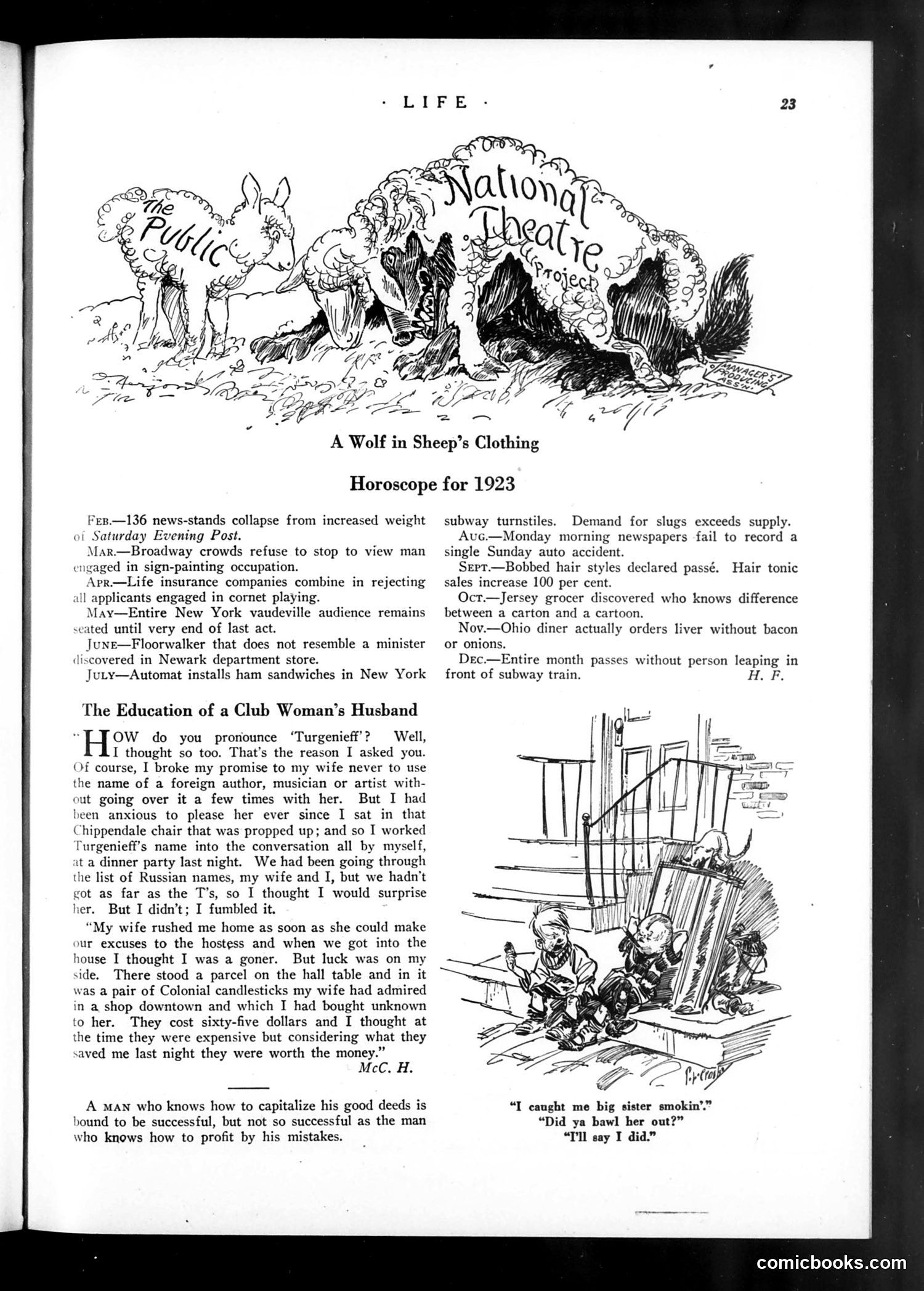
This page contains two satirical pieces typical of Life's humor: **"A Wolf in Sheep's Clothing: Horoscope for 1923"** is a list of absurdist predictions mocking contemporary American life. Each month lists an impossible or ironic scenario—news-stands collapsing from Saturday Evening Post's weight, Broadway audiences staying through entire acts, finding an honest department store floorwalker. The satire targets consumerism, media excess, and social pretense of the 1920s. **"The Education of a Club Woman's Husband"** satirizes domestic hierarchy and social anxiety. A husband mispronounces a Russian author's name at dinner, embarrassing himself before his wife. He recovers by buying expensive Colonial candlesticks, suggesting men use material gifts to appease wives' cultural ambitions. The piece mocks both wives' social pretensions and husbands' strategic gift-giving as marital damage control. The accompanying cartoon shows children—one having taught the other to smoke—representing generational misbehavior and failed parental authority, a common 1920s worry.
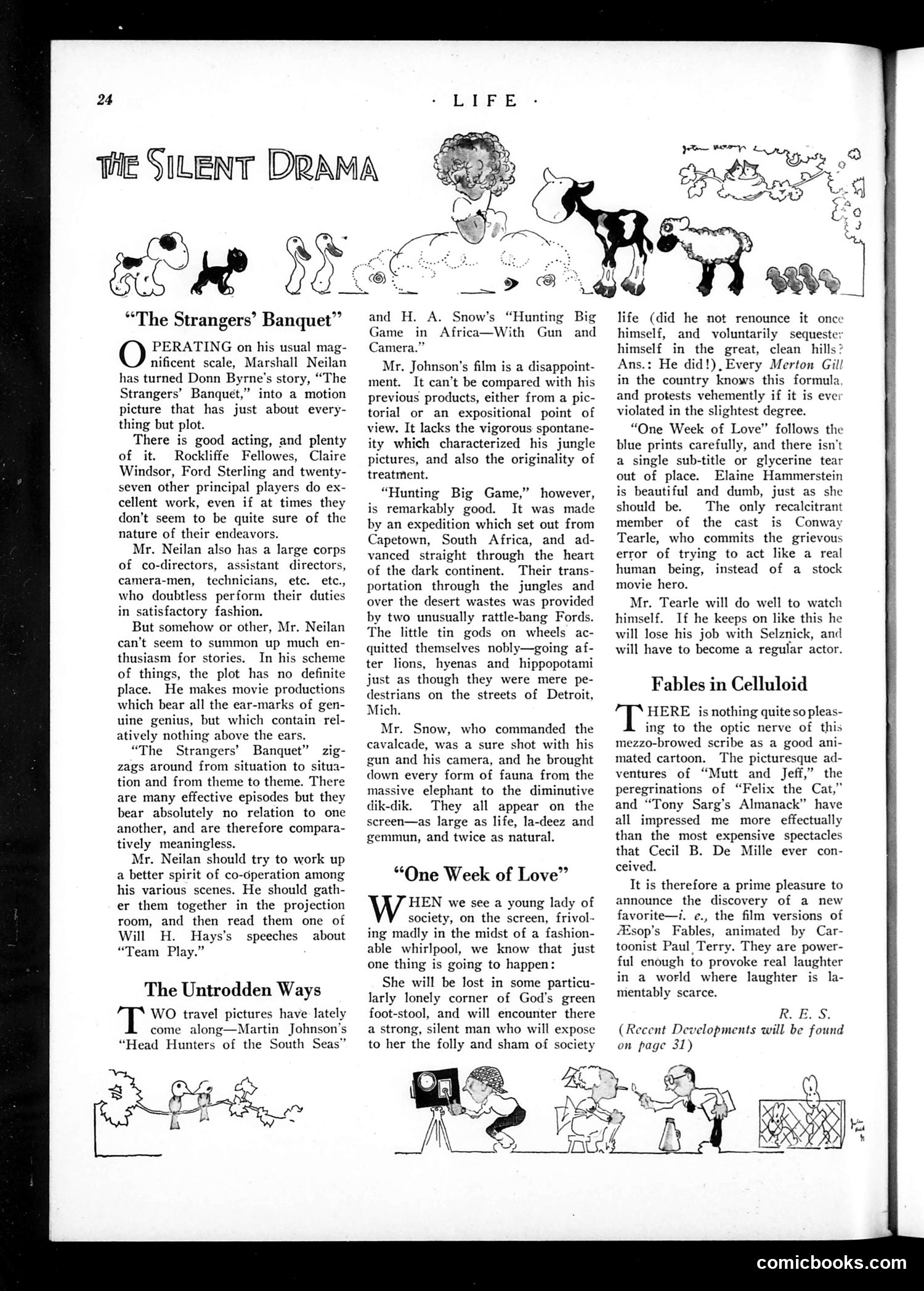
This page reviews four silent films with satirical commentary typical of Life's irreverent style. The critic praises technical execution while mocking narrative laziness: **"The Strangers' Banquet"** — Director Marshall Neilan is criticized for spectacular production values but incoherent plotting. The satire: he's a visual perfectionist who neglects storytelling, assembling impressive scenes that don't connect meaningfully. The "Team Play" reference mocks Will Hays' industry leadership rhetoric. **Travel pictures** — Martin Johnson's "Head Hunters" disappoints; H.A. Snow's "Hunting Big Game" succeeds partly through comic absurdity: Ford automobiles transporting hunters through African wilderness as casually as Detroit streets. **"One Week of Love"** — The critic ridicules the formulaic plot device (society girl meets noble rustic who rejects civilization), noting actors perform prescribed roles. Conway Tearle commits the cardinal sin of "trying to act like a real human being"—breaking the convention that silent film characters should be stylized, not naturalistic. The overarching satire: Hollywood prioritizes spectacle, formula, and convention over genuine artistry or human authenticity.
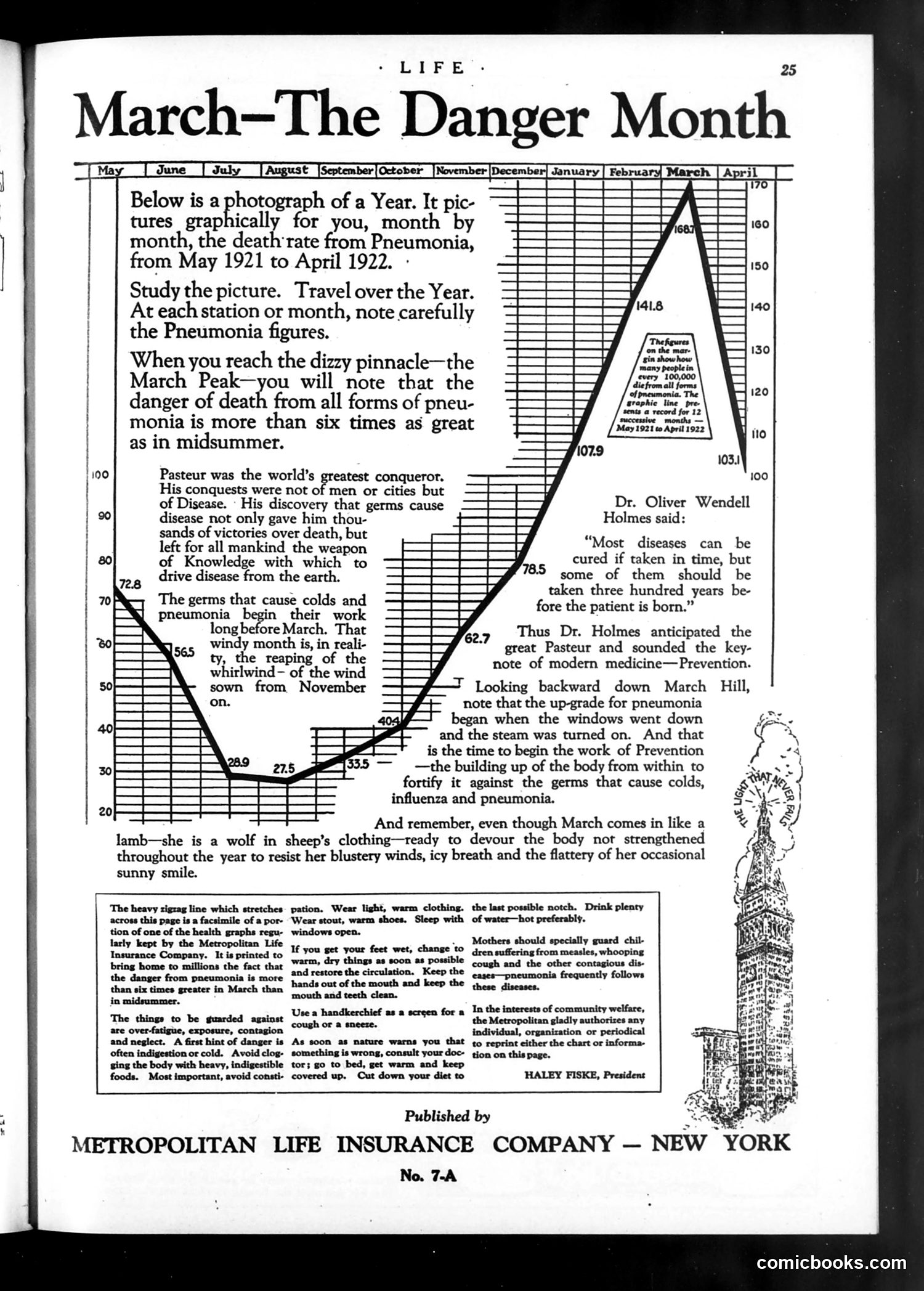
This is a public health infographic, not satire or political cartoon. Published by Metropolitan Life Insurance Company in 1922, it presents a mortality graph showing pneumonia death rates from May 1921 to April 1922, demonstrating that March deaths were six times higher than summer levels. The page uses scientific authority (citations of Pasteur and Dr. Oliver Wendell Holmes) to argue for disease prevention through hygiene and bodily fortification. It warns readers that March's deceptive mildness ("comes in like a lamb") masks deadly danger from pneumonia germs activated by winter conditions—especially when steam heat turns off and windows open. The practical advice includes wearing warm clothes, avoiding wet feet, preventing constipation, and consulting doctors early. This represents early 20th-century public health messaging that merged germ theory with behavioral recommendations. The insurance company's sponsorship reflects how insurers promoted preventive health to reduce mortality claims.
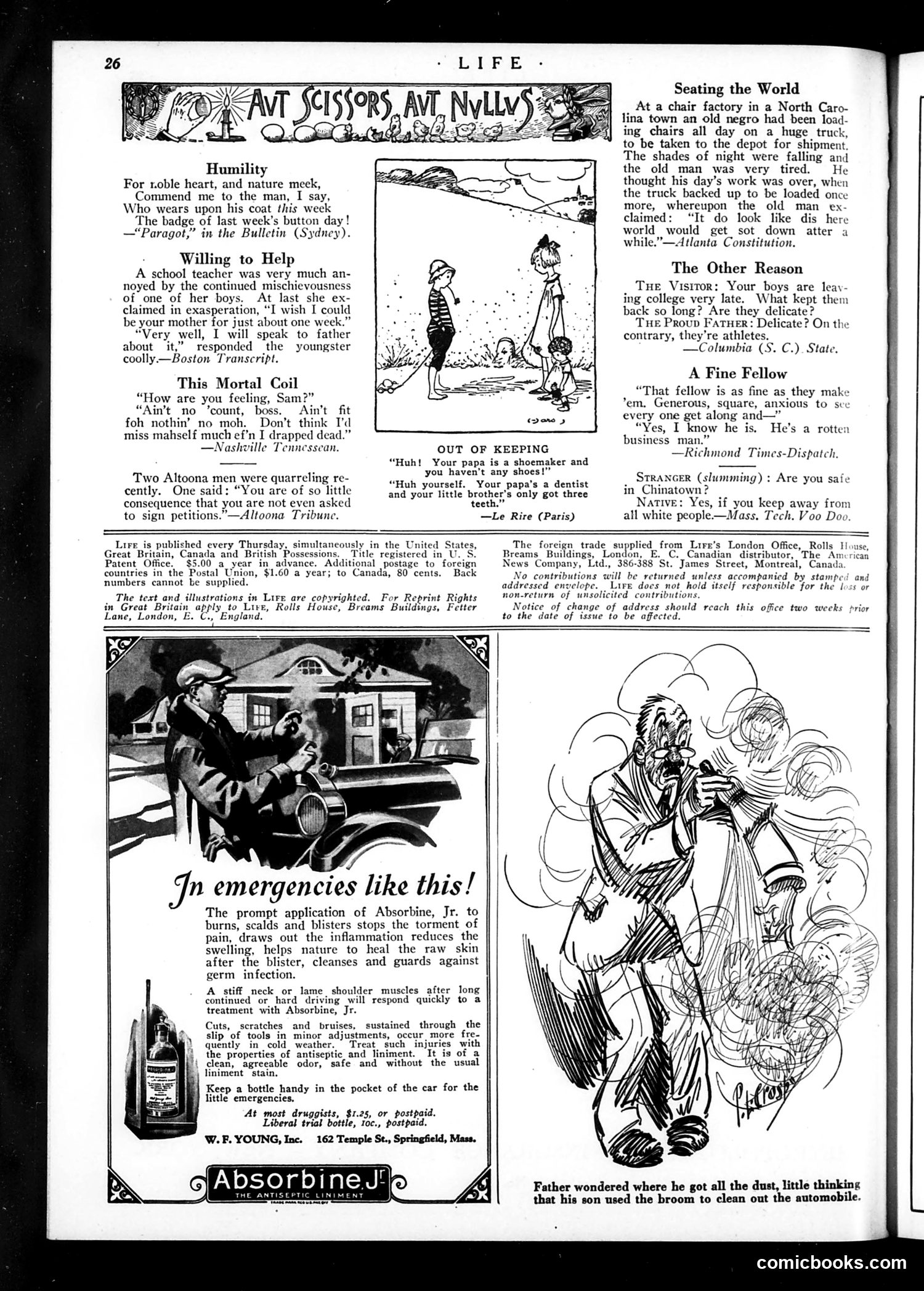
This page contains primarily **humorous anecdotes and jokes** rather than political cartoons. The content reflects early 20th-century American humor centered on social class, race, and gender dynamics. Key items include: a quip about wearing last week's "button day" badge (likely a charity fundraiser); a schoolboy's cheeky response to his teacher; racial dialect humor featuring a tired Black worker and laborers using stereotypical speech patterns; and observations about college athletes and business ethics. The "Seating the World" anecdote uses dialect humor about an exhausted Black factory worker; "The Other Reason" satirizes parents claiming sons are delayed by delicate health when they're actually athletic; and the "Chinatown" joke relies on anti-Chinese stereotypes. The page also features an **Absorbine Jr. liniment advertisement** showing emergency first aid, and a cartoon illustration of a disheveled figure (possibly depicting dust or disorder). The humor reflects period attitudes toward race and class that modern readers would find offensive.
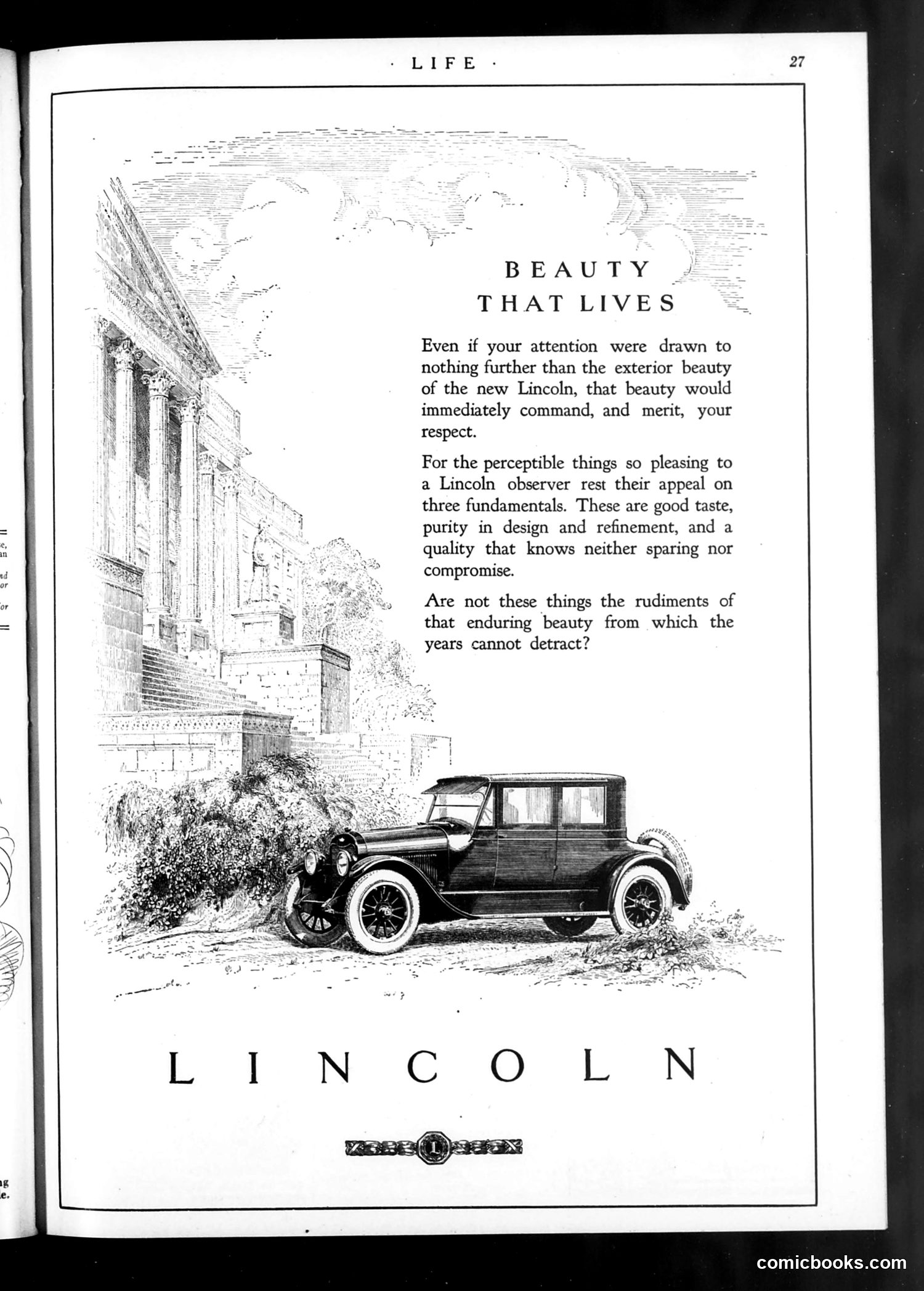
This is a **Lincoln automobile advertisement**, not a political cartoon. The page uses classical architectural imagery—a grand neoclassical building with columns—positioned above a Lincoln sedan to suggest the car embodies timeless aesthetic principles. The text argues that the Lincoln's beauty derives from three qualities: good taste, design purity, and refinement. The comparison to classical architecture implies the automobile represents enduring, high-class design that transcends temporary trends. This is aspirational advertising targeting wealthy buyers, positioning the Lincoln as a status symbol associated with cultural refinement and permanence. The "beauty that lives" phrase suggests the car's value won't depreciate—a common luxury-goods marketing claim. There is no satire or political commentary present.
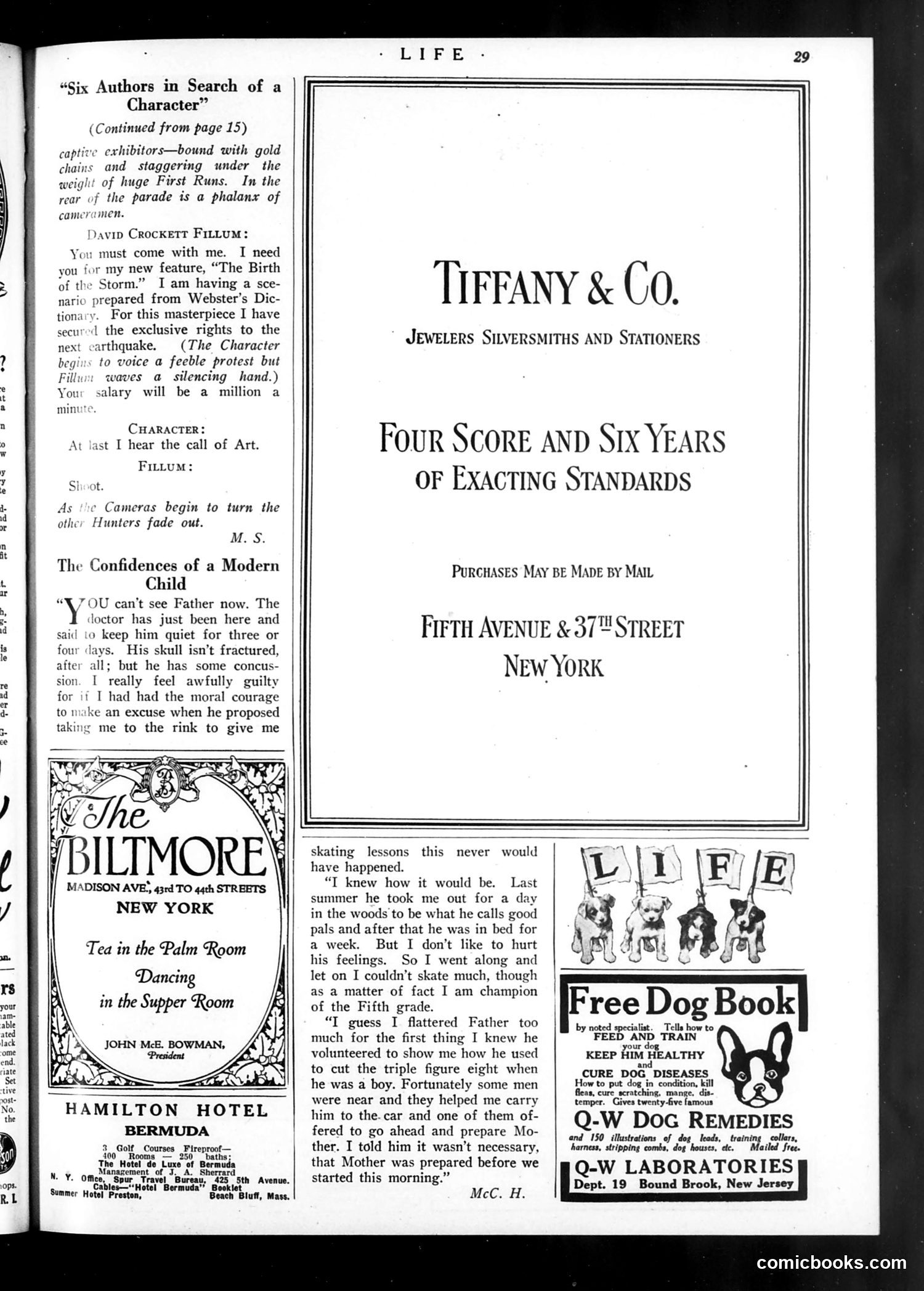
This satirical piece mocks early-20th-century parenting attitudes and children's precocious maturity. A child explains why their father is injured: he volunteered to demonstrate ice-skating tricks (specifically the "triple figure eight") to impress the child, and fell badly. The satire targets two things: fathers attempting to bond with children through vigorous activities they're too old for, and children's guilty complicity—the narrator feels responsible for the father's injury yet prioritizes not hurting his feelings over safety. The child also boasts of being "champion of the Fifth grade" at skating while pretending incompetence to flatter the father's ego. The piece satirizes both the sentimental "modern" parenting style and the sophisticated, manipulative awareness children supposedly possessed. It's a gentle critique of miscalculated attempts at companionship between generations.
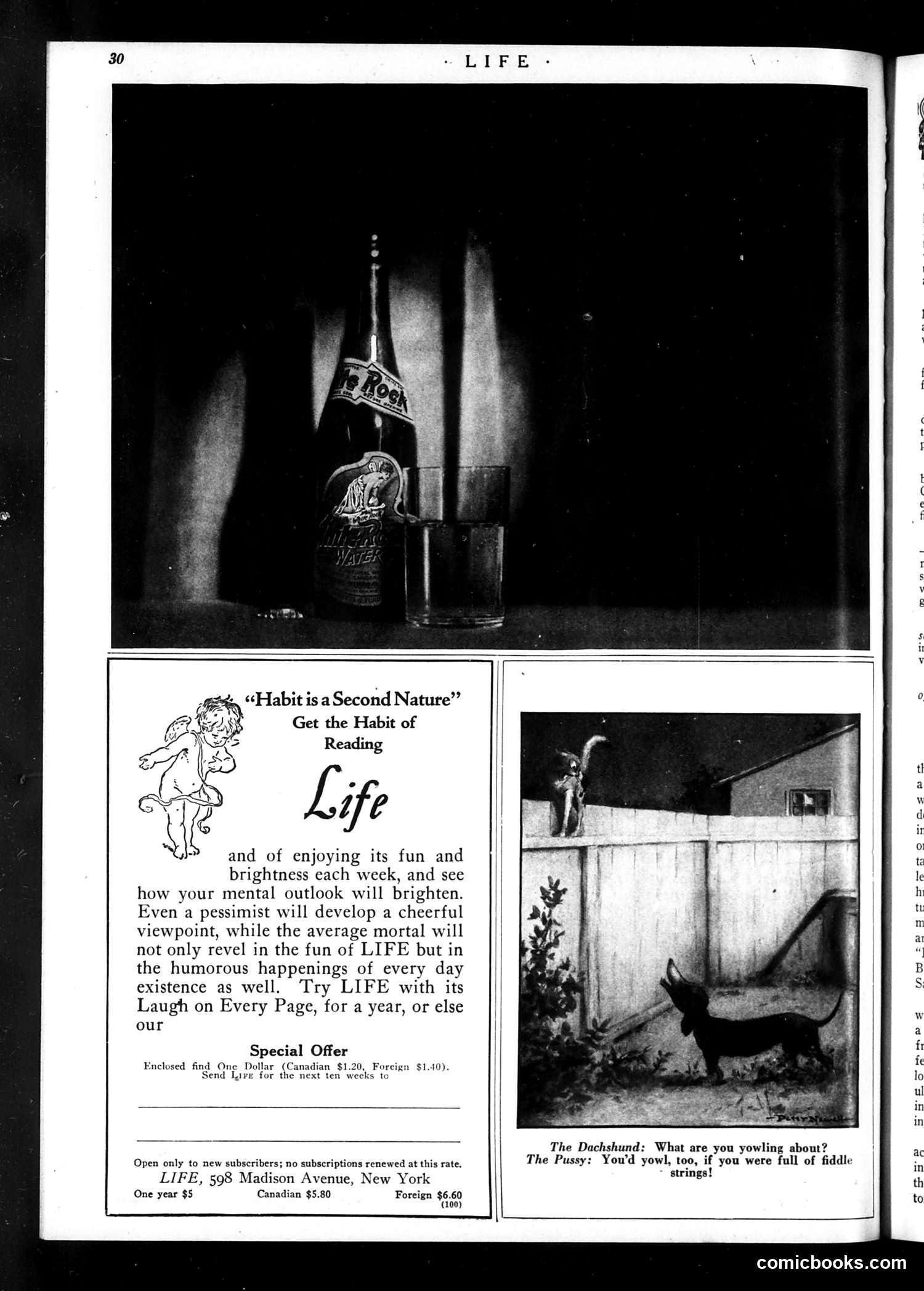
This page is primarily a **subscription advertisement** for *Life* magazine, a satirical weekly publication. The top image shows a beer bottle (likely Pabst Blue Ribbon, based on visible labeling) with candles—promoting reading as a habit. The main text uses the phrase "Habit is a Second Nature" to encourage subscriptions, promising humor and brightened outlook through weekly reading. The only actual cartoon is at bottom right: a **dog-and-cat joke** where a dachshund questions a yowling cat. The cat's punchline—"You'd yowl, too, if you were full of fiddle strings!"—is a **period joke** playing on the old superstition that cats contain fiddle strings (explaining their musical meows). This reflects early-20th-century folk humor now completely obscure. The page is essentially advertising copy with one dated visual gag, typical of magazine promotional material from this era.
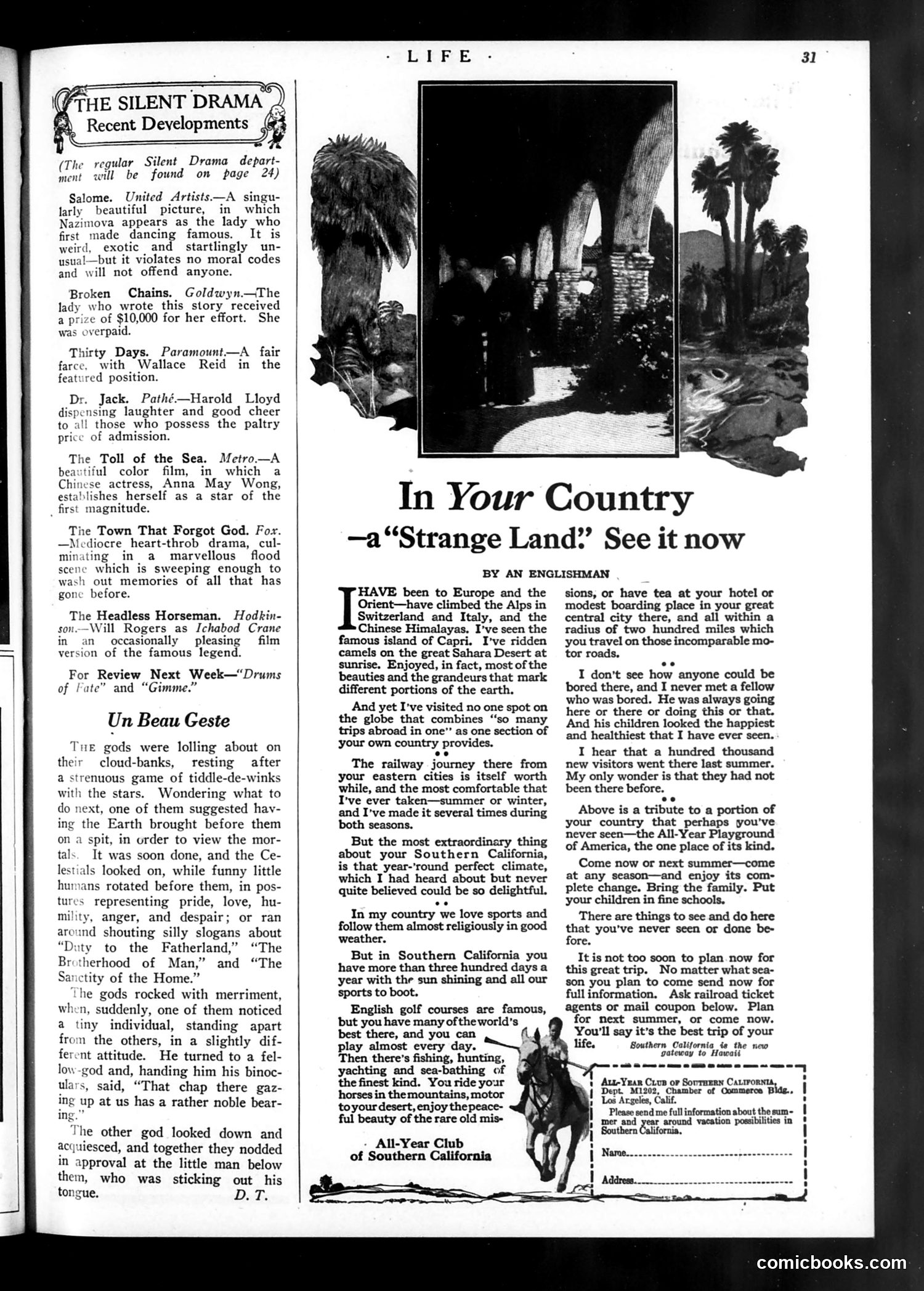
This page contains two distinct pieces of content: **"Un Beau Geste" (The Beautiful Gesture):** A satirical short story where gods observe humanity on Earth, amused by humans displaying various virtues ("Duty to the Fatherland," "Brotherhood of Man," "Sanctity of the Home"). One god notices a solitary figure with "noble bearing" standing apart—the gods approve, until the punchline reveals he's sticking out his tongue. The satire mocks the gap between pretentious public rhetoric about duty and brotherhood versus base human nature. **"In Your Country" Advertisement:** An Englishman praises Southern California's year-round climate and recreational opportunities (golf, hunting, yachting) as superior to European destinations. This is essentially a tourism advertisement promoting California as an incomparable vacation destination. The page juxtaposes cynicism about human nature with promotional optimism about American leisure and landscape—reflecting 1920s magazine culture balancing satirical commentary with commercial content.
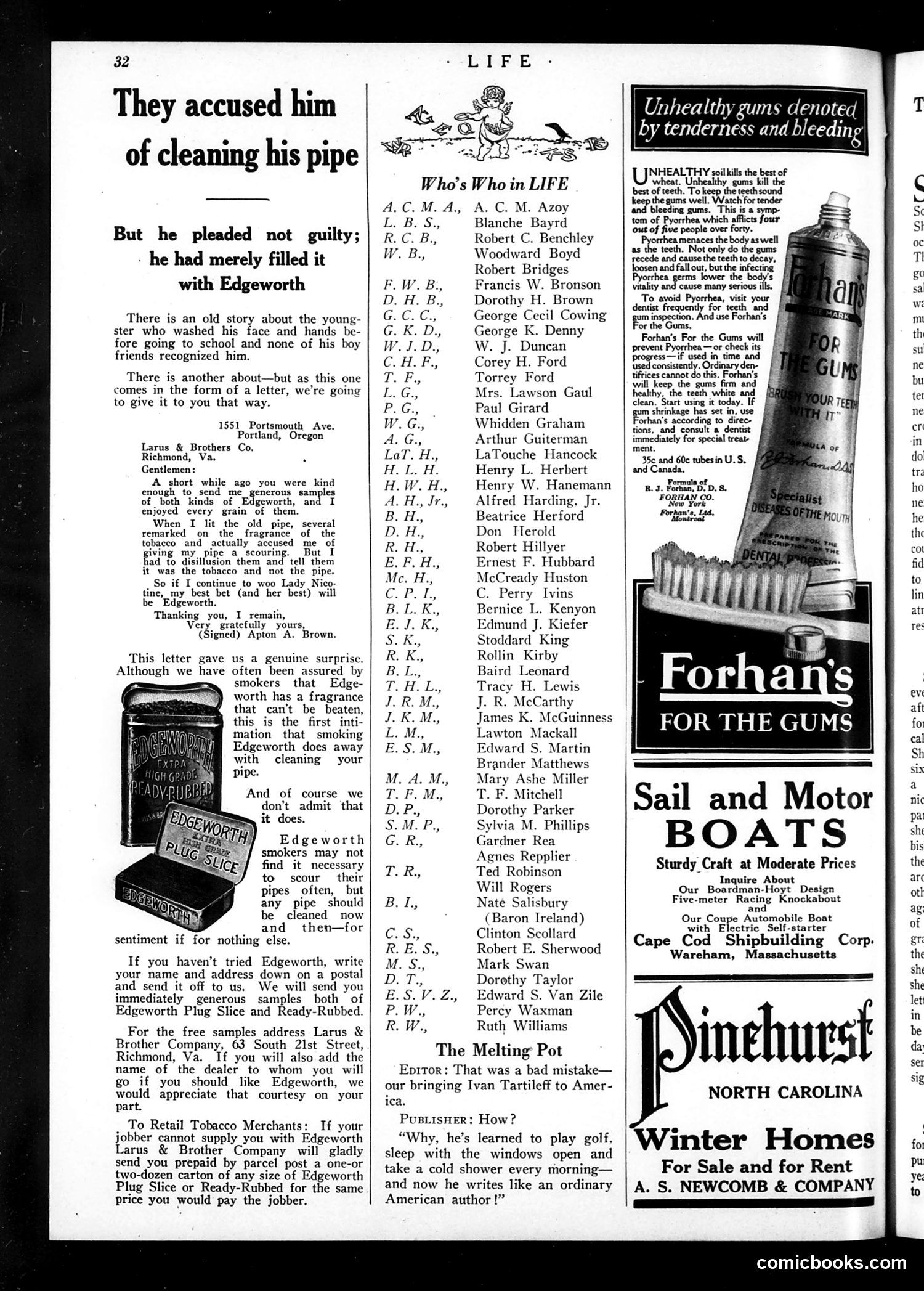
This page is primarily **advertising** for Edgeworth tobacco, framed as editorial content. The main "story" presents a letter from a customer claiming Edgeworth tobacco is so fragrant that people accused him of cleaning his pipe—implying the tobacco itself eliminates the need for pipe maintenance. The company humorously disclaims this while promoting the product's quality. The small section titled "The Melting Pot" offers social satire: an immigrant (Ivan Tartileff) has become so thoroughly "Americanized" that he's adopted American habits (golf, cold showers, sleeping with windows open) and now writes like an "ordinary American author"—suggesting that assimilation erases distinctive immigrant character. This likely reflects early-20th-century anxieties about immigration and cultural homogenization. The page also includes a "Who's Who in LIFE" directory and advertisements for boats, dental products, and real estate—typical of period magazine layouts mixing editorial, satirical, and commercial content.
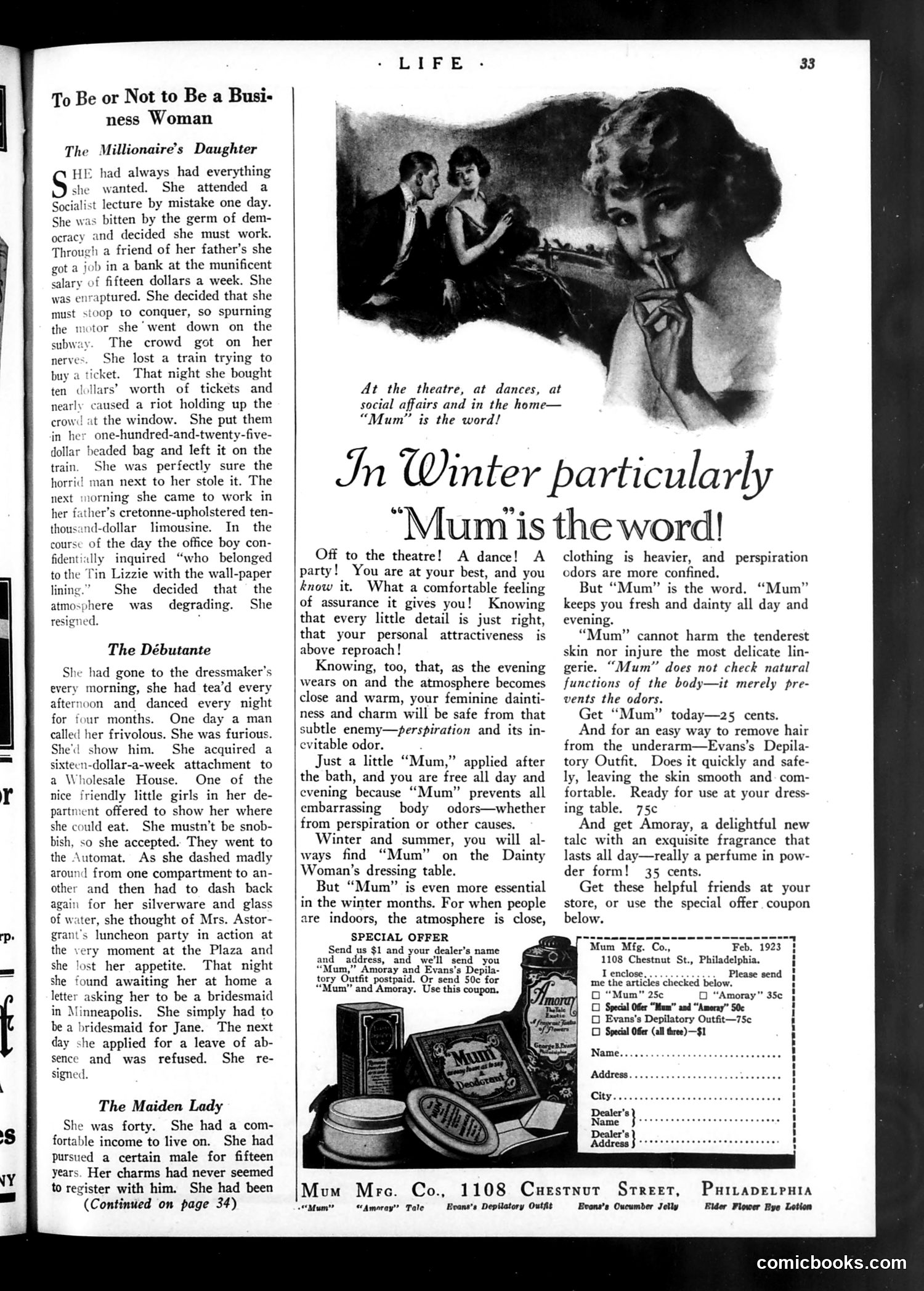
This page combines satirical short stories with a deodorant advertisement. **The Satire (left column):** Three comedic sketches mock women entering the workforce during the early 20th century. "The Millionaire's Daughter" ridicules a wealthy woman who attends a Socialist lecture, gets a $15/week bank job to "conquer," but quits after losing her $125 beaded bag on the subway—returning to her father's limousine. "The Débutante" shows a society woman who takes a job at a Wholesale House to prove she's not frivolous, but abandons it to be a bridesmaid. These stories satirize the superficiality of wealthy women dabbling in work without genuine commitment, treating employment as a temporary lark rather than necessity. **The Advertisement (right):** A "Mum" deodorant ad ironically follows, emphasizing that women attending theater, dances, and social affairs need the product to maintain "feminine daintiness"—reinforcing traditional gender expectations about appearance and propriety that the satirical stories ostensibly critique.
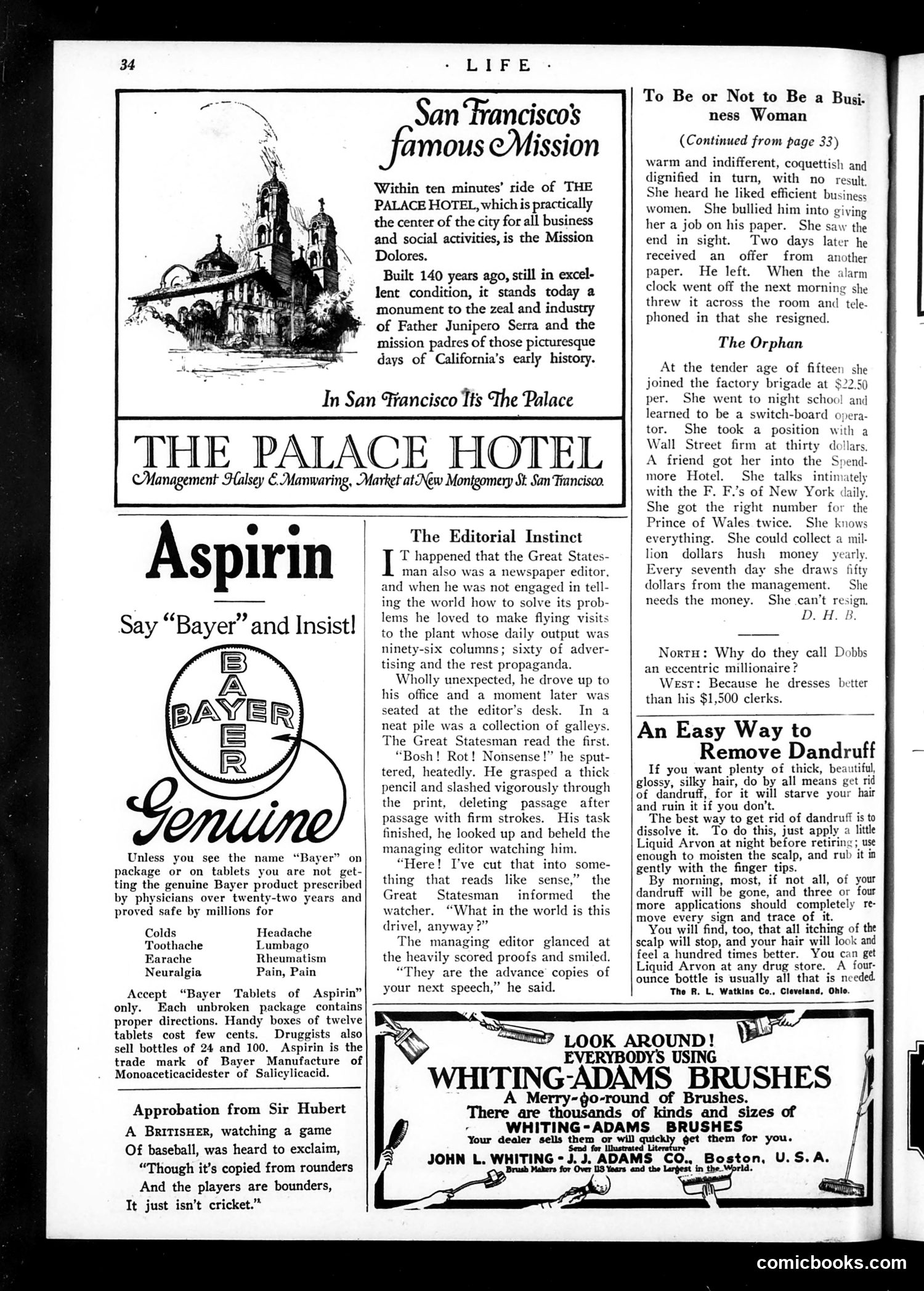
This page is predominantly **advertisements and filler content** rather than satirical cartoons. The main elements are: 1. **Palace Hotel ad** (top): Promotional material for San Francisco's Palace Hotel, highlighting nearby Mission Dolores as a tourist attraction. 2. **Bayer Aspirin ad**: A straightforward product advertisement emphasizing brand authenticity—"Say 'Bayer' and Insist!"—reflecting early-20th-century concerns about generic imitations. 3. **"The Editorial Instinct" cartoon** (center): A brief satirical piece depicting a powerful statesman visiting a newspaper office and angrily editing galleys, only to discover he's been revising his own speech—a joke about politicians' verbosity and editors' skepticism toward their output. 4. **Minor humor bits**: A British observer's comment on baseball ("It just isn't cricket") and a joke about a millionaire's sartorial taste. 5. **Various other ads and columns**: Including dandruff removal tips and Whiting-Adams brushes. The page reflects early 20th-century consumer culture and light satirical commentary on politics and journalism.
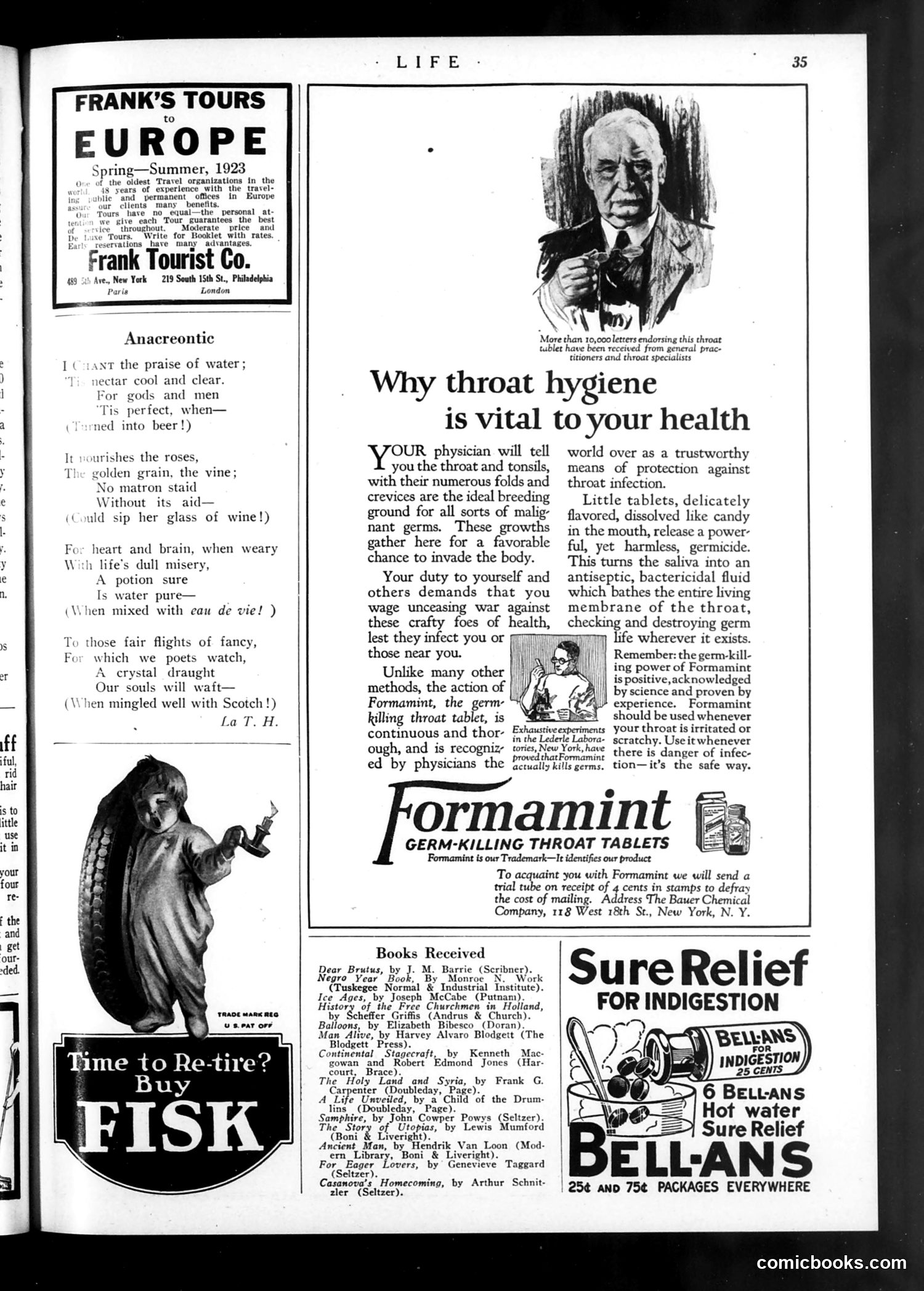
This page is primarily **advertising and book reviews**, not political satire. The main content includes: **Advertisements:** - **Formamint throat tablets**: A medical product claiming germ-killing properties, endorsed by physicians and chemists. The ad features a stern-faced man (likely a doctor) and emphasizes throat hygiene as disease prevention—typical 1920s health-anxiety marketing. - **Bell-ans indigestion remedy** and **Fisk tires**: Standard commercial ads. - **Frank's Tourist Company**: Travel packages to Europe for Spring-Summer 1923. **Literary Content:** - **"Anacreontic"**: A humorous poem praising water, then sardonically revealing the speaker actually prefers it mixed with beer, wine, or Scotch—a gentle joke on temperance hypocrisy, likely relevant to Prohibition-era America (1920s). - **Books Received**: A simple listing of newly published titles. The page reflects 1920s consumer culture, medical advertising's emphasis on germ theory and preventative health, and literary trends of that era. There is no significant political cartoon or social satire present.
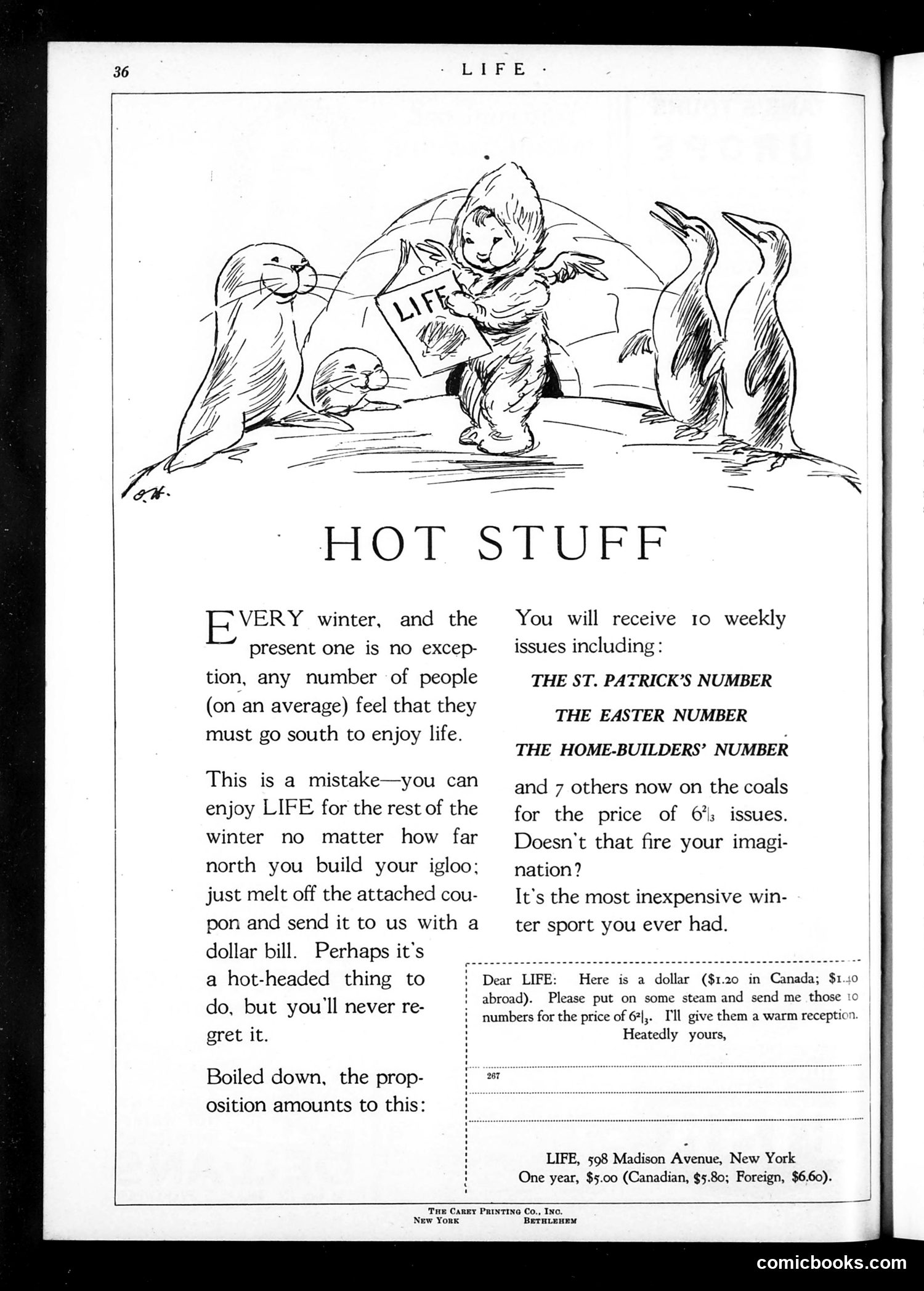
This is primarily a **subscription promotion**, not political satire. The cartoon depicts a child in arctic gear surrounded by seals and penguins, holding a *Life* magazine—a visual pun on staying warm indoors rather than traveling south for winter. The "satire" is lightweight: the ad mocks the common impulse to escape northern winters by suggesting readers stay home and enjoy *Life* magazine instead. The joke plays on "hot stuff" (appealing content) and "warm reception" (the coupon's punchline). The promotion offers 10 weekly issues—including special numbers like St. Patrick's and Easter issues—for the price of 6⅔ issues. This appears to be an economical offer marketed as affordable "winter entertainment." The page is essentially **magazine advertising** using gentle humor rather than political commentary.
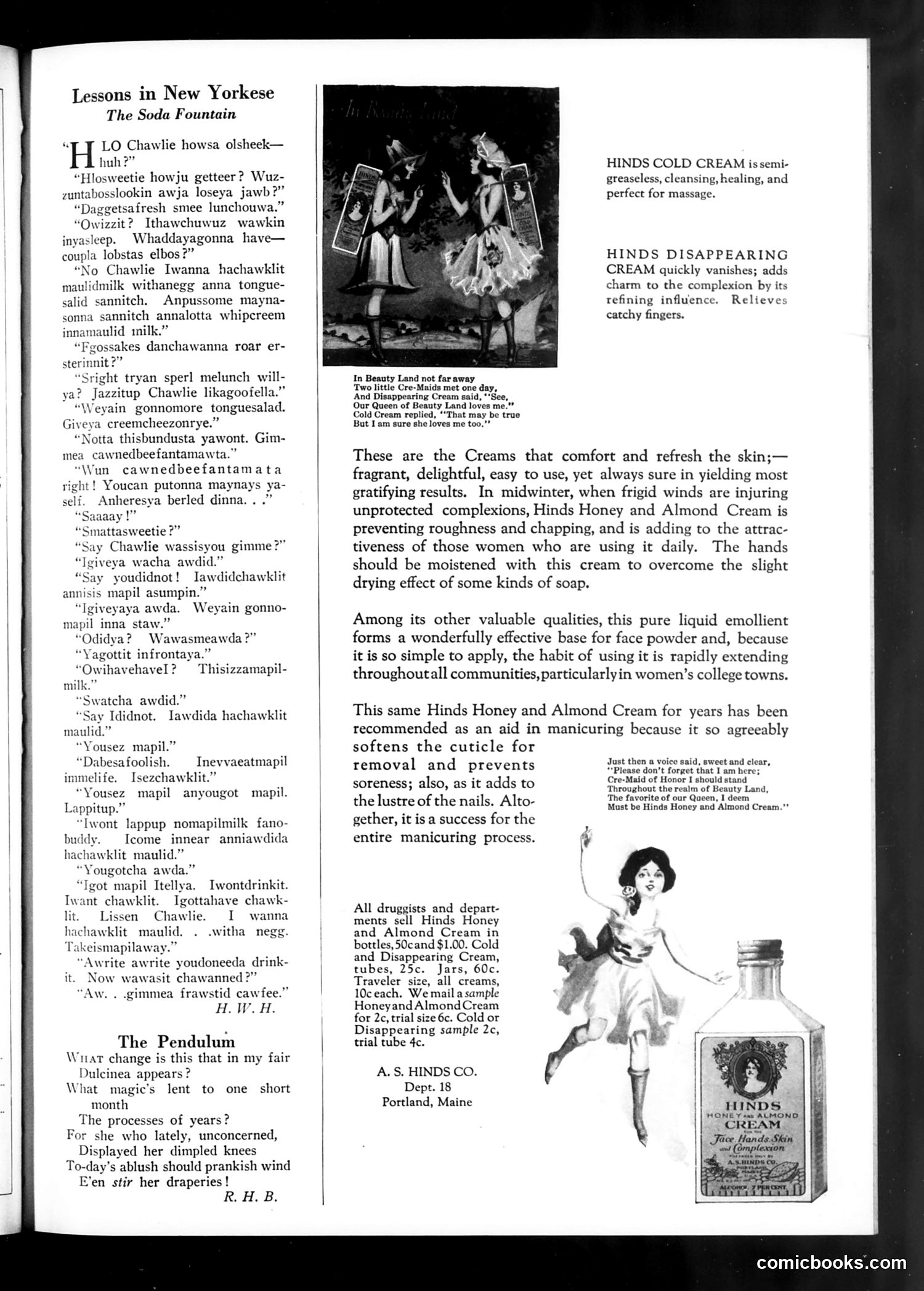
This page contains **satirical dialect humor** and **advertising**. **"Lessons in New Yorkese: The Soda Fountain"** mocks working-class New York City immigrant speech patterns—specifically the accent and slang of 1920s urban youth. The dialogue between "Chawlie" and a soda fountain worker exaggerates dropped consonants, non-standard grammar, and colloquial expressions ("Daggetsafresh smee lunchouwa," "coupla lobstas"). The satire targets the urban underclass's manner of speech as distinctly *foreign* or comical to educated readers. **"The Pendulum"** is a brief, unrelated poem about a woman's changing modesty—she once displayed her knees freely but now blushes when wind touches her clothing, suggesting shifting social standards around female propriety. The bulk of the page is **Hinds Honey and Almond Cream advertising**, featuring product descriptions, testimonial verse, and imagery of an attractive woman. This was typical Life magazine content—mixing entertainment with commercial sponsorship.
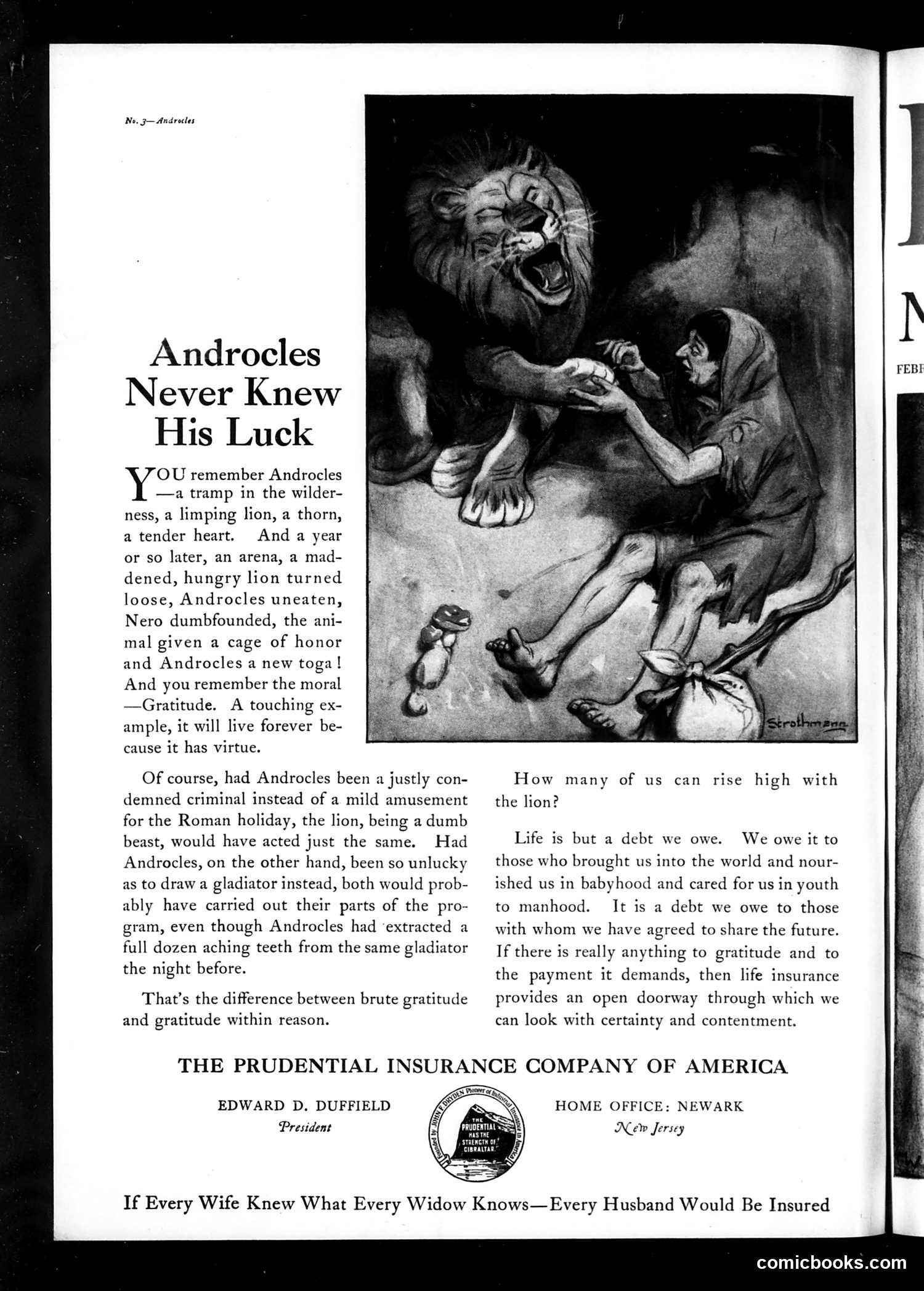
This is a Life magazine advertisement using the classical fable of Androcles and the Lion to promote life insurance. The illustration shows Androcles removing a thorn from a grateful lion's paw. The ad reframes the ancient moral lesson about gratitude to argue for financial responsibility. It contrasts "brute gratitude" (the lion's instinctive repayment) with "gratitude within reason"—implying that true gratitude means planning ahead for dependents. The final pitch targets husbands specifically: life insurance is presented as the ultimate expression of gratitude and responsibility toward wives and families. The tagline "If Every Wife Knew What Every Widow Knows—Every Husband Would Be Insured" suggests widows understand the financial devastation of an uninsured death. For modern readers: this reflects early-20th-century assumptions about male breadwinners and female financial vulnerability, using classical literature and moral philosophy to market insurance as a duty of masculine gratitude and honor.