
Life, 1923-02-01 · page 16 of 40
Life — February 1, 1923 — page 16: what you’re looking at
What you’re looking at
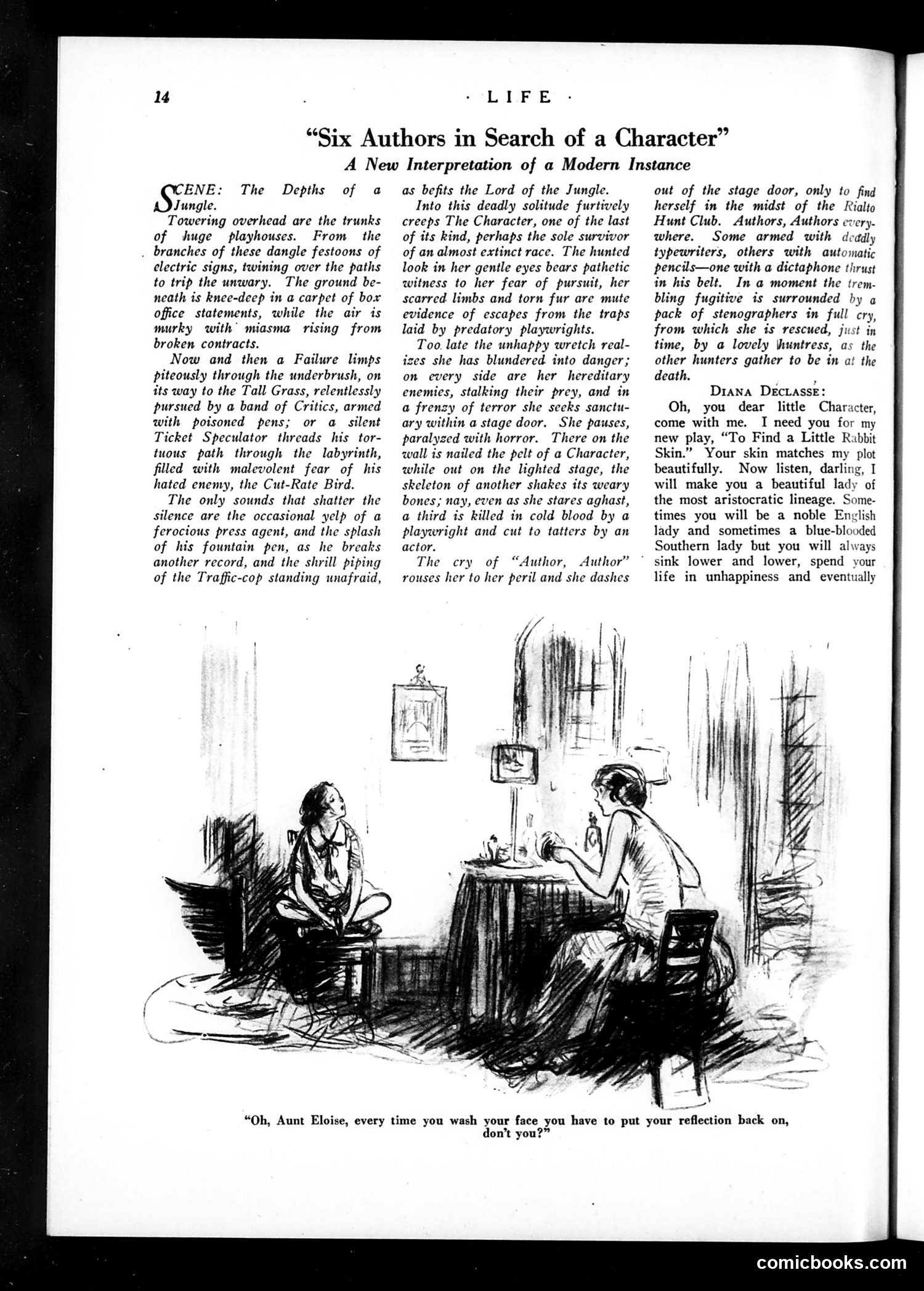
This page satirizes a theatrical work (likely referencing Pirandello's "Six Characters in Search of an Author"). The text describes a jungle setting where a mysterious "Character" eludes six authors pursuing her through various traps and dangers. The cartoon below shows two women in conversation. The caption reads: "Oh, Aunt Eloise, every time you wash your face you have to put your reflection back on, don't you?" This is a witty insult joke playing on dated female beauty standards—the implication being that Aunt Eloise's face is so plain or aged that her reflection appears to be artificial makeup rather than natural features. The humor relies on early 20th-century preoccupations with cosmetics and feminine appearance.
📄 Transcribed text from this page (OCR, searchable)
Machine-transcribed from the original scan — historical spelling and the odd misread are preserved.
LIFE “Six Authors in Search of a Character” A New Interpretation of a Modern Instance ENE: Jungle. Towering overhead are the trunks of huge playhouses. From the . branches of these dangle festoons of electric signs, twining over the paths to trip the unwary. The ground be- neath is knee-deep in a carpet of box office statements, while the air is murky with’ miasma rising from broken contracts. Now and then a Failure limps piteously through the underbrush, on its way to the Tall Grass, relentlessly pursued by a band of Critics, armed with poisoned pens; or a silent Ticket Speculator threads his tor- tuous path through the labyrinth, filled with malevolent fear of his hated enemy, the Cut-Rate Bird. The only sounds that shatter the silence are the occasional yelp of a ferocious press agent, and the splash of his fountain pen, as he breaks another record, and the shrill piping of the Traffic-cop standing unafraid, The Depths of a as befits the Lord of the Jungle. Into this deadly solitude furtively creeps The Character, one of the last of its kind, perhaps the sole survivor of an almost extinct race. The hunted look in her gentle eyes bears pathetic witness to her fear of pursuit, her scarred limbs and torn fur are mute evidence of escapes from the traps laid by predatory playwrights. Too. late the unhappy wretch real- izes she has blundered into danger; on every side are her hereditary enemies, stalking their prey, and in a frenzy of terror she seeks sanctu- ary within a stage door. She pauses, paralyzed with horror. There on the wall is nailed the pelt of a Character, while out on the lighted stage, the skeleton of another shakes its weary bones; nay, even as she stares aghast, a third is killed in cold blood by a playwright and cut to tatters by an actor. The cry of “Author, Author” rouses her to her peril and she dashes out of the stage door, only to find herself in the midst of the Rialto Hunt Club. Authors, Authors every. where. Some armed with deddly typewriters, others with automatic pencils—one with a dictaphone thrust in his belt. In a moment the trem. bling fugitive is surrounded by a pack of stenographers in full cry, from which she is rescued, just in time, by a lovely \huntress, as the other hunters gather to be in at the death, ; Diana DEcLassE: Oh, you dear little Character, come with me. I need you for my new play, “To Find a Little Rabbit Skin.” Your skin matches my plot beautifully. Now listen, darling, I will make you a beautiful lady of the most aristocratic lineage. Some- times you will be a noble English lady and sometimes a blue-blooded Southern lady but you will always * sink lower and lower, spend your life in unhappiness and eventually “Oh, Aunt Eloise, every time you wash your face you have to put your reflection back on, don’t you?” comicbooks.com