
Life, 1923-02-01 · page 22 of 40
Life — February 1, 1923 — page 22: what you’re looking at
What you’re looking at
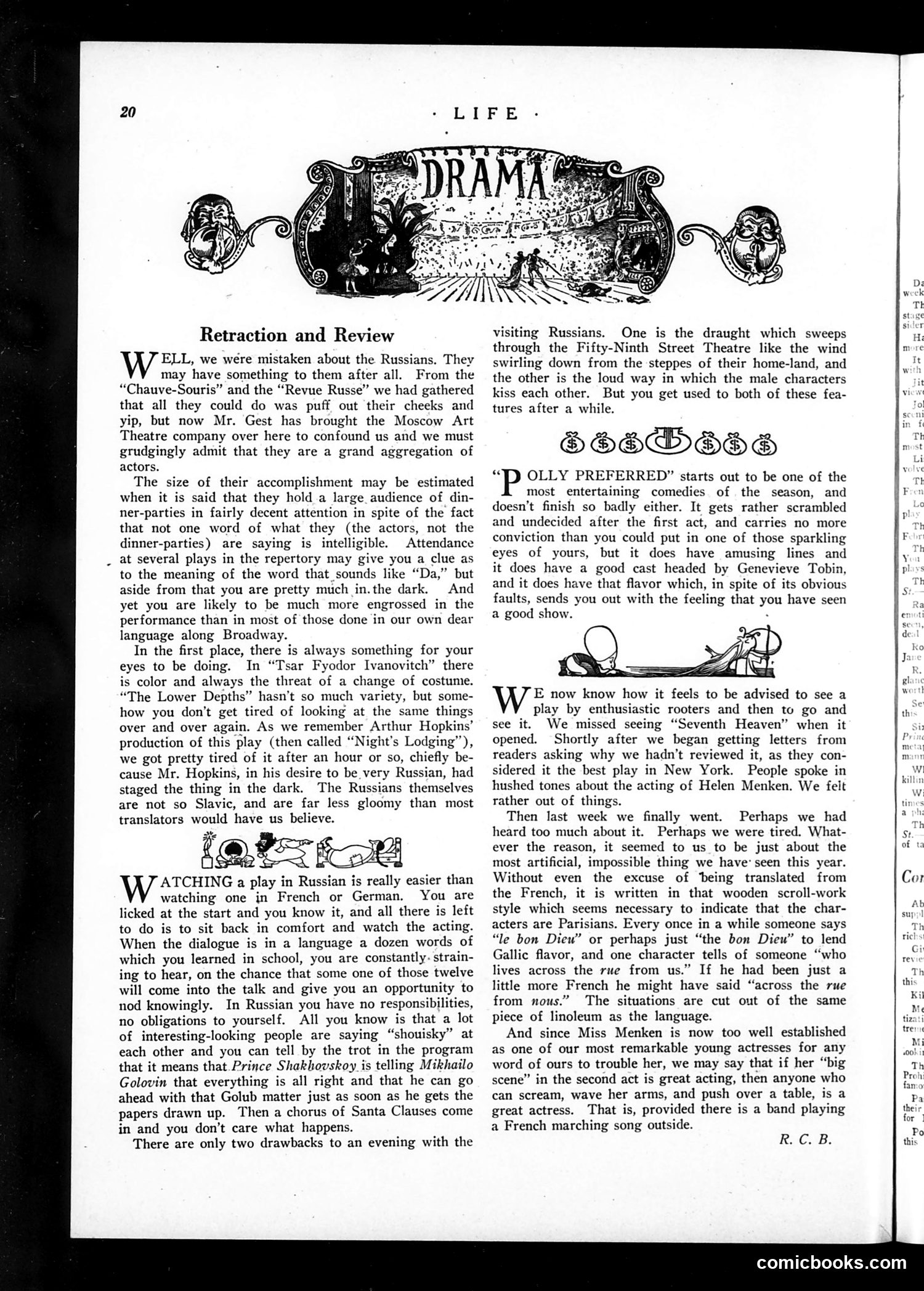
This page reviews recent theater productions, primarily the Moscow Art Theatre company's visit to New York. The critic acknowledges initial prejudice against Russian theater—previously dismissing it as mere "puffing out cheeks and yipping"—but admits the company's acting accomplishments are genuinely impressive, despite audiences understanding no Russian dialogue. The review argues that language barriers paradoxically enhance the experience: without understanding words, viewers focus entirely on physical performance and staging. The critic contrasts this favorably with Arthur Hopkins' overly dark American production of "The Lower Depths," suggesting Russian performers are "far less gloomy" than Western adaptations suggest. Additional brief reviews cover "Polly Preferred" (a mediocre comedy with Genevieve Tobin) and reference missing "Seventh Heaven" entirely. The satire targets American theatrical snobbery and xenophobia—reversing initial dismissal of Russian culture into grudging admiration, while highlighting how language barriers create unexpected advantages for foreign performance.
📄 Transcribed text from this page (OCR, searchable)
Machine-transcribed from the original scan — historical spelling and the odd misread are preserved.
Retraction and Review ELL, we were mistaken about the Russians. They may have something to them after all. From the “Chauve-Souris” and the “Revue Russe” we had gathered that all they could do was puff out their cheeks and yip, but now Mr. Gest has brought the Moscow Art Theatre company over here to confound us and we must grudgingly admit that they are a grand aggregation of actors. The size of their accomplishment may be estimated when it is said that they hold a large audience of din- ner-parties in fairly decent attention in spite of the fact that not one word of what they (the actors, not the dinner-parties) are saying is intelligible. Attendance _ at several plays in the repertory may give you a clue as to the meaning of the word that sounds like “Da,” but aside from that you are pretty much in.the dark. And yet you are likely to be much more engrossed in the performance than in most of those done in our own dear language along Broadway. In the first place, there is always something for your eyes to be doing. In “Tsar Fyodor Ivanovitch” there is color and always the threat of a change of costume. “The Lower Depths” hasn't so much variety, but some- how you don’t get tired of looking at the same things over and over again. As we remember Arthur Hopkins’ production of this play (then called “Night's Lodging”), we got pretty tired of it after an hour or so, chiefly be- cause Mr. Hopkins, in his desire to be very Russian, had staged the thing in the dark. The Russians themselves are not so Slavic, and are far less gloomy than most translators would have us believe. ON pent: \ K 7 ATCHING a play in Russian is really easier than watching one in French or German. You are licked at the start and you know it, and all there is left to do is to sit back in comfort and watch the acting. When the dialogue is in a language a dozen words of which you learned in school, you are constantly. strain- ing to hear, on the chance that some one of those twelve will come into the talk and give you an opportunity to nod knowingly. In Russian you have no responsibilities, no obligations to yourself. All you know is that a lot of interesting-looking people are saying “shouisky” at each other and you can tell by the trot in the program that it means that. Prince Shakhovskoy is telling Mikhailo Golovin that everything is all right and that he can go ahead with that Golub matter just as soon as he gets the papers drawn up. Then a chorus of Santa Clauses come in and you don’t care what happens. There are only two drawbacks to an evening with the visiting Russians. One is the draught which sweeps through the Fifty-Ninth Street Theatre like the wind swirling down from the steppes of their home-land, and the other is the loud way in which the male characters kiss each other. But you get used to both of these fea- tures after a while. EMSC NEN) ss OLLY PREFERRED” starts out to be one of the most entertaining comedies of the season, and doesn’t finish so badly either. It gets rather scrambled and undecided after the first act, and carries no more conviction than you could put in one of those sparkling eyes of yours, but it does have amusing lines and it does have a good cast headed by Genevieve Tobin, and it does have that flavor which, in spite of its obvious faults, sends you out with the feeling that you have seen a good show. : E now know how it feels to be advised to see a play by enthusiastic rooters and then to go and see it. We missed seeing “Seventh Heaven” when it opened. Shortly after we began getting letters from readers asking why we hadn't reviewed it, as they con- sidered it the best play in New York. People spoke in hushed tones about the acting of Helen Menken. We felt rather out of things. Then last week we finally went. Perhaps we had heard too much about it. Perhaps we were tired. What- ever the reason, it seemed to us to be just about the most artificial, impossible thing we have: seen this year. Without even the excuse of ‘being translated from the French, it is written in that wooden scroll-work style which seems necessary to indicate that the char- acters are Parisians. Every once in a while someone says “le bon Dieu” or perhaps just “the bon Dieu” to lend Gallic flavor, and one character tells of someone “who lives across the rue from us.” If he had been just a little more French he might have said “across the rue from nous.” The situations are cut out of the same piece of linoleum as the language. And since Miss Menken is now too well established as one of our most remarkable young actresses for any word of ours to trouble her, we may say that if her “big scene” in the second act is great acting, then anyone who can scream, wave her arms, and push over a table, is a great actress. That is, provided there is a band playing a French marching song outside. R.C. B. comicbooks.com