
Life, 1923-02-01 · page 26 of 40
Life — February 1, 1923 — page 26: what you’re looking at
What you’re looking at
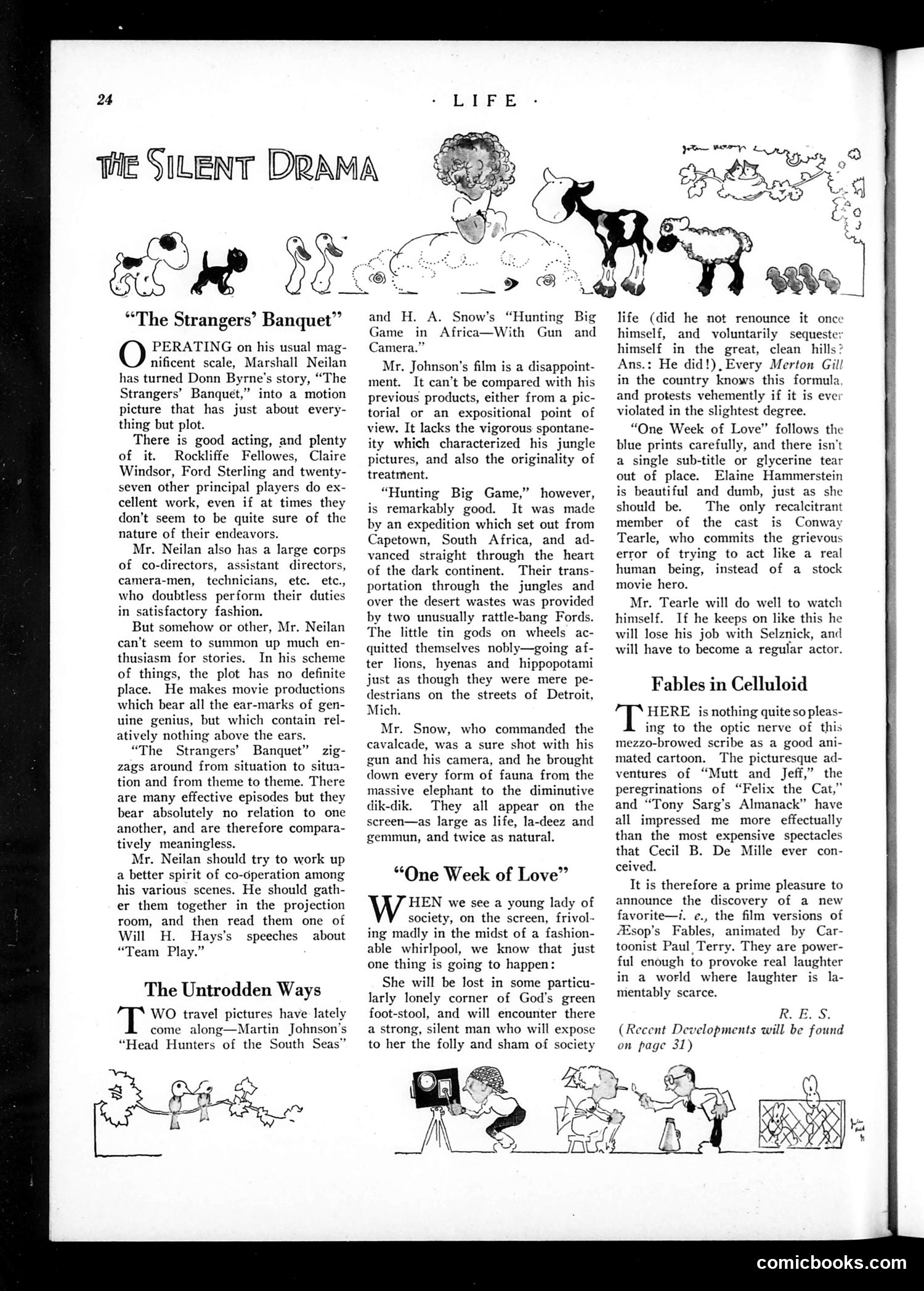
This page reviews four silent films with satirical commentary typical of Life's irreverent style. The critic praises technical execution while mocking narrative laziness: **"The Strangers' Banquet"** — Director Marshall Neilan is criticized for spectacular production values but incoherent plotting. The satire: he's a visual perfectionist who neglects storytelling, assembling impressive scenes that don't connect meaningfully. The "Team Play" reference mocks Will Hays' industry leadership rhetoric. **Travel pictures** — Martin Johnson's "Head Hunters" disappoints; H.A. Snow's "Hunting Big Game" succeeds partly through comic absurdity: Ford automobiles transporting hunters through African wilderness as casually as Detroit streets. **"One Week of Love"** — The critic ridicules the formulaic plot device (society girl meets noble rustic who rejects civilization), noting actors perform prescribed roles. Conway Tearle commits the cardinal sin of "trying to act like a real human being"—breaking the convention that silent film characters should be stylized, not naturalistic. The overarching satire: Hollywood prioritizes spectacle, formula, and convention over genuine artistry or human authenticity.
📄 Transcribed text from this page (OCR, searchable)
Machine-transcribed from the original scan — historical spelling and the odd misread are preserved.
24 Te SILENT DRAMA an “The Strangers’ Banquet” O PERATING on his usual mag- nificent scale, Marshall Neilan has turned Donn Byrne's story, “The Strangers’ Banquet,” into a motion picture that has just about every- thing but plot. There is good acting, and plenty of it. Rockliffe Fellowes, Claire Windsor, Ford Sterling and twenty- seven other principal players do ex- cellent work, even if at times they don’t seem to be quite sure of the nature of their endeavors. Mr. Neilan also has a large corps of co-directors, assistant directors, camera-men, technicians, etc. etc., who doubtless perform their duties in satisfactory fashion. But somehow or other, Mr. Neilan can’t seem to summon up much en- thusiasm for stories. In his scheme of things, the plot has no definite place. He makes movie productions which bear all the ear-marks of gen- uine genius, but which contain rel- atively nothing above the ears. “The Strangers’ Banquet” zig- zags around from situation to situa- tion and from theme to theme. There are many effective episodes but they bear absolutely no relation to one another, and are therefore compara- tively meaningless. Mr. Neilan should try to work up a better spirit of co-operation among his various scenes. He should gath- er them together in the projection room, and then read them one of Will H. Hays’s speeches about “Team Play.” The Untrodden Ways WO travel pictures have lately come along—Martin Johnson's “Head Hunters of the South Seas” eA Py and H. A. Snow’s “Hunting Big Game in Africa—With Gun and Camera.” Mr. Johnson’s film is a disappoint- ment. It can’t be compared with his previous products, either from a pic- torial or an expositional point of view. It lacks the vigorous spontane- ity which characterized his jungle pictures, and also the originality of treatment. “Hunting Big Game,” however, is remarkably good. It was made by an expedition which set out from Capetown, South Africa, and ad- vanced straight through the heart of the dark continent. Their trans- portation through the jungles and over the desert wastes was provided by two unusually rattle-bang Fords. The little tin gods on wheels ac- quitted themselves nobly—going af- ter lions, hyenas and hippopotami just as though they were mere pe- destrians on the streets of Detroit, Mich. Mr. Snow, who commanded the cavalcade, was a sure shot with his gun and his camera, and he brought down every form of fauna from the massive elephant to the diminutive dik-dik. They all appear on the screen—as large as life, la-deez and gemmun, and twice as natural. “One Week of Love” HEN we see a young lady of society, on the screen, frivol- ing madly in the midst of a fashion- able whirlpool, we know that just one thing is going to happen: She will be lost in some particu- larly lonely corner of God's green foot-stool, and will encounter there a strong, silent man who will expose to her the folly and sham of society life (did he not renounce it once himself, and voluntarily seque: himself in the great, clean hills? Ans.: He did!), Every Merton Gill in the country knows this formula and protests vehemently if it is ever violated in the slightest degree. “One Week of Love” follows the blue prints carefully, and there isn’t a single sub-title or glycerine tear out of place. Elaine Hammerstein is beautiful and dumb, just as she should be. The only recalcitrant member of the cast is Conway Tearle, who commits the grievous error of trying to act like a real human being, instead of a_ stock movie hero. Mr. Tearle will do well to watch himself. If he keeps on like this he will lose his job with Selznick, and will have to become a regular actor. Fables in Celluloid HERE is nothing quite so pleas- ing to the optic nerve of this mezzo-browed scribe as a good ani- mated cartoon. The picturesque ad- ventures of “Mutt and Jeff,” the peregrinations of “Felix the Cat,” and “Tony Sarg’s Almanack” have all impressed me more effectually than the most expensive spectacles that Cecil B. De Mille ever con- ceived. It is therefore a prime pleasure to announce the discovery of a new favorite—i. e., the film versions of ZEsop's Fables, animated by Car- toonist Paul Terry. They are power- ful enough to provoke real laughter in a world where laughter is la- mentably scarce. RB. S. (Recent Developments will be found on page 31) / iN x. ate a . “S : Wi comicbooks.com