
A complete issue · 37 pages · 1922
Life — December 28, 1922
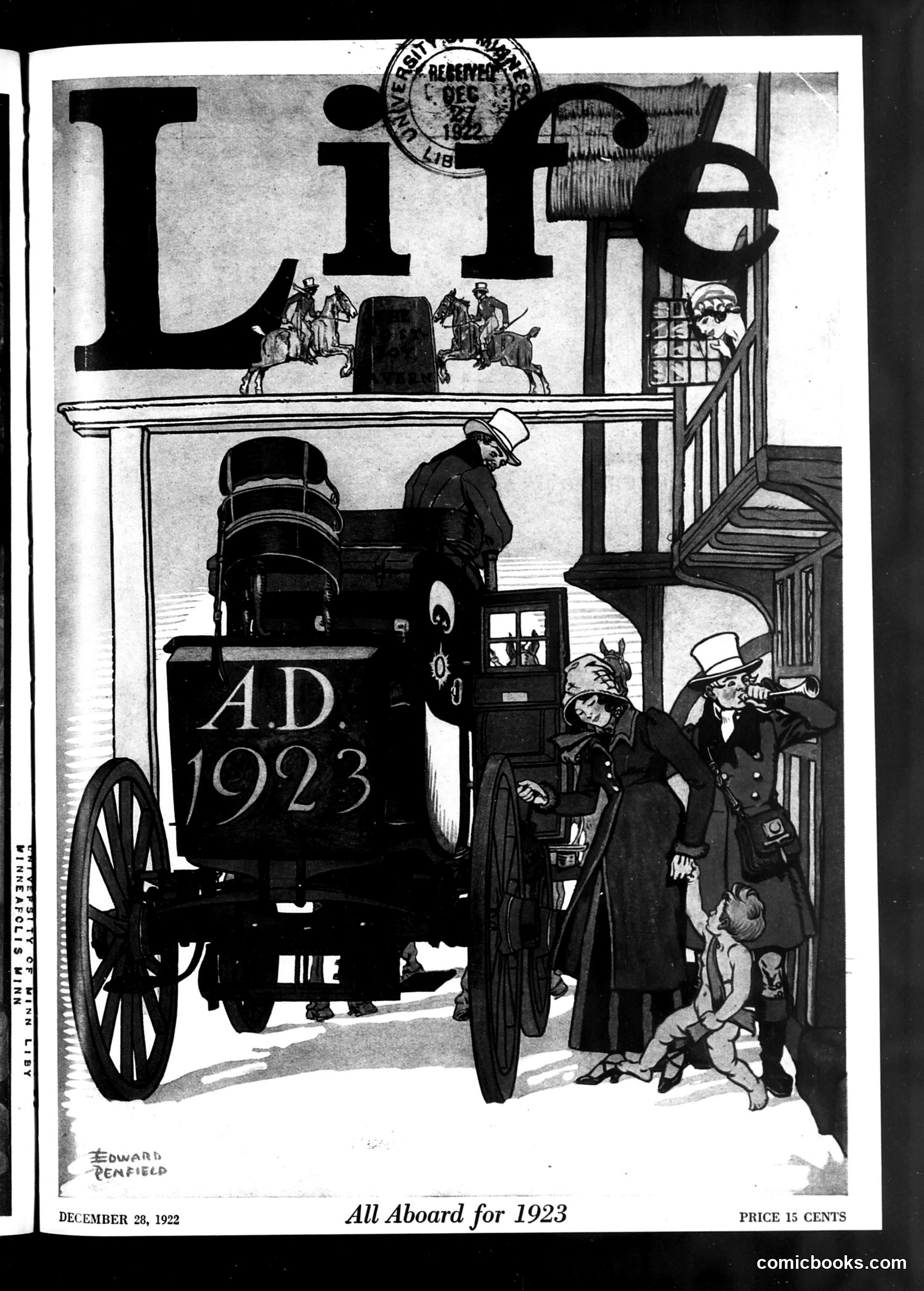
This December 28, 1922 *Life* cover illustrates "All Aboard for 1923"—a New Year's themed cartoon. The large wagon marked "A.D. 1923" represents the approaching year, driven by a figure in a top hat. Passengers boarding include well-dressed men in formal attire and top hats, suggesting prominent citizens or politicians embarking on 1923's journey. The miniature scene atop the wagon depicts figures on horseback, possibly referencing contemporary political or social events of late 1922, though the specific reference is unclear from the image alone. The satire humorously presents the new year as a vehicle carrying America's establishment figures forward. The artist Edward Penfield's signature appears at bottom. The cover's cheerful tone suggests optimism about the coming year.
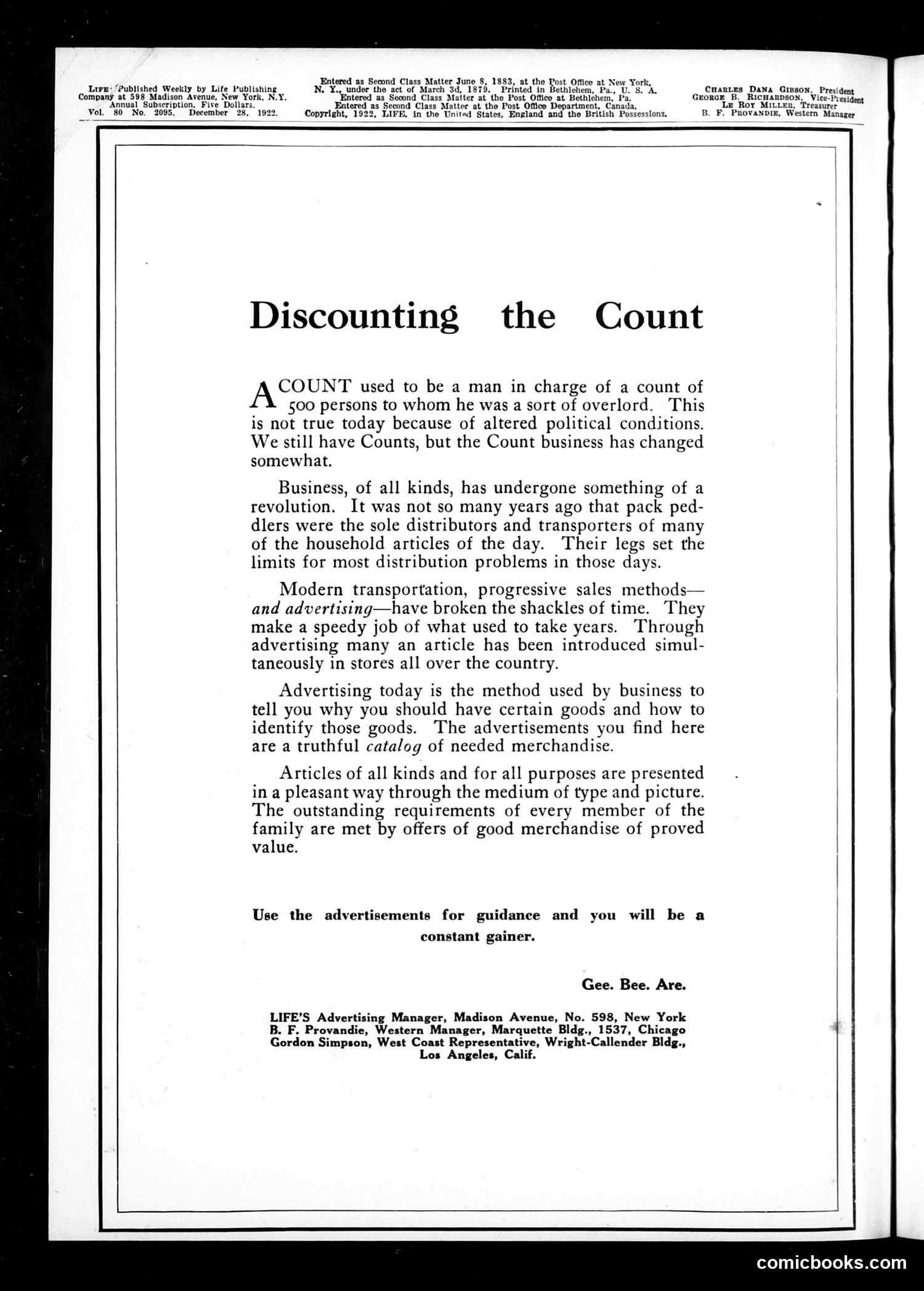
This page is primarily **advertising copy**, not a political cartoon. It's an editorial message from Life's advertising manager explaining how modern business practices have transformed distribution and sales. The title "Discounting the Count" is a pun: it plays on the obsolete position of a "Count" (a feudal overlord managing 500 people) to argue that such hierarchical business structures are outdated. Modern transportation, sales methods, and advertising have "broken the shackles of time," allowing simultaneous nationwide product distribution. The piece positions Life's advertisements as a "truthful catalog of needed merchandise" that guides consumers. The message ends with "Gee. Bee. Are." (an acronym for the advertising managers listed below). This reflects 1920s optimism about mass marketing and national commerce replacing older commercial systems.
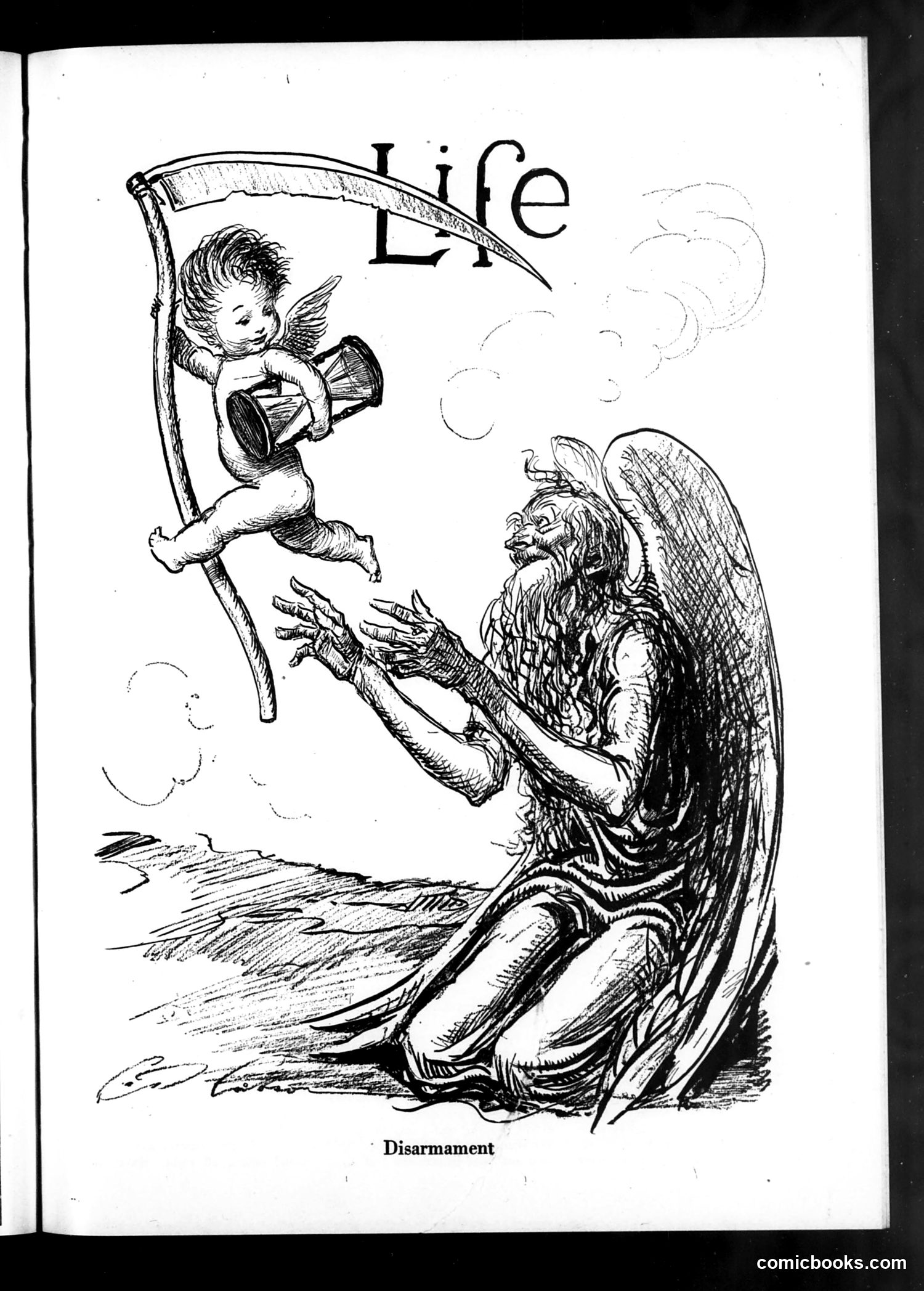
This cartoon depicts an allegorical scene about military disarmament. A winged demon or devil figure—representing war, conflict, or militarism—kneels before a cherubic baby angel holding a scythe labeled "Life." The baby appears to be offering the scythe as a symbol of peace or the end of warfare. The caption "Disarmament" suggests this satirizes contemporary disarmament debates, likely from the 1920s-1930s era when international peace movements gained traction. The satire appears cynical: the demon's suppliant posture suggests war's reluctant surrender to peace, yet the baby wields a weapon (the scythe), implying that achieving true disarmament may require force or that peace itself remains elusive and potentially violent.
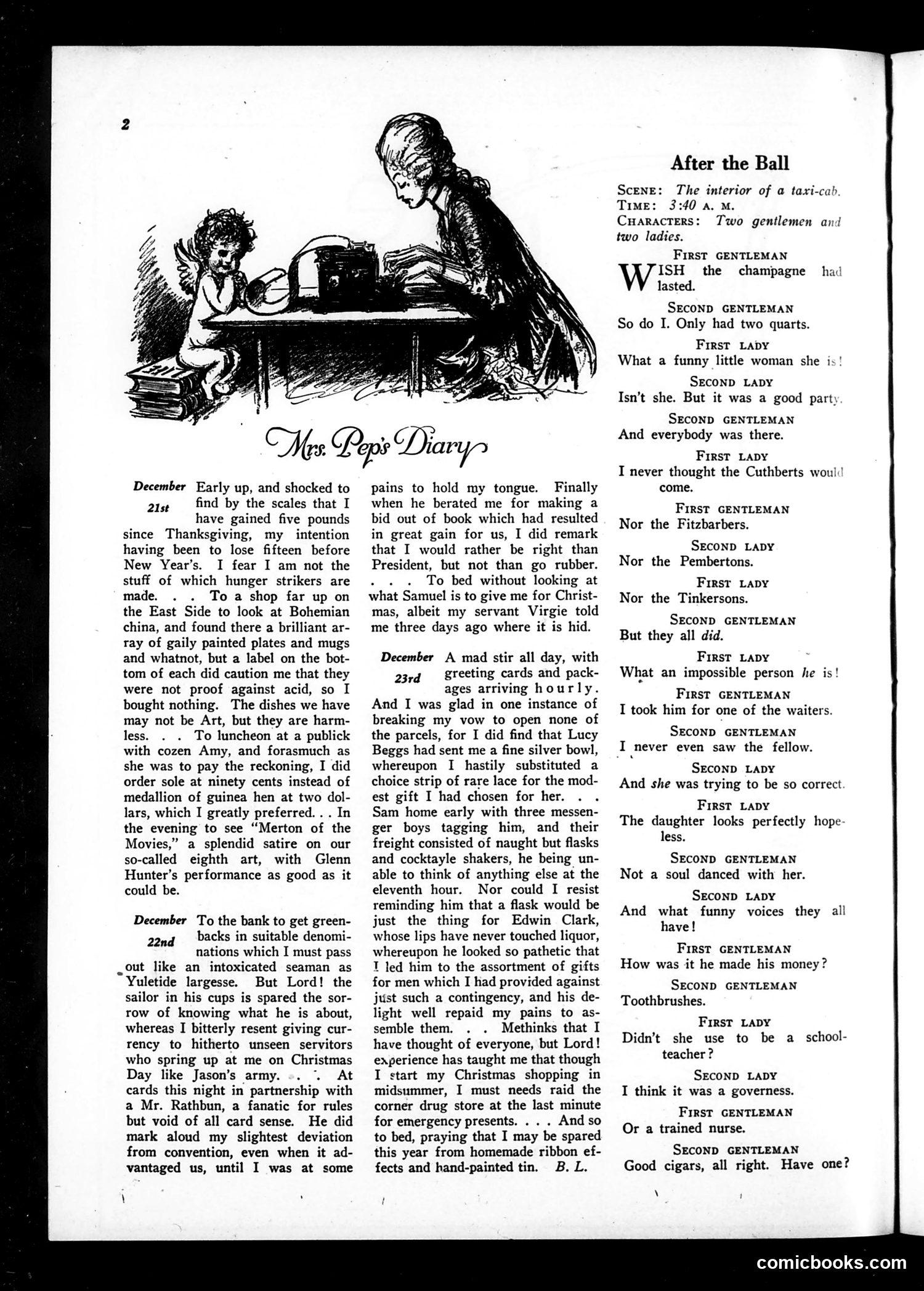
This page presents a satirical dramatic scene set in a taxi at 3:40 a.m. following a formal ball. The sketch depicts two gentlemen and two ladies discussing the evening's events and gossip. The humor centers on post-party social commentary: the gentlemen discuss their limited alcohol consumption, while the ladies critique an attendee's behavior and appearance—particularly a woman described as "impossible" and "hopeless" who apparently didn't dance. There's mockery of her education level (possibly a governess or trained nurse). The accompanying diary entries from "Mrs. Pep's Diary" (December 21st and 23rd) provide additional satirical observations about holiday shopping, gift-giving anxieties, and social obligations among the upper classes. The overall satire targets early 20th-century elite social pretensions and the tedious nature of high-society events and gossip.
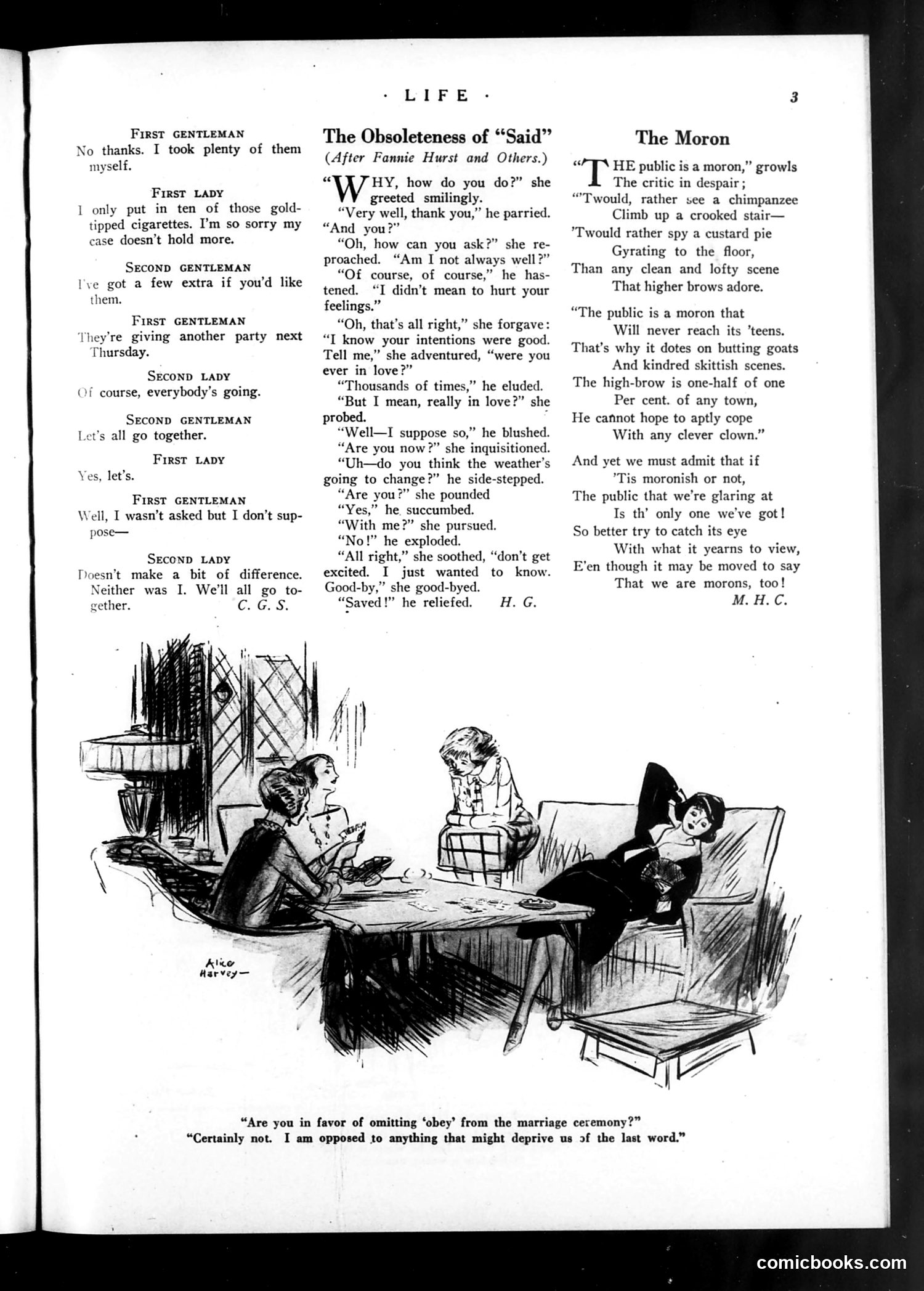
This page contains three distinct pieces of humor: 1. **"The Obsoleteness of 'Said'"** — A dialogue satire mocking overwrought Victorian prose. The author critiques writers who replace the simple word "said" with elaborate alternatives like "breathed," "soothed," and "pursued." The humor lies in demonstrating how ridiculous this stylistic excess becomes. 2. **"The Moron"** — A poem attacking public taste, suggesting average people appreciate lowbrow entertainment (slapstick, "skittish scenes") rather than sophisticated culture. The critic expresses contempt for popular preferences. 3. **The cartoon** below shows a social scene where a man lies on a couch while women converse, accompanying a caption about omitting "obey" from marriage vows—satirizing contemporary debates over modern marriage and women's rights. All pieces reflect early 20th-century intellectual commentary on language, taste, and social change.
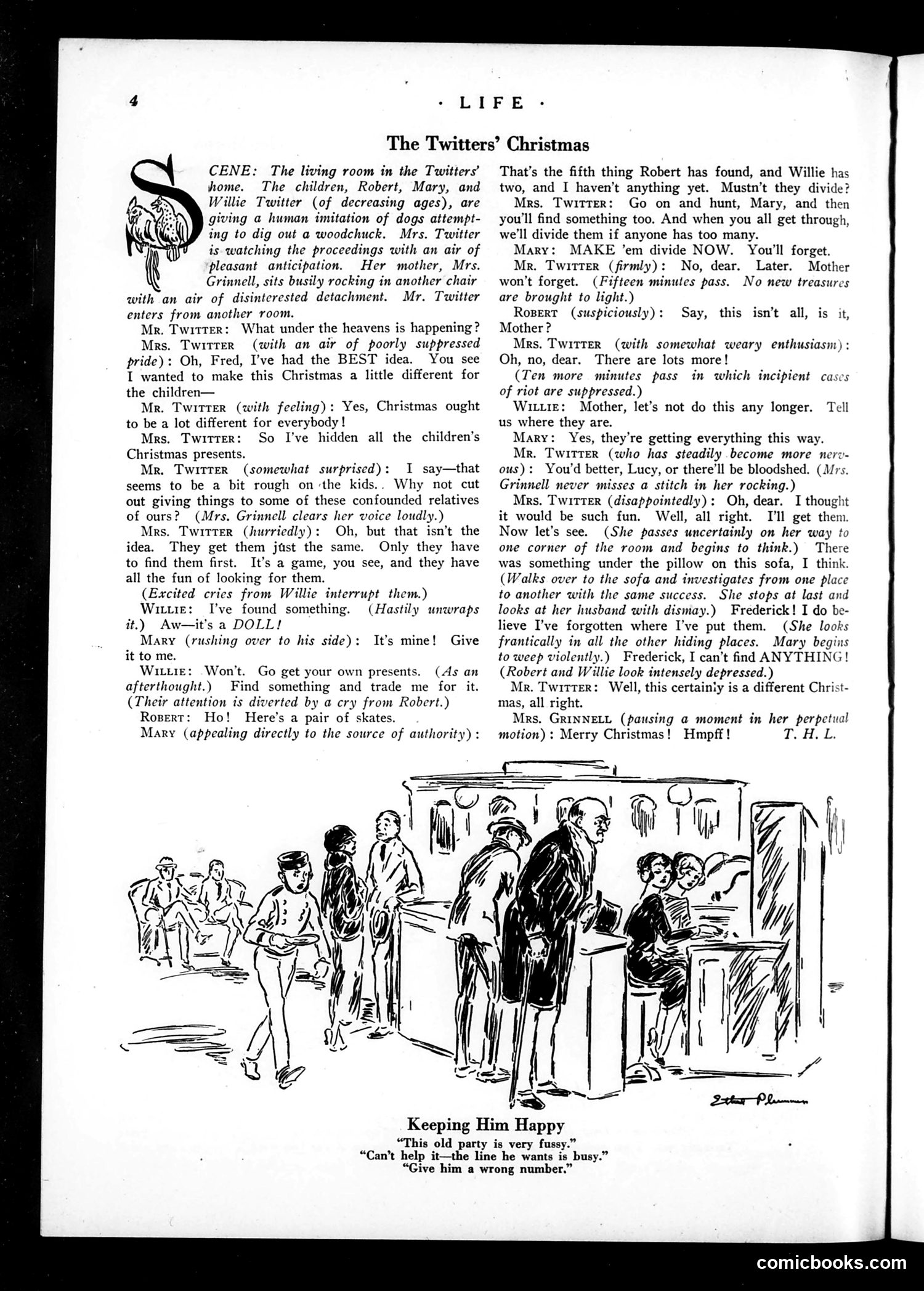
This is a satirical domestic comedy sketch about a chaotic middle-class household during Christmas preparations. The Twitters family—parents Mr. and Mrs. Twitter with children Robert, Mary, and Willie—attempt to hide Christmas presents but constantly bicker over where items are hidden and whether gifts should be divided equally among the children. The satire targets: 1) the commercialization of Christmas through excessive gift-giving, 2) the difficulty of maintaining Christmas "magic" when children are present, and 3) class anxieties about proper holiday conduct. Mrs. Grinnell's final "Merry Christmas! Humph!" suggests the general dissatisfaction underlying holiday gatherings. The accompanying cartoon "Keeping Him Happy" depicts a crowded party with related holiday social performance anxiety.
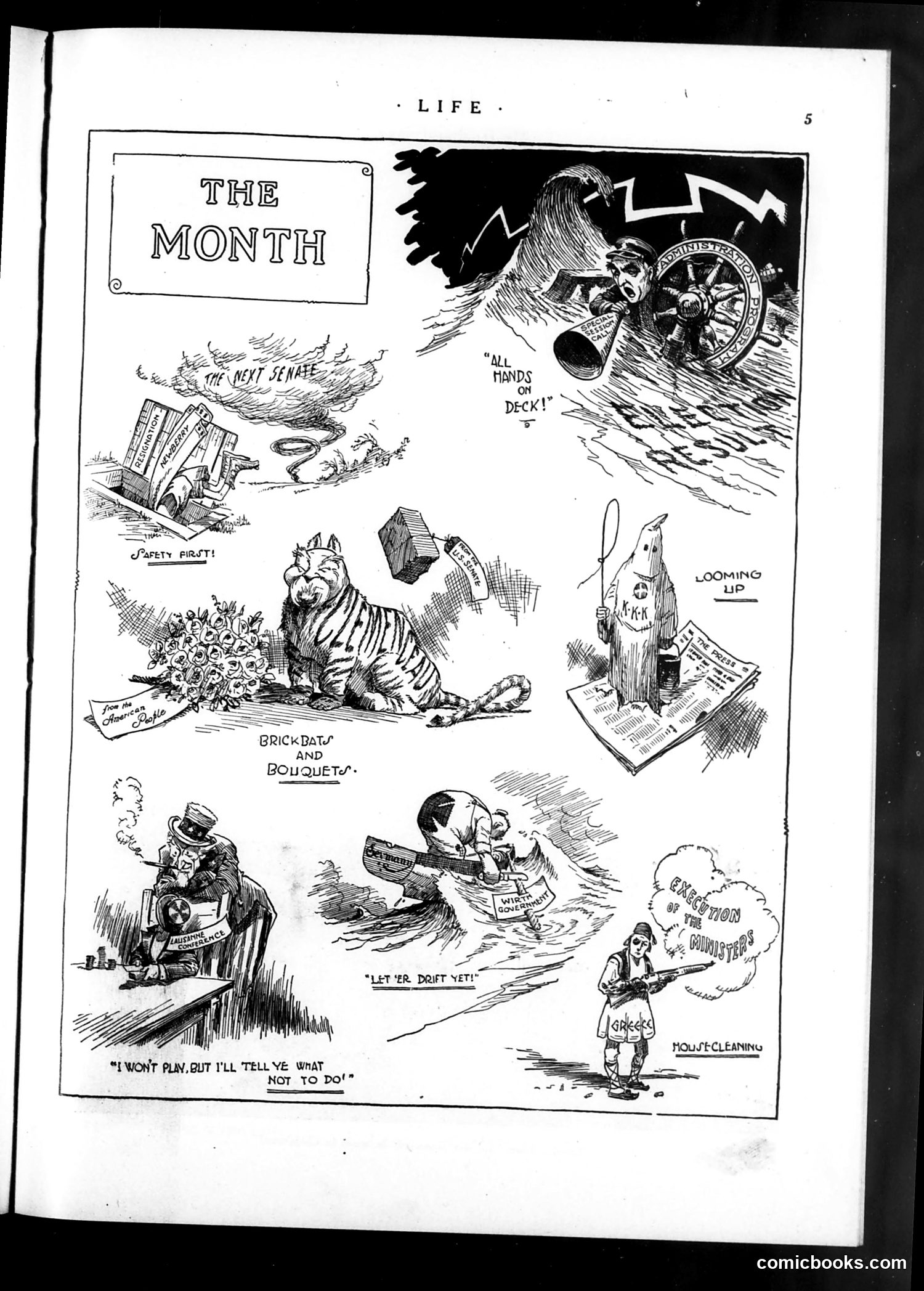
This page presents six political cartoons satirizing early 20th-century issues: 1. **"Safety First!"** - Overturned Senate with papers scattered, mocking Congressional incompetence 2. **"Brick Dust and Bouquets"** - A dog receiving flowers, likely satirizing hollow praise given to political figures 3. **"Hands on Deck"** - A military/naval vessel in distress, suggesting military unpreparedness 4. **"Looming Up"** - An ominous figure emerging from newspapers, representing a gathering threat 5. **"I Won't Play, But I'll Tell You What Not to Do"** - A figure giving unwanted advice, criticizing armchair politicians 6. **"House Cleaning"** - A Greek figure sweeping, likely referencing governmental reform efforts The cartoons collectively critique political leadership, military readiness, and public discourse of the era through exaggeration and symbolic imagery typical of Progressive-era satire.
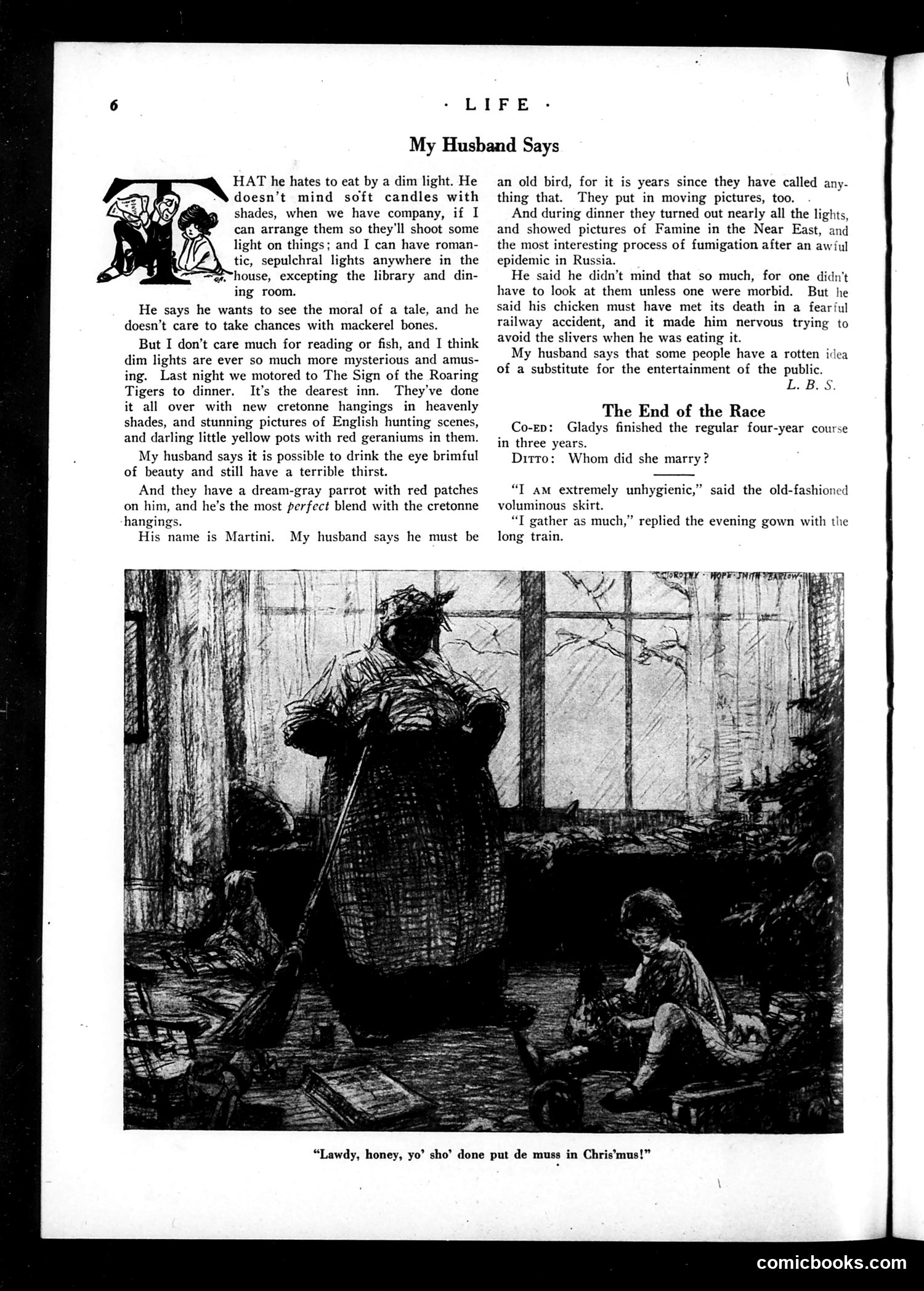
This page contains two separate pieces. "My Husband Says" is a humorous domestic column where a wife complains about her husband's peculiar tastes—he dislikes dim lighting, prefers realistic moral tales, and frequents an inn called The Sign of the Roaring Tigers. The humor derives from her exasperated cataloging of his odd preferences. "The End of the Race" appears to be a brief comedic dialogue about a woman who completed a four-year course in three years, with wordplay about hygiene and fashion. The accompanying illustration depicts a woman with children in what appears to be a tenement or modest home, with the caption suggesting domestic comedy about putting "muss" (mess) in Christmas.
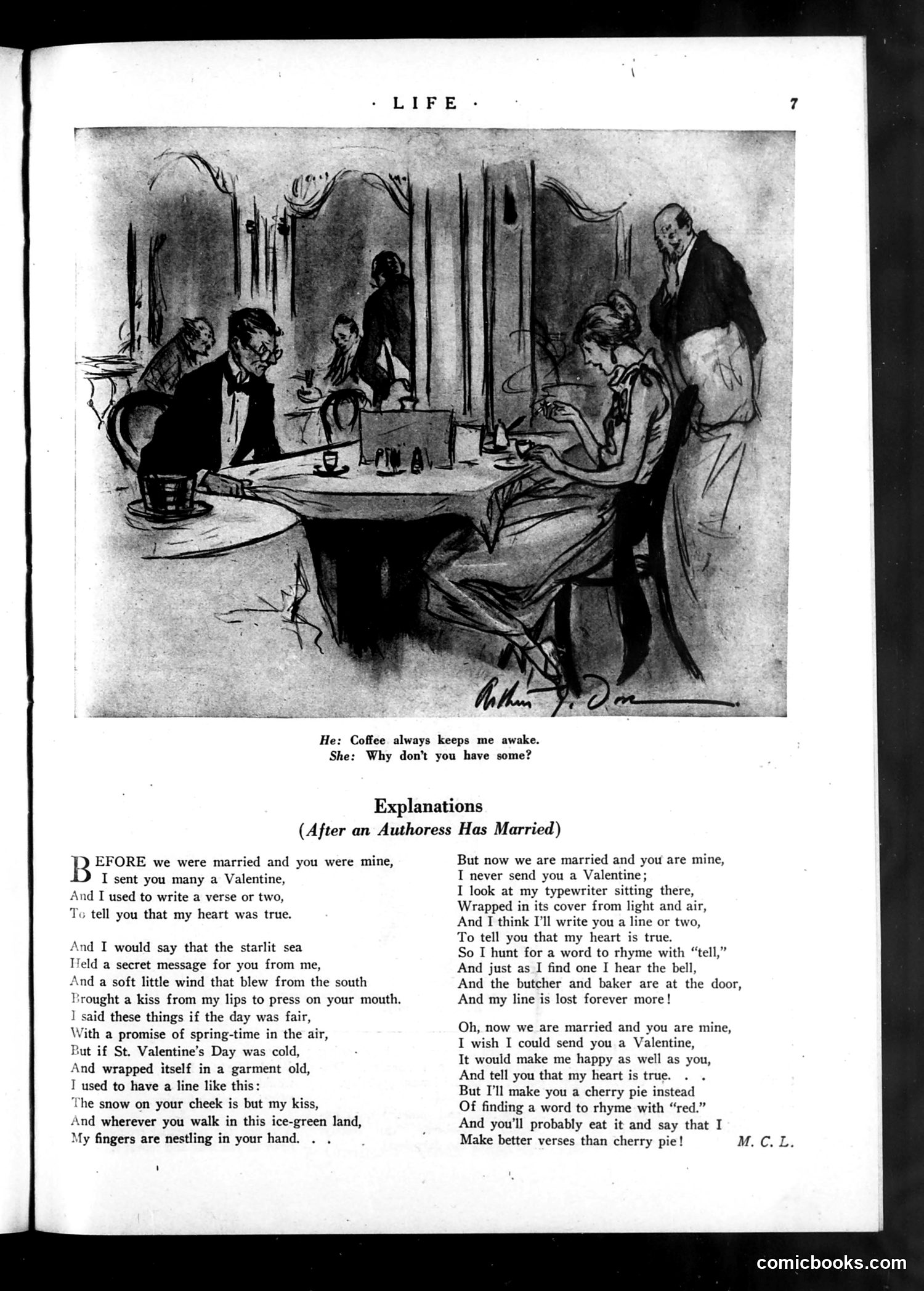
This page contains a single-panel cartoon and a poem, both about marriage. The cartoon shows a man and woman at a table with other figures in the background. The man says he needs coffee to stay awake; the woman asks why he won't have some. The joke appears to satirize how marriage changes romantic attention—the implicit suggestion being that her company no longer keeps him engaged (he needs caffeine instead). The poem "Explanations (After an Authoress Has Married)" reinforces this theme. It contrasts the romantic gestures before marriage (valentines, love letters, poetic lines) with domestic reality after marriage (cherry pie instead of poetry). The humor lies in the husband's frank admission that marriage has replaced romance with practical domesticity and household concerns. Both pieces satirize the disillusionment that can follow marriage, particularly targeting changes in affection and effort between spouses.
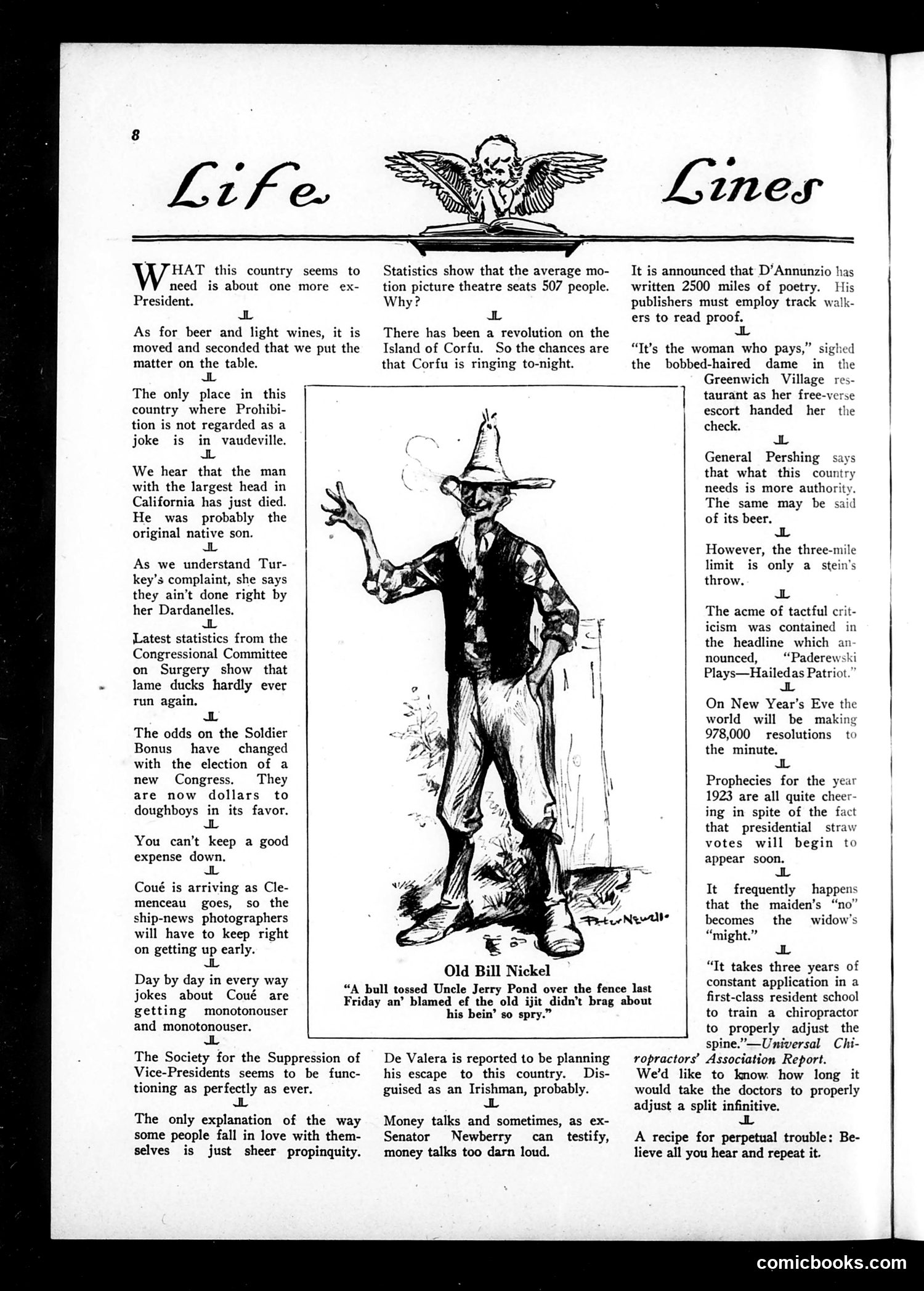
This page contains brief humorous observations and one central illustration labeled "Old Bill Nickel." The cartoon depicts a scraggly, unkempt figure in a tall hat with a large nose, captioned with a quote about Uncle Jerry Pond tossing him over a fence, with the figure claiming he "didn't brag about his bein' spry." The surrounding "Life Lines" section offers satirical quips about contemporary issues: prohibition jokes, congressional inefficiency, General Pershing's authority, the three-mile limit (likely regarding coastal law enforcement during Prohibition), and theater attendance statistics. The humor relies on wordplay and social commentary typical of 1920s satire—targeting government incompetence, alcohol prohibition enforcement, and general American foibles. The specific identity of "Old Bill Nickel" remains unclear from context alone.
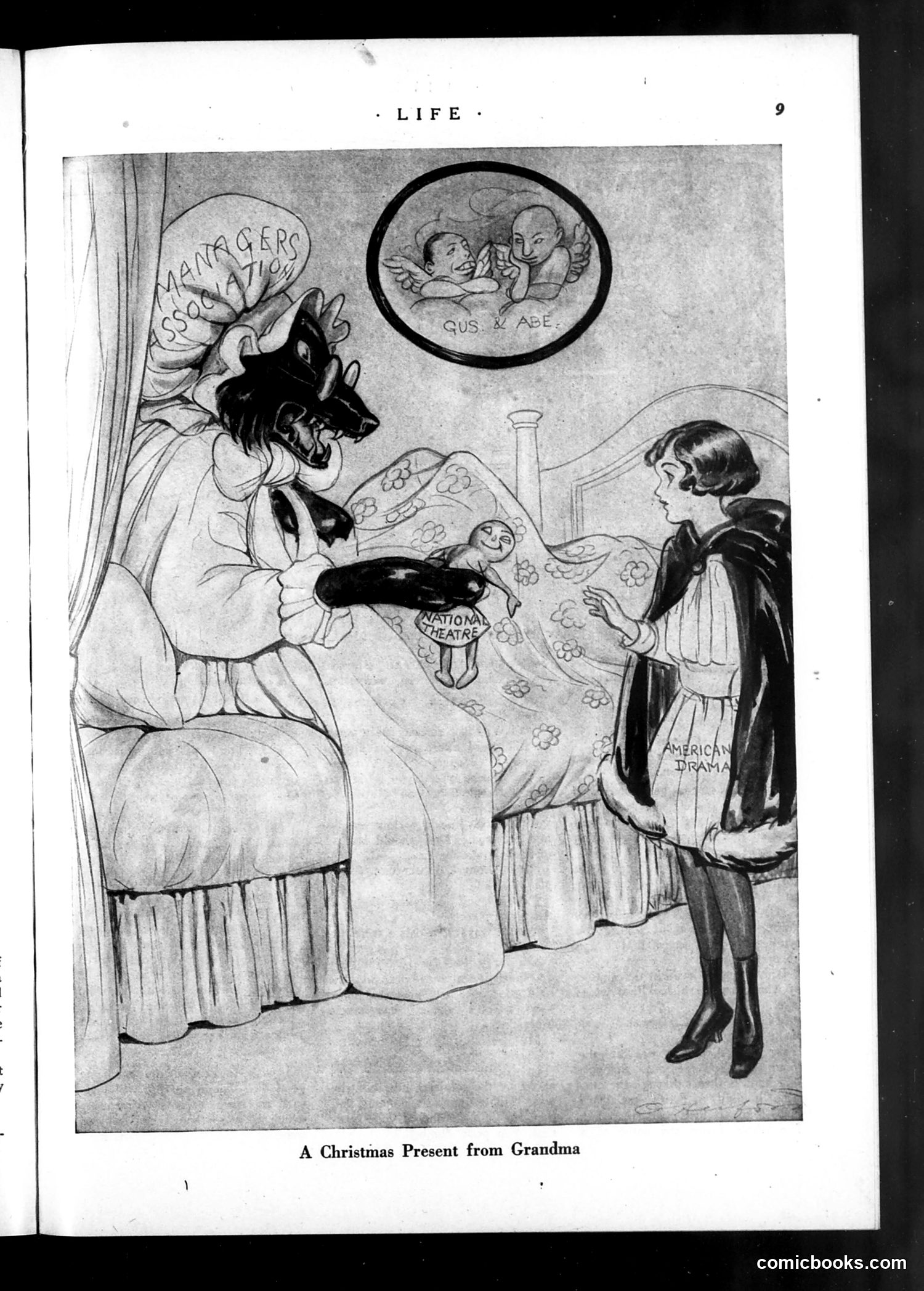
This satirical cartoon depicts an elderly woman presenting theatrical masks labeled "National Theatre" and "American Drama" to a young girl. The woman wears a wolf-mask caricature on her head, and two cherubs labeled "Quis L. Abe" float above in thought. The satire appears to comment on American theater's relationship to European (particularly German, suggested by the wolf imagery) theatrical traditions. The "grandmother" likely represents European cultural influence gifting American drama its theatrical forms. The cherubs' inscription remains unclear but may reference classical theatrical authority. The overall message critiques American drama as derivative—receiving its cultural inheritance rather than developing original forms, with potentially ominous undertones suggested by the predatory wolf imagery.
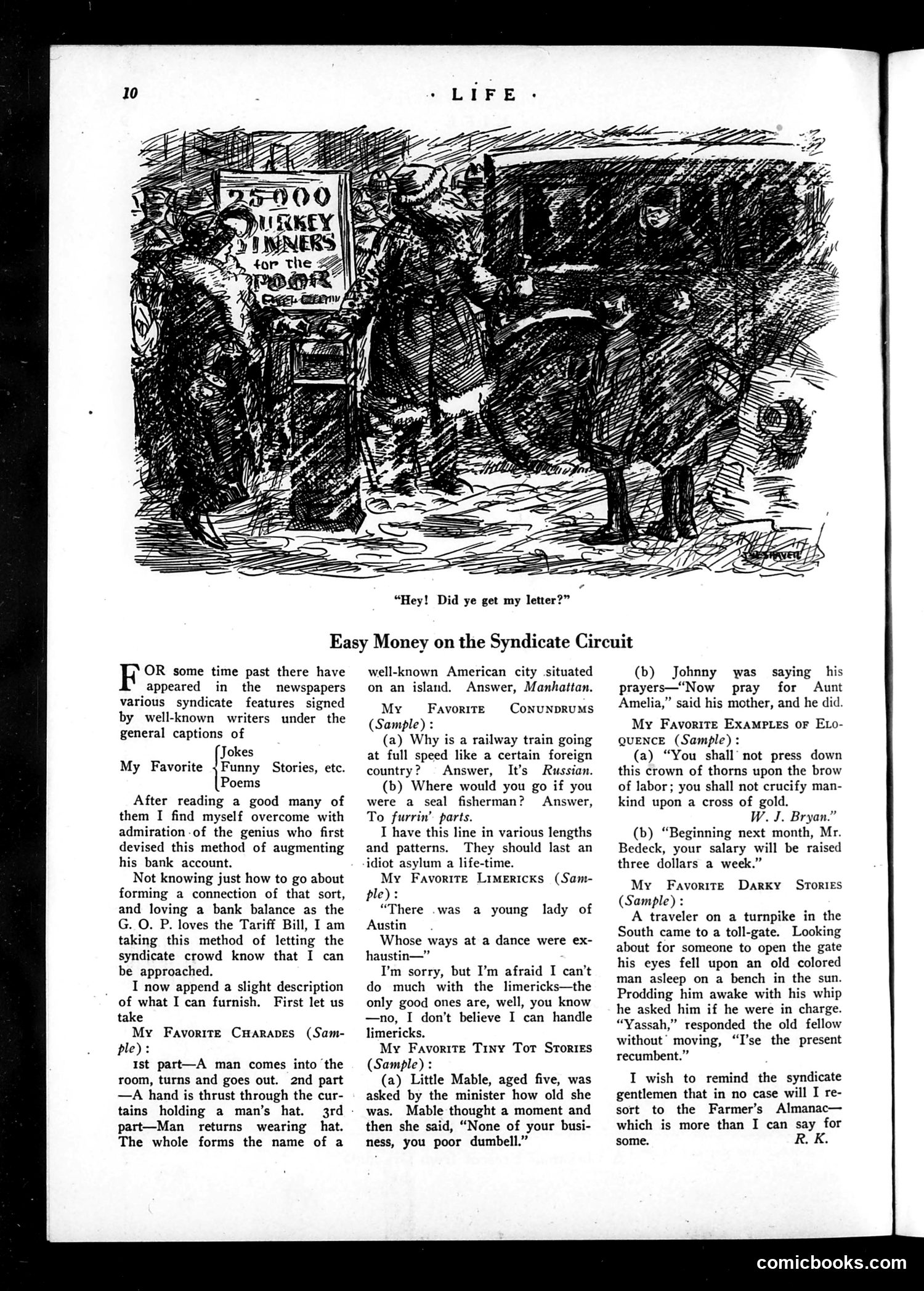
This page satirizes the syndication business for newspaper humor content. The cartoon at top shows what appears to be a street vendor or hustler with a sign advertising "25,000 TURKEY DINNERS for the POOR Each Death" — likely mocking exploitative charitable schemes or sensationalist newspaper stunts. The article discusses how writers could make money by creating "syndicated features" — jokes, funny poems, and stories sold to multiple newspapers simultaneously. The author lists examples of popular syndicated content types: funny stories, limericks, and "darky stories" (period racial stereotypes presented as humor). The satire targets both the formulaic nature of mass-produced newspaper humor and the financial incentives driving lowest-common-denominator content to maximize syndication profits.
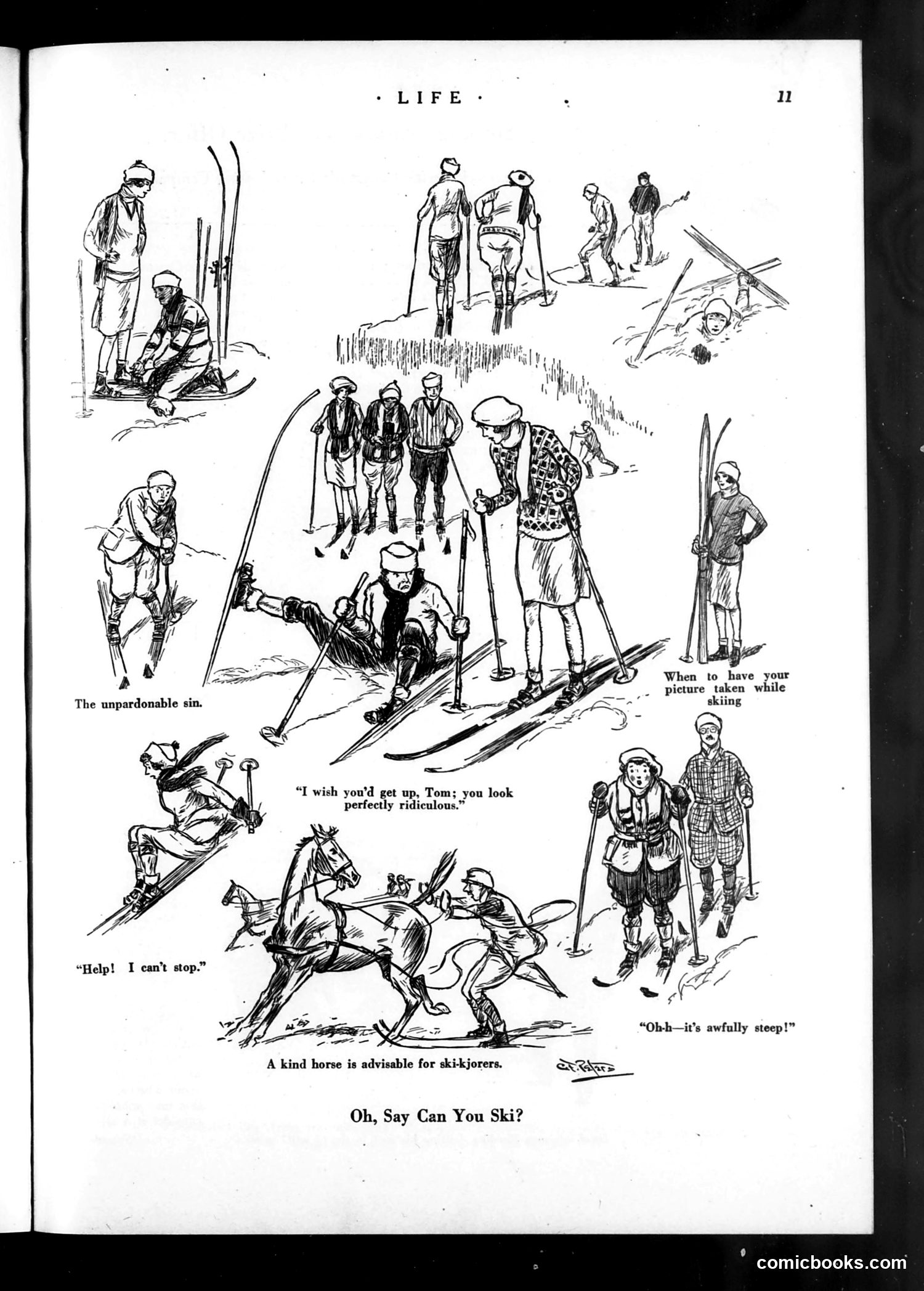
This is a humorous instructional page about skiing, a recreational activity that was becoming fashionable among wealthy Americans in the early 20th century. The various vignettes satirize common skiing mishaps and social awkwardness: - "The unpardonable sin" mocks poor skiing form - "I wish you'd get up, Tom; you look perfectly ridiculous" depicts a fall - "Help! I can't stop" shows loss of control - "A kind horse is advisable for ski-jiggers" jokes about falling repeatedly - "When to have your picture taken while skiing" and "Ooh—it's awfully steep!" satirize vanity and fear The cartoon targets both novice skiers and the social pretensions of the wealthy leisure class adopting this new sport. The humor relies on physical comedy and exaggerated situations relatable to anyone attempting skiing.
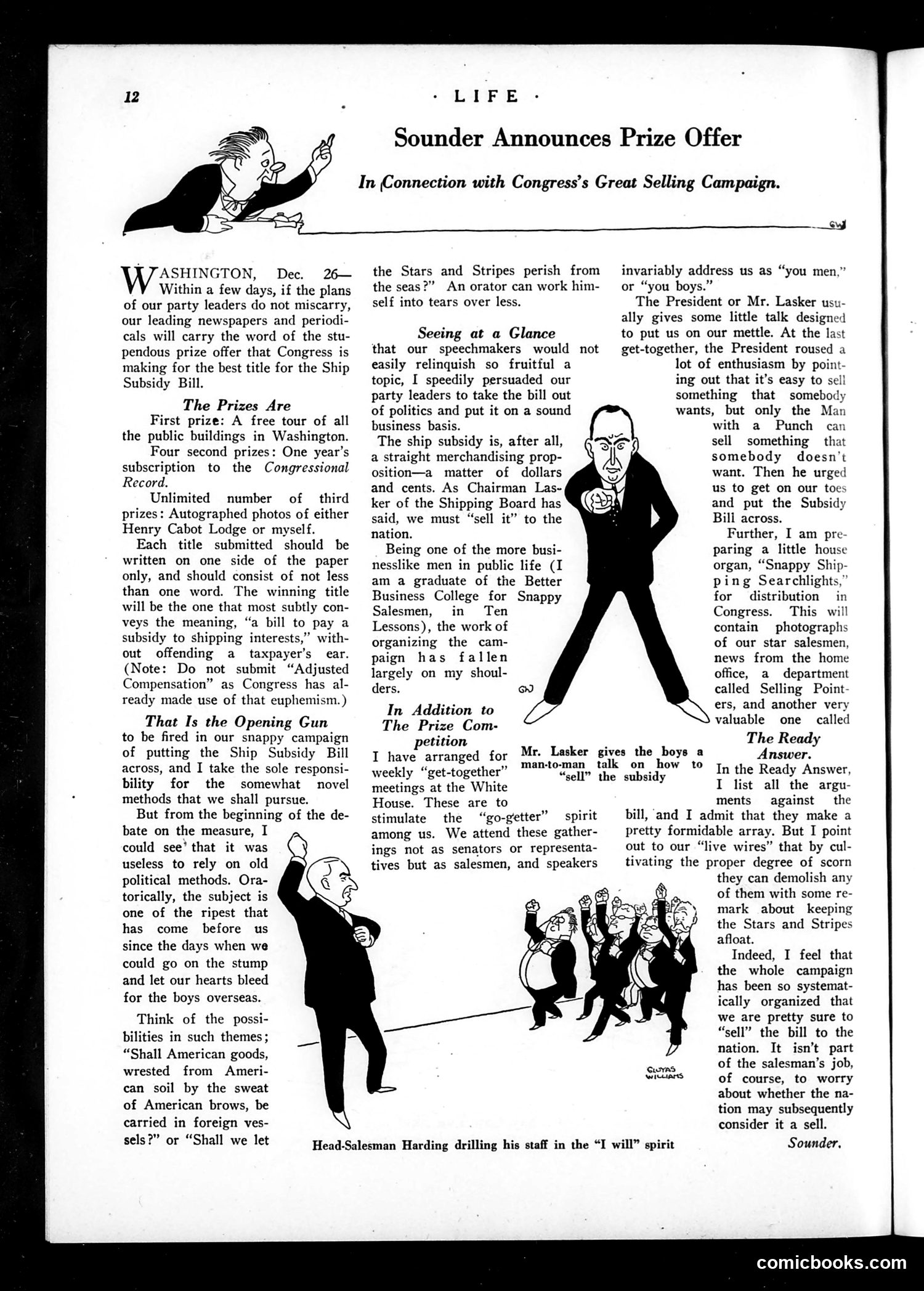
This 1917 *Life* magazine page satirizes efforts to promote the "Ship Subsidy Bill" through a sales campaign. The article, bylined "Sounder," mocks the government's approach to securing congressional support for shipping subsidies by announcing a prize contest—framing a serious policy matter as if it were a commercial product to "sell." The cartoons show a head-salesman drilling his staff to promote the bill with missionary zeal. The satire targets the absurdity of using high-pressure sales tactics and motivational speeches on politicians to pass legislation benefiting shipping interests. The piece criticizes both the bill itself and the manipulative methods employed to advance it, suggesting that important national policy should not be marketed like consumer goods to unsuspecting legislators.
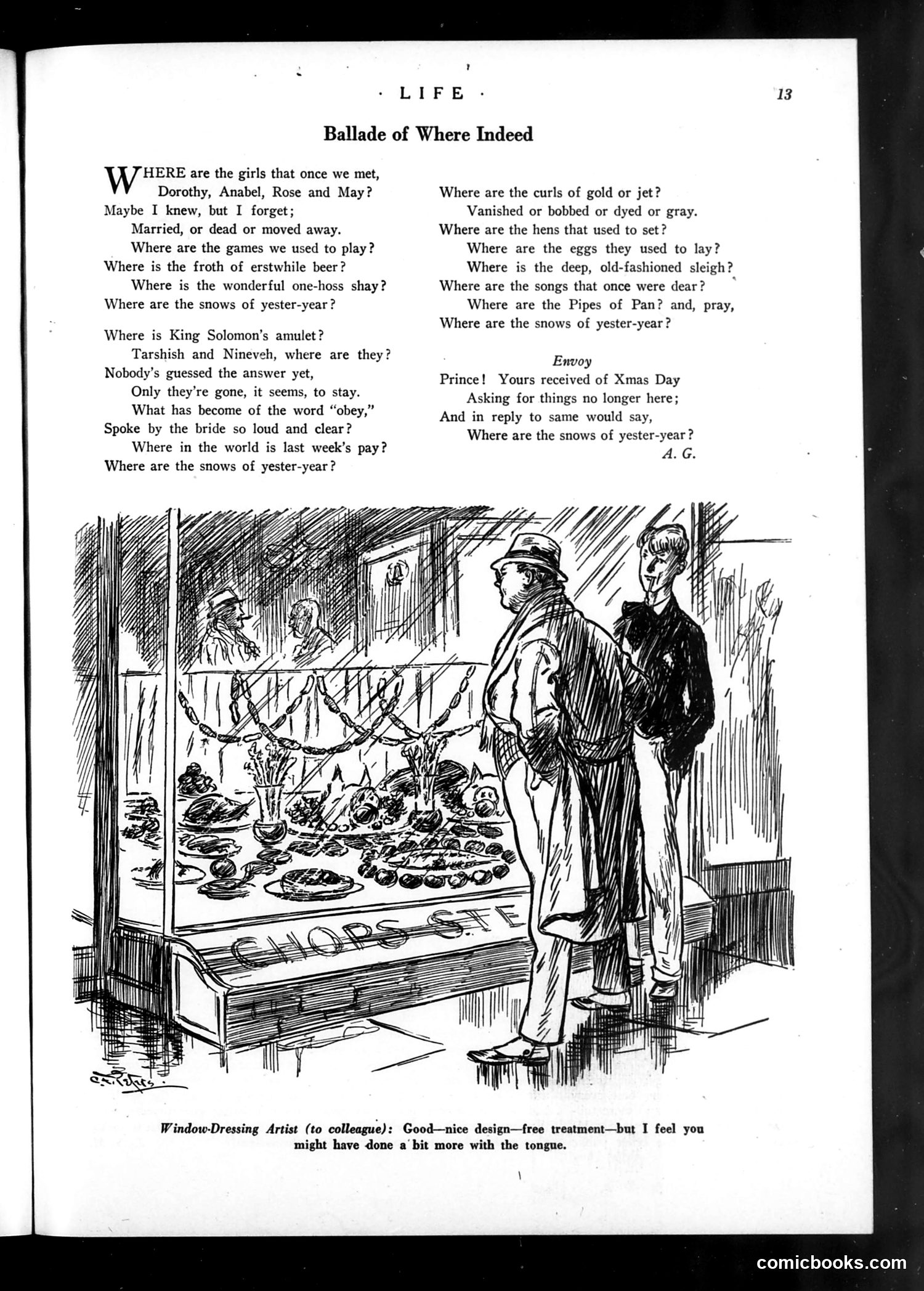
This page contains a nostalgic poem by A.G. (likely Franklin P. Adams, a Life contributor) lamenting things lost to time—girls from the past, childhood games, lost songs, and last week's pay. The repeated refrain "Where are the snows of yester-year?" references medieval poetry's theme of transience. The accompanying cartoon depicts two men in early 20th-century dress examining a shop window display labeled "CHOPS" (meat cuts). The caption jokes that a window-dressing artist did good work but "might have done a bit more with the tongue"—a pun on both decorative presentation and verbal persuasiveness. Together, the content reflects early 1900s urban life preoccupations: nostalgia, consumerism, and workplace anxieties (the poem mentions "last week's pay").
This page contains editorial commentary on urban congestion and social issues rather than traditional political cartoons. The main text discusses **New York City's traffic problems**—private automobiles clogging streets—and compares it to similar issues worldwide. It references the **Shantung controversy** (Japanese occupation) and censorship of Mr. Wilson regarding the treaty, suggesting government incompetence. The article critiques **the Ku Klux Klan**, describing it as seeking "approval" while destroying liberty. It also mentions **Mayor Mitchell** and the Roman Catholic Church's involvement in urban issues, likely the Hylan administration's conflicts with Catholic institutions. The satire targets governmental inability to solve practical problems—transportation, housing, poverty—while citizens waste energy on destructive organizations like the Klan rather than constructive reform.
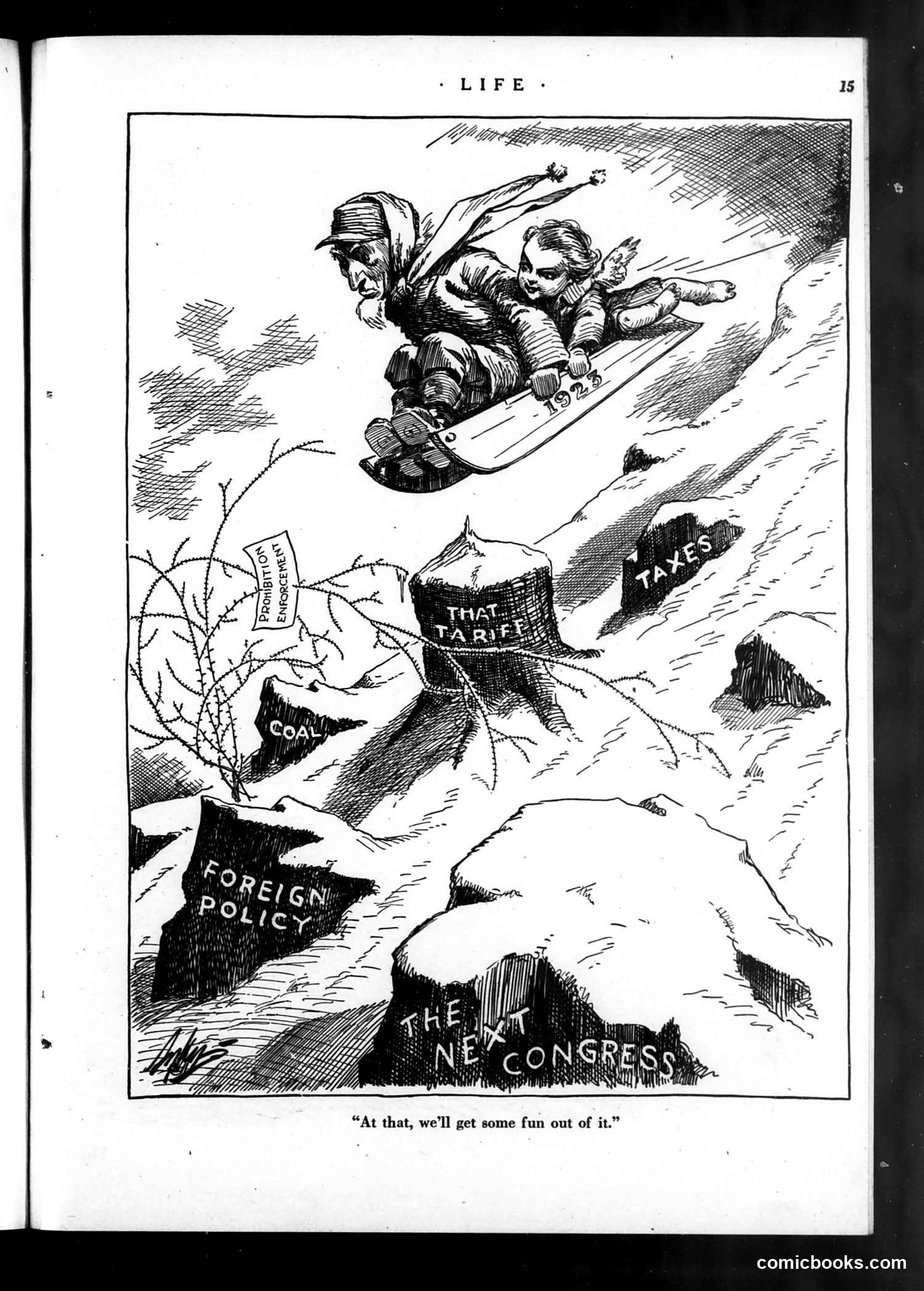
This Life magazine cartoon depicts two figures sledding down a snowy slope toward obstacles labeled "Foreign Policy," "Coal," "That Tariff," and "Taxes," with "The Next Congress" at the bottom. The figures appear to be politicians or government representatives (one wearing a military helmet) gleefully sledding toward multiple policy challenges. The caption—"At that, we'll get some fun out of it"—suggests dark humor about approaching legislative difficulties. The cartoon satirizes political leaders treating serious economic and foreign policy problems as entertainment rather than serious matters requiring careful governance. The snow-covered landscape and downhill trajectory imply these issues are careening toward the incoming Congress uncontrolled. The specific timeframe is unclear from visible information alone, though the style suggests early-to-mid 20th century.
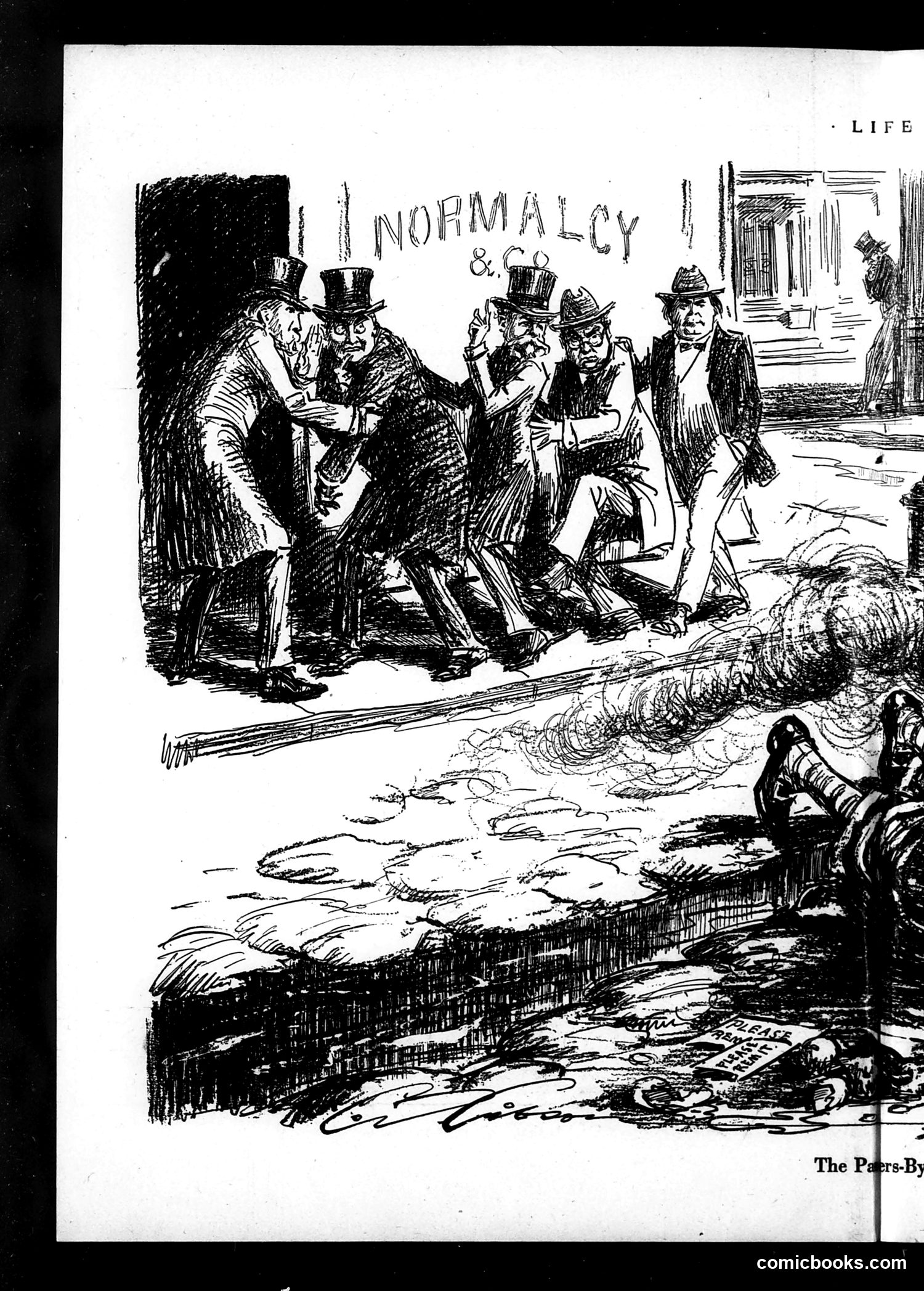
This cartoon satirizes the concept of "normalcy"—likely referencing President Warren G. Harding's 1920 campaign promise of a "return to normalcy" following World War I's upheaval. The image shows well-dressed businessmen in top hats operating what appears to be a commercial establishment labeled "NORMALCY & CO." They're conducting business near industrial/construction equipment, suggesting they're profiting from or managing the post-war economic transition. The satire appears to mock how political leaders and business interests instrumentalized the appeal of "normalcy" for commercial gain during the 1920s. The cartoon implies that "normalcy" became less an authentic social goal and more a marketing concept exploited by the wealthy establishment to advance their interests during America's economic boom period.
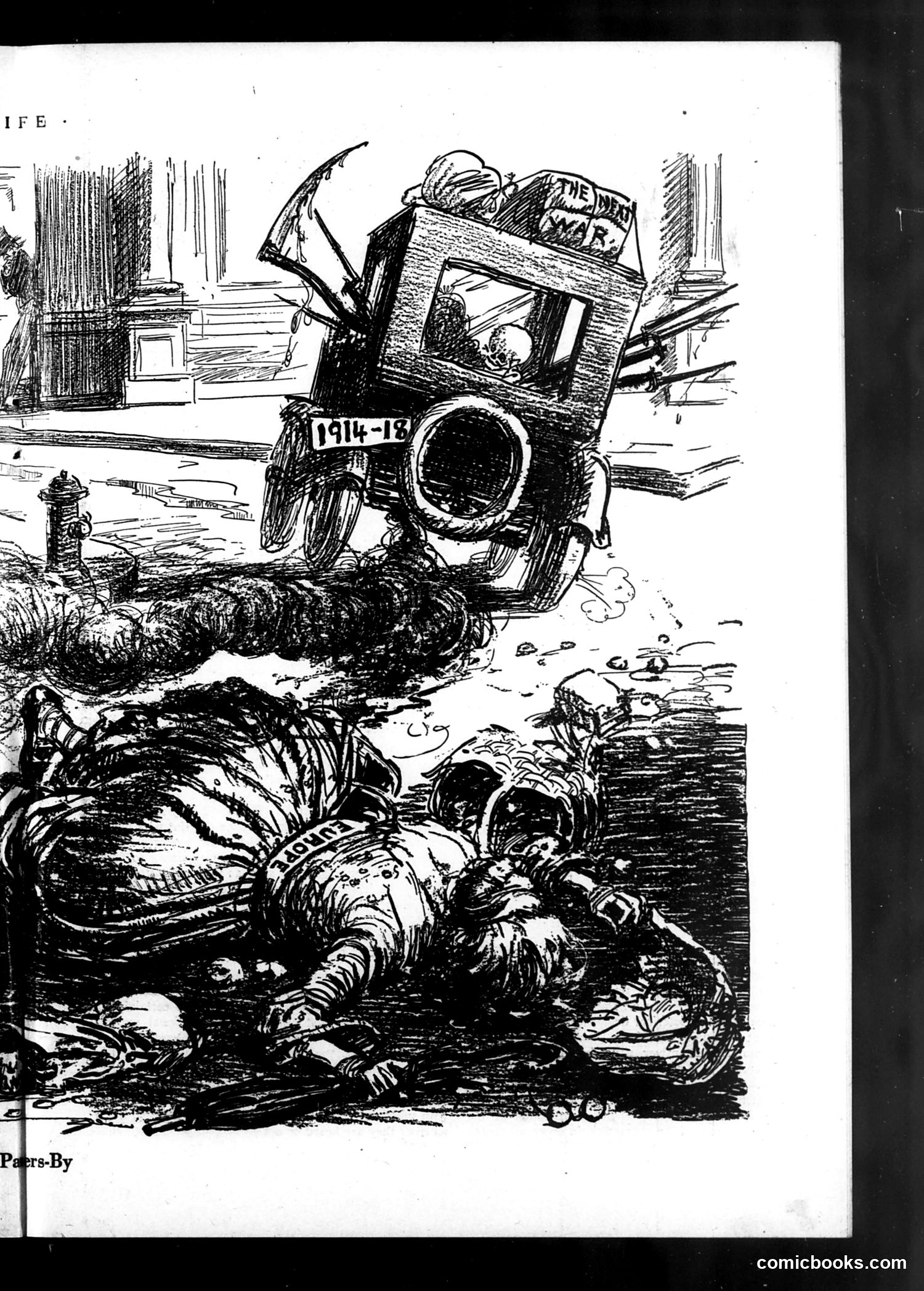
This is a dark satirical cartoon about World War I (dated "1914-18" on the vehicle). The image depicts Death as a skeletal figure wielding a scythe, driving a skeletal automobile laden with war materials. The vehicle crushes fallen soldiers beneath it. The cartoon criticizes the industrial-scale carnage of WWI—how modern mechanized warfare turned combat into mass slaughter. The "automobile of death" suggests how technological advancement paradoxically enabled unprecedented killing. The piled bodies represent the millions killed during the war. This reflects American anxieties about the war's brutality, likely published during or shortly after WWI when the full human cost became apparent. The satire condemns how industrial society had weaponized itself to devastating effect.
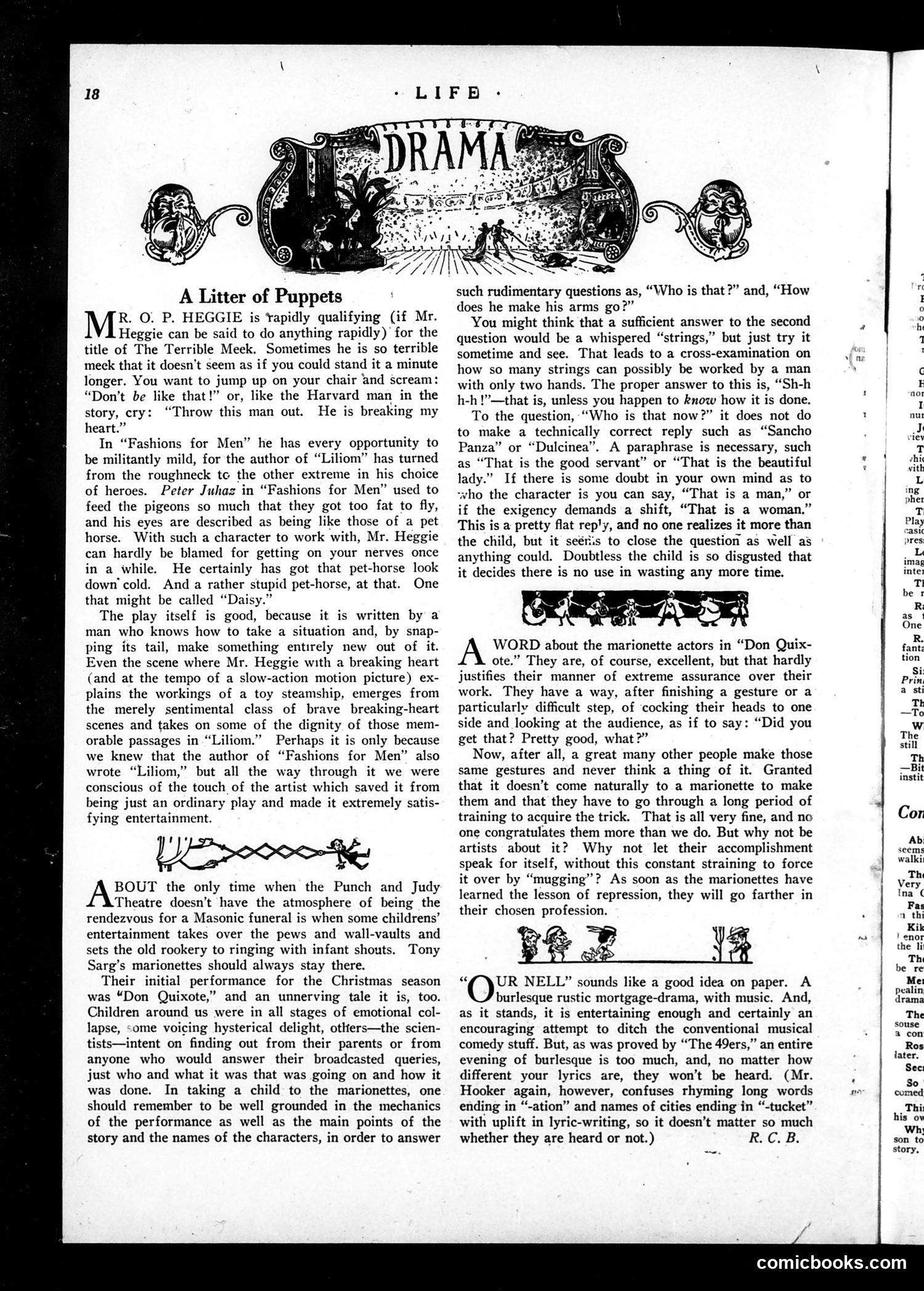
This page contains three theater reviews. The main piece critiques R.O.P. Heggie's performance in "Fashions for Men," a play by the author of "Liliom." The critic praises the play's construction but finds Heggie's acting excessively mild and emotionally restrained—his "pet-horse look" and slow-motion delivery, though appropriate to his character, become tiresome. A second section humorously addresses marionette actors in "Don Quixote," noting their impressive technical control while gently mocking their self-congratulatory manner. The final section describes taking children to Tony Sarg's marionette performance, satirizing parents' difficulty answering children's literal questions about how puppets work and character identities. The critic suggests vague, evasive answers ("Sh-h h-h!") are more effective than technical accuracy. The overall tone is urbane, witty commentary on theatrical performance for a sophisticated magazine audience.
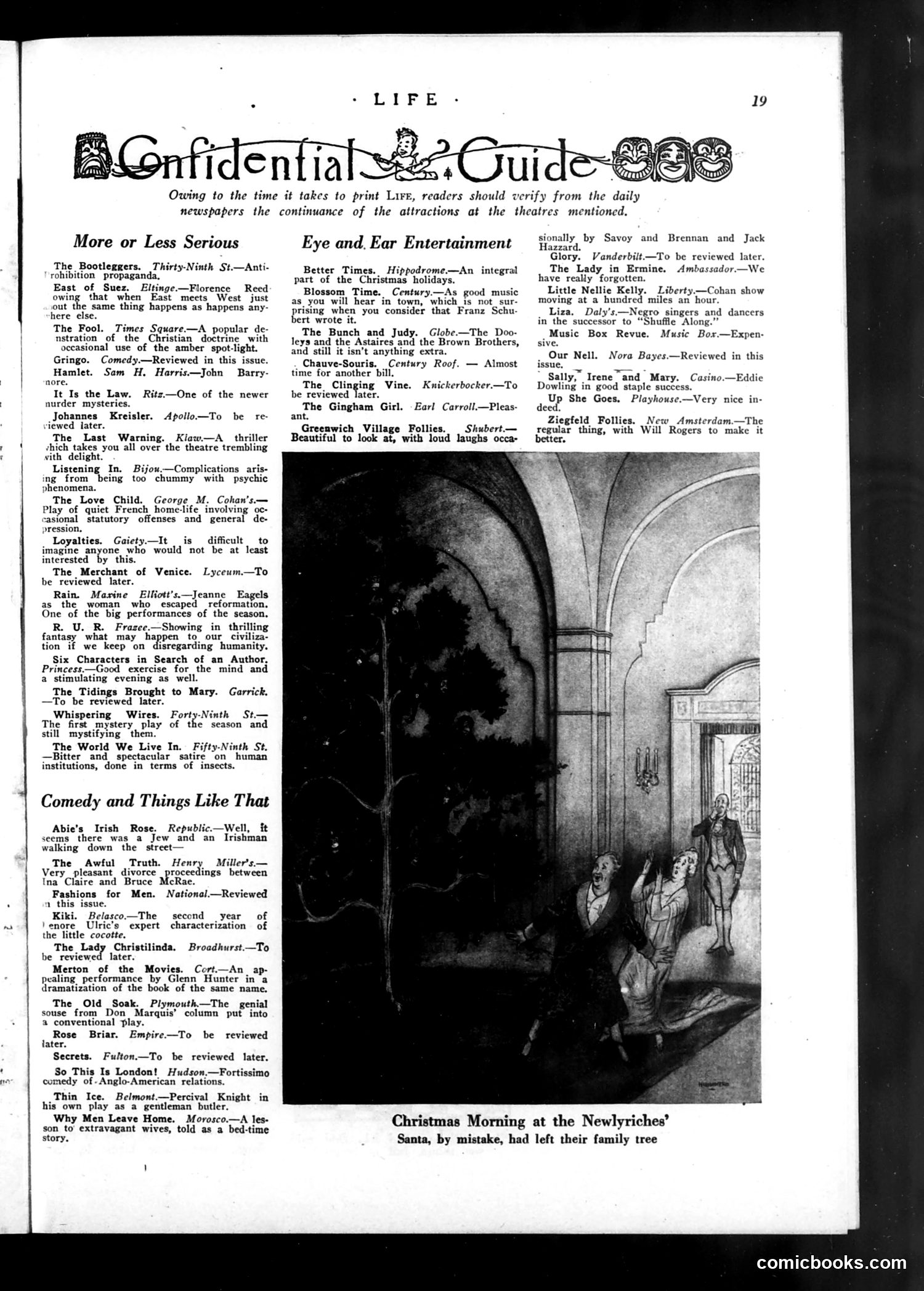
This is a **theater review guide** rather than a political cartoon. It lists Broadway shows currently playing, organized by genre ("More or Less Serious" and "Comedy and Things Like That"), with brief satirical descriptions of each production. The **single illustration** shows a domestic Christmas scene titled "Christmas Morning at the Newlyriches'—Santa, by mistake, had left their family tree." The joke is visual and class-based: wealthy "nouveau riche" characters appear bewildered because Santa accidentally left a *tree* (likely a small sapling or potted plant) instead of expensive gifts. The humor mocks newly wealthy families' materialism and presumed disappointment at receiving something natural rather than luxury items. The page reflects 1920s theater culture, referencing popular shows like *Rain* (starring Jeanne Eagels) and *Abie's Irish Rose*, while the reviews use sardonic wit typical of Life's satirical voice—for example, describing *The Fool* as "a popular demonstration of the Christian doctrine."
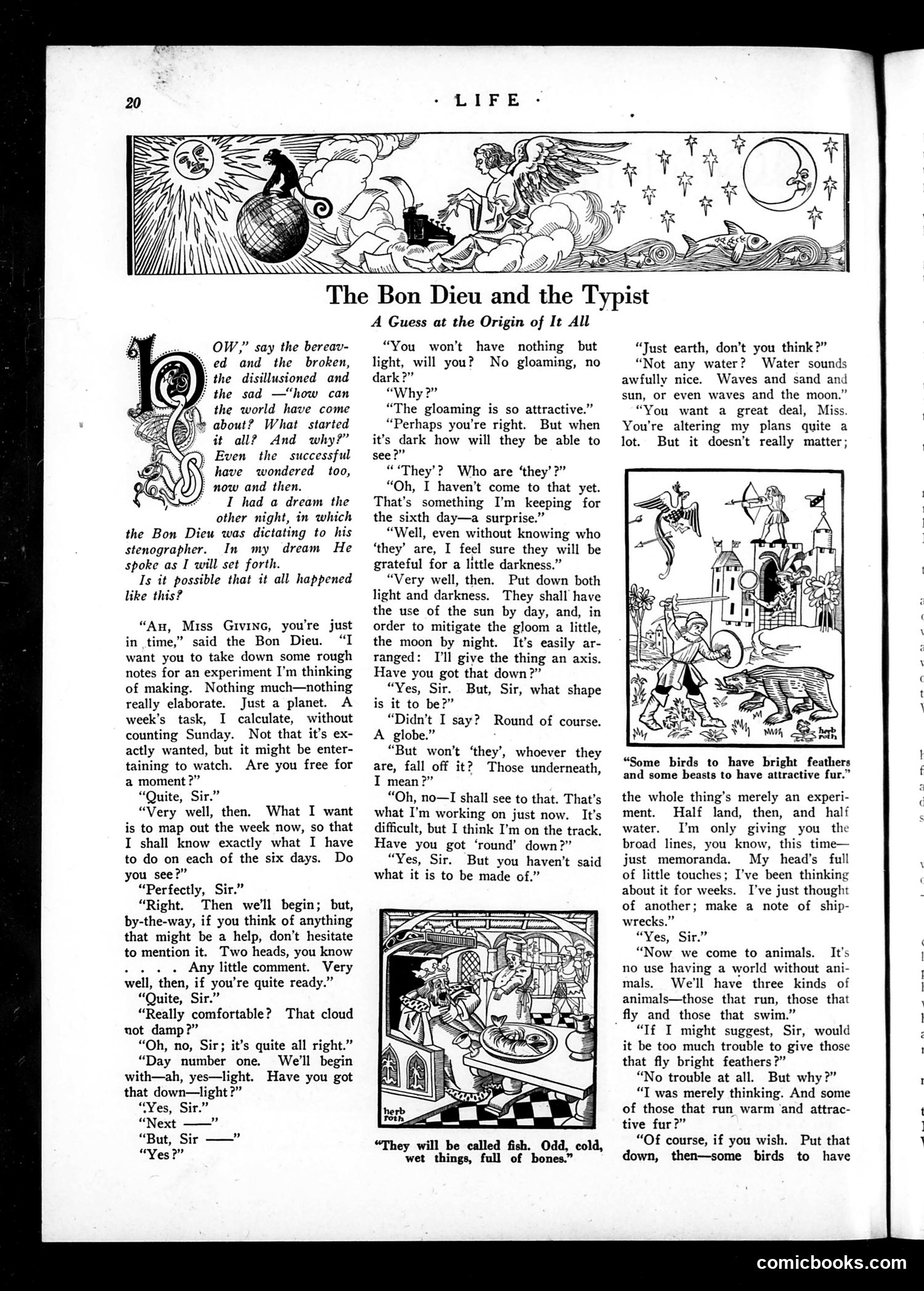
This satirical piece imagines God ("Bon Dieu") dictating creation to a stenographer named "Miss Giving." The humor rests on treating divine creation as a mundane business process—God is essentially workshopping the world like an executive planning a project. The typist functions as the voice of practical suggestion and aesthetic preference. She objects to an all-light world, advocates for water and moonlight, and proposes that animals have attractive features like bright feathers and fur. God patronizingly agrees, calling creation "merely an experiment." The satire targets **Victorian sensibilities about design and utility**: the idea that creation should be both functional and beautiful. By having God adopt these concerns through his secretary's prompting, the piece gently mocks how humans project their own aesthetic values onto divine design—suggesting our preferences aren't cosmic necessities but rather pleasant accidents of divine improvisation. The "typist" may also subtly reference the growing presence of women in office work during this era, though her role here is primarily comic rather than socially pointed.
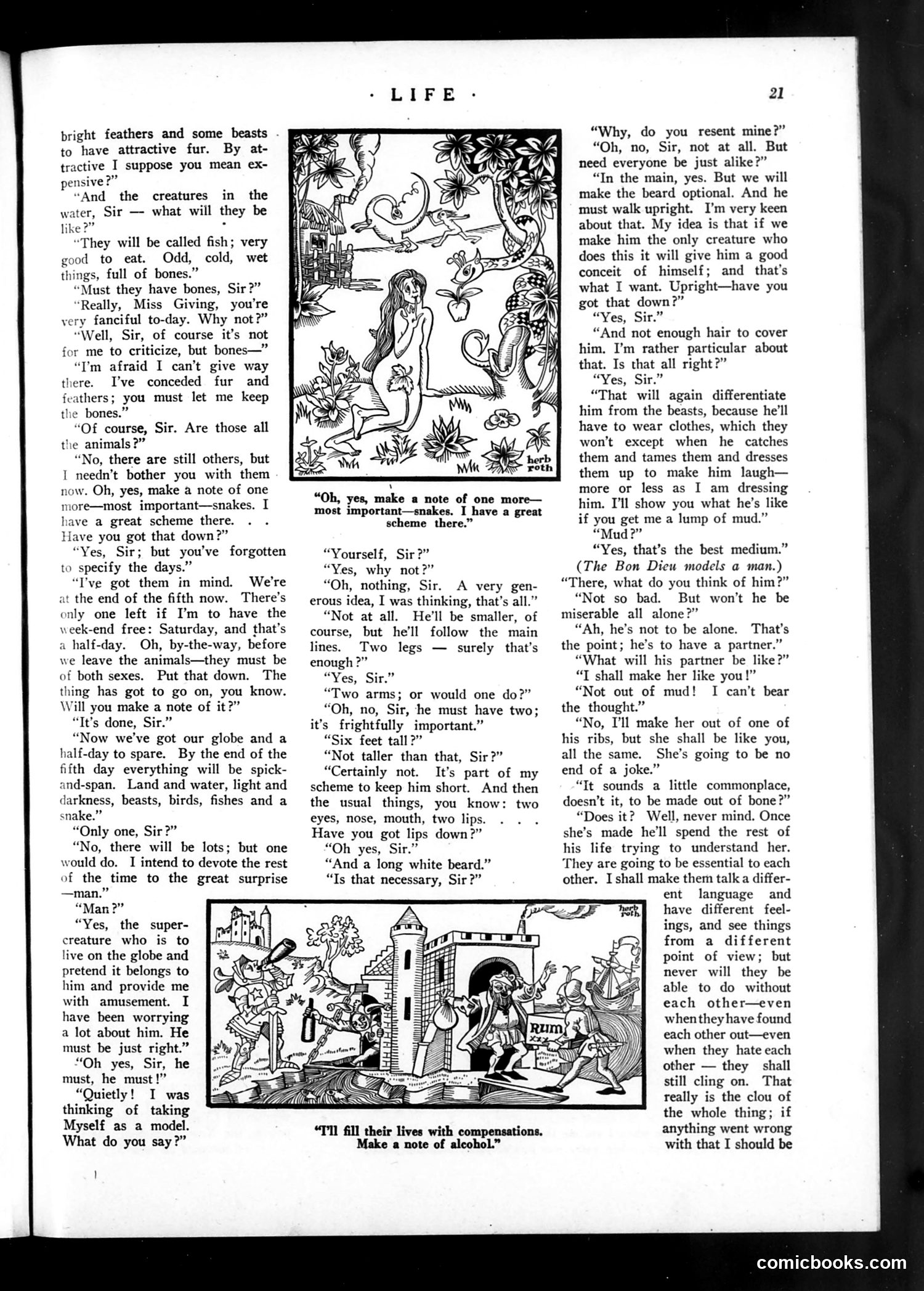
This page satirizes the *Book of Genesis* creation story by reimagining God ("The Bon Dieu") as a designer or engineer discussing his plans with a secretary. The satire mocks both religious literalism and Victorian attitudes about human nature and gender. **The joke:** God treats creation like a bureaucratic project—specifying requirements, taking notes, and managing a tight schedule to secure a weekend. He decides mankind should be bipedal (giving humans an inflated sense of importance), hairless (requiring clothes), and intellectually inferior to himself. **The gender satire:** When told he'll create woman "like you" (the female secretary), she protests being made the model for humanity. This mocks both the theological subordination of women and the condescension inherent in Victorian gender relations—making the secretary's discomfort at being chosen as woman's template the punchline itself. **The final note about alcohol** cynically suggests compensating humans for their miserable existence through intoxication—dark social commentary on industrial-era working-class life.
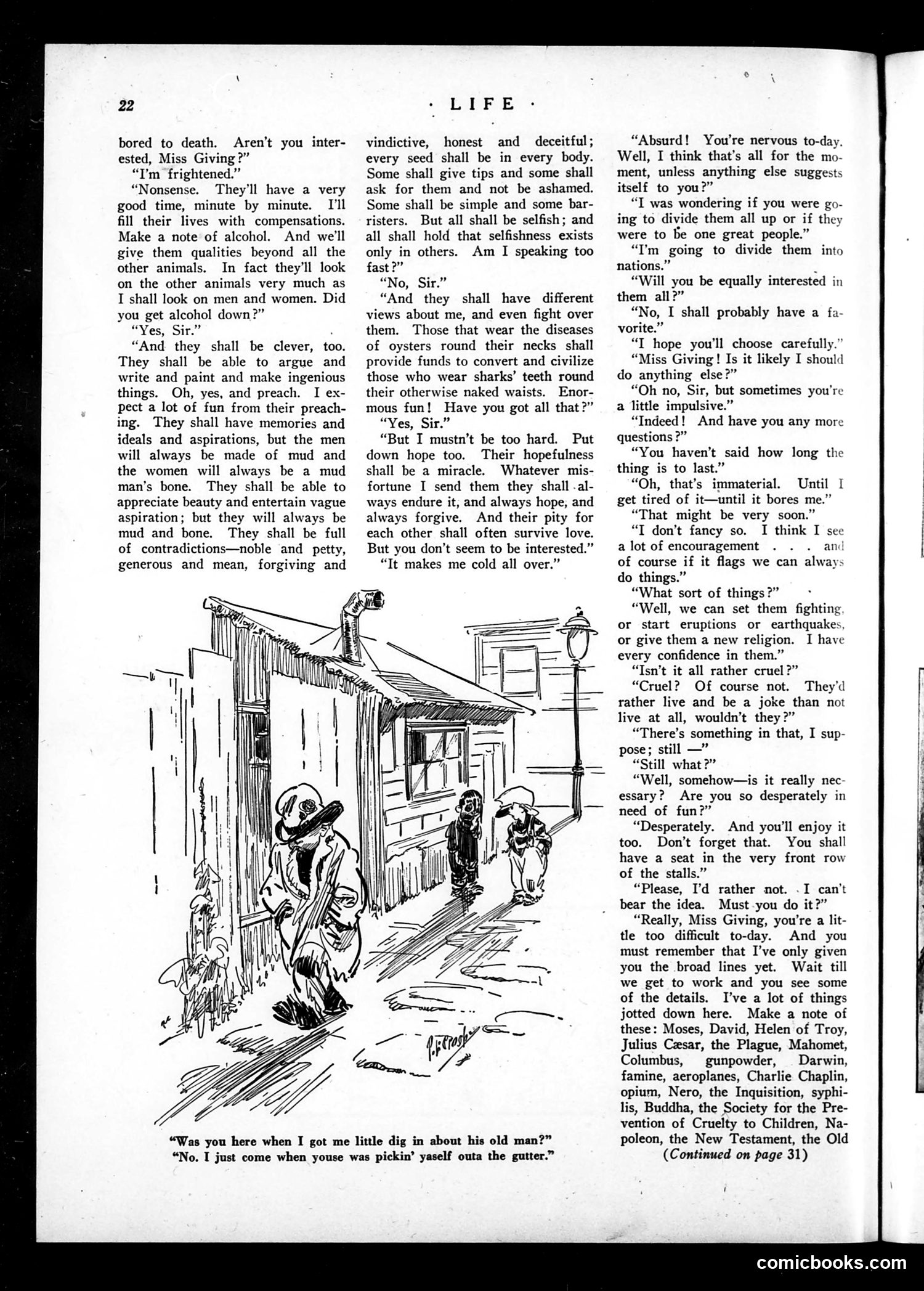
This page presents a philosophical dialogue between what appears to be **God (or a creator figure) and "Miss Giving"** (likely representing humanity or conscience). The cartoon illustration shows two figures outside a modest dwelling—one appears to be instructing the other. The satire critiques **human nature itself**. The creator character outlines humanity's fundamental contradictions: they'll be clever yet foolish, moral yet selfish, hopeful yet suffering, capable of beauty and cruelty. He acknowledges giving humans alcohol, religion, and internal divisions ("nations") while claiming benevolent intentions. The sharp social commentary targets **human hypocrisy**—people who wear religious symbols (oyster pearls, shark teeth) while judging others' morality. Miss Giving's growing discomfort represents the ethical objections to existence's inherent suffering and absurdity. The final exchange reveals the darkest joke: **life exists primarily for entertainment value**, with wars, plagues, and earthquakes as diversions when interest flags. This represents early-20th-century **satirical pessimism about divine creation and human nature**—questioning whether existence serves any purpose beyond amusement.
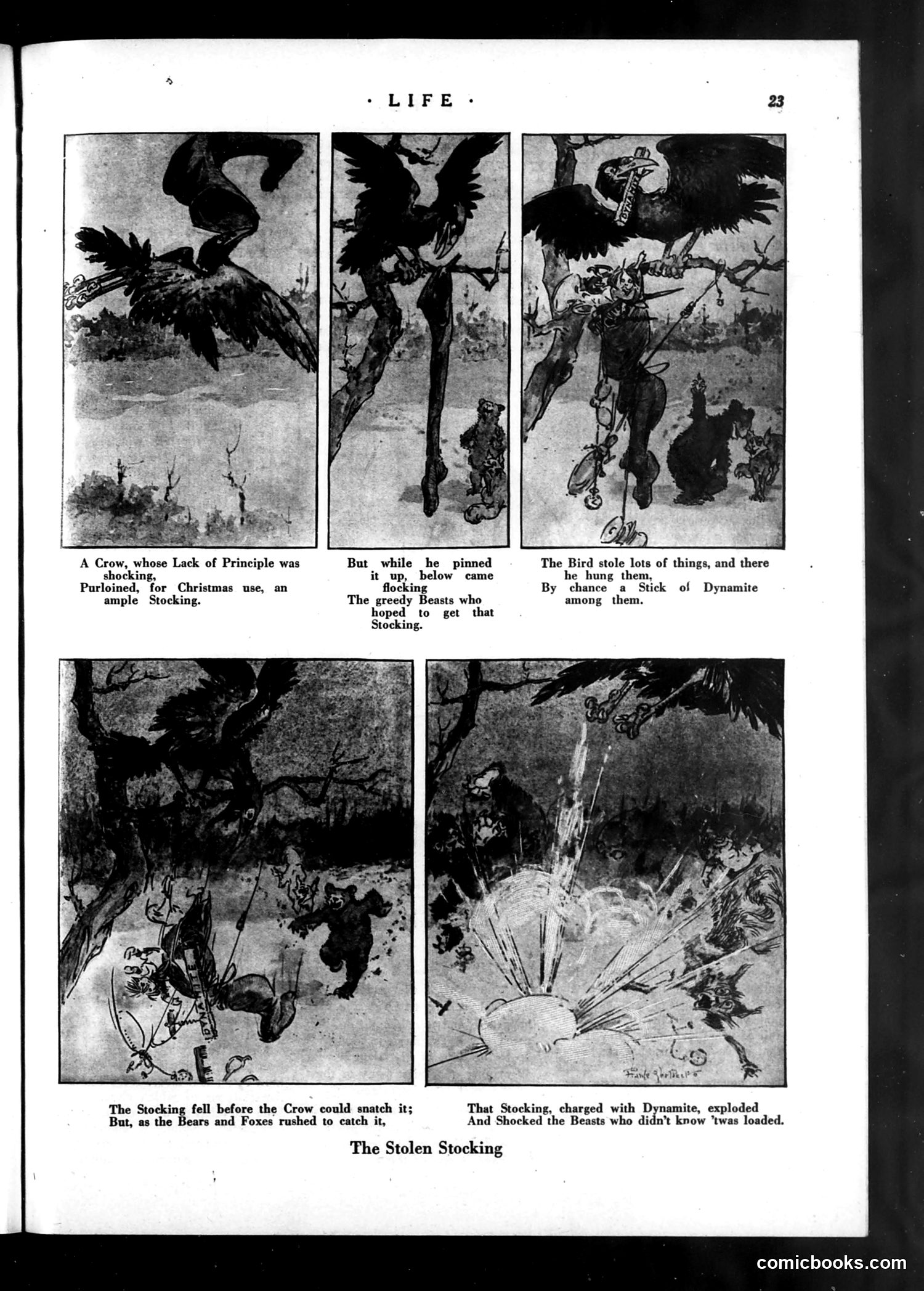
This is a moral fable told in five sequential panels. A dishonest crow steals a Christmas stocking and hangs it in a tree. Greedy bears and foxes below attempt to retrieve it. Unknown to them, the stocking contains dynamite, which explodes when they rush to catch it as it falls. The satire operates as a straightforward cautionary tale about greed and ill-gotten gains. The "Lack of Principle" crow represents dishonesty; the animals represent those who would benefit from or pursue stolen goods. The dynamite explosion serves as divine or karmic retribution—the moral consequence of pursuing what doesn't belong to them. This appears to be a Victorian-era fable using animal characters to teach ethical lessons to readers (likely children or general audiences), common in Life magazine's satirical approach. The joke is that greed itself becomes self-destructive, even without moral judgment.
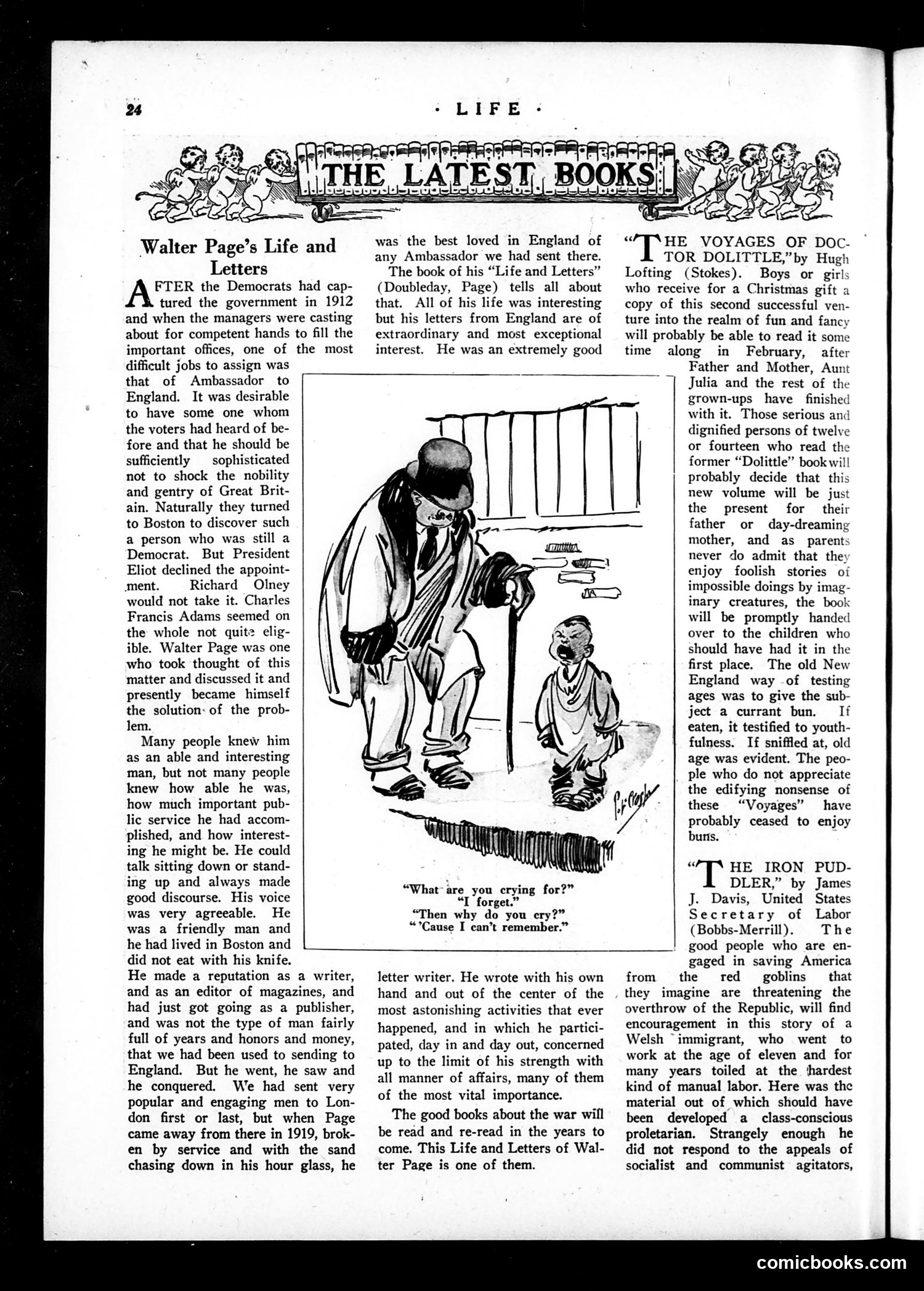
This page reviews three books, with one accompanying cartoon. The cartoon (middle of page) depicts an adult and child in conversation, illustrating a joke about memory: when asked why he's crying, the child says "I forget," then when asked why he cries if he forgot, responds "'Cause I can't remember." The main text discusses **Walter Page's Life and Letters**, reviewing the biography of the U.S. Ambassador to England during WWI (1912-1919). The article praises Page as an able diplomat and writer who served with distinction during America's involvement in the war, emphasizing his importance to the war effort. The page also advertises Hugh Lofting's **Doctor Dolittle** sequel and James J. Davis's autobiography **The Iron Puddler** (Davis was Secretary of Labor under President Harding). The cartoon itself is a simple children's joke with no political content—it's humor about the illogic of childhood reasoning, fitting the magazine's satirical tone.
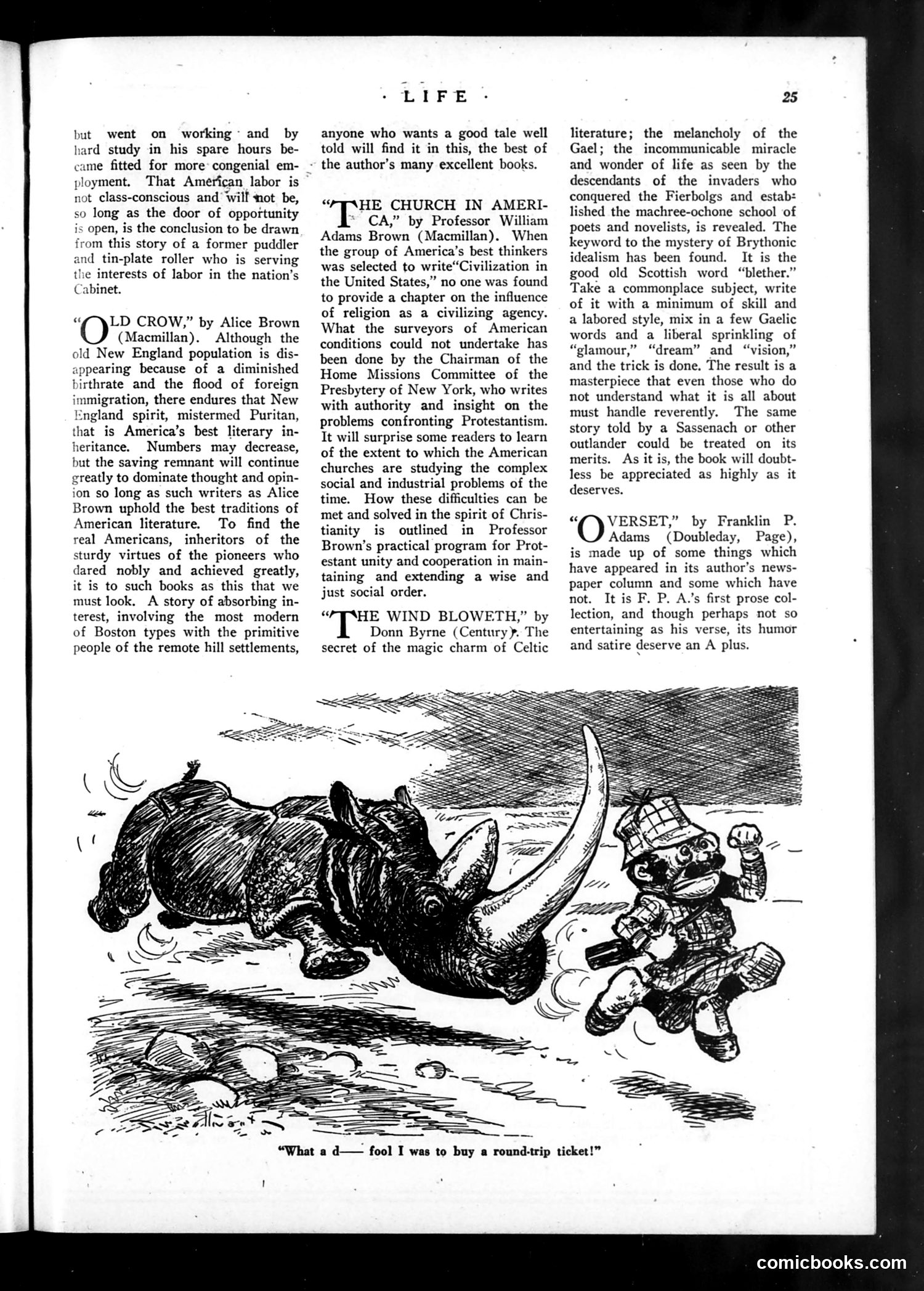
This page contains book reviews and one political cartoon. The cartoon depicts a disheveled man being chased by a rhinoceros, with the caption "What a d— fool I was to buy a round-trip ticket!"—a joke about traveling to Africa (suggested by the rhino) and regretting a round-trip purchase, implying he won't survive the return journey. The reviews discuss literary works, including "The Wind Bloweth" by Donn Byrne. The reviewer sarcastically critiques this Irish-themed novel, suggesting that by adding Gaelic words, vague language ("glamour," "dream," "vision"), and mystical Celtic atmosphere to an otherwise mundane story, Byrne creates an artificially elevated work that readers treat with undeserved reverence. The review mocks how ethnicity and literary affectation can substitute for actual literary merit—a dig at romantic Celticism popular in early 20th-century literature.
This is a film criticism column announcing Life magazine's "Hall of Film Fame" selections for 1922. The author lists eleven notable motion pictures, including *Robin Hood*, *Nanook of the North*, *Oliver Twist*, and *Grandma's Boy* (featuring Harold Lloyd). The satire is gentle: the critic humorously notes that his choices won't affect Hollywood's behavior—producers won't "dance along Hollywood Boulevard" if praised or "commit suicide" if ignored. He observes that spectacle and historical settings dominated the year's best films, though he credits genuinely artistic work like Flaherty's documentary *Nanook* and small-scale dramas like *Tol'able David*. The column praises Marion Davies and Lillian Gish while gently mocking Norma Talmadge's "slipshod carelessness" and noting Rudolph Valentino received his best role in *Blood and Sand*. This reflects 1920s silent cinema's preference for costume epics and star vehicles over contemporary stories.
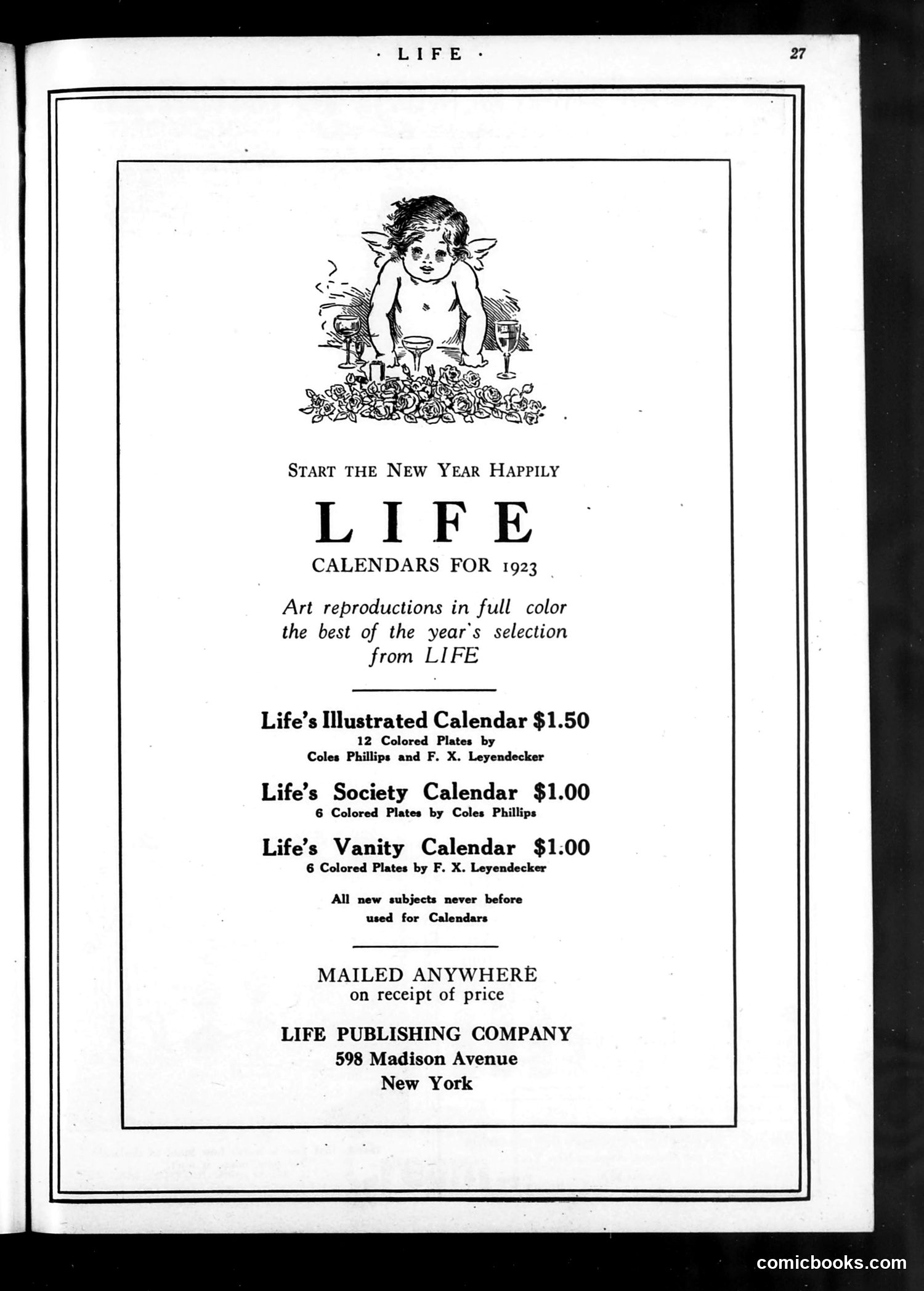
This is an advertisement page, not a political cartoon. It promotes Life magazine's 1923 calendar offerings from the Life Publishing Company in New York. The page features a cherub illustration at the top—a common decorative motif of the era—surrounded by festive imagery including champagne glasses and flowers, reinforcing the "Start the New Year Happily" theme. Three calendar products are advertised: an Illustrated Calendar ($1.50) with twelve colored plates, a Society Calendar ($1.00), and a Vanity Calendar ($1.00), featuring artwork by noted illustrators Coles Phillips and F. X. Leyendecker. The advertisement emphasizes that all subjects are new and previously unpublished. The page targets affluent readers who could afford decorative calendars as luxury items during the 1920s.
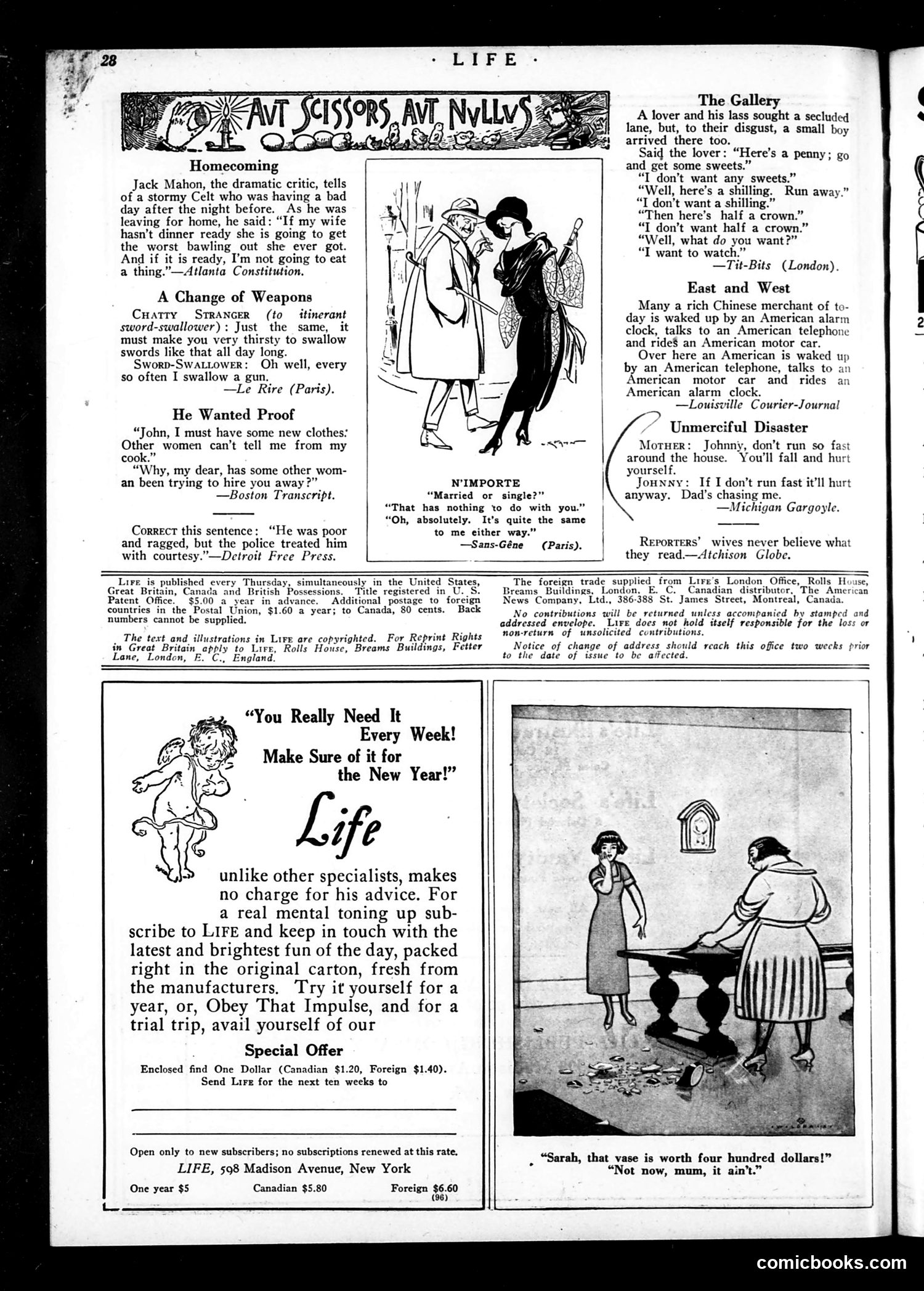
This page from *Life* magazine presents a collection of satirical humor pieces and advertisements typical of early 20th-century American comedy journalism. **The Cartoons & Jokes:** The content includes brief, disconnected anecdotes and quips mocking everyday social situations: a drunk Irishman dreading his wife's reaction to dinner; a sword-swallower and his thirst; marital discord over clothing; and cultural contrasts (Chinese merchants adopting American technology while Americans remain tied to their own gadgets). **The Satire:** These pieces rely on period stereotypes—the "stormy Celt," gender dynamics in marriage, and East-West cultural differences. The humor is gentle domestic satire rather than political commentary, reflecting *Life*'s role as a humor magazine focused on middle-class American life. **The Advertisement:** The large lower section promotes *Life* magazine itself as essential weekly reading, using Cupid imagery and emphasizing its role providing "mental toning up" and entertainment. Subscription rates are listed for U.S., Canadian, and foreign readers. The page is primarily advertising with humor content serving as editorial material.
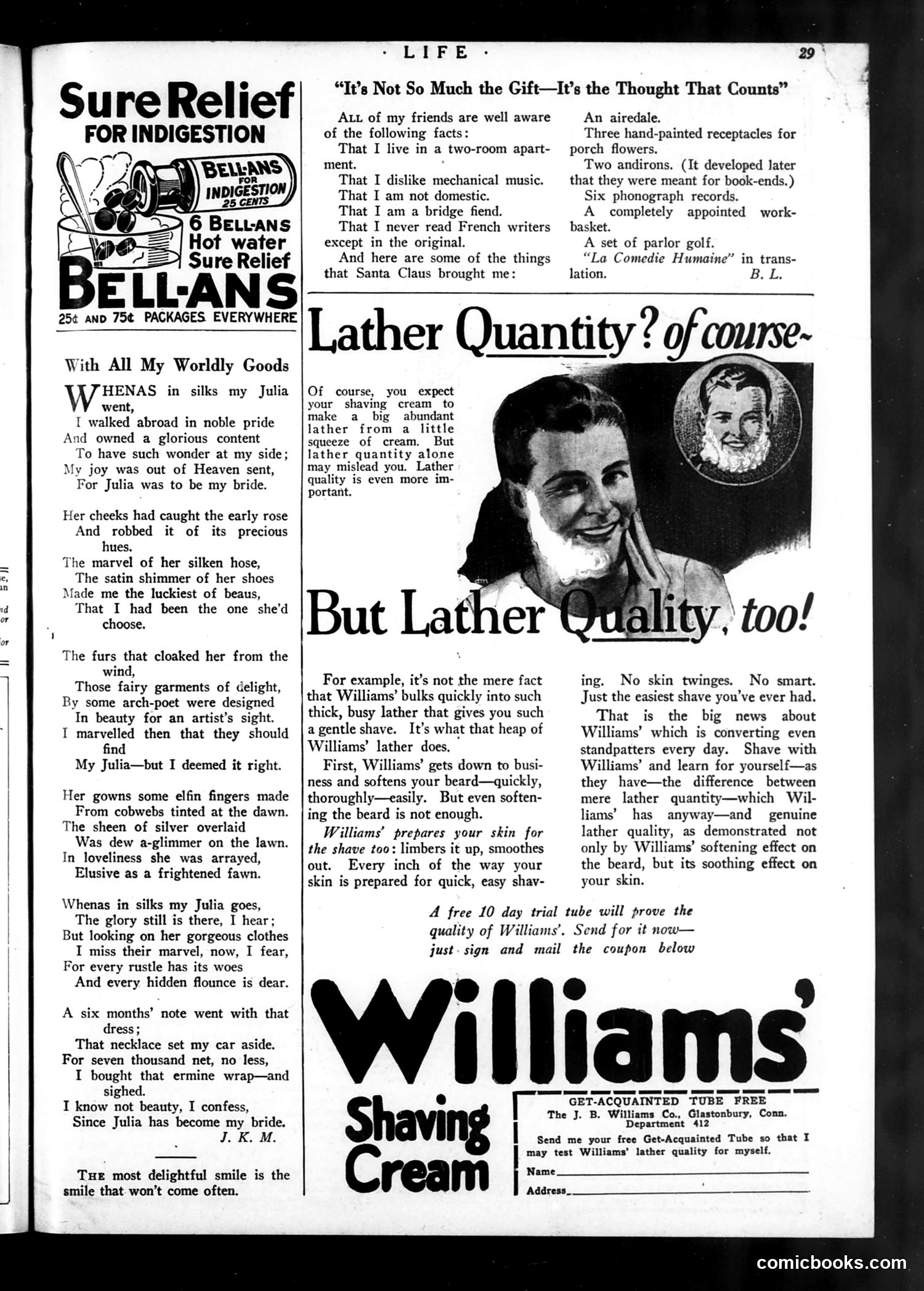
This page contains mixed content: advertisements and satirical pieces typical of Life magazine's format. **The Satirical Content:** "With All My Worldly Goods" is a poem (bylined J.K.M.) satirizing newlywed disillusionment. A man rhapsodizes about his bride Julia's beauty and expensive wardrobe before marriage, but after six months, he resents the financial burden—the dress required a loan, the necklace drained savings, the fur coat cost $7,000. The satire mocks both his initial romantic blindness and the way marriage transforms luxury goods into financial anchors. The closing line sums it: having acquired a wife, he's lost his ability to appreciate beauty itself. "It's Not So Much the Gift—It's the Thought That Counts" humorously details a bachelor receiving wholly inappropriate gifts (an airedale dog, phonograph records, a work-basket) from well-meaning friends who clearly don't know him—reinforcing the title's irony about thoughtfulness versus actual thoughtfulness. **The Advertisements:** Bellans (indigestion relief) and Williams' Shaving Cream ads fill the remainder—standard period advertising emphasizing product quality and efficacy.
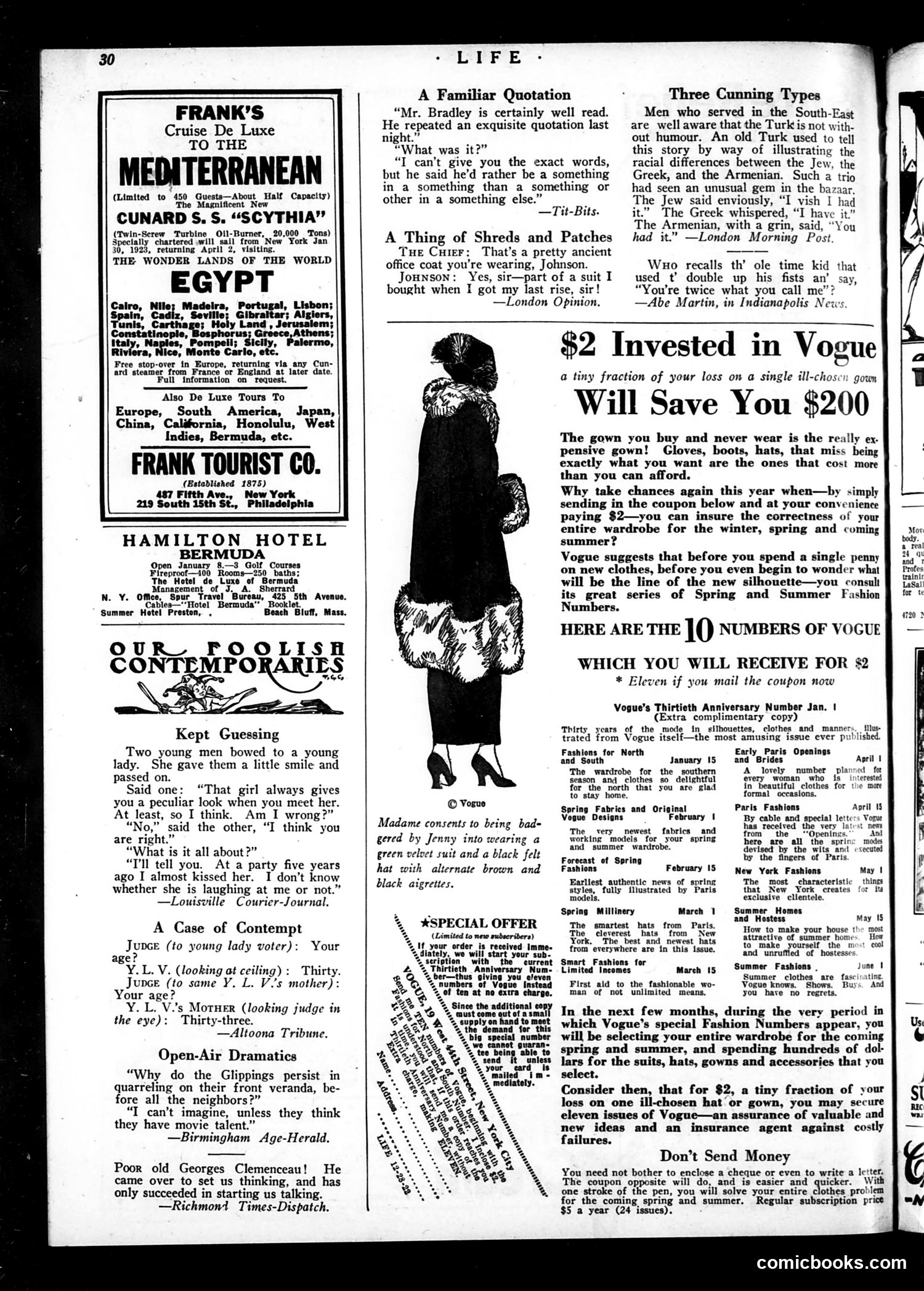
This page is primarily **advertisements and filler content** — travel agencies (Frank Tourist Co., Hamilton Hotel), and a major Vogue magazine subscription pitch. The satirical humor is minimal and marginal. The few jokes present are typical early-1920s light humor: - **"A Familiar Quotation"**: Mr. Bradley quotes something pretentiously but can't remember the exact words — satire on pseudo-intellectualism and bluffing. - **"Three Cunning Types"**: An ethnic joke contrasting Jewish, Greek, and Armenian character stereotypes through a bazaar anecdote — reflective of period attitudes. - **"Kept Guessing"**: A young woman's ambiguous smile confuses two suitors — mild romantic humor about female inscrutability. The page's main purpose is advertising luxury travel (Mediterranean cruises, Bermuda hotels) and promoting Vogue's spring fashion numbers to wealthy readers — reflecting Life's audience of affluent 1920s Americans.
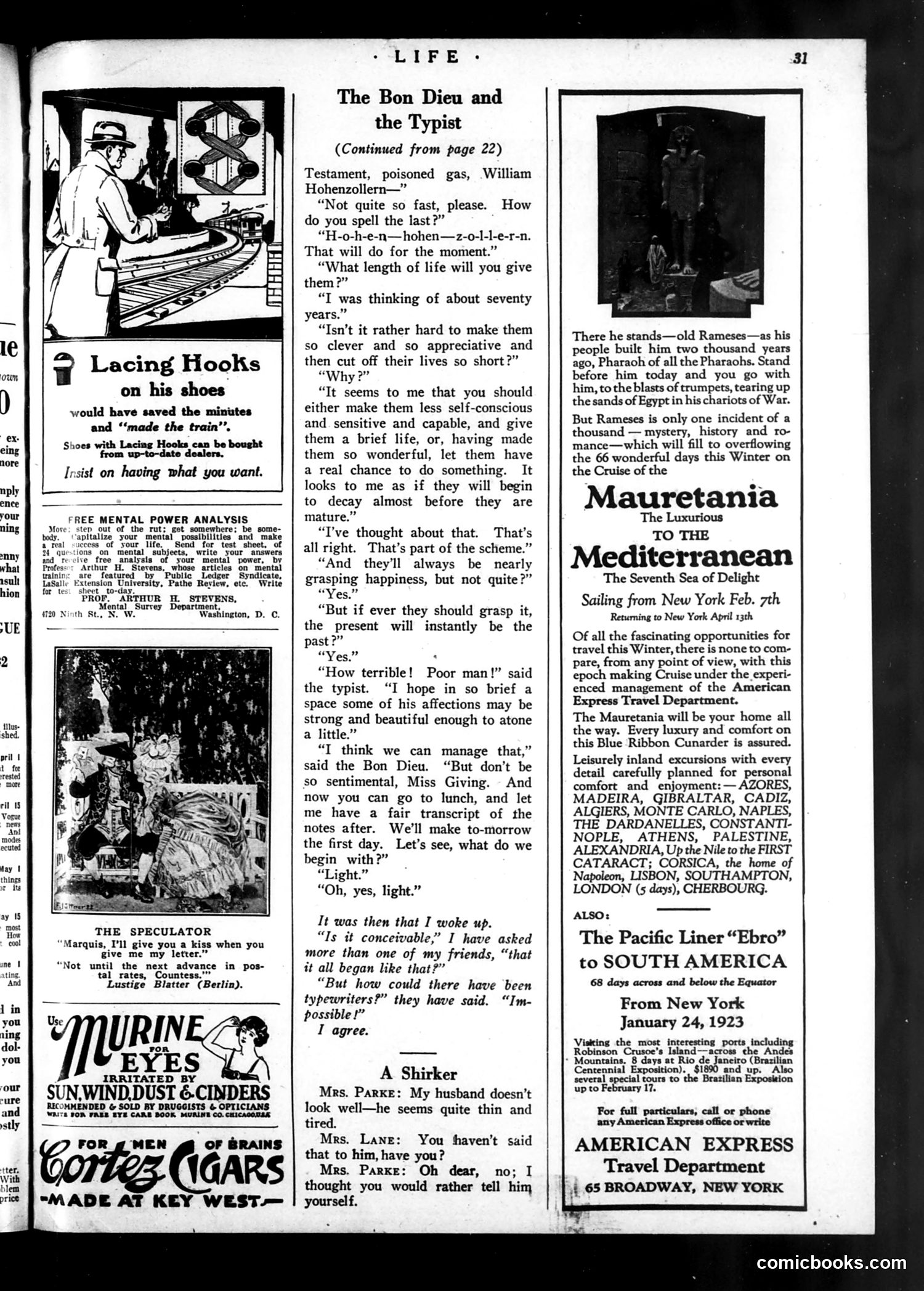
This satirical piece imagines God dictating Creation to a typist, addressing profound questions about human suffering. God explains he's creating beings with intelligence and sensitivity, but deliberately giving them short lifespans—about seventy years. The typist protests this seems cruel: why make humans capable of grasping happiness if they'll never quite achieve it before dying? God dismisses her sentimentality. The satire critiques theodicy (reconciling God's goodness with human suffering) through this mundane office-worker framing. By making Creation a bureaucratic dictation task, the piece mocks attempts to philosophically justify suffering and mortality as part of divine design. The "typist" represents human perspective questioning divine logic—a common post-WWI concern, given the page's reference to "poisoned gas" and warfare. The dream-ending joke ("How could there have been typewriters?") deflates the whole premise, suggesting such explanations for existence are ultimately absurd.
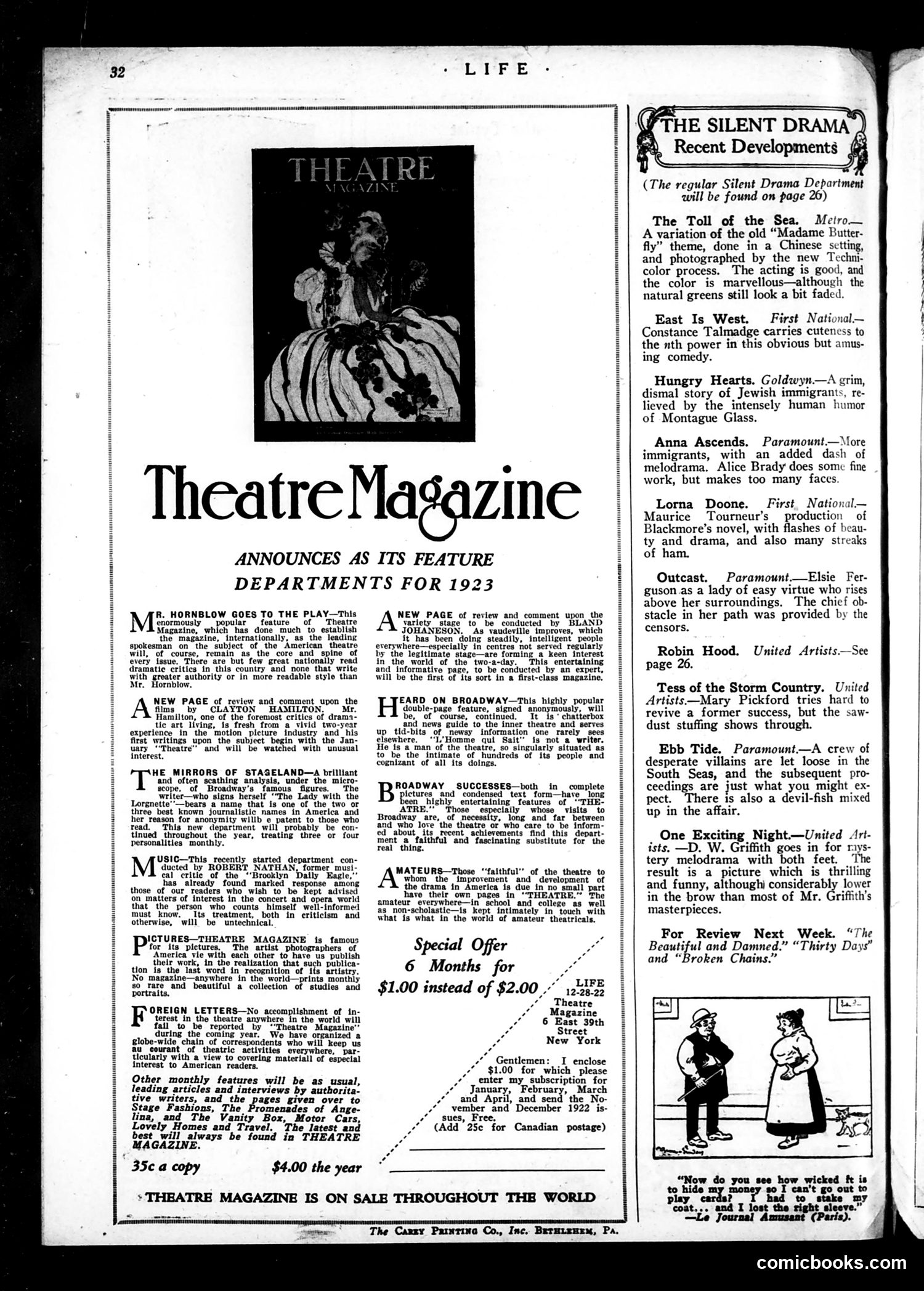
This is primarily an **advertisement page**, not a political cartoon. It announces Theatre Magazine's editorial departments for 1923. The page features a theatrical photograph (likely from a contemporary production) at top, with the magazine's title prominently displayed below. The content describes various editorial features: drama criticism by R. Hornblow, film reviews by Clayton Hamilton, Broadway gossip by anonymous columnists ("The Lady with the Lorgnette," "L'Homme qui Sait"), music coverage, and theatrical photography. **Key historical context**: This reflects 1920s American entertainment culture, when theater and early cinema were major public interests. The emphasis on Broadway insiders, anonymous society commentary, and celebrity coverage reflects the era's fascination with theatrical glamour and gossip. **The bottom-right cartoon** (separate from the magazine ad) depicts a humorous domestic scene about wasted money—unrelated to the Theatre Magazine content. This is essentially a **trade publication advertisement** showcasing editorial prestige to attract readers and advertisers.
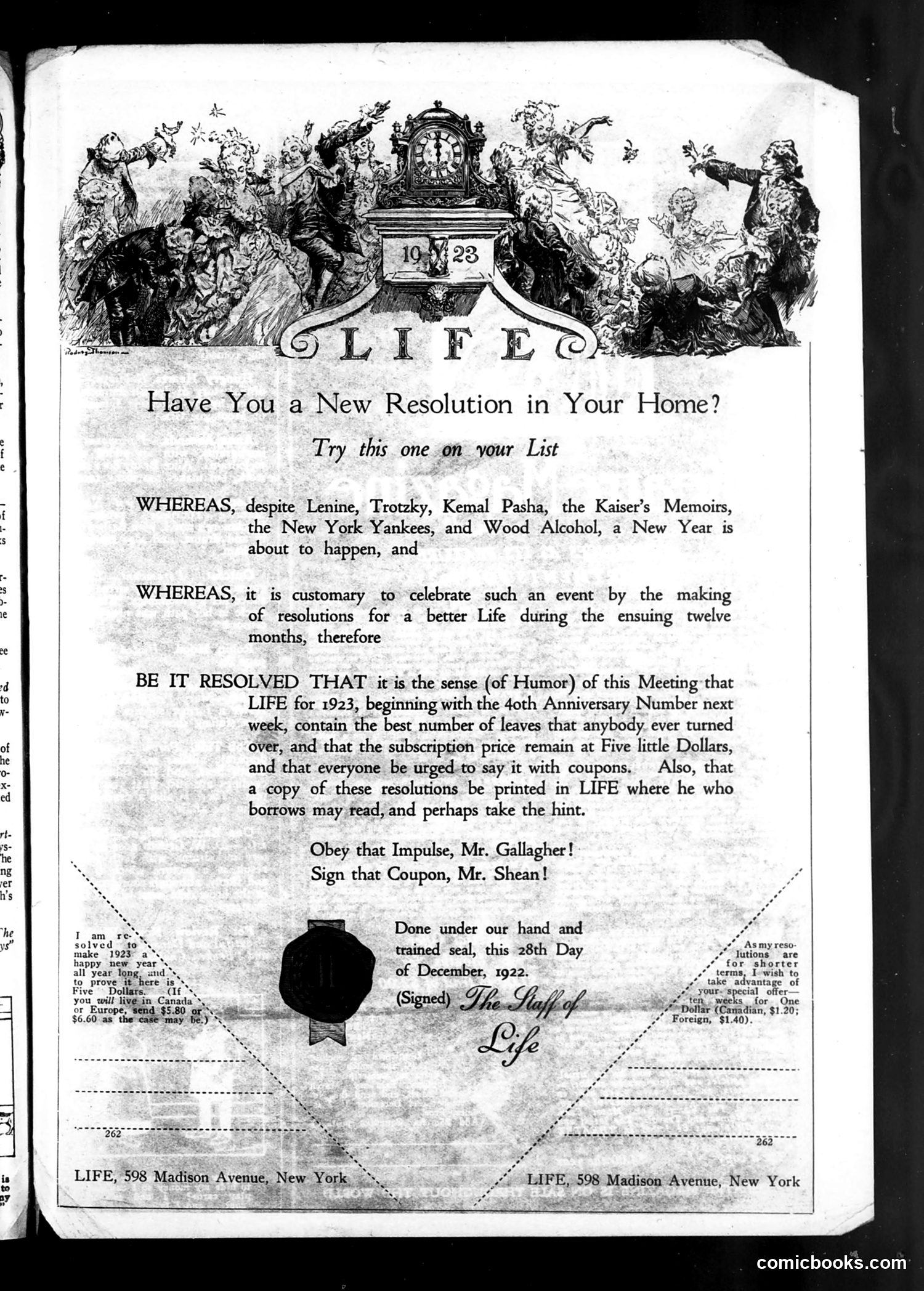
This is a humorous self-promotional piece by *Life* magazine disguised as a mock legal resolution. The ornate masthead shows figures celebrating around a clock striking midnight, establishing the New Year's theme. The satire references current 1922 events to frame why readers need *Life's* humor: Lenin, Trotsky (Russian communist leaders), Kemal Pasha (Turkish nationalist), the Kaiser's memoirs, the New York Yankees, and wood alcohol (dangerous bootleg liquor during Prohibition). These represent serious, depressing world events justifying the need for satirical relief. The "resolution" is essentially an advertisement encouraging subscriptions at five dollars, with instructions to "say it with coupons"—a playful dig at the period's coupon-clipping culture. References to "Mr. Gallagher" and "Mr. Shean" likely allude to a popular contemporary comedy duo. The document functions as both satire and direct marketing, using humor about contemporary troubles to sell the magazine.
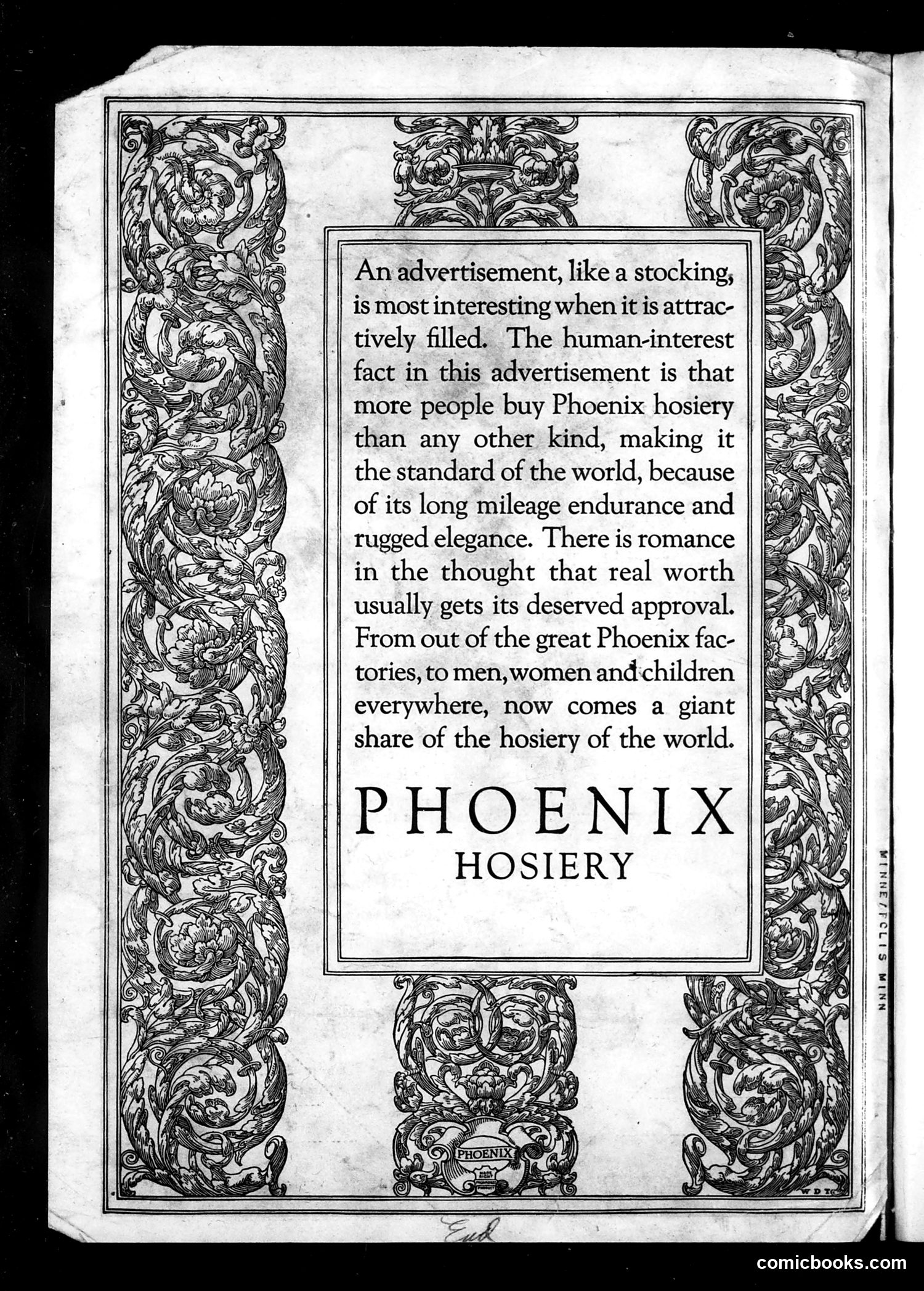
This is a full-page advertisement for Phoenix Hosiery, not political satire. The opening line uses a clever metaphor comparing advertisements to stockings—both are "most interesting when attractively filled." The ad claims Phoenix is the world's leading hosiery brand due to durability and "rugged elegance." It emphasizes that quality products receive deserved recognition, positioning Phoenix as a standard-bearer serving "men, women and children everywhere." The ornate decorative border frames the text in a luxury-goods style typical of early 20th-century magazine advertising. There is no cartoon, caricature, or satirical commentary visible—this is straightforward commercial promotion using rhetorical flourish about merit and universal appeal.

This appears to be a blank or nearly blank page from Life magazine, with only minimal text visible along the left margin (appears to be reference marks or page identifiers) and "MINNEAPOLIS MINN" printed at the bottom. The page contains no discernible cartoon, illustration, or substantive content that would allow for historical analysis. It may be a blank page separating articles, an advertisement space, or a page where the original image did not scan or reproduce clearly. Without visible content—whether satirical drawings, caricatures, or readable text—I cannot identify figures, political references, or satirical intent.