
Life, 1922-12-28 · page 21 of 37
Life — December 28, 1922 — page 21: what you’re looking at
What you’re looking at
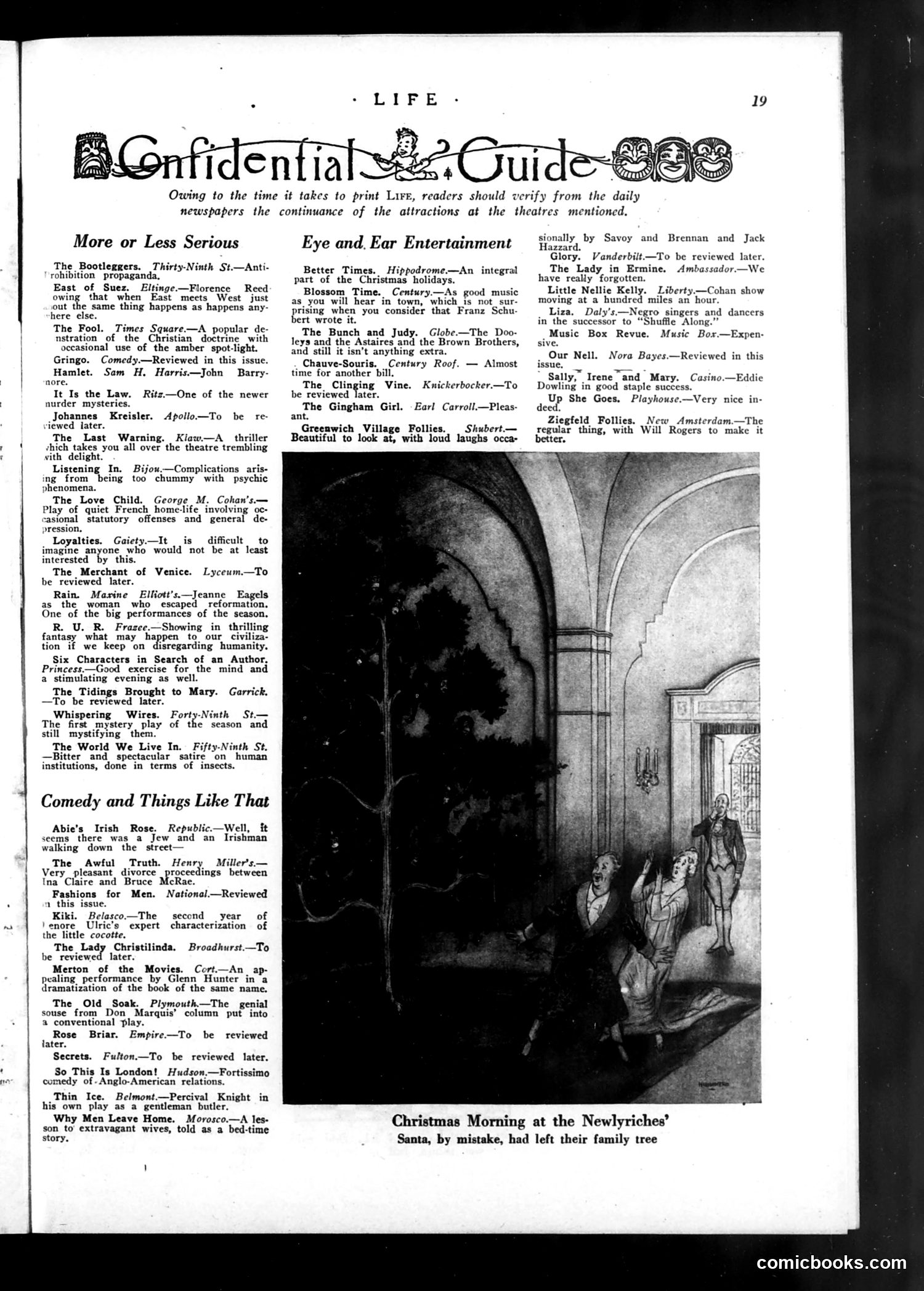
This is a **theater review guide** rather than a political cartoon. It lists Broadway shows currently playing, organized by genre ("More or Less Serious" and "Comedy and Things Like That"), with brief satirical descriptions of each production. The **single illustration** shows a domestic Christmas scene titled "Christmas Morning at the Newlyriches'—Santa, by mistake, had left their family tree." The joke is visual and class-based: wealthy "nouveau riche" characters appear bewildered because Santa accidentally left a *tree* (likely a small sapling or potted plant) instead of expensive gifts. The humor mocks newly wealthy families' materialism and presumed disappointment at receiving something natural rather than luxury items. The page reflects 1920s theater culture, referencing popular shows like *Rain* (starring Jeanne Eagels) and *Abie's Irish Rose*, while the reviews use sardonic wit typical of Life's satirical voice—for example, describing *The Fool* as "a popular demonstration of the Christian doctrine."
📄 Transcribed text from this page (OCR, searchable)
Machine-transcribed from the original scan — historical spelling and the odd misread are preserved.
19 Owing to the time it takes to print Lire, readers should verify from the daily newspapers the continuance of the attractions at the theatres mentioned, More or Less Serious The Bootleggers. Thirty-Ninth St.—Anti- rohibition propaganda, East of Suez. Eltinge.—Florence Reed owing that when East mects West just out the same thing happens as happens any- here else. The Fool. Times Square—A popular de- nstration of the Christian doctrine with occasional use of the amber spot-light. Gringo. Comedy.—Reviewed in this issue. Hamlet. Sam H. Harris—John Barry- aore. It Is the Law. Ritz —One of the newer nurder mysterie: Johannes Kreisler. Apollo.—To be re- iewed later. The Last Warning. Kiaw.—A thriller vhich takes you all over the theatre trembling vith delight. Listening In. ng from being phenomena. The Love Child. George M. Cohan’s.— Play of quiet French home-life involving oc- casional statutory offenses and general de- pression, Loyalties. Gaicty—It is difficult to imagine anyone who would not be at least interested by this. The Merchant of Venice. be reviewed later. Rain. Marine Elliott’s.—Jeanne Eagels as the woman who escaped reformation. One of the big performances of the season, R. U. R. Frazee.—Showing in thrilling fantasy what may happen to our civiliza- tion if we keep on disregarding humanity. Six Characters in Search of an Author. Princess.—Good exercise for the mind and a stimulating evening as well. The Tidings Brought to Mary. Garrick, —To be reviewed later. Whispering Wires. Forty-Ninth St.— The first mystery play of the season and still mystifying ‘them. The World We Live In. Fifty-Ninth St. —Bitter and spectacular satire on human institutions, done in terms of insects. Bijou,—Complications aris- too chummy with psychic Lyceum.—To Comedy and Things Like That Abie's Irish Rose. Republic.—Well, {t seems there was a Jew and an Irishman walking down the street— The Awful Truth. Henry Miller’s— Very pleasant. divorce proceedings between ‘cRae, National.—Reviewed Ina Claire and Bruce Fashions for Men. 1 this issue. Kiki. Belasco—The Jenore Ulric’s expert the little cocotte, The Lady Chri be reviewed later. Merton of the Movies. Cort.—An_ ap- pealing performance by Glenn Hunter in a dramatization of the book of the same name, The Old Soak. Plymouth—The genial souse from Don Marquis’ column put into a conventional play. second year of characterization of linda, Broadhurst.—To Rose Briar. Empire—To be reviewed later. Secrets. Fulton.—To be reviewed later. So This Is London! Hudson.—Fortissimo comedy of -Anglo-American relations. Thin Ice. Belmont.—Percival Knight in his own play as a gentleman butler. Why Men Leave Home. Morosco.—A les- son to extravagant wives, told as a bed-time story. Eye and. Ear Entertainment Better Times. Hippodrome.—An integral part of the Christmas holidays. Blossom Time. Century.—As good music as_you will hear in town, which 1s not_sur- prising when you consider that Franz Schu- bert wrote it. The Bunch and Judy. Globe.—The Doo- leys and the Astaires and the Brown Brothers, and still it isn’t anything extra. Chauve-Souris. Century Roof. — Almost time for another bill. The Clinging Vine. be reviewed Tater. The Gingham Girl. Earl Carroll_—Pleas- nt. Knickerbocker.—To a Greenwich Village Follies. Shubert— Beautiful to look at, with loud laughs occa- Brennan and Jack ionally by Savoy and Hazzard. Glory. The Lady in Ermine. have really forgotten. Little Nellie Kelly. Liberty—Cohan show moving at a hundred miles an hour. _ Liza. Daly’s.—Negro singers and dancers in the successor to “Shuffle Along.” _Music Box Revue. Music Box—Expen- sive. _ Our Nell. issue, = Sally,” Irene and Mary. Casino.—Eddie Dowling in good staple success. Up She Goes. Playhouse.—Very nice in- deed. Vanderbilt—To be reviewed later. Ambassador.—We Nora Bayes.—Reviewed in this Ziegfeld Follies. New Amsterdam.—The regular thing, with Will Rogers to make it ter. Christmas Morning at the Newlyriches’ Santa, by mistake, had left their family tree comicbooks.com