
Life, 1922-12-28 · page 27 of 37
Life — December 28, 1922 — page 27: what you’re looking at
What you’re looking at
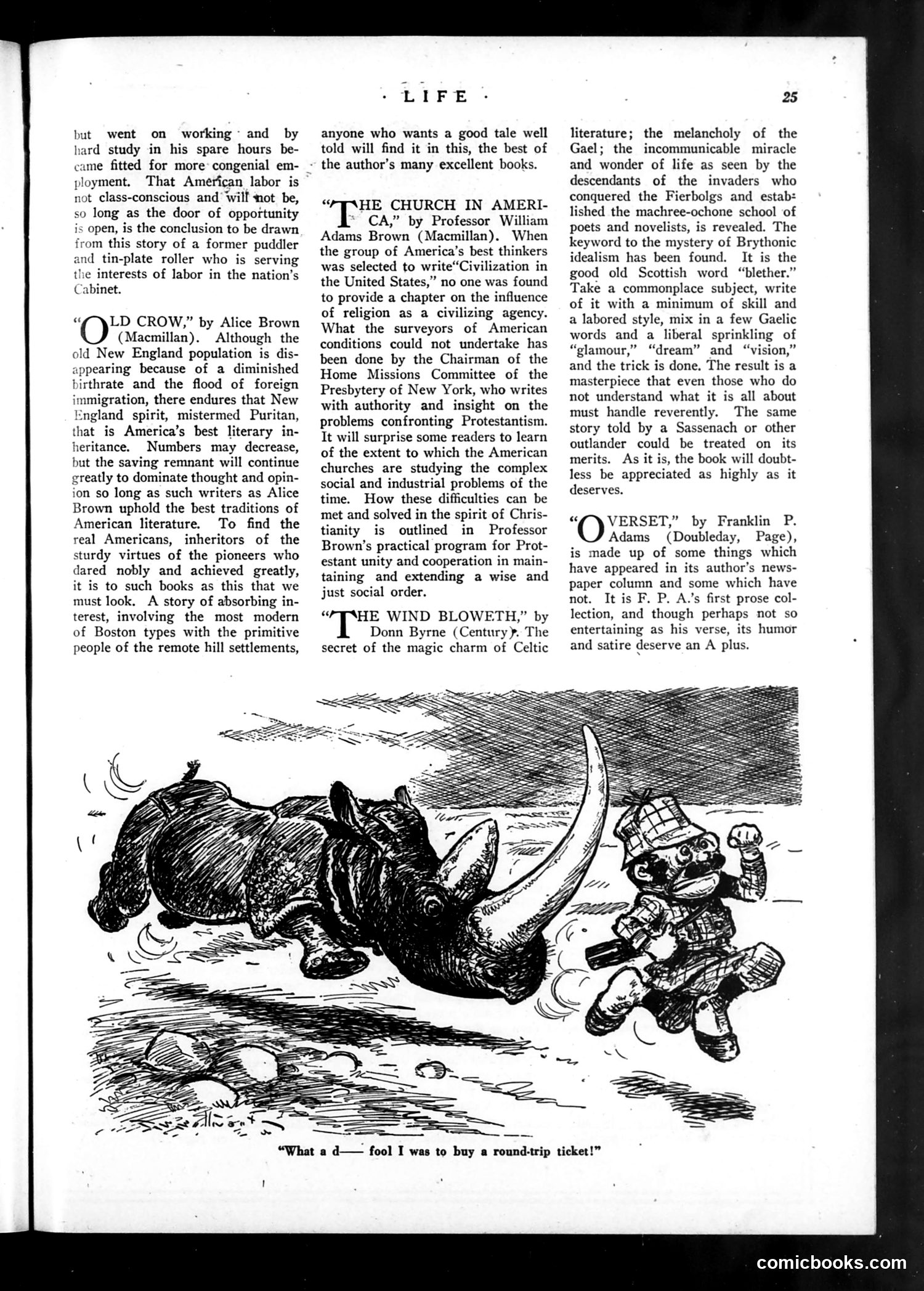
This page contains book reviews and one political cartoon. The cartoon depicts a disheveled man being chased by a rhinoceros, with the caption "What a d— fool I was to buy a round-trip ticket!"—a joke about traveling to Africa (suggested by the rhino) and regretting a round-trip purchase, implying he won't survive the return journey. The reviews discuss literary works, including "The Wind Bloweth" by Donn Byrne. The reviewer sarcastically critiques this Irish-themed novel, suggesting that by adding Gaelic words, vague language ("glamour," "dream," "vision"), and mystical Celtic atmosphere to an otherwise mundane story, Byrne creates an artificially elevated work that readers treat with undeserved reverence. The review mocks how ethnicity and literary affectation can substitute for actual literary merit—a dig at romantic Celticism popular in early 20th-century literature.
📄 Transcribed text from this page (OCR, searchable)
Machine-transcribed from the original scan — historical spelling and the odd misread are preserved.
but went on working and by hard study in his spare hours be- came fitted for more congenial em- ployment. That American labor is not class-conscious and ‘will not be, so long as the door of opportunity is open, is the conclusion to be drawn from this story of a former puddler and tin-plate roller who is serving interests of labor in the nation’s Cabinet. “ LD CROW,” by Alice Brown (Macmillan). Although the old New England population is dis- appearing because of a diminished birthrate and the flood of foreign immigration, there endures that New England spirit, mistermed Puritan, that is America’s best literary in- heritance. Numbers may decrease, but the saving remnant will continue greatly to dominate thought and opin- ion so long as such writers as Alice Brown uphold the best traditions of American literature. To find the real Americans, inheritors of the sturdy virtues of the pioneers who dared nobly and achieved greatly, it is to such books as this that we must look. A story of absorbing in- terest, involving the most modern of Boston types with the primitive people of the remote hill settlements, _ LIFE anyone who wants a good tale well told will find it in this, the best of ~ the author’s many excellent books. % HE CHURCH IN AMERI- CA,” by Professor William Adams Brown (Macmillan). When the group of America’s best thinkers was selected to write“Civilization in the United States,” no one was found to provide a chapter on the influence of religion as a civilizing agency. What the surveyors of American conditions could not undertake has been done by the Chairman of the Home Missions Committee of the Presbytery of New York, who writes with authority and insight on the problems confronting Protestantism. It will surprise some readers to learn of the extent to which the American churches are studying the complex social and industrial problems of the time. How these difficulties can be met and solved in the spirit of Chris- tianity is outlined in Professor Brown’s practical program for Prot- estant unity and cooperation in main- taining and extending a wise and just social order. “ HE WIND BLOWETH,” by Donn Byrne (Century ». The secret of the magic charm of Celtic 25 literature; the melancholy of the Gael; the incommunicable miracle and wonder of life as seen by the descendants of the invaders who conquered the Fierbolgs and estab: lished the machree-ochone school of poets and novelists, is revealed. The keyword to the mystery of Brythonic idealism has been found. It is the good old Scottish word “blether.” Take a commonplace subject, write of it with a minimum of skill and a labored style, mix in a few Gaelic words and a liberal sprinkling of “glamour,” “dream” and “vision,” and the trick is done. The result is a masterpiece that even those who do not understand what it is all about must handle reverently. The same story told by a Sassenach or other outlander could be treated on its merits. As it is, the book will doubt- less be appreciated as highly as it deserves. ba VERSET,” by Franklin P. Adams (Doubleday, Page), is made up of some things which have appeared in its author’s news- paper column and some which have not. It is F. P. A.’s first prose col- lection, and though perhaps not so entertaining as his verse, its humor and satire deserve an A plus. “What a d— fool I was to buy a round-trip ticket!” comicbooks.com