
Life, 1922-12-28 · page 23 of 37
Life — December 28, 1922 — page 23: what you’re looking at
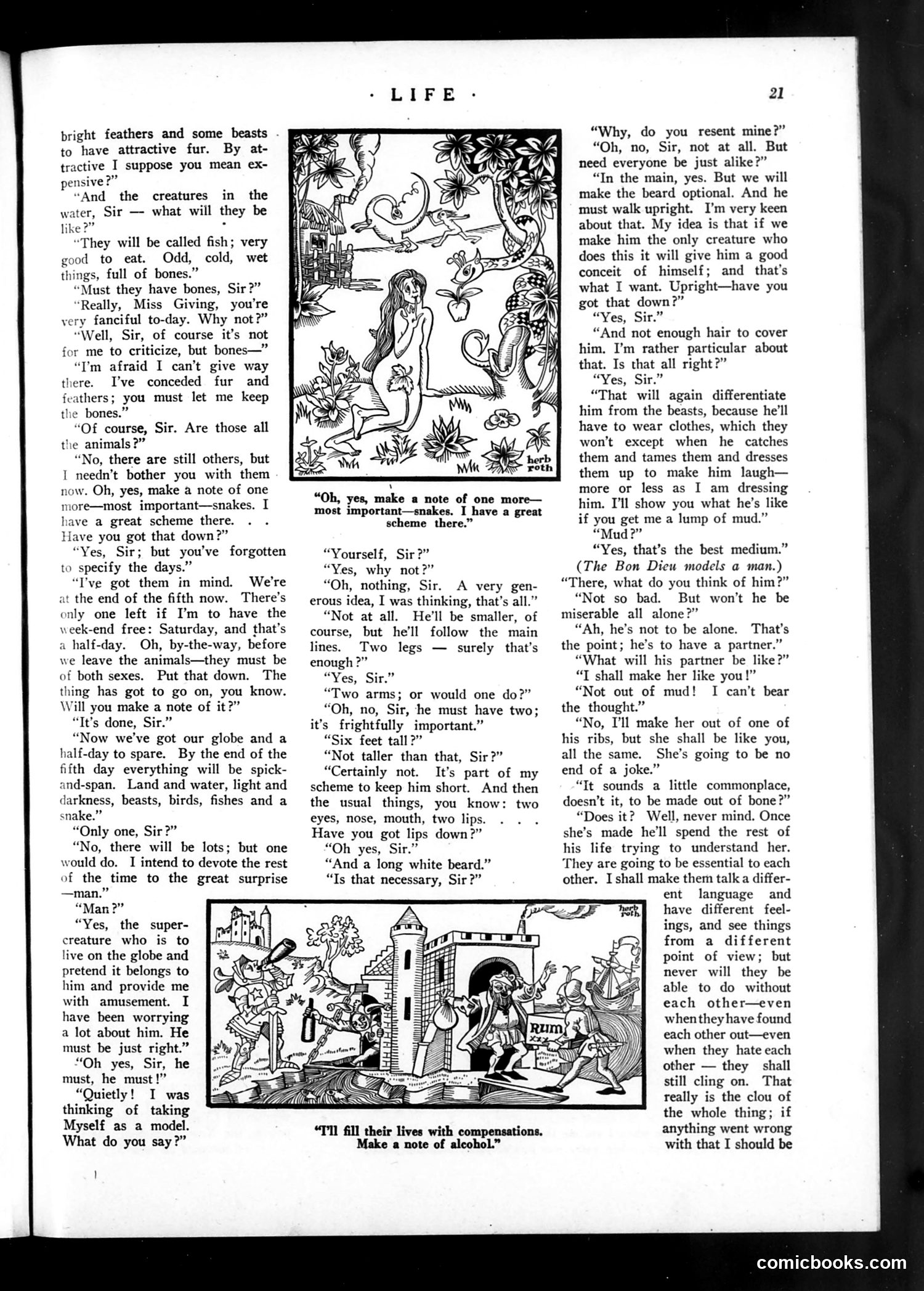
What you’re looking at
This page satirizes the *Book of Genesis* creation story by reimagining God ("The Bon Dieu") as a designer or engineer discussing his plans with a secretary. The satire mocks both religious literalism and Victorian attitudes about human nature and gender. **The joke:** God treats creation like a bureaucratic project—specifying requirements, taking notes, and managing a tight schedule to secure a weekend. He decides mankind should be bipedal (giving humans an inflated sense of importance), hairless (requiring clothes), and intellectually inferior to himself. **The gender satire:** When told he'll create woman "like you" (the female secretary), she protests being made the model for humanity. This mocks both the theological subordination of women and the condescension inherent in Victorian gender relations—making the secretary's discomfort at being chosen as woman's template the punchline itself. **The final note about alcohol** cynically suggests compensating humans for their miserable existence through intoxication—dark social commentary on industrial-era working-class life.
📄 Transcribed text from this page (OCR, searchable)
Machine-transcribed from the original scan — historical spelling and the odd misread are preserved.
bright feathers and some beasts to have attractive fur. By at- tractive I suppose you mean ex- pensive ?” “And the creatures in the water, Sir — what will they be like?” id “They will be called fish; very good to eat. Odd, cold, wet things, full of bones.” “Must they have bones, Sir?” ‘Really, Miss Giving, you're very fanciful to-day. Why not?” “Well, Sir, of course it’s not for me to criticize, but bones—” “I'm afraid I can’t give way there. I’ve conceded fur and feathers; you must let me keep he bones.” “Of course, Sir. Are those all the animals?” “No, there are still others, but I needn’t bother you with them now. Oh, yes, make a note of one more—most important—snakes. I have a great scheme there. Have you got that down?” “Yes, Sir; but you've forgotten to specify the days.” “I've got them in mind. We're at the end of the fifth now. There’s only one left if I’m to have the week-end free: Saturday, and that’s a half-day. Oh, by-the-way, before we leave the animals—they must be of both sexes. Put that down. The thing has got to go on, you know. Will you make a note of it?” “It’s done, Sir.” “Now we've got our globe and a half-day to spare. By the end of the fifth day everything will be spick- and-span. Land and water, light and darkness, beasts, birds, fishes and a snake.” “Only one, Sir?” “No, there will be lots; but one would do. I intend to devote the rest of the time to the great surprise —man.” “Man?” “Yes, the super- creature who is to live on the globe and pretend it belongs to him and provide me with amusement. I have been worrying a lot about him. He must be just right.” “Oh yes, Sir, he must, he must!” “Quietly! I was thinking of taking Myself as a model. What do you say?” . “Oh, yes, make a note of one more— most important—snakes. I have a great scheme there.” “Yourself, Sir?” “Yes, why not?” “Oh, nothing, Sir. A very gen- erous idea, I was thinking, that’s all.” “Not at all. He'll be smaller, of course, but he'll follow the main lines. Two legs — surely that’s enough ?” “Yes, Sir.” “Two arms; or would one do?” “Oh, no, Sir, he must have two; it’s frightfully important.” “Six feet tall?” “Not taller than that, Sir?” “Certainly not. It’s part of my scheme to keep him short. And then the usual things, you know: two eyes, nose, mouth, two lips. Have you got lips down?” “Oh yes, Sir.” “And a long white beard.” “Is that necessary, Sir?” “TI fill their lives with compensations. Make a note of alcohol.” 21 “Why, do you resent mine?” “Oh, no, Sir, not at all. But need everyone be just alike?” “In the main, yes. But we will make the beard optional. And he must walk upright. I’m very keen about that. My idea is that if we make him the only creature who does this it will give him a good conceit of himself; and that’s what I want. Upright—have you got that down?” “Yes, Sir.” “And not enough hair to cover him. I’m rather particular about that. Is that all right?” “Yes, Sir.” “That will again differentiate him from the beasts, because he'll have to wear clothes, which they won't except when he catches them and tames them and dresses them up to make him laugh— more or less as I am dressing him. I’ll show you what he’s like if you get me a lump of mud.” “Mud?” “Yes, that’s the best medium.” (The Bon Dieu models a man.) “There, what do you think of him?” “Not so bad. But won't he be miserable all alone?” “Ah, he’s not to be alone. That's the point; he’s to have a partner.” “What will his partner be like?” “I shall make her like you!” “Not out of mud! I can’t bear the thought.” “No, I'll make her out of one of his ribs, but she shall be like you, all the same. She’s going to be no end of a joke.” “It sounds a little commonplace, doesn’t it, to be made out of bone?” “Does it? Well, never mind. Once she’s made he'll spend the rest of his life trying to understand her. They are going to be essential to each other. I shall make them talk a differ- ent language and have different feel- ings, and see things from a different point of view; but never will they be able to do without each other—even when they have found each other out—even when they hate each other — they shall still cling on. That really is the clou of the whole thing; if anything went wrong with that I should be comicbooks.com