
Life, 1922-12-28 · page 16 of 37
Life — December 28, 1922 — page 16: what you’re looking at
What you’re looking at
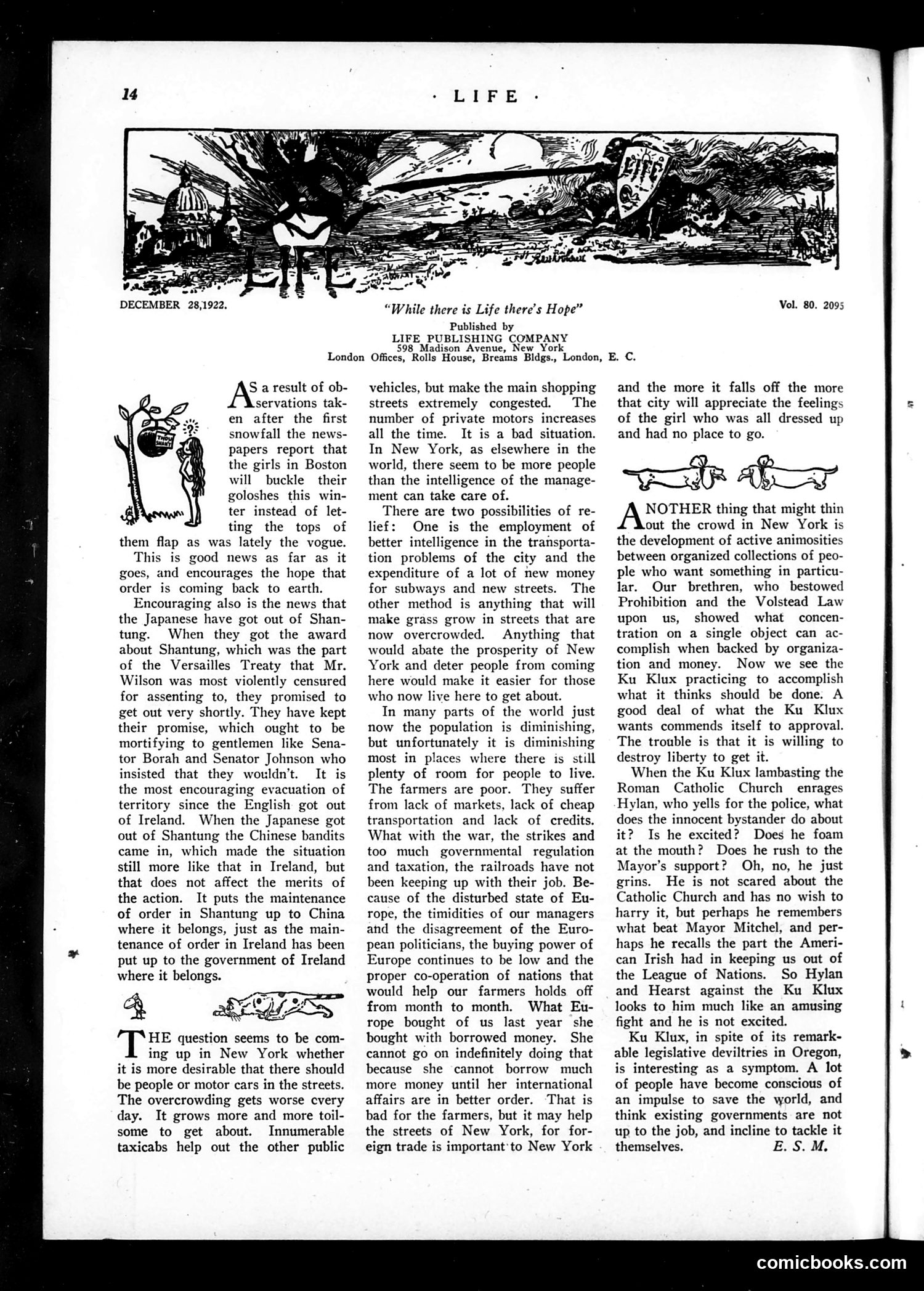
This page contains editorial commentary on urban congestion and social issues rather than traditional political cartoons. The main text discusses **New York City's traffic problems**—private automobiles clogging streets—and compares it to similar issues worldwide. It references the **Shantung controversy** (Japanese occupation) and censorship of Mr. Wilson regarding the treaty, suggesting government incompetence. The article critiques **the Ku Klux Klan**, describing it as seeking "approval" while destroying liberty. It also mentions **Mayor Mitchell** and the Roman Catholic Church's involvement in urban issues, likely the Hylan administration's conflicts with Catholic institutions. The satire targets governmental inability to solve practical problems—transportation, housing, poverty—while citizens waste energy on destructive organizations like the Klan rather than constructive reform.
📄 Transcribed text from this page (OCR, searchable)
Machine-transcribed from the original scan — historical spelling and the odd misread are preserved.
DECEMBER 28,1922. “While there is Life there's Hope” Published by LIFE PUBLISHING eee 598 Madison Avenue, New York Vol. 80. 2095 London Offices, Rolls House, Breams Bldgs., London, E. C. S a result of ob- servations tak- en after the first snowfall the news- papers report that the girls in Boston will buckle their goloshes this win- ter instead of let- ting the tops of them flap as was lately the vogue. This is good news as far as it goes, and encourages the hope that order is coming back to earth. Encouraging also is the news that the Japanese have got out of Shan- tung. When they got the award about Shantung, which was the part of the Versailles Treaty that Mr. Wilson was most violently censured for assenting to, they promised to get out very shortly. They have kept their promise, which ought to be mortifying to gentlemen like Sena- tor Borah and Senator Johnson who insisted that they wouldn’t. It is the most encouraging evacuation of territory since the English got out of Ireland. When the Japanese got out of Shantung the Chinese bandits came in, which made the situation still more like that in Ireland, but that does not affect the merits of the action. It puts the maintenance of order in Shantung up to China where it belongs, just as the main- tenance of order in Ireland has been put up to the government of Ireland where it belongs. HE question seems to be com- ing up in New York whether it is more desirable that there should be people or motor cars in the streets. The overcrowding gets worse cvery day. It grows more and more toil- some to get about. Innumerable taxicabs help out the other public vehicles, but make the main shopping streets extremely congested. The number of private motors increases all the time. It is a bad situation. In New York, as elsewhere in the world, there seem to be more people than the intelligence of the manage- ment can take care of. There are two possibilities of re- lief: One is the employment of better intelligence in the transporta- tion problems of the city and the expenditure of a lot of new money for subways and new streets. The other method is anything that will make grass grow in streets that are now overcrowded. Anything that would abate the prosperity of New York and deter people from coming here would make it easier for those who now live here to get about. In many parts of the world just now the population is diminishing, but unfortunately it is diminishing most in places where there is still plenty of room for people to live. The farmers are poor. They suffer from lack of markets, lack of cheap transportation and lack of credits. What with the war, the strikes and too much governmental regulation and taxation, the railroads have not been keeping up with their job. Be- cause of the disturbed state of Eu- rope, the timidities of our managers and the disagreement of the Euro- pean politicians, the buying power of Europe continues to be low and the proper co-operation of nations that would help our farmers holds off from month to month. What Eu- rope bought of us last year she bought with borrowed money. She cannot go on indefinitely doing that because she cannot borrow much more money until her international affairs are in better order. That is bad for the farmers, but it may help the streets of New York, for for- eign trade is important'to New York and the more it falls off the more that city will appreciate the feelings of the girl who was all dressed up and had no place to go. ode Afi NOTHER thing that might thin out the crowd in New York is the development of active animosities between organized collections of peo- ple who want something in particu- lar. Our brethren, who bestowed Prohibition and the Volstead Law upon us, showed what concen- tration on a single object can ac- complish when backed by organiza- tion and money. Now we see the Ku Klux practicing to accomplish what it thinks should be done. A good deal of what the Ku Klux wants commends itself to approval. The trouble is that it is willing to destroy liberty to get it. When the Ku Klux lambasting the Roman Catholic Church enrages Hylan, who yells for the police, what does the innocent bystander do about it? Is he excited? Does he foam at the mouth? Does he rush to the Mayor’s support? Oh, no, he just grins. He is not scared about the Catholic Church and has no wish to harry it, but perhaps he remembers what beat Mayor Mitchel, and per- haps he recalls the part the Ameri- can Irish had in keeping us out of the League of Nations. So Hylan and Hearst against the Ku Klux looks to him much like an amusing fight and he is not excited. Ku Klux, in spite of its remark- able legislative deviltries in Oregon, is interesting as a symptom. A lot of people have become conscious of an impulse to save the world, and think existing governments are not up to the job, and incline to tackle it themselves. E. S. M. a comicbooks.com