
Life, 1922-12-28 · page 5 of 37
Life — December 28, 1922 — page 5: what you’re looking at
What you’re looking at
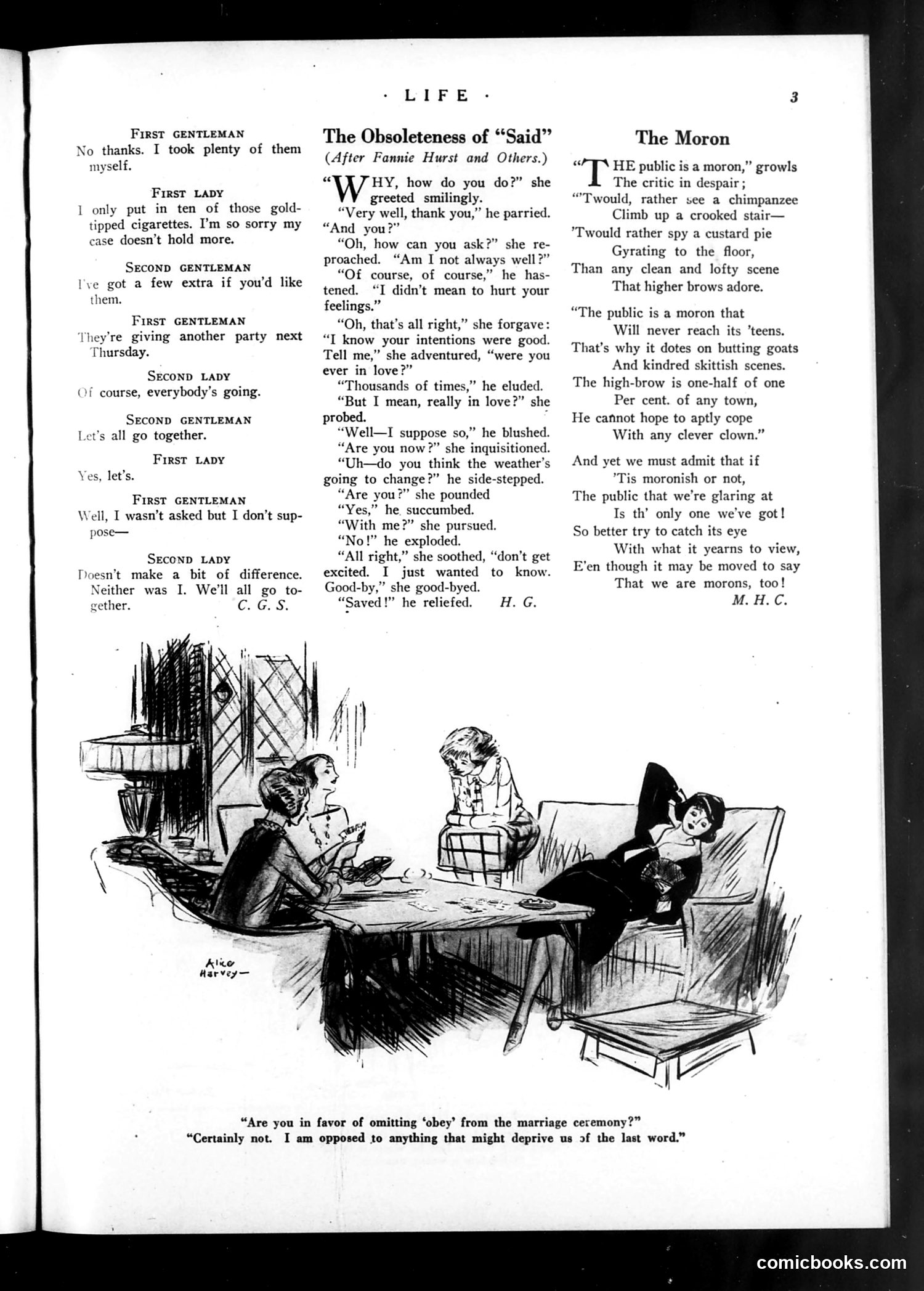
This page contains three distinct pieces of humor: 1. **"The Obsoleteness of 'Said'"** — A dialogue satire mocking overwrought Victorian prose. The author critiques writers who replace the simple word "said" with elaborate alternatives like "breathed," "soothed," and "pursued." The humor lies in demonstrating how ridiculous this stylistic excess becomes. 2. **"The Moron"** — A poem attacking public taste, suggesting average people appreciate lowbrow entertainment (slapstick, "skittish scenes") rather than sophisticated culture. The critic expresses contempt for popular preferences. 3. **The cartoon** below shows a social scene where a man lies on a couch while women converse, accompanying a caption about omitting "obey" from marriage vows—satirizing contemporary debates over modern marriage and women's rights. All pieces reflect early 20th-century intellectual commentary on language, taste, and social change.
📄 Transcribed text from this page (OCR, searchable)
Machine-transcribed from the original scan — historical spelling and the odd misread are preserved.
First GENTLEMAN No thanks. I took plenty of them myself. First LADY 1 only put in ten of those gold- tipped cigarettes. I’m so sorry my case doesn’t hold more. SECOND GENTLEMAN lve got a few extra if you'd like them. First GENTLEMAN ‘They're giving another party next Thursday. SECOND LADY Of course, everybody's going. SECOND GENTLEMAN Let’s all go together. First LADY Yes, let’s. First GENTLEMAN Well, I wasn’t asked but I don’t sup- pose— SECOND LADY Doesn't make a bit of difference. Neither was I. We'll all go to- gether. Allee Harvey— LIFE - The Obsoleteness of “Said” (After Fannie Hurst and Others.) a HY, how do you do?” she greeted smilingly. “Very well, thank you,” he parried. “And you?” “Oh, how can you ask?” she re- proached. “Am I not always well?” “Of course, of course,” he has- tened. “I didn’t mean to hurt your feelings.” “Oh, that’s all right,” she forgave: “T know your intentions were good. Tell me,” she adventured, “were you ever in love?” “Thousands of times,” he eluded. “But I mean, really in love?” she probed. : “Well—I suppose so,” he blushed. “Are you now?” she inquisitioned. “Uh—do you think the weather's going to change?” he side-stepped. “Are you?” she pounded “Yes,” he, succumbed. “With me?” she pursued. “No!” he exploded. “All right,” she soothed, “don’t get excited. I just wanted to know. Good-by,” she good-byed. “Saved!” he reliefed. H.G. The Moron “ HE public is a moron,” growls The critic in despair ; ““Twould, rather see a chimpanzee Climb up a crooked stair— ’Twould rather spy a custard pie Gyrating to the floor, Than any clean and lofty scene That higher brows adore. “The public is a moron that Will never reach its ’teens. That’s why it dotes on butting goats And kindred skittish scenes. The high-brow is one-half of one Per cent. of any town, He cannot hope to aptly cope With any clever clown.” And yet we must admit that if ’Tis moronish or not, The public that we're glaring at Is th’ only one we've got! So better try to catch its eye With what it yearns to view, E’en though it may be moved to say That we are morons, too! M. H.C. “Are you in favor of omitting ‘obey’ from the marriage ceremony?” “Certainly not. I am opposed to anything that might deprive us of the last word.” comicbooks.com