
Life, 1922-12-28 · page 28 of 37
Life — December 28, 1922 — page 28: what you’re looking at
What you’re looking at
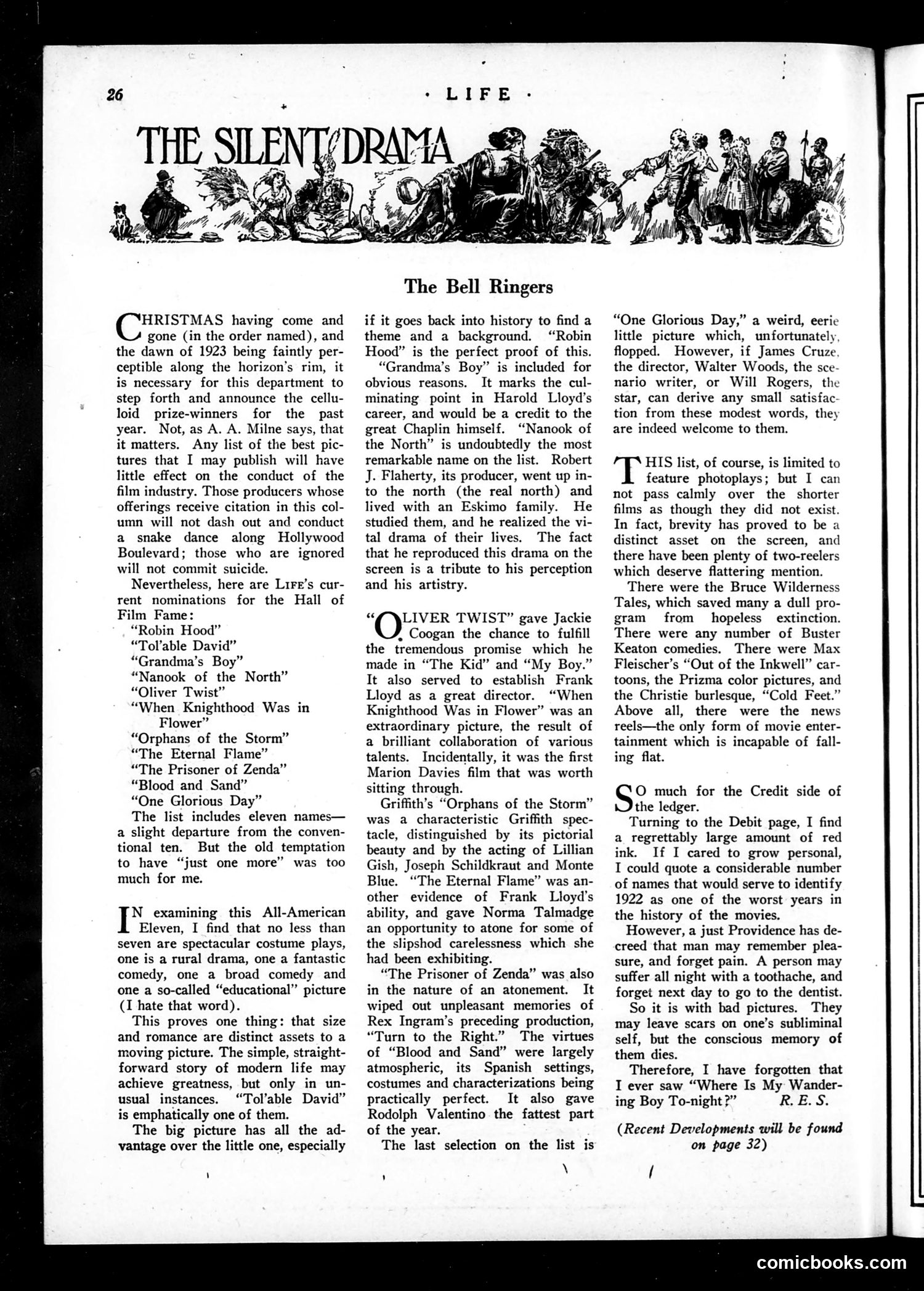
This is a film criticism column announcing Life magazine's "Hall of Film Fame" selections for 1922. The author lists eleven notable motion pictures, including *Robin Hood*, *Nanook of the North*, *Oliver Twist*, and *Grandma's Boy* (featuring Harold Lloyd). The satire is gentle: the critic humorously notes that his choices won't affect Hollywood's behavior—producers won't "dance along Hollywood Boulevard" if praised or "commit suicide" if ignored. He observes that spectacle and historical settings dominated the year's best films, though he credits genuinely artistic work like Flaherty's documentary *Nanook* and small-scale dramas like *Tol'able David*. The column praises Marion Davies and Lillian Gish while gently mocking Norma Talmadge's "slipshod carelessness" and noting Rudolph Valentino received his best role in *Blood and Sand*. This reflects 1920s silent cinema's preference for costume epics and star vehicles over contemporary stories.
📄 Transcribed text from this page (OCR, searchable)
Machine-transcribed from the original scan — historical spelling and the odd misread are preserved.
HRISTMAS having come and gone (in the order named), and the dawn of 1923 being faintly per- ceptible along the horizon’s rim, it is necessary for this department to step forth and announce the cellu- loid prize-winners for the past year. Not, as A. A. Milne says, that it matters. Any list of the best pic- tures that I may publish will have little effect on the conduct of the film industry. Those producers whose offerings receive citation in this col- umn will not dash out and conduct a snake dance along Hollywood Boulevard; those who are ignored will not commit suicide. Nevertheless, here are Lire’s cur- rent nominations for the Hall of Film Fame: “Robin Hood” “Tol’able David” “Grandma’s Boy” “Nanook of the North” “Oliver Twist” “When Knighthood Was i Flower” “Orphans of the Storm” “The Eternal Flame” “The Prisoner of Zenda” “Blood and Sand” “One Glorious Day” The list includes eleven names— a slight departure from the conven- tional ten. But the old temptation to have “just one more” was too much for me. N examining this All-American Eleven, I find that no less than seven are spectacular costume plays, one is a rural drama, one a fantastic comedy, one a broad comedy and one a so-called “educational” picture (I hate that word). This proves one thing: that size and romance are distinct assets to a moving picture. The simple, straight- forward story of modern life may achieve greatness, but only in un- usual instances. “Tol’able David” is emphatically one of them. The big picture has all the ad- vantage over the little one, especially The Bell Ringers if it goes back into history to find a theme and a background. “Robin Hood” is the perfect proof of this. “Grandma’s Boy” is included for obvious reasons. It marks the cul- minating point in Harold Lloyd’s career, and would be a credit to the great Chaplin himself. “Nanook of the North” is undoubtedly the most remarkable name on the list. Robert J. Flaherty, its producer, went up in- to the north (the real north) and lived with an Eskimo family. He studied them, and he realized the vi- tal drama of their lives. The fact that he reproduced this drama on the screen is a tribute to his perception and his artistry. af LIVER TWIST” gave Jackie r, Coogan the chance to fulfill the tremendous promise which he made in “The Kid” and “My Boy.” It also served to establish Frank Lloyd as a great director. “When Knighthood Was in Flower” was an extraordinary picture, the result of a brilliant collaboration of various talents. Incidentally, it was the first Marion Davies film that was worth sitting through. Griffith’s “Orphans of the Storm” was a characteristic Griffith spec- tacle, distinguished by its pictorial beauty and by the acting of Lillian Gish, Joseph Schildkraut and Monte Blue. “The Eternal Flame” was an- other evidence of Frank Lloyd's ability, and gave Norma Talmadge an opportunity to atone for some of the slipshod carelessness which she had been exhibiting. “The Prisoner of Zenda” was also in the nature of an atonement. It wiped out unpleasant memories of Rex Ingram’s preceding production, “Turn to the Right.” The virtues of “Blood and Sand” were largely atmospheric, its Spanish settings, costumes and characterizations being practically perfect. It also gave Rodolph Valentino the fattest part of the year. The last selection on the list is \ “One Glorious Day,” a weird, eerie little picture which, unfortunately, flopped. However, if James Cruze the director, Walter Woods, the sce- nario writer, or Will Rogers, the star, can derive any small satisfac- tion from these modest words, they are indeed welcome to them. HIS list, of course, is limited to feature photoplays; but I can not pass calmly over the shorter films as though they did not exist. In fact, brevity has proved to be a distinct asset on the screen, and there have been plenty of two-reelers which deserve flattering mention. There were the Bruce Wilderness Tales, which saved many a dull pro- gram from hopeless extinction. There were any number of Buster Keaton comedies. There were Max Fleischer’s “Out of the Inkwell” car- toons, the Prizma color pictures, and the Christie burlesque, “Cold Feet.” Above all, there were the news reels—the only form of movie enter- tainment which is incapable of fall- ing flat. O much for the Credit side of the ledger. Turning to the Debit page, I find a regrettably large amount of red ink. If I cared to grow personal, I could quote a considerable number of names that would serve to identify 1922 as one of the worst years in the history of the movies. However, a just Providence has de- creed that man may remember plea- sure, and forget pain. A person may suffer all night with a toothache, and forget next day to go to the dentist. So it is with bad pictures. They may leave scars on one’s subliminal self, but the conscious memory of them dies. Therefore, I have forgotten that I ever saw “Where Is My Wander- ing Boy To-night ?” RE. S. (Recent Developments will be found on page 32) comicbooks.com