
Life, 1922-12-28 · page 24 of 37
Life — December 28, 1922 — page 24: what you’re looking at
What you’re looking at
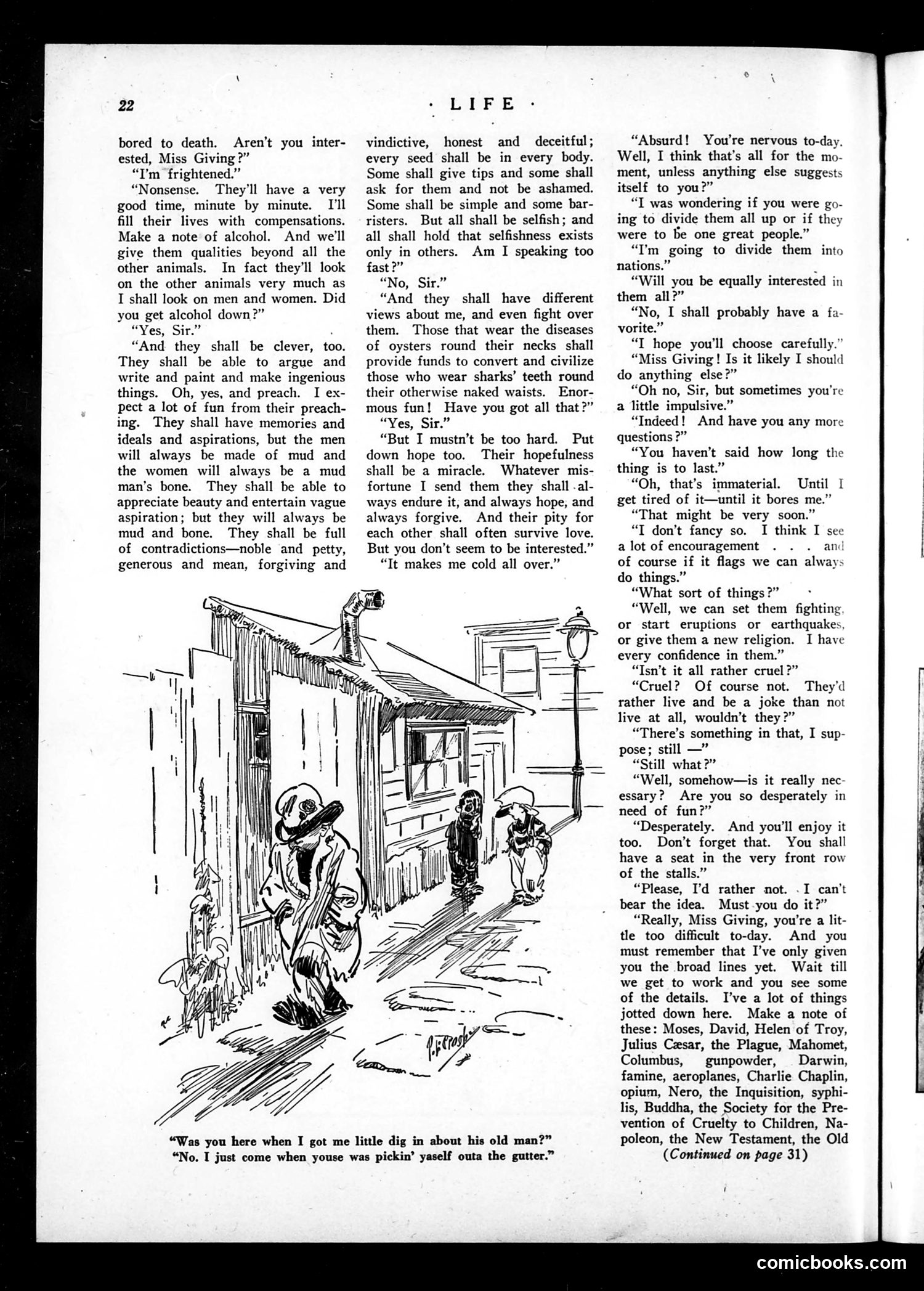
This page presents a philosophical dialogue between what appears to be **God (or a creator figure) and "Miss Giving"** (likely representing humanity or conscience). The cartoon illustration shows two figures outside a modest dwelling—one appears to be instructing the other. The satire critiques **human nature itself**. The creator character outlines humanity's fundamental contradictions: they'll be clever yet foolish, moral yet selfish, hopeful yet suffering, capable of beauty and cruelty. He acknowledges giving humans alcohol, religion, and internal divisions ("nations") while claiming benevolent intentions. The sharp social commentary targets **human hypocrisy**—people who wear religious symbols (oyster pearls, shark teeth) while judging others' morality. Miss Giving's growing discomfort represents the ethical objections to existence's inherent suffering and absurdity. The final exchange reveals the darkest joke: **life exists primarily for entertainment value**, with wars, plagues, and earthquakes as diversions when interest flags. This represents early-20th-century **satirical pessimism about divine creation and human nature**—questioning whether existence serves any purpose beyond amusement.
📄 Transcribed text from this page (OCR, searchable)
Machine-transcribed from the original scan — historical spelling and the odd misread are preserved.
22 bored to death. Aren't you inter- ested, Miss Giving?” “T’m frightened.” “Nonsense. They'll have a very good time, minute by minute. I'll fill their lives with compensations. Make a note of alcohol. And we'll give them qualities beyond all the other animals. In fact they'll look on the other animals very much as I shall look on men and women. Did you get alcohol down?” “Yes, Sir.” . “And they shall be clever, too. They shall be able to argue and write and paint and make ingenious things. Oh, yes, and preach. I ex- pect a lot of fun from their preach- ing. They shall have memories and ideals and aspirations, but the men will always be made of mud and the women will always be a mud man’s bone. They shall be able to appreciate beauty and entertain vague aspiration; but they will always be mud and bone. They shall be full of contradictions—noble and petty, generous and mean, forgiving and iy - LIFE - vindictive, honest and deceitful; every seed shall be in every body. Some shall give tips and some shall ask for them and not be ashamed. Some shall be simple and some bar- risters. But all shall be selfish; and all shall hold that selfishness exists only in others. Am I speaking too fast?” “No, Sir.” “And they shall have different views about me, and even fight over them. Those that wear the diseases of oysters round their necks shall provide funds to convert and civilize those who wear sharks’ teeth round their otherwise naked waists. Enor- mous fun! Have you got all that?” “Yes, Sir.” “But I mustn’t be too hard. Put down hope too. Their hopefulness shall be a miracle. Whatever mis- fortune I send them they shall -al- ways endure it, and always hope, and always forgive. And their pity for each other shall often survive love. But you don’t seem to be interested.” “Tt makes me cold all over.” “Was you here when I got me little dig in about his old man?” “No. I just come when youse was pickin’ yaself outa the gutter.” “Absurd! You're nervous to-day. Well, I think that’s all for the mo- ment, unless anything else suggests itself to you?” “T was wondering if you were go- ing to divide them all up or if they were to be one great people.” “I’m going to divide them into nations.” < “Will you be equally interested in them all?” “No, I shall probably have a fa- vorite.” “I hope you'll choose carefully.” “Miss Giving! Is it likely I should do anything else?” “Oh no, Sir, but sometimes you're a little impulsive.” “Indeed! And have you any more questions ?” “You haven't said how long the thing is to last.” “Oh, that’s immaterial. Until I get tired of it—until it bores me.” “That might be very soon.” “T don't fancy so. I think I see a lot of encouragement . . . ani of course if it flags we can always do things.” “What sort of things?” “Well, we can set them fighting or start eruptions or earthquakes, or give them a new religion. I have every confidence in them.” “Isn't it all rather cruel?” “Cruel? Of course not. They'd rather live and be a joke than not live at all, wouldn’t they?” “There’s something in that, I sup- pose; still —” “Still what ?” “Well, somehow—is it really nec- essary? Are you so desperately in need of fun?” “Desperately. And you'll enjoy it too. Don’t forget that. You shall have a seat in the very front row of the stalls.” “Please, I’d rather not. .I can't bear the idea. Must-you do it?” “Really, Miss Giving, you're a lit- tle too difficult to-day. And you must remember that I’ve only given you the broad lines yet. Wait till we get to work and you see some of the details. I’ve a lot of things jotted down here. Make a note of these: Moses, David, Helen of Troy, Julius Cesar, the Plague, Mahomet, Columbus, gunpowder, Darwin, famine, aeroplanes, Charlie Chaplin, opium, Nero, the Inquisition, syphi- lis, Buddha, the Society for the Pre- vention of Cruelty to Children, Na- poleon, the New Testament, the Old (Continued on page 31) comicbooks.com