
Life, 1922-12-28 · page 22 of 37
Life — December 28, 1922 — page 22: what you’re looking at
What you’re looking at
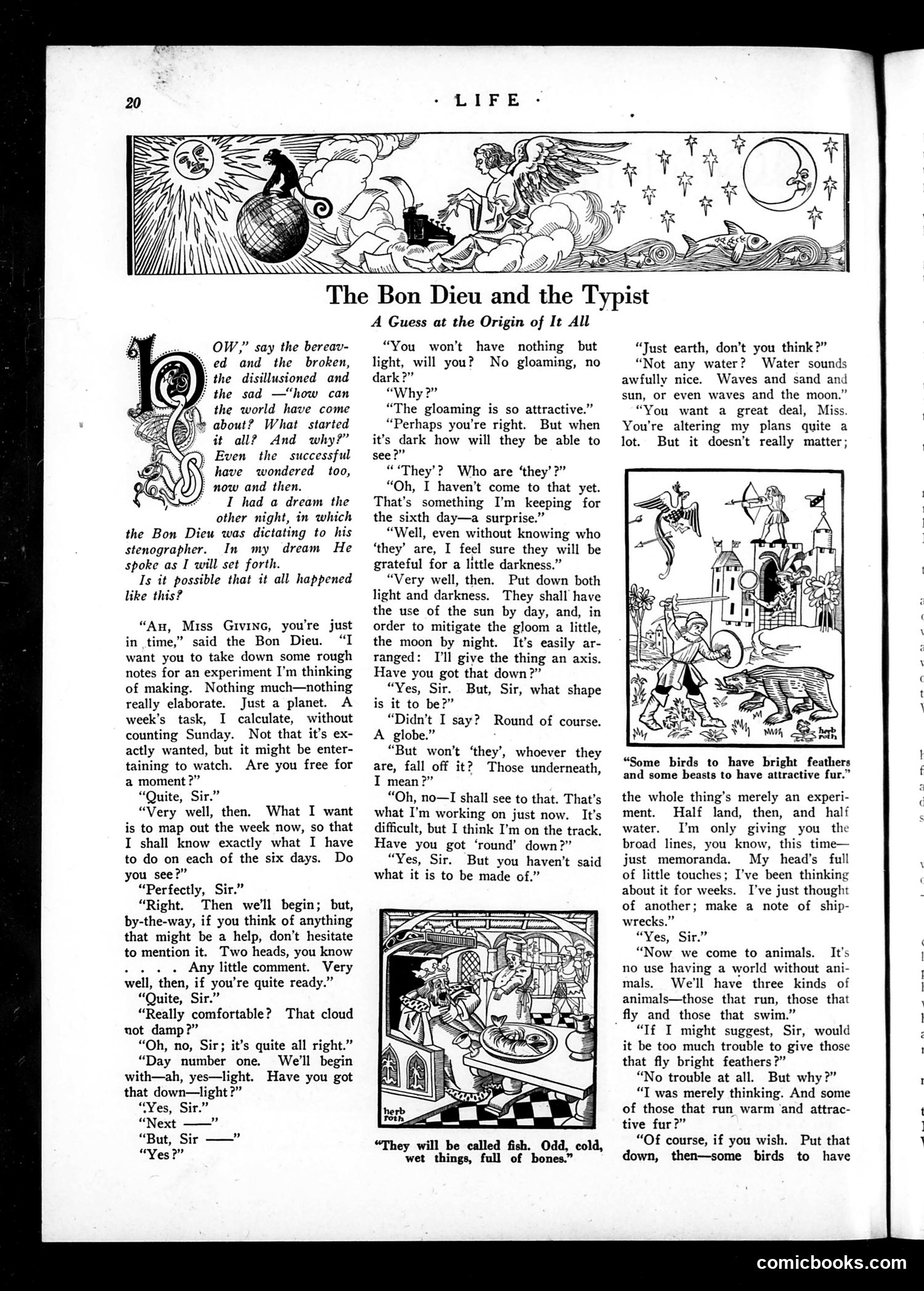
This satirical piece imagines God ("Bon Dieu") dictating creation to a stenographer named "Miss Giving." The humor rests on treating divine creation as a mundane business process—God is essentially workshopping the world like an executive planning a project. The typist functions as the voice of practical suggestion and aesthetic preference. She objects to an all-light world, advocates for water and moonlight, and proposes that animals have attractive features like bright feathers and fur. God patronizingly agrees, calling creation "merely an experiment." The satire targets **Victorian sensibilities about design and utility**: the idea that creation should be both functional and beautiful. By having God adopt these concerns through his secretary's prompting, the piece gently mocks how humans project their own aesthetic values onto divine design—suggesting our preferences aren't cosmic necessities but rather pleasant accidents of divine improvisation. The "typist" may also subtly reference the growing presence of women in office work during this era, though her role here is primarily comic rather than socially pointed.
📄 Transcribed text from this page (OCR, searchable)
Machine-transcribed from the original scan — historical spelling and the odd misread are preserved.
The Bon Dien and the Typ OW,” say the bereav- ed and the broken, the disillusioned and the sad —“how can the world have come © about? What started it all? And why?” » Even the successful . have wondered too, now and then. I had a dream the other night, in which the Bon Dieu was dictating to his stenographer. In my dream He spoke as I will set forth. Is it possible that it all happened like this? “An, Miss GiviNG, you're just in time,” said the Bon Dieu. “I want you to take down some rough notes for an experiment I’m thinking of making. Nothing much—nothing really elaborate. Just a planet. A week’s task, I calculate, without counting Sunday. Not that it’s ex- actly wanted, but it might be enter- taining to watch. Are you free for a moment?” “Quite, Sir.” “Very well, then. What I want is to map out the week now, so that I shall know exactly what I have to do on each of the six days. Do you see?” “Perfectly, Sir.” “Right. Then we'll begin; but, by-the-way, if you think of anything that might be a help, don’t hesitate to mention it. Two heads, you know . . Any little comment. Very well, then, if you’re quite ready.” “Quite, Sir.” “Really comfortable? That cloud not damp?” “Oh, no, Sir; it’s quite all right.” “Day number one. We'll begin with—ah, yes—light. Have you got that down—light ?” “Yes, Sir.” “Next ——’ “But, Sir ——” “Yes?” ’ A Guess at the Origin of It All “You won't have nothing but light, will you? No gloaming, no dark?” “Why?” “The gloaming is so attractive.” “Perhaps you're right. But when it’s dark how will they be able to see?” ““They’? Who are ‘they’ ?” “Oh, I haven't come to that yet. That’s something I’m keeping for the sixth day—a surprise.” “Well, even without knowing who ‘they’ are, I feel sure they will be grateful for a little darkness.” “Very well, then. Put down both light and darkness. They shall have the use of the sun by day, and, in order to mitigate the gloom a little, the moon by night. It’s easily ar- ranged: I'll give the thing an axis. Have you got that down?” “Yes, Sir. But, Sir, what shape is it to be?” “Didn't I say? Round of course. A globe.” “But won't ‘they’, whoever they are, fall off it? Those underneath, I mean?” “Oh, no—I shall see to that. That’s what I'm working on just now. It’s difficult, but I think I’m on the track. Have you got ‘round’ down?” “Yes, Sir. But you haven't said what it is to be made of.” “They will be called fish. Odd, cold, wet things, full of bones.” “Just earth, don’t you think?” “Not any water? Water sounds awfully nice. Waves and sand and sun, or even waves and the moon.” “You want a great deal, Miss. You're altering my plans quite a lot. But it doesn’t really matter; “Some birds to have bright feathers and some beasts to have attractive fur.” the whole thing’s merely an experi- ment. Half land, then, and half water. I’m only giving you the broad lines, you know, this time— just memoranda. My head’s full of little touches; I’ve been thinking about it for weeks. I’ve just thought of another; make a note of ship- wrecks.” “Yes, Sir.” “Now we come to animals. It's no use having a world without ani- mals. We'll have three kinds of animals—those that run, those that _ fly and those that swim.” “Tf I might suggest, Sir, would it be too much trouble to give those that fly bright feathers?” “No trouble at all. But why?” “I was merely thinking. And some of those that run warm and attrac- tive fur?” “Of course, if you wish. Put that lown, then—some birds to have comicbooks.com