
Life, 1922-12-28 · page 26 of 37
Life — December 28, 1922 — page 26: what you’re looking at
What you’re looking at
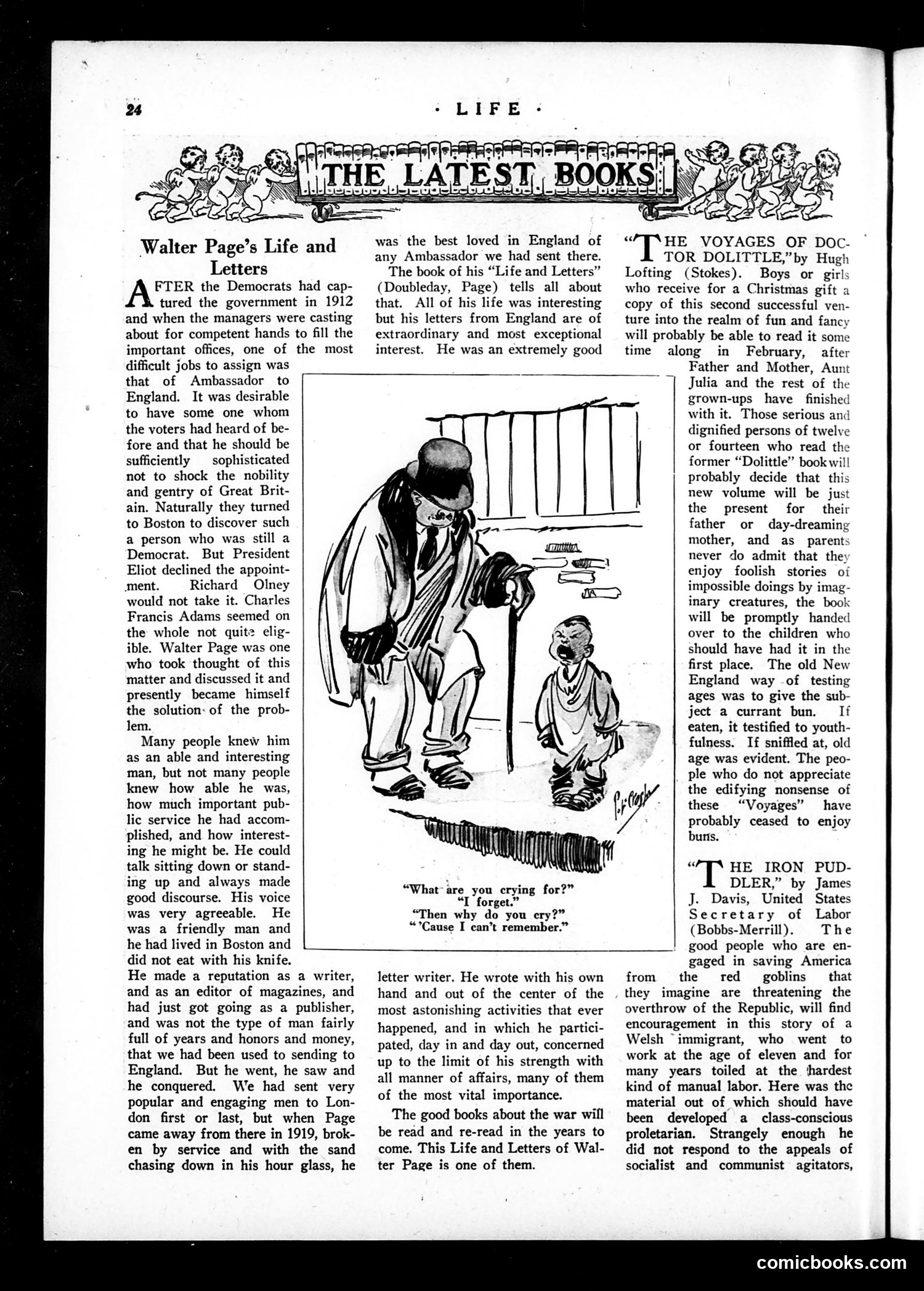
This page reviews three books, with one accompanying cartoon. The cartoon (middle of page) depicts an adult and child in conversation, illustrating a joke about memory: when asked why he's crying, the child says "I forget," then when asked why he cries if he forgot, responds "'Cause I can't remember." The main text discusses **Walter Page's Life and Letters**, reviewing the biography of the U.S. Ambassador to England during WWI (1912-1919). The article praises Page as an able diplomat and writer who served with distinction during America's involvement in the war, emphasizing his importance to the war effort. The page also advertises Hugh Lofting's **Doctor Dolittle** sequel and James J. Davis's autobiography **The Iron Puddler** (Davis was Secretary of Labor under President Harding). The cartoon itself is a simple children's joke with no political content—it's humor about the illogic of childhood reasoning, fitting the magazine's satirical tone.
📄 Transcribed text from this page (OCR, searchable)
Machine-transcribed from the original scan — historical spelling and the odd misread are preserved.
Walter Page’s Life and Letters FTER the Democrats had cap- tured the government in 1912 and when the managers were casting about for competent hands to fill the important offices, one of the most difficult jobs to assign was was the best loved in England of any Ambassador we had sent there. The book of his “Life and Letters” (Doubleday, Page) tells all about that. All of his life was interesting but his letters from England are of extraordinary and most exceptional He was an extremely good interest. so HE VOYAGES OF DOc- TOR DOLITTLE,”by Hugh Lofting (Stokes). Boys or girls who receive for a Christmas gift a copy of this second successful ven- ture into the realm of fun and fancy will probably be able to read it some time along in February, after Father and Mother, Aunt that of Ambassador to England. It was desirable to have some one whom the voters had heard of be- fore and that he should be sufficiently sophisticated not to shock the nobility and gentry of Great Brit- ain. Naturally they turned to Boston to discover such a person who was still a Democrat. But President Eliot declined the appoint- ment. Richard Olney would not take it. Charles Francis Adams seemed on the whole not quite elig- ible. Walter Page was one who took thought of this matter and discussed it and presently became himself the solution: of the prob- Jem. Many people knew him as an able and interesting man, but not many people knew how able he was, how much important pub- lic service he had accom- plished, and how interest- ing he might be. He could talk sitting down or stand- ing up and always made good discourse. His voice was very agreeable. He was a friendly man and he had lived in Boston and “What are you crying for?” “I forget.” “Then why do you ery?” “*Cause I can’t remember.” Julia and the rest of the grown-ups have finished with it. Those serious and dignified persons of twelve or fourteen who read the former “Dolittle” book will probably decide that this new volume will be just the present for their father or day-dreaming mother, and as parents never do admit that they enjoy foolish stories oi impossible doings by imag- inary creatures, the book will be promptly handed over to the children who should have had it in the first place. The old New England way of testing ages was to give the sub- ject a currant bun. If eaten, it testified to youth- fulness. If sniffled at, old age was evident. The peo- ple who do not appreciate the edifying nonsense of these “Voyages” have probably ceased to enjoy buns. ss HE IRON PUD- DLER,” by James J. Davis, United States Secretary of Labor (Bobbs-Merrill). The good people who are en- did not eat with his knife. He made a reputation as a writer, and as an editor of magazines, and had just got going as a publisher, and was not the type of man fairly full of years and honors and money, that we had been used to sending to England. But he went, he saw and he conquered. We had sent very popular and engaging men to Lon- don first or last, but when Page came away from there in 1919, brok- en by service and with the sand chasing down in his hour glass, he letter writer. He wrote with his own hand and out of the center of the most astonishing activities that ever happened, and in which he partici- pated, day in and day out, concerned up to the limit of his strength with all manner of affairs, many of them of the most vital importance. The good books about the war will be read and re-read in the years to come. This Life and Letters of Wal- ter Page is one of them. gaged in saving America from the red _ goblins that they imagine are threatening the overthrow of the Republic, will find encouragement in this story of a Welsh “immigrant, who went to work at the age of eleven and for many years toiled at the ‘hardest kind of manual labor. Here was the material out of which should have been developed a_ class-conscious proletarian. Strangely enough he did not respond to the appeals of socialist and communist agitators, comicbooks.com