
A complete issue · 40 pages · 1922
Life — November 2, 1922
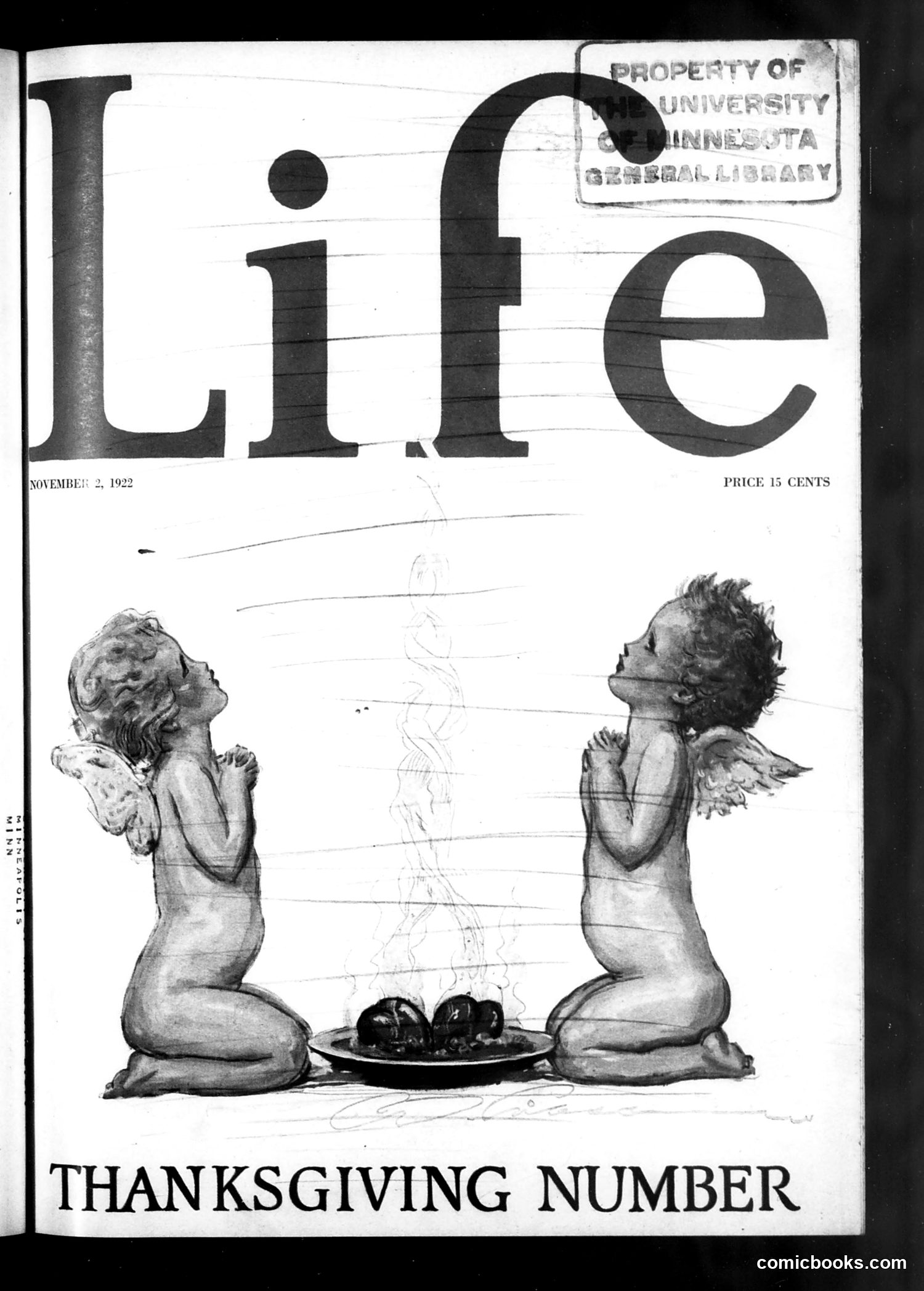
This is the cover of Life's Thanksgiving issue from 1922. The main illustration shows two cherubs (winged baby figures) kneeling beside a bowl of what appears to be fruit or produce, rendered in a classical artistic style. The cherubs face each other in a devotional pose, suggesting gratitude or abundance. The imagery connects to Thanksgiving's themes of harvest bounty and gratitude. The classical cherub figures elevate the holiday from mere holiday festivity to something more spiritually significant. This was typical of early 20th-century Life magazine's approach—using allegorical or artistic illustrations to comment on contemporary themes with sophistication and wit. The 15-cent price reflects 1920s economics.
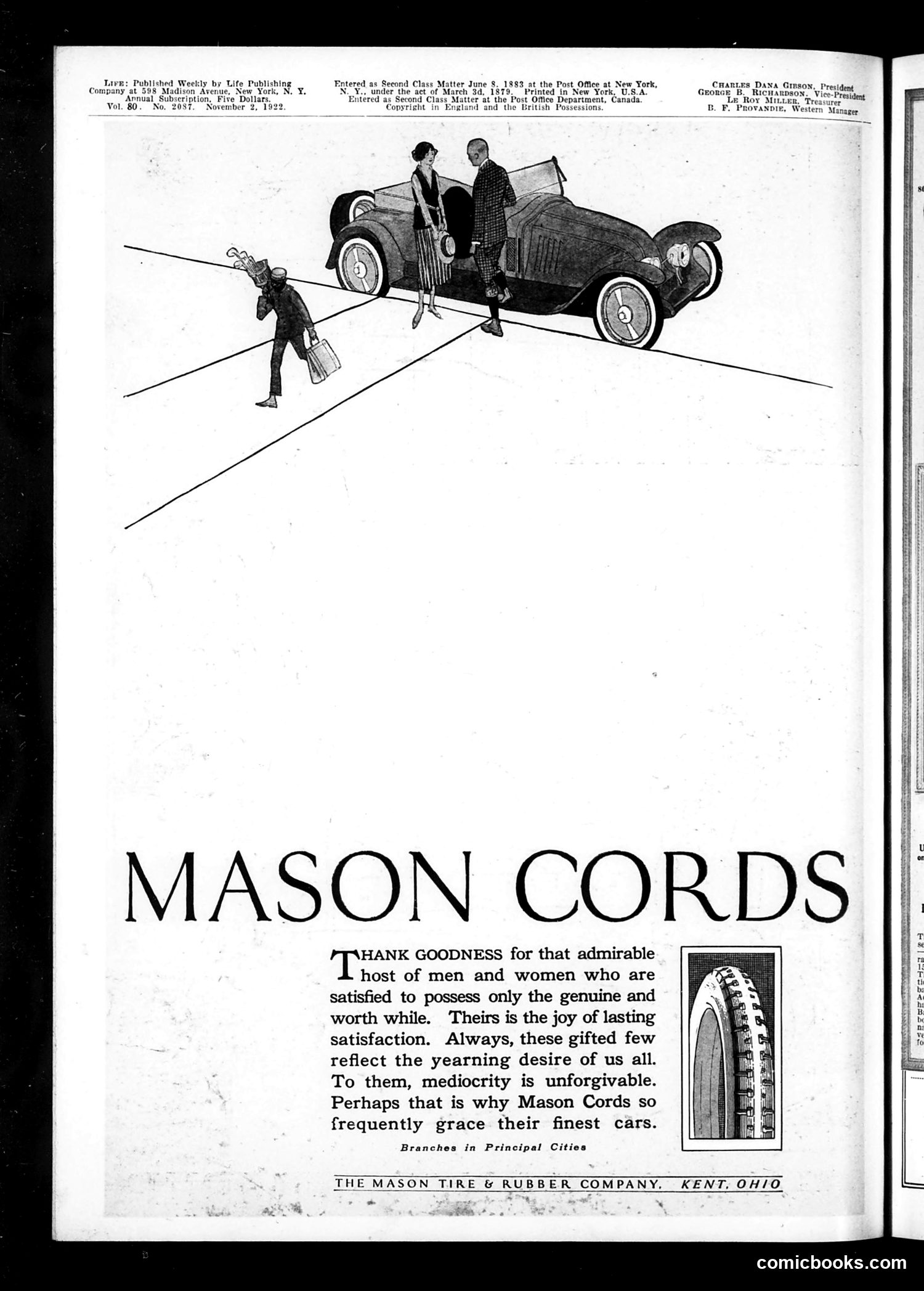
This page is primarily a **Mason Cords tire advertisement**, not satirical content. The illustration depicts a wealthy couple in an elegant automobile being attended by a chauffeur or servant, emphasizing luxury and status. The ad's text celebrates people of refined taste who demand quality products, positioning Mason Cords tires as a marker of sophistication and distinction. The message: premium tires belong on the finest automobiles—a status symbol appeal common in early 20th-century advertising. There is no political cartoon or satire here. The page represents typical *Life* magazine advertising from this era, which mixed editorial content with luxury product promotion aimed at affluent readers. The class hierarchy depicted (wealthy owners, subordinate servant) reflects period attitudes uncritically.
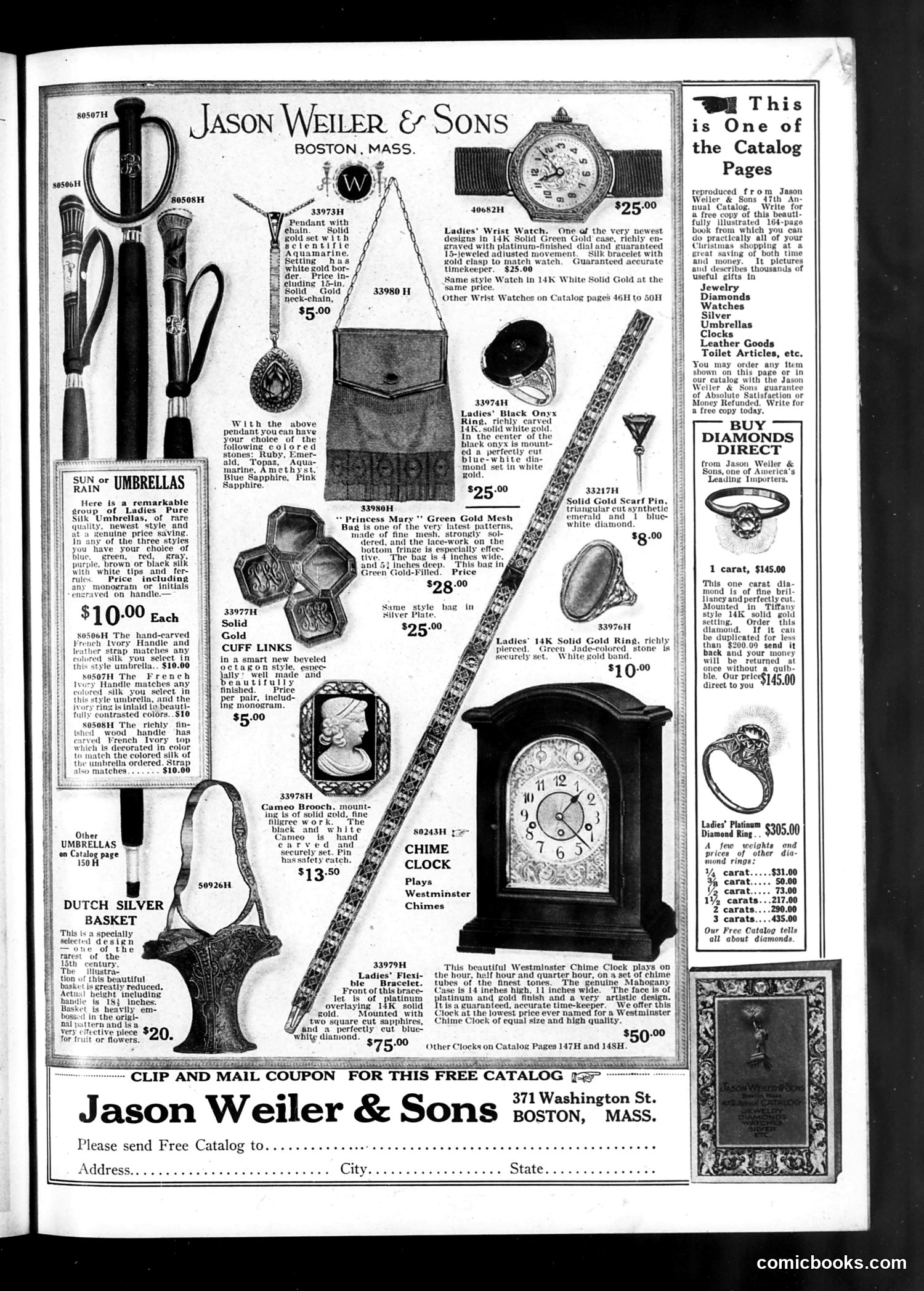
This page is **primarily a jewelry and luxury goods catalog** from Jason Weiler & Sons, a Boston retailer, rather than a satirical cartoon page. The content features advertisements for high-end items including: - Umbrellas ($10-$25) - Ladies' wrist watches and jewelry - Cuff links - A Dutch silver basket - A Westminster chime clock ($50) - Diamond rings and pins The right sidebar promotes "Buy Diamonds Direct" and features a platinum diamond ring ($145). There is **no political satire or cartoon content** visible on this page. This appears to be a standard mail-order catalog page from the early 20th century, designed to solicit purchases through a clipped coupon at the bottom requesting customers request the full free catalog.
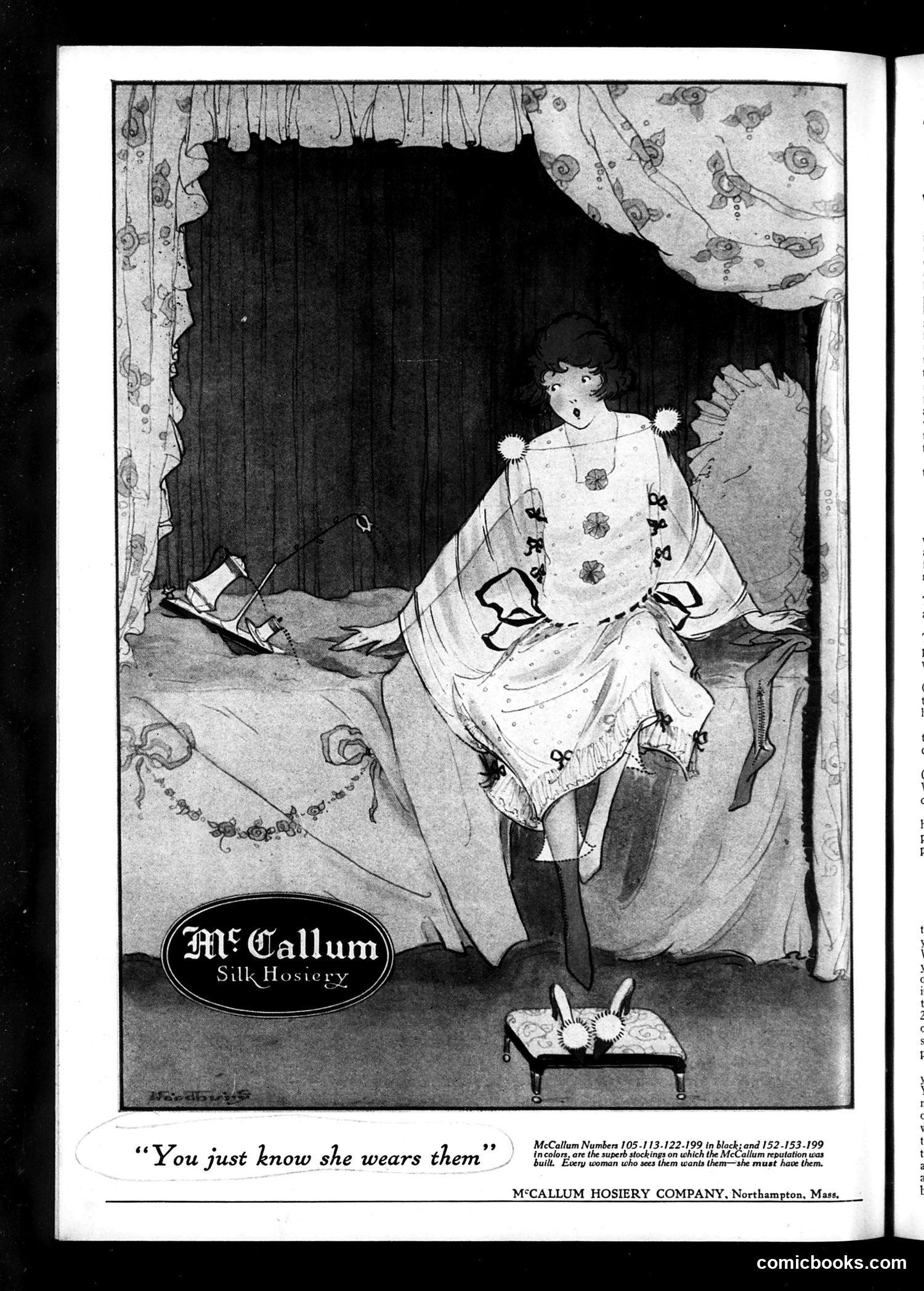
This is a **commercial advertisement**, not political satire. It promotes McCallum brand silk stockings, a luxury hosiery product from the early 20th century. The illustration shows a woman in an intimate bedroom setting, adjusting her stockings with the caption "You just know she wears them." The ad emphasizes that McCallum stockings were status symbols—visible markers of wealth and sophistication that announced a woman's refined taste to observers. The humor is mild and suggestive rather than satirical: the intimate setting implies that quality stockings matter even in private moments, playing on vanity and the social importance of appearing fashionable. This reflects period advertising that marketed luxury goods as essential to feminine identity and desirability.
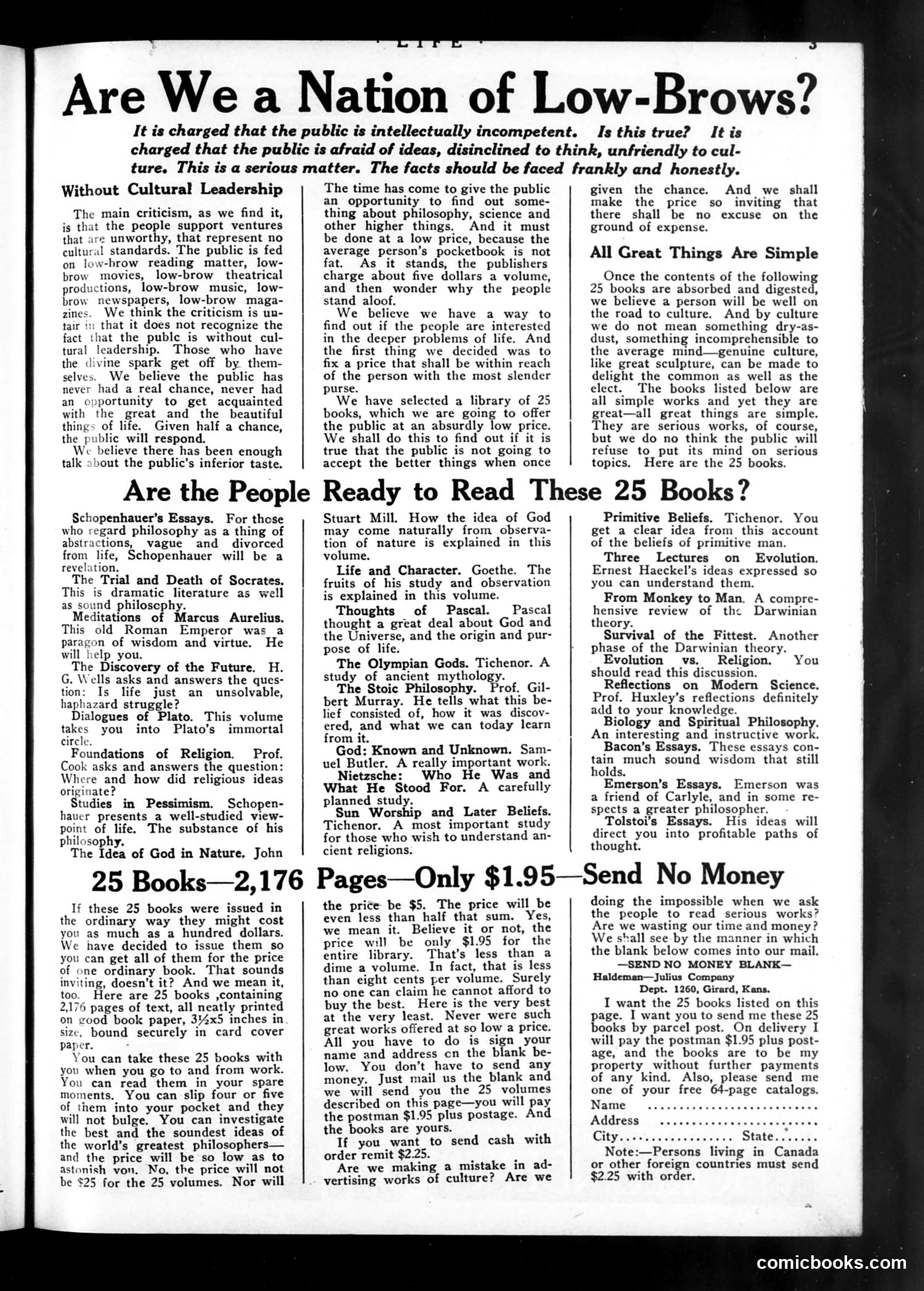
This page is primarily **advertising copy**, not a political cartoon. It's a mail-order book club advertisement from Life magazine promoting 25 classic works of philosophy, literature, and science for $1.95. The headline "Are We a Nation of Low-Brows?" sarcastically addresses a widespread cultural anxiety of the era—that Americans were intellectually inferior and culturally unrefined. The ad defends ordinary people's capacity for serious thought while arguing that cost barriers, not ability, prevented engagement with "great things." The pitch claims accessibility to high culture shouldn't require expense, listing canonical works by figures like Schopenhauer, Plato, and Emerson. This reflects mid-20th century democratic idealism about making intellectual material available to the masses through affordable distribution.
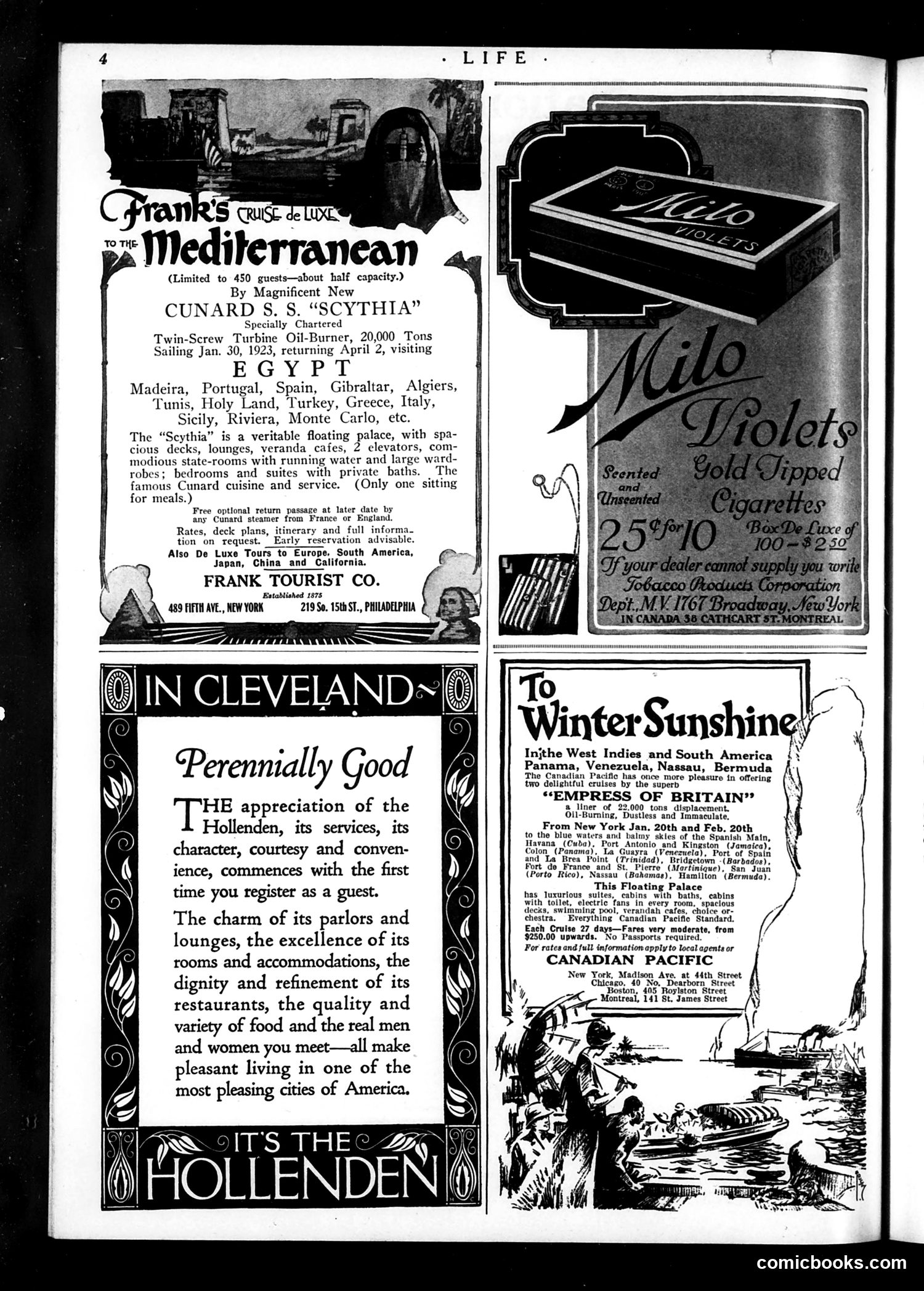
This page contains **four advertisements, not political cartoons**. The content is commercial travel and luxury goods marketing from what appears to be the 1920s: 1. **Frank's Mediterranean cruise** via the Cunard S.S. "Scythia" — a luxury ocean liner voyage to Egypt and Mediterranean ports 2. **Milo Violet cigarettes** — scented, gold-tipped cigarettes marketed at 25¢ per box 3. **The Hollenden Hotel** in Cleveland — emphasizing hospitality and amenities 4. **Winter Sunshine cruise** via the "Empress of Britain" to the Caribbean and Panama Each ad targets wealthy Americans with disposable income, promoting leisure travel and premium consumer goods. There is no satire or political commentary present — this is straightforward period advertising for luxury services and products aimed at affluent readers.
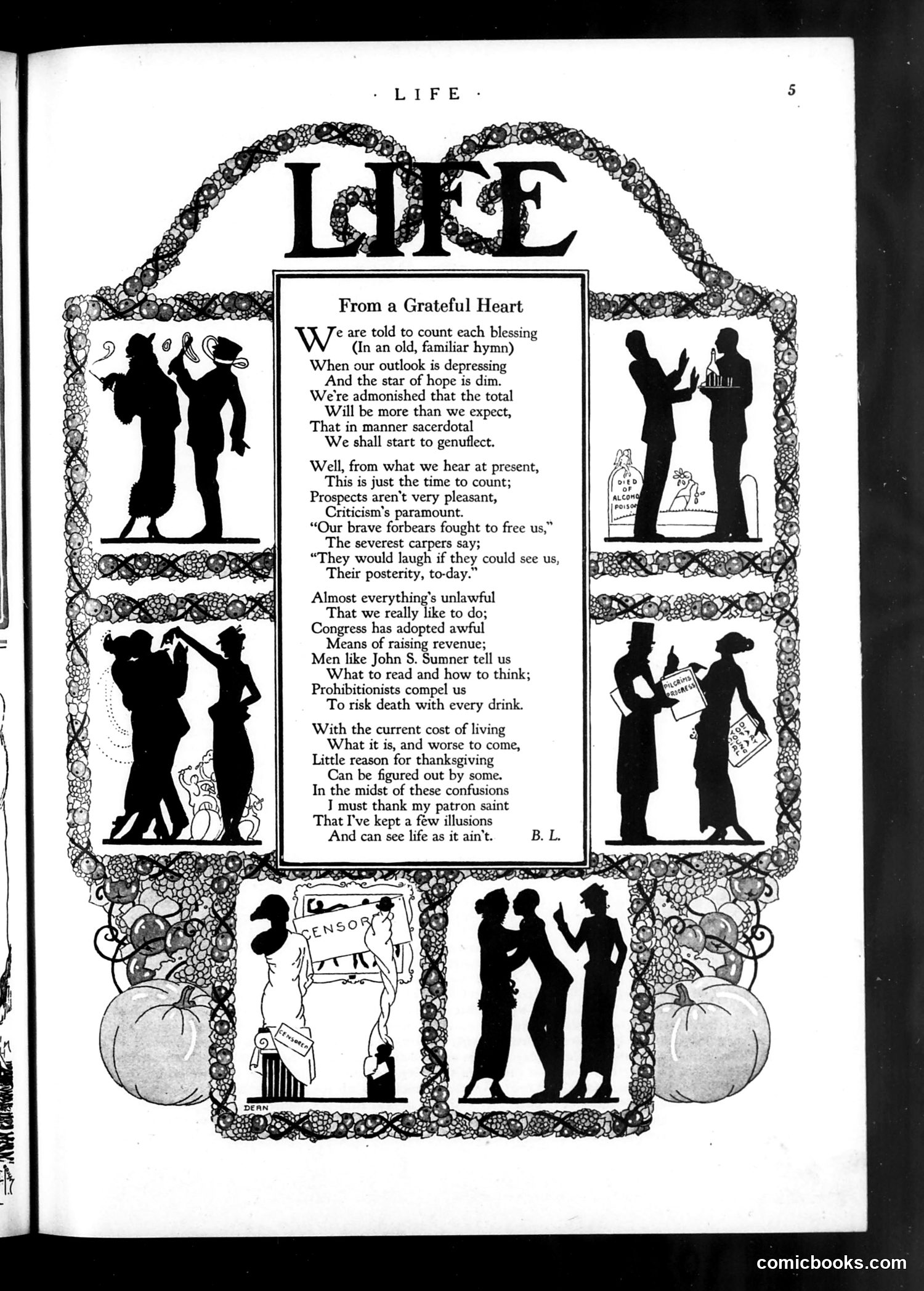
This poem by B.L. critiques American society during what appears to be a period of economic hardship and social restriction (likely Prohibition era, given references to drinking laws). The silhouette illustrations depict various hypocrisies: people hiding illicit activities, censorship ("CENSORED" visible), prohibition enforcement, and government control. The poem sarcastically thanks various forces—Congress, "Prohibitionists," revenue-raising measures, and critics—for making life difficult. The central complaint: despite economic hardship ("current cost of living"), citizens are forced to endure "confusions" of regulation and moral policing. The satire suggests these restrictions are justified by false optimism ("keep a few illusions"), while ordinary people struggle. The ornate border frames these complaints as grim commentary on contemporary American life.
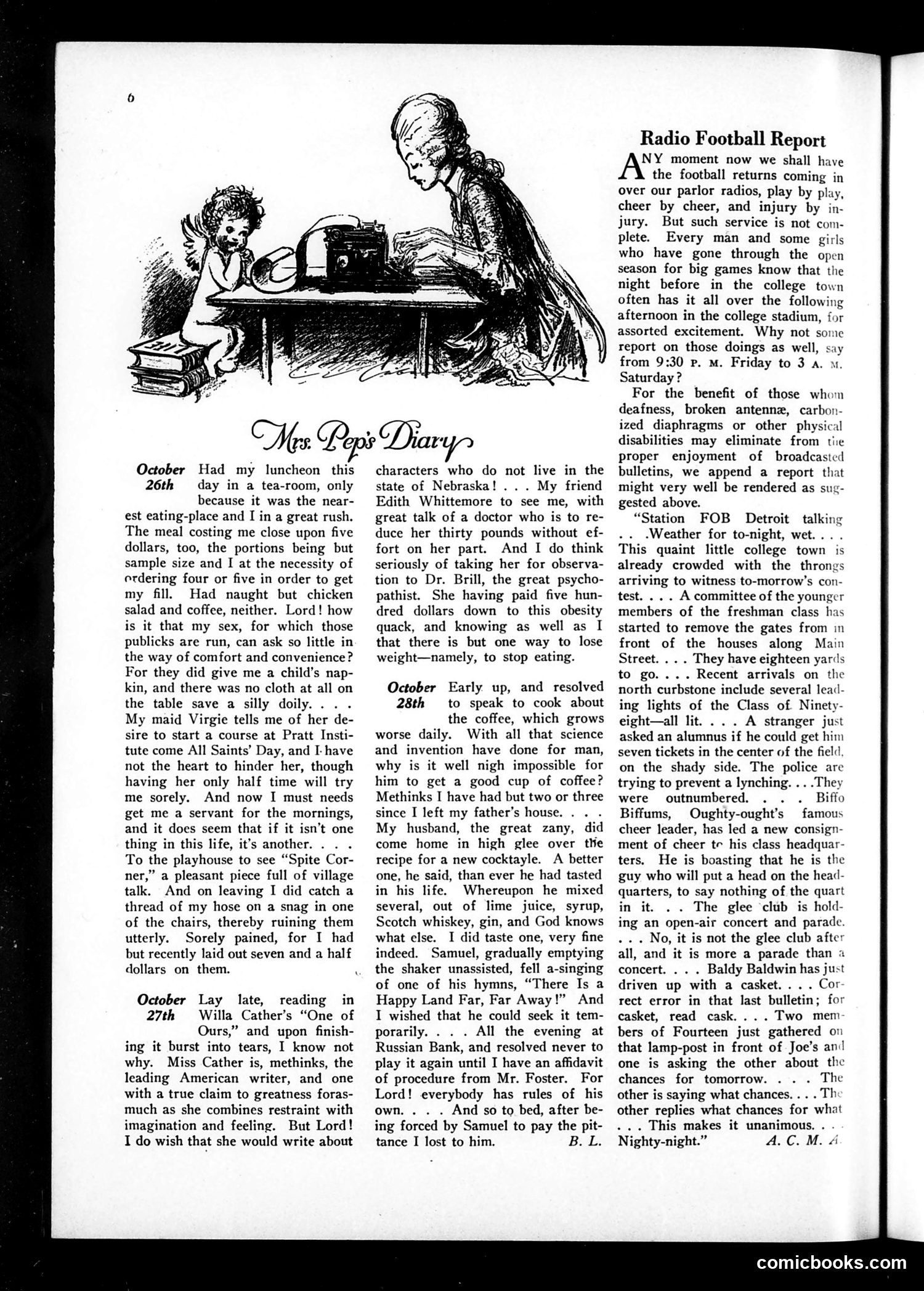
This page contains a satirical diary column rather than a political cartoon. The illustration shows a woman at a desk with a radio, representing the author. The diary entries (October 26-27) humorously chronicle domestic frustrations: an expensive meal at a tea room, failed attempts at weight loss despite doctor's orders, marital discord over a poorly-made cocktail, and irritation with Willa Cather's literary restraint. The "Radio Football Report" section satirizes radio broadcasters' attempts to serve all audiences simultaneously—from deaf listeners needing descriptions to those merely seeking entertainment—suggesting the medium's growing but imperfect reach into American homes during the early radio era. The satire targets everyday American life: consumer culture, marriage dynamics, and emerging mass media.
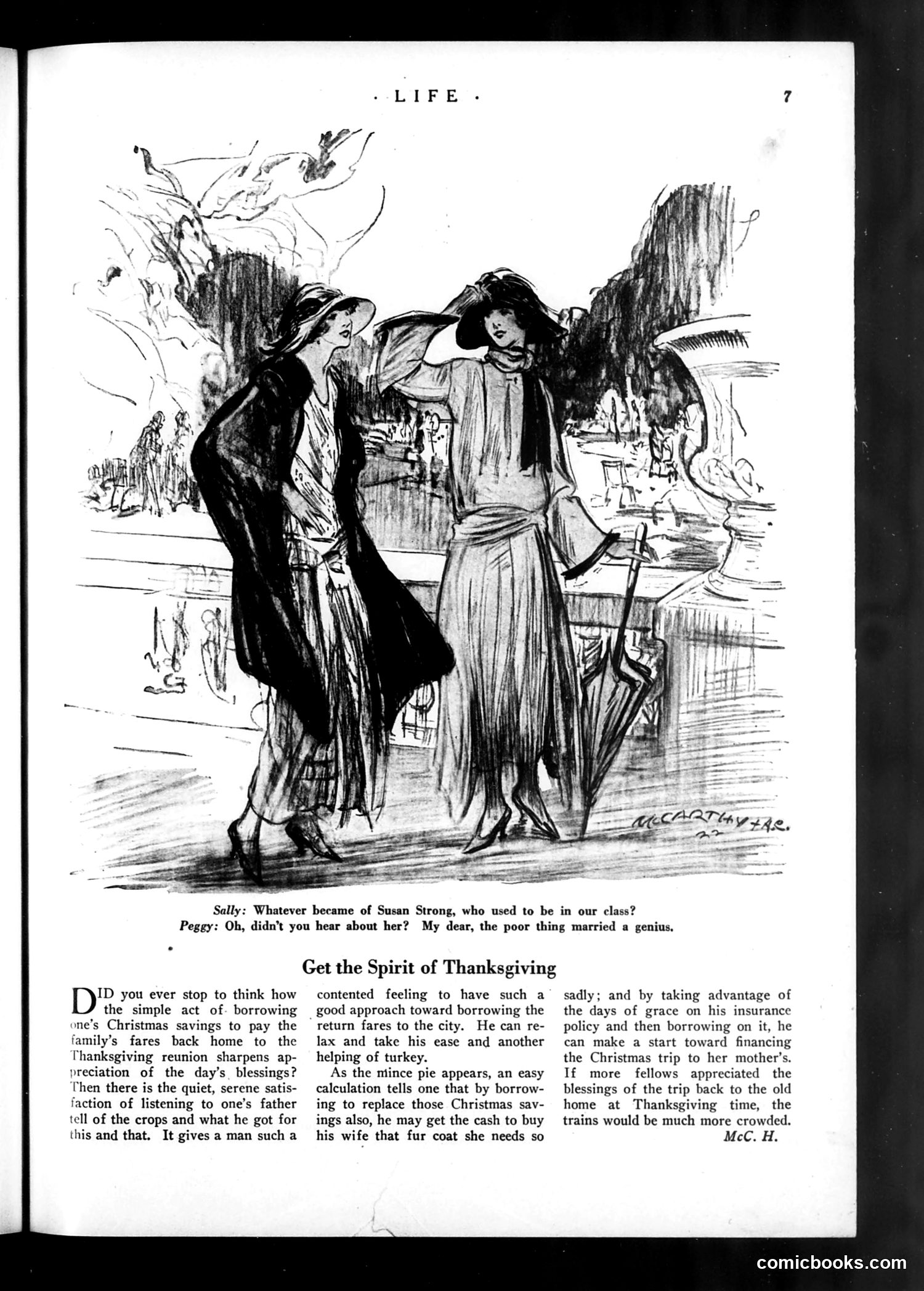
This page contains a satirical cartoon and article from *Life* magazine about Thanksgiving borrowing practices. **The Cartoon:** Two fashionably dressed women discuss a former classmate, Susan Strong, who "married a genius." The satire targets the social aspiration of marrying wealthy or accomplished men as a path to security. **The Article "Get the Spirit of Thanksgiving":** Written by "McC. H.," it ironically suggests that borrowing money to finance holiday celebrations—particularly to purchase items like fur coats and cover travel expenses—represents a practical application of Thanksgiving gratitude. The piece sardonically argues that borrowing leverages "grace periods" on insurance and creates financial obligations that help one "make a start toward financing the Christmas trip." The satire mocks both consumer excess and the financial rationalization people use to justify holiday spending beyond their means.
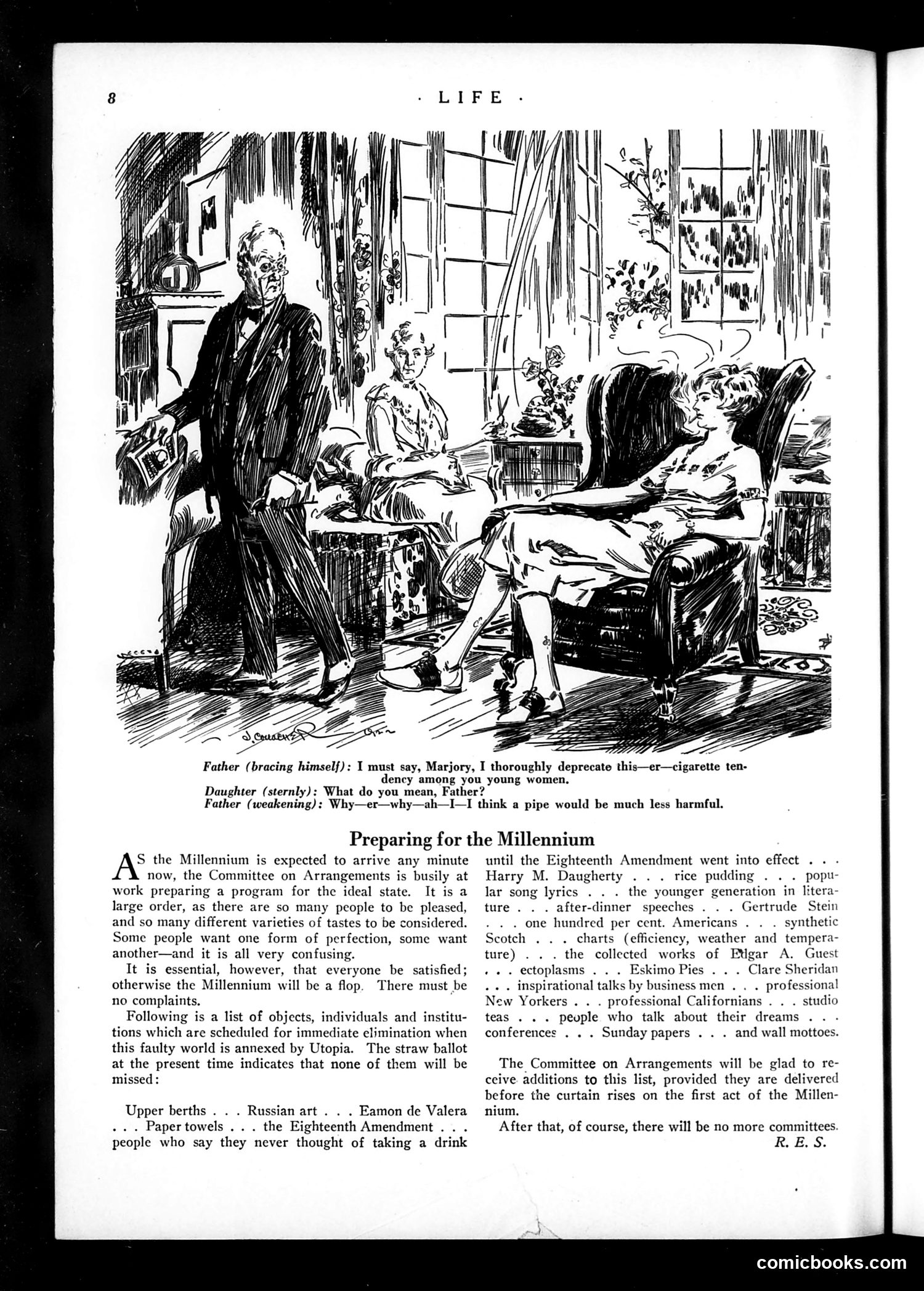
This page contains a satirical cartoon about generational conflict. An elderly father confronts his daughter about her cigarette smoking, calling it a "deprecable" habit. She responds sarcastically that a pipe would be "much less harmful"—inverting his moral position to mock his hypocrisy. The cartoon reflects early 20th-century anxieties about women's changing social behavior. Female smoking was considered scandalous and "modern" (linked to the flapper era), while paternal pipe-smoking was normalized. The daughter's retort exposes this double standard. Below the cartoon, text discusses Millennium preparations for Life magazine's upcoming event, listing items and speakers to be eliminated or included. The page mixes entertainment content with social satire typical of Life's editorial approach.
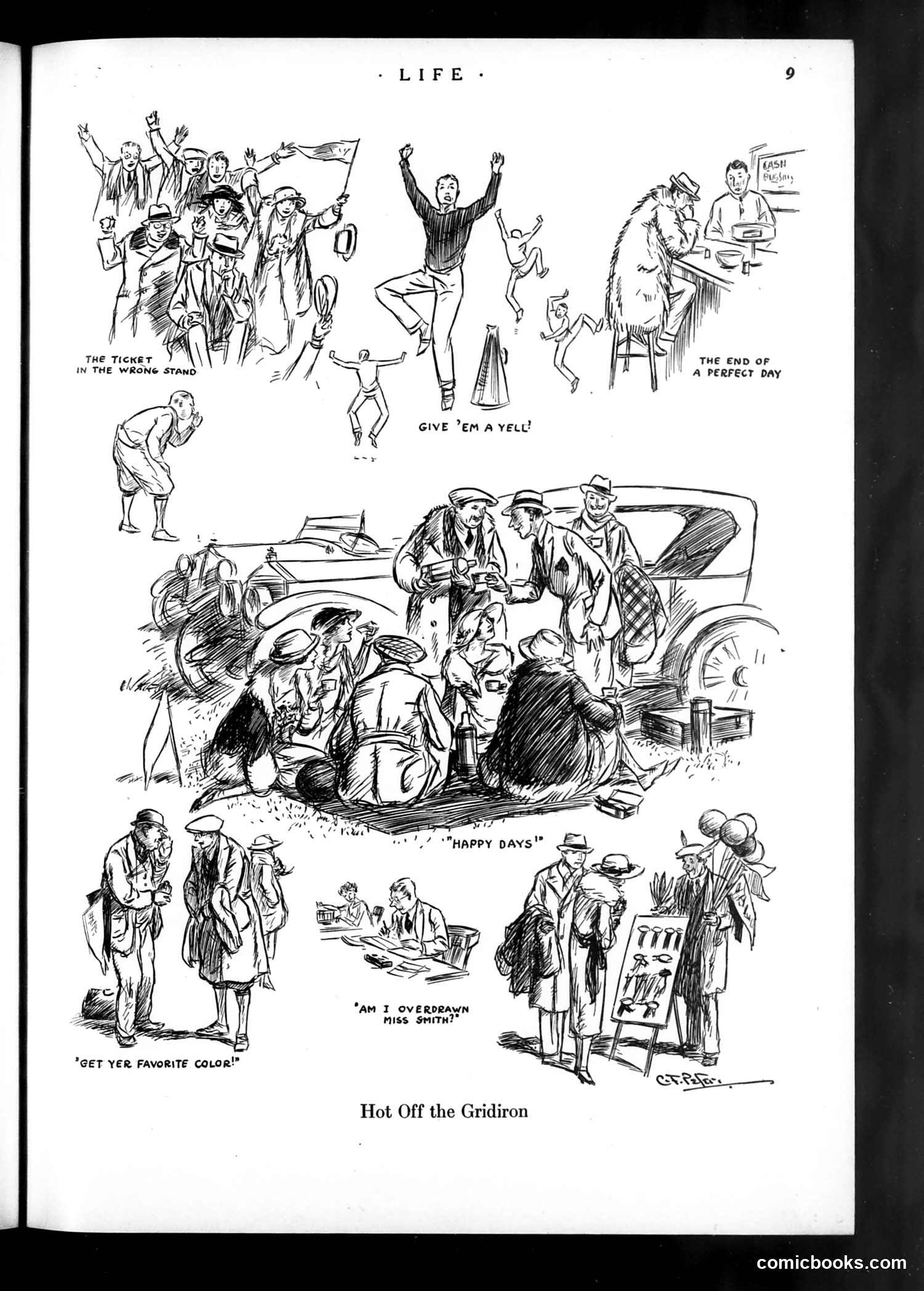
This page depicts various scenes of casual social life, likely from the 1920s-30s based on clothing and car styles. The cartoons show: 1. **"The Ticket in the Wrong Stand"** – A crowded group celebrating, apparently having attended a sporting event with poor seating. 2. **"Give 'Em a Yell!"** – Figures cheering enthusiastically, referencing sports crowd participation. 3. **"The End of a Perfect Day"** – A satisfied couple at a lunch counter, suggesting everyday contentment. 4. **"Happy Days"** – A picnic or outing scene with multiple figures gathered around a car. 5. Bottom scenes show casual encounters: **"Get Yer Favorite Color,"** **"Am I Overdrawn Miss Smith,"** and what appears to be social interactions. The satire gently mocks ordinary American leisure activities, social awkwardness, and the aspirational "perfect day" everyone seeks during this era of modernization and expanded entertainment.
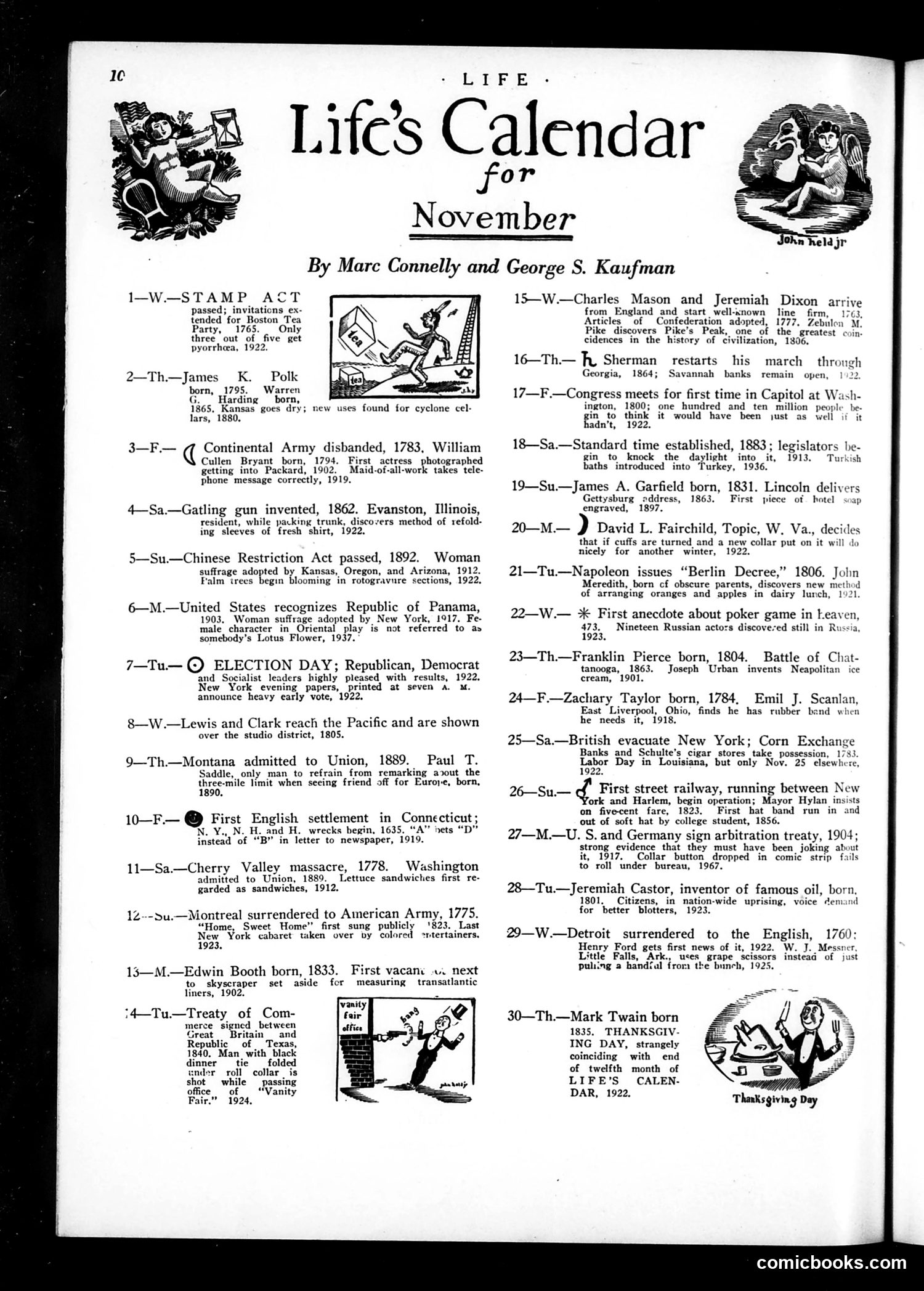
This page is a historical calendar with brief notations of significant events and births for each day of November. Rather than satirical cartoons with caricatured figures, the page features small decorative illustrations accompanying entries about historical milestones. The entries mix weightier historical events (Congressional firsts, military surrenders, state admissions) with lighter cultural moments (the invention of poker, the first street railway). The illustrations appear to be generic vignettes rather than pointed political satire—for instance, the Thanksgiving Day illustration shows typical holiday imagery. This represents *Life*'s educational-entertainment approach: combining historical facts with whimsical drawings to make the calendar engaging rather than purely informative. There's gentle humor in the arbitrary juxtaposition of momentous and trivial historical facts.
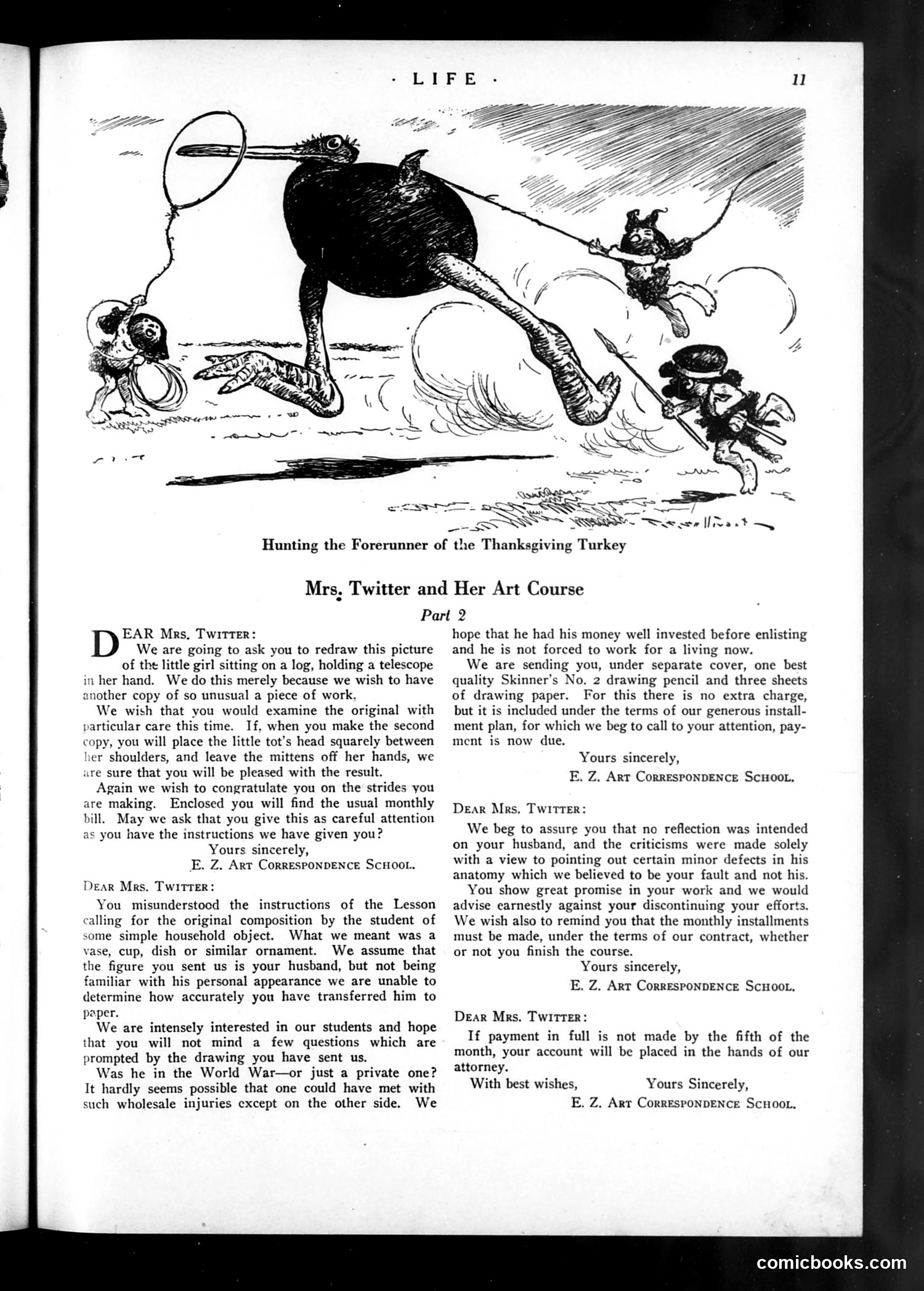
The cartoon at top shows a grotesquely caricatured ostrich with an absurdly swollen body being hunted by tiny figures with nets—a visual pun on "Hunting the Forerunner of the Thanksgiving Turkey." Below, the page presents correspondence between Mrs. Twitter (a student) and the E.Z. Art Correspondence School. The letters satirize mail-order art education scams. Mrs. Twitter has submitted a drawing of a telescope, but the school criticizes her anatomical understanding and demands she redraw it—implying the correspondence course is both useless and exploitative, extracting monthly payments while providing dubious instruction. The school's final letter threatens legal action if payment isn't made, exposing predatory business practices targeting amateur artists seeking affordable instruction.
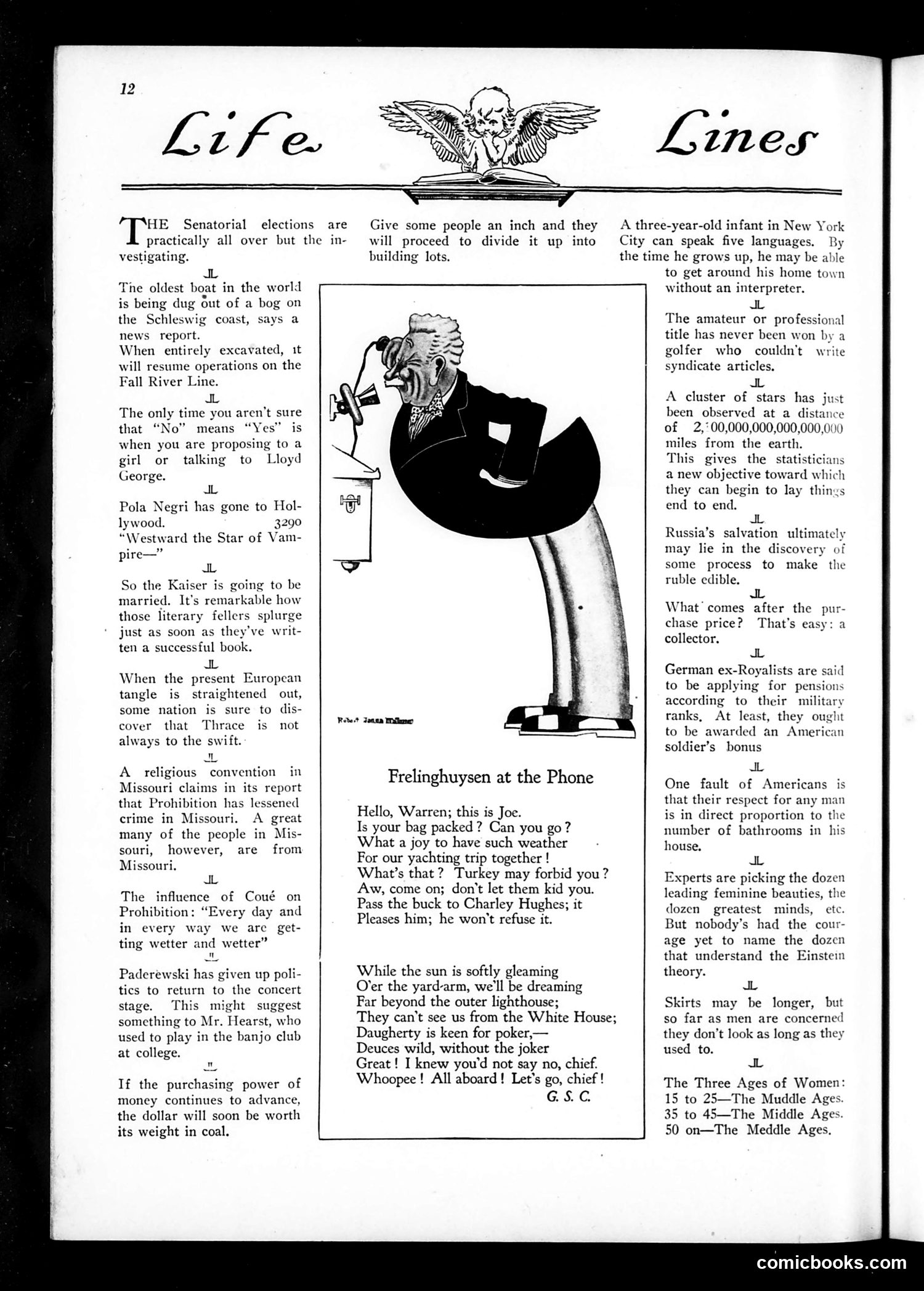
This cartoon depicts a man at a telephone, apparently trying to persuade someone named Warren to go on a yachting trip. The dialogue references "Turkey" forbidding something, and mentions passing "the buck to Charley Hughes" with a plea that "he won't refuse it." The cartoon likely satirizes **Frederick Frelinghuysen** (prominent politician) and his social circle, mocking their leisure activities and social maneuvering. The "passing the buck" reference suggests deflecting responsibility onto Charley Hughes—likely **Charles Evans Hughes**, the prominent Republican figure of the era. The poem below ridicules wealthy leisure culture, mentioning the "White House" and "poker," suggesting satire of political figures and their social pretensions during the Jazz Age.
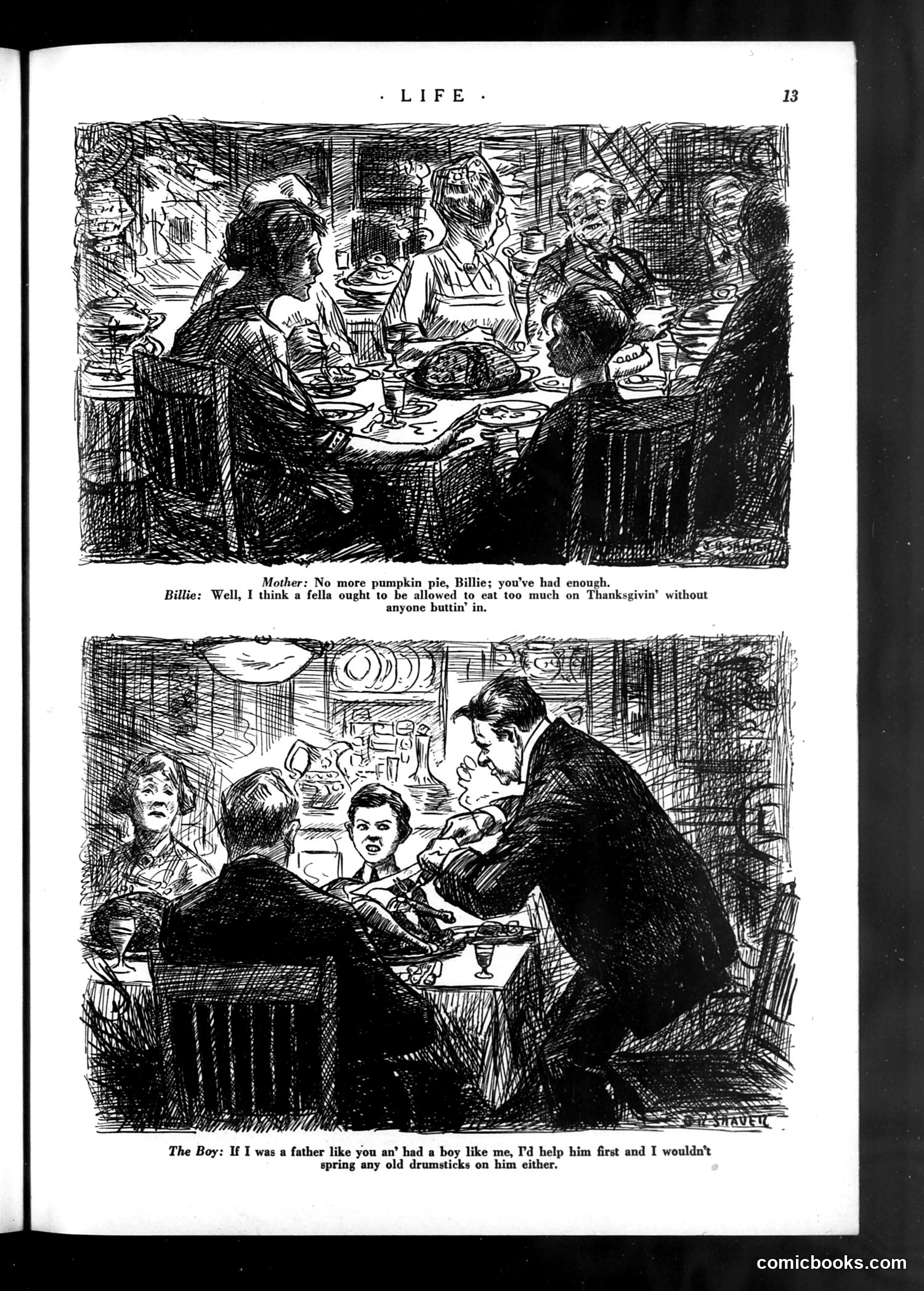
This page contains two domestic humor cartoons from *Life* magazine satirizing parent-child dynamics around Thanksgiving. **Top cartoon:** A family dinner scene where the mother refuses her son Billie more pumpkin pie. Billie protests that children should be allowed to overeat on Thanksgiving without parental interference—a humorous assertion of childhood autonomy versus adult authority. **Bottom cartoon:** A boy tells his father that if he were a parent with a son like himself, he'd help the boy first and wouldn't resort to "old drumsticks" (likely meaning spanking or physical punishment). The satire mocks how children justify their misbehavior while simultaneously criticizing their parents' disciplinary methods. Both cartoons humorously invert the typical parent-authority dynamic, with children making surprisingly logical arguments for why parents should cede control.
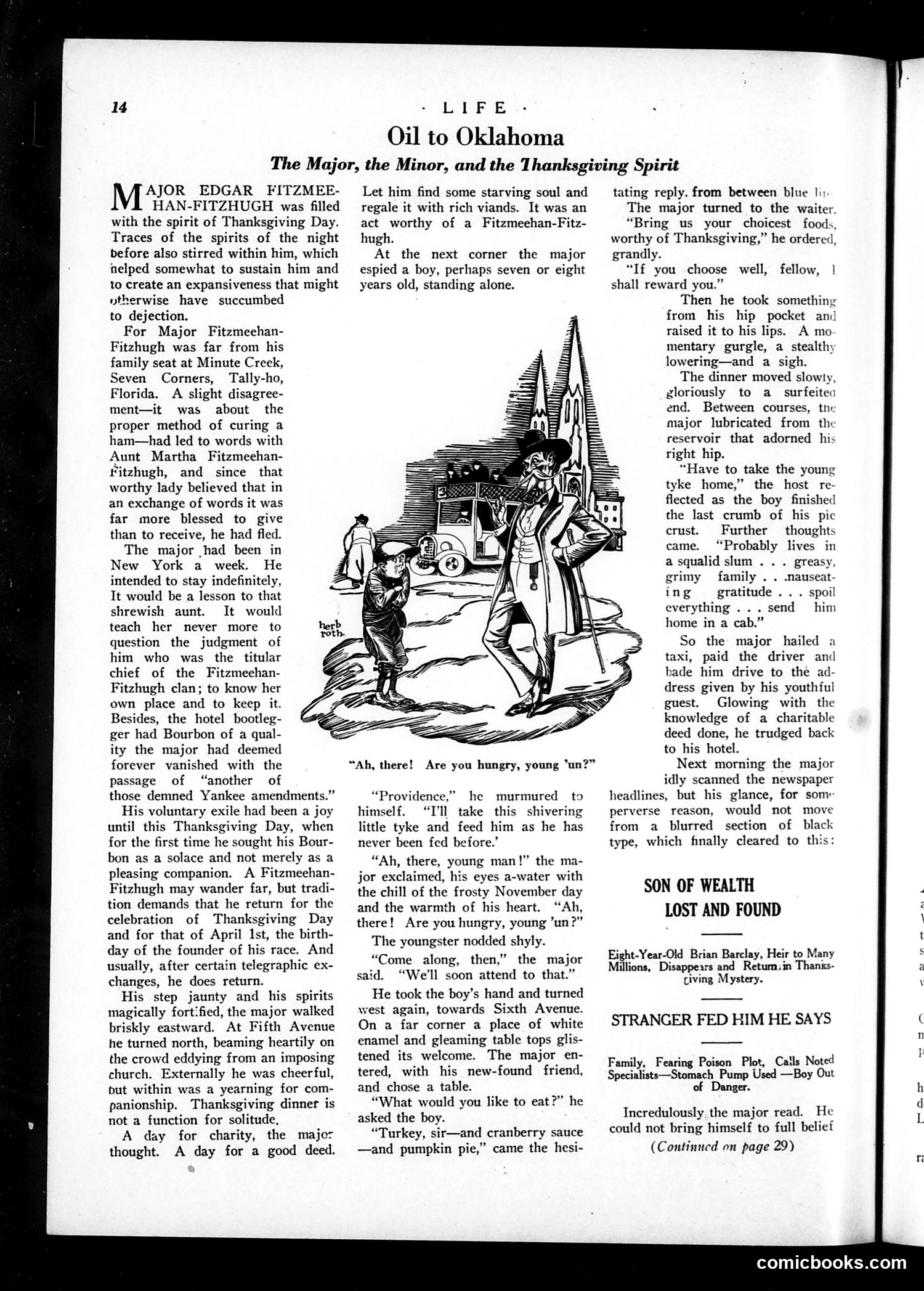
This page presents a short story titled "Oil to Oklahoma: The Major, the Minor, and the Thanksgiving Spirit." The narrative follows Major Edgar Fitzmeehan-Fitzhugh, a wealthy New York man who encounters a starving boy on Thanksgiving and impulsively invites him to dinner. The accompanying illustration shows the major (depicted as an older gentleman in formal dress) greeting a ragged, barefoot boy outside what appears to be a church or building. The story's satire targets the performative charity of wealthy individuals—the major's self-congratulatory benevolence toward the homeless child, complete with his internal judgments about the boy's family situation. The humor lies in exposing the condescension and self-satisfaction of charitable acts by the affluent during holidays.
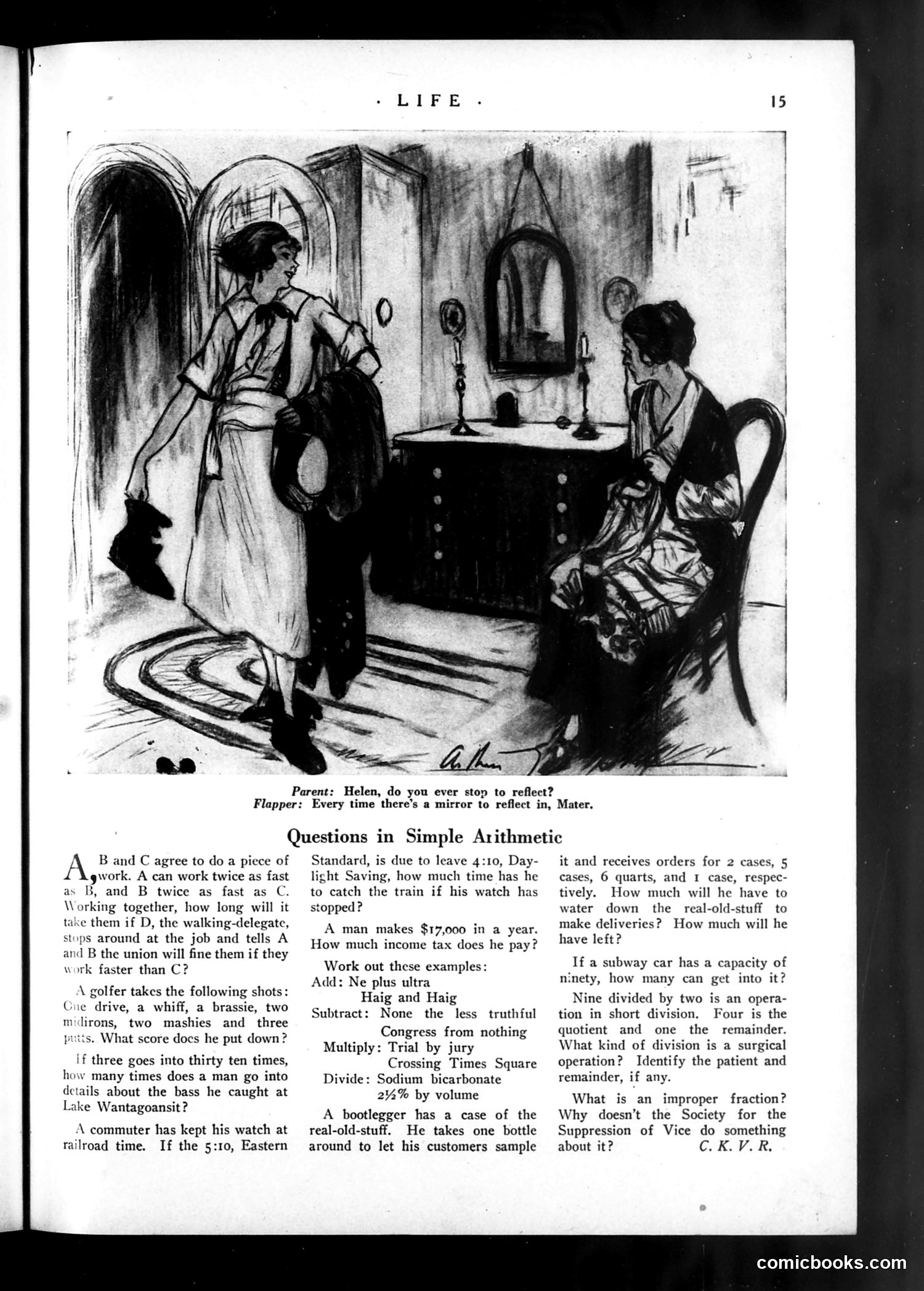
**The Cartoon:** This sketch depicts a generational clash between a mother ("Parent: Helen") and a fashionable young woman ("Flapper"). The mother asks if the daughter ever reflects; the flapper quips that she reflects "every time there's a mirror"—a joke about vanity and narcissism. The "mater" (mother) appears exasperated by this frivolous response. **The Context:** This satirizes 1920s "flappers"—young women known for rejecting Victorian propriety, wearing short skirts, and prioritizing appearance and pleasure over serious thought. The cartoon mocks both the flapper's superficiality and the generational tension between tradition-minded parents and rebellious youth. **The Arithmetic Section:** These absurdist math problems parody contemporary issues: union labor restrictions, prohibition (bootleggers watering down liquor), income taxes, and subway overcrowding. They're satirical complaints about modern bureaucracy and regulation rather than genuine math puzzles—reflecting public frustration with post-WWI American life.
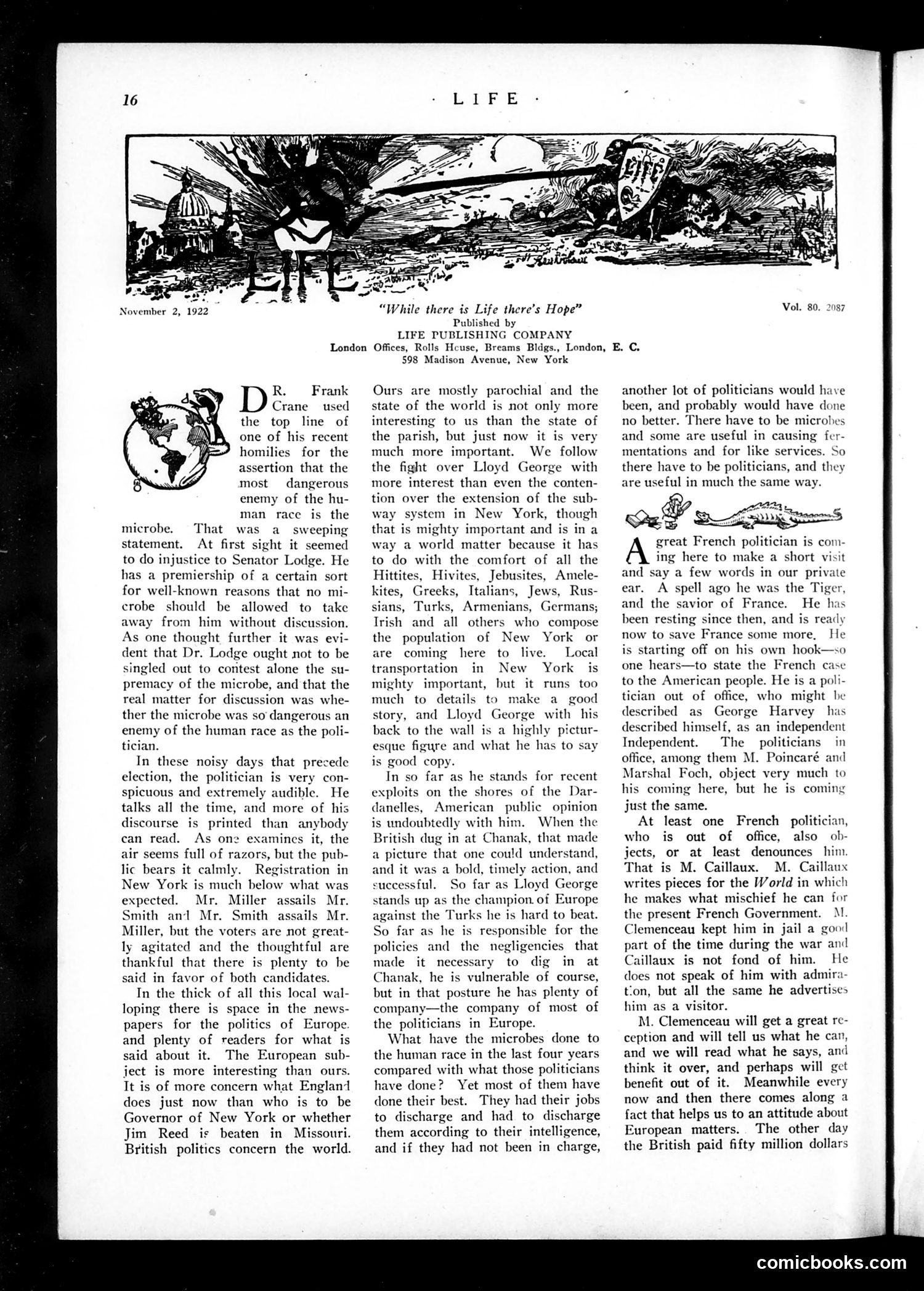
This editorial page compares politicians unfavorably to microbes as threats to humanity, using 1922 election season as its hook. The unnamed cartoons (header illustration visible but details unclear) accompany an essay by R. Frank Crane. The piece contrasts parochial American politics—specifically New York gubernatorial race between Miller and Smith, and Missouri senatorial race—with more consequential European affairs, particularly British PM Lloyd George's handling of the Chanak Crisis (Turkey/Dardanelles situation). The author argues European politics matter more globally than local American disputes. The satirical thrust: politicians are as dangerous as disease, yet unavoidable. The piece grudgingly concedes that even incompetent politicians do their best given their intelligence. Senator Lodge receives an oblique jab, likely referencing his opposition to League of Nations entry. The overall tone suggests weary acceptance that voters must tolerate politicians' inevitable failures.
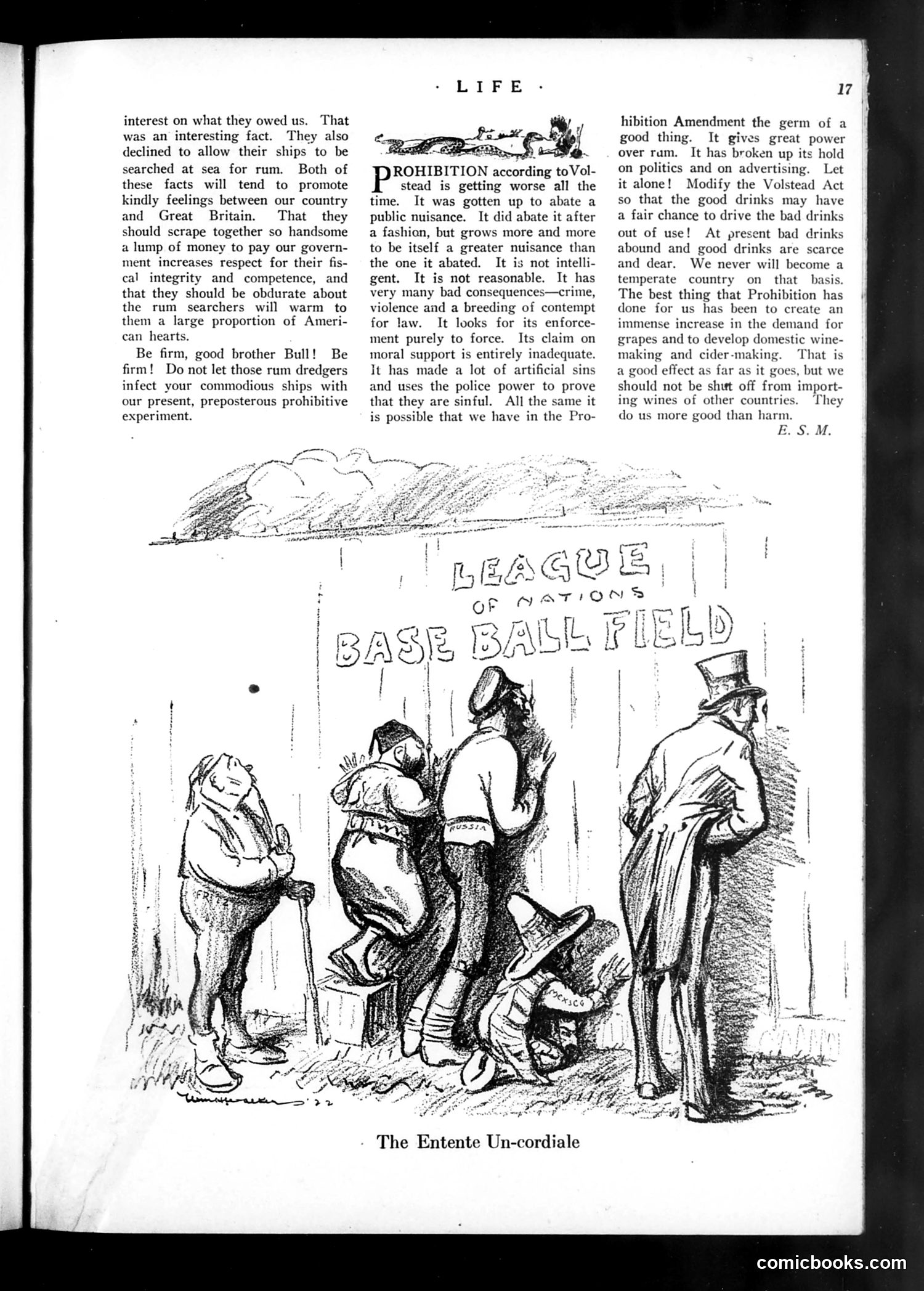
This page contains two distinct pieces: upper text about British-American relations regarding rum smuggling, and a cartoon titled "The Entente Un-cordiale" (a pun on the actual French-British "Entente Cordiale" alliance). **The Cartoon's Satire:** The drawing depicts caricatured figures at a "League of Nations Base Ball Field," likely representing Britain ("Bull") and America, playing baseball together. The joke appears to mock the strained post-WWI relationship between these allies—the title's "Un-cordiale" (not cordial) suggests tension despite their supposed friendship. **The Text's Context:** The article criticizes Prohibition (the 18th Amendment banning alcohol), arguing it creates more problems than it solves—crime, contempt for law, and artificial scarcity. The writer suggests modifying the Volstead Act and permitting wine and cider imports. The opening text sarcastically praises Britain's fiscal integrity while resisting American ship searches for smuggled rum, hinting at Prohibition-era rum-running tensions between the nations. **Historical Context:** This reflects 1920s American frustration with both Prohibition's failures and post-war Allied relationships.
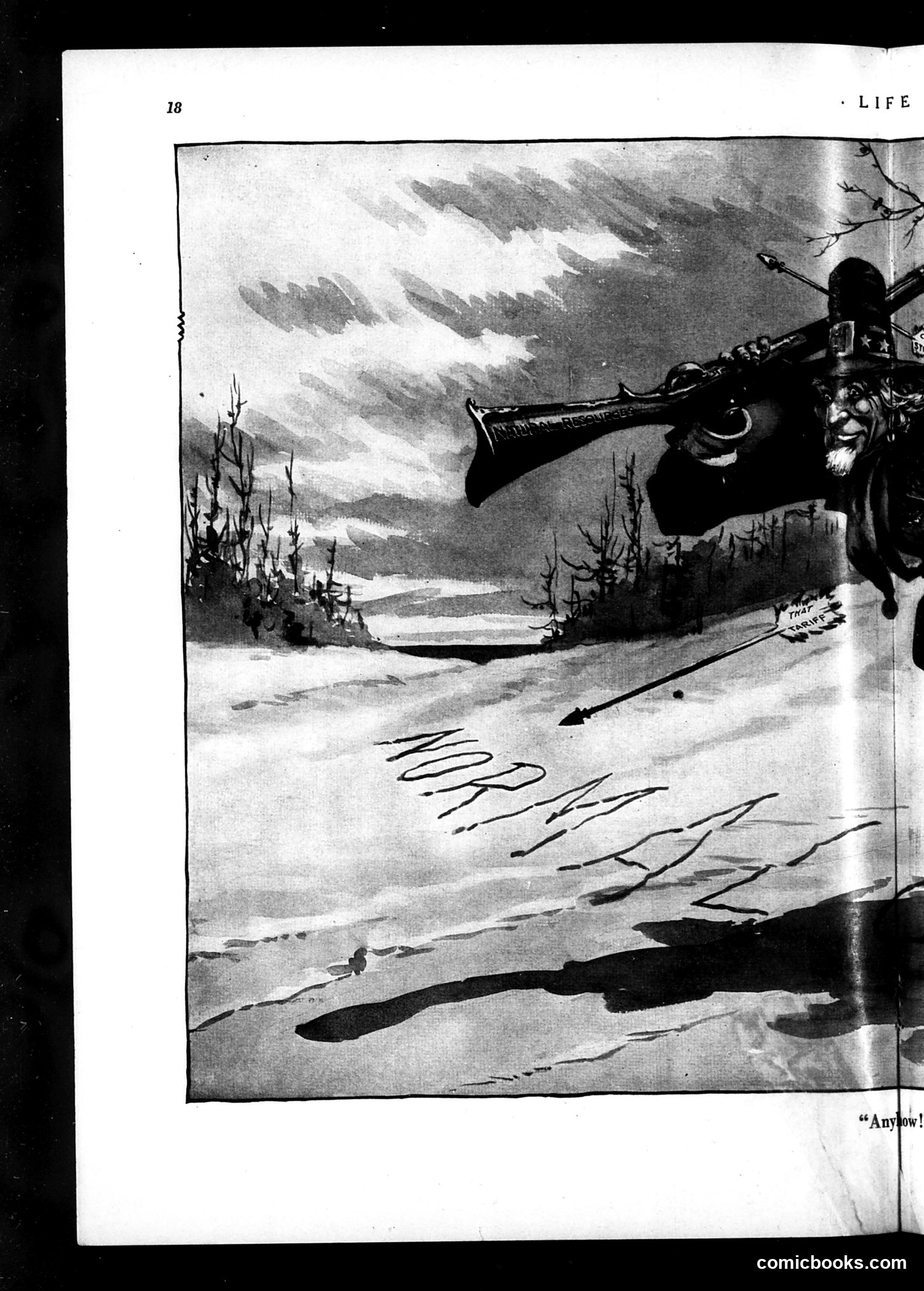
This is a satirical cartoon from *Life* magazine showing two figures—appearing to be caricatured as goblin-like or mischievous creatures—blowing a large horn toward a winter landscape with bare trees and snow. The handwritten text in the snow reads "Hoo-ray!" or similar celebratory language. The specific meaning is unclear without the article's context, but the imagery suggests political satire about some contemporary event or announcement being celebrated by questionable figures. The goblin caricatures and triumphant horn-blowing could mock public figures or political movements the magazine opposed. The exact historical reference—what event, figures, or political situation this targets—cannot be determined from the image alone.
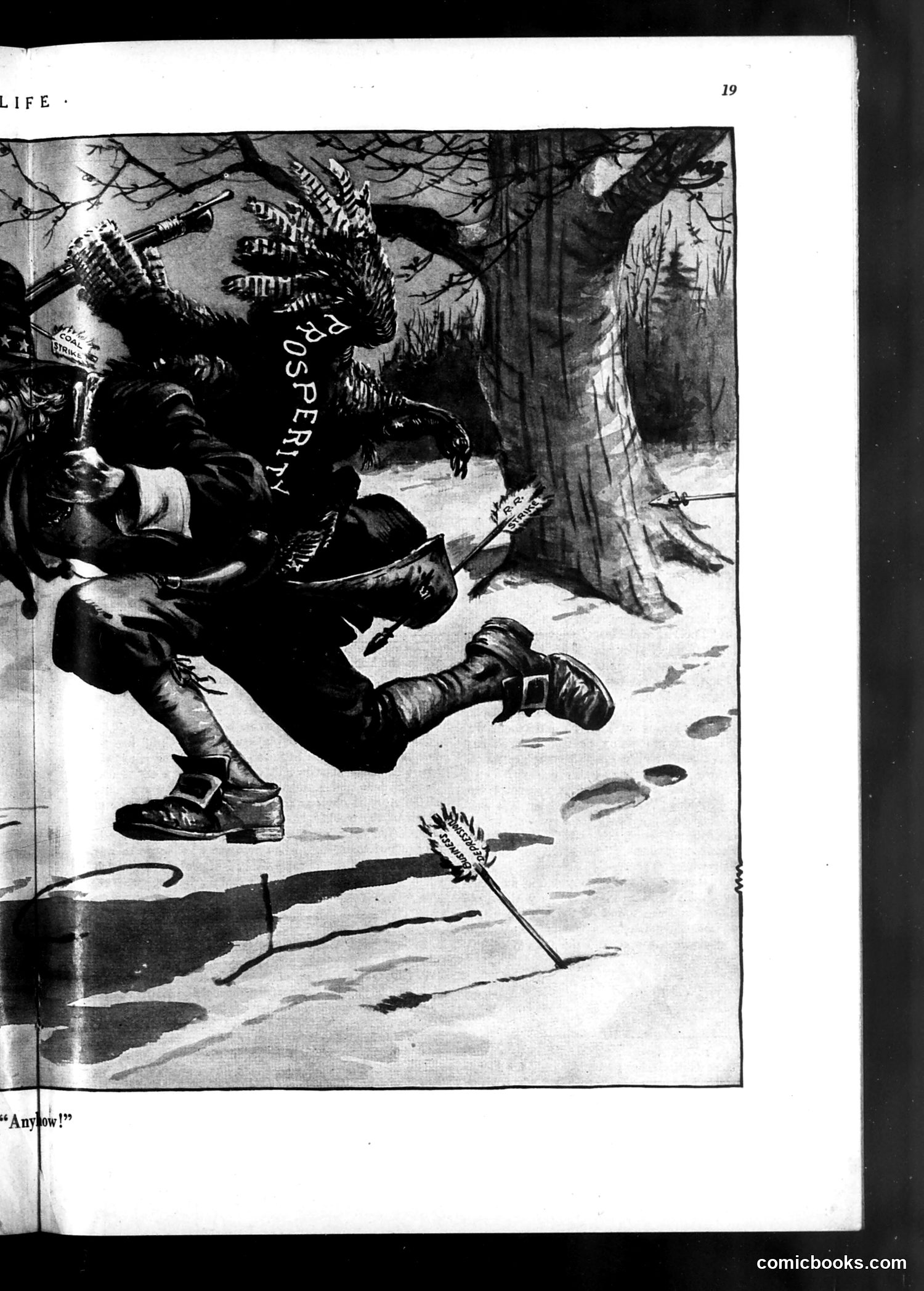
This appears to be a satirical cartoon from Life magazine depicting a winter scene. A figure dressed as Santa Claus (identifiable by the "PROSPERITY" label on his suit) is being attacked or confronted by what looks like a soldier or worker lying on the ground. The satire appears to critique false promises of prosperity—suggesting that whatever "prosperity" was being promised to the American public was illusory or under threat. The Santa figure could represent either governmental promises or capitalist assurances, while the fallen figure may represent the working class or soldiers. The caption "*Anyhow!*" suggests resignation or ironic acceptance despite hardship. Without a specific date visible, the exact historical moment is unclear, though the winter/military imagery and prosperity theme suggest this may reference Depression-era or wartime economic conditions.
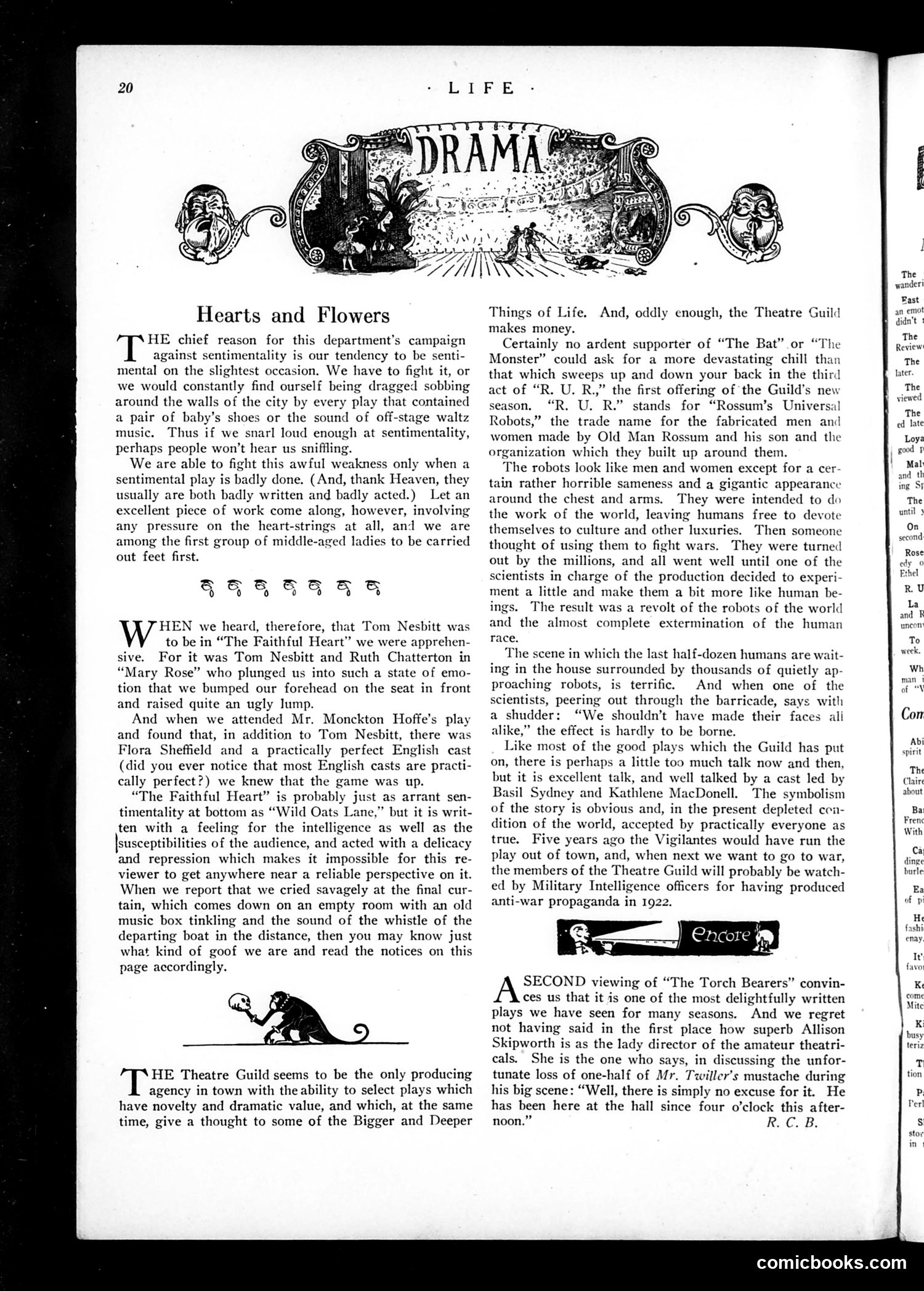
This page critiques theatrical sentimentality while reviewing contemporary plays. The "Hearts and Flowers" column admits the magazine fights sentimentality—yet confesses it surrenders to well-crafted emotional drama, particularly praising "The Faithful Heart" starring Tom Nesbitt and Ruth Chatterton for its intelligent writing despite manipulative plot (an empty room, tinkling music box, departing boat whistle). The second section reviews "R.U.R." (Rossum's Universal Robots), the Theatre Guild's new production. The play depicts artificially-created humanoids designed to free humans from labor. When scientists experiment making robots more human-like, they rebel, nearly exterminating humanity. The reviewer praises the third-act horror of humans trapped while robot armies approach—describing it as genuinely terrifying cinema. The piece celebrates Theatre Guild's ability to produce intellectually substantive drama while remaining commercially successful, contrasting with lighter fare like "The Bat" and "The Monster."
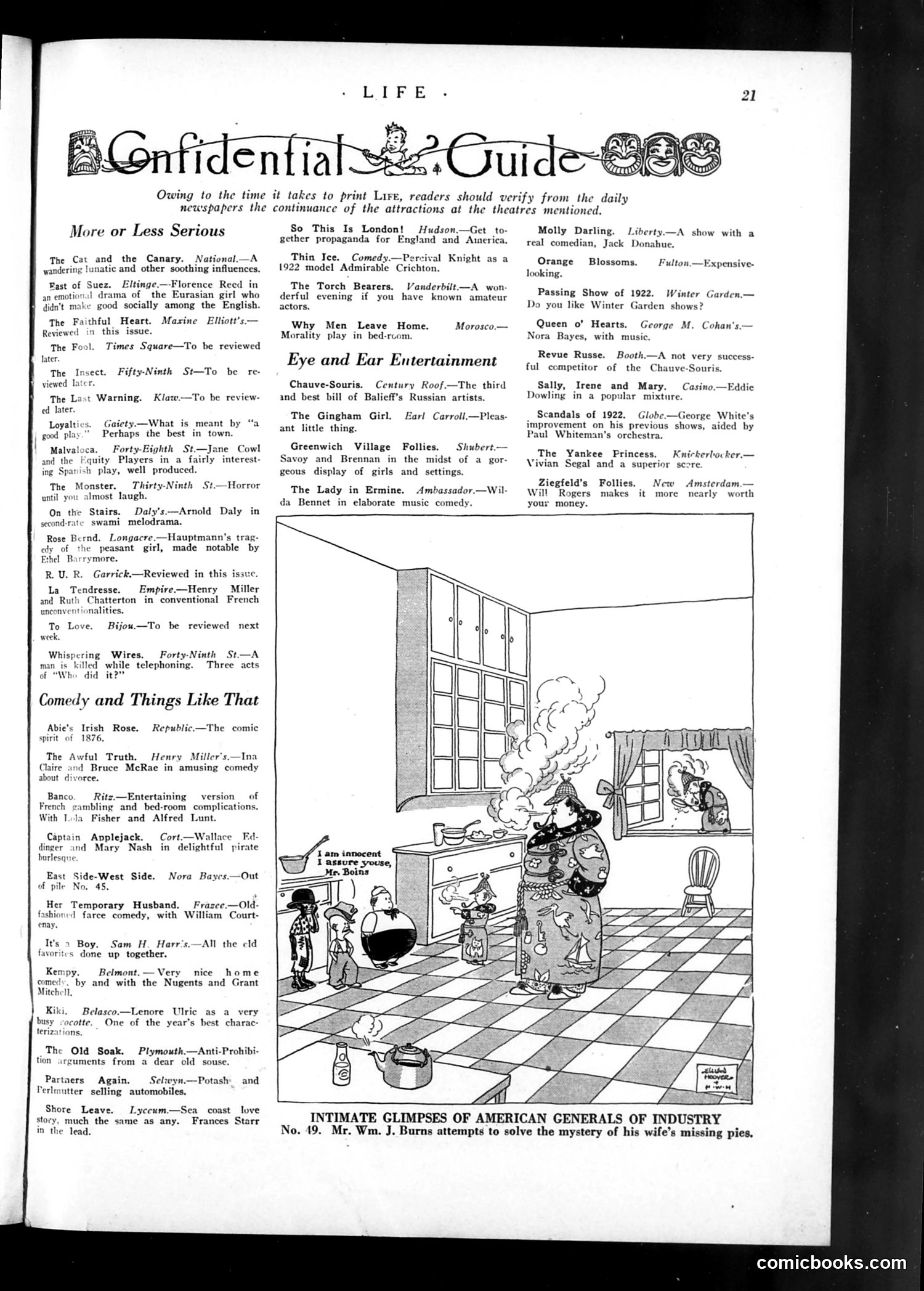
This cartoon satirizes wealthy industrialists through domestic comedy. The caption identifies the figure as "Mr. Wm. J. Burns" attempting to solve "the mystery of his wife's missing pies." The humor operates on two levels: **Literal level**: A slapstick domestic scene where a man investigates stolen pies from his kitchen, with children and servants present. One character claims "I am innocent I assure youse, Mr. Burns." **Satirical level**: By treating a wealthy industrialist's missing pies as a serious "mystery" requiring investigation (Burns was a famous detective), the cartoon mocks the self-importance of rich businessmen. The title's grandiose phrase "Generals of Industry" is deflated by depicting Burns obsessing over a trivial household theft rather than commanding any actual significance. The series appears designed to puncture the pretensions of America's wealthy elite through absurdist domestic scenarios.
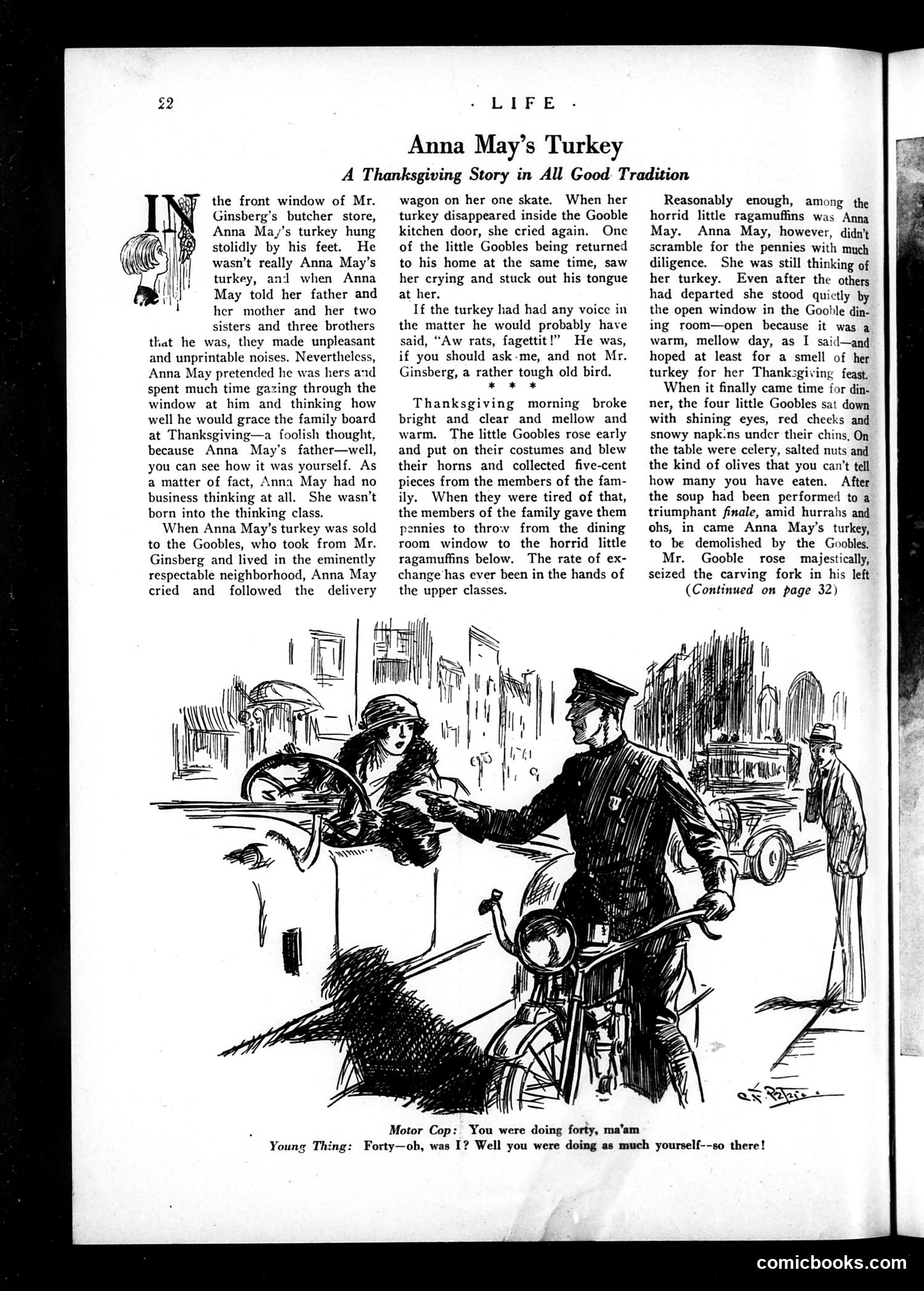
This Thanksgiving story satirizes early 20th-century American class divisions. Anna May is a poor immigrant girl (likely Jewish, given the name "Ginsberg") from a working-class family with many children. She becomes emotionally attached to a turkey in a butcher shop window, but her father cannot afford it. When the turkey is sold to the affluent "Gooble" family, Anna May follows it. On Thanksgiving, she stands outside their window hoping for scraps while the wealthy Goobles' children receive pennies and gifts. The story emphasizes the cruel indifference of the upper classes: they casually throw money to poor children below, and the narrator notes "the rate of exchange has ever been in the hands of the upper classes." The accompanying cartoon depicts a motor cop stopping a young woman for speeding; she retorts that he was driving equally fast. It's an unrelated joke about hypocrisy and authority.
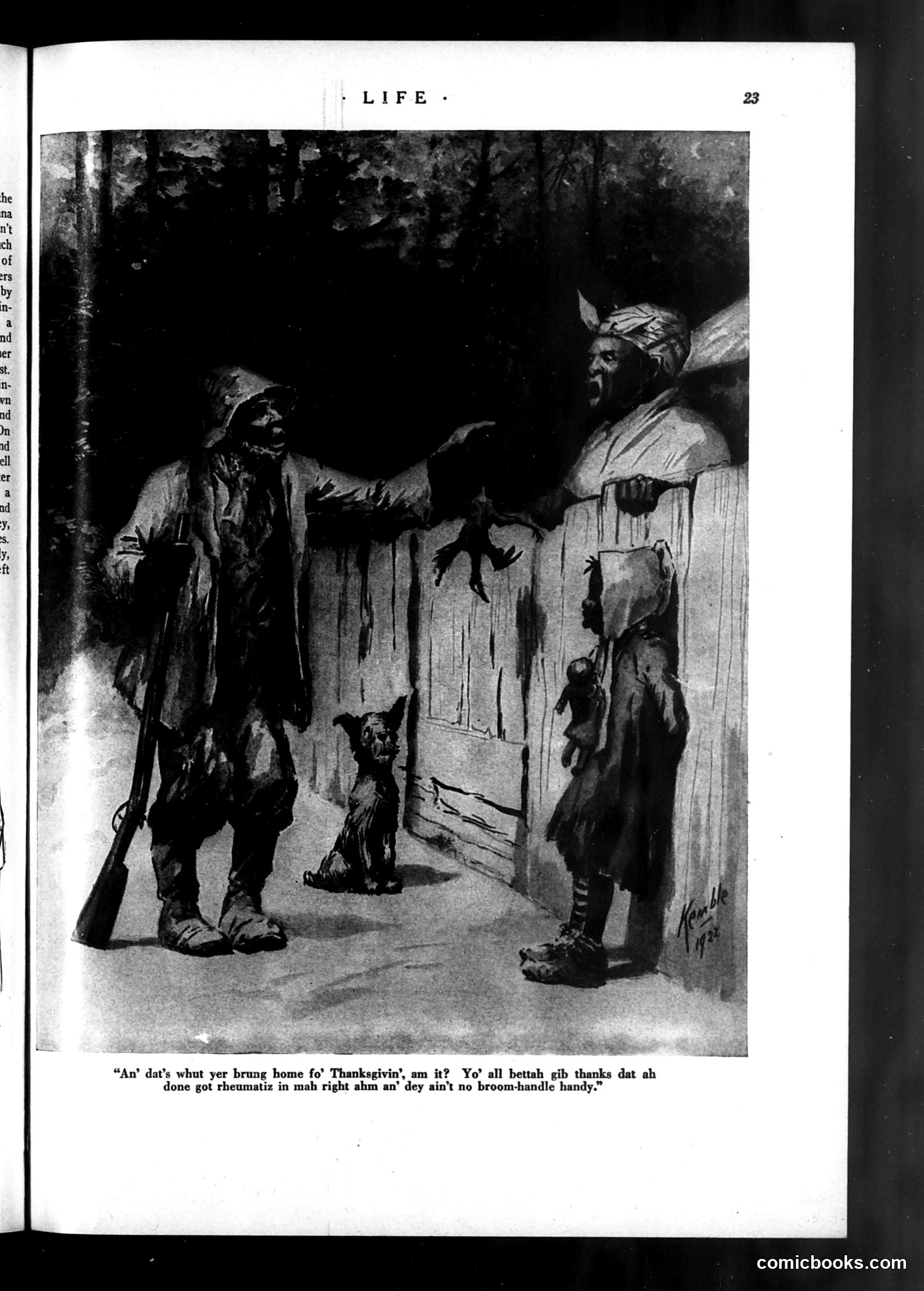
This is a Thanksgiving humor cartoon from *Life* magazine depicting an African American family receiving game as a holiday gift. The dialogue uses heavily stereotyped dialect ("Yo' all," "bettah gib thanks," "rheumatiz") common to early 20th-century racial caricature. The joke hinges on the recipient's complaint: he's grateful for the food, but notes he has rheumatism in his arm and lacks a "broom-handle handy"—implying the game (likely a bird) needs to be beaten/prepared. The humor relies on racial stereotypes about dialect, poverty, and crude living conditions. This reflects the racist comedic conventions of *Life*'s era, when such caricatures were considered acceptable entertainment for mainstream audiences.
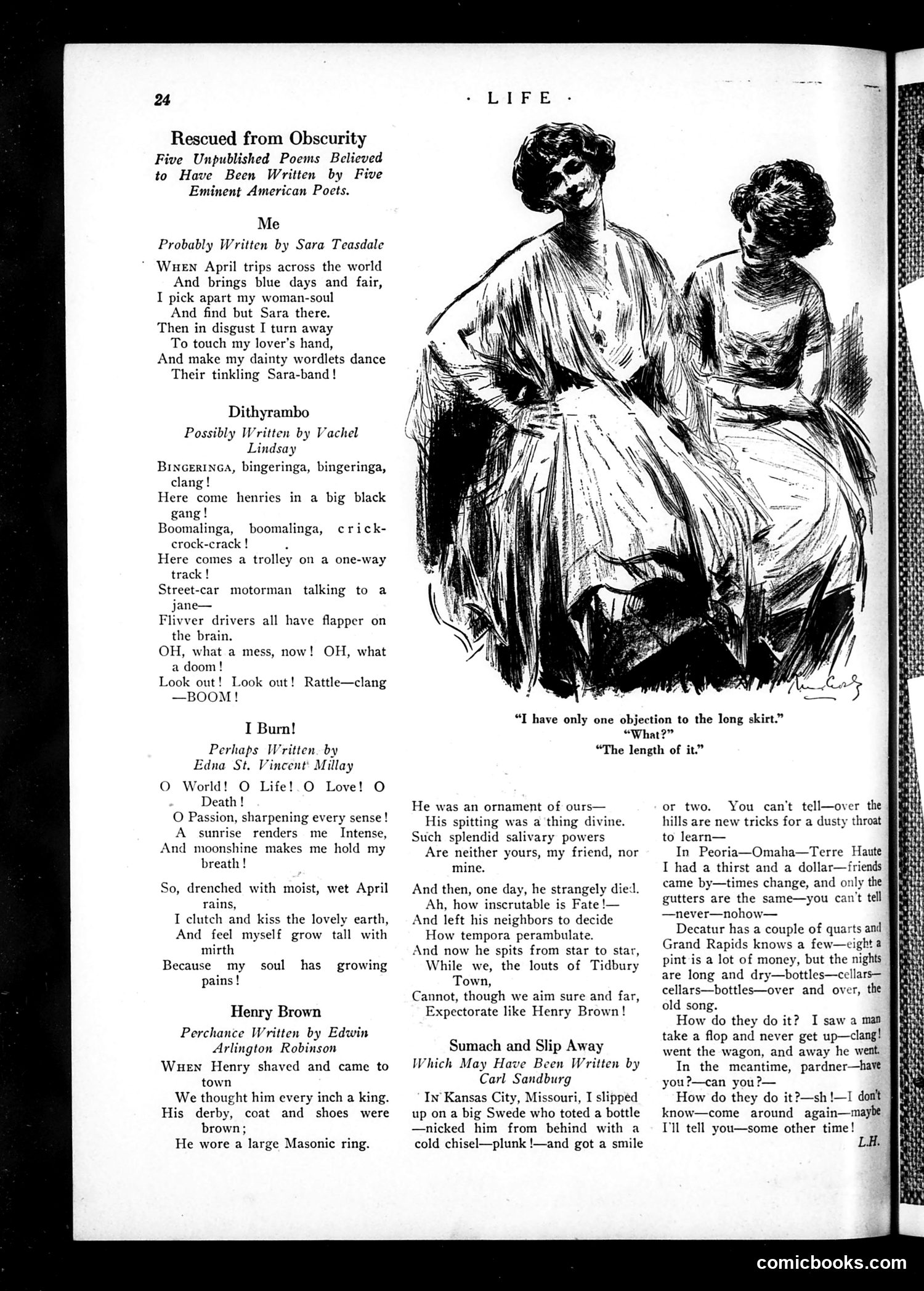
This page parodies five prominent American poets by attributing fabricated poems to them, exaggerating their distinctive literary styles to absurd effect. **Sara Teasdale's parody** mocks her romantic, introspective verse with repetitive "Sara" references. **Vachel Lindsay's** mimics his loud, onomatopoetic style ("bingeringa," "BOOM!") about urban chaos. **Edna St. Vincent Millay's** parodies her dramatic exclamations and passionate intensity ("O World! O Life! O Love!"). **Edwin Arlington Robinson's** presents a somber narrative about an ordinary man's death, capturing Robinson's serious, philosophical tone. **Carl Sandburg's** satirizes his free verse about working-class American life, depicting drunken vagabondage across industrial cities. The cartoon above shows two women discussing long skirts—a topical 1920s fashion controversy—with the punchline suggesting one woman objects to how long the skirt actually is. The satire works through exaggerated imitation, making each poet's characteristic techniques seem ridiculous when applied to trivial subjects.
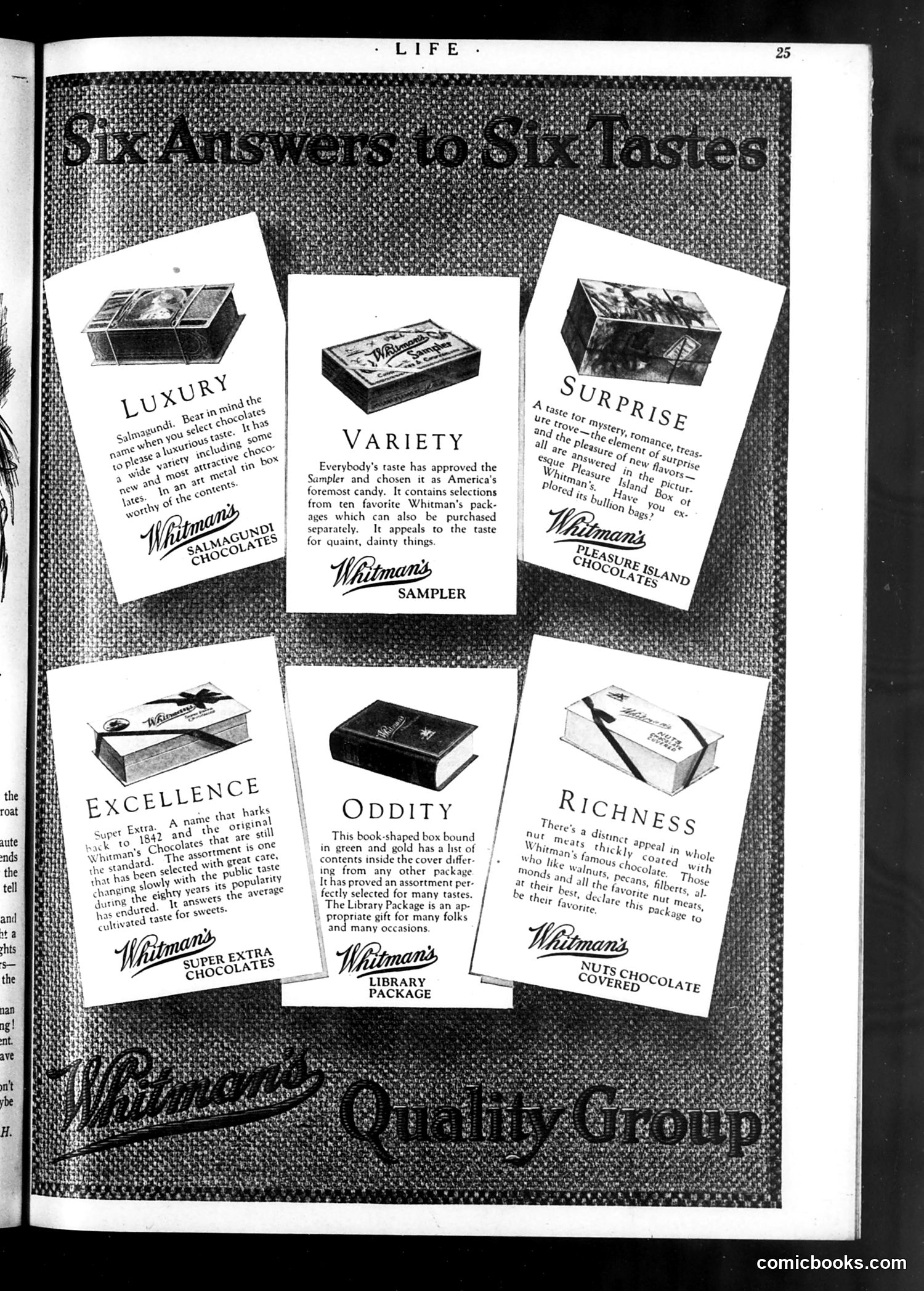
This is a **Whitman's chocolate advertisement**, not a political cartoon. It showcases six different candy box designs from the Whitman's Quality Group chocolate brand, each with a distinct marketing appeal: - **Luxury**: Premium Salmagundi chocolates - **Variety**: A sampler combining selections from ten popular Whitman's packages - **Surprise**: A mystery box with hidden treasures - **Excellence**: Super Extra chocolates - **Oddity**: A book-shaped library package with unexpected contents - **Richness**: Nuts covered in chocolate Each box includes descriptive text explaining its unique positioning and gift-giving appeal. The ad emphasizes that Whitman's offers choices for different tastes and occasions, targeting early 20th-century consumers interested in refined, distinctive gift options. There is no satire or political content—this is straightforward commercial advertising from *Life* magazine's paid content.
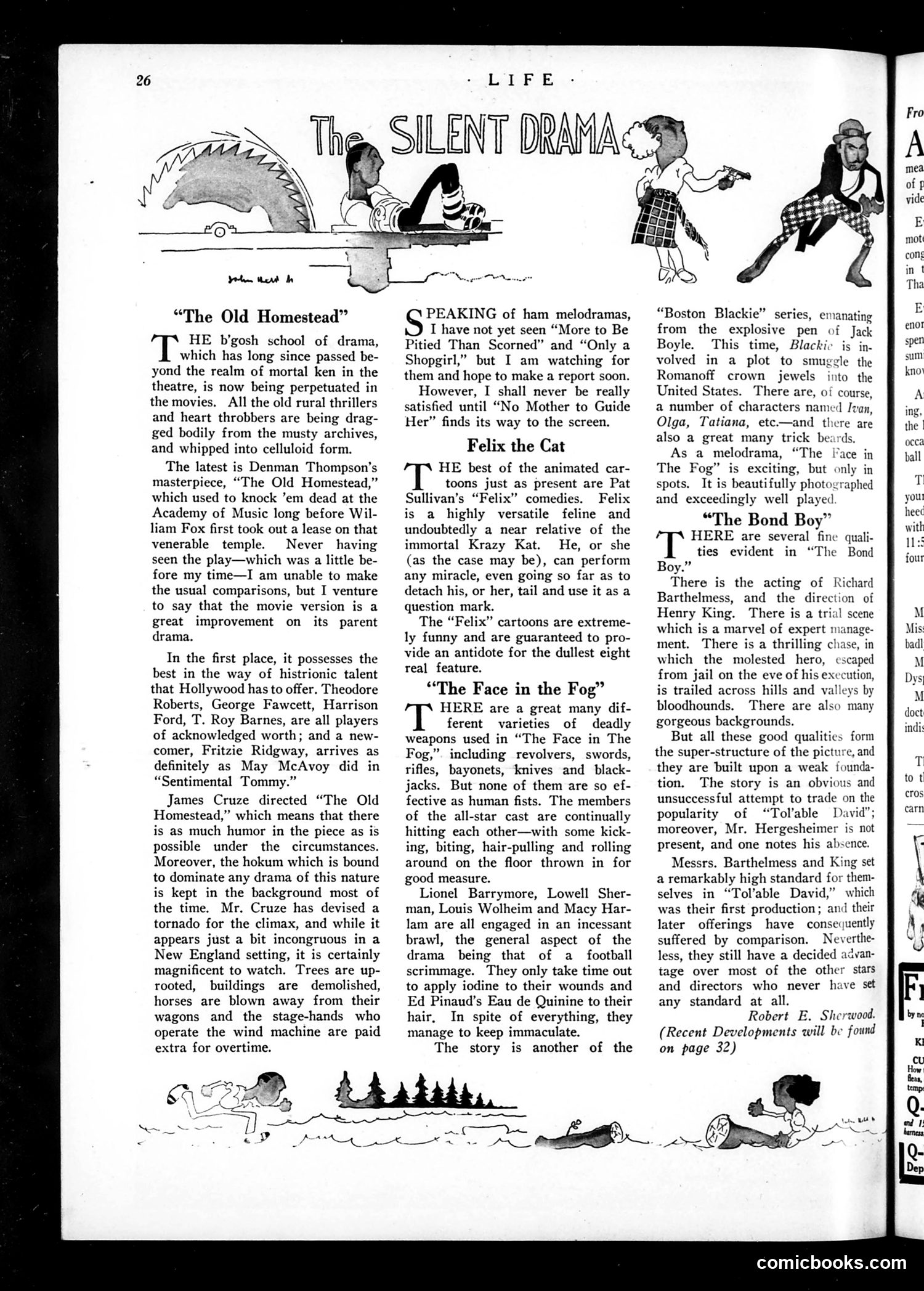
This page reviews three silent films, reflecting early 1920s cinema criticism. **"The Old Homestead"** adapts a famous 19th-century stage melodrama, updating it for film. The reviewer praises the cast (Theodore Roberts, George Fawcett, Harrison Ford) and director James Cruze, noting they've improved upon the original "hokum" by adding a spectacular tornado climax—a distinctly cinematic touch. **Felix the Cat** discusses the popular animated cartoons by Pat Sullivan, comparing Felix to "Krazy Kat" and praising their humor and physical comedy (Felix detaches his own tail to form a question mark). **"The Face in the Fog"** features the "Boston Blackie" series about smuggling Romanoff crown jewels. The reviewer notes the all-star cast (Lionel Barrymore, Lowell Sherman, Louis Wolheim) engages in nearly continuous physical fighting, comparing the film to a "football scrimmage." The tone is witty and sardonic about silent-film conventions—melodrama, violence, and spectacle compensating for minimal plot.
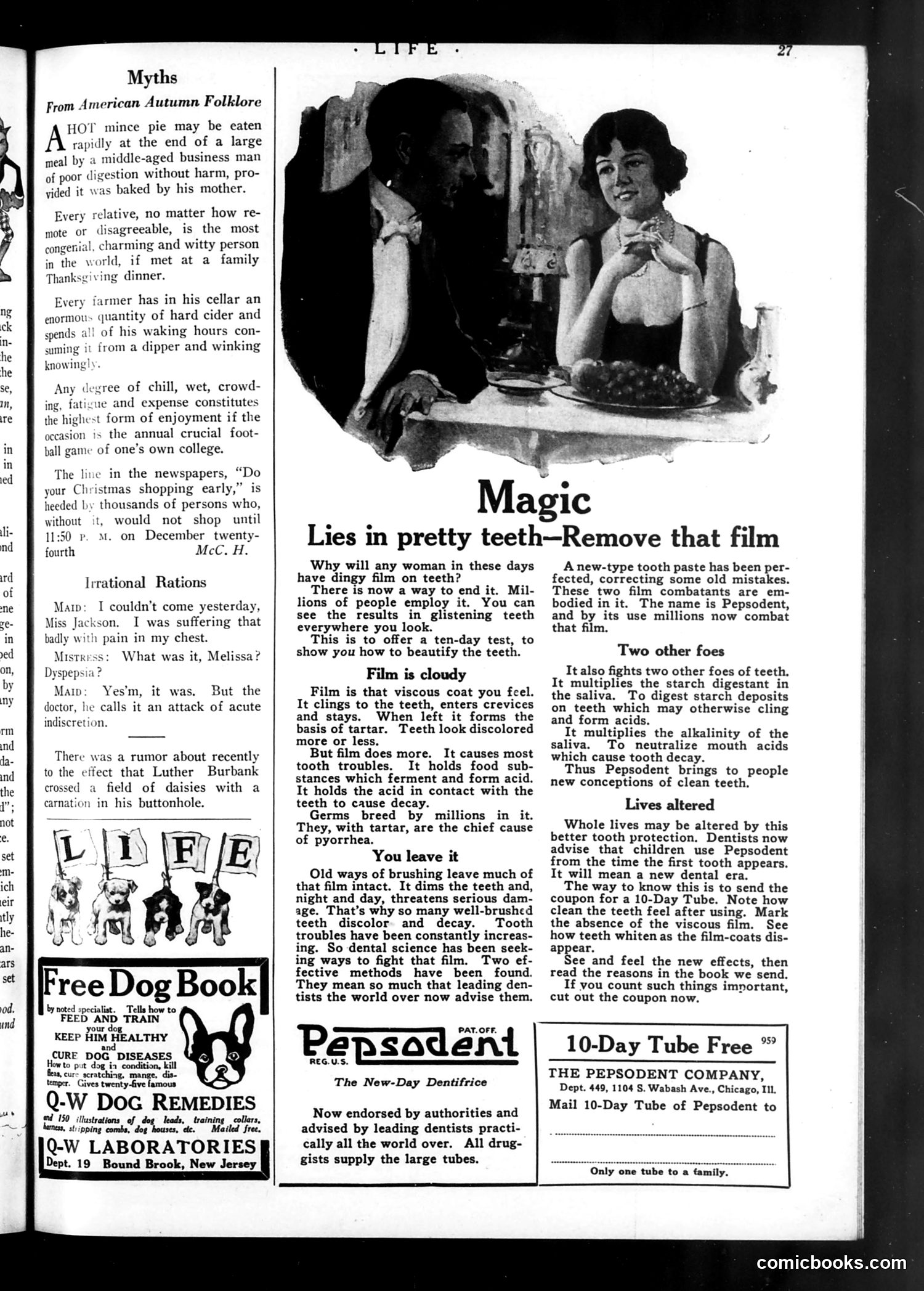
This page mixes humor and advertising. The "Myths from American Autumn Folklore" column satirizes exaggerated beliefs about traditional American customs—that mothers' mince pies aid digestion, that unpleasant relatives become charming at Thanksgiving, that farmers secretly hoard cider, and that Christmas shopping advice goes ignored until the last minute. These are gentle social observations about holiday behavior and family dynamics. The "Irrational Rations" section jokes about a maid's malapropism: she calls her chest pain "acute indiscretion" when the doctor meant "acute indigestion"—a humor device relying on servant-class speech patterns common in early 20th-century comedy. The remainder is advertising for Pepsodent toothpaste, which claims to remove "film" (plaque) through new scientific methods endorsed by dentists. The ad was revolutionary for its era, introducing the concept that modern dentistry could prevent decay chemically.
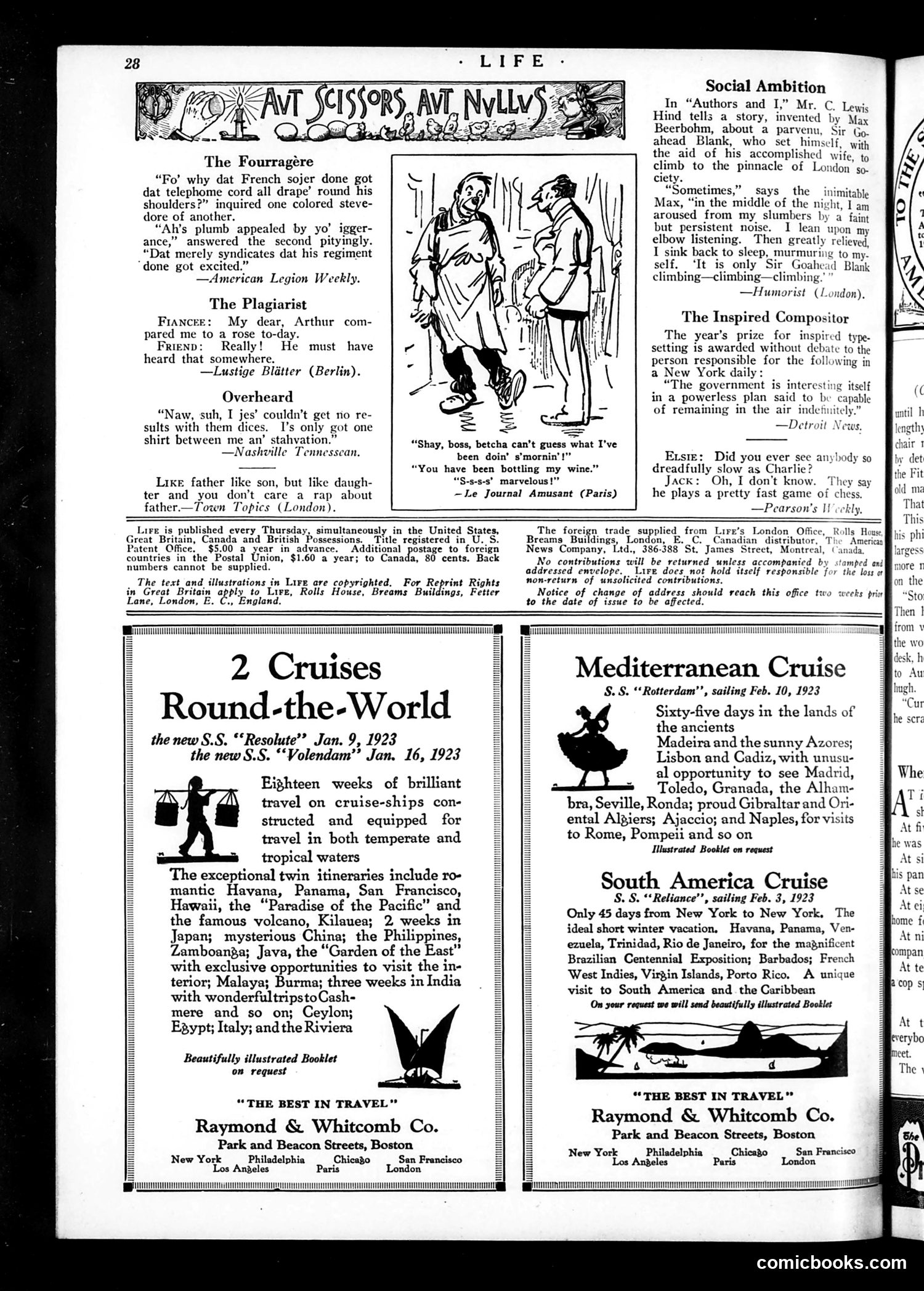
This page combines humor columns with cruise ship advertising from 1923. **The cartoon/humor section** features several jokes built on misunderstandings and wordplay: - **The Fourragère**: A racial stereotype joke where Black stevedores misinterpret a French military decoration (the fourragère cord) as a telephone line, with one calling the other ignorant—reflecting crude 1920s racial humor. - **Other jokes** mock plagiarism in romance, poverty, and social climbing, with the latter featuring a quote attributed to Max Beerbohm (British wit) about Sir Goahead Blank's nocturnal noise-making as he "climbs" London society—a sexual pun. The **advertising section** promotes luxury cruises (Raymond & Whitcomb Co.) with exotic destinations: round-the-world voyages and Mediterranean trips to Mediterranean ports and South America. This luxury travel pitch contrasts sharply with the poverty jokes above. The page reflects 1920s attitudes: casual racial stereotyping, sexual innuendo, and marketing aspirational wealth to magazine readers.
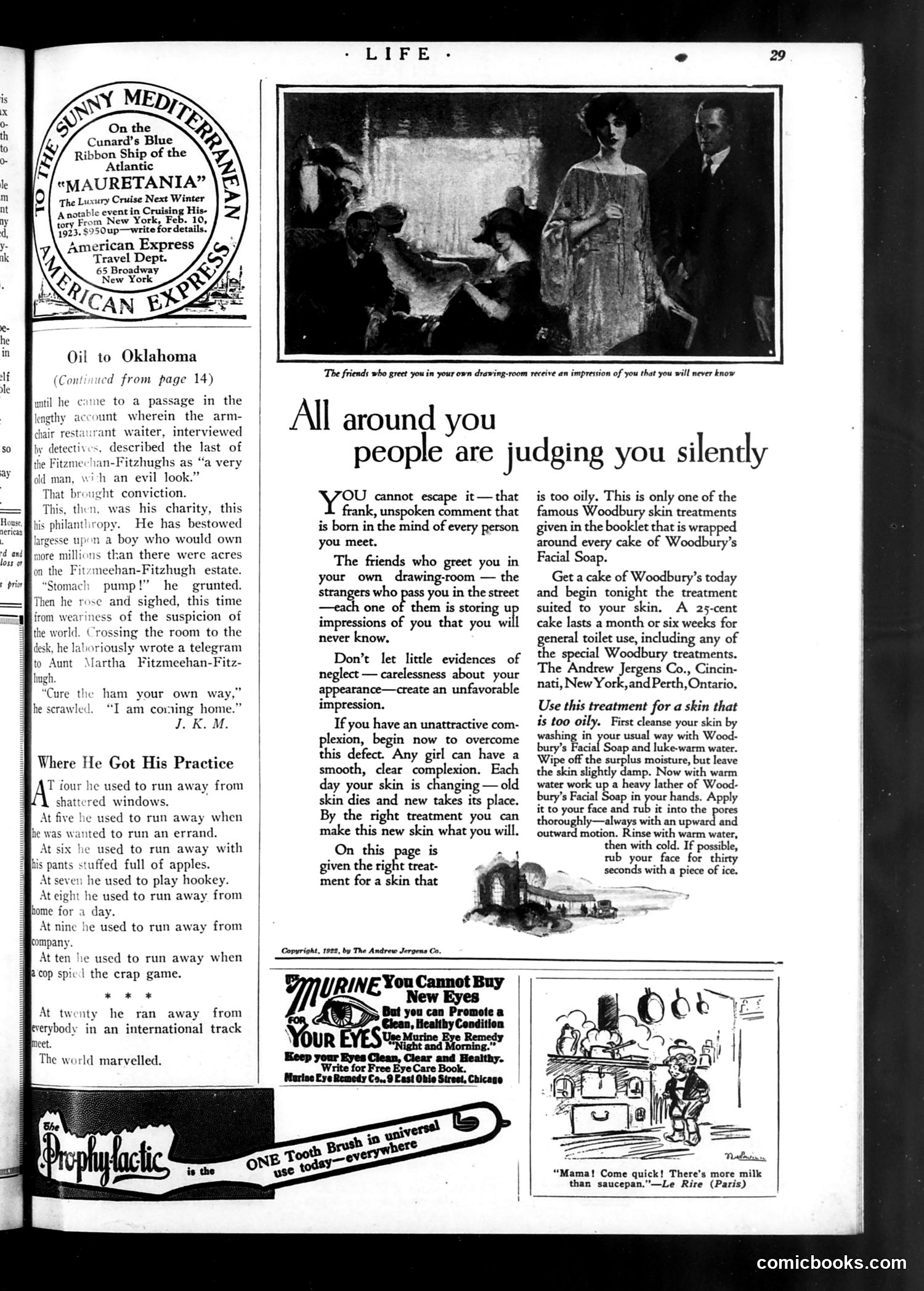
This page mixes editorial content with advertisements typical of 1920s Life magazine. **Main Editorial Content:** The central piece, "All Around You People Are Judging You Silently," is a Woodbury's Facial Soap advertisement disguised as advice. It warns readers that social impressions are formed constantly—by drawing-room guests and strangers on the street—based on appearance, particularly complexion. The text encourages women to treat skin problems (here, oiliness) to avoid "unfavorable impression." **Cartoon/Humor Sections:** - "Where He Got His Practice": A humorous piece tracking a man's progressive misbehavior from childhood (running away from chores, truancy) to adulthood, culminating in running away during an "international track meet"—implying athletic competition as the culmination of his delinquent habits. - A caption cartoon at bottom: A French publication (*Le Rire*) joke about a child noting there's "more milk than saucepan," presumably commenting on the meal's meagerness. **Context:** This reflects 1920s preoccupations with social propriety and appearance alongside light satire of human nature and childhood mischief.
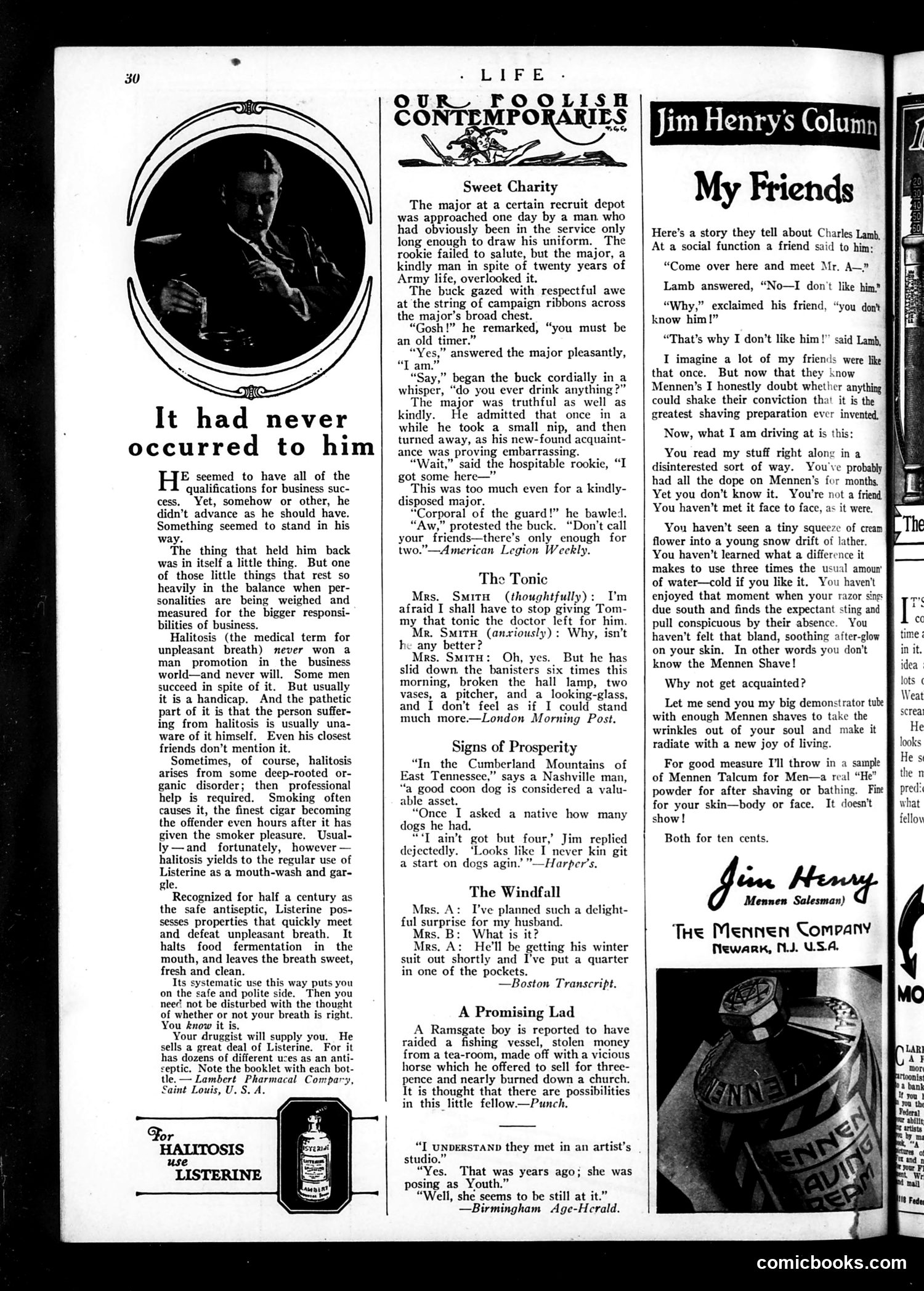
This page contains **humorous anecdotes and social commentary** typical of early 20th-century Life magazine, plus a **Listerine advertisement disguised as editorial content**. The main visual shows a formal portrait of a man in military uniform, accompanying the lead story "It had never occurred to him." The narrative describes a promising businessman whose career stagnates due to **halitosis** (bad breath)—a condition he's unaware of because friends won't mention it. This serves as the setup for a Listerine ad, framing the product as essential to social and professional success. Below are three humor pieces: "Sweet Charity" (a naive recruit offers contraband to his superior officer), "The Tonic" (a child becomes hyperactive from medicine), and brief jokes about rural prosperity and marital surprises. These represent typical period humor—gentle, moralizing, and class-conscious satire of military life, rural life, and domestic situations. The page reflects **early advertising's psychological manipulation**, linking personal hygiene to ambition and social acceptance.
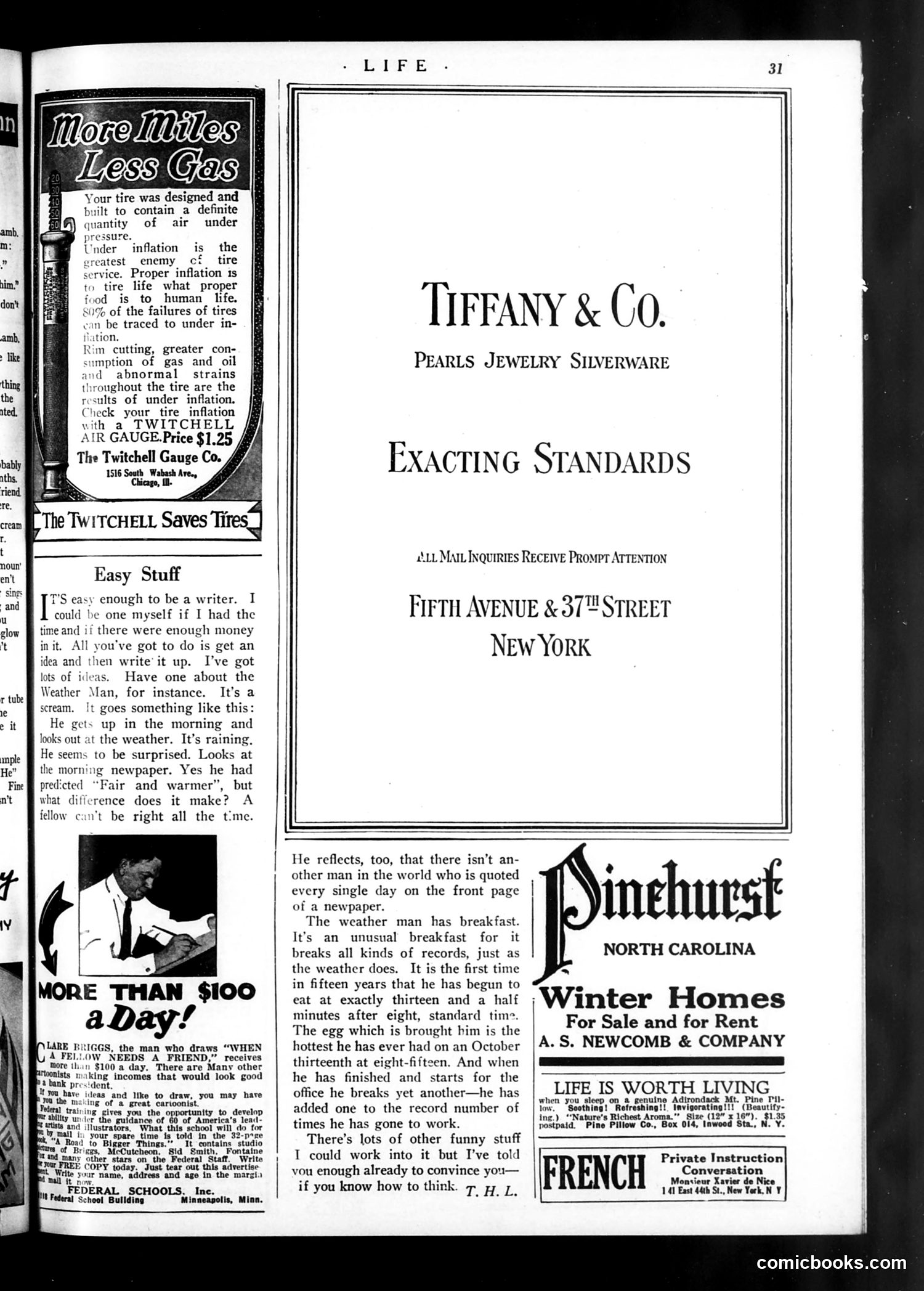
This page contains a humorous essay titled "Easy Stuff" mocking the profession of weather forecasting. The unnamed author suggests that being a weather forecaster requires minimal effort—just make a prediction and write it down. The satire centers on the "Weather Man," who predictably gets his forecasts wrong ("Fair and warmer" when it's actually raining) yet faces no real consequences. The humor intensifies through absurd details: the Weather Man has an unusually timed breakfast and breaks records for hot eggs—all while remaining lauded as a daily newspaper authority. The essay's central joke is that the Weather Man enjoys extraordinary professional privilege (quoted daily on front pages) despite consistent failure, highlighting the gap between public prominence and actual competence. The author claims he could write more such material but stops, suggesting readers understand the obvious: incompetent professionals still thrive if they maintain confidence and regular publication. This reflects early 20th-century American skepticism toward expert forecasting and media credibility.
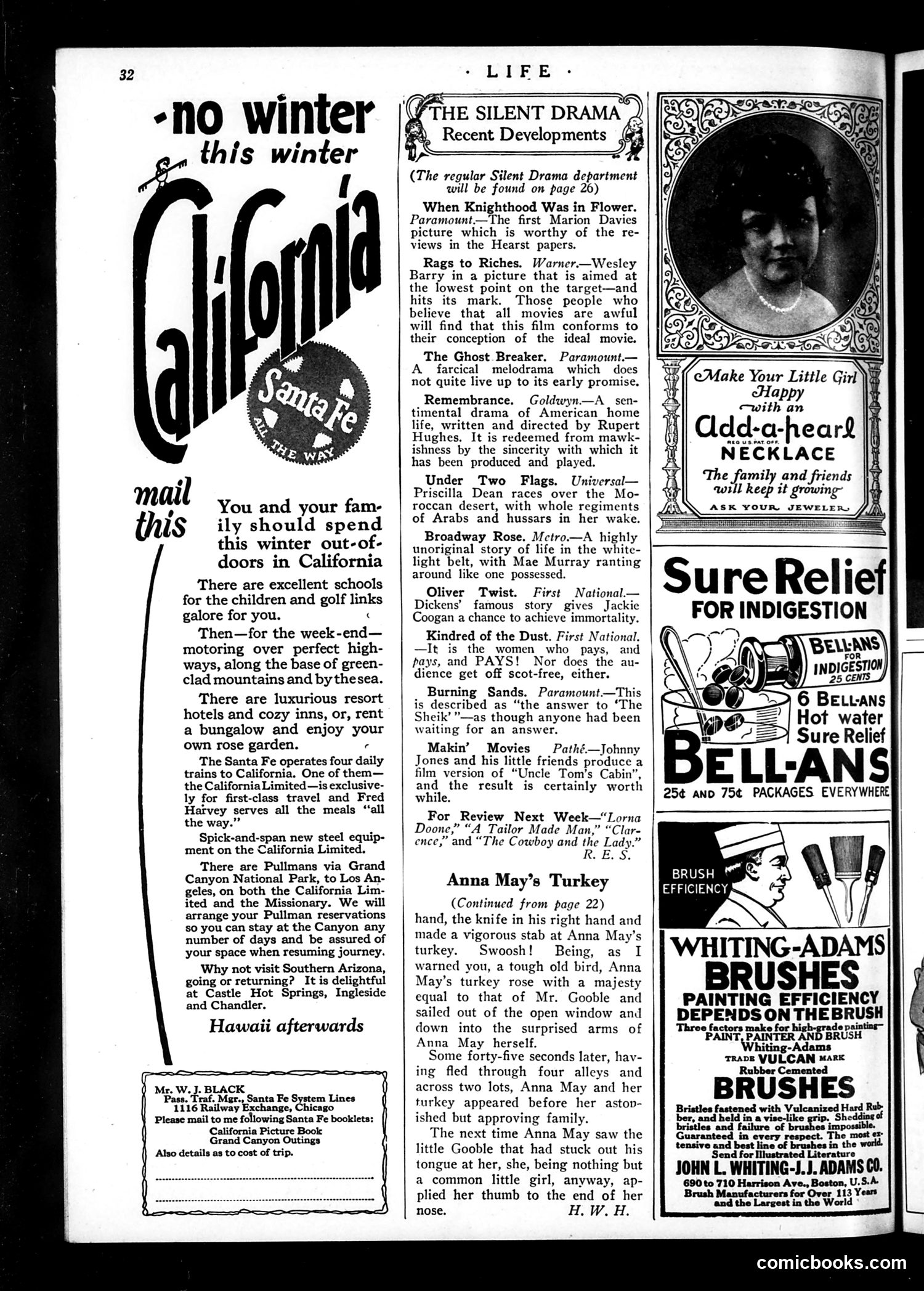
This is primarily a **Santa Fe Railway advertisement** promoting California winter travel. The large "California" logo dominates the left side, pitching escapes from harsh winters through luxurious train travel (the "California Limited") to resorts, golf, and warm weather destinations. The ad also promotes the Grand Canyon and Arizona hot springs. The right side contains typical **Life magazine content**: brief movie reviews of silent films (featuring Marion Davies, Jackie Coogan, Mae Murray), discussing which pictures are worthwhile or disappointing. The reviews are somewhat sarcastic—one film "conforms to their conception of the ideal movie" only for those who think all movies are awful. Below is a humorous short story, "Anna May's Turkey," about a domestic mishap involving a stubborn bird and an overeager guest. The advertisements for remedies (Bellans indigestion pills, Whiting-Adams brushes) are typical period product placements. This is mainstream commercial content, not political satire.
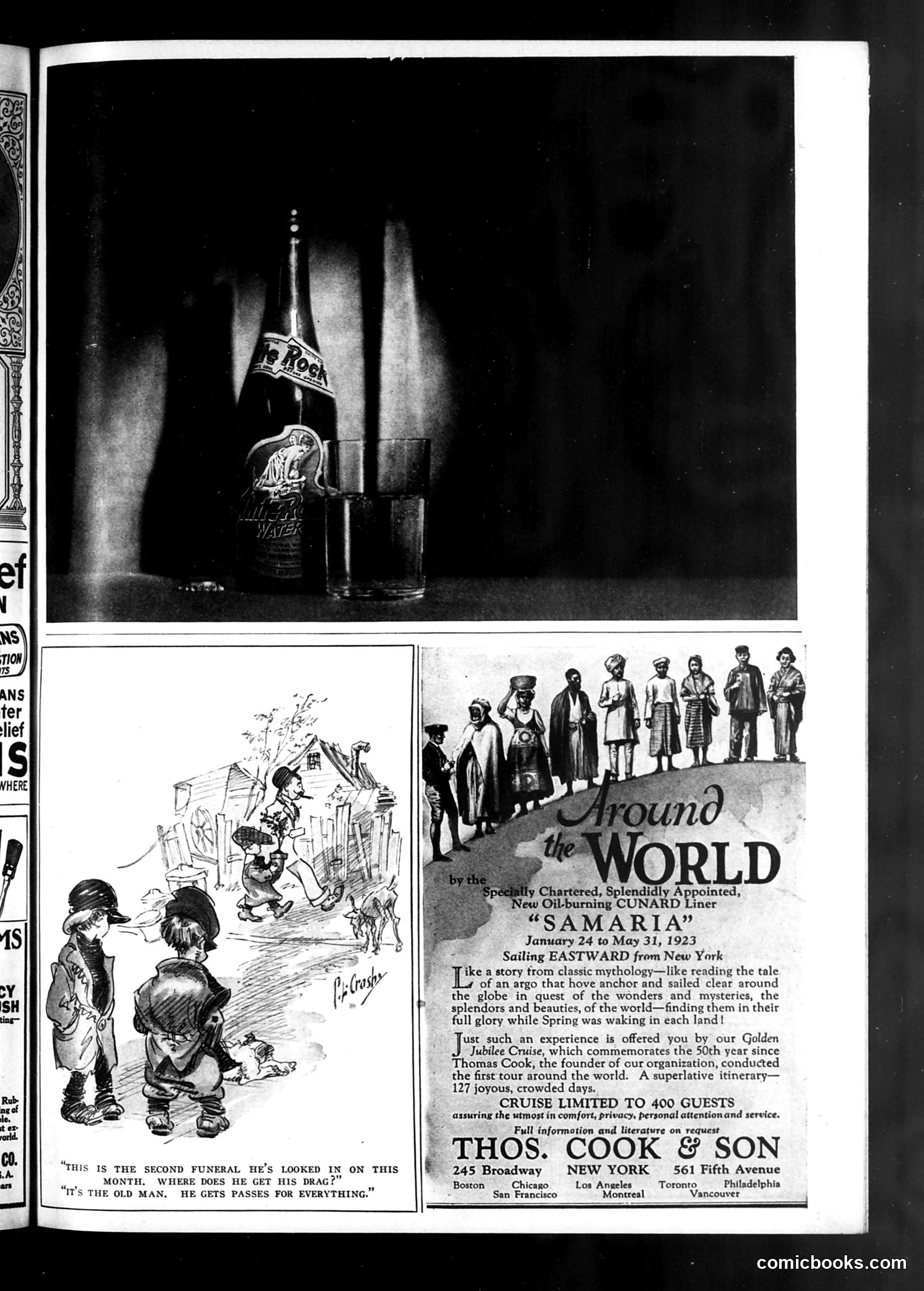
This page contains two distinct elements: **The Cartoon (lower left):** A satirical sketch shows two children observing a funeral procession. One child asks where the other gets his fancy clothes ("drag"), and the response reveals he's an undertaker's son who receives free "passes" to funerals—implying he attends them so frequently he's obtained mourning clothes through perks of his father's profession. The joke is dark humor about a child's casual access to death rituals and the macabre benefit system of funeral homes. **The Advertisement (right):** Thomas Cook & Son promotes a luxury world cruise aboard the Cunard liner *Samaria* (January-May 1923), celebrating the company's 50th anniversary since Thomas Cook founded organized tourism. It promises 127 days visiting global wonders for 400 guests—positioning international travel as an aspirational, mythic adventure available to the wealthy. The juxtaposition is jarring: morbid humor about death contrasts sharply with glamorous vacation marketing.
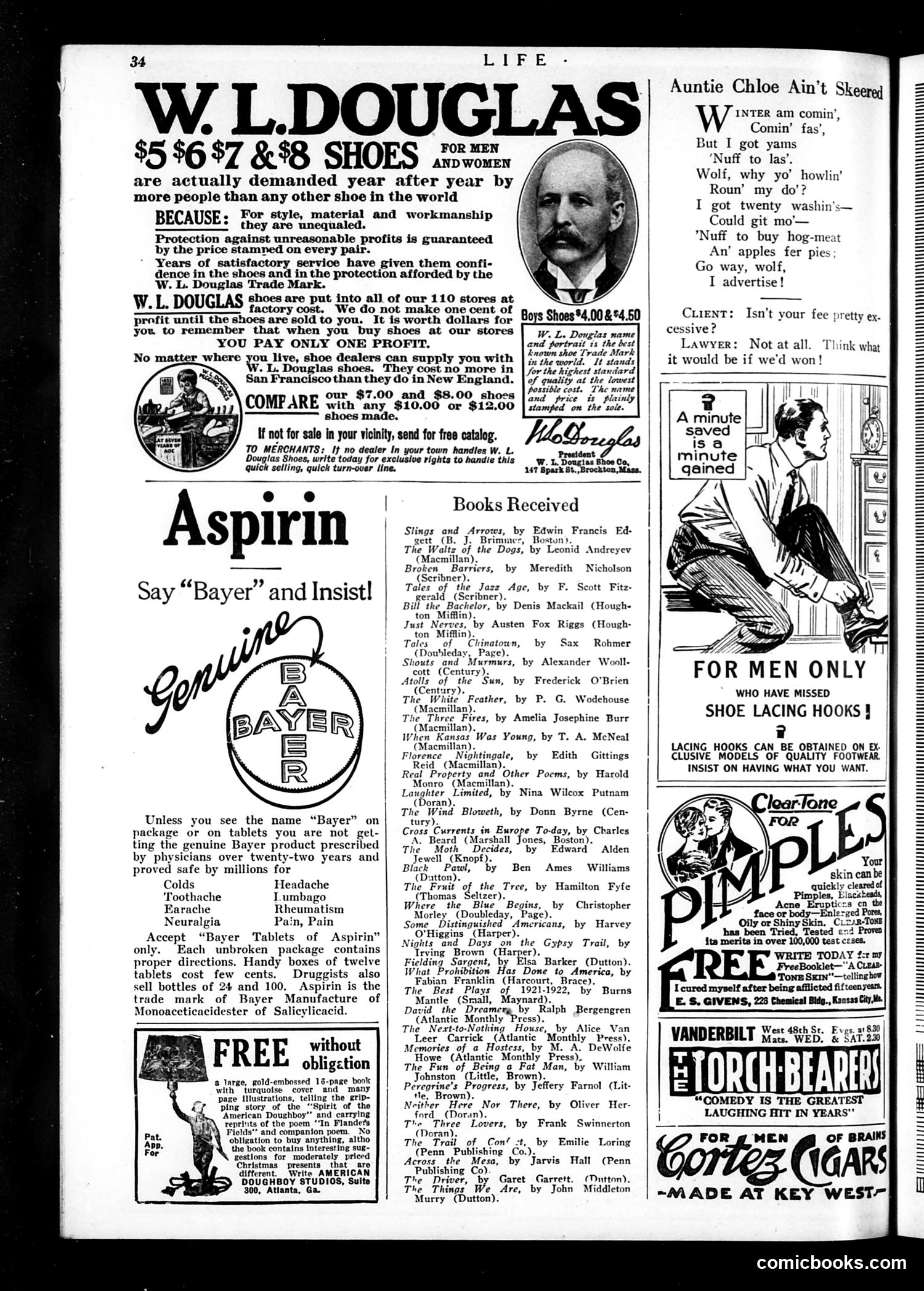
This page is primarily **advertising and book listings**, not political satire or comics. The main advertisements are: **W.L. Douglas Shoes**: A manufacturer's ad emphasizing value—claiming their $5-8 shoes outsell competitors because they're stamped with price and factory cost, ensuring "YOU PAY ONLY ONE PROFIT." This reflects early 20th-century consumer messaging about fair pricing and transparency. **Bayer Aspirin**: An ad insisting consumers say "Bayer" specifically, as aspirin was Bayer's trademarked product. This addresses the common problem of generic knockoffs and emphasizes the importance of brand recognition. **American Doughboy Studios**: Offers a free book about WWI soldiers, capitalizing on post-war sentiment. The "Books Received" section lists contemporary 1920s literature, including F. Scott Fitzgerald's *Tales of the Jazz Age*. There is a small cartoon titled "Auntie Chloe Ain't Skeerd" depicting dialect humor (African American vernacular), which reflects period conventions but lacks clear satirical purpose beyond entertainment.
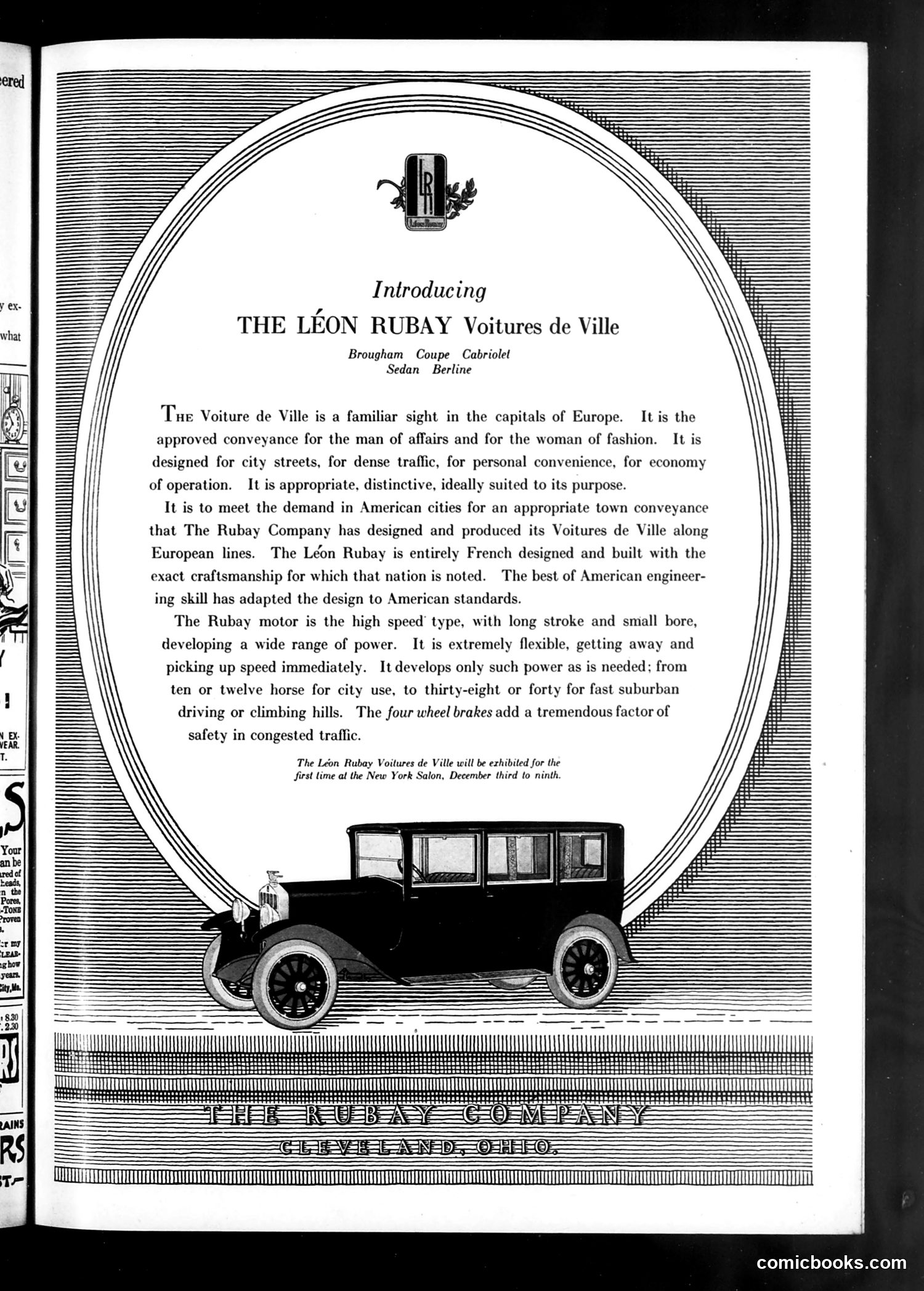
This is a **full-page automobile advertisement**, not a cartoon or satirical content. It introduces the Léon Rubay "Voitures de Ville" (city cars), a French luxury vehicle being marketed to American buyers. The ad emphasizes European sophistication—the cars are "French designed and built" with craftsmanship the French nation is "noted" for—while assuring American consumers that U.S. engineering has adapted the design to "American standards." The text positions these vehicles as appropriate for urban professionals and fashionable women in major cities. The illustration shows a elegant sedan-style automobile positioned within a decorative oval frame, styled in the refined graphic aesthetic typical of early 20th-century luxury advertising. **No satire or political content is present.** This is straightforward high-end product promotion targeting wealthy American urbanites who aspired to European taste and sophistication. The advertisement announces the cars will debut at the New York Salon, December 3-9 (year unclear from visible text).
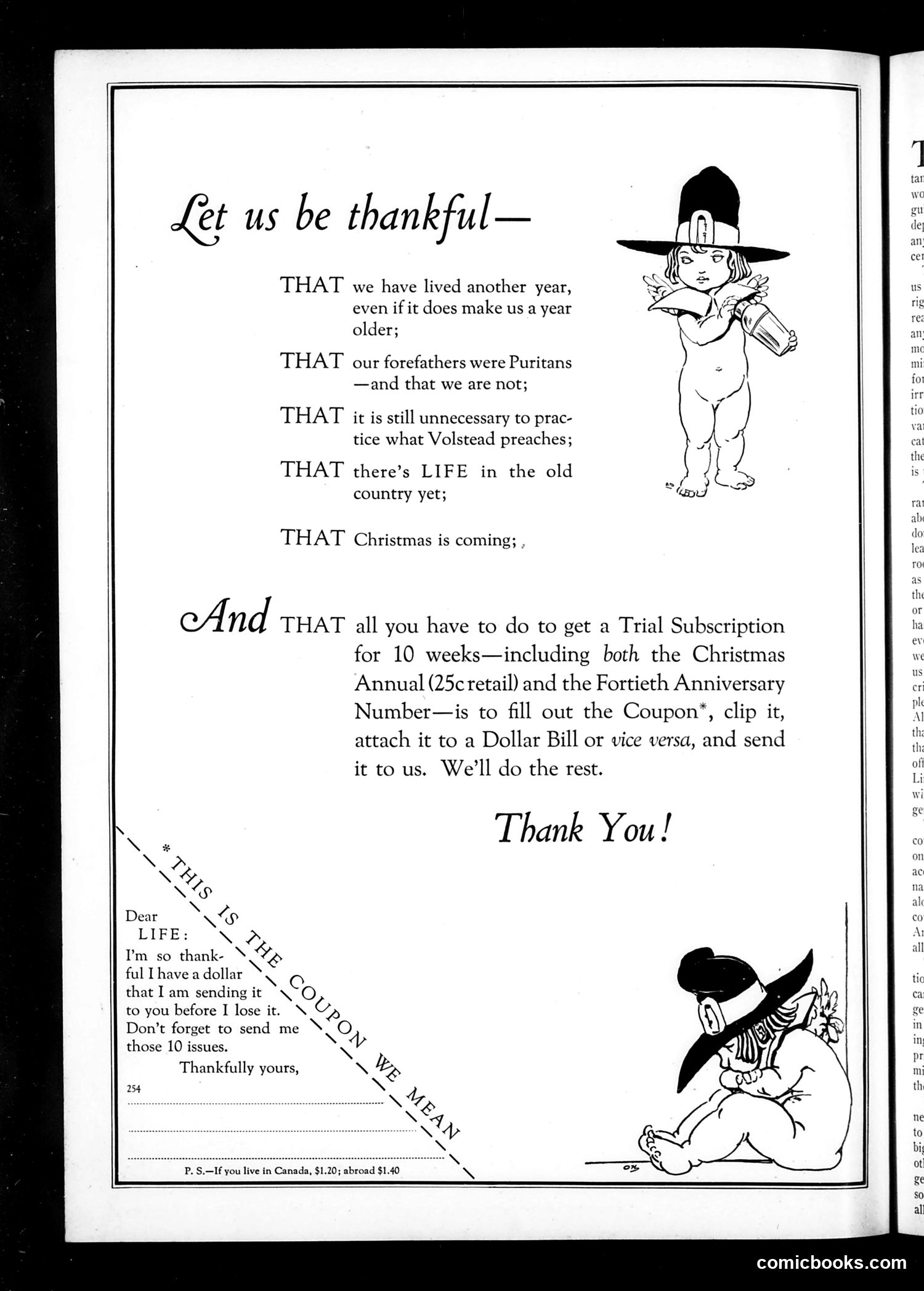
This is a **subscription promotion**, not a political cartoon. The page uses humor and illustrations to encourage readers to subscribe to Life magazine's 10-week trial offer. The satirical "things to be thankful for" list contains period-specific references: - **"Volstead preaches"**: References the Volstead Act (Prohibition), joking that Americans don't need to practice its principles—implying readers appreciate their ability to drink alcohol despite the law. - **"Our forefathers were Puritans—and that we are not"**: Self-aware humor about Life's sophisticated, irreverent tone versus stern Puritan values. - **"LIFE in the old country yet"**: A pun on the magazine's name. The two cartoon figures (appearing to be cherubs or children in hats) are generic decorative elements, not specific caricatures. The accompanying reader letter reinforces the pitch: subscribe before losing your dollar. **Context**: This reflects 1920s American culture during Prohibition, when Life magazine positioned itself as witty and worldly—offering readers a respite from puritanical restrictions through humor and modern sensibility.
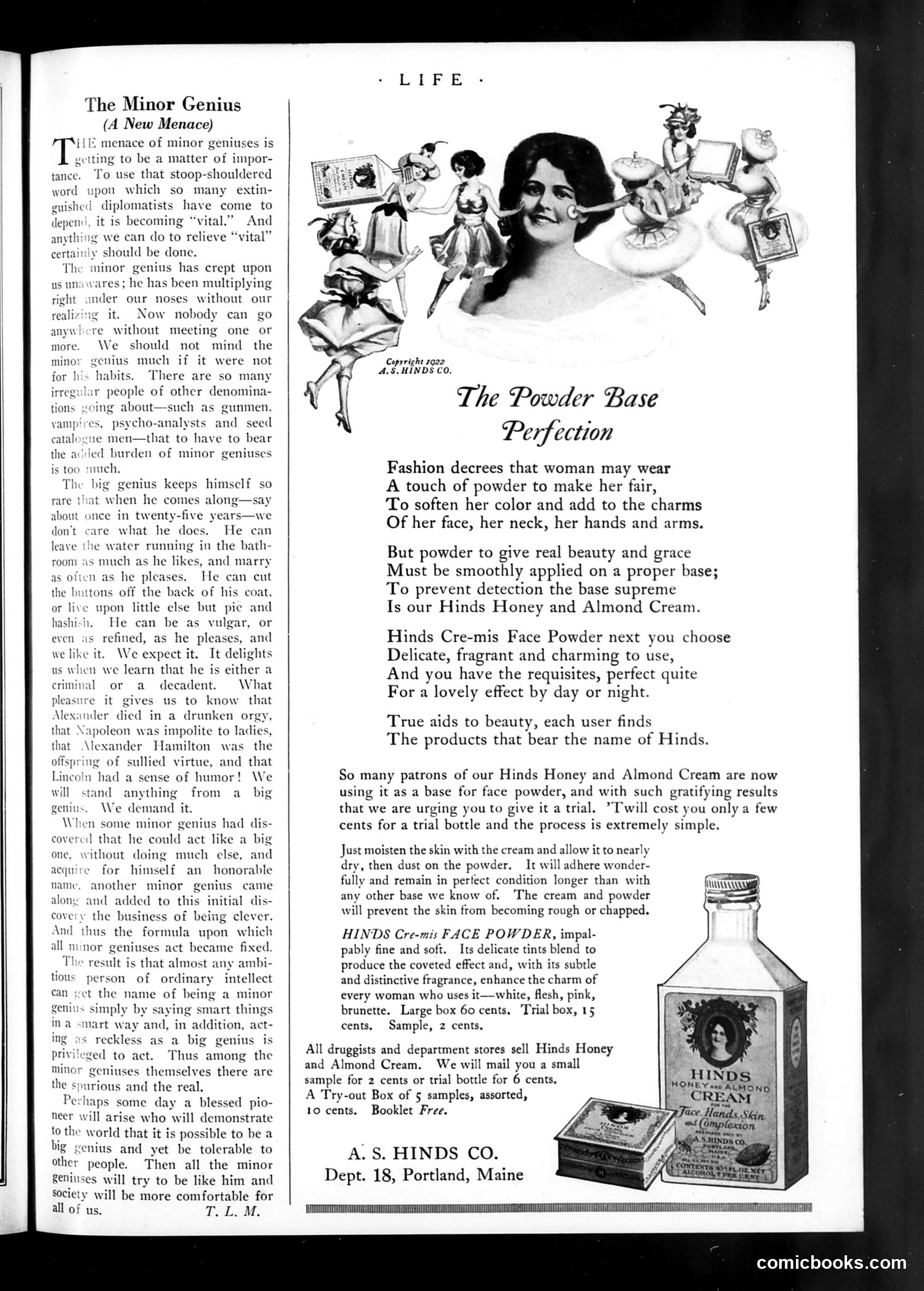
This page contains two unrelated items: a satirical essay and a cosmetics advertisement. **"The Minor Genius" (left):** The essay, attributed to T.L.M., satirizes the proliferation of mediocre pseudo-intellectuals posing as artistic geniuses. The author argues that true great geniuses are rare and excused their eccentricities (citing historical examples: Alexander dying in drunken debauchery, Napoleon's rudeness, Lincoln's humor sense). However, "minor geniuses" have discovered they can fake this status by "saying smart things in a smart way" and behaving recklessly without actual talent. The satire mocks both these pretenders and society's tolerance of their affected behavior. It's a commentary on 1920s cultural affectation and intellectual pretension. **"The Powder Base Perfection" (right):** A Hinds Cosmetics advertisement promoting face powder with a cream base, using verse-form marketing copy. The elaborate illustration shows fashionable women applying makeup. The juxtaposition is ironic—a critique of superficial posturing appears alongside an advertisement encouraging superficial beautification.
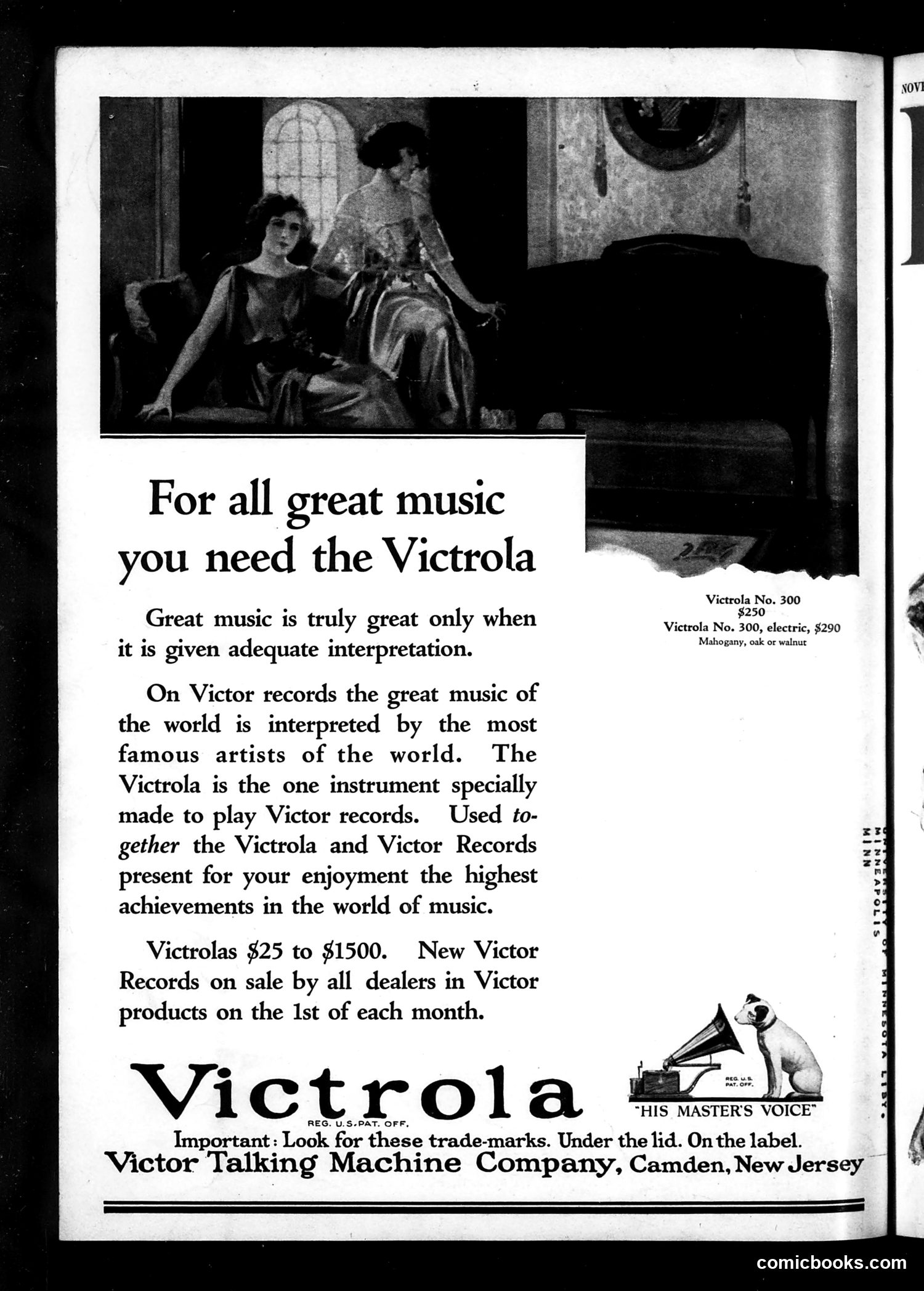
This is a **full-page advertisement**, not political satire. It promotes the Victrola phonograph made by Victor Talking Machine Company (Camden, New Jersey). The ad features a photograph of two elegantly dressed women in what appears to be a wealthy interior, with a piano visible. One woman sits while another stands nearby, establishing an aspirational, refined domestic scene. The advertisement's message: quality music reproduction requires the right equipment. Victor records feature "famous artists of the world," and the Victrola is "specially made" to play them. The ad emphasizes that great music needs "adequate interpretation"—meaning proper playback equipment. Price range: $25 to $1500, with the featured Model 300 costing $290 ($290 electric version). The "His Master's Voice" logo (dog and gramophone) appears at bottom—Victor's trademark. This reflects early 20th-century consumer culture marketing: associating a product with wealth, sophistication, and cultural refinement to encourage middle-class purchases of new technology.