
Life, 1922-11-02 · page 5 of 40
Life — November 2, 1922 — page 5: what you’re looking at
What you’re looking at
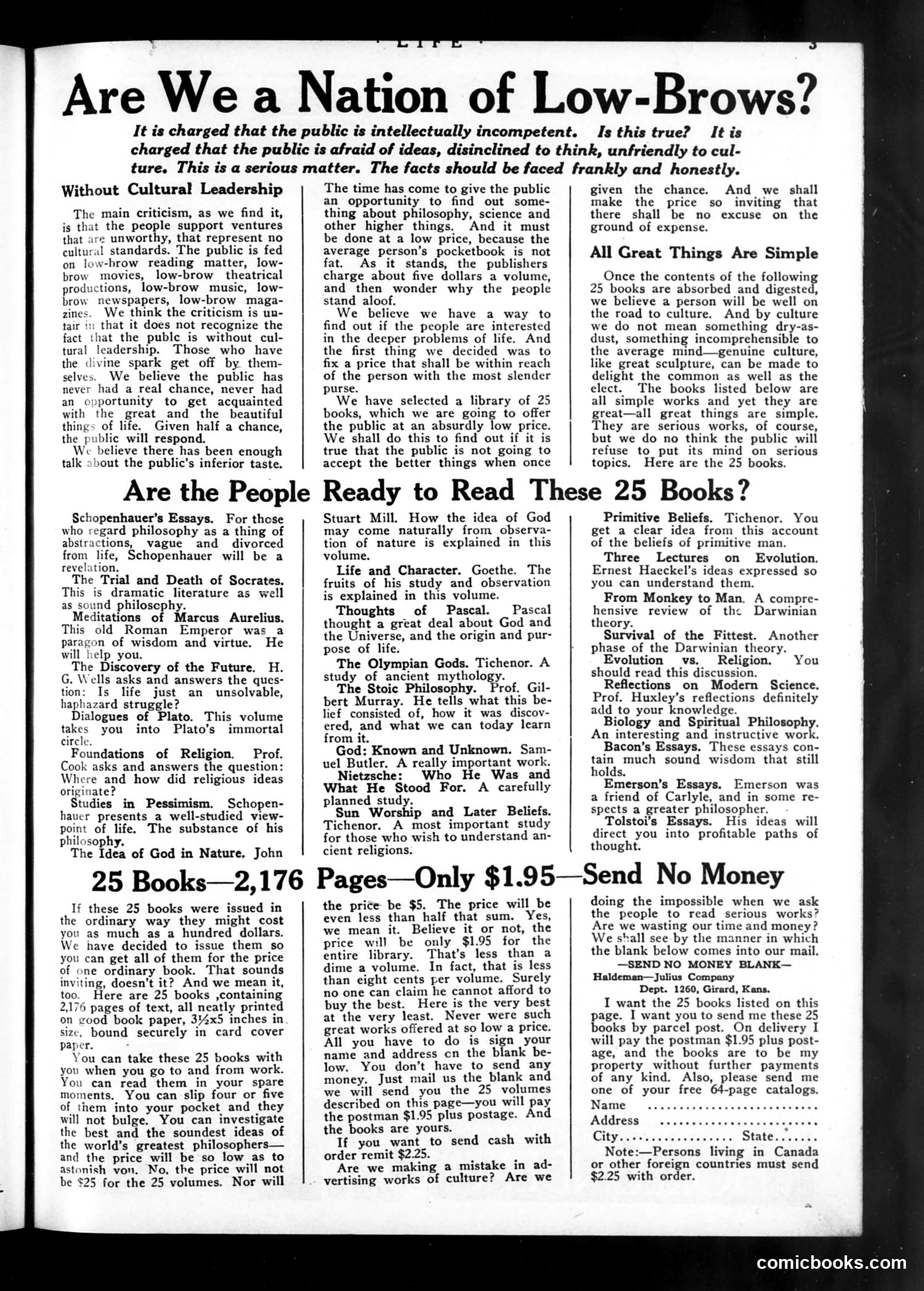
This page is primarily **advertising copy**, not a political cartoon. It's a mail-order book club advertisement from Life magazine promoting 25 classic works of philosophy, literature, and science for $1.95. The headline "Are We a Nation of Low-Brows?" sarcastically addresses a widespread cultural anxiety of the era—that Americans were intellectually inferior and culturally unrefined. The ad defends ordinary people's capacity for serious thought while arguing that cost barriers, not ability, prevented engagement with "great things." The pitch claims accessibility to high culture shouldn't require expense, listing canonical works by figures like Schopenhauer, Plato, and Emerson. This reflects mid-20th century democratic idealism about making intellectual material available to the masses through affordable distribution.
📄 Transcribed text from this page (OCR, searchable)
Machine-transcribed from the original scan — historical spelling and the odd misread are preserved.
Are We a Nation of Low-Brows? It is charged that the public is intellectually incompetent. Is this true? It is charged that the public is afraid of ideas, disinclined to think, unfriendly to cul- ture. This is a serious matter. The facts should be faced frankly and honestly. Without Cultural Leadership The main criticism, as we find it, is that the people support ventures that are unworthy, that represent no cultural standards. The public is fed on low-brow reading matter, low- brow movies, low-brow theatrical productions, low-brow music, low- brow newspapers, low-brow maga- zines. We think the criticism is un- the divine spark get off by. them- selves. We believe the public has never had a real chance, never had an opportunity to get acquainted with the great and the beautiful things of life. Given half a chance, the public will respond. We believe there has been enough talk about the public’s inferior taste. Are the People Schopenhauer’s Essays. For those who regard philosophy as a thing of abstractions, vague and divorced from life, Schopenhauer will be a revelation. The Trial and Death of Socrates. This is dramatic literature as well as sound philosephy. Meditations of Marcus Aurelius. This old Roman Emperor was a n of wisdom and virtue. He Ip you. The Discovery of the Future. H. G. Wells asks and answers the ques- tion: Is life just an unsolvable, haphazard struggle? Dialogues of Plato. This volume takes you into Plato’s immortal circle. Foundations of Religion. Prof. Cook asks and answers the question: Where and how did religious ideas originate? Studies in Pessimism. Schopen- hauer presents a well-studied view- point of life. The substance of his philosophy. The Idea of God in Nature. John The time has come to give the public an opportunity to find out some- thing about philosophy, science and other higher things. And it must be done at a low price, because the average person’s pocketbook is not fat. As it stands, the publishers charge about five dollars a volume, and then wonder why the people stand aloof. We believe we have a way to find out if the people are interested in the deeper problems of life. And the first thing we decided was to fix a price that shall be within reach of the person with the most slender purse. We have selected a library of 25 books, which we are going to offer the public at an absurdly low price. We shall do this to find out if it is true that the public is not going to accept the better things when once given the chance. And we shall make the price so inviting that there shall be no excuse on the ground of expense. All Great Things Are Simple Once the contents of the following 25 books are absorbed and digested, we believe a person will be well on the road to culture. And by culture we do not mean something dry-as- dust, something incomprehensible to the average mind—genuine culture, like great sculpture, can be made to delight the common as well as the elect. The books listed below are all simple works and yet they are great—all great things are simple. They are serious works, of course, but we do no think the public will refuse to put its mind on serious topics. Here are the 25 books. Ready to Read These 25 Books? Stuart Mill. How the idea of God may come naturally from observa- tion of nature is explained in this volume. Life and Character. Goethe. The fruits of his study and observation is explained in this volume. Thoughts of Pascal. Pascal thought a great deal about God and the Universe, and the origin and pur- pose of life. The Olympian Gods. Tichenor. A study of ancient mythology. The Stoic Philosophy. Prof. Gil- bert Murray. He tells what this be- lief consisted of, how it was discov- ered, and what we can today learn from it. God: Known and Unknown. Sam- uel Butler. A really important work. Nietzsche: Who He Was and What He Stood For. A carefully planned study. . Sun Worship and Later Beliefs. Tichenor. A most important study for those who wish to understand an- cient religions. Primitive Beliefs. Tichenor. You get a clear idea from this account of the beliefs of primitive man. Three Lectures on Evolution, Ernest Haeckel’s ideas expressed so you can understand them. From Monkey to Man. A compre- hensive review of the Darwinian theory. Survival of the Fittest. Another phase of the Darwinian theory. Evolution vs. Religion. You should read this discussion. Reflections on Modern Science. Prof. Huxley’s reflections definitely add to your knowledge. Biology and Spiritual Fhilosophy. An interesting and instructive work. Bacon’s Essays. These essays con- tain much sound wisdom that still holds. Emerson’s Essays. Emerson was a friend of Carlyle, and in some re- spects a greater philosopher. Tolstoi’s Essays. His ideas will direct you into profitable paths of thought. 25 Books—2,176 Pages—Only $1.95—Send No Money If these 25 books were issued in the ordinary way they might cost you as much as a hundred dollars. We have decided to issue them so you can get all of them for the price of one ordinary book. That sounds inviting, doesn’t it? And we mean it, too. Here are 25 books ,containing 2,176 pages of text, all neatly printed on good book paper, 314x5 inches in size, bound securely in card cover Paper. - You can take these 25 books with you when you go to and from work. You can read them in your spare moments. You can slip four or five of them into your pocket and they will not bulge. You can investigate the best and the soundest ideas of the world’s greatest philosophers— and the price will be so low as to astonish von. No, the price will not be $25 for the 25 volumes. Nor will the price be $5. The price will be even less than half that sum. Yes, we mean it. Believe it or not, the price wil) be only $1.95 for the entire library. That’s less than a dime a volume. In fact, that is less than eight cents per volume. Surely no one can claim he cannot afford to buy the best. Here is the very best at the very least. Never were such great works offered at so low a price. All you have to do is sign your name and address cn the blank be- low. You don’t have to send any money. Just mail us the blank and we will send you the 25 volumes described on this page—you will pay the postman $1.95 plus postage. And the books are yours. : If you want to send cash with order remit $2.25. : Are we making a mistake in ad- vertising works of culture? Are we doing the impossible when we ask the people to read serious works? Are we wasting our time and money? We shall see by the manner in which the blank below comes into our mail. —SEND NO MONEY BLANK— Haldeman—Julius Company Dept. 1260, Girard, Kans. I want the 25 books listed on this page. I want you to send me these 25 books by parcel post. On delivery I will pay the postman $1.95 plus post- age, and the books are to be my property without further payments of any kind. Also, please send me one of your free 64-page catalogs. Name Address Note:—Persons living in Canada or other foreign countries must send $2.25 with order. comicbooks.com