
Life, 1922-11-02 · page 16 of 40
Life — November 2, 1922 — page 16: what you’re looking at
What you’re looking at
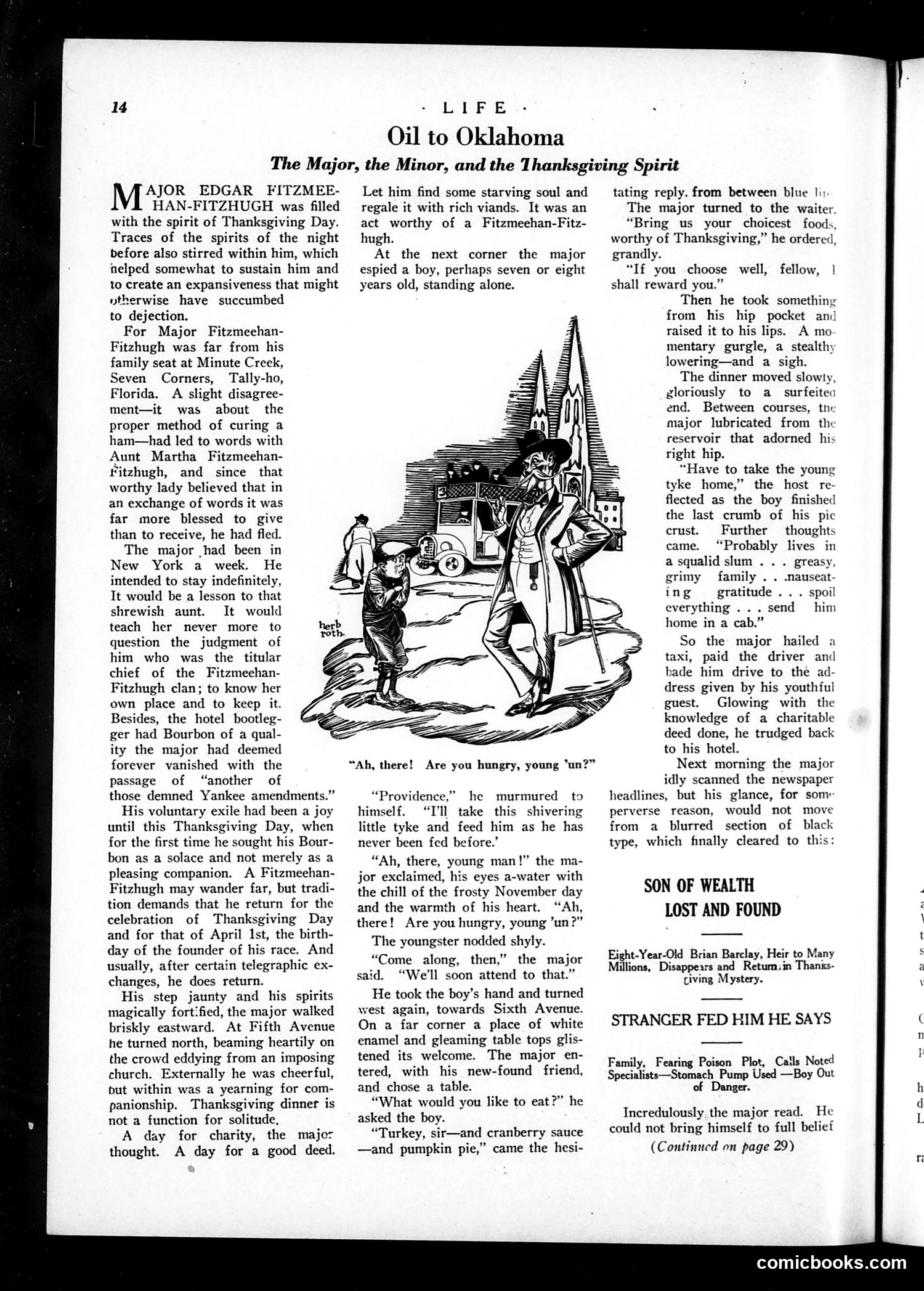
This page presents a short story titled "Oil to Oklahoma: The Major, the Minor, and the Thanksgiving Spirit." The narrative follows Major Edgar Fitzmeehan-Fitzhugh, a wealthy New York man who encounters a starving boy on Thanksgiving and impulsively invites him to dinner. The accompanying illustration shows the major (depicted as an older gentleman in formal dress) greeting a ragged, barefoot boy outside what appears to be a church or building. The story's satire targets the performative charity of wealthy individuals—the major's self-congratulatory benevolence toward the homeless child, complete with his internal judgments about the boy's family situation. The humor lies in exposing the condescension and self-satisfaction of charitable acts by the affluent during holidays.
📄 Transcribed text from this page (OCR, searchable)
Machine-transcribed from the original scan — historical spelling and the odd misread are preserved.
LIFE Oil to Oklahoma The Major, the Minor, and the Thanksgiving Spirit AJOR EDGAR FITZMEE- HAN-FITZHUGH was filled with the spirit of Thanksgiving Day. Traces of the spirits of the night before also stirred within him, which nelped somewhat to sustain him and to create an expansiveness that might otherwise have succumbed to dejection. For Major Fitzmeehan- Fitzhugh was far from his family seat at Minute Creek, Seven Corners, Tally-ho, Florida. A slight disagree- ment—it was about the proper method of curing a ham—had led to words with Aunt Martha Fitzmeehan- Fitzhugh, and since that worthy lady believed that in an exchange of words it was far more blessed to give than to receive, he had fled. The major had been in New York a week. He intended to stay indefinitely, It would be a lesson to that shrewish aunt. It would teach her never more to question the judgment of him who was the titular chief of the Fitzmeehan- Fitzhugh clan; to know her own place and to keep it. Besides, the hotel bootleg- ger had Bourbon of a qual- ity the major had deemed forever vanished with the passage of “another of those demned Yankee amendments.” His voluntary exile had been a joy until this Thanksgiving Day, when for the first time he sought his Bour- bon as a solace and not merely as a pleasing companion. A Fitzmeehan- Fitzhugh may wander far, but tradi- tion demands that he return for the celebration of Thanksgiving Day and for that of April Ist, the birth- day of the founder of his race. And usually, after certain telegraphic ex- changes, he does return. His step jaunty and his spirits magically fortified, the major walked briskly eastward. At Fifth Avenue he turned north, beaming heartily on the crowd eddying from an imposing church. Externally he was cheerful, but within was a yearning for com- panionship. Thanksgiving dinner is not a function for solitude, A day for charity, the majo: thought. A day for a good deed. Let him find some starving soul and regale it with rich viands. It was an act worthy of a Fitzmeehan-Fitz- hugh. At the next corner the major espied a boy, perhaps seven or eight years old, standing alone. “Ah, there!) Are you hungry, young ’un?” “Providence,” he murmured to himself. “I'll take this shivering little tyke and feed him as he has never been fed before.’ “Ah, there, young man!” the ma- jor exclaimed, his eyes a-water with the chill of the frosty November day and the warmth of his heart. “Ah, there! Are you hungry, young ’un?” The youngster nodded shyly. “Come along, then,” the major said. “We'll soon attend to that.” He took the boy’s hand and turned west again, towards Sixth Avenue. On a far corner a place of white enamel and gleaming table tops glis- tened its welcome. The major en- tered, with his new-found friend, and chose a table. “What would you like to eat?” he asked the boy. “Turkey, sir—and cranberry sauce —and pumpkin pie,” came the hesi- tating reply. from between blue li; The major turned to the waiter. “Bring us your choicest foods, worthy of Thanksgiving,” he ordered, grandly. “If you choose well, fellow, | shall reward you.” Then he took something from his hip pocket and raised it to his lips. A mo mentary gurgle, a stealthy lowering—and a sigh. The dinner moved slowly, gloriously to a surfeitea end. Between courses, tne major lubricated from the reservoir that adorned his right hip. “Have to take the young tyke home,” the host re- flected as the boy finished the last crumb of his pic crust. Further thoughts came. “Probably lives in a squalid slum . . . greasy, grimy family . . .nauseat- ing gratitude . . . spoil everything ... send him home in a cab.” So the major hailed a taxi, paid the driver and bade him drive to the ad- dress given by his youthful guest. Glowing with the knowledge of a charitable deed done, he trudged back to his hotel. Next morning the major idly scanned the newspaper headlines, but his glance, for som perverse reason, would not move from a blurred section of black type, which finally cleared to this: SON OF WEALTH LOST AND FOUND Eight-Year-Old Brian Barclay, Heir to Many Millions, Disappears and Retum:in Thanks- civing Mystery. STRANGER FED HIM HE SAYS Family, Fearing Poison Plot, Cails Noted Specialists—Stomach Pump Used —Boy Out of Danger. Incredulously the major read. He could not bring himself to full belief (Continued on page 29) comicbooks.com