
Life, 1922-11-02 · page 28 of 40
Life — November 2, 1922 — page 28: what you’re looking at
What you’re looking at
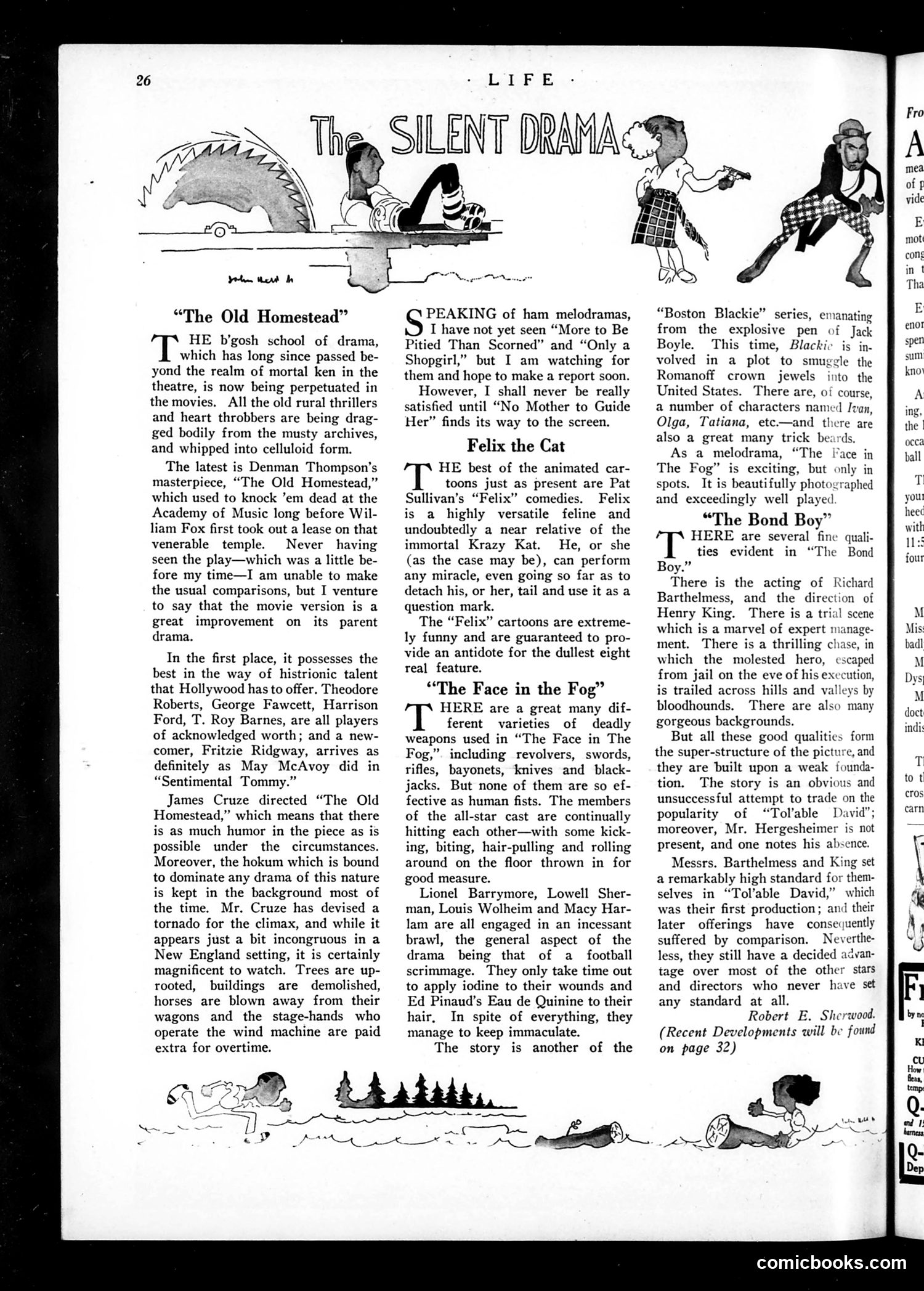
This page reviews three silent films, reflecting early 1920s cinema criticism. **"The Old Homestead"** adapts a famous 19th-century stage melodrama, updating it for film. The reviewer praises the cast (Theodore Roberts, George Fawcett, Harrison Ford) and director James Cruze, noting they've improved upon the original "hokum" by adding a spectacular tornado climax—a distinctly cinematic touch. **Felix the Cat** discusses the popular animated cartoons by Pat Sullivan, comparing Felix to "Krazy Kat" and praising their humor and physical comedy (Felix detaches his own tail to form a question mark). **"The Face in the Fog"** features the "Boston Blackie" series about smuggling Romanoff crown jewels. The reviewer notes the all-star cast (Lionel Barrymore, Lowell Sherman, Louis Wolheim) engages in nearly continuous physical fighting, comparing the film to a "football scrimmage." The tone is witty and sardonic about silent-film conventions—melodrama, violence, and spectacle compensating for minimal plot.
📄 Transcribed text from this page (OCR, searchable)
Machine-transcribed from the original scan — historical spelling and the odd misread are preserved.
“The Old Homestead” HE b’gosh school of drama, which has long since passed be- yond the realm of mortal ken in the theatre, is now being perpetuated in the movies. All the old rural thrillers and heart throbbers are being drag- ged bodily from the musty archives, and whipped into celluloid form. The latest is Denman Thompson’s masterpiece, “The Old Homestead,” which used to knock ’em dead at the Academy of Music long before Wil- liam Fox first took out a lease on that venerable temple. Never having seen the play—which was a little be- fore my time—I am unable to make the usual comparisons, but I venture to say that the movie version is a great improvement on its parent drama. In the first place, it possesses the best in the way of histrionic talent that Hollywood has to offer. Theodore Roberts, George Fawcett, Harrison Ford, T. Roy Barnes, are all players of acknowledged worth; and a new- comer, Fritzie Ridgway, arrives as definitely as May McAvoy did in “Sentimental Tommy.” James Cruze directed “The Old Homestead,” which means that there is as much humor in the piece as is possible under the circumstances. Moreover, the hokum which is bound to dominate any drama of this nature is kept in the background most of the time. Mr. Cruze has devised a tornado for the climax, and while it appears just a bit incongruous in a New England setting, it is certainly magnificent to watch. Trees are up- rooted, buildings are demolished, horses are blown away from their wagons and the stage-hands who operate the wind machine are paid extra for overtime. LIFE PEAKING of ham melodramas, I have not yet seen “More to Be Pitied Than Scorned” and “Only a Shopgirl,” but I am watching for them and hope to make a report soon. However, I shall never be really satisfied until “No Mother to Guide Her” finds its way to the screen. Felix the Cat HE best of the animated car- toons just as present are Pat Sullivan’s “Felix” comedies. Felix is a highly versatile feline and undoubtedly a near relative of the immortal Krazy Kat. He, or she (as the case may be), can perform any miracle, even going so far as to detach his, or her, tail and use it as a question mark. The “Felix” cartoons are extreme- ly funny and are guaranteed to pro- vide an antidote for the dullest eight real feature. “The Face in the Fog” HERE are a great many dif- ferent varieties of deadly weapons used in “The Face in The Fog,”. including revolvers, swords, rifles, bayonets, knives and black- jacks. But none of them are so ef- fective as human fists. The members of the all-star cast are continually hitting each other—with some kick- ing, biting, hair-pulling and rolling around on the floor thrown in for good measure. Lionel Barrymore, Lowell Sher- man, Louis Wolheim and Macy Har- lam are all engaged in an incessant brawl, the general aspect of the drama being that of a football scrimmage. They only take time out to apply iodine to their wounds and Ed Pinaud’s Eau de Quinine to their hair, In spite of everything, they manage to keep immaculate. The story is another of the “Boston Blackie” series, emanating from the explosive pen of Jack Boyle. This time, Blackie is in- volved in a plot to smuggle the Romanoff crown jewels into the United States. There are, of course, a number of characters named Ivan, Olga, Tatiana, etc.—and there are also a great many trick beards. As a melodrama, “The lace in The Fog” is exciting, but only in spots. It is beautifully photographed and exceedingly well played “The Bond Boy” HERE are several fine quali- ties evident in “The Bond Boy.” There is the acting of Richard Barthelmess, and the direction of Henry King. There is a trial scene which is a marvel of expert ment. There is a thrilling chase, which the molested hero, escaped from jail on the eve of his execution, is trailed across hills and valleys by bloodhounds. There are also many gorgeous backgrounds. But all these good qualities form the super-structure of the picture, and they are built upon a weak founda- tion. The story is an obvious and unsuccessful attempt to trade on the popularity of “Tol’able David’; moreover, Mr. Hergesheimer is not present, and one notes his absence. Messrs. Barthelmess and King set a remarkably high standard for them- selves in “Tol’able David,” which was their first production; and their later offerings have consequently suffered by comparison. Neverthe- less, they still have a decided advan- tage over most of the other stars and directors who never have set any standard at all. Robert E. Sherwood. (Recent Developments will be found on page 32) comicbooks.com A mea of f vide E mot cong in t Tha E enor spen sum kno