
Life, 1922-11-02 · page 24 of 40
Life — November 2, 1922 — page 24: what you’re looking at
What you’re looking at
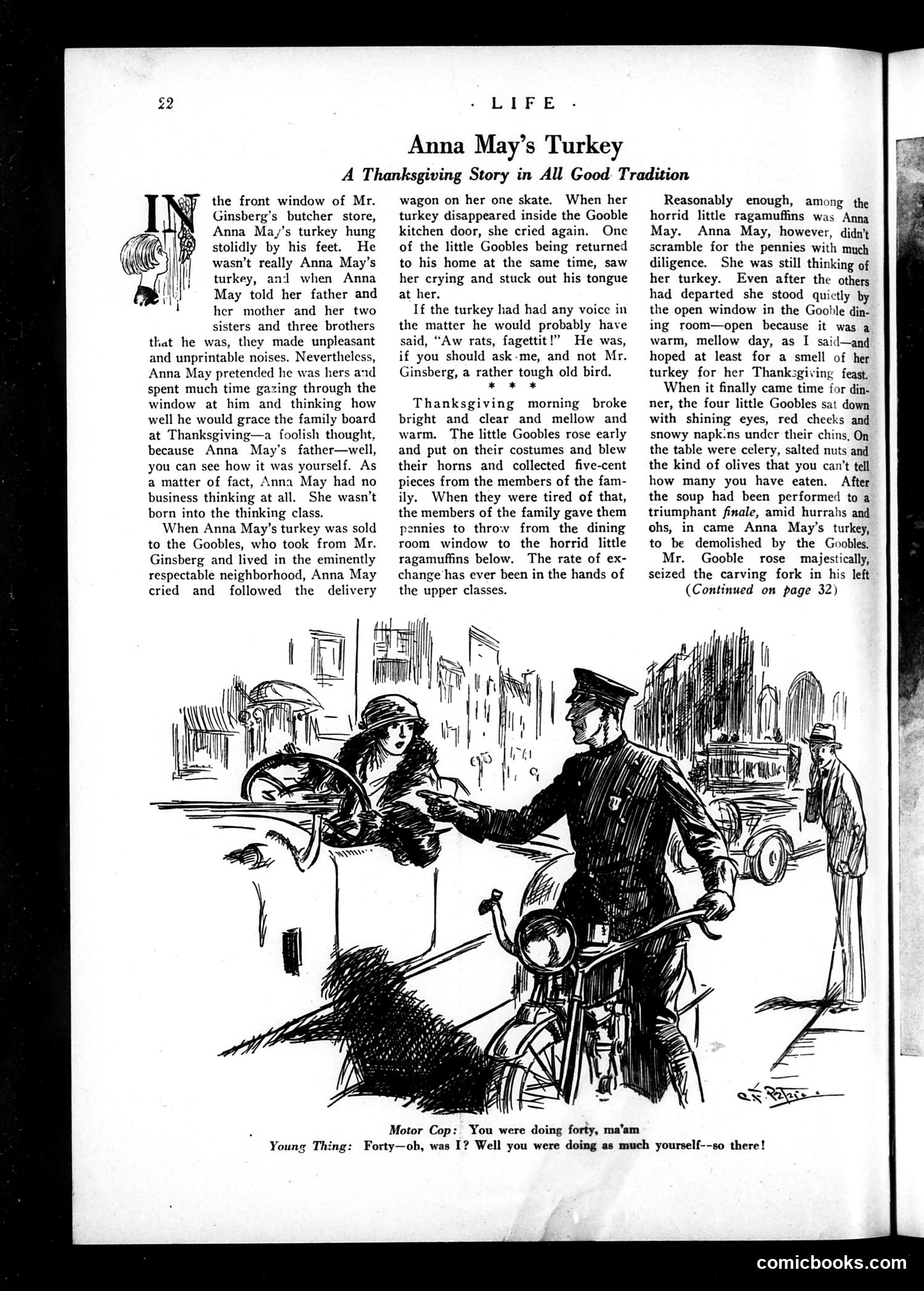
This Thanksgiving story satirizes early 20th-century American class divisions. Anna May is a poor immigrant girl (likely Jewish, given the name "Ginsberg") from a working-class family with many children. She becomes emotionally attached to a turkey in a butcher shop window, but her father cannot afford it. When the turkey is sold to the affluent "Gooble" family, Anna May follows it. On Thanksgiving, she stands outside their window hoping for scraps while the wealthy Goobles' children receive pennies and gifts. The story emphasizes the cruel indifference of the upper classes: they casually throw money to poor children below, and the narrator notes "the rate of exchange has ever been in the hands of the upper classes." The accompanying cartoon depicts a motor cop stopping a young woman for speeding; she retorts that he was driving equally fast. It's an unrelated joke about hypocrisy and authority.
📄 Transcribed text from this page (OCR, searchable)
Machine-transcribed from the original scan — historical spelling and the odd misread are preserved.
LIFE Anna May’s Turkey A Thanksgiving Story in All Good: Tradition the front window of Mr. Ginsberg’s butcher store, Anna May’s turkey hung stolidly by his feet. He wasn’t really Anna May’s turkey, and when Anna May told her father and her mother and her two sisters and three brothers that he was, they made unpleasant and unprintable noises. Nevertheless, Anna May pretended he was hers and spent much time gazing through the window at him and thinking how well he would grace the family board at Thanksgiving—a foolish thought, because Anna May’s father—well, you can see how it was yourself. As a matter of fact, Anna May had no business thinking at all. She wasn’t born into the thinking class. When Anna May’s turkey was sold to the Goobles, who took from Mr. Ginsberg and lived in the eminently respectable neighborhood, Anna May cried and followed the delivery wagon on her one skate. When her turkey disappeared inside the Gooble kitchen door, she cried again. One of the little Goobles being returned to his home at the same time, saw her crying and stuck out his tongue at her. If the turkey had had any voice in the matter he would probably have said, “Aw rats, fagettit!” He was, if you should ask-me, and not Mr. Ginsberg, a rather tough old bird. * * * Thanksgiving morning broke bright and clear and mellow and warm. The little Goobles rose early and put on their costumes and blew their horns and collected five-cent pieces from the members of the fam- ily. When they were tired of that, the members of the family gave them pennies to throw from the dining room window to the horrid little ragamuffins below. The rate of ex- change’has ever been in the hands of the upper classes. Motor Cop: You were doing forty, ma’am Young Thing: Forty—ob, was I? Well you were doing as much yourself--so there! Reasonably enough, among the horrid little ragamuffins was Anna May. Anna May, however, didn't scramble for the pennies with much diligence. She was still thinking of her turkey. Even after the others had departed she stood quictly by the open window in the Gooble din- ing room—open because it was a warm, mellow day, as I said—and hoped at least for a smell of her turkey for her Thanksgiving feast, When it finally came time for din- ner, the four little Goobles sat down with shining eyes, red cheeks and snowy napk:ns under their chins, On the table were celery, salted nuts and the kind of olives that you can’t tell how many you have eaten. After the soup had been performed to a triumphant finale, amid hurrahs and ohs, in came Anna May’s turkey, to be demolished by the Goobles, Mr. Gooble rose majestically, seized the carving fork in his left (Continued on page 32) comicbooks.com