
A complete issue · 36 pages · 1922
Life — October 12, 1922
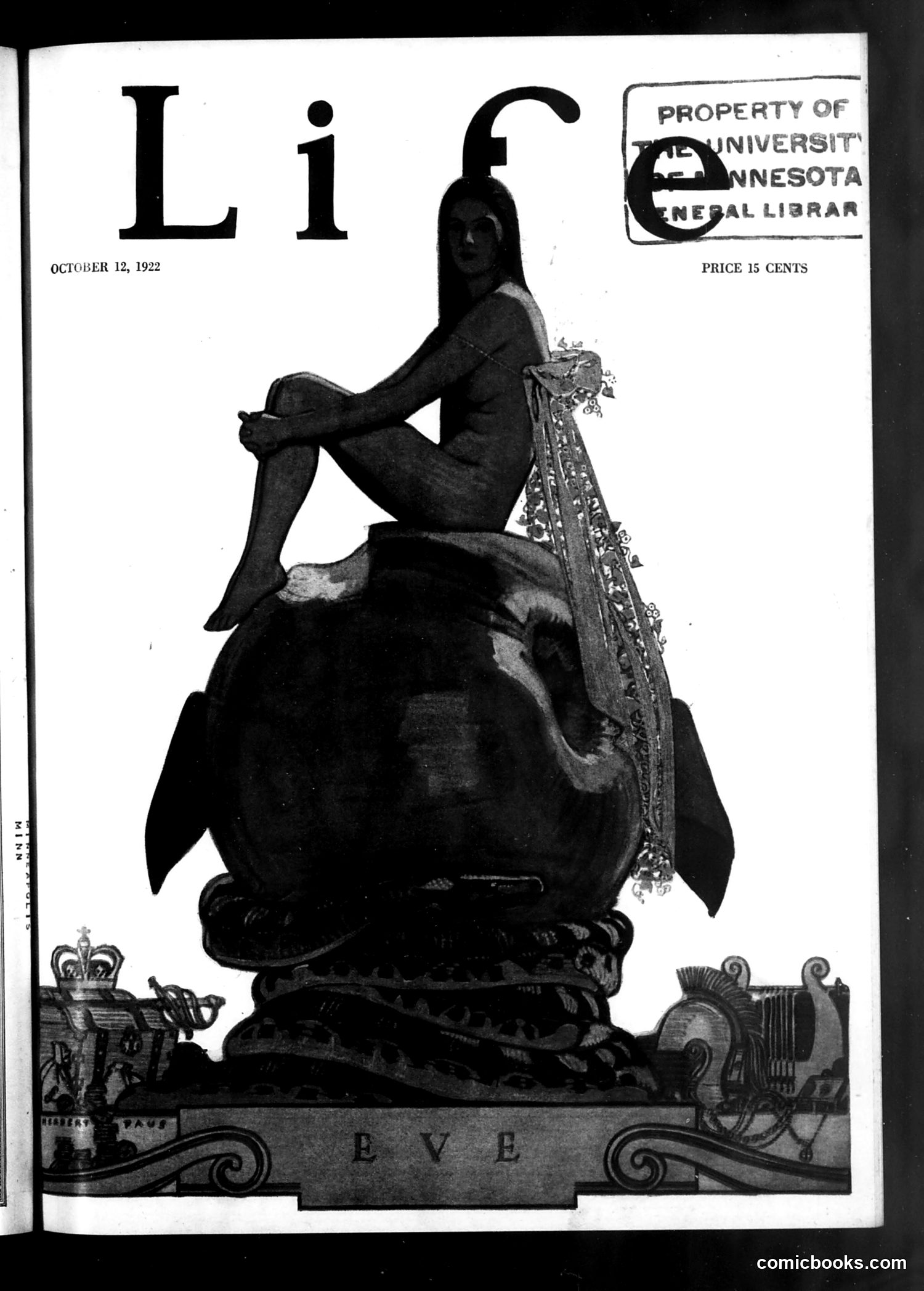
This cover depicts a woman perched atop a large fish, labeled "EVE" at the base. She wears a headpiece resembling a hook or crown and holds what appears to be a decorative item. The classical styling—with ornamental vessels flanking the composition—suggests this is allegorical satire. The imagery likely comments on 1920s gender relations or sexuality. The fish may reference temptation or seduction (biblical Eve associations), while the woman's commanding pose suggests ironic commentary on female power or changing women's roles during the Jazz Age. Without additional text visible on the page, the precise political or social target remains unclear, though the Art Deco styling indicates contemporary 1920s concerns about modernity and social change.
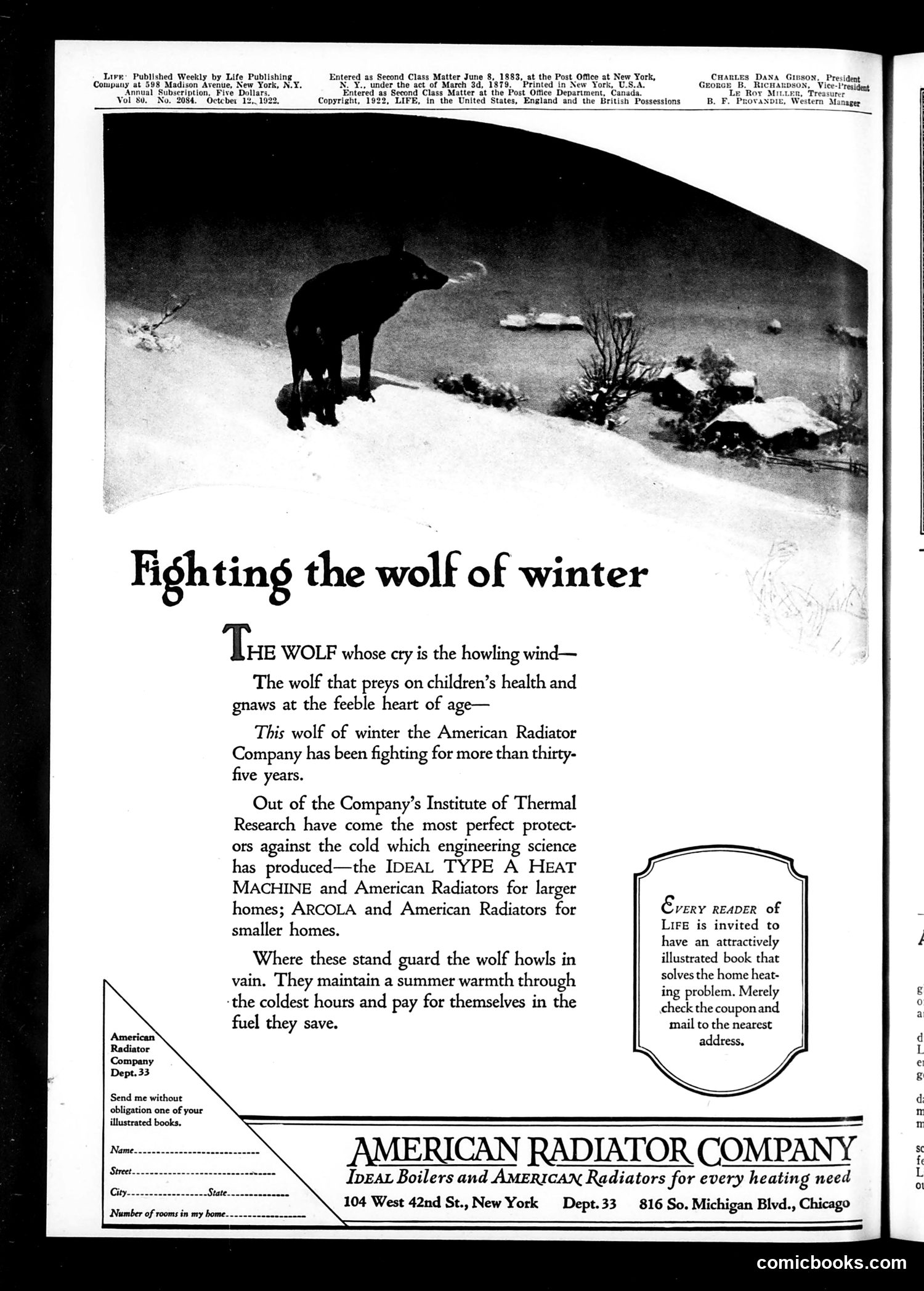
This page is **primarily an advertisement**, not satire or political commentary. The American Radiator Company uses metaphorical language to market heating systems. The image shows an elephant struggling in snow—a visual metaphor for winter's hardship. The text personifies winter as a predatory "wolf" threatening children's health and elderly people's vitality. This rhetorical strategy frames the company's radiators (IDEAL TYPE A HEAT MACHINE, ARCOLA, and American Radiators) as protective shields against nature's dangers. The coupon at bottom invites readers to request an illustrated book about home heating solutions. This is straightforward commercial messaging dressed in dramatic, poetic language typical of 1920s advertising. There is no political satire or cartoon joke present—the "fighting" referenced is purely metaphorical marketing copy.
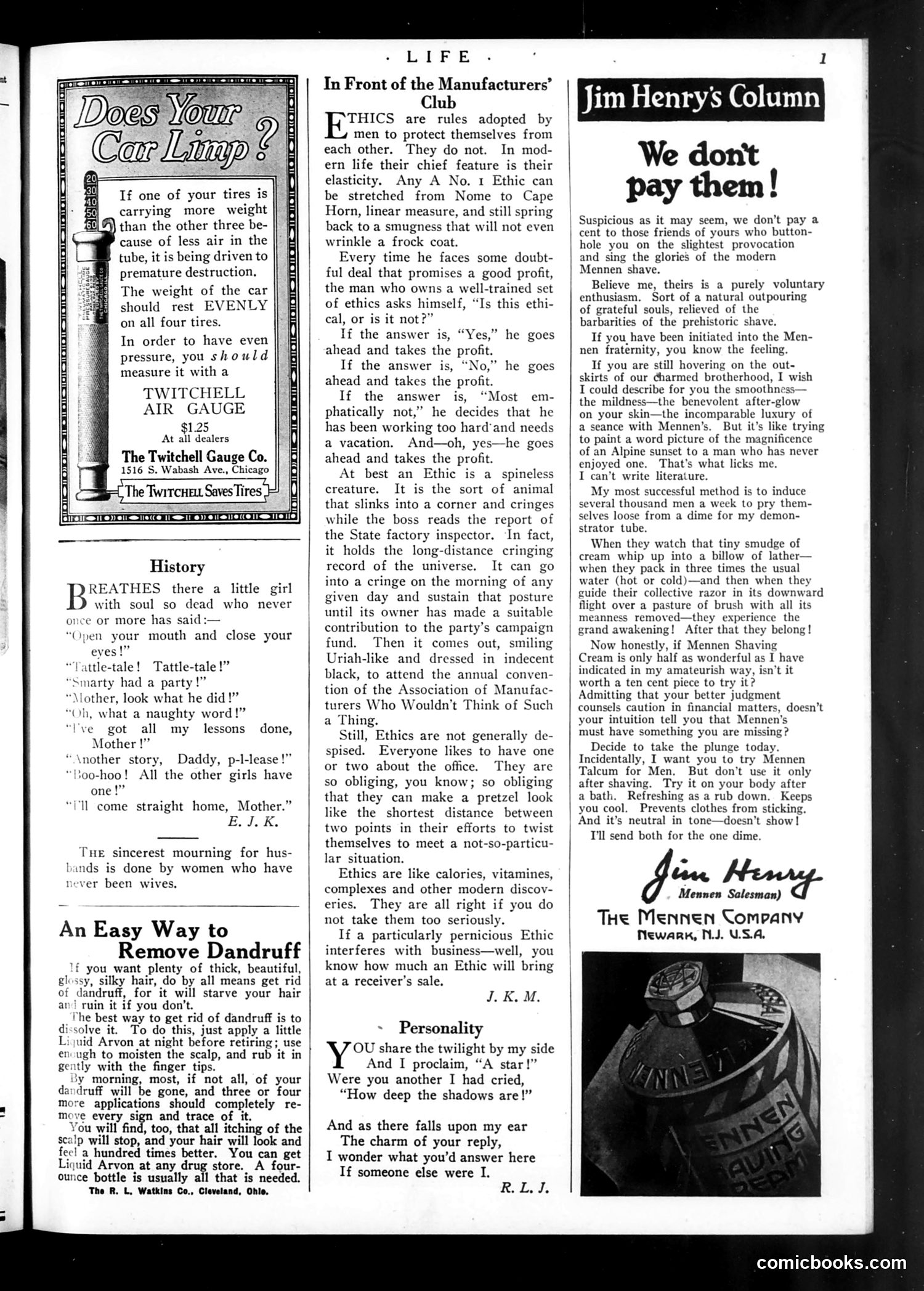
This page contains primarily **advertising and advice columns** rather than political satire. The main content includes: 1. **"Does Your Car Limp?"** — A Twitchell Gauge tire pressure advertisement 2. **"History"** — A light domestic humor piece about a girl's party ("Tattle-tale") 3. **"An Easy Way to Remove Dandruff"** — Product advice 4. **"In Front of the Manufacturers' Club"** — Social commentary on business ethics, discussing how businessmen adopt convenient moral rules 5. **Jim Henry's Column** — A satirical piece mocking Mennen Shaving Cream's marketing claims, suggesting the product is oversold 6. **"Personality"** — Romantic poetry The page reflects early 20th-century consumer culture with heavy advertising mixed with gentle social humor rather than sharp political satire.
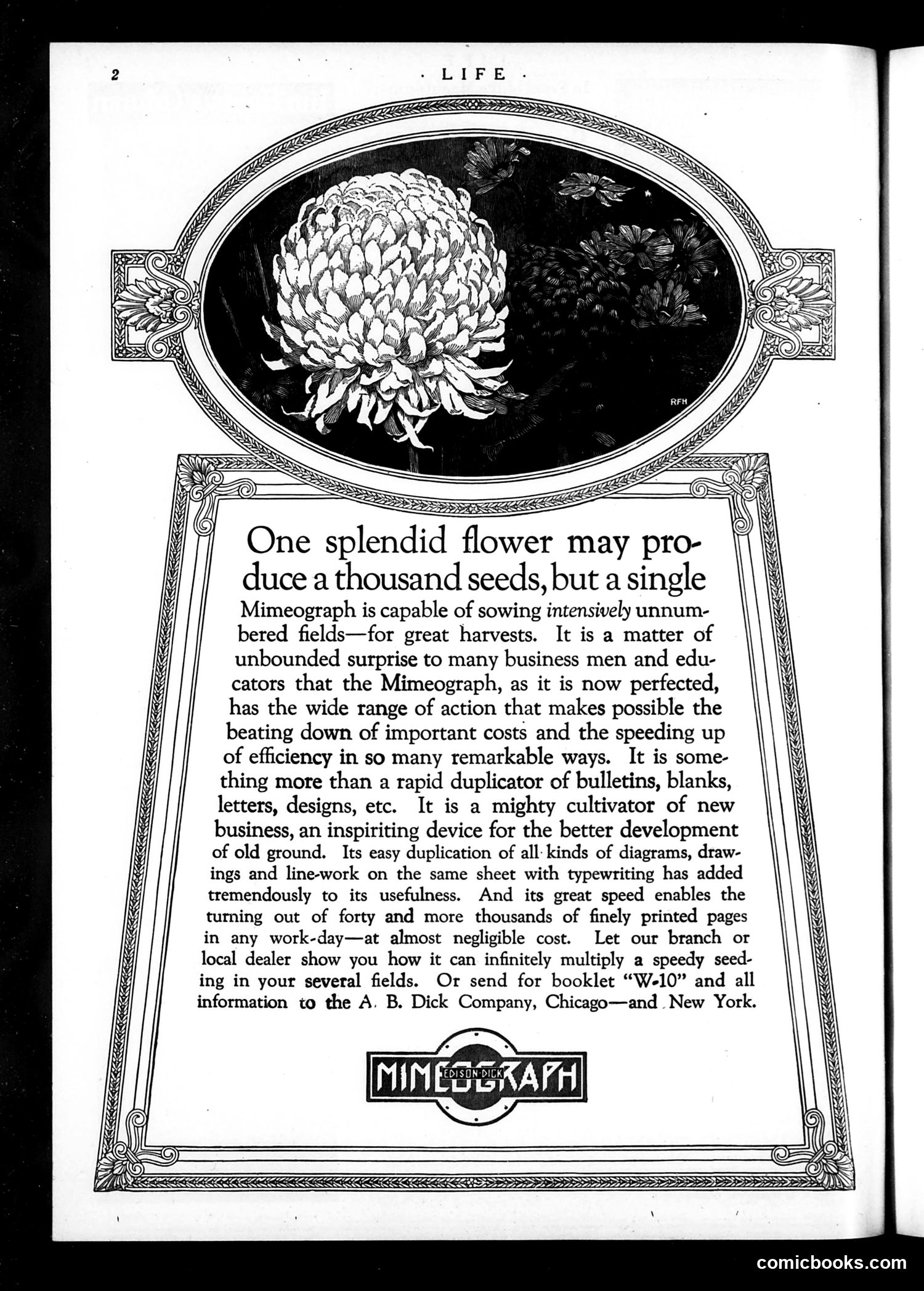
This is **not a political cartoon or satire page**, but rather a **product advertisement** for the Mimeograph duplicating machine, manufactured by A. B. Dick Company of Chicago and New York. The page features a photograph of a chrysanthemum flower at the top, used as a metaphor: just as one flower produces many seeds, one original document can produce thousands of copies via Mimeograph. The text promotes the machine's business applications—duplicating bulletins, letters, diagrams, and designs quickly and cheaply. It emphasizes the device's efficiency in reducing costs and increasing productivity for businesses and institutions. The advertisement closes by directing interested readers to contact local dealers or request booklet "W-10" for more information. This is straightforward commercial messaging, not satirical content.
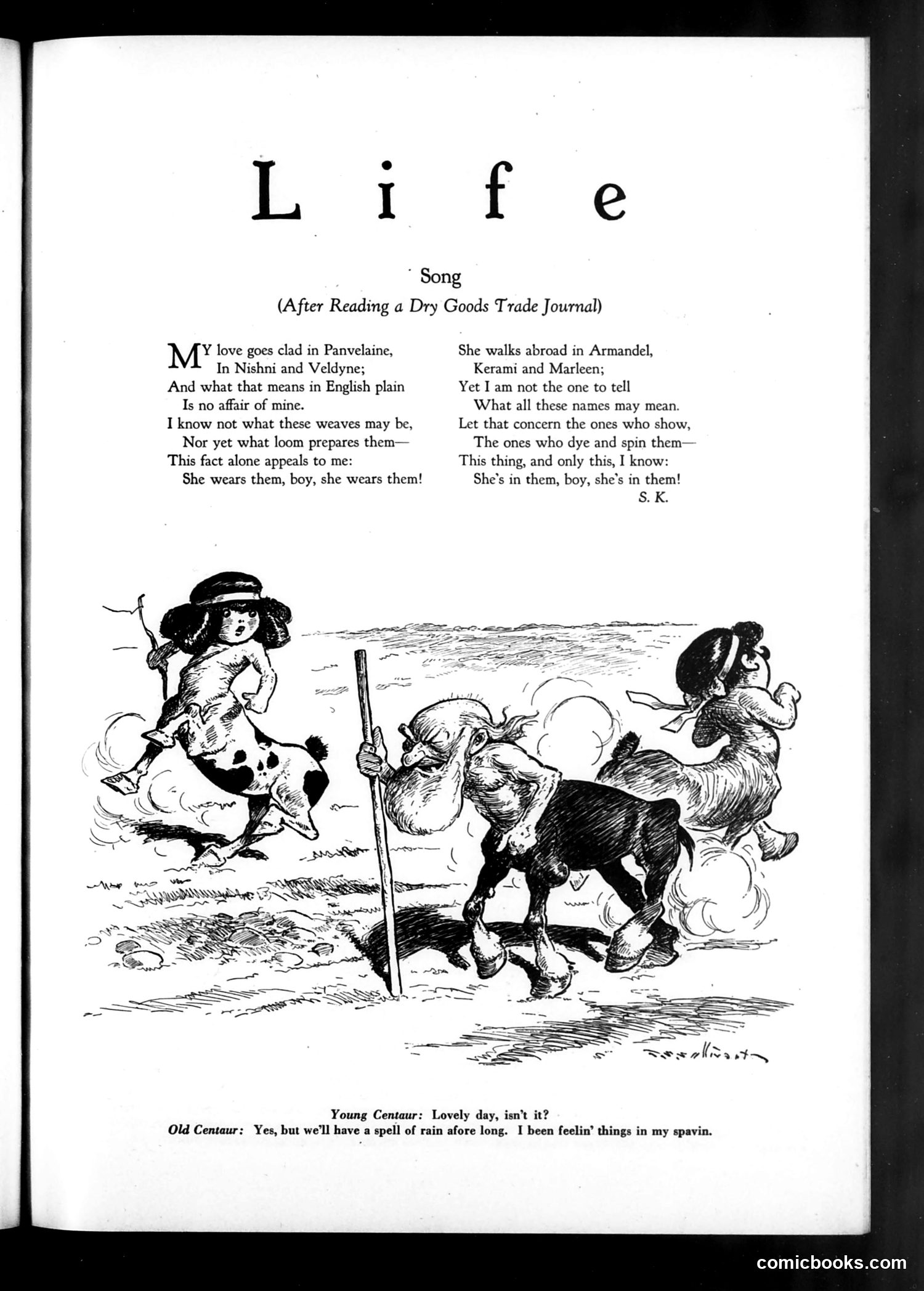
This page presents a poem by S.K. titled "Life," subtitled "(After Reading a Dry Goods Trade Journal)." The poem uses fabrics and textiles as metaphors for romantic love—the speaker's beloved wears Panvelaine, Nishni, Veldyne, Armandel, Kerami, and Marleen (appearing to be fabric names from trade catalogs). The accompanying illustration depicts two centaur-like figures (human torsos with animal bodies) in conversation about weather, with dialogue suggesting rural or working-class characters. The satire appears to mock both the dry goods/textile industry's commercial language and perhaps the contrast between commercial materialism and natural, rustic life. The poem celebrates that fabrics' meaning matters less than that "she wears them"—a commentary on consumption, love, and material culture in modern commerce.
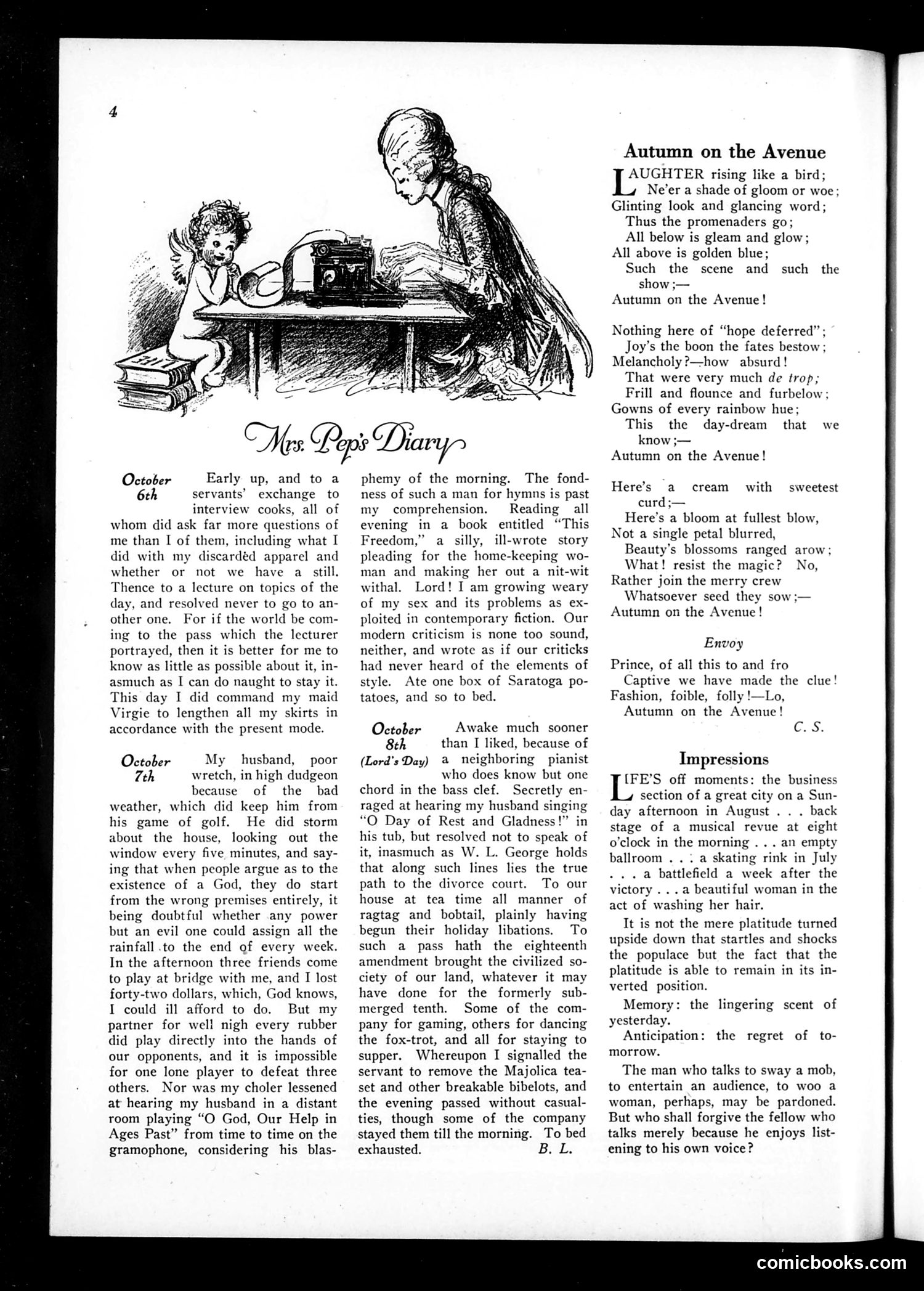
This page contains **no political cartoons**. Instead, it features: 1. **"Mrs. Pep's Diary"** — a humorous domestic column with entries from October 6th and 8th describing mundane household frustrations: servants, poorly-written novels, bad weather disrupting golf, and a bridge game where the author lost money. 2. **Poetry section** — "Autumn on the Avenue" and other verses celebrating fall scenery and romance. 3. **"Impressions"** — a brief reflective prose piece about urban life and human nature. The illustration shows a woman at a writing desk with a cherub figure, accompanying the diary column. This is **social satire** targeting middle-class domestic life and intellectual pretensions rather than political commentary. It's typical *Life* magazine content from the early 20th century: lighthearted commentary on everyday bourgeois concerns.
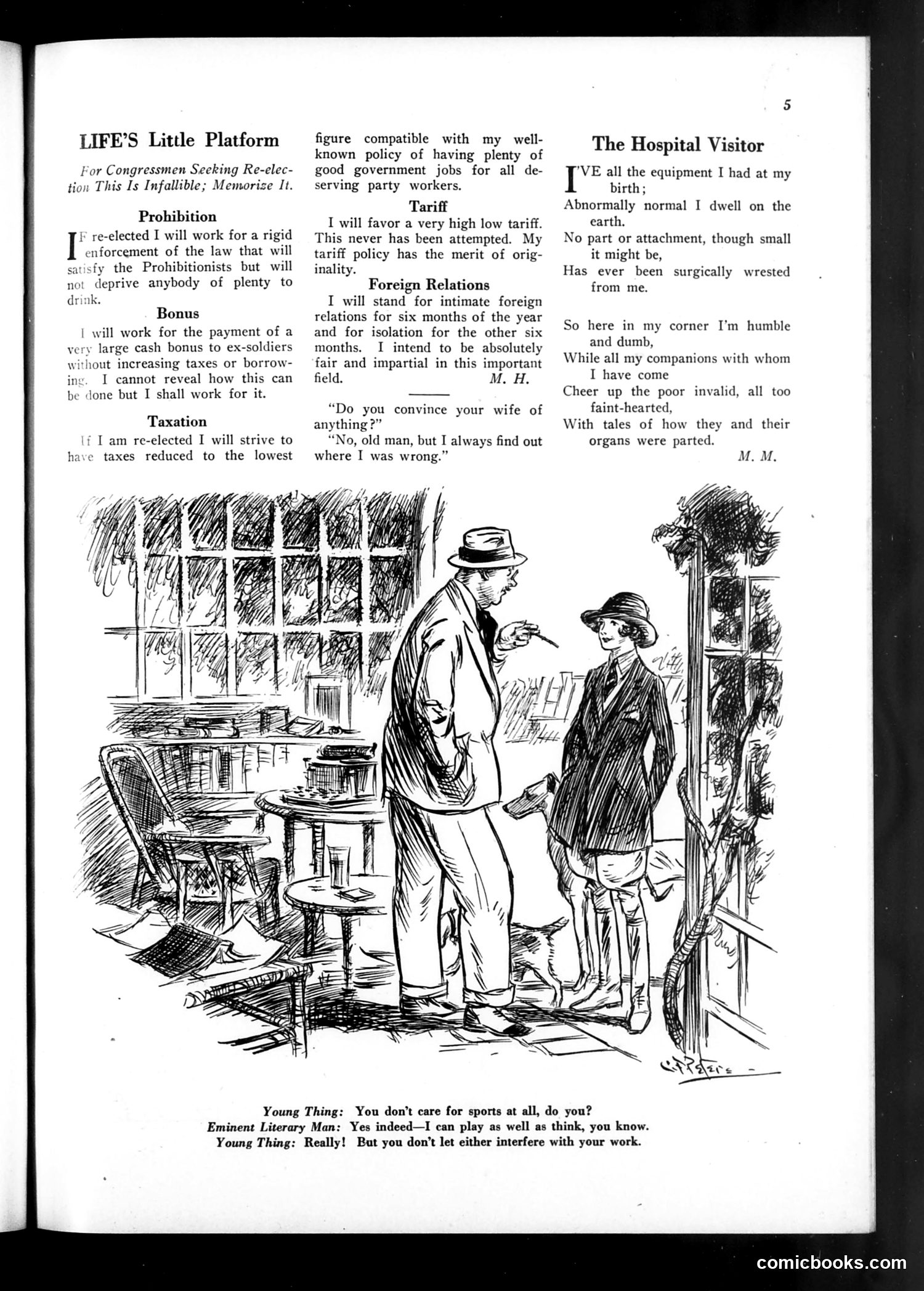
This page contains two satirical pieces from *Life* magazine: **Left side**: "LIFE's Little Platform" lists political campaign promises (Prohibition, Tariff, Foreign Relations, Taxation, Bonus) with tongue-in-cheek brevity, mocking the shallow nature of political platforms. **Right side**: "The Hospital Visitor" is a poem about visiting an invalid, attributed to M.M. **The cartoon** depicts an "Eminent Literary Man" being confronted by a "Young Thing" about his lack of sports interest. The literary man defensively claims he "can play as well as think," while the young man retorts that the author doesn't "let either interfere with your work." The satire mocks intellectual pretension—suggesting the famous writer uses sports disinterest as an affectation to seem more cerebral, while his actual work suffers from neglect. The joke critiques both artistic vanity and the performative nature of intellectual identity.
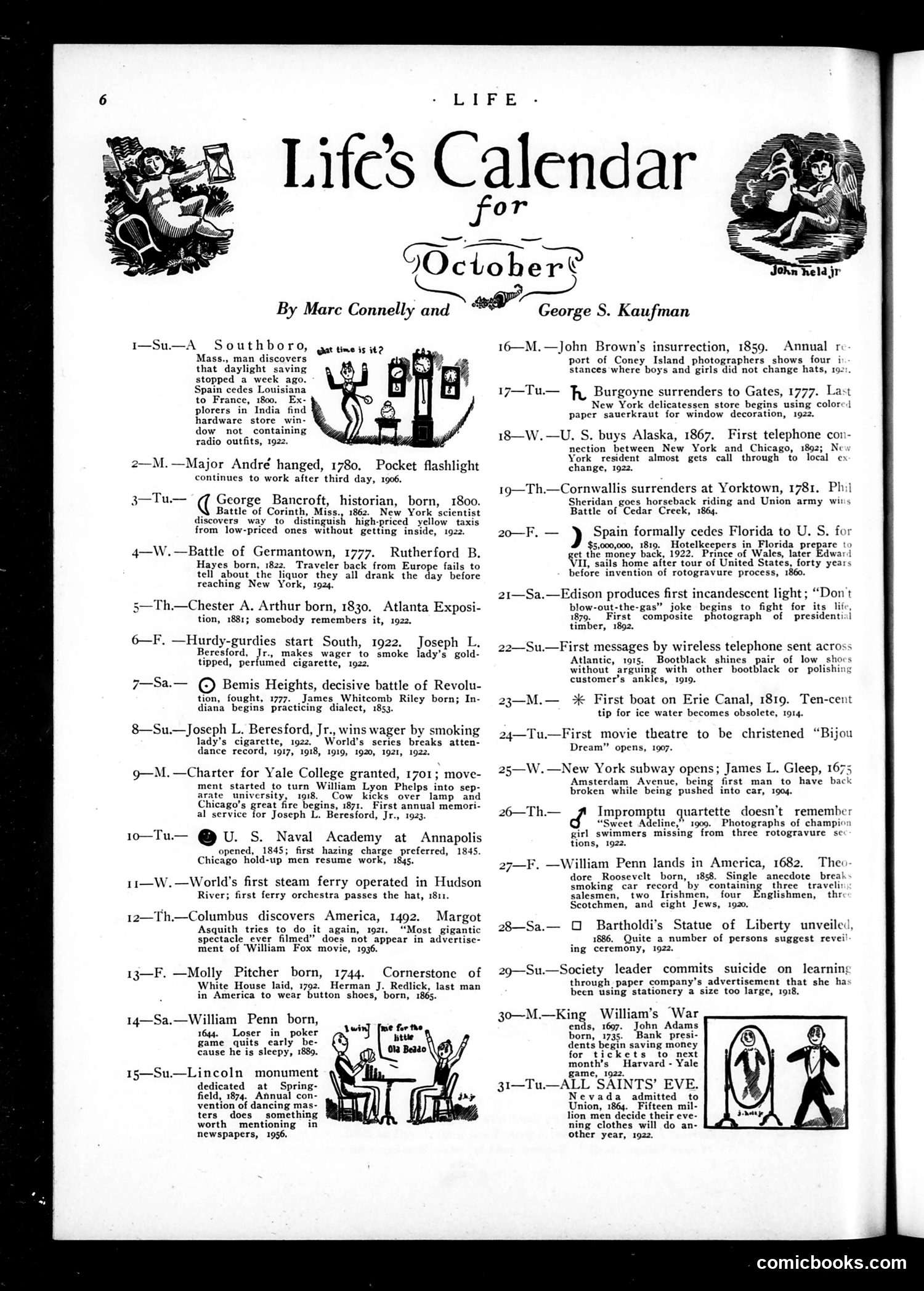
This is a historical calendar page listing notable events for October, authored by Marc Connelly and George S. Kaufman. The page contains two small cartoon illustrations: 1. **Left cartoon** (near October 1): Shows a figure with a clock, likely illustrating the daylight-saving time entry for that date. 2. **Right cartoon** (near October 15): Depicts figures in period dress, possibly relating to historical events listed. The page primarily functions as an educational/humorous calendar documenting significant American historical moments—from the Battle of Corinth (1862) to the dedication of the Lincoln Monument (1922). Rather than satirical commentary, it serves as a historical reference decorated with period-appropriate illustrations, presenting factual events with occasional wry commentary typical of *Life* magazine's approach to presenting historical information to its readers.
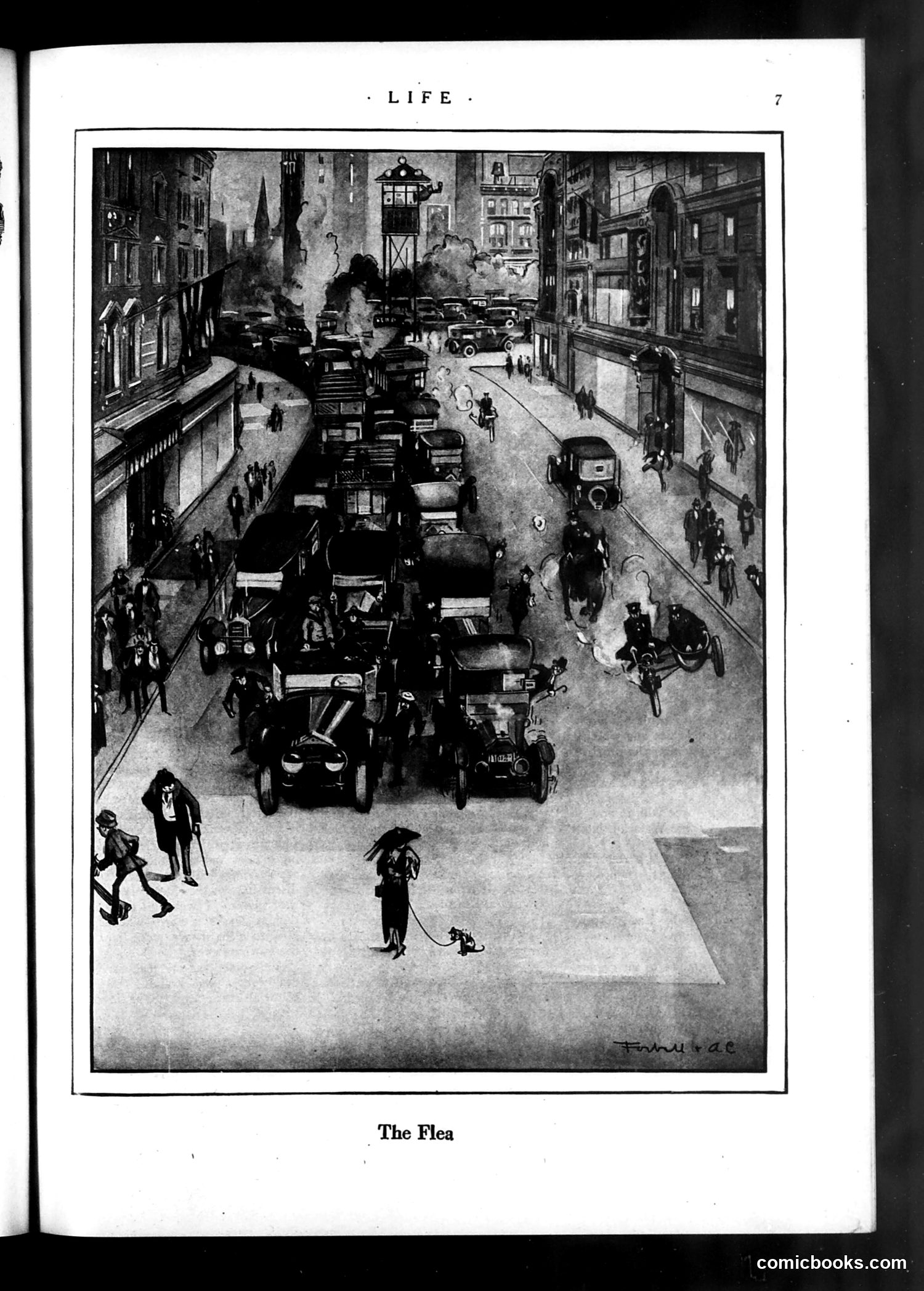
This satirical illustration depicts an aerial view of a busy urban street market or bazaar, labeled "The Flea." The composition shows a crowded, chaotic scene with numerous vehicles, pedestrians, and vendor stalls densely packed together on a street. The satire likely targets the disorder and congestion of a popular flea market—a secondhand goods market known for being cramped and hectic. The artist (signed, appearing to be from the 1920s) uses the bird's-eye perspective to emphasize the overwhelming density and anarchic nature of the marketplace. The joke appears to be visual: the literal "flea" market is portrayed as a chaotic, swarming mass of commerce where people and vehicles crowd together in uncomfortable proximity—fitting imagery for something named after parasitic insects.
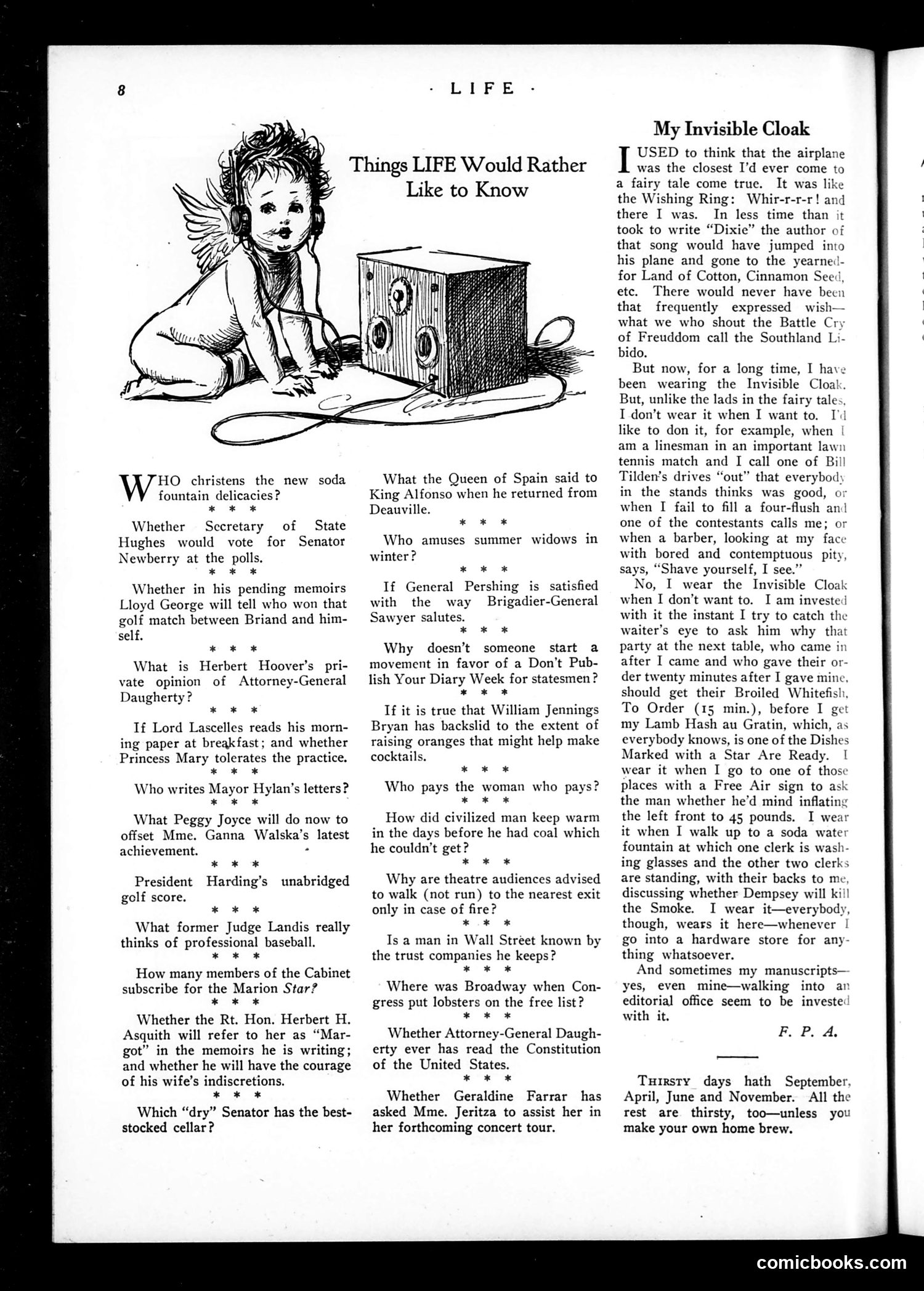
This is a gossip/humor column listing unanswered questions about public figures and political matters of the era. The left column features whimsical questions about politicians and celebrities—whether Secretary of State Hughes would support Senator Newberry, what President Harding's golf score is, and opinions of Attorney-General Daugherty. The right column, "My Invisible Cloak," is a personal essay about wearing an "invisible cloak" to avoid social embarrassment—a metaphorical wish to disappear during awkward moments (failed tennis shots, barber critiques, etc.). The decorative illustration shows a cherub with a radio speaker, fitting the modern 1920s context. This reflects typical Life magazine humor: political gossip mixed with relatable personal observations about social anxiety, all assuming readers knew contemporary public figures.
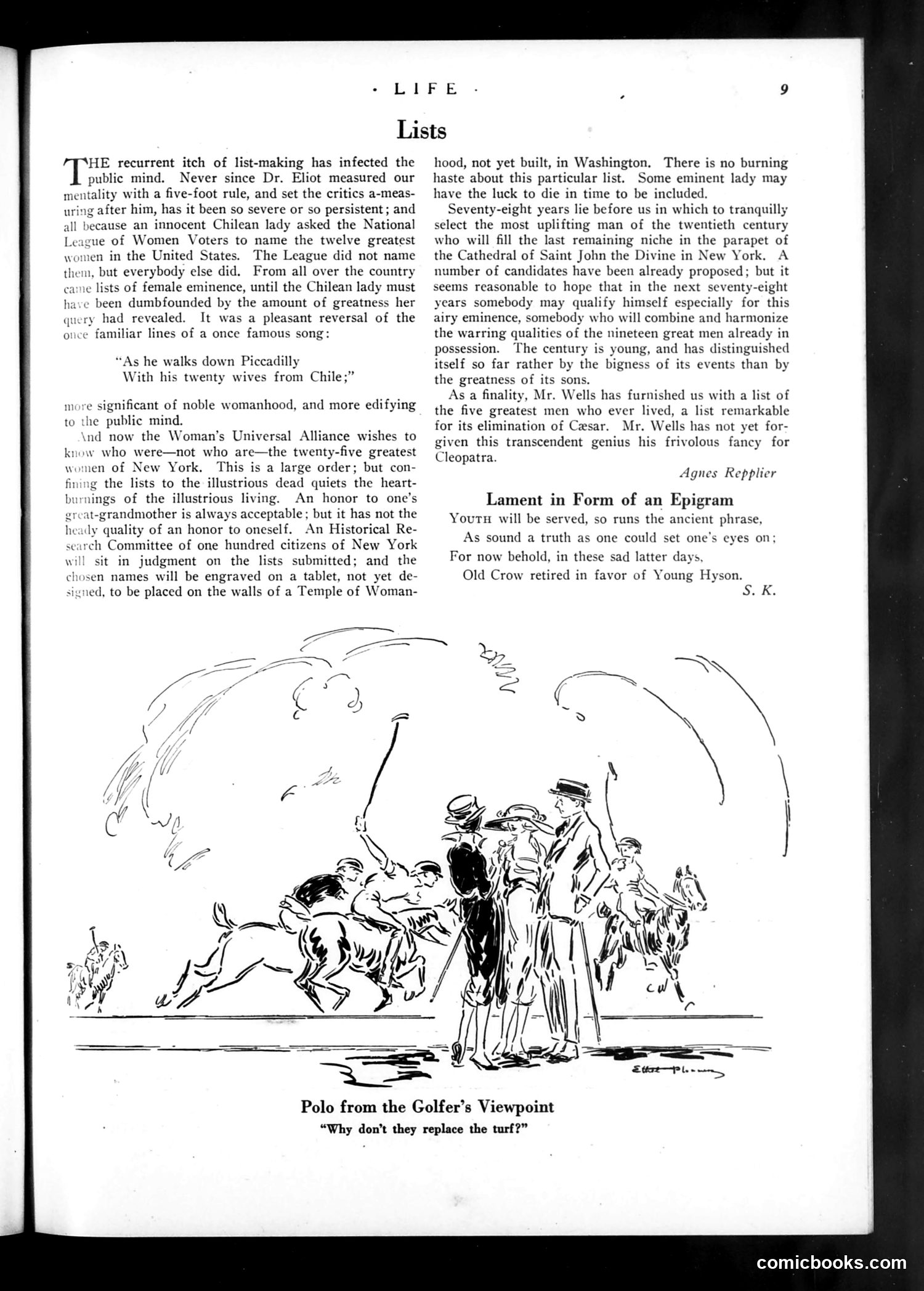
This page contains two distinct pieces: an essay on "Lists" and a cartoon titled "Polo from the Golfer's Viewpoint." **The Essay** discusses the public obsession with list-making, referencing Dr. Eliot's "five-foot rule" for measuring culture. It humorously critiques attempts to rank society's greatest women and men, noting the absurdity of such endeavors. **The Cartoon** shows polo players mid-game while spectators stand nearby. The caption—"Why don't they replace the turf?"—presents a golfer's complaint, satirizing the sporting priorities of wealthy New Yorkers. The joke assumes polo fields and golf courses compete for the same social real estate, mocking how the upper class allocates prime land to fashionable sports rather than practical grounds maintenance.
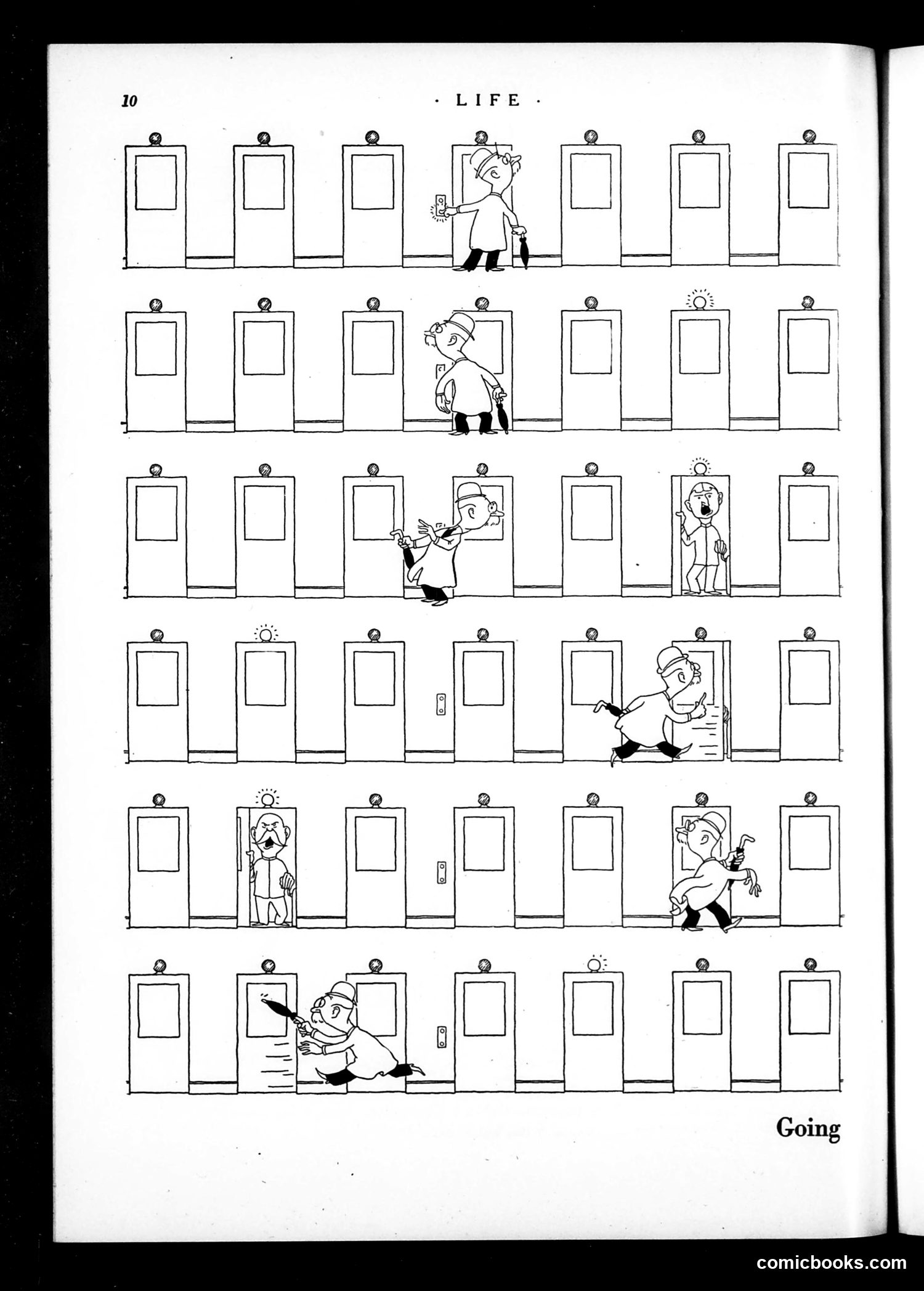
This six-panel comic strip depicts a man attempting to leave his apartment building, growing increasingly frantic with each panel. He starts calmly checking his mailbox, then becomes progressively more agitated—running, leaping, and finally tumbling through the hallway while struggling with doors. The title "Going" suggests the humor lies in the *difficulty* of simply departing one's home. This likely satirizes the common urban experience of delays and obstacles preventing a timely exit—forgotten items, stubborn doors, unexpected interruptions, or general household chaos. The exaggerated physical comedy and the man's escalating desperation illustrate the minor frustrations of daily life, a relatable theme for Life magazine's audience. The visual progression emphasizes how a simple task becomes increasingly complicated.
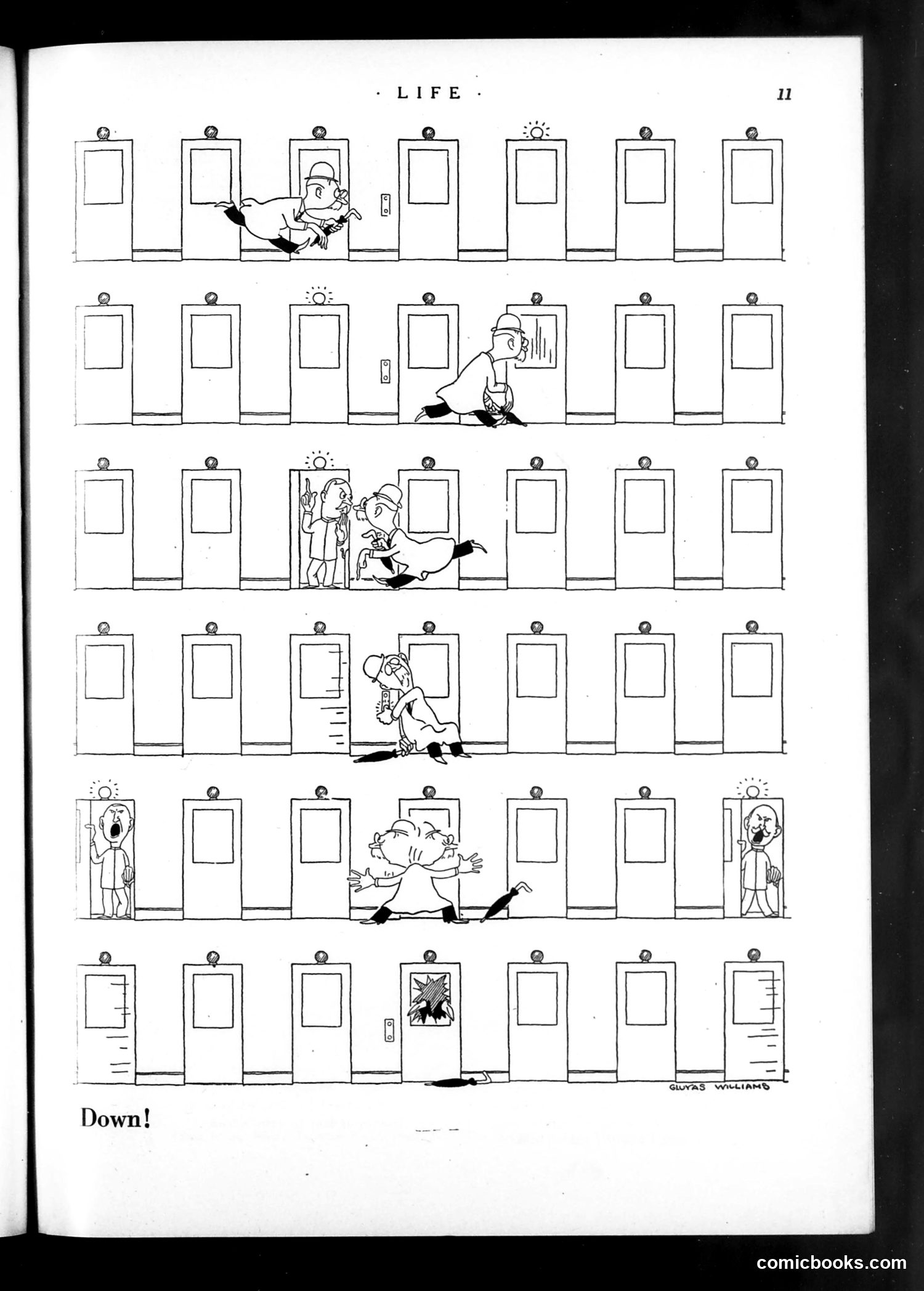
This six-panel comic by Gluyas Williams depicts an escalating office building scenario. A man in a hat repeatedly presses an elevator button on different floors, becoming increasingly frustrated. By the final panel, he's apparently given up on the elevator entirely—the last frame shows what appears to be a chaotic scene at ground level. The satire targets the common frustration of waiting for elevators in modern office buildings. Williams exaggerates the man's mounting impatience and desperation across the sequence, culminating in the "Down!" caption. The joke likely comments on the absurdity of urban office life and the helplessness people feel when confronted with slow, unresponsive mechanical systems—a relatable complaint for Life magazine's readers in the early-to-mid twentieth century.
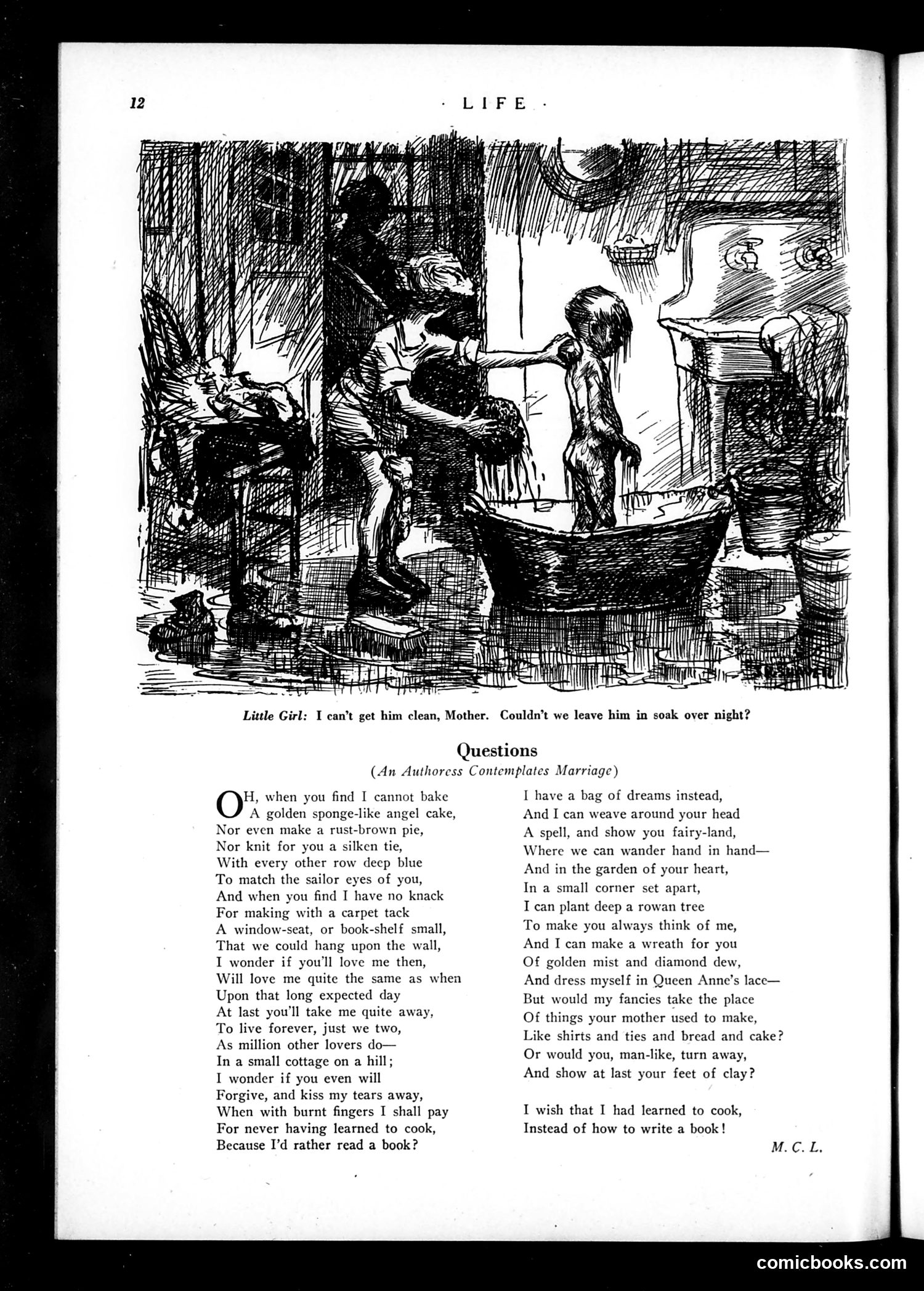
The cartoon shows a domestic scene where a mother is attempting to bathe a young child while the child protests, "I can't get him clean, Mother. Couldn't we leave him in soak over night?" This is gentle household humor satirizing the universal difficulty of bathing reluctant children. The joke relies on the child's literal suggestion—soaking overnight—as a humorous solution to the mother's frustration with getting the boy clean. Below is a poem titled "Questions (An Authoress Contemplates Marriage)" by M.C.L. It's a woman's anxious reflection on marriage, expressing doubts about whether her future husband will love her if she lacks domestic skills (baking, knitting, making furniture). The poem's final lines reveal ironic self-awareness—she wishes she'd learned to cook instead of write books, satirizing both women's limited expected roles and intellectual women's social anxieties about marriageability.
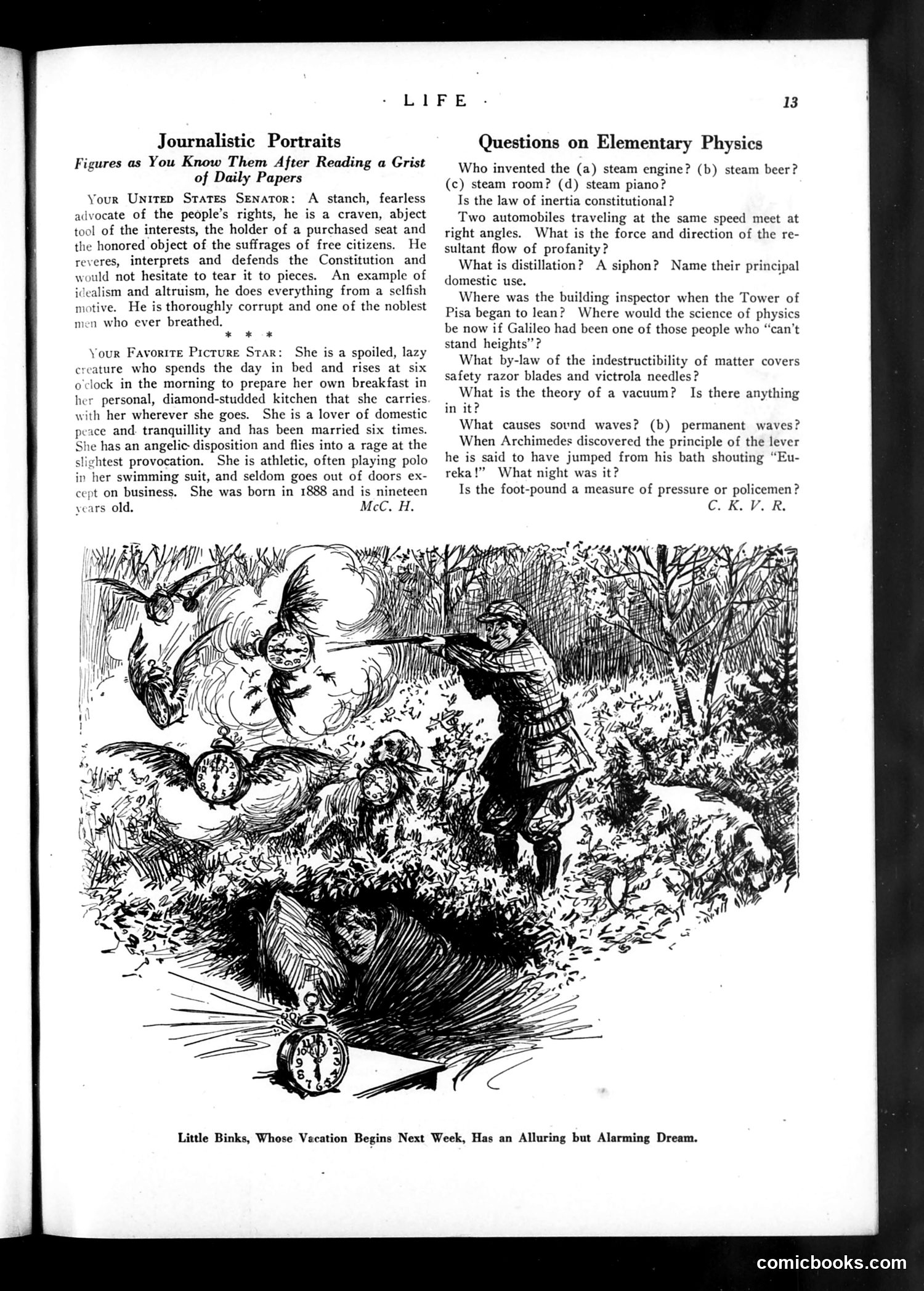
This page from *Life* magazine contains two distinct sections: **Top Section**: "Journalistic Portraits" offers satirical character sketches. A U.S. Senator is mocked as a corrupt defender of special interests over constitutional principles. A "Favorite Picture Star" is portrayed as a spoiled, lazy woman who spends her day in bed, breakfast in her luxurious kitchen, then plays polo and swims—born in 1888, making her nineteen years old. The satire targets wealthy idleness and privilege. **Bottom Section**: An illustration captioned "Little Binks, Whose Vacation Begins Next Week, Has an Alluring but Alarming Dream" depicts a child's anxiety dream about holiday freedom—featuring fantastical creatures and chaotic adventure. The cartoon humorously captures the contradictory emotions children experience about upcoming vacations: excitement mixed with nervous apprehension.
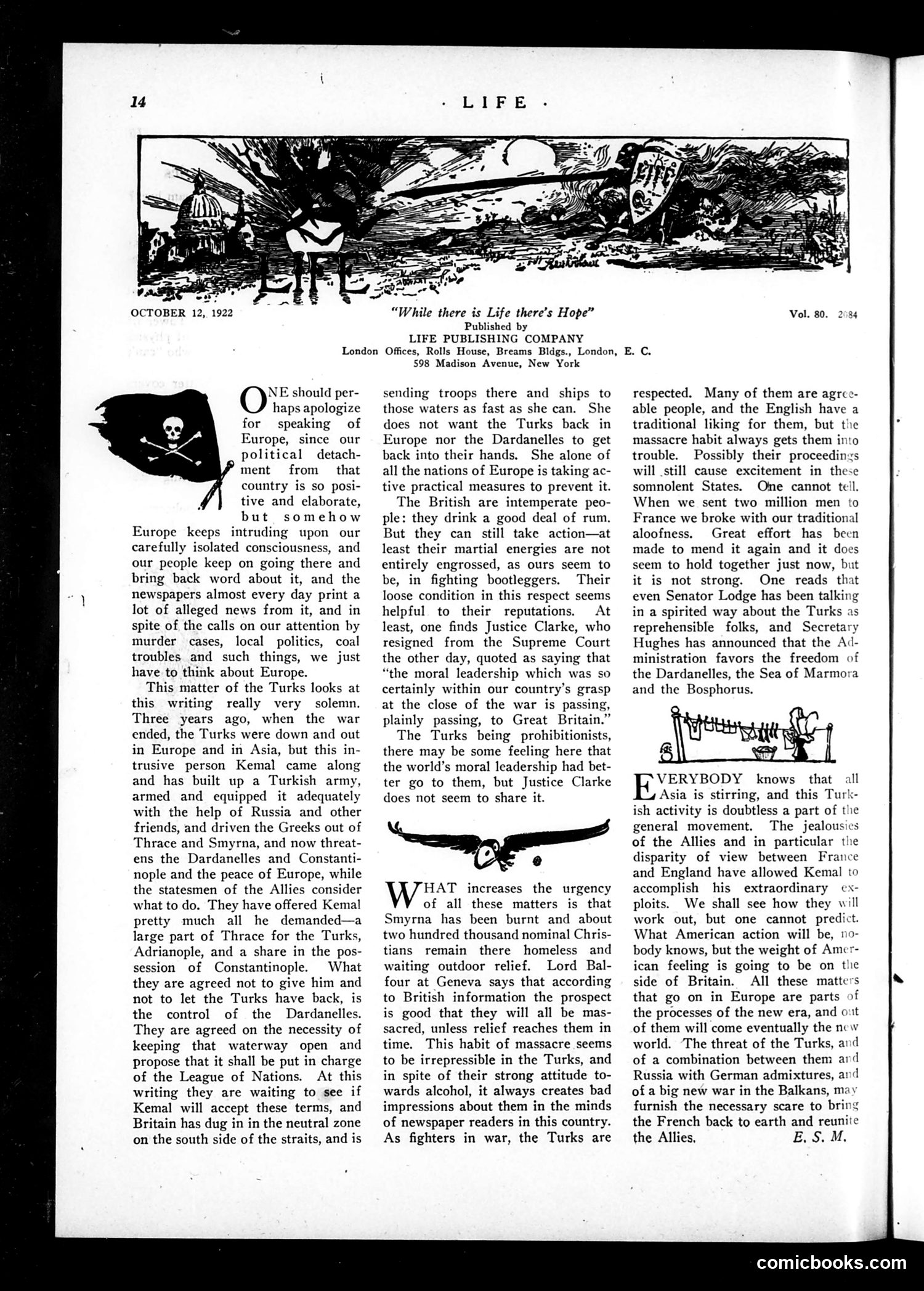
The masthead illustration depicts a skeletal figure (Death) overlooking a devastated landscape with burning buildings and the moon—a commentary on post-World War I destruction, particularly regarding Turkish-Greek conflicts in Asia Minor. The article discusses European political instability, specifically criticizing Turkish leader Kemal's military actions against the Dardanelles and Constantinople. The piece expresses concern that Britain and America are not adequately addressing the humanitarian crisis: two hundred thousand Christians remain homeless after Turkish massacres. The satire targets Western indifference to ongoing Middle Eastern violence and appeals for stronger Allied intervention. References to "Justice Clarke" resigning from the Supreme Court and Secretary Hughes suggest American leadership is distracted from critical international crises.
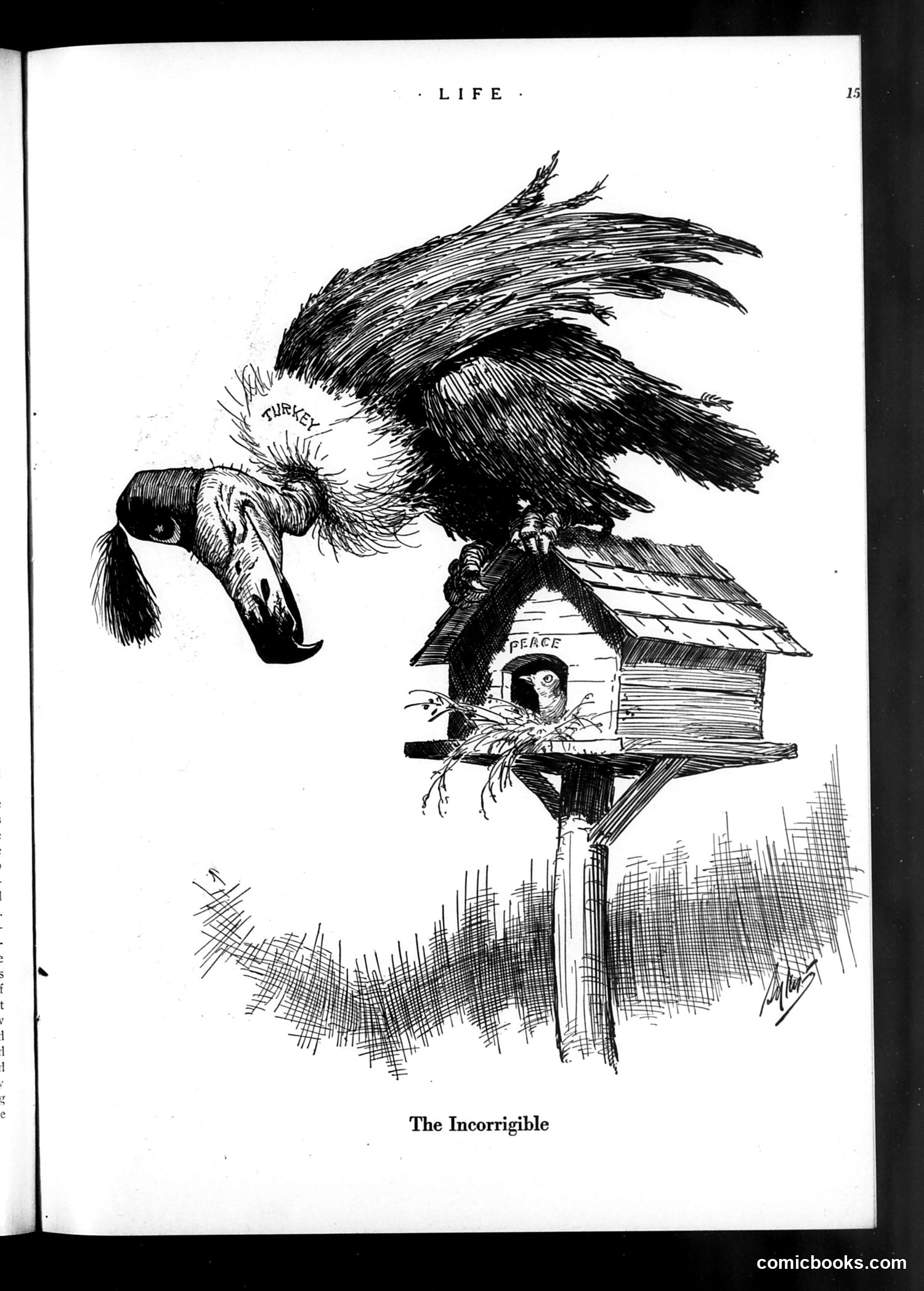
This political cartoon depicts a turkey labeled "TURKEY" carrying an olive branch (symbol of peace) in its beak, approaching a birdhouse labeled "PEACE." The turkey appears aggressive and menacing despite ostensibly bearing a peace offering—its wings spread threateningly and its posture suggests deception rather than peaceful intent. The satire likely comments on Turkish foreign policy or diplomatic overtures during a historical period when Turkey's actions contradicted its peaceful rhetoric. The "incorrigible" turkey cannot be trusted; it remains fundamentally aggressive regardless of surface gestures toward peace. The cartoon critiques what the artist saw as Turkey's inherent untrustworthiness in international relations, suggesting that peaceful declarations masked hostile intentions.
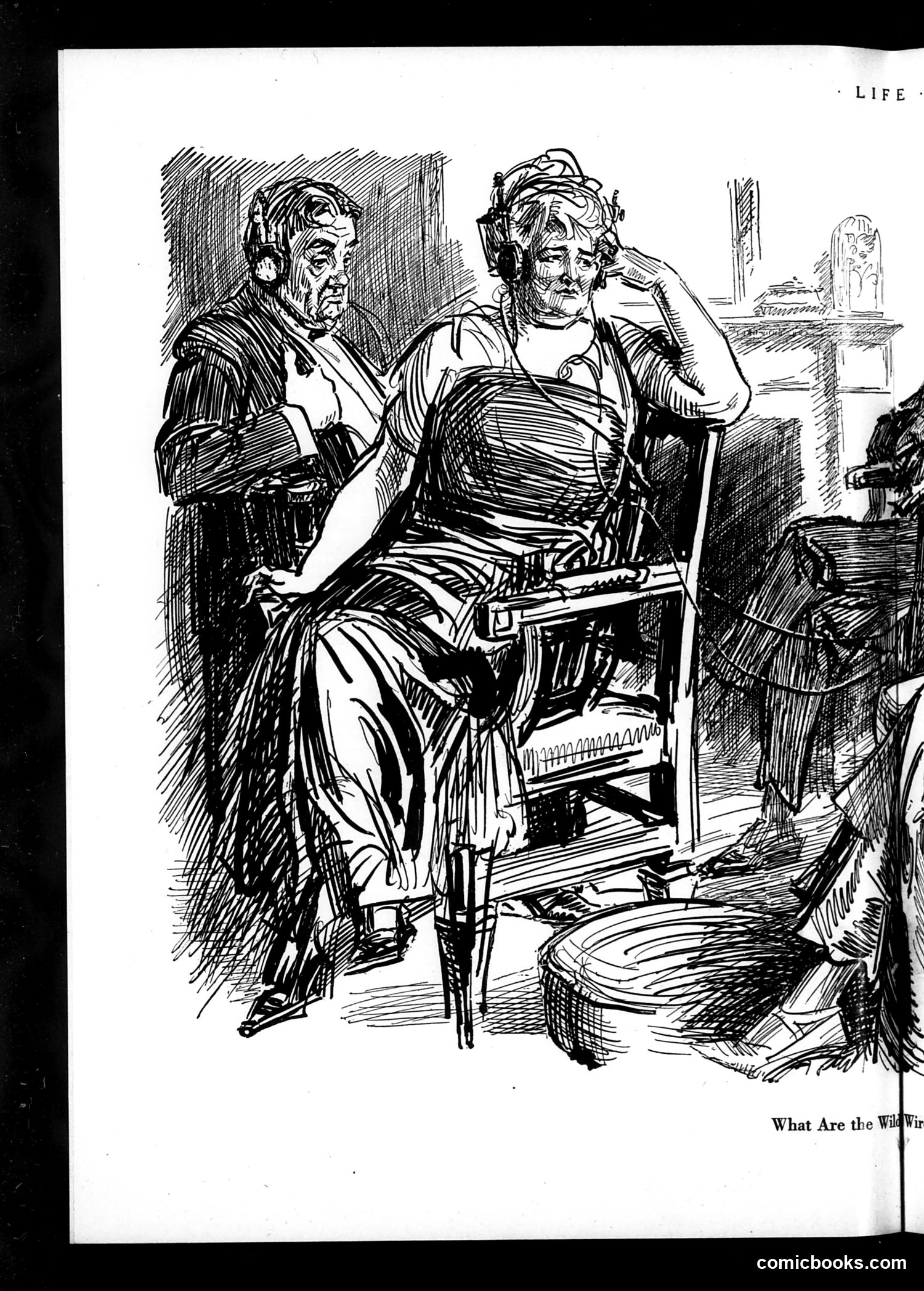
This is a pen-and-ink sketch from *Life* magazine showing two figures wearing headphones in what appears to be a radio or communications setting. A man stands behind a seated woman who adjusts her headphones. The interior includes broadcasting equipment and a window showing a cityscape. The partially visible caption reads "What Are the Wild—" (text cut off), suggesting this illustrates a popular song, radio program, or cultural reference of the era. Without the complete caption or publication date visible, the specific satirical point remains unclear. The sketch's style and setting suggest this commentary relates to early-to-mid 20th century radio culture or broadcasting industry topics, but the exact subject and joke cannot be determined from the visible portions alone.
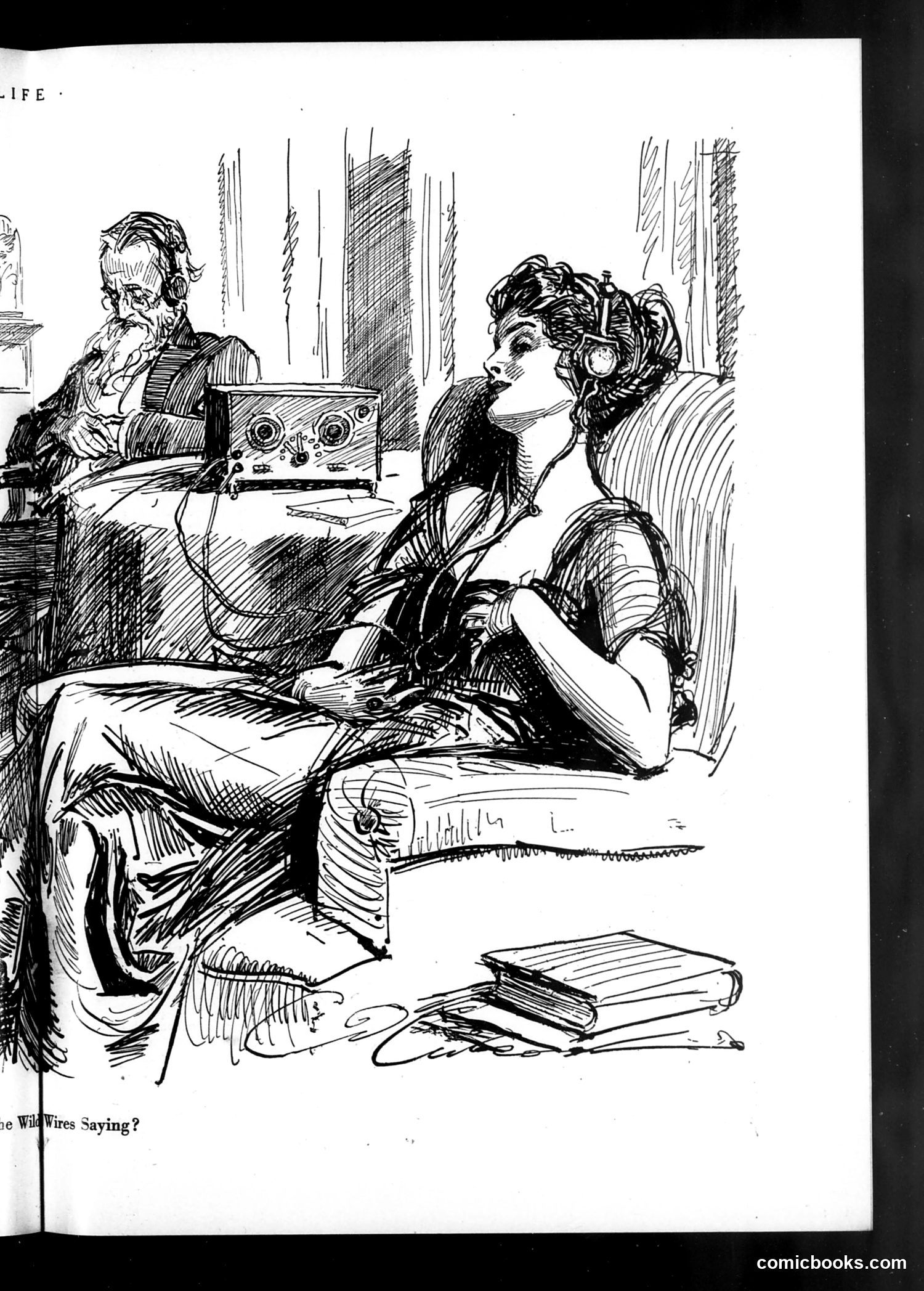
This appears to be an early 20th-century Life magazine satirical illustration. The scene depicts what looks like a medical or scientific examination, with an older bearded man (possibly a doctor or authority figure) observing a woman using some kind of mechanical device with headphones or earpieces—likely representing early wireless/radio technology or a telephone apparatus. The partially visible caption "...the Wild Wires Saying?" suggests satire about new communication technology. The woman's expression and positioning suggest curiosity or concern about this modern device. The cartoon likely mocks either: - Public anxiety about new wireless technology - Gender-related attitudes toward women adopting modern technology - The mysterious or suspicious nature of early communications devices The specific satirical point remains unclear without the complete caption and full publication context.
This page critiques three Broadway plays with the sardonic tone Life magazine employed toward theatrical pretension. **"La Tendresse"** — The critic mocks French dramatic snobbery. That a play has a French title and unknown pronunciations once impressed American audiences, but sixty-five years of theater-going has cured them of this "awe." The play is dismissed as "good, old-fashioned dull junk" despite featuring actress Ruth Chatterton. **"East of Suez"** — Somerset Maugham's play, altered considerably from its London version, is critiqued as melodramatic and derivative—no more original than a play by Owen Davis. The reviewer notes it resembles old stock-company fare that audiences voted to revive by "postal ballot." **"The Exciters"** — Praised for honest absurdity: it makes no pretense of plausibility, asking only that audiences remain entertained. Actress Tallulah Bankhead receives qualified praise. The satire targets American audiences' former susceptibility to European cultural cachet and contemporary theatrical mediocrity masquerading as sophistication.
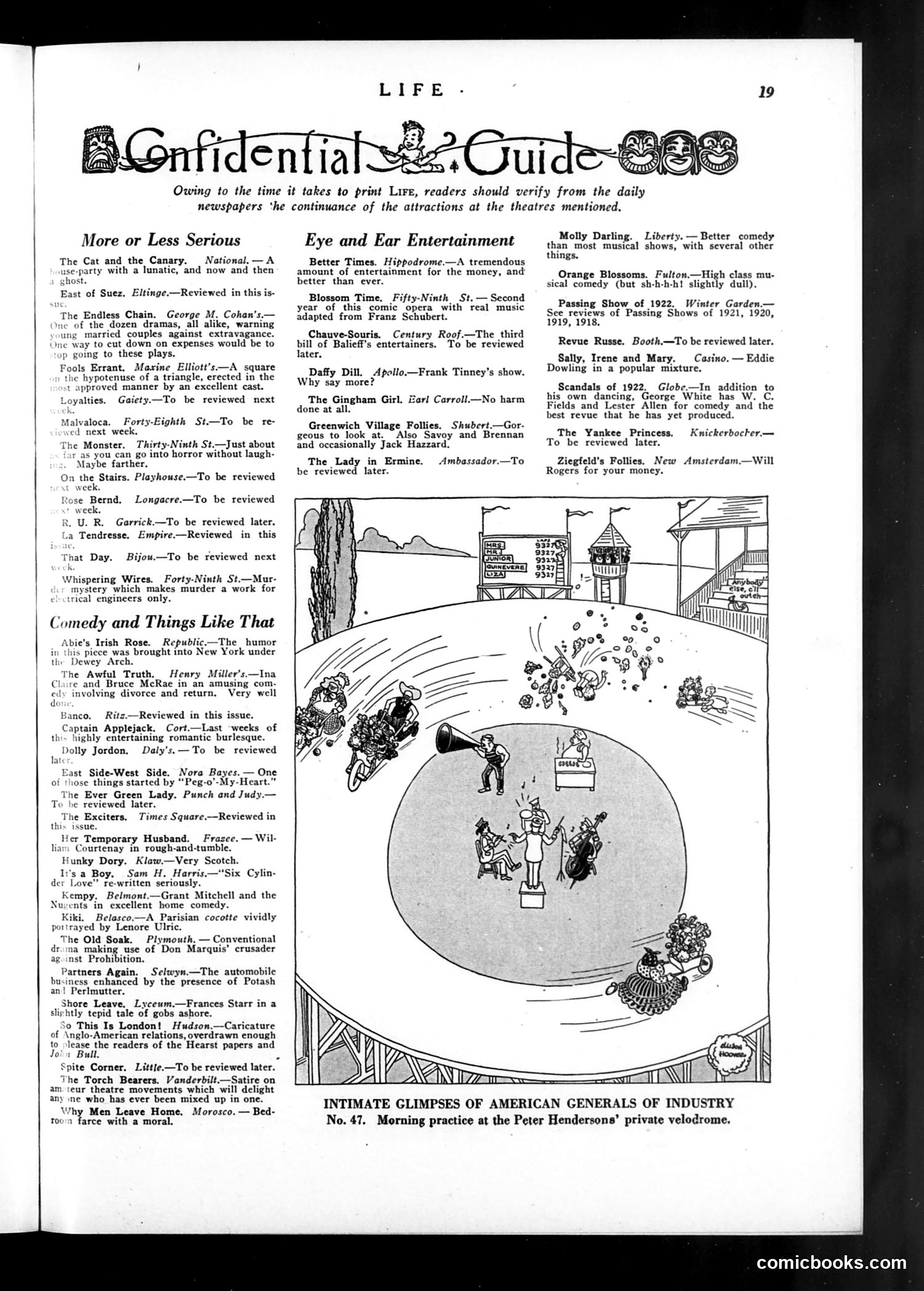
This is a theater review section from *Life* magazine (a satirical publication, not the modern photo magazine). The page catalogs Broadway shows playing in New York, divided into categories: "More or Less Serious," "Comedy and Things Like That," and "Eye and Ear Entertainment" (musicals/vaudeville). The large illustration at bottom depicts a circus or vaudeville performance—acrobats, performers, and audience—labeled "Intimate Glimpses of American Generals of Industry No. 41," satirizing wealthy industrialists' leisure activities at private venues like the Hendersons' "velodrome" (a cycling track converted for entertainment). The reviews themselves are brief, often dismissive quips. For example, *The Endless Chain* is mocked for warning against marital extravagance, with the joke that avoiding these plays would actually save money. The satire targets both theatrical quality and the moralistic themes popular at the time, particularly anti-Prohibition messaging (*The Old Soak*) and amateur theater pretension (*The Torch Bearers*).
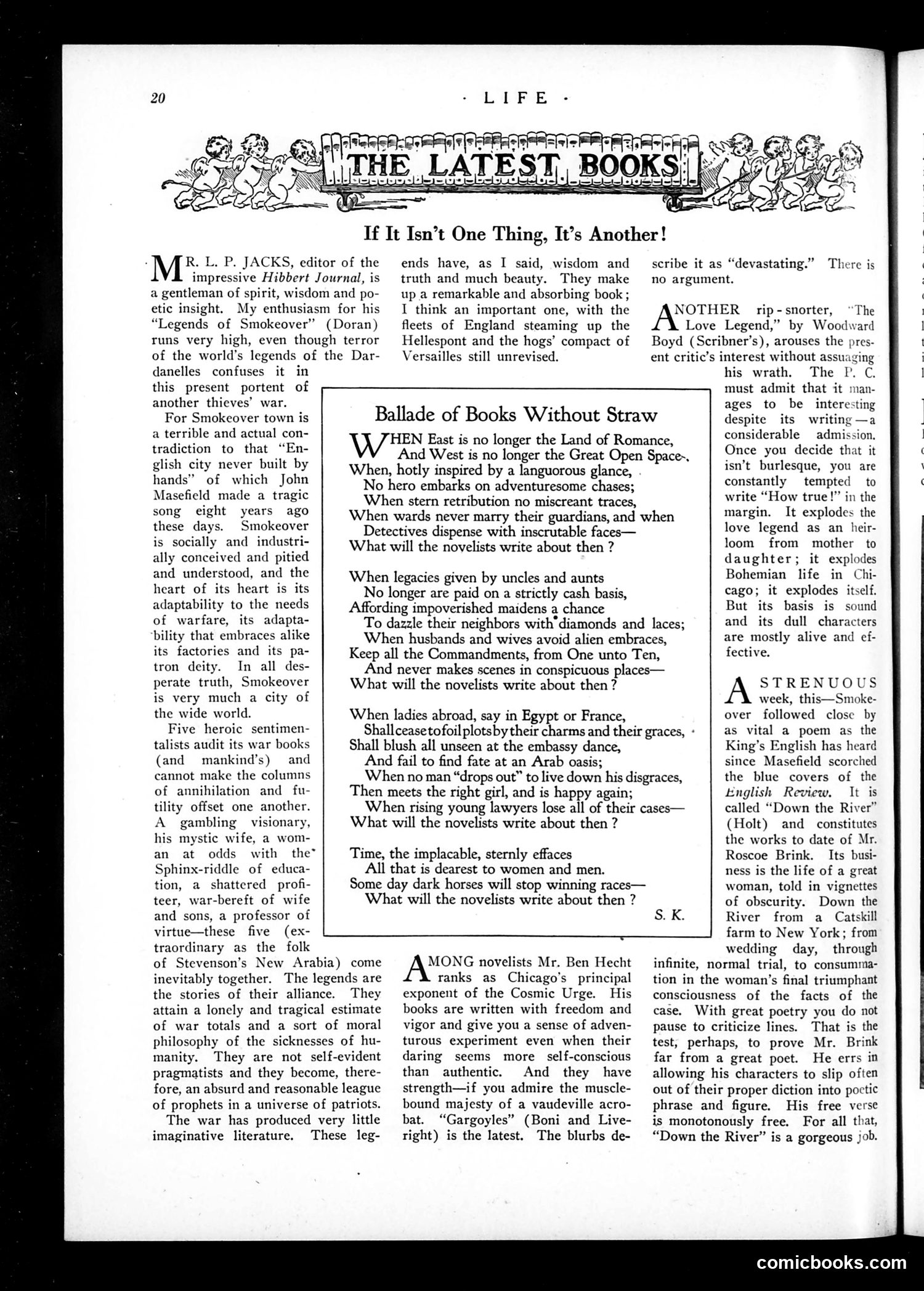
This is a *Life* magazine book review column featuring literary criticism alongside a satirical poem. The main text reviews two novels set in "Smokeover"—a fictional industrial American city—praising their realistic portrayal of post-WWI social decay and moral compromise. The centerpiece is "Ballade of Books Without Straw," a clever parody asking: *what will novelists write about when modern life loses its dramatic conflicts?* The poem sarcastically catalogs Victorian and Edwardian plot devices—seduction, financial desperation, secret scandals, forbidden romance—that were staples of 19th-century fiction. It asks what happens when social codes collapse, morality improves, and fate stops delivering convenient dramatic moments. The satire mocks how dependent popular literature was on artificial moral crises and class-based complications. It's fundamentally about the modernist crisis: older narrative structures feel obsolete in post-war society, yet writers haven't developed compelling replacements. The joke is that novels need something to write *about*—and progress itself is boring.
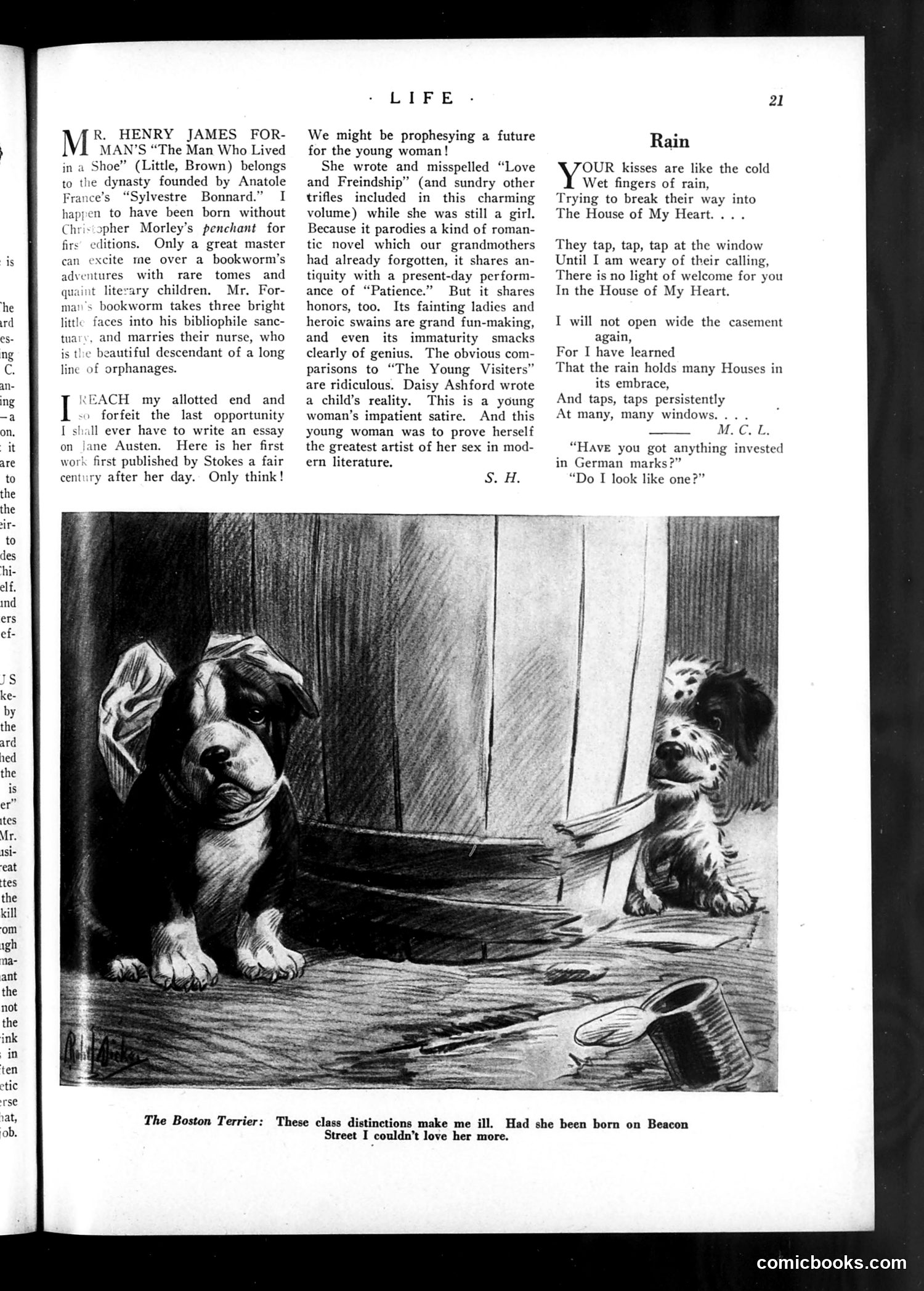
This page contains literary reviews and a humorous illustration. The main cartoon depicts two dogs—a large Boston Terrier and a smaller dog—with the terrier commenting on "class distinctions." The caption reads: "These class distinctions make me ill. Had she been born on Beacon Street I couldn't love her more." The satire targets American social snobbery, particularly Boston's class-conscious culture. "Beacon Street" references Boston's prestigious neighborhood, home to wealthy Brahmin families. The joke: the terrier claims class doesn't matter ("I couldn't love her more"), yet the very mention of Beacon Street betrays that social status determines worth. The irony—that even dogs reflect human prejudices about breeding and social standing—mocks American pretension. The page also reviews Jane Austen's early satirical work and discusses literary merit alongside a poem titled "Rain."
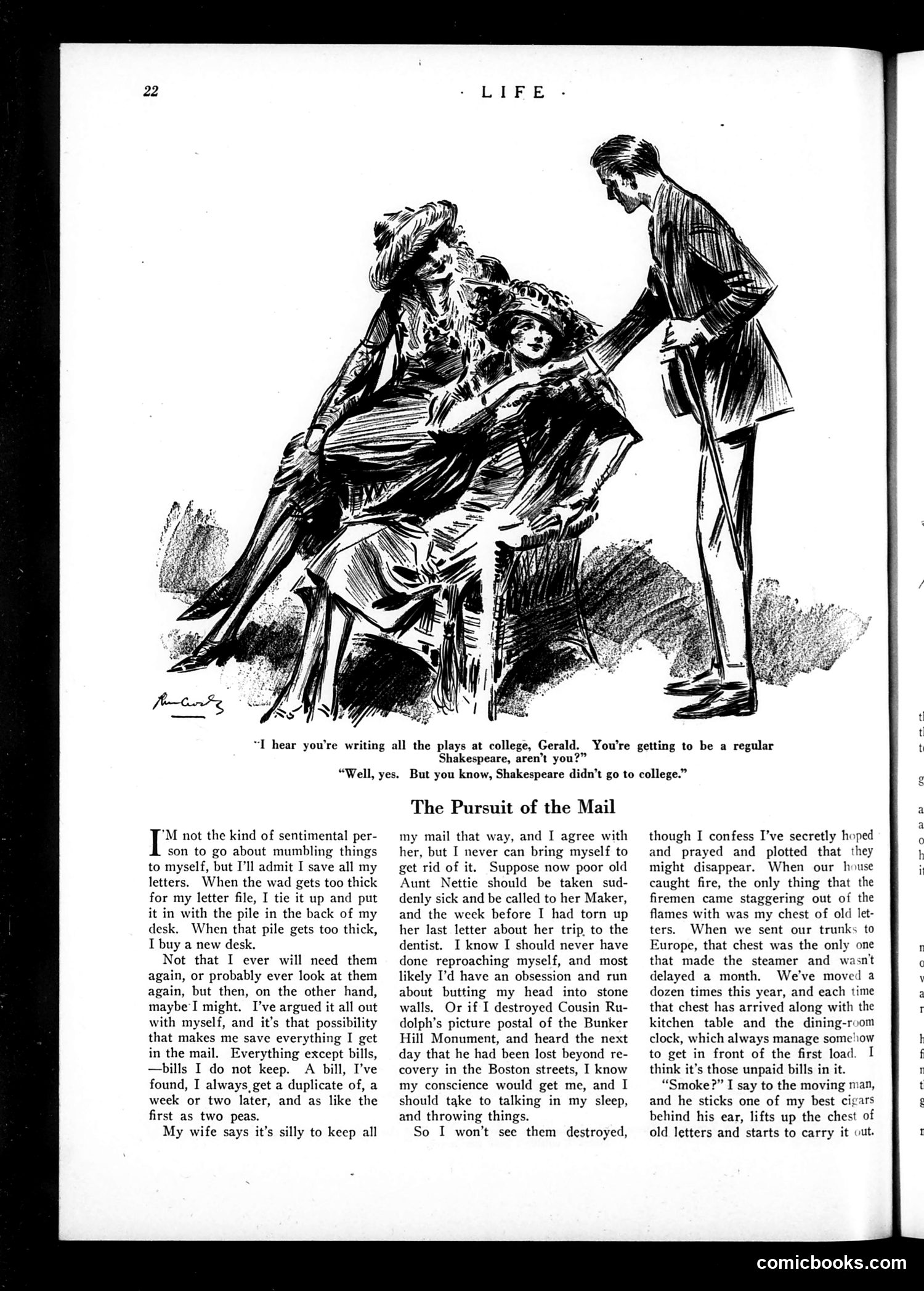
**The Cartoon:** A college student named Gerald is complimented on writing plays and compared to Shakespeare. His witty response—that Shakespeare didn't attend college—suggests that formal education isn't necessary for literary talent, a mild jab at credentialism. **The Article:** "The Pursuit of the Mail" is humorous domestic satire about a man who compulsively saves all his letters despite knowing he'll never reread them. He fears hypothetical guilt: destroying Aunt Nettie's letter before she dies, or losing Cousin Rudolph's postcard before learning of his death in Boston. Yet mysteriously, his cherished letter-chest always survives house fires, moves abroad, and relocations—while he ironically suspects it's the unpaid bills inside that mysteriously protect it. The joke targets middle-class anxiety about sentimentality and obligation, poking fun at how we irrationally cling to mementos while harboring secret hopes they'd disappear.
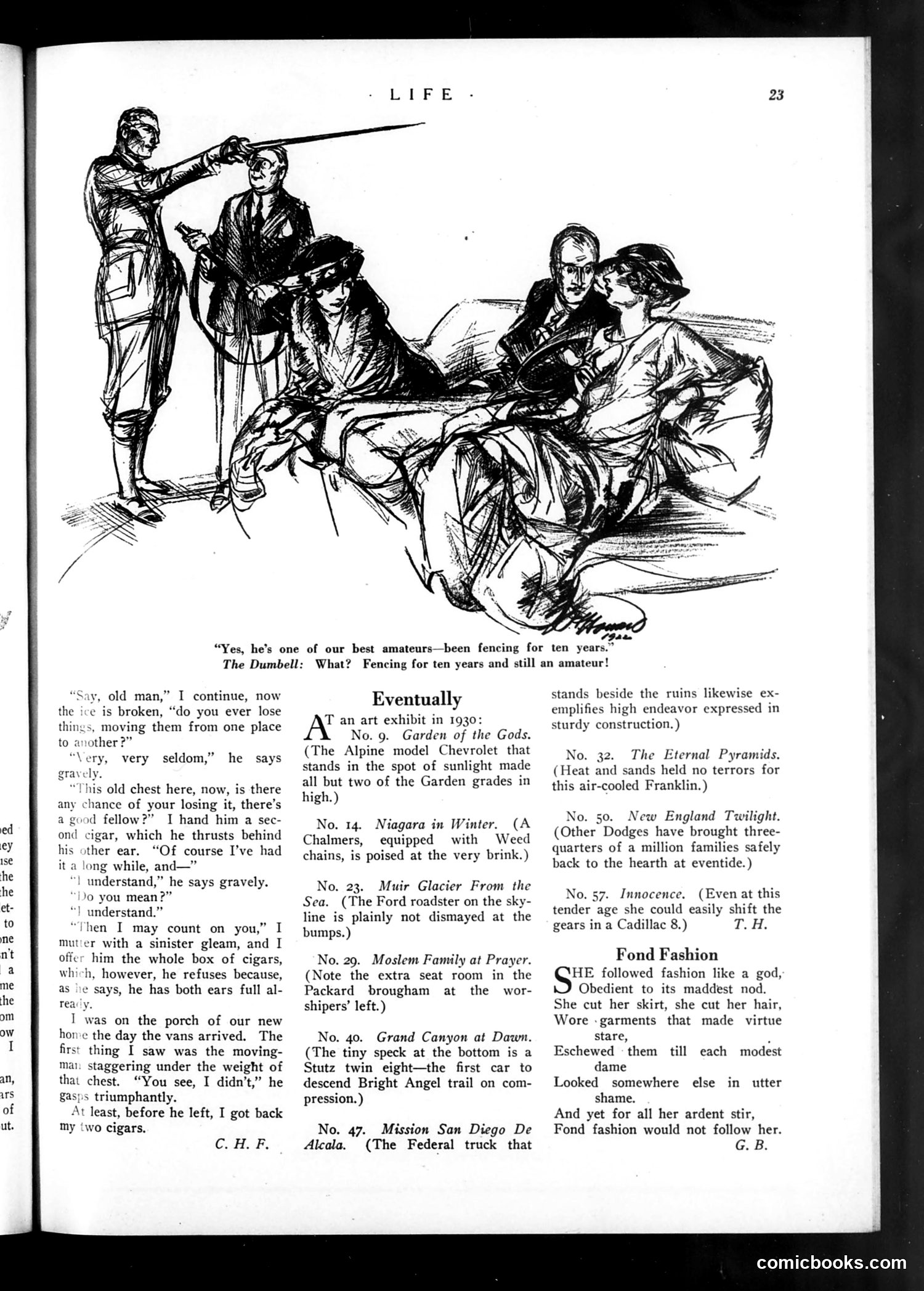
**The Cartoon (top):** A sketch illustrating "The Dumbell" story below. A man demonstrates his moving prowess by losing nothing—including two cigars he absent-mindedly stuck behind his ear. The humor relies on physical comedy: the moving man triumphantly reports he "didn't" lose the chest, unaware he's lost the cigars. **"Eventually" Section:** Satirical captions describing an imaginary 1930 art exhibit where famous natural landmarks are "paintings" that actually feature parked automobiles. The joke mocks both automotive advertising's ubiquity and pretentious art exhibits. Cars dominate every scene—from the Grand Canyon to Niagara Falls to Egyptian pyramids—suggesting cars have infiltrated even America's most iconic landscapes. **"Fond Fashion" Poem:** A short verse about a woman who slavishly follows fashion trends (cutting her skirt and hair short), but ironically, fashion never follows *her*—she remains a mere follower, never a trendsetter. It's gentle social satire about conformity and the futility of chasing trends. Both pieces mock 1920s-30s consumer culture: excessive automobile marketing and fashion obsession.
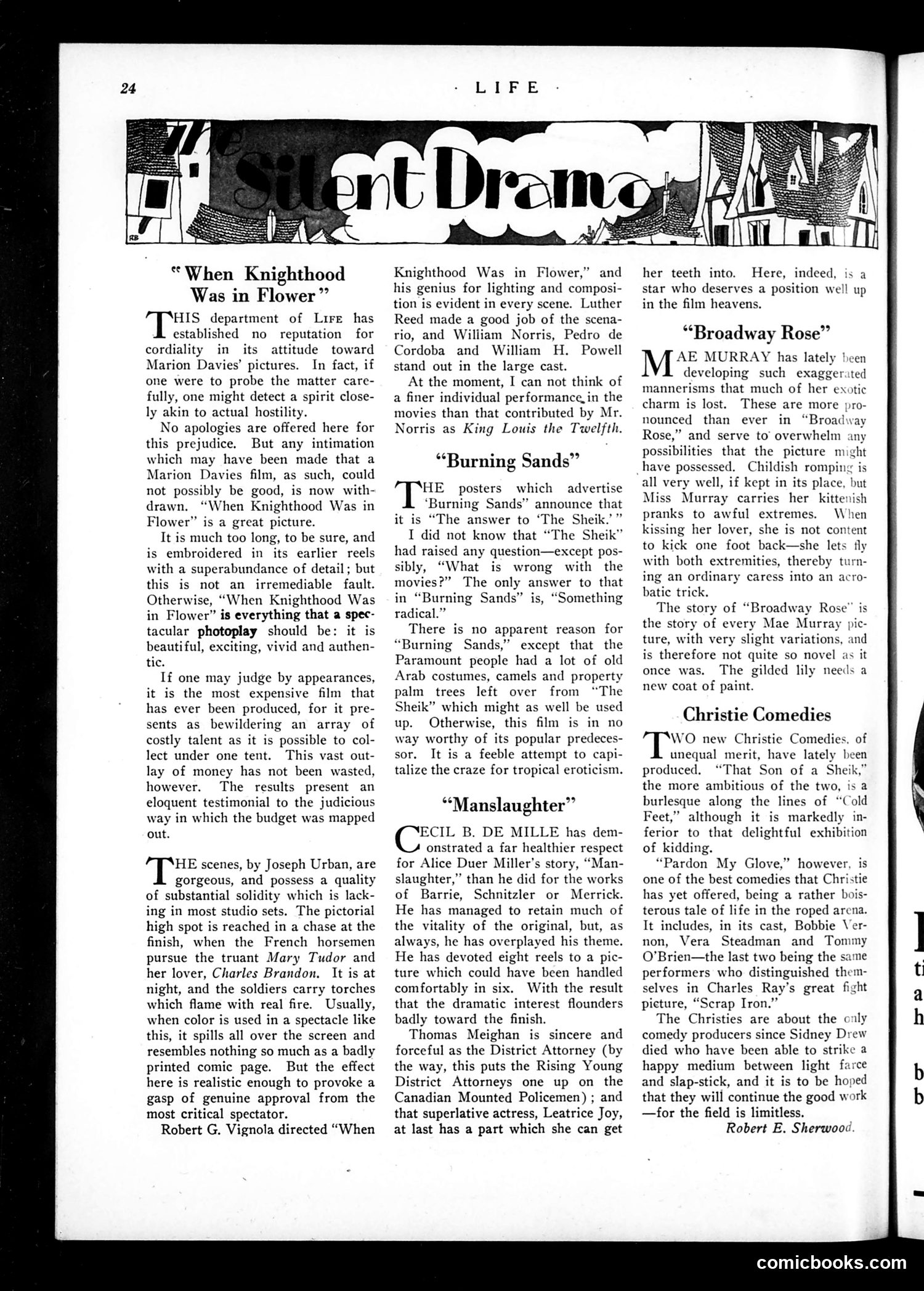
This page reviews four 1920s silent films. Life's critic surprisingly praises Marion Davies' *"When Knighthood Was in Flower,"* reversing the magazine's established hostility toward her pictures. The review credits director Robert G. Vignola and highlights a torchlit chase scene as visually impressive. *"Burning Sands"* is dismissed as a cynical cash-grab—Paramount recycling Arabian costumes and props from the popular *"The Sheik"* without artistic merit. *"Manslaughter,"* directed by Cecil B. DeMille, successfully adapts Alice Duer Miller's story but suffers from DeMille's characteristic over-elaboration, running eight reels when six would suffice. The final section discusses Christie Comedies, noting their quality after producer Sidney Drew's death. The tone throughout is authoritative but sarcastic—the critic uses humor to mock formulaic filmmaking while acknowledging genuine craftsmanship where evident.

This is a **product advertisement**, not political satire. It's a Fisk Tires company ad from an era when Life magazine published both humor and commercial content. The image features a **baby or cherub figure riding inside a tire**, with the tagline "Time to Re-tire? (Buy Fisk)." The pun plays on "retire" (rest/replace old tires) versus "re-tire" (put on new tires). The cherub conveys safety, comfort, and trustworthiness—suggesting Fisk tires are so reliable and comfortable, even an infant would be safe riding in one. The ad emphasizes Fisk's claimed superiority: durability, mileage, economy, strength, and safety. The phrase "buy *enough* service" subtly suggests purchasing quality rather than cheap alternatives. This represents early 20th-century advertising strategy: using memorable visual humor and aspirational imagery to build brand loyalty rather than focusing purely on technical specifications.
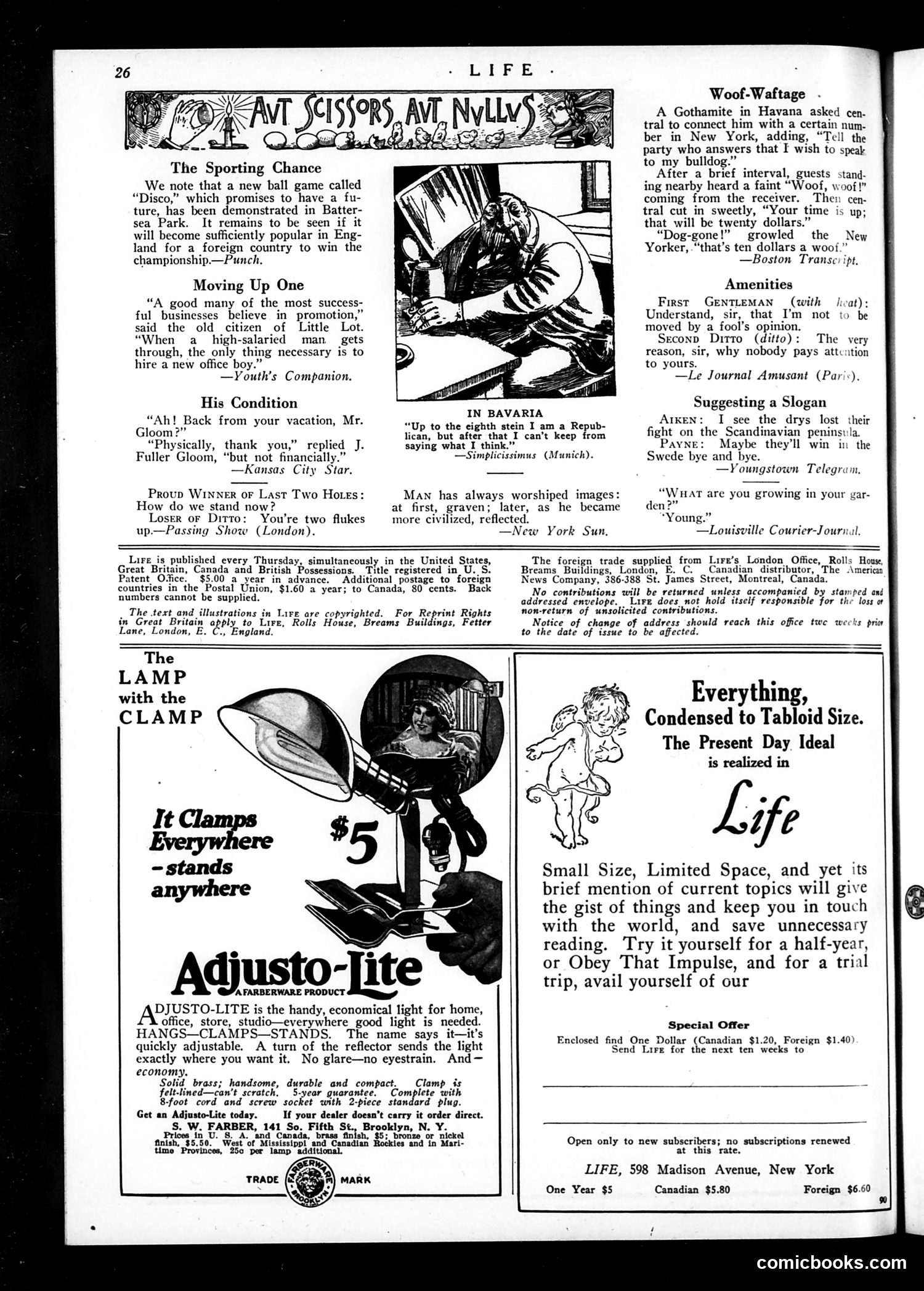
This page from Life magazine (a satirical publication) contains multiple brief humor pieces rather than a single political cartoon: **Main Cartoon**: "In Bavaria" depicts a German beer drinker claiming he's a Republican until his eighth stein, then loses control—a joke about alcohol's effects on political judgment and self-control. **Other Satirical Pieces**: Short anecdotes mock various subjects: - A new ball game called "Disco" (unclear what this references) - Business promotion practices - A vacationer financially exhausted despite physical rest - A telephone operator's expensive mistake connecting a man to his barking dog in Havana - Two gentlemen dismissing each other's opinions **Context**: These are typical early-20th-century Life magazine humor—gentle social satire targeting everyday absurdities (expensive long-distance calls, drinking culture, business customs) rather than explicit political commentary. The humor relies on wordplay and situational irony rather than visual caricature. The page is primarily advertising (Adjusto-Lite lamp, Life subscription offers) with scattered jokes throughout.
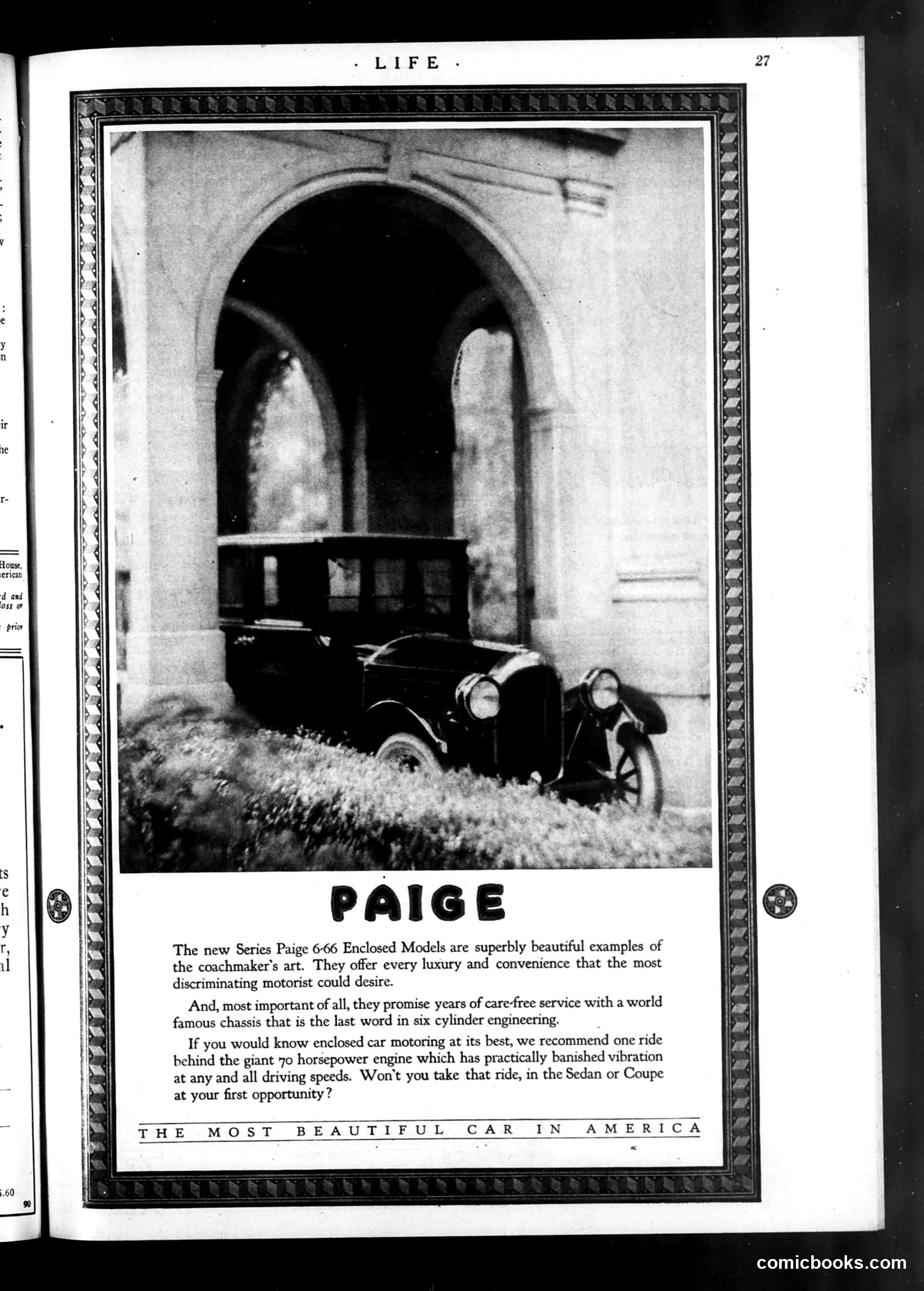
This is a **Paige automobile advertisement**, not political satire or a cartoon. It promotes the new Series Paige 6-66 Enclosed Models as luxury vehicles. The image shows a vintage car (appears to be from the 1920s era) parked beneath an architectural arch, emphasizing elegance and sophistication. The ad copy emphasizes the car's beauty, engineering (a 70-horsepower six-cylinder engine), and vibration-reduction technology—highlighting features that appealed to early automotive buyers concerned about ride quality. The tagline "The Most Beautiful Car in America" reflects the era's marketing focus on aesthetic design alongside mechanical performance. This represents typical early 20th-century automotive advertising that combined luxury aspirations with technical specifications to attract affluent consumers.
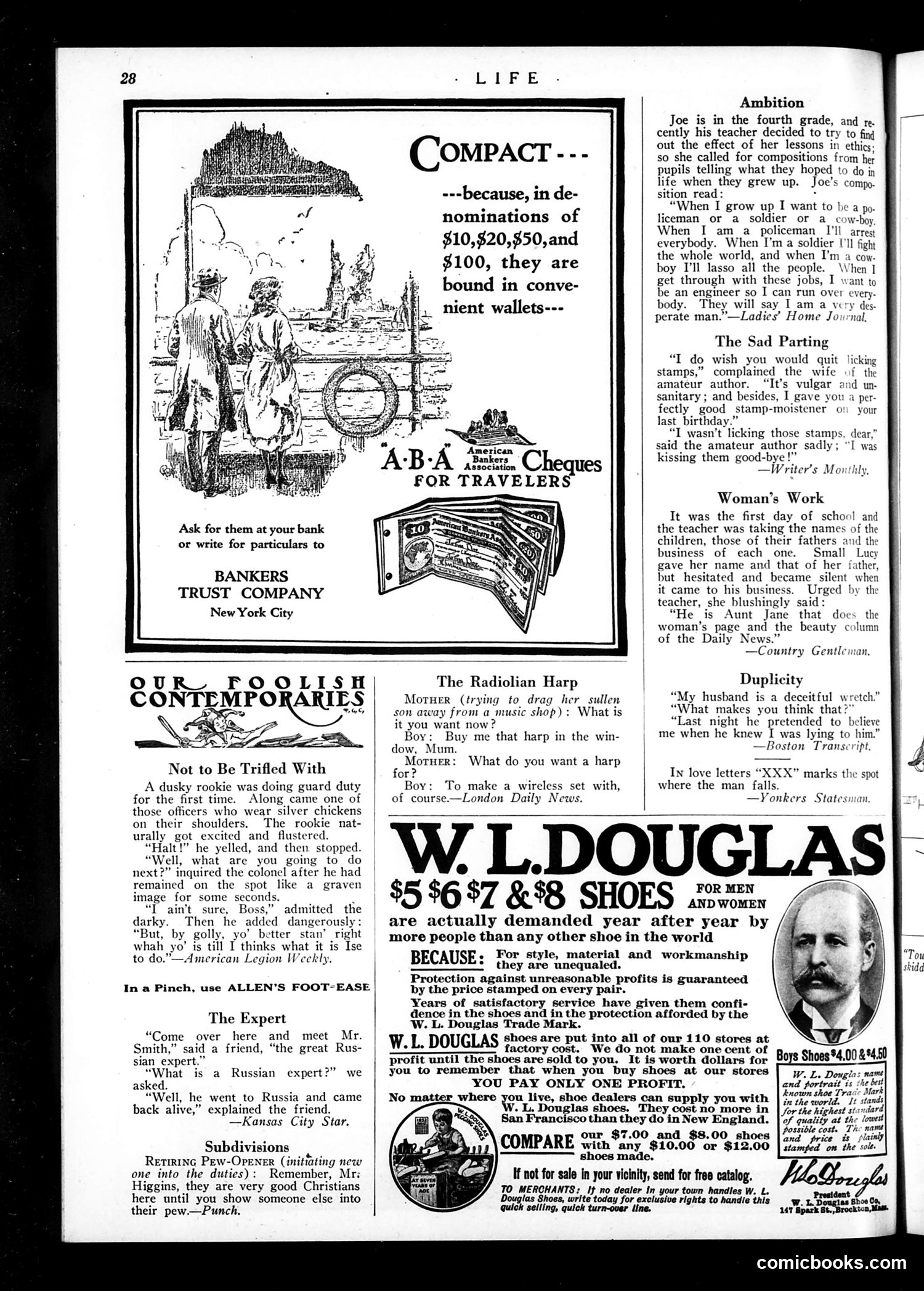
This page contains several brief humorous anecdotes typical of Life's satirical style, plus period advertisements. **"Ambition"** mocks a schoolboy's essay on career aspirations—his composition cheerfully describes wanting to arrest everybody as a policeman, fight the whole world as a soldier, lasso people as a cowboy, and run over everyone as an engineer. The humor lies in the child's innocent brutality masquerading as ambition. **"The Sad Parting"** plays on a writer's obsessive attachment to his work: his wife assumes he's unsanitary licking stamps, but he's actually kissing them goodbye—mourning submission of his manuscript. **"Woman's Work"** satirizes a father's embarrassment when his young daughter must publicly state his profession: he works on the women's page and beauty column, considered unmanly work. Other brief items mock military incompetence, marital duplicity, and modern gadgetry. The page is primarily advertising, particularly W.L. Douglas shoes and Bankers Trust Company traveler's cheques.
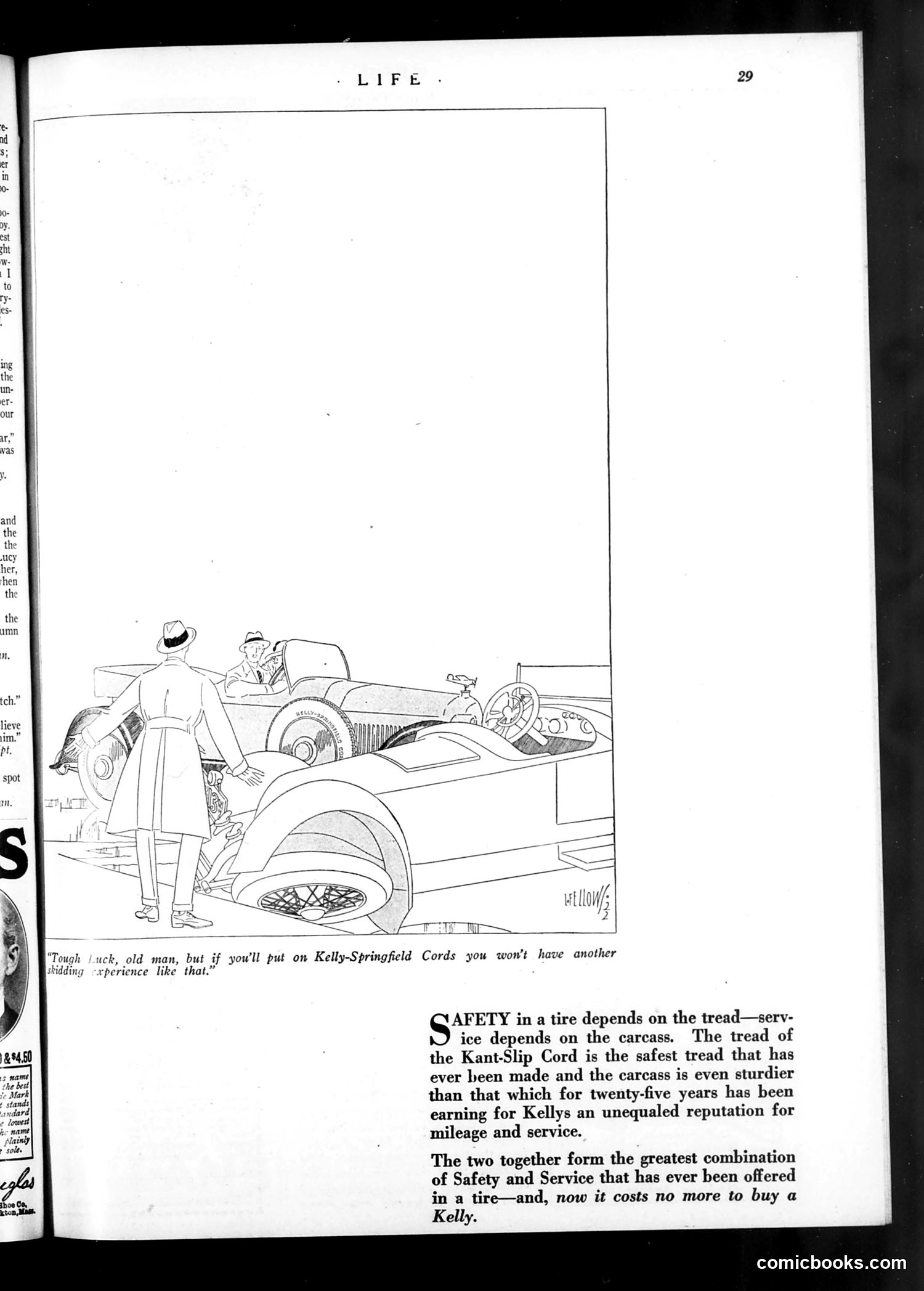
This is a **tire advertisement disguised as humorous content** rather than political satire. The cartoon depicts a woman examining a damaged automobile tire, with a man in a car behind her. The caption jokes about a bad driving experience, leading to the sales pitch: Kelly-Springfield Cord tires will prevent such incidents. The advertisement claims Kelly tires offer superior safety through their "Kant-Slip Cord" tread and sturdy carcass—allegedly the best available at no premium cost. The text emphasizes 25 years of reputation for reliability. This represents early 20th-century **magazine advertising strategy**: using humorous or relatable scenarios to transition into product promotion. There's no political satire here—it's commercial content typical of *Life* magazine's mixed editorial-advertising format during this era.
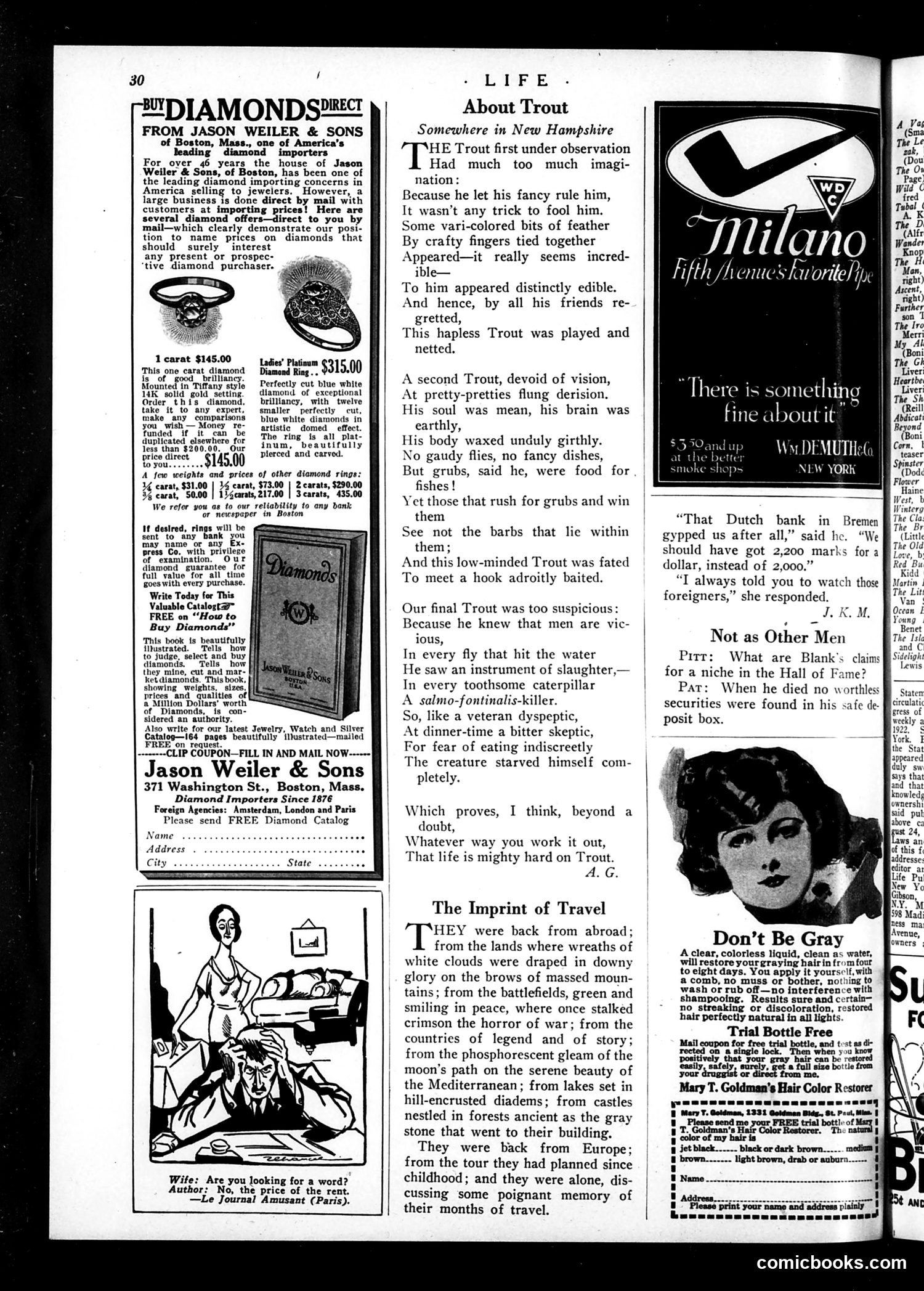
This page contains primarily **advertisements and light satirical verse**, not political commentary. The main content includes: **Diamond Advertisement** (Jason Weiler & Sons): A straightforward mail-order diamond pitch emphasizing direct importing prices and value. **"About Trout" poem** (attributed A.G.): A humorous allegory about three trout types—one too imaginative (fooled by fancy lures), one too crude (caught on real bait), and one too paranoid (starves from suspicion). The poem's moral: "life is mighty hard on Trout" regardless of approach. This is gentle satire about human nature through animal behavior, common in Life's lighter content. **"The Imprint of Travel"** (partially visible): Appears to be sentimental verse about travelers returning from Europe, describing romantic imagery of mountains and battlefields. The page reflects Life's dual character: serious satirical commentary elsewhere, but also light verse and advertisements aimed at educated, affluent readers interested in diamonds and travel. No specific political figures or dated references are evident here.
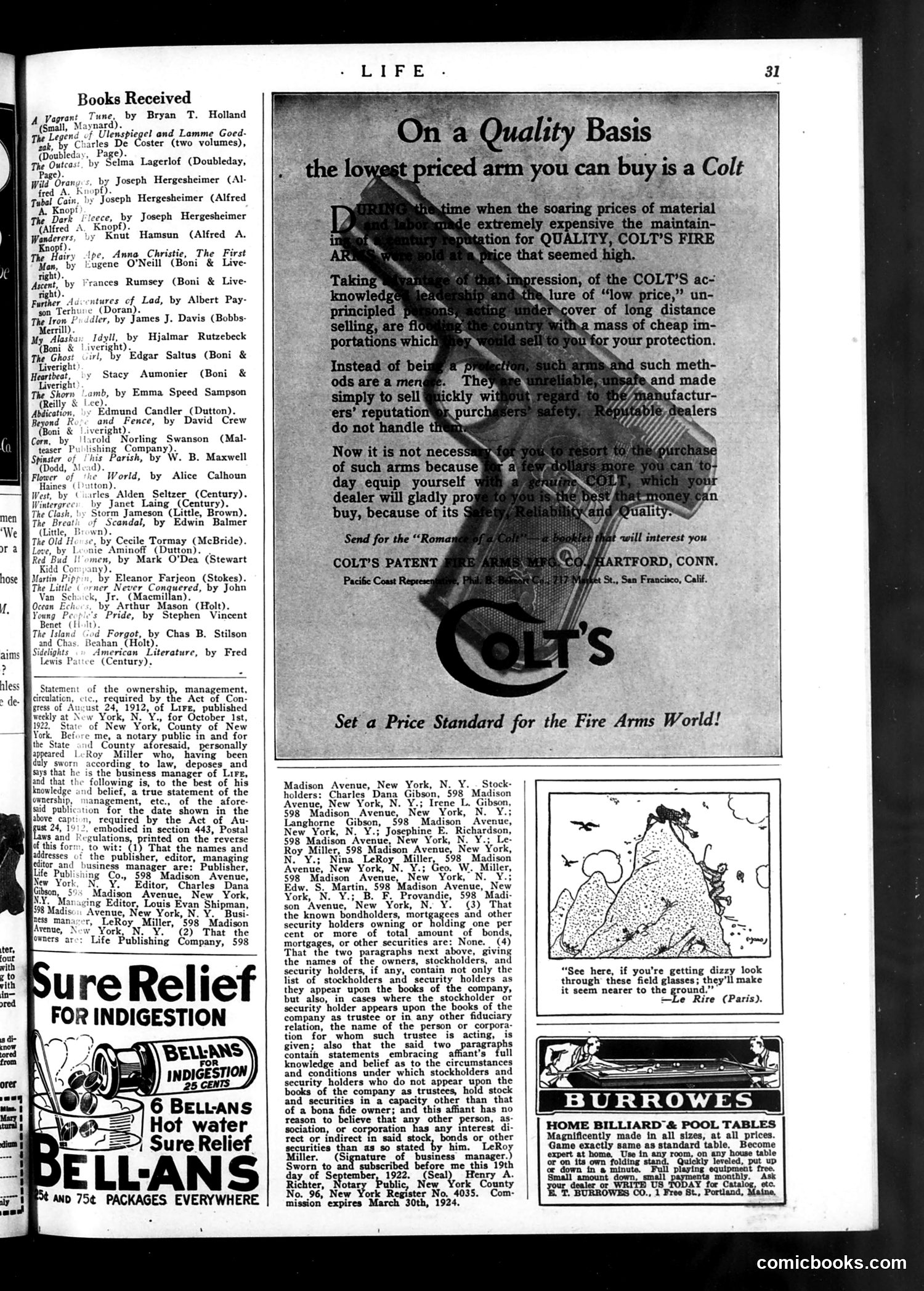
This is primarily a **books received section and ownership statement** from *Life* magazine (October 1912), with minimal satirical content visible. The main content lists recently published books, standard fare for a literary magazine. Below that is a required legal statement disclosing *Life*'s ownership structure—showing Charles Dana Gibson (the famous illustrator) and associates as stockholders at the magazine's Madison Avenue offices. The **advertisements** are more interesting: Colt firearms promote their handguns as affordable and reliable ("lowest priced arm you can buy"), while Bellans advertises indigestion relief and Burrowes advertises billiard tables. There's also a small cartoon showing someone dizzy from field glasses, captioned as relating to *Life* magazine. No significant political satire is evident on this particular page—it's largely administrative and commercial content typical of *Life*'s format as a general-interest publication mixing humor, literature coverage, and advertising.
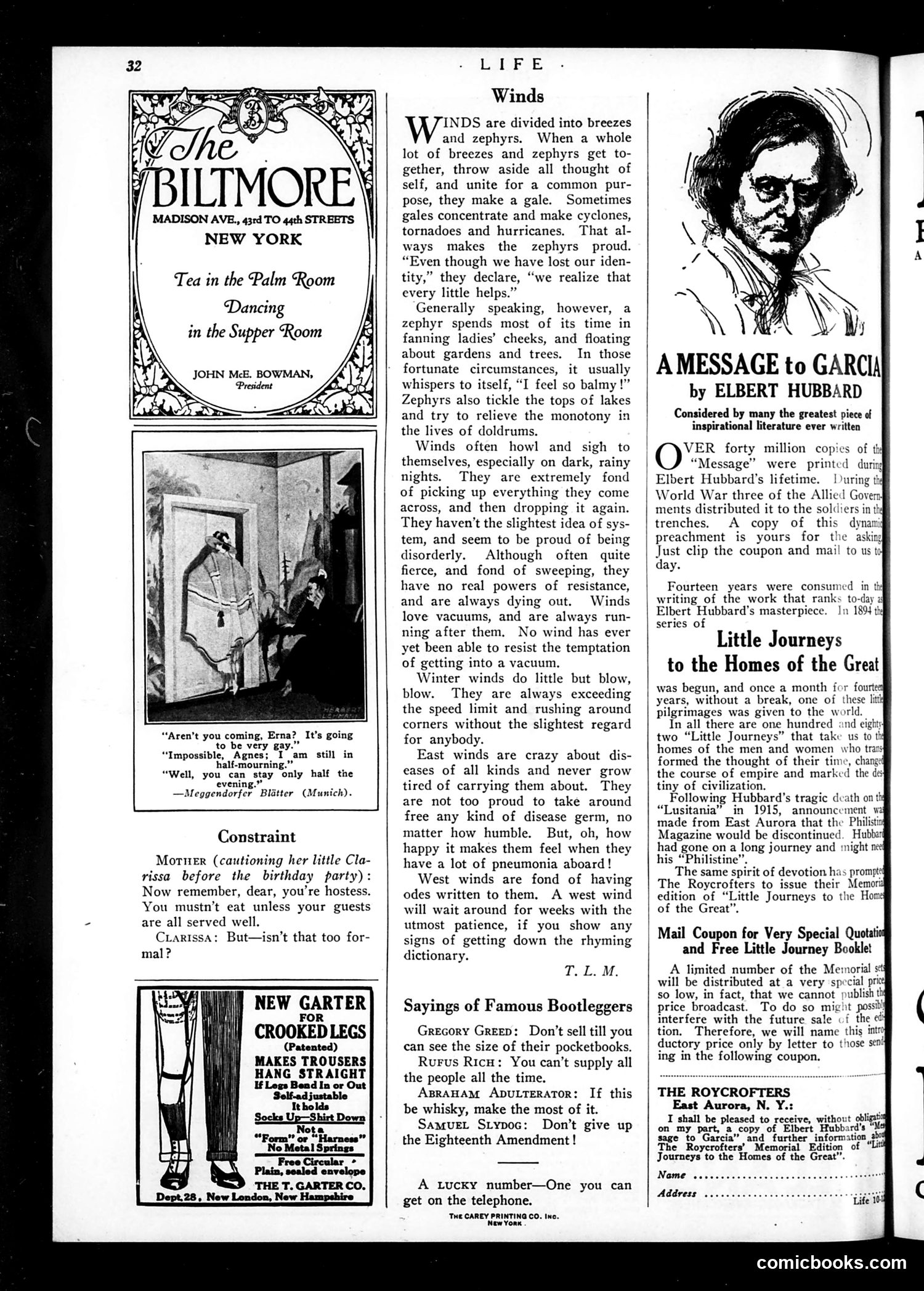
This page contains three distinct elements: **Two brief satirical cartoons** about social etiquette: one depicts a woman unable to attend a party because she's in "half-mourning" (a period of reduced social activity following bereavement); the second shows a hostess instructing her daughter not to eat before guests are served—social constraint as upper-class propriety. **A humorous essay on "Winds"** personifying meteorological phenomena with human characteristics—zephyrs are vain, east winds spread disease, west winds court poets. This is whimsical nature-writing typical of *Life*'s satirical style. **Advertisements and promotional material**, including one for Elbert Hubbard's "Message to Garcia" and his "Little Journeys to the Homes of the Great." Hubbard was a famous early-20th-century motivational writer. **One advertisement** for a "New Garter for Trousers"—a practical garment ad. The page is primarily advertising and light satirical content rather than political commentary. The social-etiquette cartoons gently mock rigid upper-class conventions of the era.
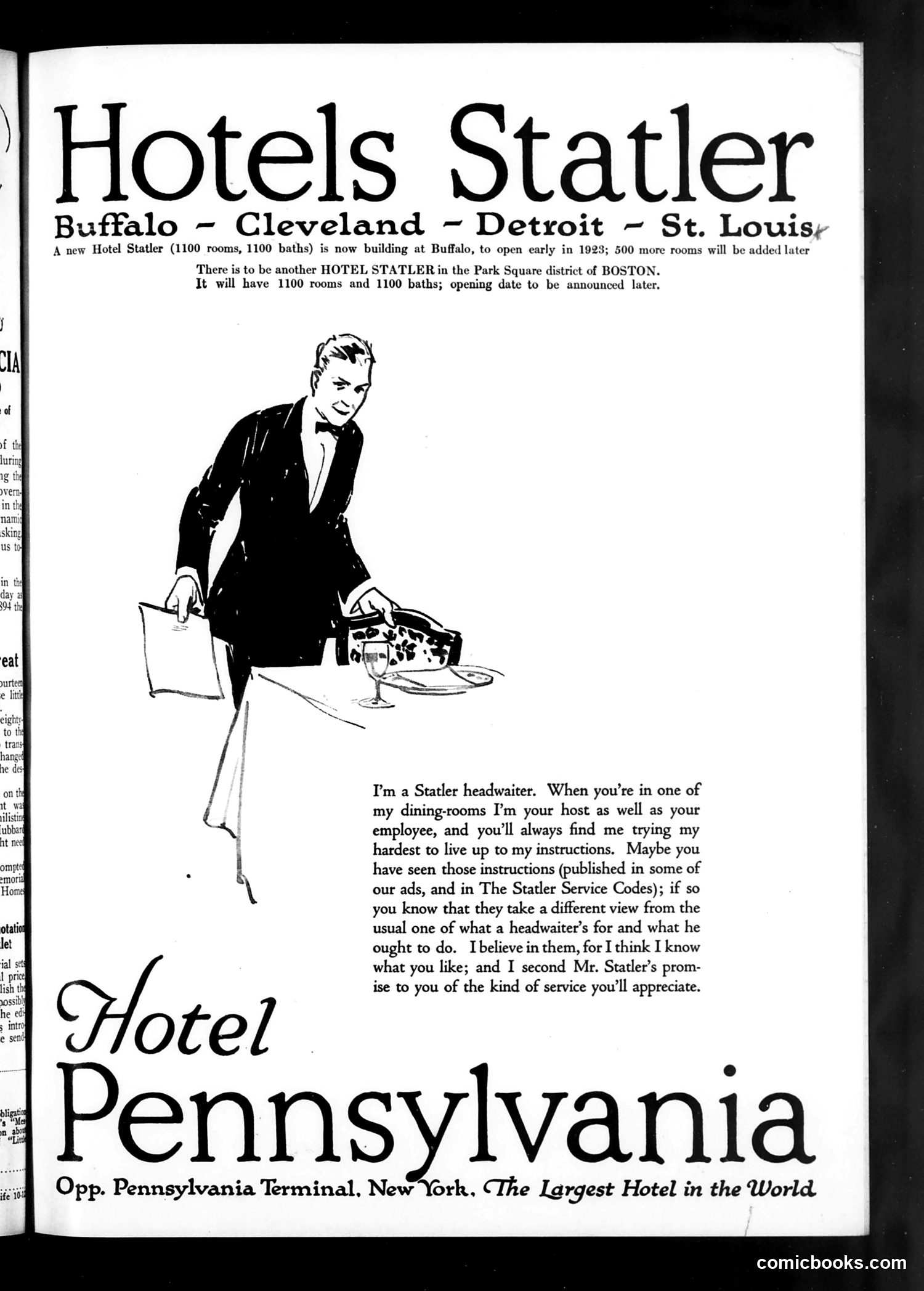
This is primarily a **hotel advertisement**, not political satire or comics. It promotes the Statler Hotels chain, announcing new locations in Buffalo, Cleveland, Detroit, St. Louis, and Boston opening in the early 1920s. The illustration features a well-dressed headwaiter addressing the reader directly. His monologue emphasizes the Statler chain's distinctive service philosophy—positioning the headwaiter as both "host" and employee, claiming to understand guests' preferences better than traditional hotel service. He references published "Statler Service Codes," suggesting the chain marketed itself on detailed, guest-focused protocols rather than conventional hospitality standards. The Hotel Pennsylvania location is touted as "The Largest Hotel in the World," a boastful claim typical of 1920s hotel advertising. The page reflects the era's emphasis on modern hospitality standards and the competitive luxury-hotel market of the Jazz Age.
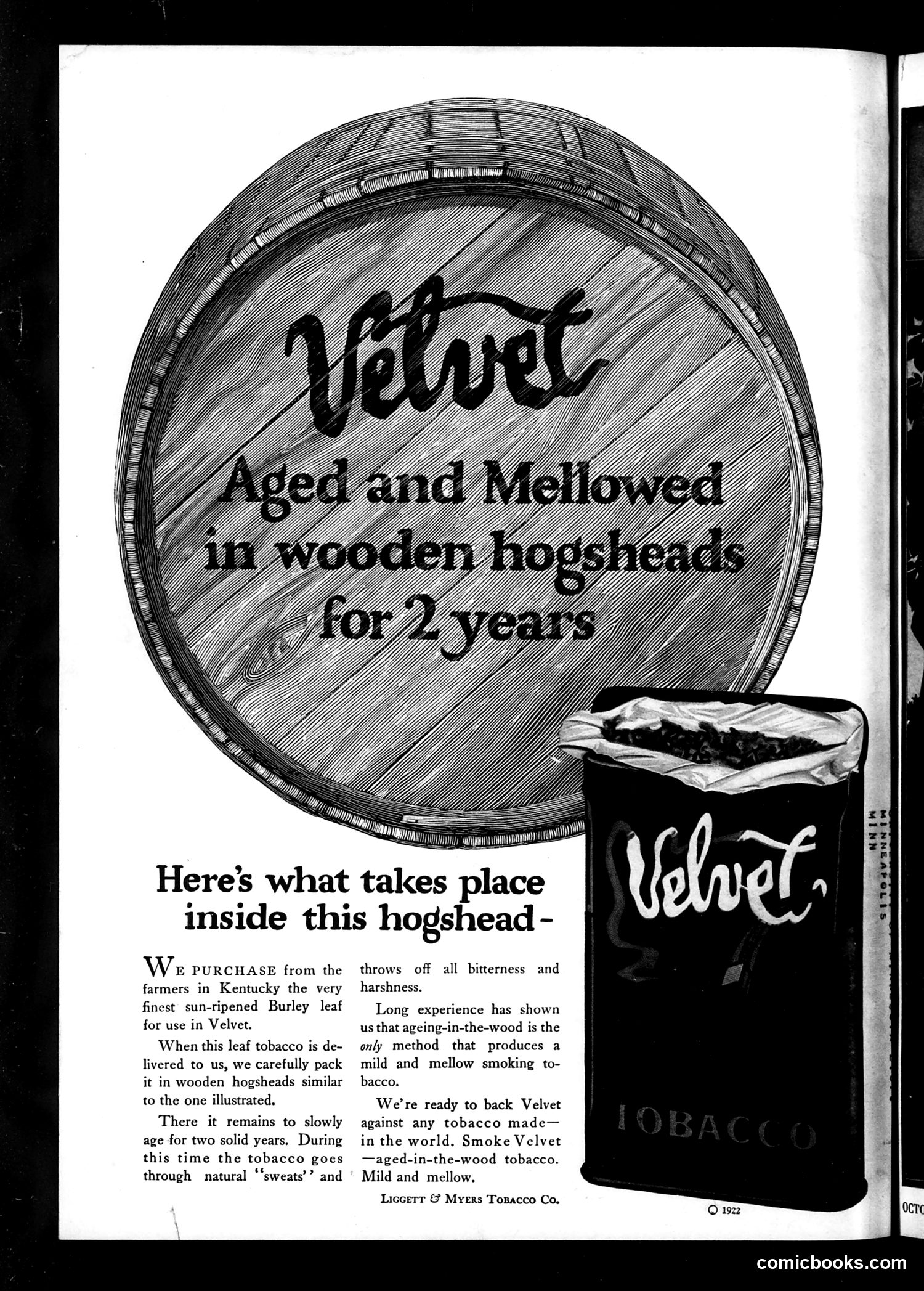
This is a **tobacco advertisement**, not a political cartoon. It's a 1922 advertisement for Velvet tobacco by Liggett & Myers Tobacco Co. The page shows a large wooden barrel/hogshead and explains Velvet's manufacturing process: the company purchases Kentucky burley leaf tobacco and ages it in wooden hogsheads for two years, allowing natural "sweats" to mellow the tobacco and remove bitterness. This aging-in-wood method is presented as producing superior, milder smoking tobacco compared to competitors. The accompanying package image shows a Velvet tobacco tin. The advertisement's rhetorical strategy is to emphasize craftsmanship, patience, and natural processes—positioning Velvet as the premium choice through careful aging, rather than competing on price. There is **no satire or political content** here; this is straightforward product marketing from the early 20th century, before tobacco advertising restrictions.