
Life, 1922-10-12 · page 23 of 36
Life — October 12, 1922 — page 23: what you’re looking at
What you’re looking at
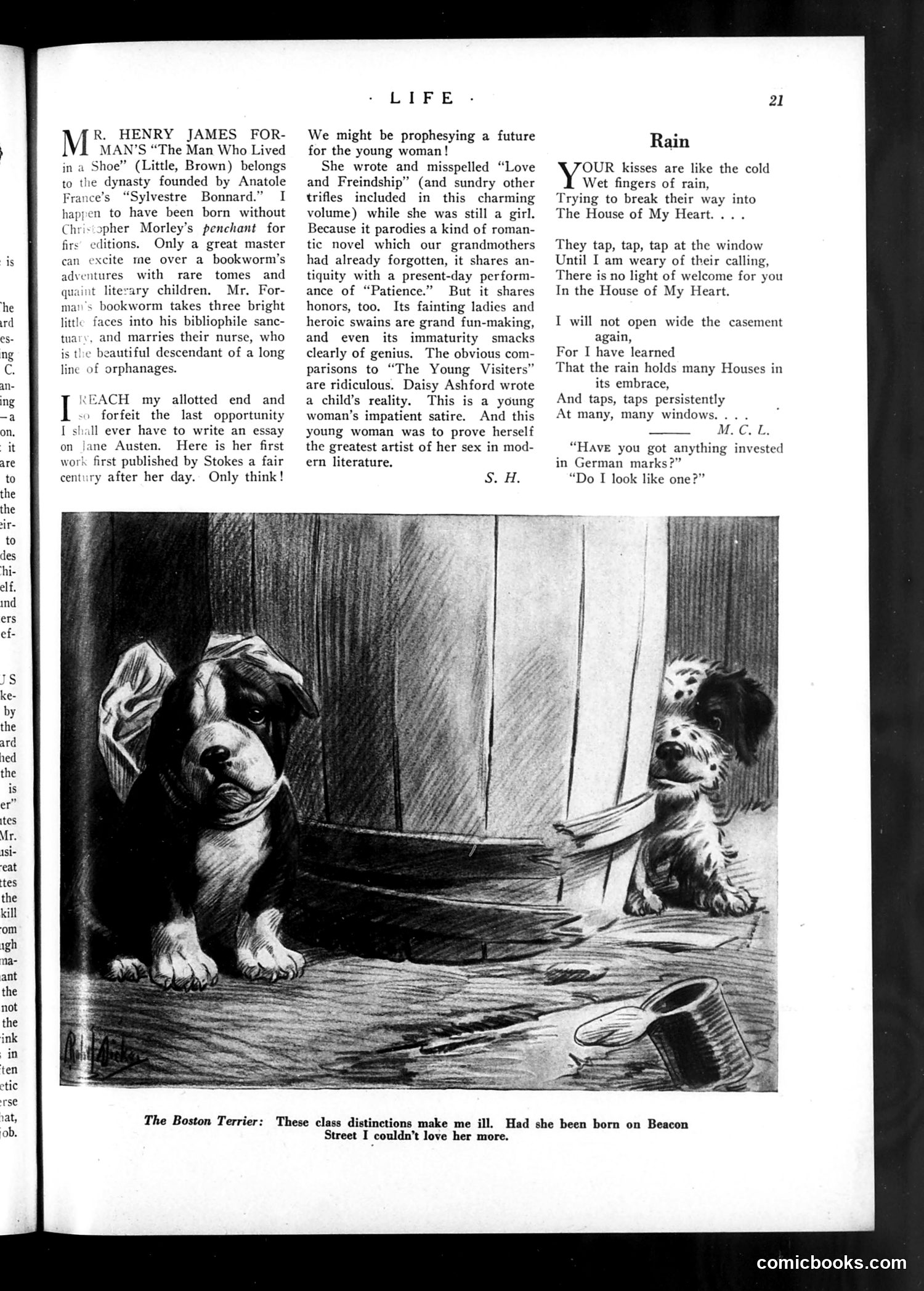
This page contains literary reviews and a humorous illustration. The main cartoon depicts two dogs—a large Boston Terrier and a smaller dog—with the terrier commenting on "class distinctions." The caption reads: "These class distinctions make me ill. Had she been born on Beacon Street I couldn't love her more." The satire targets American social snobbery, particularly Boston's class-conscious culture. "Beacon Street" references Boston's prestigious neighborhood, home to wealthy Brahmin families. The joke: the terrier claims class doesn't matter ("I couldn't love her more"), yet the very mention of Beacon Street betrays that social status determines worth. The irony—that even dogs reflect human prejudices about breeding and social standing—mocks American pretension. The page also reviews Jane Austen's early satirical work and discusses literary merit alongside a poem titled "Rain."
📄 Transcribed text from this page (OCR, searchable)
Machine-transcribed from the original scan — historical spelling and the odd misread are preserved.
R. HENRY JAMES FOR- MV MAN’S “The Man Who Lived in a Shoe” (Little, Brown) belongs to the dynasty founded by Anatole France’s “Sylvestre Bonnard.” I happen to have been born without Chris:opher Morley’s penchant for firs. editions. Only a great master cite me over a bookworm’s adventures with rare tomes and quaint literary children, Mr, For- man's bookworm takes three bright little faces into his bibliophile sanc- tuary, and marries their nurse, who is the beautiful descendant of a long line of orphanages. *EACH my allotted end and I forfeit the last opportunity I shall ever have to write an essay on jane Austen. Here is her first work first published by Stokes a fair century after her day. Only think! LIFE We might be prophesying a future for the young woman! She wrote and misspelled “Love and Freindship” (and sundry other trifles included in this charming volume) while she was still a girl. Because it parodies a kind of roman- tic novel which our grandmothers had already forgotten, it shares an- tiquity with a present-day perform- ance of “Patience.” But it shares honors, too. Its fainting ladies and heroic swains are grand fun-making, and even its immaturity smacks clearly of genius. The obvious com- parisons to “The Young Visiters” are ridiculous. Daisy Ashford wrote a child’s reality. This is a young woman’s impatient satire. And this young woman was to prove herself the greatest artist of her sex in mod- ern literature. S. H. The Boston Terrier: These class distinctions make me ill. Street I couldn’t love her more. Rain OUR kisses are like the cold Wet fingers of rain, Trying to break their way into The House of My Heart... . They tap, tap, tap at the window Until I am weary of their calling, There is no light of welcome for you In the House of My Heart. I will not open wide the casement again, For I have learned That the rain holds many Houses in its embrace, And taps, taps persistently At many, many windows. . . . MM: C28; “Have you got anything invested in German marks?” “Do I look like one?” Had she been born on Beacon comicbooks.com