
Life, 1922-10-12 · page 22 of 36
Life — October 12, 1922 — page 22: what you’re looking at
What you’re looking at
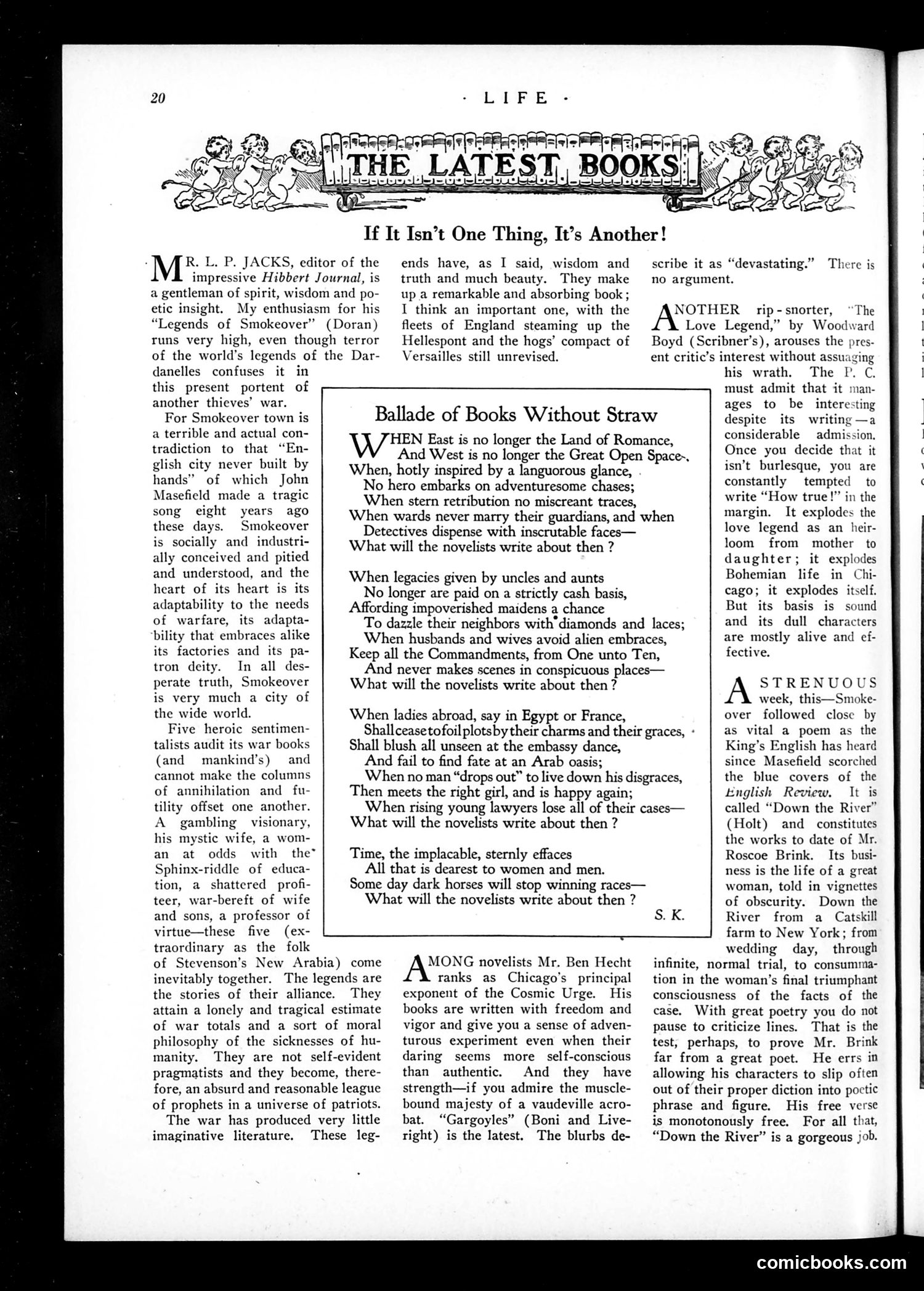
This is a *Life* magazine book review column featuring literary criticism alongside a satirical poem. The main text reviews two novels set in "Smokeover"—a fictional industrial American city—praising their realistic portrayal of post-WWI social decay and moral compromise. The centerpiece is "Ballade of Books Without Straw," a clever parody asking: *what will novelists write about when modern life loses its dramatic conflicts?* The poem sarcastically catalogs Victorian and Edwardian plot devices—seduction, financial desperation, secret scandals, forbidden romance—that were staples of 19th-century fiction. It asks what happens when social codes collapse, morality improves, and fate stops delivering convenient dramatic moments. The satire mocks how dependent popular literature was on artificial moral crises and class-based complications. It's fundamentally about the modernist crisis: older narrative structures feel obsolete in post-war society, yet writers haven't developed compelling replacements. The joke is that novels need something to write *about*—and progress itself is boring.
📄 Transcribed text from this page (OCR, searchable)
Machine-transcribed from the original scan — historical spelling and the odd misread are preserved.
If It Isn’t One Thing, It’s Another! R. L. P. JACKS, editor of the impressive Hibbert Journal, is a gentleman of spirit, wisdom and po- etic insight. My enthusiasm for his “Legends of Smokeover” (Doran) runs very high, even though terror of the world’s legends of the Dar- danelles confuses it in this present portent of ends have, as I said, wisdom and truth and much beauty. They make up a remarkable and absorbing book ; I think an important one, with the fleets of England steaming up the Hellespont and the hogs’ compact of Versailles still unrevised. scribe it as “devastating.” no argument. There is NOTHER rip-snorter, The Love Legend,” by Woodward Boyd (Scribner’s), arouses the pres- ent critic’s interest without assuaging his wrath. The P. C. another thieves’ war. For Smokeover town is a terrible and actual con- tradiction to that “En- Ballade of Books Without Straw HEN East is no longer the Land of Romance, must admit that it man- ages to be interesting despite its writing —a considerable admission, Once you decide that it ah V V And West is no longer the Great Open Space~. When, hotly inspired by a languorous glance, No hero embarks on adventuresome chases; When stern retribution no miscreant traces, When wards never marry their guardians, and when Detectives dispense with inscrutable faces— glish city never built by hands” of which John Masefield made a tragic song eight years ago these days. Smokeover is socially and industri- isn’t burlesque, you are constantly tempted to write “How true!” in the margin. It explodes the love legend as an heir- loom from mother to ally conceived and pitied and understood, and the heart of its heart is its adaptability to the needs of warfare, its adapta- bility that embraces alike its factories and its pa- tron deity. In all des- perate truth, Smokeover is very much a city of the wide world. Five heroic sentimen- talists audit its war books (and) mankind’s) and cannot make the columns of annihilation and fu- tility offset one another. A gambling visionary, his mystic wife, a wom- an at odds with the~ Sphinx-riddle of educa- tion, a shattered profi- teer, war-bereft of wife and sons, a professor of virtue—these five (ex- What will the novelists write about then ? When legacies given by uncles and aunts No longer are paid on a strictly cash basis, Affording impoverished maidens a chance To dazzle their neighbors with’diamonds and laces; and its dull characters When husbands and wives avoid alien embraces, Keep all the Commandments, from One unto Ten, And never makes scenes in conspicuous places— What will the novelists write about then? When ladies abroad, say in Egypt or France, Shallceasetofoil plotsby their charms and their graces, « Shall blush all unseen at the embassy dance, And fail to find fate at an Arab oasis; When no man “drops out” to live down his disgraces, Then meets the right girl, and is happy again; When rising young lawyers lose all of their cases— What will the novelists write about then ? Time, the implacable, sternly effaces All that is dearest to women and men. Some day dark horses will stop winning races— What will the novelists write about then ? daughter; it explodes Bohemian life in Chi- cago; it explodes itself. But its basis is sound are mostly alive and ef- fective. STRENUOUS week, this—Smoke- over followed close by as vital a poem as the King’s English has heard since Masefield scorched the blue covers of the English Review. It is called “Down the River” (Holt) and constitutes the works to date of Mr. Roscoe Brink. Its busi- ness is the life of a great woman, told in vignettes of obscurity. Down the River from a Catskill farm to New York; from S.K. traordinary as the folk of Stevenson’s New Arabia) come inevitably together. The legends are the stories of their alliance. They attain a lonely and tragical estimate of war totals and a sort of moral philosophy of the sicknesses of hu- manity. They are not self-evident pragmatists and they become, there- fore, an absurd and reasonable league of prophets in a universe of patriots. The war has produced very little imaginative literature. These leg- MONG novelists Mr. Ben Hecht ranks as Chicago's principal exponent of the Cosmic Urge. His books are written with freedom and vigor and give you a sense of adven- turous experiment even when their daring seems more self-conscious than authentic. And they have strength—if you admire the muscle- bound majesty of a vaudeville acro- bat. “Gargoyles” (Boni and Live- right) is the latest. The blurbs de- wedding day, through infinite, normal trial, to consumma- tion in the woman’s final triumphant consciousness of the facts of the case. With great poetry you do not pause to criticize lines. That is the test, perhaps, to prove Mr. Brink far from a great poet. He errs in allowing his characters to slip often out of their proper diction into poctic phrase and figure. His free verse is monotonously free. For all that, “Down the River” is a gorgeous job. comicbooks.com