
Life, 1922-10-12 · page 16 of 36
Life — October 12, 1922 — page 16: what you’re looking at
What you’re looking at
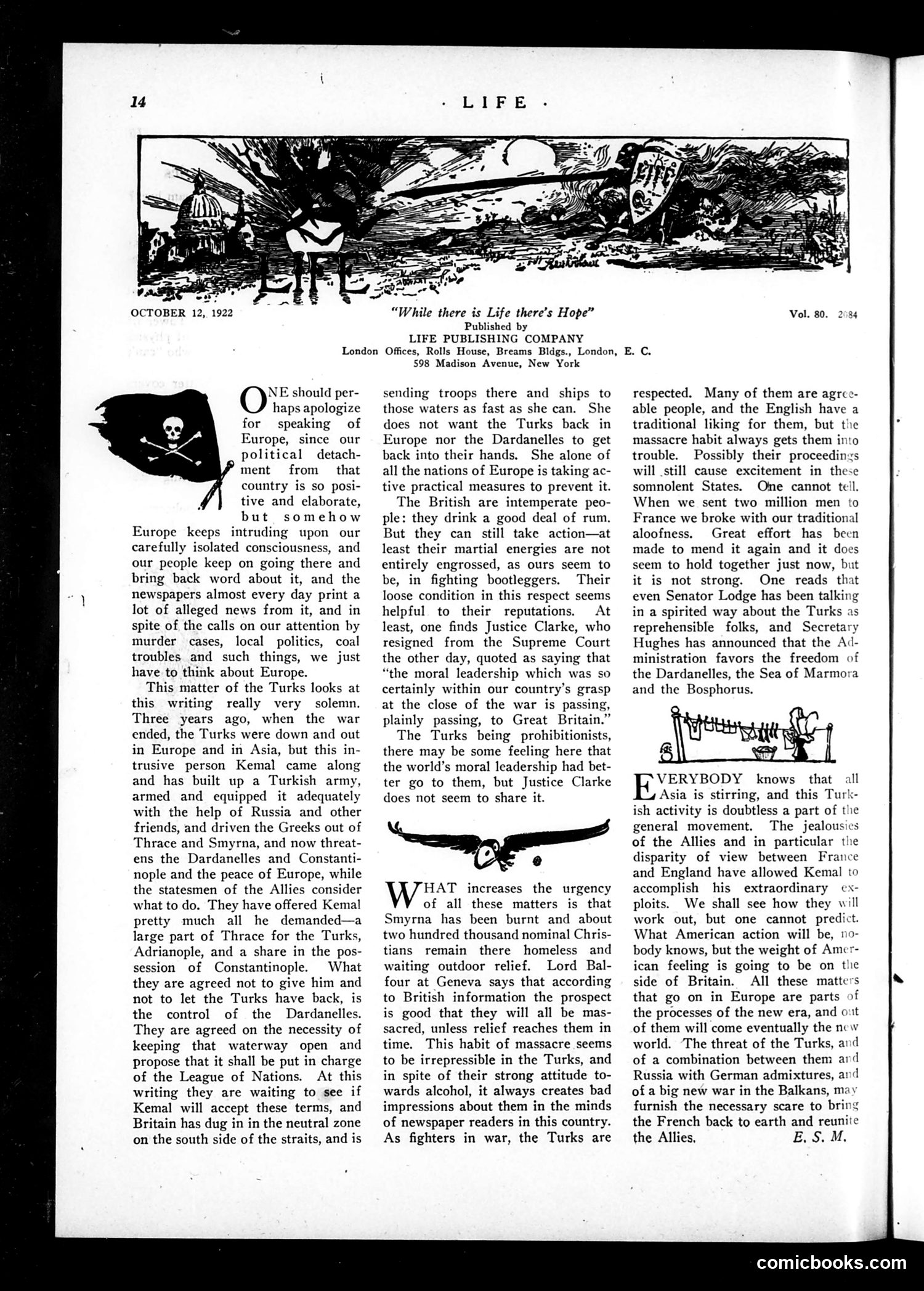
The masthead illustration depicts a skeletal figure (Death) overlooking a devastated landscape with burning buildings and the moon—a commentary on post-World War I destruction, particularly regarding Turkish-Greek conflicts in Asia Minor. The article discusses European political instability, specifically criticizing Turkish leader Kemal's military actions against the Dardanelles and Constantinople. The piece expresses concern that Britain and America are not adequately addressing the humanitarian crisis: two hundred thousand Christians remain homeless after Turkish massacres. The satire targets Western indifference to ongoing Middle Eastern violence and appeals for stronger Allied intervention. References to "Justice Clarke" resigning from the Supreme Court and Secretary Hughes suggest American leadership is distracted from critical international crises.
📄 Transcribed text from this page (OCR, searchable)
Machine-transcribed from the original scan — historical spelling and the odd misread are preserved.
OCTOBER 12, 1922 “While there is Life there’s Hope” Published by LIFE PUBLISHING COMPANY London Offices, Rolls House, Breams Bldgs., London, E. C. should per- haps apologize for speaking of Europe, since our political detach- ment from that country is so posi- tive and elaborate, but somehow Europe keeps intruding upon our carefully isolated consciousness, and our people keep on going there and bring back word about it, and the newspapers almost every day print a lot of alleged news from it, and in spite of the calls on our attention by murder cases, local politics, coal troubles and such things, we just have to think about Europe. This matter of the Turks looks at this writing really very solemn. Three years ago, when the war ended, the Turks were down and out in Europe and in Asia, but this in- trusive person Kemal came along and has built up a Turkish army, armed and equipped it adequately with the help of Russia and other friends, and driven the Greeks out of Thrace and Smyrna, and now threat- ens the Dardanelles and Constanti- nople and the peace of Europe, while the statesmen of the Allies consider what to do. They have offered Kemal pretty much all he demanded—a large part of Thrace for the Turks, Adrianople, and a share in the pos- session of Constantinople. What they are agreed not to give him and not to let the Turks have back, is the control of the Dardanelles. They are agreed on the necessity of keeping that waterway open and propose that it shall be put in charge of the League of Nations. At this writing they are waiting to see if Kemal will accept these terms, and Britain has dug in in the neutral zone on the south side of the straits, and is 598 Madison Avenue, New York sending troops there and ships to those waters as fast as she can. She does not want the Turks back in Europe nor the Dardanelles to get back into their hands. She alone of all the nations of Europe is taking ac- tive practical measures to prevent it. The British are intemperate peo- ple: they drink a good deal of rum. But they can still take action—at least their martial energies are not entirely engrossed, as ours seem to be, in fighting bootleggers. Their loose condition in this respect seems helpful to their reputations. At least, one finds Justice Clarke, who resigned from the Supreme Court the other day, quoted as saying that “the moral leadership which was so certainly within our country’s grasp at the close of the war is passing, plainly passing, to Great Britain.” The Turks being prohibitionists, there may be some feeling here that the world’s moral leadership had bet- ter go to them, but Justice Clarke does not seem to share it. HAT increases the urgency of all these matters is that Smyrna has been burnt and about two hundred thousand nominal Chris- tians remain there homeless and waiting outdoor relief. Lord Bal- four at Geneva says that according to British information the prospect is good that they will all be mas- sacred, unless relief reaches them in time. This habit of massacre seems to be irrepressible in the Turks, and in spite of their strong attitude to- wards alcohol, it always creates bad impressions about them in the minds of newspaper readers in this country. As fighters in war, the Turks are respected. Many of them are agrce- able people, and the English have a traditional liking for them, but the massacre habit always gets them into trouble. Possibly their proceedings will still cause excitement in these somnolent States. One cannot tell. When we sent two million men to France we broke with our traditional aloofness. Great effort has been made to mend it again and it does seem to hold together just now, but it is not strong. One reads that even Senator Lodge has been talking in a spirited way about the Turks as reprehensible folks, and Secretary Hughes has announced that the Ad- ministration favors the freedom of the Dardanelles, the Sea of Marmora and the Bosphorus. | Deere knows that all Asia is stirring, and this Turk- ish activity is doubtless a part of the general movement. The jealousies of the Allies and in particular the disparity of view between France and England have allowed Kemal to accomplish his extraordinary ex- ploits. We shall see how they will work out, but one cannot predict. What American action will be, no- body knows, but the weight of Amer- ican feeling is going to be on tlie side of Britain. All these matters that go on in Europe are parts of the processes of the new era, and out of them will come eventually the new world. The threat of the Turks, and of a combination between them ard Russia with German admixtures, and of a big new war in the Balkans, may furnish the necessary scare to bring the French back to earth and reunite the Allies, E.S. M. comicbooks.com