
Life, 1922-10-12 · page 25 of 36
Life — October 12, 1922 — page 25: what you’re looking at
What you’re looking at
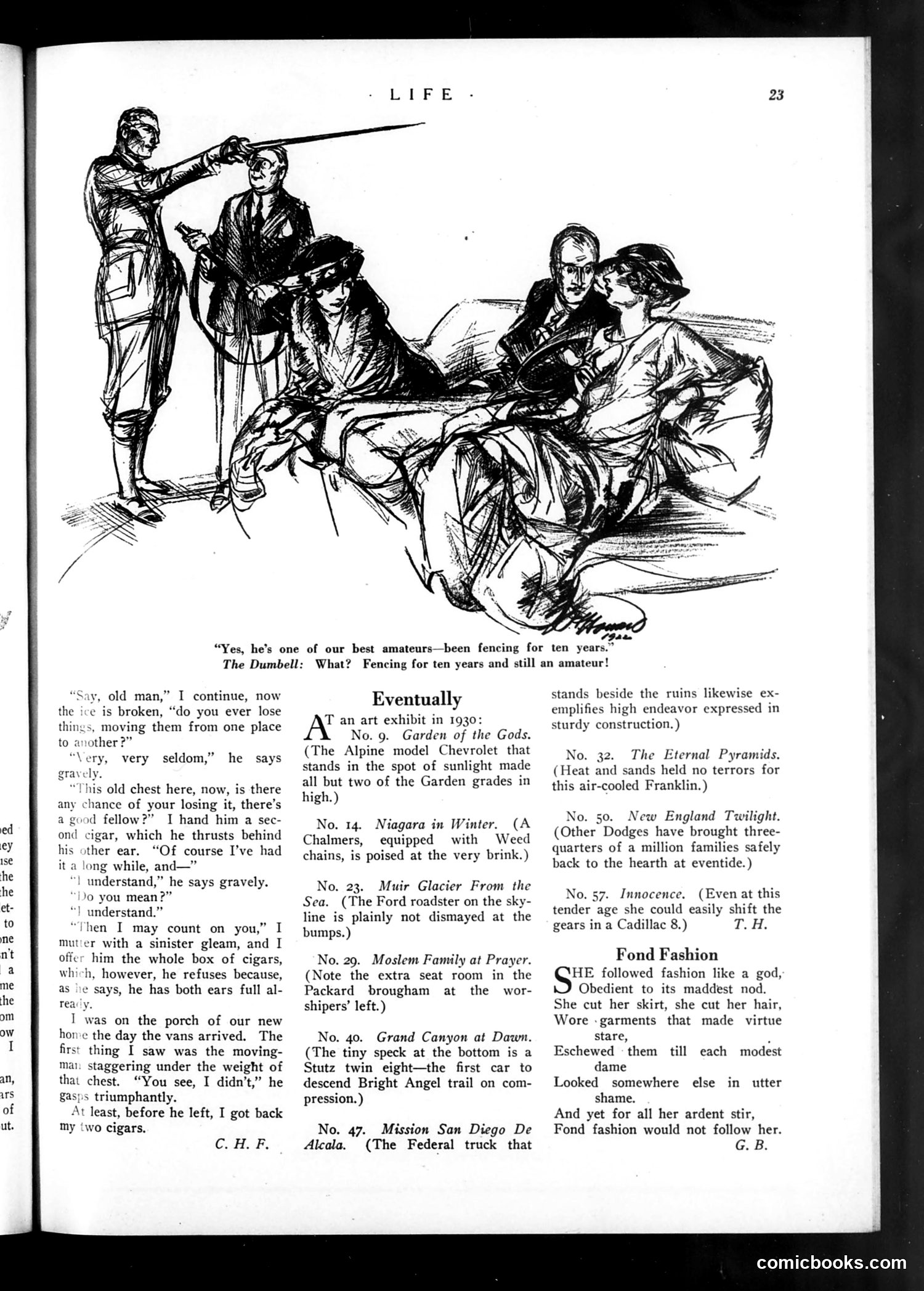
**The Cartoon (top):** A sketch illustrating "The Dumbell" story below. A man demonstrates his moving prowess by losing nothing—including two cigars he absent-mindedly stuck behind his ear. The humor relies on physical comedy: the moving man triumphantly reports he "didn't" lose the chest, unaware he's lost the cigars. **"Eventually" Section:** Satirical captions describing an imaginary 1930 art exhibit where famous natural landmarks are "paintings" that actually feature parked automobiles. The joke mocks both automotive advertising's ubiquity and pretentious art exhibits. Cars dominate every scene—from the Grand Canyon to Niagara Falls to Egyptian pyramids—suggesting cars have infiltrated even America's most iconic landscapes. **"Fond Fashion" Poem:** A short verse about a woman who slavishly follows fashion trends (cutting her skirt and hair short), but ironically, fashion never follows *her*—she remains a mere follower, never a trendsetter. It's gentle social satire about conformity and the futility of chasing trends. Both pieces mock 1920s-30s consumer culture: excessive automobile marketing and fashion obsession.
📄 Transcribed text from this page (OCR, searchable)
Machine-transcribed from the original scan — historical spelling and the odd misread are preserved.
“Yes, he’s one of our best amateurs—been fencing for ten years.” The Dumbell: “Say, old man,” I continue, now the ice is broken, “do you ever lose things, moving them from one place to another?” “Very, very seldom,” he says s old chest here, now, is there hance of your losing it, there’s vd fellow?” I hand him a sec- cigar, which he thrusts behind ther ear. “Of course I’ve had ong while, and—” | understand,” he says gravely. /o you mean?” ! understand.” “Then I may count on you,” I mutier with a sinister gleam, and I offer him the whole box of cigars, which, however, he refuses because, as ve says, he has both ears full al- ready. 1 was on the porch of our new home the day the vans arrived. The first thing I saw was the moving- man staggering under the weight of that chest. “You see, I didn’t,” he gasps triumphantly. t least, before he left, I got back my ‘wo cigars. C. H. F. Eventually T an art exhibit in 1930: No. 9. Garden of the Gods. (The Alpine model Chevrolet that stands in the spot of sunlight made all but two of the Garden grades in high.) No. 14. Niagara in Winter. (A Chalmers, equipped with Weed chains, is poised at the very brink.) No. 23. Muir Glacier From the Sea. (The Ford roadster on the sky- line is plainly not dismayed at the bumps.) No. 29. Moslem Family at Prayer. (Note the extra seat room in the Packard brougham at the wor- shipers’ left.) No. 40. Grand Canyon at Dawn. (The tiny speck at the bottom is a Stutz twin eight—the first car to descend Bright Angel trail on com- pression.) No. 47. Mission San Diego De Alcala. (The Federal truck that What? Fencing for ten years and still an amateur! stands beside the ruins likewise ex- emplifies high endeavor expressed in sturdy construction.) No. 32. The Eternal Pyramids. (Heat and sands held no terrors for this air-cooled Franklin.) No. 50. New England Twilight. (Other Dodges have brought three- quarters of a million families safely back to the hearth at eventide.) No. 57. Innocence. (Even at this tender age she could easily shift the gears in a Cadillac 8.) T.H. Fond Fashion HE followed fashion like a god, Obedient to its maddest nod. She cut her skirt, she cut her hair, Wore -garments that made virtue stare, . Eschewed them till each modest dame Looked somewhere else in shame. And yet for all her ardent stir, Fond fashion would not follow her. G. B. utter comicbooks.com