
Life, 1922-10-12 · page 21 of 36
Life — October 12, 1922 — page 21: what you’re looking at
What you’re looking at
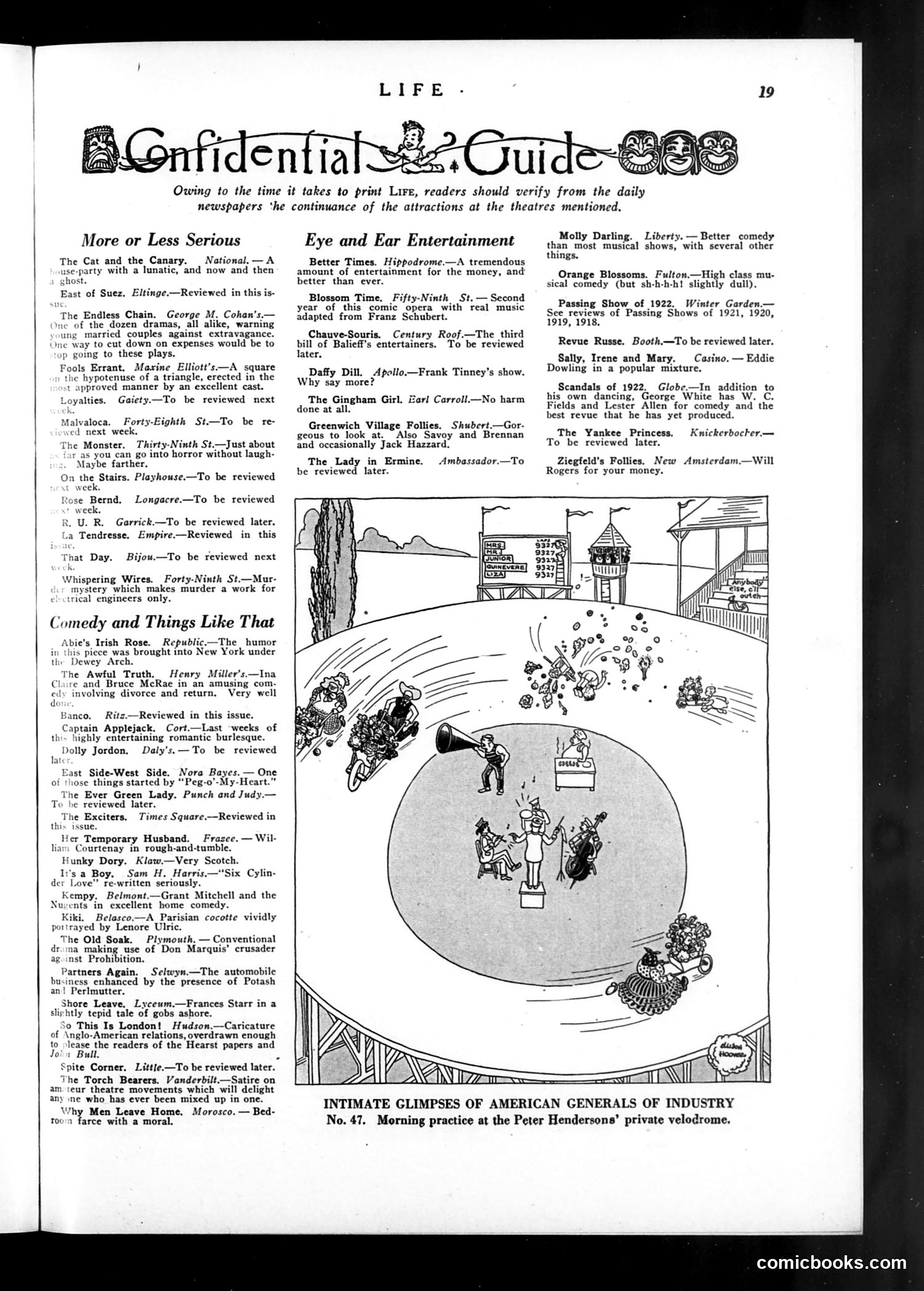
This is a theater review section from *Life* magazine (a satirical publication, not the modern photo magazine). The page catalogs Broadway shows playing in New York, divided into categories: "More or Less Serious," "Comedy and Things Like That," and "Eye and Ear Entertainment" (musicals/vaudeville). The large illustration at bottom depicts a circus or vaudeville performance—acrobats, performers, and audience—labeled "Intimate Glimpses of American Generals of Industry No. 41," satirizing wealthy industrialists' leisure activities at private venues like the Hendersons' "velodrome" (a cycling track converted for entertainment). The reviews themselves are brief, often dismissive quips. For example, *The Endless Chain* is mocked for warning against marital extravagance, with the joke that avoiding these plays would actually save money. The satire targets both theatrical quality and the moralistic themes popular at the time, particularly anti-Prohibition messaging (*The Old Soak*) and amateur theater pretension (*The Torch Bearers*).
📄 Transcribed text from this page (OCR, searchable)
Machine-transcribed from the original scan — historical spelling and the odd misread are preserved.
19 Owing to the time it takes to print Lire, readers should verify from the daily newspapers ‘he continuance of the attractions at the theatres mentioned. More or Less Serious The Cat and the Canary. National, —A arty with a lunatic, and now and then ghost. East of Suez. Eltinge—Reviewed in this is- The Endless Chain. George M. Cohan’s.— ine of the dozen dramas, all alike, warning ung married couples against extravagance. One way to cut down on expenses would be to p going to these plays. Fools Errant. Mawine Elliott’s—A square the hypotenuse of a triangle, erected in the ‘approved manner by an excellent cast. Loyalties. Gaiety.—To be reviewed next Malvaloca. Forty-Eighth St—To be re- ed next week. The Monster. Thirty-Ninth St.—Just about as you can go into horror without laugh- Maybe farther. On the Stairs, Playhouse.—To be reviewed week. Rose Bernd. Longacre.—To be reviewed week. %. U. R. Garrick—To be reviewed later. ua Tendresse. Empire.—Reviewed in this That Day. Bijou.—To be reviewed next Whispering Wires. Forty-Ninth St.—Mur- ystery which makes murder a work for chctrical engineers only. Comedy and Things Like That Abie’s Irish Rose. Republic—The humor n this piece was brought into New York under Dewey Arch. he Awful Truth. Henry Miller’s—Ina re and Bruce McRae in an amusing com. involving divorce and return, Very well Banco, Rits.—Reviewed in this issue. Captain Applejack. Cort.—Last weeks of this highly entertaining romantic burlesque. Dolly Jordon, Daly’s.—To be reviewed lat East Side-West Side. Nora Bayes. — One ‘ose things started by “Peg-o’-My-Heart.” ¢ Ever Green Lady. Punch and Judy.— e reviewed later. The Exciters. Times Square—Reviewed in this issue. Her Temporary Husband. Frazee. — Wil- liam Courtenay in rough-and-tumble. Hunky Dory. Klaw.—Very Scotch. It's a Boy. Sam H. Harris,—“Six Cylin- der Love” re-written seriously. Kempy, Belmont.—Grant Mitchell and the Nuvents in excellent home comedy. Belasco.—A Parisian cocotte vividly ‘ed by Lenore Ulric. The Old Soak. Plymouth. — Conventional droma making use of Don Marquis’ crusader ag.inst Prohibition. Partners Again. Selwyn.—The automobile business enhanced by the presence of Potash an! Perlmutter. Shore Leave, Lycewm.—Frances Starr in a slightly tepid tale of gobs ashore. So This Is London! Hudson.—Caricature of \nglo-American relations, overdrawn enough to lease the readers of the Hearst papers and Joi Bull. 6 Spite Corner, Little.—To be reviewed later. The Torch Bearers. Vanderbilt.—Satire on am ‘eur theatre movements which will delight any ne who has ever been mixed up in one. why Men Leave Home. Morosco. — Bed- Toon farce with a moral. my Eye and Ear Entertainment Better Times. Hippodrome.—A tremendous amount of entertainment for the money, and’ better than ever. Blossom Time. Fifty-Ninth St.— Second year of this comic opera with real music adapted from Franz Schubert. Chauve-Souris. Century Roof—The third bill of Balieff's entertainers. To be reviewed later. Daffy Dill. Apollo.—Frank Tinney’s show. Vhy say more? The Gingham Girl. Zar! Carroll—No harm done at all. Greenwich Village Follies. Shubert.—Gor- geous to look at. Also Savoy and Brennan and occasionally Jack Hazzard. The Lady in Ermine. Ambassador.—To be reviewed later. Molly Darling. Liberty. — Better comedy than most musical shows, with several other things. Orange Blossoms. Fulton.—High class mu- sical comedy (but sh-h-h-h! slightly dull). Passing Show of 1922. Winter Garden.— See reviews of Passing Shows of 1921, 1920, 1919, 1918. Revue Russe. Booth.—To be reviewed later. Sally, Irene and Mary. Casino. — Eddie Dowling in a popular mixture, Scandals of 1922. Globe.—In addition to his own dancing, George White has W. C. Fields and Lester Allen for comedy and the best revue that he has yet produced. The Yankee Princess. Knickerbocker.— To be reviewed later. Ziegfeld’s Follies. New Amsterdam.—Will Rogers for your money. INTIMATE GLIMPSES OF AMERICAN GENERALS OF INDUSTRY No. 47. Morning practice at the Peter Hendersons’ private velodrome, comicbooks.com