
Life, 1922-10-12 · page 26 of 36
Life — October 12, 1922 — page 26: what you’re looking at
What you’re looking at
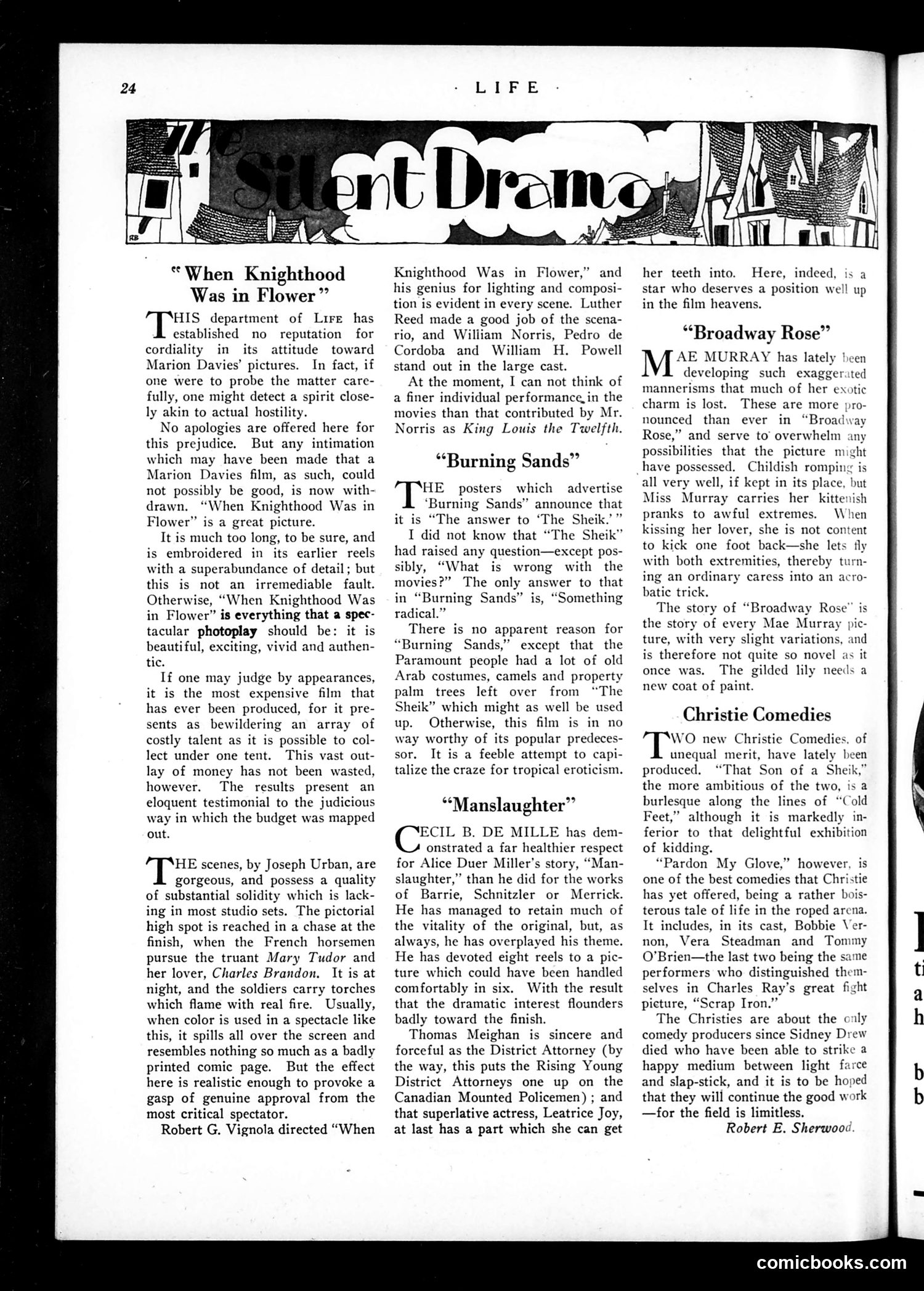
This page reviews four 1920s silent films. Life's critic surprisingly praises Marion Davies' *"When Knighthood Was in Flower,"* reversing the magazine's established hostility toward her pictures. The review credits director Robert G. Vignola and highlights a torchlit chase scene as visually impressive. *"Burning Sands"* is dismissed as a cynical cash-grab—Paramount recycling Arabian costumes and props from the popular *"The Sheik"* without artistic merit. *"Manslaughter,"* directed by Cecil B. DeMille, successfully adapts Alice Duer Miller's story but suffers from DeMille's characteristic over-elaboration, running eight reels when six would suffice. The final section discusses Christie Comedies, noting their quality after producer Sidney Drew's death. The tone throughout is authoritative but sarcastic—the critic uses humor to mock formulaic filmmaking while acknowledging genuine craftsmanship where evident.
📄 Transcribed text from this page (OCR, searchable)
Machine-transcribed from the original scan — historical spelling and the odd misread are preserved.
“When Knighthood Was in Flower” HIS department of Lire has established no reputation for cordiality in its attitude toward Marion Davies’ pictures. In fact, if one were to probe the matter care- fully, one might detect a spirit close- ly akin to actual hostility. No apologies are offered here for this prejudice. But any intimation which may have been made that a Marion Davies film, as such, could not possibly be good, is now with- drawn. “When Knighthood Was in Flower” is a great picture. It is much too long, to be sure, and is embroidered in its earlier reels with a superabundance of detail; but this is not an irremediable fault. Otherwise, “When Knighthood Was in Flower” is everything that a spec- tacular photoplay should be: it is beautiful, exciting, vivid and authen- tic. If one may judge by appearances, it is the most expensive film that has ever been produced, for it pre- sents as bewildering an array of costly talent as it is possible to col- lect under one tent. This vast out- lay of money has not been wasted, however. The results present an eloquent testimonial to the judicious way in which the budget was mapped out. HE scenes, by Joseph Urban, are gorgeous, and possess a quality of substantial solidity which is lack- ing in most studio sets. The pictorial high spot is reached in a chase at the finish, when the French horsemen pursue the truant Mary Tudor and her lover, Charles Brandon, It is at night, and the soldiers carry torches which flame with real fire. Usually, when color is used in a spectacle like this, it spills all over the screen and resembles nothing so much as a badly printed comic page. But the effect here is realistic enough to provoke a gasp of genuine approval from the most critical spectator. Robert G. Vignola directed “When Knighthood Was in Flower,” and his genius for lighting and composi- tion is evident in every scene. Luther Reed made a good job of the scena- rio, and William Norris, Pedro de Cordoba and William H. Powell stand out in the large cast. At the moment, I can not think of a finer individual performance in the movies than that contributed by Mr. Norris as King Louis the Twelfth. “Burning Sands” HE posters which advertise ‘Burning Sands” announce that it is “The answer to ‘The Sheik.’” I did not know that “The Shei had raised any question—except pos- sibly, “What is wrong with the movies?” The only answer to that in “Burning Sands” is, “Something radical.” There is no apparent reason for “Burning Sands,” except that the Paramount people had a lot of old Arab costumes, camels and property palm trees left over from “The Sheik” which might as well be used up. Otherwise, this film is in no way worthy of its popular predeces- sor. It is a feeble attempt to capi- talize the craze for tropical eroticism. “Manslaughter” 'ECIL B. DE MILLE has dem- onstrated a far healthier respect for Alice Duer Miller's story, “Man- slaughter,” than he did for the works of Barrie, Schnitzler or Merrick. He has managed to retain much of the vitality of the original, but, as always, he has overplayed his theme. He has devoted eight reels to a pic- ture which could have been handled comfortably in six. With the result that the dramatic interest flounders badly toward the finish. Thomas Meighan is sincere and forceful as the District Attorney (by the way, this puts the Rising Young District Attorneys one up on the Canadian Mounted Policemen) ; and that superlative actress, Leatrice Joy, at last has a part which she can get her teeth into. Here, indeed, is a star who deserves a position well up in the film heavens. “Broadway Rose” AE MURRAY has lately been developing such exaggerated mannerisms that much of her exotic charm is lost. These are more pro- nounced than ever in “Broadway Rose,” and serve to overwhelm any possibilities that the picture might have possessed. Childish romping is all very well, if kept in its place, but Miss Murray carries her kittenish pranks to awful extremes. When kissing her lover, she is not content to kick one foot back—she lets fly with both extremities, thereby turn- ing an ordinary caress into an acro- batie trick. The story of “Broadway Rose” is the story of every Mae Murray pic- ture, with very slight variations, and is therefore not quite so novel as it once was. The gilded lily needs a new coat of paint. Christie Comedies WO new Christie Comedies. of unequal merit, have lately produced. “That Son of a Sheik,” the more ambitious of the two, is a burlesque along the lines of “Cold Feet,” although it is markedly in- ferior to that delightful exhibition of kidding. “Pardon My Glove,” however, is one of the best comedies that Christie has yet offered, being a rather bois- terous tale of life in the roped arena. It includes, in its cast, Bobbie Ver- non, Vera Steadman and Tommy O’Brien—the last two being the same performers who distinguished them- selves in Charles Ray's great fight picture, “Scrap Iron,” The Christies are about the only comedy producers since Sidney Drew died who have been able to strike @ happy medium between light farce and slap-stick, and it is to be hoped that they will continue the good work —for the field is limitless. Robert E. Sherwood comicbooks.com