
Life, 1922-10-12 · page 20 of 36
Life — October 12, 1922 — page 20: what you’re looking at
What you’re looking at
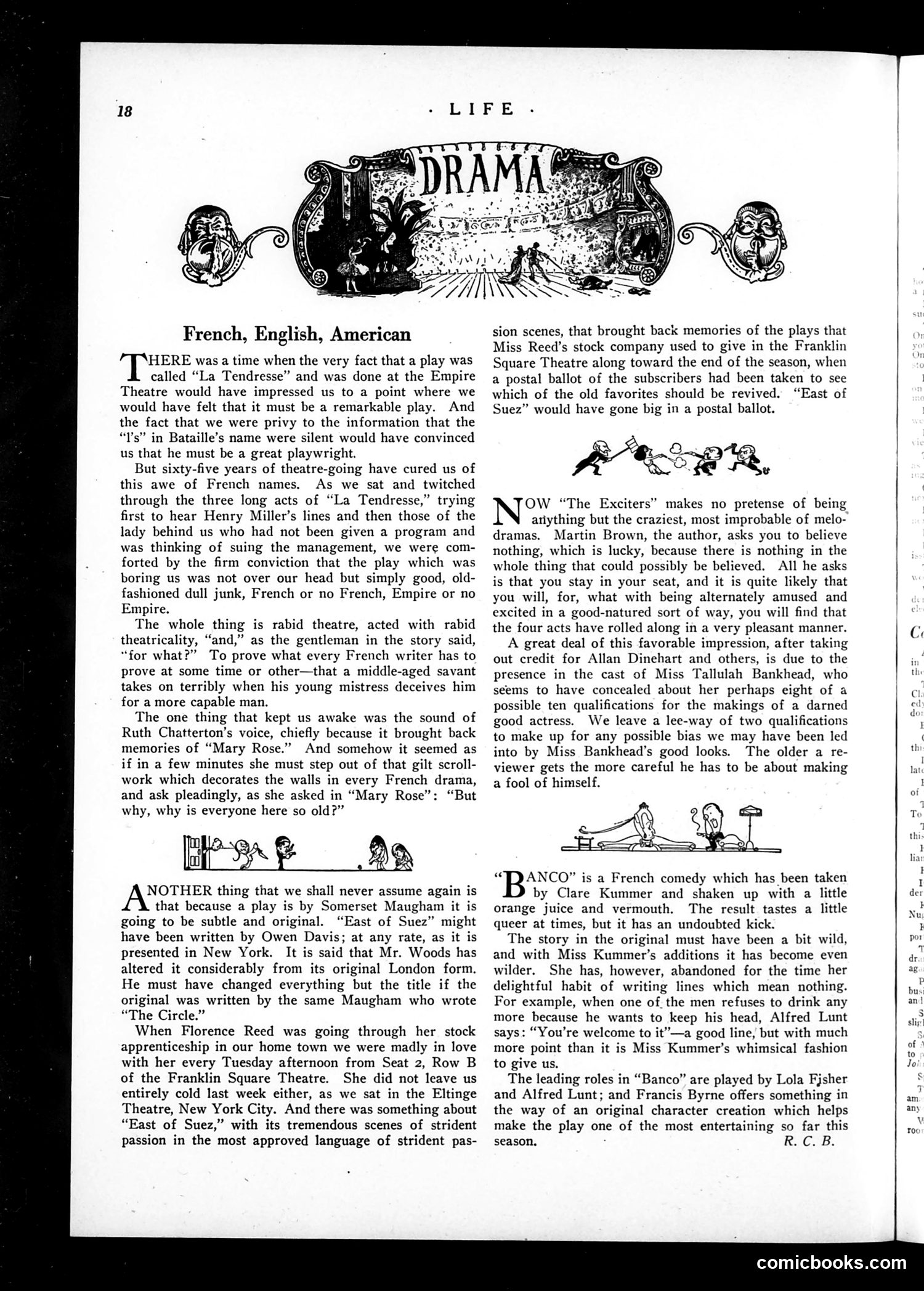
This page critiques three Broadway plays with the sardonic tone Life magazine employed toward theatrical pretension. **"La Tendresse"** — The critic mocks French dramatic snobbery. That a play has a French title and unknown pronunciations once impressed American audiences, but sixty-five years of theater-going has cured them of this "awe." The play is dismissed as "good, old-fashioned dull junk" despite featuring actress Ruth Chatterton. **"East of Suez"** — Somerset Maugham's play, altered considerably from its London version, is critiqued as melodramatic and derivative—no more original than a play by Owen Davis. The reviewer notes it resembles old stock-company fare that audiences voted to revive by "postal ballot." **"The Exciters"** — Praised for honest absurdity: it makes no pretense of plausibility, asking only that audiences remain entertained. Actress Tallulah Bankhead receives qualified praise. The satire targets American audiences' former susceptibility to European cultural cachet and contemporary theatrical mediocrity masquerading as sophistication.
📄 Transcribed text from this page (OCR, searchable)
Machine-transcribed from the original scan — historical spelling and the odd misread are preserved.
18 French, English, American HERE was a time when the very fact that a play was called “La Tendresse” and was done at the Empire Theatre would have impressed us to a point where we would have felt that it must be a remarkable play. And the fact that we were privy to the information that the “I's” in Bataille’s name were silent would have convinced us that he must be a great playwright. But sixty-five years of theatre-going have cured us of this awe of French names. As we sat and twitched through the three long acts of “La Tendresse,” trying first to hear Henry Miller’s lines and then those of the lady behind us who had not been given a program and was thinking of suing the management, we were com- forted by the firm conviction that the play which was boring us was not over our head but simply good, old- fashioned dull junk, French or no French, Empire or no Empire. The whole thing is rabid theatre, acted with rabid theatricality, ‘“‘and,” as the gentleman in the story said, “for what?” To prove what every French writer has to prove at some time or other—that a middle-aged savant takes on terribly when his young mistress deceives him for a more capable man. The one thing that kept us awake was the sound of Ruth Chatterton’s voice, chiefly because it brought back memories of “Mary Rose.” And somehow it seemed as if in a few minutes she must step out of that gilt scroll- work which decorates the walls in every French drama, and ask pleadingly, as she asked in “Mary Rose”: “But why, why is everyone here so old?” at BAF aN NOTHER thing that we shall never assume again is that because a play is by Somerset Maugham it is going to be subtle and original. “East of Suez” might have been written by Owen Davis; at any rate, as it is presented in New York. It is said that Mr. Woods has altered it considerably from its original London form. He must have changed everything but the title if the original was written by the same Maugham who wrote “The Circle.” When Florence Reed was going through her stock apprenticeship in our home town we were madly in love with her every Tuesday afternoon from Seat 2, Row B of the Franklin Square Theatre. She did not leave us entirely cold last week either, as we sat in the Eltinge Theatre, New York City. And there was something about “East of Suez,” with its tremendous scenes of strident passion in the most approved language of strident pas- sion scenes, that brought back memories of the plays that Miss Reed’s stock company used to give in the Franklin Square Theatre along toward the end of the season, when a postal ballot of the subscribers had been taken to see which of the old favorites should be revived. “East of Suez” would have gone big in a postal ballot. PCB, OW “The Exciters” makes no pretense of being arlything but the craziest, most improbable of melo- dramas. Martin Brown, the author, asks you to believe nothing, which is lucky, because there is nothing in the whole thing that could possibly be believed. All he asks is that you stay in your seat, and it is quite likely that you will, for, what with being alternately amused and excited in a good-natured sort of way, you will find that the four acts have rolled along in a very pleasant manner. A great deal of this favorable impression, after taking out credit for Allan Dinehart and others, is due to the presence in the cast of Miss Tallulah Bankhead, who seems to have concealed about her perhaps eight of a possible ten qualifications for the makings of a darned good actress. We leave a lee-way of two qualifications to make up for any possible bias we may have been led into by Miss Bankhead’s good looks. The older a re- viewer gets the more careful he has to be about making a fool of himself. “FQANCO” is a French comedy which has been taken by Clare Kummer and shaken up with a little orange juice and vermouth. The result tastes a little queer at times, but it has an undoubted kick. The story in the original must have been a bit wild, and with Miss Kummer’s additions it has become even wilder. She has, however, abandoned for the time her delightful habit of writing lines which mean nothing. For example, when one of. the men refuses to drink any more because he wants to keep his head, Alfred Lunt says: “You're welcome to it”—a good line, but with much more point than it is Miss Kummer’s whimsical fashion to give us. The leading roles in “Banco” are played by Lola Fjsher and Alfred Lunt; and Francis Byrne offers something in the way of an original character creation which helps make the play one of the most entertaining so far this season, g RGB. am any To comicbooks.com